




Abstract
Keywords
In the wake of another mass shooting in the USA, with the gunman widely reported as having mental health problems (Associated Press, 2013), it is timely to again consider the relationship between belief in the dangerousness of people with mental illness and stigma. Belief that people with mental illness are violent is a major driver of stigma and there is evidence that this belief has increased in Australia in recent years (Reavley and Jorm, 2012).
One view, championed particularly by Fuller Torrey (2011), is that lack of treatment has fuelled a rise in belief that mentally ill people are dangerous. Writing from a US perspective, Fuller Torrey argues that: (i) stigma towards individuals with mental illnesses has increased over the past half century; (ii) violent acts committed by mentally ill people have increased over the past half century; (iii) the perception of violent behaviour by mentally ill people is an important cause of stigma; (iv) most episodes of violence committed by mentally ill people are associated with failure to treat them; (v) treating people with serious mental illnesses significantly decreases episodes of violence; and (vi) reducing violent behaviour among individuals with mental illnesses will reduce stigma.
We agree with the argument that there is an association between untreated mental illness and violent behaviour and that better mental health services are important to reducing such behaviour and reducing stigma. However, Fuller Torrey’s argument treats acts of violence by mentally ill people as the sole driver of stigma. We argue that media reporting of violent acts in the USA is an even more important factor, both in the USA and across the world. We base our argument on the following points:
1. People who have most contact with mentally ill people are less likely to believe they are dangerous
If direct experience of violent behaviour by mentally ill people was the primary factor behind the belief that they are dangerous, then it would be expected that people who have more contact would be more likely to believe in dangerousness. Mental health professionals have a high level of contact, including with people who are untreated. However, a number of studies have found that mental health professionals have less belief in dangerousness than the public, although there are others showing no difference (Jorm et al., 2012). Similarly, studies comparing mental health professionals with other health professionals all show less belief in dangerousness in the mental health professionals. Importantly, no study has found that professional contact increases belief in dangerousness.
Similar findings come from surveys of members of the public who have had personal contact. Reports of contact have been found to be associated with less belief in dangerousness across a broad range of populations (Jorm et al., 2012). While there are many negative results as well, it is notable that no study has found that contact is associated with greater belief in dangerousness.
2. Belief in dangerousness is more likely to be due to media exposure than to personal experience of violent acts by mentally ill people
If exposure to violent acts by mentally ill people drives the belief that they are dangerous, then we would expect that many members of the public would have had direct experience of violent acts. A national survey of adults in the USA in 1990 asked respondents: “How many people do you know personally who have been hospitalized for mental illness?” and “Were you ever threatened or physically harmed by someone who had been hospitalized for mental illness?”(Phelan and Link, 2004). It was found that 68% knew at least one person and 10% knew five or more people. However, only 9% had ever been threatened or physically harmed. By contrast, 70% believed that patients in mental hospitals may be dangerous. These findings clearly show that personal experience of violence cannot be the sole cause of public belief in dangerousness.
The more likely source of belief in dangerousness is exposure to media reports. A study of newspaper reporting on mental illness in the USA found that 39% of reports concerned dangerousness and violence (Corrigan et al., 2005). There is evidence that such reports can increase belief in dangerousness. In Germany, public surveys were carried out before and after two widely reported violent attacks on politicians by people with schizophrenia and there was an increase in belief in dangerousness (Angermeyer and Matschinger, 1996). Experimental evidence also supports an effect of media reports of violence by mentally ill people. A study of German high school children randomized them to either read an article linking mental illness with violent crime or one providing factual information on schizophrenia (Dietrich et al., 2006). Reading the article on violent crime led to increased belief in dangerousness.
3. Belief that mentally ill people are dangerous is much more common in the USA than in other developed countries
Surveys have been carried out in a range of countries asking members of the public about beliefs that people who are mentally ill are dangerous or violent. In a recent review, we looked at studies in which beliefs were assessed in relation to either a vignette of an untreated person or to diagnostic label and information that the person was untreated (Jorm et al., 2012). While differences in methodology across many of the surveys make direct comparison difficult, there is clearly a large variation between samples in the prevalence of belief in dangerousness or violence (see Figure 1). It is particularly striking that developed countries (Australia, Canada, Germany and Japan) generally have a much lower prevalence of such beliefs than developing countries (Brazil, India and Turkey). This may be because of better mental health services in developed countries. However, the USA is an exception, with prevalence rates more similar to those of developing countries. Even a depressed child is seen as likely to be violent by 42% of American adults.
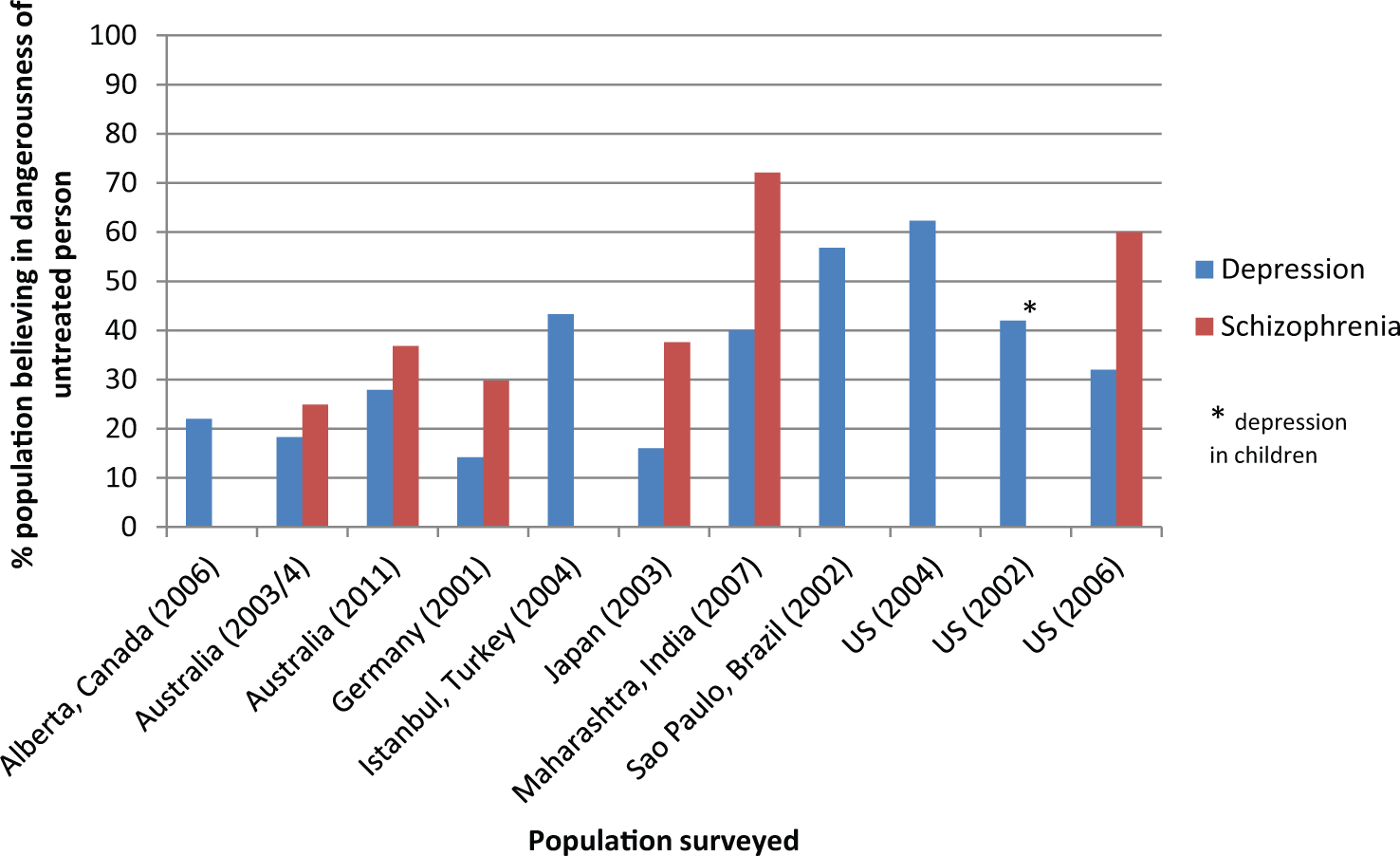
Prevalence of belief in dangerousness in representative samples of the public carried out since 2001.
4. The USA has a high rate of homicide compared to other developed countries, which is related to firearm availability
Why would the USA be so different from other developed countries? A possible explanation is that the USA has the highest homicide rate and the highest rate of civilian firearm ownership among developed countries (Hoskin, 2001). Regression analyses of cross-national homicide rates find that firearm availability is an important predictor of homicide rate (Hoskin, 2001). A characteristic of firearms compared to other weapons is that they can more easily result in multiple deaths.
5. Crimes involving multiple murders are more newsworthy and may get linked to mental illness through use of the insanity defence
In choosing crime stories to report, the media give greater salience to certain types of stories. Two major predictors of increased story salience are type of crime, with murder more salient than other crimes, and the number of victims of the crime (Chermak, 1998). The use of the insanity defence in murder cases further increases their newsworthiness and links such crimes with mental illness in the minds of the public, even though this defence is generally not successful in the USA (Borum and Fulero, 1999).
Connecting the dots
While violent acts are more common in people with untreated mental illness, this factor cannot fully explain the widespread public belief that mentally ill people are dangerous and violent. Most people do not have any direct experience of violent acts by mentally ill people and those who have the most direct contact are less likely to believe that mentally ill people are dangerous. Instead, media exposure to acts of violence appears to be a more important driver of belief in dangerousness. Media exposure is more likely when there are multiple homicides and such crimes are more likely where firearms are more readily available. Such crimes may be linked to mental illness through use of the insanity defence. The USA has a higher prevalence of belief in dangerousness than other developed countries. We propose that this is due to its high rate of firearm availability and high homicide rate, which results in more salient news items linking violence with mental illness.
Media reports of multiple homicides by mentally ill people in the USA unfortunately have worldwide interest. In Australia, for example, there was widespread reporting of the shooting in Washington’s naval yard mentioned above. Readers may also remember the shooting by a mentally ill man of 19 people in Arizona, including Congresswoman Gabrielle Giffords. To illustrate the news impact, we carried out a search of the national newspaper The Australian and found that Congresswoman Giffords was mentioned 160 times in the 6 months following her attempted assassination, but only once in the 12 months before. Such dramatic but rare events are very newsworthy and tend to be conveyed worldwide through wire services (such as Associated Press cited above) which supply stories on a 24-hour news cycle (Metcalfe and Gascoigne, 1995). In this way, the USA may be exporting stigma to the rest of the world.
Footnotes
Funding
This work was supported by the National Health and Medical Research Council.
Declaration of interest
The authors report no conflicts of interest. The authors alone are responsible for the content and writing of the paper.