



Abstract
Historically, the public portrayal of mental illness has been dominated by depictions of violence, isolation, loss, misery, homelessness, personal failure and ineffective health and social services. Media framing of health issues influences both public and political opinion and may thus impact on health and social policy [1, 2]. Framing includes both the content as well as how an issue or person is positioned [1, 3]. Although many frames can be used in structuring health-related items, news utilizes several time-honoured genres including celebrity illnesses; gawp stories (depictions of eccentricity, abnormality and bizarre behaviour); moral tales and falls from grace; scientific marvels; danger in the familiar; and the wisdom of commonsense cures (‘grandma was right’ stories) [4, 5].
Research has consistently documented a tendency for both print and television media to reinforce negative stereotypes of people with mental illness [5–7]. This has been described as a form of institutionalized stigma [7, 8] and may erode efforts to build community support for policies designed to reduce the isolation and discrimination experienced by people with mental illness and their families [9–11]. Further negative depictions may result in a greater tendency to inappropriately perceive those with mental illnesses as dangerous [12]; a preference not to live near someone with a mental illness [13]; a lower endorsement of community care options [13]; and employer reluctance to hire people with mental illnesses [6, 14].
In response, globally, we have seen a range of population-based health promotion, illness awareness, syndrome prevention and health-care reform initiatives [1–6, 13, 15–21]. All of these initiatives focus on reducing stigmatizing attitudes and related societal barriers to health care, employment, educational opportunities and other social services. Active engagement of the mass media is seen as essential to those processes. To date, there has been little evidence, however, of impacts on the representation in the media of people who are affected by these conditions.
Previous research has documented the extent to which the term ‘mental illness’ itself engenders fear and stereotypes of chronic disability [22–24]. Internationally, emphasis has been placed largely on changing community attitudes towards those with psychotic disorders, modifying the media portrayal of suicide and other, rarer adverse events [8, 25]; the central role of key professional groups and other national health agencies [2, 26]; and the utilization of guidelines for better reporting [12, 27, 28].
By contrast, recent Australian campaigns have emphasized active promotion of positive personal experiences and genuine engagement of broad community support, as the fundamental means for changing media portrayals of mental illness [1, 13, 29, 30]. At the point of initiation of beyondblue: the national depression initiative, there was good evidence that Australians did not rate mental disorders among the nation's major health issues [9, 31]. Communication of the day-to-day impacts of living with a common mental disorder such as anxiety, depression or alcohol or substance misuse, and the potential benefits associated with evidence-based treatments, had not been widely promoted [11, 32]. Further, a key decision was made to focus national attention on common (anxiety, depression), rather than psychotic disorders [33].
Through the efforts of beyondblue and its associated patient participation framework ‘blueVoices’ [34], a primary emphasis was placed on active promotion of positive experiences and recovery from anxiety and depression [34–36]. These used first-person accounts by a wide range of community leaders, serving and ex-politicians, media personalities, celebrities, sportspersons, artists and family members. This effort has had substantial effects on those communities exposed to these strategies [37–40].
The present study describes television coverage of mental health/illness and assesses progress on calls for more first-person news accounts from those with mental illness. It also examines discourse about mental illness by mental health experts and politicians. No previous study in Australia and few international studies have specifically examined the depiction of mental illness by those who have experienced it or have examined news depictions of other news actors such as mental health experts or politicians.
The specific objectives of this study were to (i) describe recent television news and current affairs coverage of mental illness to determine how the free-to-air news media in Australia represents mental illness; (ii) determine the extent to which people with mental illness were represented and how they were depicted; and (iii) determine the presence and content of the views of mental health experts and politicians within reports.
Methods
The televised sample was drawn from the University of Sydney's School of Public Health digital database, which comprises news and current affairs items related to health aired on all five free-to-air Sydney television stations [38]. Between May 2005 and October 2007, 538 items with a main focus on mental health were identified. Items were determined to be about mental health if a condition/illness/treatment initiative related to mental health was the focus or if the item was about mental health services. Mental health items represented 4% of the total (13 356) of all health-related items, and 6% of the (8976) items with a main focus on a specific health condition as opposed to generic material about health.
A content and frame analysis coding system was designed and used to code the items for channel, programme type, age group and gender represented in the item, presence of specific information related to mental health resources, reference to suicide, news actor depiction of mental illness and news angle, or the overall theme of the item.
A coding scheme for news actor-depictions was developed using an iterative process of observing these depictions, identifying common themes and then collapsing more specific depictions of the people with mental illnesses such as successful/recovered, threatening, and bizarre into two broad categories: ‘one of us’ (positive or neutral depictions), which included representations of people with mental illness as no different than the rest of the population other than having an illness; and ‘one of them’, (negative depictions), which included representations of people with mental illness as bizarre, threatening or a burden on society. When an item included interviews with more than one person with a mental illness, only the first person to appear in the item was included in the analysis.
Similarly, the news angle coding was developed using an iterative process of classifying news items for primary, explicit themes and then collapsing more specific themes into seven broad categories (two positive, two neutral, two negative and one category for mixed angles) of what each story was essentially about (Table 1).
Categories
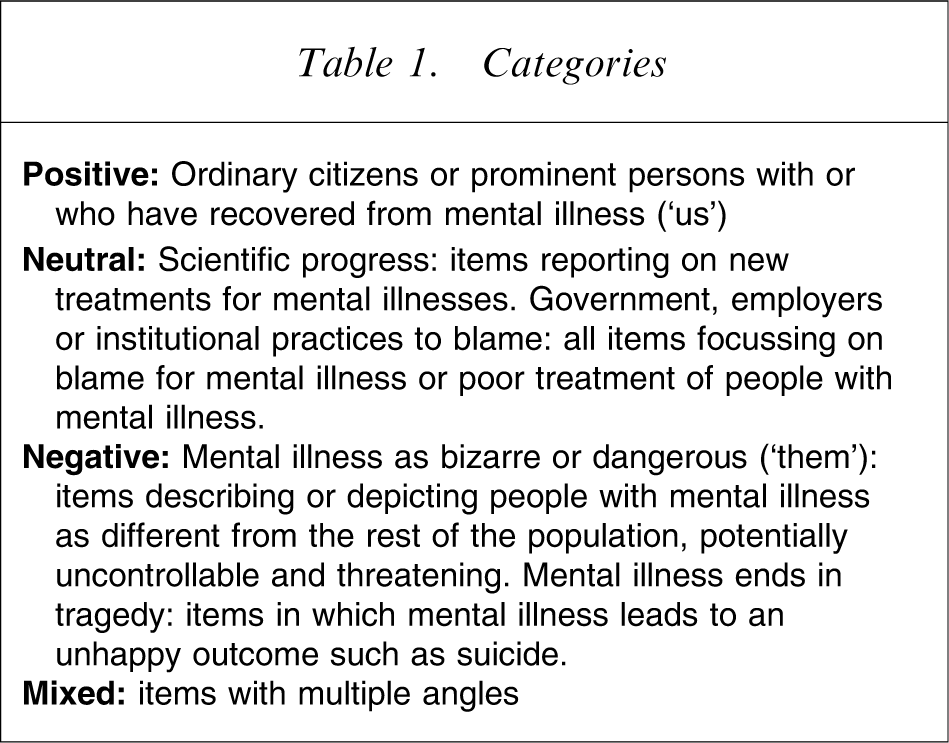
Coding was conducted by two of the authors (LM, NJ), each coding different items. Eight additional coders were recruited and provided with coding definitions of the aforementioned categories. These additional coders then coded 15 randomly selected examples of TV items. To establish inter-rater reliability for codes requiring subjective judgement, kappa statistics were calculated.
Results
An overall kappa score for the three news-actors (person with a mental illness, experts in mental health, and politicians) for eight raters was 0.60 and ranged from 0.56 for self depiction to 1.00 for both experts and politicians. For news angle, the kappa score for eight raters was 0.62.
Relative to actual burden of disease in Australia, mental illness was underrepresented on free-to-air television. Mental disorders account for 13% of the total burden of disease for all age groups in Australia and up to 36% for 15–44-year-olds [41], while only 6% of the items with a focus on any specific health condition were related to mental illness.
Of the 538 items, 285 (53%) were news items, with the remainder being current affairs, breakfast television and documentary programmes. There were 172 items (32%) broadcast on the Nine Network; 125 (23%) on the Seven Network; 104 (19%) on the ABC; 78 (14%) on Network Ten and 59 (11%) on SBS. A χ2 test showed that frequency of items between the five channels was not evenly distributed (χ2 = 74.4, df = 4, p < 0.001).
A specific mental illness such as depression or schizophrenia was highlighted in 232 items (43%), and suicide was mentioned in 189 items (35%). Two hundred and sixty-seven items (50%) emphasized a specific age group. Adults featured most frequently, being in 222 items (83%), followed by adolescents (19 items, 7%), while children accounted for 17 items (6%) and older adults featured in only nine items (3%).
Similar to findings from previous research [42], only 67 items (13%) included some reference to resources such as phone numbers or websites for organizations offering support services. This information was more common in the current affairs items (60 items) compared with news items, which were typically of much shorter duration.
Positive depictions
Identification of the news angles that attracted the most coverage (Table 2) showed that positive human interest stories made up over half of the items. One hundred and ninety-five (36%) were categorized as ‘Ordinary citizen with, or who has recovered from, mental illness (us)’. Another 104 items (19%) depicted prominent people's experiences of mental illness and/or recovery, giving a total of 56% of positive recovery-focused items.
Types of news angles in the coverage of mental health
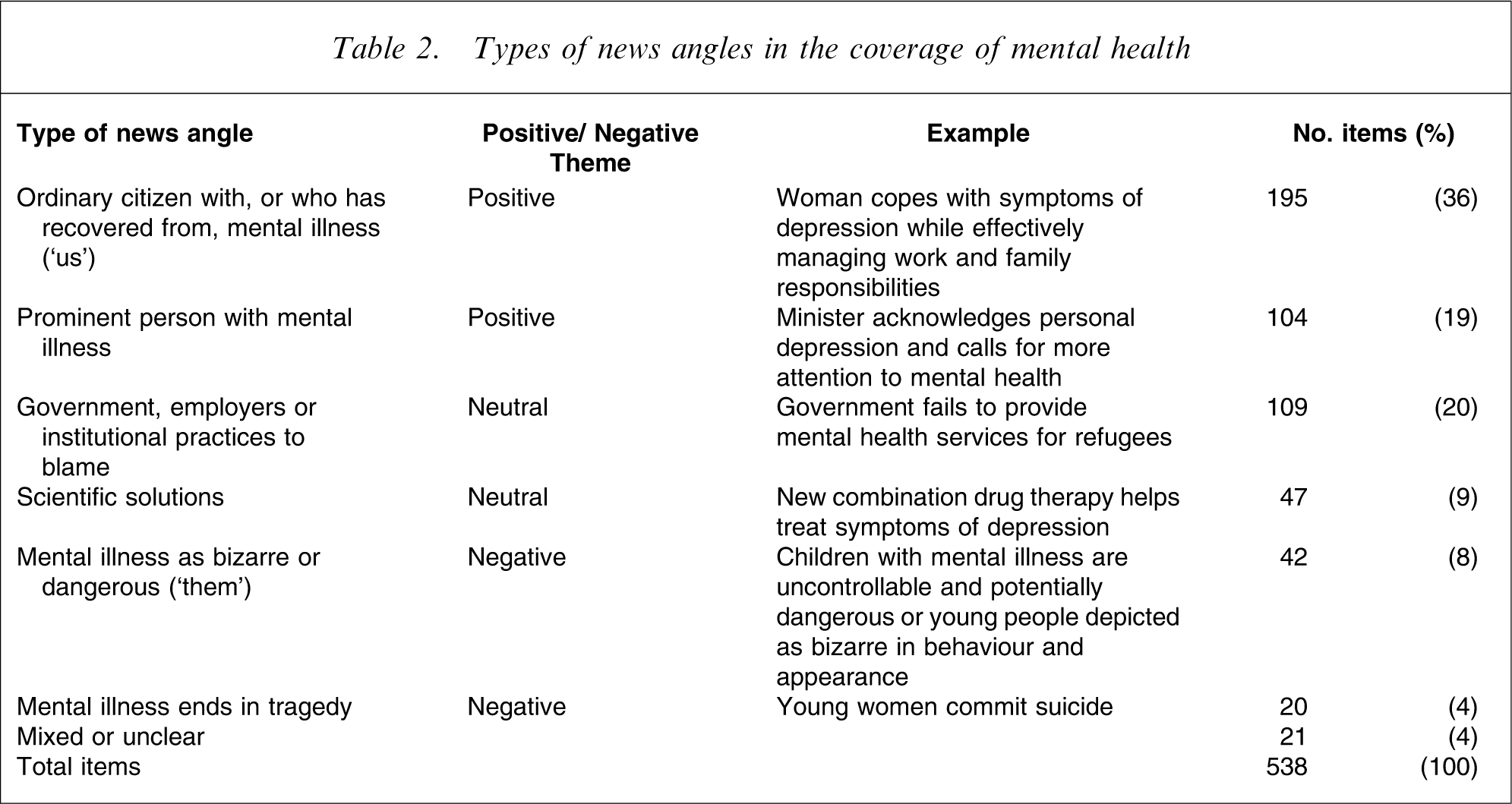
In addition to human interest stories, 29% of items were broadly neutral in their overall depiction of mental illness. These included ‘Government, employers or institutional practices to blame’, which comprised 109 (20%) of the items. This category typically reflected views of people with mental illnesses in stories depicting or alleging unjust treatment by either the government or a business. Although categorized as neutral in the study, items coded in this category frequently depicted people with mental illnesses as deserving of appropriate treatment, thus adding further to those items that presented mental illness in a positive or sympathetic light. Nine per cent of items were ‘scientific progress’ stories.
Negative depictions
Two categories conveyed negative views of mental illness. The first included 42 items (8%) in which mental illness was depicted as bizarre or dangerous (‘them’). Additionally, 20 items (4%) were classified as ‘mental illness ends in tragedy’. These primarily were reports of suicides and other negative consequences of mental illness. A further 21 items (4%) had either an unclear or mixed news angle.
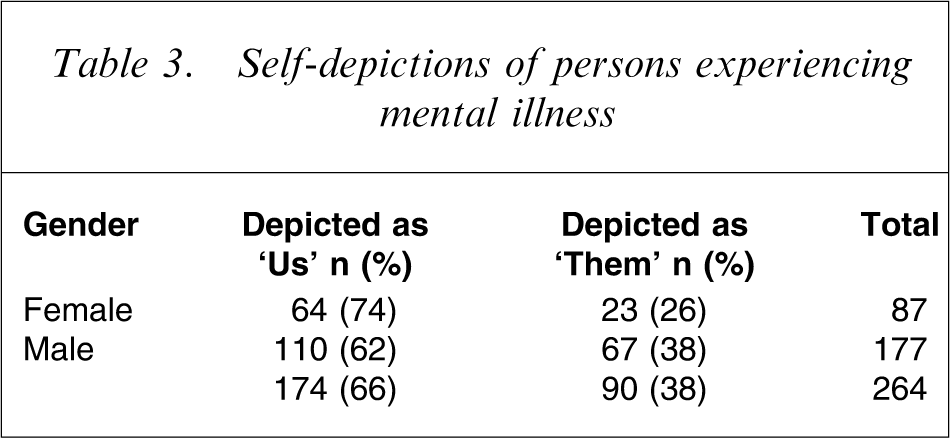
The specific way in which three different news-actors (individuals with mental illness, experts, and politicians) represented those with mental illness was analysed using two broad categories: ‘one of us’ (positive or neutral depictions) and ‘one of them’ (negative depictions). Individuals with mental illnesses were present in 264 items (49%). Of the 264 individuals with mental illness represented, 177 (67%) were male and 87 (33%) were female. Most (174 items, 66%) of these self-depictions were categorized as representing persons with mental health disorders who were ‘one of us’, with the depictions being either neutral or positive. Ninety of the self-representations (34%) depicted persons with mental illness as ‘one of them’ or somehow different from the rest of us either because they were dangerous, bizarre, withdrawn or a burden on society (Table 3).
Self-depictions of persons experiencing mental illness
Experts such as psychiatrists or psychologists overwhelmingly represented and described people with mental illness as being like ‘one of us’. Of the 249 items that included an expert, 236 (95%) spoke of people with mental illness as being in every way ordinary and unremarkable, other than having a mental illness. Similarly, politicians tended to depict people with mental illness as ‘one of us’. In the 95 items that included the comments of a politician, 80 (84%) were categorized as being like ‘one of us’.
Discussion
Television news and current affairs coverage of mental heath/illness in Australia represents only 6% of items with a main focus on a specific health condition but, unlike previous findings in different settings and media [5, 7, 22], provides a predominantly positive view of mental illness, with nearly 85% of the news angles categorized as either positive or neutral. Over half of all news stories (56%) included positively rated human interest stories of coping and recovery from mental illness by both prominent and everyday people, in which the decisions, made by those being interviewed, to be open about their illnesses, repudiated any notions of shame. A further 20% featured themes that were sympathetic to those with mental illness. A decline in the prevalence of negative themes including associations with dangerousness, bizarre behaviour or tragedy was apparent in this sample (12% compared to previous studies in Australia, which found >60% negative themes) [43]. This finding suggests a trend towards a further reduction in reinforcement of negative stereotypes about mental illness in the media initially observed in a 2004 study of Australian print media [42]. Overall, this sample of television news and current affairs items represents people with mental illness as part of the broader Australian community and does not predominantly associate mental illness with violence or bizarre behaviour, as has been observed in previous studies.
The high percentage of people with mental illness giving first-person reports (264, 49%) contrasts with previous findings of 0.8% and 17.2% [42, 44]. Similar to previous findings [44], the present findings suggest that when people with mental illnesses represent themselves, the depictions are more often (66%) positive. The most common self-representation of a person with mental illness was a man depicting himself as ‘one of us’. Male subjects were depicted in 67% of the items that included first-person reports compared to female subjects, who were depicted in only 33% of the items, despite female subjects having a slightly higher burden of disease associated with mental disorders (47%:53%, male: female) in the Australian population [41]. This suggests that female subjects with mental illness may be slightly underrepresented in the media. Children, adolescents and older adults were underrepresented and were featured in only 6%, 7% and 3% of the sample, respectively, while children account for 19% of the population and older adults account for 13.4% [45].
Both experts and politicians were well represented in the present study, with experts appearing in 46% of the items and politicians appearing in 18%. Both of these news-actors represented people with mental illnesses in an inclusive manner, 95% and 84% categorized as ‘one of us’ respectively, which differs from previous research that concluded that the inclusion of psychiatrists did not result in a positive representation of mental illness [37]. The relatively high number of items representing those with mental illnesses as being no different from the rest of the population (other than having a mental illness) coupled with the reduction in negative themes such as associations with danger and bizarreness is more in line with Australia's guidelines for reporting on mental illness [21], may reflect an evolution in industry norms being applied by news editors, and be early evidence of a reduction in the institutional stigma observed in the past [7, 8].
Bell postulated that all news can be divided into news about ‘us’ or about ‘them’ and that traditionally people with mental illness have been relegated to the ‘them’ category [46]. Bell suggested that those with mental illness have historically remained in the ‘them’ category, while many ethnic and racial minorities have moved into the ‘us’ category. This is because people with mental illnesses do not easily form coherent communities, are often reluctant to identify themselves and because there has been little advocacy to make mental illness more of an ‘us’ issue.
The present findings appear to indicate that the deliberate media strategies promoted by beyondblue, MindFrame and other similar national strategies in recent years have fundamentally changed the wider community discourse about mental disorders. Prominent people now show a willingness to acknowledge their personal experiences with mental illness (19% of the present sample featured prominent people with mental illnesses). All campaigns in Australia now place the person with the experience at the centre of the story, rather than relying on professional, anonymous or other dehumanized accounts. In this sample, 49% of stories included self-representations by people with mental illnesses.
The evidence from the present study, in combination with other evidence of the impacts of these campaigns on changing social attitudes, increasing illness awareness and improving community support for the use of evidence-based treatments, could help to shape similar initiatives in other countries as well as other international collaborative projects. Specifically, the extent to which health experts, politicians and high-profile members of the community are prepared to join with people who experience common mental disorders and continue to make themselves readily available for public discussion is of the utmost importance.
There is no doubt that the fundamental shift in the public discourse in Australia away from the use of generic terms such as ‘mental illness’; an emphasis on less common forms of mental illness (particularly the psychoses); and uncommon but tragic complications such as suicide were both deliberate and controversial. Specifically, this strategic shift ran the risk of further isolating those affected by the psychotic disorders. It seems clear, however, that the end result of the deliberate approach to appeal to ‘every family’ [47] and support a broad inclusive approach has actually been to assist later work with changing engagement with other less common disorders such as bipolar disorder and schizophrenia [11].
Importantly, this ‘every family’ approach was not simply imposed by one illness-specific organization (e.g. beyondblue) but was actively supported by the national peak body, the Mental Health Council of Australia (MHCA) [48]. The MHCA represents a more diverse set of organizations and people likely to be most affected by any significant change in direction or emphasis. The media campaigns were also complemented by political advocacy aimed at developing broader engagement of the health, employment and social services sectors. This not only drew attention to deficits in care [10, 48] but also highlighted opportunities for social and health investments [47].
Actual improvements in access to effective medical therapies in the 1990s, and increased financial supports for psychological treatments in the last 5 years, are also likely to have contributed to the positive portrayals of the potential benefits of receiving care. Media campaigns that are not conducted in association with actual service reform may appear rather shallow or contrived, particularly if they are largely financed by governments. Media events that report real people receiving effective treatments and returning to work and social function have the key element of authenticity. This was characteristic of the key media strategies of beyondblue, which relied very heavily on conventional news reporting and had few actual investments in paid advertising or direct government sponsorship. Similarly, efforts by organizations such as MindFrame, which have specifically targeted more effective and accurate reporting by journalists, have likely contributed to more positive depictions of mental illness in the news media.
In Australia there is still much work to be done. Future efforts should increase the emphasis on women, adolescents, children and older adults, each of whom were underrepresented in the present media sample. The new national youth mental health foundation, headspace [49], is another significant national investment that builds on earlier campaigns. Other efforts include continuing to support people with mental illness and their families with media training and continuously providing information to journalists regarding mental health issues that are relevant for these groups. Advocacy efforts could also be aimed at encouraging journalists to strengthen public awareness by providing more specific information about the options in available treatment, how to access services and where to engage ongoing community support.
Footnotes
Acknowledgements
Funding for the database was provided by a grant from the Cancer Council NSW and for the study by the Brain and Mind Research Institute.