




Abstract
The Internet has become one of the most common, expeditious and important communication tools of our global society. Despite its manifest benefits, a particular set of behavioural overuse problems, termed Internet addiction, have emerged, especially in the adolescent population [1–5]. Internet addiction was initially described by Young as a variant of pathological gambling without an associated alcohol and/or substance dependence disorder [2]. Beard and Wolf outlined some modifications to Young's approach that enhanced the validity and reliability of the Internet addiction diagnosis [1]. These criteria have become established in the field. Recently, the American Psychiatric Association recommended that three or more of seven key criteria are required for a diagnosis of Internet addiction disorder. These include being preoccupied with the Internet (thinks about previous online activity and/or is anticipating the next online session); spending increasing amounts of time on the Internet in order to feel satisfied; making unsuccessful attempts to control, cut back or stop Internet use; social, occupational, recreational activities decreased, given up or employment threatened by Internet use [1]. Recent studies in China have shown Internet addiction to have the highest point prevalence in adolescence compared to other life stages [3–5]. Further, there is a significant positive correlation between the level of emotional and behaviour problems and the severity of Internet addiction. These problems include increased social anxiety, increased irritability, increased hyperactivity, impulsiveness and aggression, increased interpersonal sensitivity, increased difficulties making and maintaining friendships and decreased self-esteem. In addition, decreased organizational and strategizing ability and time management skills characterize the adolescents with Internet addiction [6,7].
To date, group cognitive behavioural therapy (CBT) has been shown to be effective in aiding adolescents with Internet addiction; in parti cular, a multimodal school-based intervention [8–10]. This involves (i) group CBT for adolescent students with Internet addiction; (ii) psychoeducation for teachers on the recognition and psychological treatment of Internet addiction; and (iii) group cognitive behavioural parent training delivered at the same time as for the adolescent Internet addiction group [8–10]. Improved impulse control, emotional stability and decreased Internet addiction behaviours have been shown immediately after the multimodal school-based intervention. A maintenance effect for this intervention, however, has not been demonstrated as yet. The purpose of the present study was therefore to investigate whether a randomized, controlled trial of this multimodal school-based intervention is effective at 6 months after its delivery.
Methods
Participants
Fifty-six adolescent students with Internet addiction, according to the Beard and Wolf criteria [1], were recruited from 10 secondary schools in Shanghai, selected at random from the 100 available secondary schools. These students were spending approximately 6.53 ± 1.68 h per day using the Internet online. The Principal of each school gave permission for their school to be part of the study. Teachers in each school gave information about the study to students in their classes. This information was taken home by the students and read by them and their parents/guardians. If the students and their parents/guardians expressed interest in being involved, they met with the study staff at their school for a screening session. A total of 224 students took part in these screening interviews. Students were excluded if they had evidence of any comorbid medical disorder, pre-existing psychiatric disorder and/or were taking any psychoactive medication.
Thirty-two students were randomly allocated to the multimodal school-based intervention, while 24 students were randomly placed in the control group. A random number generator computer program was used to achieve randomization. We aimed to recruit 60 children, 30 in each group. Power calculations based upon previous Internet overuse self-rating scale studies yielded moderate effect sizes (d = 0.55–0.85; d = M
1-M
2/σ
pooled
, where σ
pooled
=  and M1 and M2 represent means in untreated and treated patient groups, respectively) suggesting that 60 young people (30 active group) and 30 clinical control participants were required for an experimental power of 0.80. There were 28 boys and four girls (mean age of 15.39 ± 1.69 years) in the active group and 17 boys and seven girls (mean age of 16.63 ± 1.23 years) in the control group. The two groups did not differ in age, gender composition or educational level. The multimodal school-based intervention was completed in the active group schools while there was no school-based intervention in the control group schools.
Measures
Beard's Diagnostic Questionnaire for Internet addiction
This scale has eight items in all, with a dichotomous (Yes/No) Likert scale [1]. Internet addiction is diagnosed when all of the first five items and at least one of the next three items are met.
Internet Overuse Self-Rating Scale
This scale consists of 20 items in all and uses a 4 point Likert scale [5,6]. The higher the score, the more severe the participant's Internet addiction. Validity and reliability are adequate for China.
Time Management Disposition Scale
The Time Management Disposition Scale (TMDS) has 44 items in all, with three specific factors: the ‘worth of time’, ‘control over time’ and ‘efficacy of time’ [11]. The higher the score, the better time management reported. Validity and reliability are adequate for China.
Strength and Difficulties Questionnaire (Chinese edition)
This scale has 25 items in all and uses a 3 point Likert scale supporting five factors: ‘emotional symptoms’, ‘conduct problems’, ‘hyperactivity and attention deficit problems’, ‘peer relationship problems’ and ‘pro-social behaviour’ [12]. For the first four factors, the lower the score, the better, and for the last factor the higher the score, the better. Validity and reliability are adequate for China.
Screen for Child Anxiety Related Emotional Disorders (SCARED)
The Screen for Child Anxiety Related Emotional Disorders (SCARED) consists of 41 items in all and uses 3 point Likert sale supporting five factors: ‘somatic/panic’, ‘generalized anxiety’, ‘separation anxiety’, ‘social anxiety’ and ‘school anxiety’ [13]. The higher the score, the higher the level of a given anxiety factor in a child. Validity and reliability are adequate for China.
Procedure
The multimodal school-based intervention and control groups were established through random ascertainment of first, the schools to receive Beard's Diagnostic Questionnaire for Internet addiction, and second, the adolescents and schools to be in the active versus the control groups. The immediate post-intervention assessment was conducted blind to the individual's group status, as was the 6 month follow up assessment. All students, their parents and teachers attended and completed all sessions.
Multimodal school-based intervention
(1) Group CBT was delivered to adolescent students with Internet addiction: 6–10 students with Internet addiction participated in an eight-session group CBT run by two child and adolescent psychiatrists. Each session lasted 1.5–2 h. In each session of group therapy, a different topic was discussed. These topics included how to recognize and control your feelings; principles of healthy communication between parents and children; techniques for dealing with relationships developed via the Internet; techniques for dealing with content experienced via the Internet; techniques for controlling your impulses; techniques for recognizing when addictive behaviour is occurring; and how to stop addictive behaviour. The last session was a review session.
(2) Group cognitive behavioural parent training was delivered at the same time as adolescent group CBT. Topics covered were principles and techniques for recognizing your child's feeling states; principles and techniques for good communication between family members; problem-solving principles and techniques; principles and techniques for controlling your own feelings and behaviour; and principles and techniques for managing adolescents with Internet addiction.
(3) Psychoeducation for delivered to teachers regarding the recognition and psychological treatment of Internet addiction. This treatment package contained all the elements of both the adolescent and parent groups. It was delivered to teachers through workshops that were part of their professional development. Each workshop contained didactic teaching, analysis and discussion of case examples and reflective role plays.
Statistical analysis
SPSS 11.5-derived paired t-tests were used to examine the relationship between continuous variables (SPSS, Chicago, IL, USA). The effect sizes of variables that significantly differed were calculated using the Cohen's d statistic: the range for a small effect is 0.20–0.50; for a medium effect it is 0.50–0.80; and for a large effect it is ≥0.8 [14]. Paired t-tests rather than analysis of covariance were used because of the potential for baseline values to not be equal between groups [15]. Hence, ANCOVA could mislead. Therefore, even though paired t-tests have a higher variance, they remain unbiased in such circumstances.
Results
The Internet Overuse Self-Rating Scale did not differ between the active and the control groups at baseline, immediately after the intervention or at 6 month follow up. Both groups decreased immediately after the intervention and at 6 month follow up compared to before the intervention. The active group effect sizes both immediately and at 6 month follow up, however, were large (Cohen's d = 1.08, 1.35) compared to those of the control group (Cohen's d = 0.66, 0.67; Table 1).
Internet Overuse Self-Rating Scale

Paired t-test before and after the intervention and at 6 months follow up: ∗∗p < 0.01, ∗∗∗p < 0.001.
The active and control groups did not differ at baseline or immediately after the intervention, but did have higher scores on all subscales of the TMDS at 6 month follow up. Effect sizes were predominantly small on all the subscales (Cohen's d = 0.41–0.54). The active group decreased immediately after the intervention and at 6 month follow up compared to before the intervention on the ‘efficacy of time’ and ‘control over time’ TMDS subscales. Effect sizes were predominantly medium for the two follow up time points on the two subscales (Cohen's d = 0.70–0.91). In contrast, the control group did not differ on any of the TMDS subscales from baseline to immediately after the intervention to 6 month follow up (Table 2).
Time Management Disposition Scale
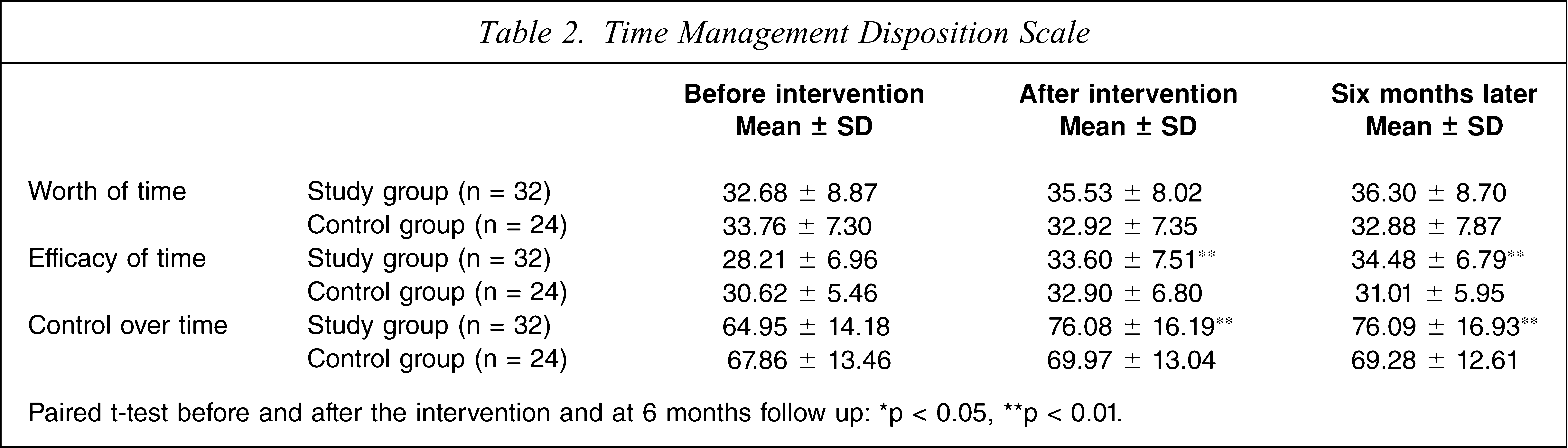
Paired t-test before and after the intervention and at 6 months follow up: ∗p < 0.05, ∗∗p < 0.01.
The active and control groups did not differ at baseline, immediately after the intervention or at 6 month follow up on the emotional symptoms, conduct problems or prosocial behaviour scales of the Strength and Difficulties Questionnaire (SDQ) (Chinese version). The active group, however, had more hyperactivity and attention deficit problems and peer relationship problems at baseline than the control group, although the groups did not differ on these measures immediately after the intervention or at 6 month follow up. The active group decreased immediately after the intervention and at 6 month follow up compared to before the intervention on the emotional symptoms, conduct problems, hyperactivity and attention deficit problems and peer relationship problems scales. Further, they demonstrated a similar pattern of increase in the prosocial behaviour scales from baseline to 6 month follow up. In contrast, the control group did not differ on any of the SDQ (Chinese version) scales from baseline to immediately after the intervention to 6 month follow up. The active group effect sizes were uniformly small (Cohen's d = 0.44–0.59), except for the emotional symptoms, conduct problems and hyperactivity and attention-deficit problems scales at 6 month follow up, and the hyperactivity and attention-deficit problems scale immediately after the intervention, which were medium (Cohen's d = 0.73/0.60/0.61/0.61, respectively; Table 3).
Strengths and Difficulties Questionnaire (Chinese version)
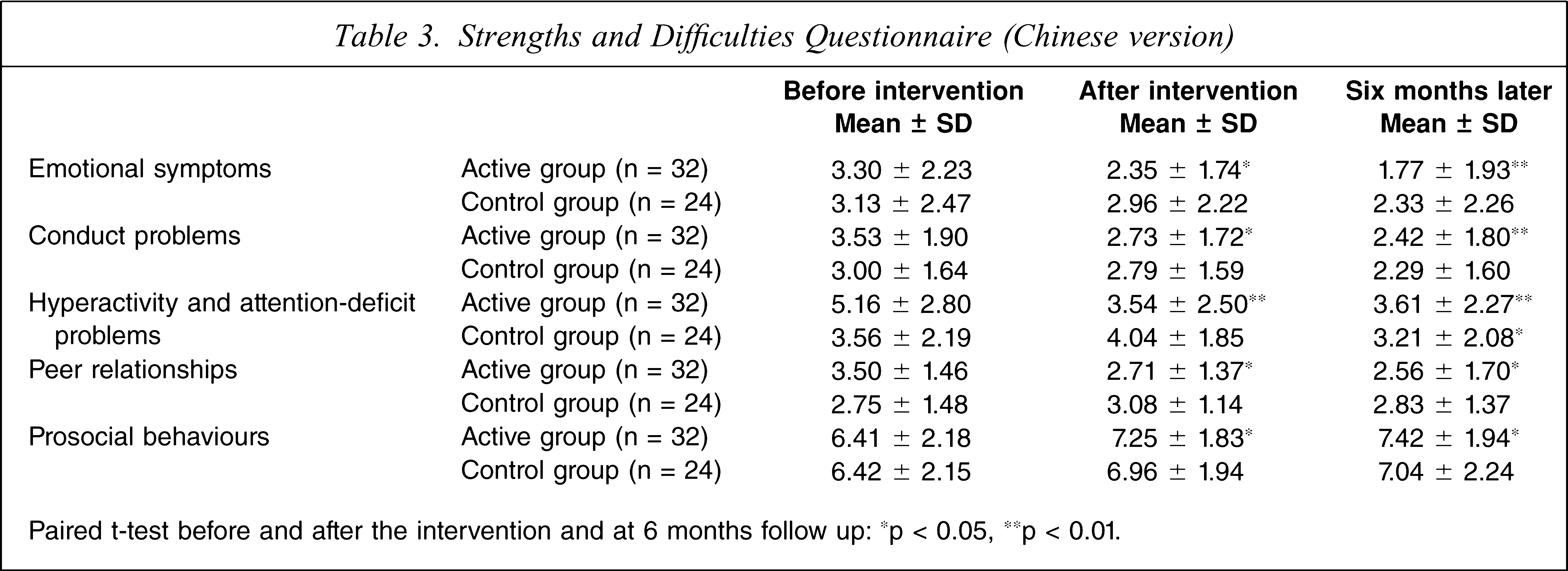
Paired t-test before and after the intervention and at 6 months follow up: ∗p < 0.05, ∗∗p < 0.01.
The active and control groups did not differ at baseline, except for the school anxiety subscale of the SCARED, for which the active group reported higher levels of school anxiety. In contrast, the active group demonstrated lower scores on all scales compared to the control group, immediately after the intervention and at 6 month follow up, except for the school anxiety scale immediately after the intervention. Effect sizes were predominantly small immediately after the intervention (Cohen's d = 0.4–0.48) and medium at 6 month follow up (Cohen's d = 0.61–0.79). The active group decreased immediately after the intervention and at 6 month follow up compared to before the intervention on all the SCARED subscales. Effect sizes were predominantly medium (Cohen's d = 0.62–0.93). In contrast, the control group did not differ on any of the SCARED scales from baseline to immediately after the intervention to 6 month follow up (Table 4).
Screen for Child Anxiety Related Emotional Disorders
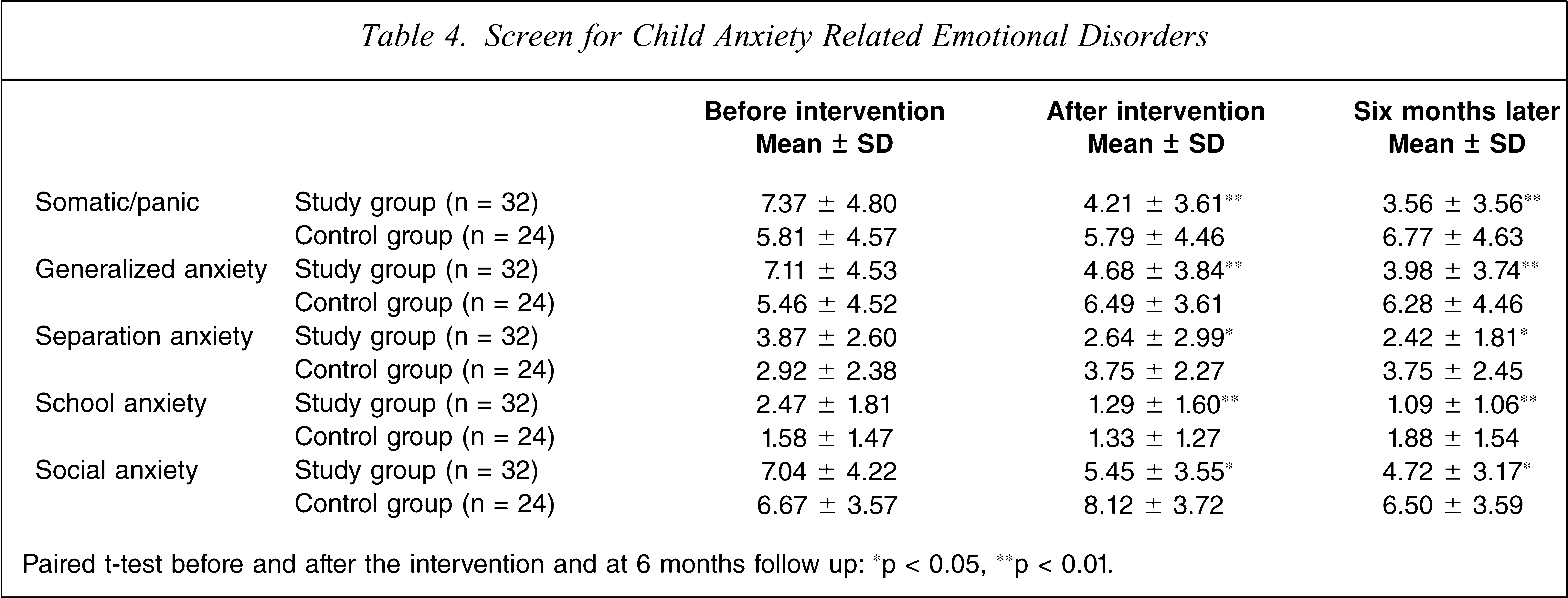
Paired t-test before and after the intervention and at 6 months follow up: ∗p < 0.05, ∗∗p < 0.01.
Discussion
The Internet Overuse Self-Rating Scale is similar to Young's Internet Addiction Screening Scale [2] in number and content of items. Interestingly, both the active group and the control group improved over time, with no difference evident between them. This implies that regardless of the multimodal school-based intervention, Internet addiction behaviour has the potential to change and improve. There was a larger effect size evident, however, in the active group over time, which suggests that changes in associated emotional, cognitive and behavioural problems may have had an influence. Such an association has been suggested in previous treatment studies [8–10].
In contrast, the TMDS showed only that the multi-modal school-based intervention group had an improved use of time (‘efficacy of time’) and control over time usage (‘control over time’) at the 6 month follow up. This suggests that the multimodal school-based intervention did uniquely aid the improved Internet addiction behaviour. Internet addiction adolescents’ valuing of time (‘worth of time’), however, did not differ between the two groups. This implies that their assessment of time's value is not related to their efficient use of time and control over its use. Recent studies have shown that time management is positively correlated with a given individual's feeling of happiness in life and self-satisfaction, and negatively correlated with anxiety and depression [16]. It has also been reporte d that one's attitude toward time is congruent with one's personality and/or temperament characteristics [17].
Consistent with these reported associations, we found that only the active group demonstrated decreased emotional (particularly anxiety), hyperactive and inattentive, conduct and peer relationship problems, with a commensurate increase in manifest prosocial behaviour, over time. This is an important finding for the multimodal school-based intervention because Internet addiction is known to have a greater-than-chance association with anxiety, especially social anxiety, and impulsiveness, hyperactivity and inattention [18–20]. Interestingly, all these symptom domains demonstrated a large effect size improvement only with the multimodal school-based intervention.
In summary, the multimodal school-based intervention did lead to an improved emotional state and regulation ability, behavioural and self-management style in the adolescents identified with Internet addiction. The generalizability of these findings, however, are limited by the absence of pre-existing comorbid conditions such as high- and low-prevalence psychiatric disorders and language learning disorders (reading/spelling/arithmetic/writing), verbal and visuospatial IQ data and key motor, speech and language developmental milestones data. Such information could allow us to examine the possible differential response of adolescents with Internet addiction in the context of these key comorbid conditions and developmental risk factors. This should be a focus of future randomized, controlled studies of Internet addiction, along with investigation of younger and older cohorts from different developmental periods.
Footnotes
Acknowledgements
The authors would like to acknowledge the hard work of the staff of the Shanghai Mental Health Center and the adolescents and their families who took part in this study. This research was funded by the Shanghai Mental Health Center. Professor Yasong Du has received research funding from Xi'an-Janssen Pharmaceutical, Eli Lilly, and Shanxi Ruifulai Pharmaceutical.