




Abstract
Districts with expansive school choice must decide how to match students and schools. Increasingly, districts are centralizing applications on one-stop portals that feature information about schooling options, admission requirements, and a single application and deadline with the hope of increasing transparency and streamlining the enrollment process. After Chicago Public Schools introduced a centralized platform (GoCPS), students were more likely to enroll in high-performing high schools, although this continued as a pre-existing upward trend. Enrollment declined slightly at charter schools and increased at neighborhood schools, mirroring shifts in applications. GoCPS reduced the number of admission offers, likely lessening uncertainty around ninth-grade enrollment. Districts implementing similar systems should consider the availability of seats at high-demand schools and reduce barriers to navigating choice systems.
School Choice in Urban School Districts
Districts may take a decentralized stance on student assignment, with each school developing their own admission rules and procedures and with students navigating multiple application processes (Harris et al., 2015). Decentralized systems are burdensome to families who, for example, have limited access to information about schools and their application requirements or who face transportation or language barriers (Fong & Faude, 2018; Pattillo, 2015; Shapiro et al., 2019). In addition, when each school controls admission decisions, some students end up with multiple offers across schools within a single district while others receive none. This inefficiency can lead to uncertainty about enrollment decisions for students, complicate planning for school leaders, and result in shuffling of students between schools in the first months of the school year.
Another approach to student assignment is for application and enrollment systems to be centralized with the district overseeing the entire process. These systems feature a one-stop web-based portal where students can research school options and find information about program admission requirements. Centralization can help level the playing field by providing all students access to the same information about schools (Gross et al., 2015). Students use the same portal to complete one application, ranking schools and programs based on their preferences. After the application deadline, the district typically makes a “single-best offer” to each student, eliminating the problem of individual students holding multiple offers and ensuring students receive the best possible match (Abdulkadiroğlu et al., 2005).
Two of the earliest adopters of centralized enrollment systems were Denver in 2011 and New Orleans in 2012 after nearly all public schools were converted to charter schools in the wake of Hurricane Katrina. The details of these systems differ across districts (see Online Supplemental Appendix Table A1). Some districts like New York City and Boston require applications for all eighth graders regardless of the type of school they want to attend. Places like Chicago, D.C., and Denver do not require students to apply to high school, and students have a default school assignment based on their residential address. Charter schools typically operate applications separately from other district schools, although notable exceptions include Chicago and Denver where charter schools are part of the centralized system. Districts also must decide which students receive admission offers to which programs. Most schools admit students via lottery, often giving priority to certain students such as those with a sibling already attending the school. Other schools have application requirements like test scores or auditions, and then students are admitted based on their application points. Some districts make only one admission offer to a student while in other places a student might be admitted to multiple programs.
In this brief, we use the implementation of a centralized enrollment system in Chicago Public Schools (CPS) as a case study for investigating students’ enrollment decisions as the district transitioned away from a more decentralized approach. In Fall 2018, the first cohort of CPS ninth graders enrolled in high schools using GoCPS, an online student application and enrollment portal for all of the districts’ traditional, magnet, and charter schools. The district aimed to create an enrollment system that was more equitable and efficient than the pre-existing patchwork of application procedures. The superintendent at the time, Janice Jackson, said, “We cannot have a system that allows some people to feel that they can access it with ease, while others feel like it’s too complicated and choose to disengage” (Masterson, 2017).
In the years following GoCPS, we find that enrollment patterns across different high schools remained mostly stable. Student enrollment in schools with high graduation rates was on the rise prior to GoCPS, and this trend continued after, including for students of color and for students eligible for free or reduced-price lunch (FRL). GoCPS made it easier to apply to charter schools at a time when the city’s public school population was already shrinking raising concerns among some Chicagoans that enrollment in traditional neighborhood schools would decline even faster (see, e.g., Adu-Wadier et al., 2023; Emmanuel, 2019; Lutton, 2013). However, the share of ninth-grade students enrolling in neighborhood high schools increased slightly, offset by small declines in charter enrollment. These changes were driven by Black students’ enrollment decisions. We speculate that GoCPS raised the visibility of specialized programs at neighborhood schools. Finally, the district’s decision to assign students to schools using a centralized system clearly resulted in a decline in the number of offers made to students, which likely reduced uncertainty about fall enrollment for students and schools.
A Case Study: School Assignment in Chicago Public Schools
CPS is an urban district with extensive school choice. Each student has a default high school determined by where they live, and students can apply to charters, selective schools, magnets, and specialized programs at neighborhood schools. Three of four ninth graders (77%) enroll outside of their neighborhood school (Barrow & Sartain, 2019). CPS (2022) serves a diverse student population: Forty-seven percent of students identified as Hispanic or Latino, 36% as Black or African American, and 73% as economically disadvantaged.
In Fall 2017, the first cohort of eighth graders applied to enter high school using GoCPS for Fall 2018. GoCPS is a web-based application portal providing centralized and comprehensive information about school location, performance, program offerings, and application requirements for all high school programs within CPS, including the district’s 43 charter high schools. On the portal, students can filter schools based on performance metrics, type (e.g., charter, selective enrollment), and proximity to their home. Research has shown that easy access to information on school quality affects application choices (Valant & Weixler, 2022), suggesting that adoption of GoCPS had the potential to alter application patterns and, ultimately, student enrollment. Eighth graders fill out at most two applications within the GoCPS portal: one for the 11 selective enrollment programs and another for all other high school (i.e., choice) programs. 1 There is a single deadline for applying to all programs. In the spring, a typical student receives one offer—a single-best offer from a program on their choice application—and can choose between that and their zoned high school. 2 CPS does not require all students to apply to high school, and students who do not apply are guaranteed a seat in the general education program at their zoned school.
Prior to the implementation of GoCPS, applications to charter schools had to be submitted directly to schools or charter management organizations; the district managed applications to some large programs like International Baccalaureate (IB) and Career and Technical Education (CTE); and other applications went to high schools directly. Deadlines varied. Decentralization also meant that students could receive and accept multiple offers, and school-level enrollment could fluctuate well into the school year as waitlists moved, making budgeting and planning difficult.
In this brief, we show trends in ninth-grade enrollment by school performance and type:
Enrollment in high-performing high schools 3 : For the purposes of this brief, we define a high school as “high performing” if its cohort graduation rate is at or above 80%. 4 The Online Supplemental Appendix also shows results by school accountability rating. Competition for seats in selective enrollment schools has been well documented in the media, but only 8% of CPS schools are selective enrollment (e.g., Dampier, 2019). However, 42% of high schools graduated over 80% of their students in 2016–2017, and 54% of high schools received a top accountability rating. Thus, the GoCPS platform may have brought attention to high-performing options beyond the well-known selective high schools.
Enrollment in neighborhood versus charter high schools: The charter sector grew substantially in a relatively short period of time—ninth-grade enrollment in charter schools went from 3% in 2002 to 26% in 2016 (Barrow & Sartain, 2017). Although the number of charter high schools in the district was relatively stable over the years just prior to and during the implementation of GoCPS (see Online Supplemental Appendix Figure A1), centralizing charter applications on the GoCPS platform made it easier for students to apply to charter schools. Neighborhood school proponents were concerned that this might shift even more students into the charter sector, resulting in further enrollment declines at neighborhood schools. This concern was exacerbated by steadily declining student enrollment in CPS (see Online Supplemental Appendix Figure A2) served by the same number of high schools.
Data Sources
We characterize patterns for three different aspects of the centralized enrollment system in Chicago: where students enrolled in high school, where students applied, and the district’s admission offers to students. To do this, we compiled data for the 2015–2016 through 2021–2022 school years (additional details are in the Online Supplemental Appendix Data Description and Regression Equations and Table A2):
Yearly school-level student enrollment by grade level;
School-level information such as cohort graduation rate, accountability rating, and type (e.g., neighborhood, charter); and
Applications to and offers from all district programs for GoCPS years, as well as from programs that were centralized prior to GoCPS.
Findings From Chicago
Student Enrollment: Ninth-Grade Enrollment by High School Graduation Rate Was Largely Unchanged After GoCPS
Figure 1 shows trends in the share of students enrolled in a high school where the ninth-grade cohort graduation rate is at least 80%. (See Online Supplemental Appendix Figure A3 for enrollment at schools with high accountability ratings.) Prior to GoCPS, graduation rates at CPS high schools were already improving dramatically. 5 In 2015–2016, 43% of ninth graders were enrolled in a high school with a high graduation rate; by 2021–2022, that number had risen to 70% (shown in Panel A). This upward trend means that students are more likely to attend high schools where many more students graduate now than in past years, but the increase does not appear to be because of the adoption of GoCPS. Figure 1 Panel B holds each high school’s graduation rate constant (i.e., for all years, we assign each high school its graduation rate from the 2018–2019 school year), which shows that enrollment trends are very consistent. (Online Supplemental Appendix Table A3 shows statistical tests.)
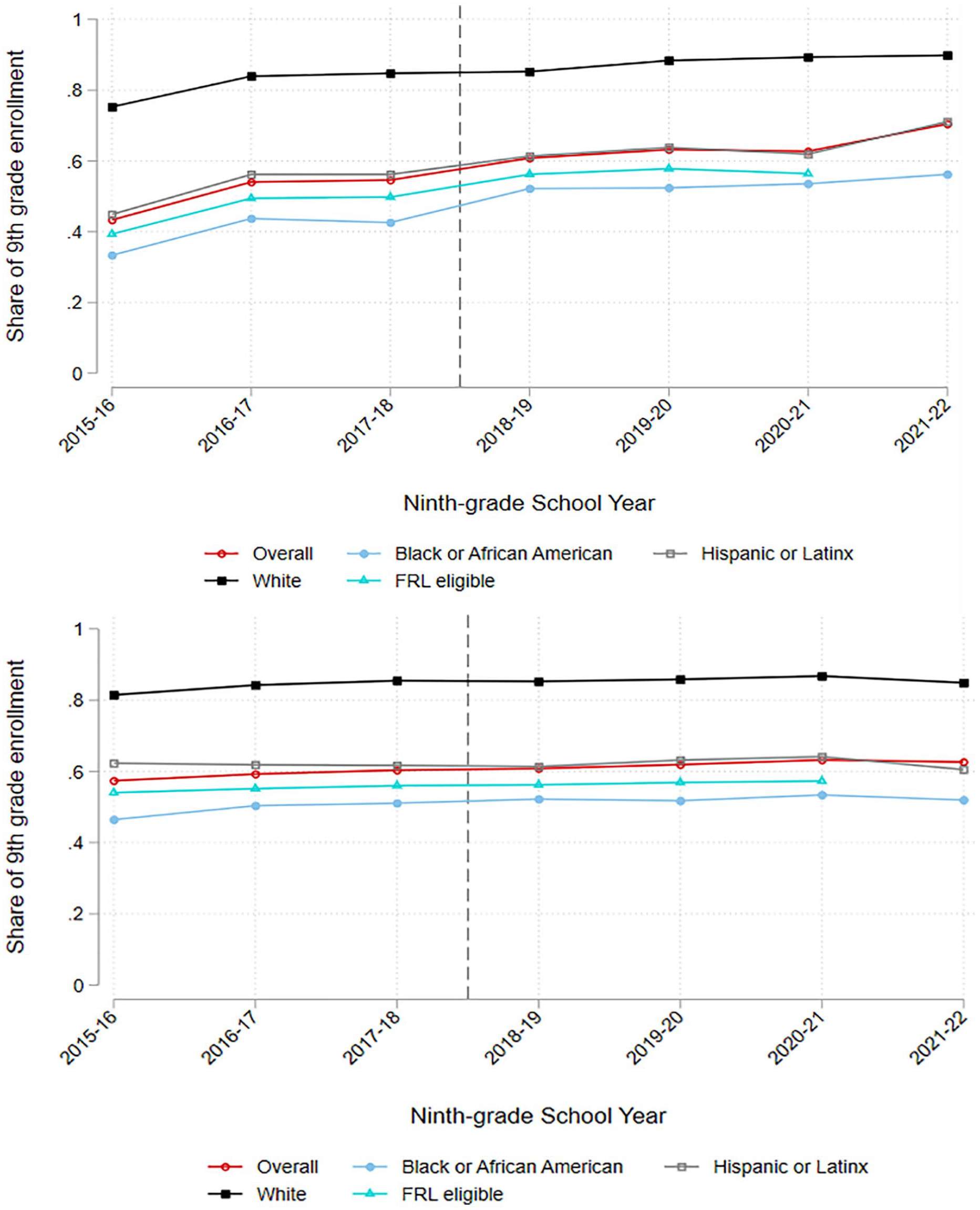
Trends in Ninth-Grade Enrollment at High Schools With Graduation Rates at or Above 80%. Panel A: Share of Students Enrolled in High-Graduation-Rate Schools (Using Actual Rate). Panel B. Share of Students Enrolled in High-Graduation-Rate Schools (Holding Rate Constant)
Overall student enrollment patterns may mask changes in the likelihood of enrollment at high-performing schools for different groups of students. For example, we might observe an increase in enrollment of Black students at high-performing high schools, although that would have to be offset by a decrease in enrollment of non-Black students at those same schools. Yet, we find no evidence that this reallocation of seats occurred—also shown in Figure 1. Regardless of student race/ethnicity or FRL eligibility, student enrollment at high schools with high graduation rates continued on their pre-GoCPS upward trajectories. (Supplemental Appendix Tables A4 and A5 show statistical tests.)
The stability of enrollment in schools by graduation rate after GoCPS raises questions about the availability of seats at high schools with high graduation rates. Students may have applied to high-performing schools at higher rates with GoCPS, but enrollment changes can only follow if there are seats available at those schools. In the first year of GoCPS, we estimate that the district had capacity to serve 64% of its ninth-grade students in schools with high graduation rates, and most seats at those schools (roughly 90%) were already filled before the introduction of GoCPS. Thus, more equitable access to high-performing schools would mean either investing in schools to improve their graduation rates or changing who is sitting in the seats at high-performing schools. 6
Student Enrollment: After GoCPS, Students Were Slightly Less Likely to Attend a Charter School and More Likely to Attend a Neighborhood School
Despite concerns that the centralized application process would make it easier to apply to charter or magnet schools and result in lower enrollment at neighborhood schools, we find no evidence that enrollment declined at neighborhood schools. Figure 2 shows enrollment by school type. Between Fall 2015 and Fall 2021, student enrollment at charter schools fell from 28% to 21% of all ninth graders (Panel A). Over the same period, the percentage of ninth-grade students enrolled in neighborhood high schools went from 42% to 47% (Panel B). Relative to Fall 2017, the number of ninth-grade students enrolling at neighborhood schools was statistically higher in most years after GoCPS (see Online Supplemental Appendix Table A3). These differences are largely explained by increases in enrollment at neighborhood high schools by Black students (see Online Supplemental Appendix Tables A6 and A7). We note that the pandemic may have influenced this change in the later years (Fall 2020 and Fall 2021) if students were seeking to enroll in a school closer to home to reduce public transportation use. 7 Finally, 25% of charter seats and 44% of neighborhood school seats were open prior to the implementation of GoCPS, so seat availability was less of a constraint by school type than at high-performing high schools.
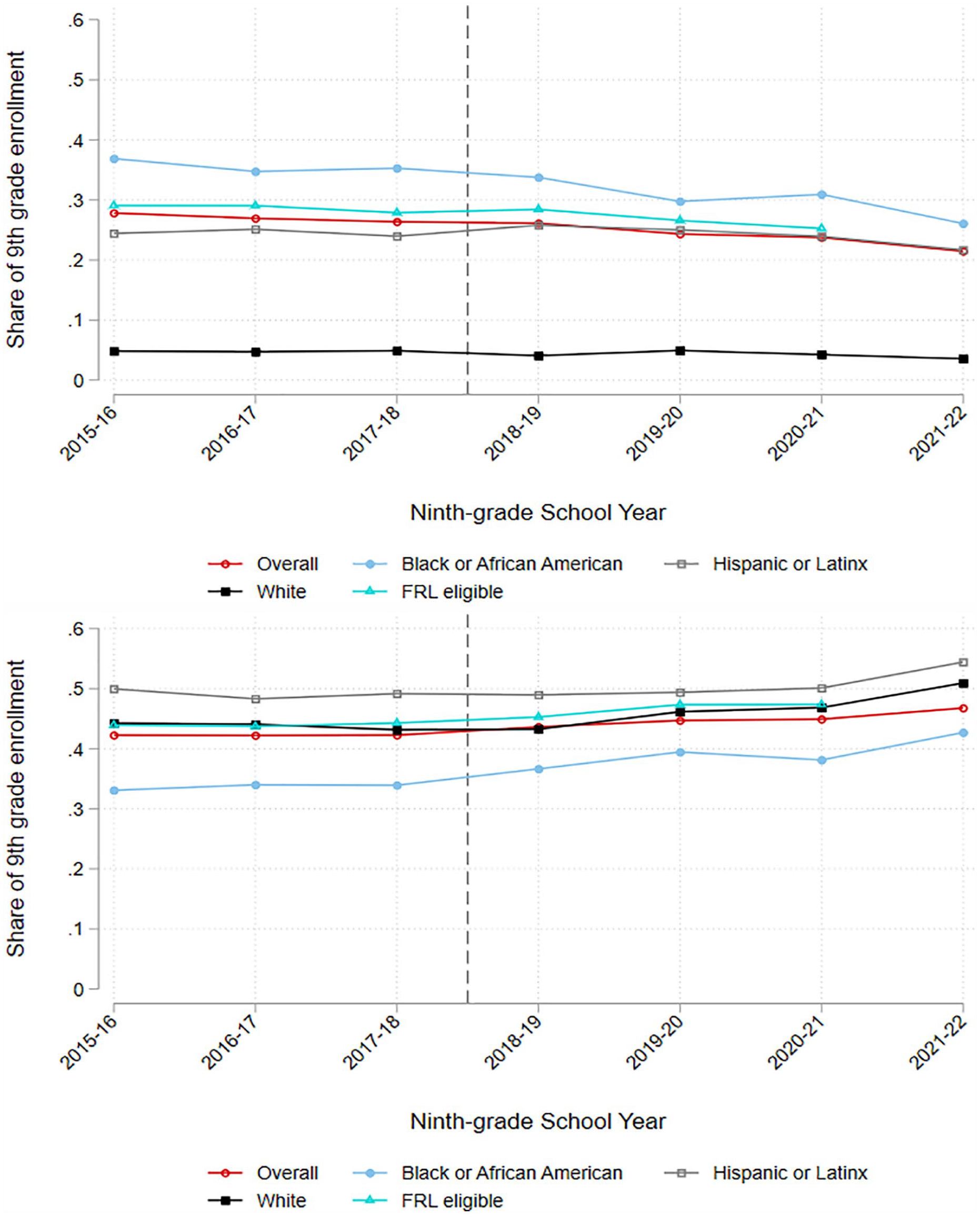
Trends in Ninth-Grade Enrollment by School Type. Panel A: Charter School Enrollment. Panel B: Neighborhood School Enrollment
Applying to High School: Applications to High-Performing Schools Held Steady, While Applications to Neighborhood Schools Increased Over Time
Enrollment decisions are the ultimate outcome of the GoCPS process, and those decisions depend on where students apply to school, capacity at schools, and district offers. However, because of the decentralized nature of applying to high school prior to GoCPS, there is no record of historical applications and offers across all schools. Therefore, we focus on how applications changed in the years following the introduction of GoCPS, as families, students, and schools learned more about the system. Figure 3 shows the distribution of applications to schools by their graduation rate (Panel A) and type (Panel B). As with ninth-grade enrollment, the percentage of applications to schools with high graduation rates increased in the years following the introduction of GoCPS. In 2018–2019, 37% (69) of applications were for programs at schools with graduation rates above 90% (80), and by 2021–2022, 44% (77) of applications were for schools with very high graduation rates. (Online Supplemental Appendix Figure A4 shows the distribution of applications holding graduation rate constant.) Applications by school type (Panel B) shifted slightly toward neighborhood schools and away from charter schools, similar to changes in student enrollment. Between 2018–2019 and 2012–2022, the share of applications to charter schools declined by about 2 percentage points, while the share of applications to neighborhood schools increased by 3 percentage points.
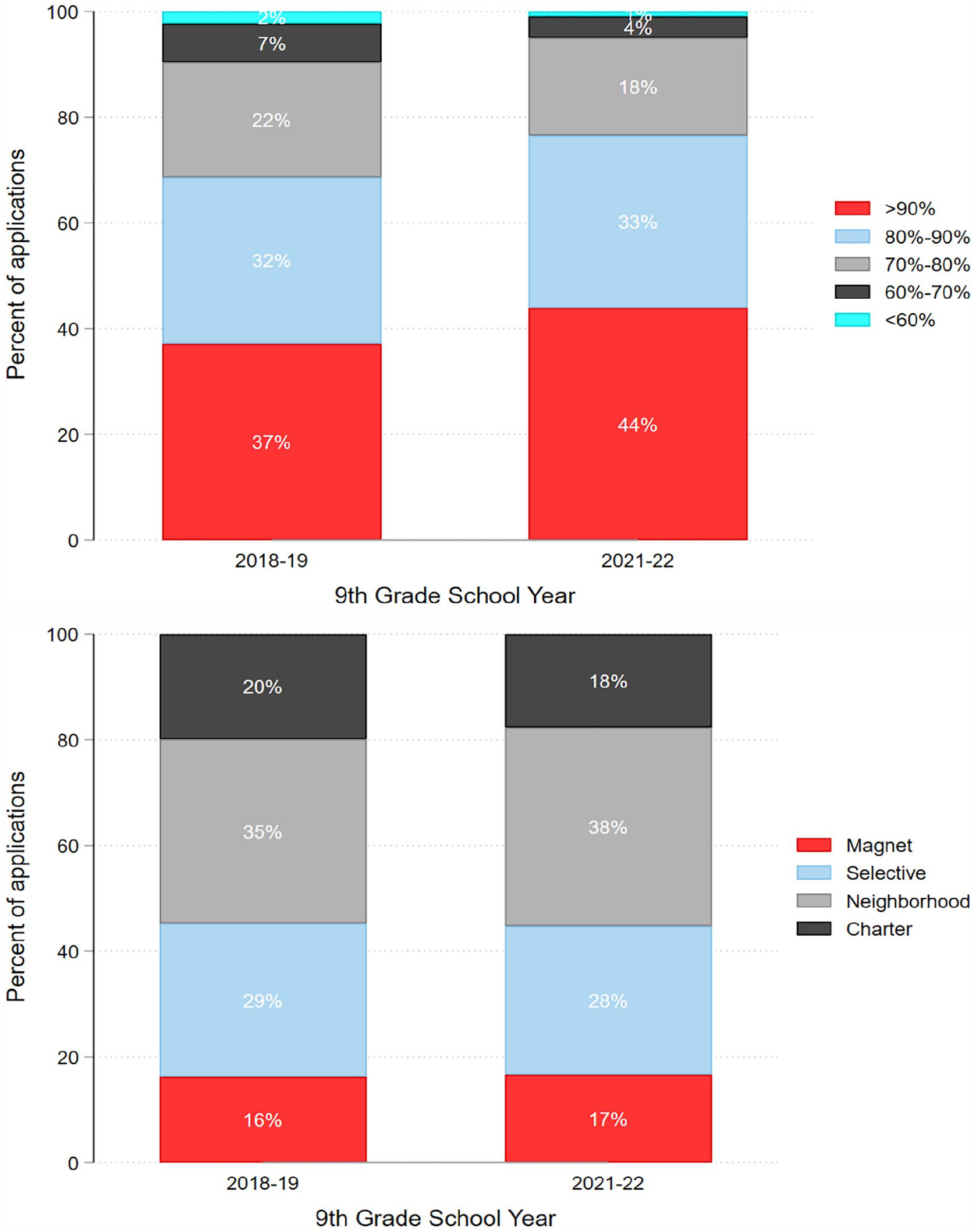
Distribution of Student Applications by School Characteristics Over Time. Panel A: High School Graduation Rate. Panel B: School Type
For some high school programs, we can make comparisons in applications before and after GoCPS. Applications to selective enrollment, IB, CTE, and military programs were centralized prior to GoCPS, representing 39% of all high school programs and 32% of all seats in Fall 2018. For the first time, GoCPS housed information about and applications to all high school programs, potentially allowing students to learn about and apply to a wider range of high school options than in the past. If that was the case, we might expect a reduction in applications submitted to the well-known already-centralized programs. Figure 4 Panel A supports this hypothesis. Applications to centralized programs had been on the rise prior to GoCPS, but there was a 26% decline in the number of applications to these programs in the first year of GoCPS. Applications to these programs continued to decline in subsequent years (a 21% decrease between Fall 2018 and Fall 2021, while enrollment over the same period declined by 5%), suggesting that GoCPS shifted student applications toward programs that were not already part of a centralized application process.
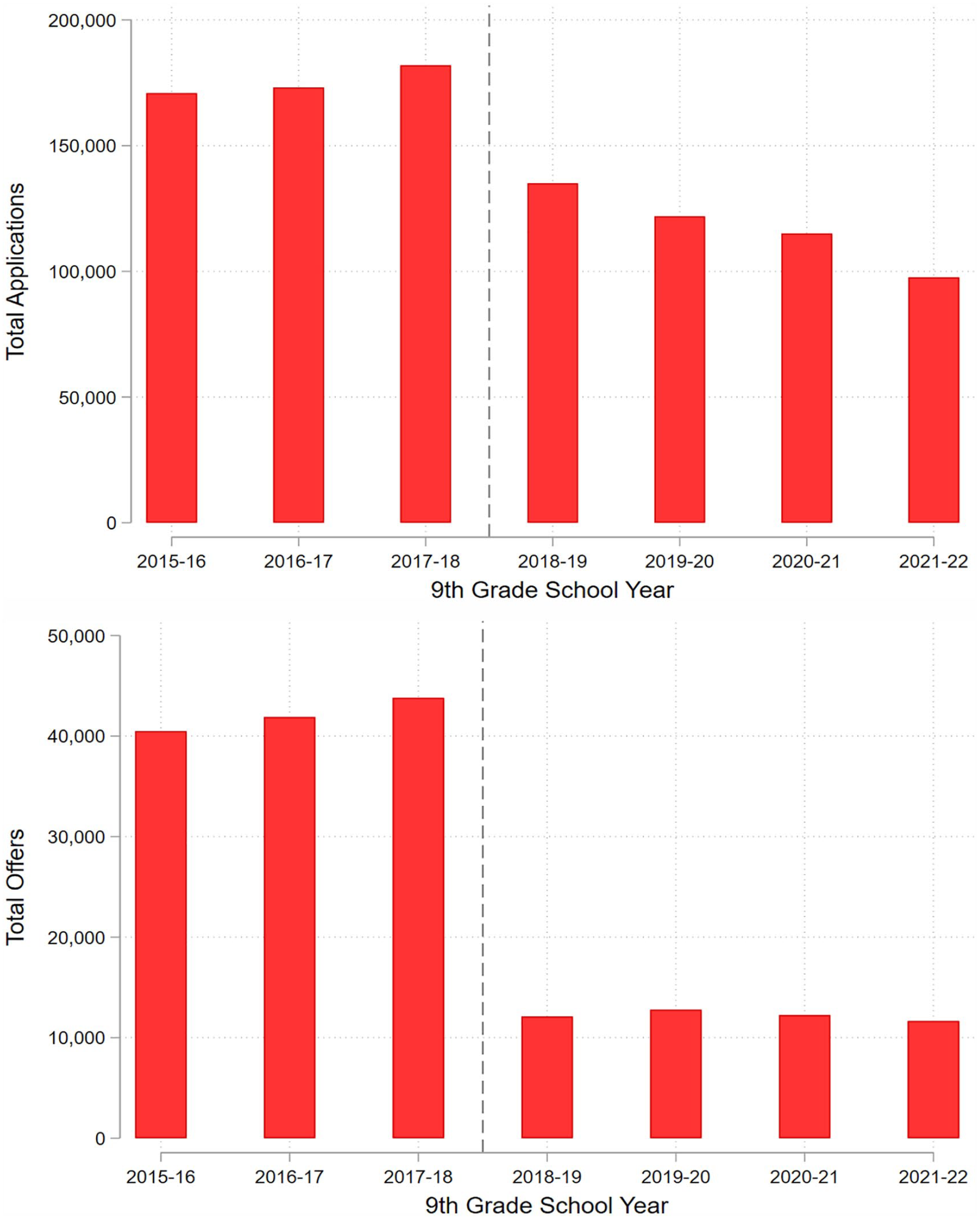
Number of Applications and Offers for Centralized Programs Over Time. Panel A: Number of Applications. Panel B: Number of Offers
Admission Offers: The District Reduced the Number of Offers Made to Students Under the Centralized System
One major advantage of a centralized enrollment system for districts and schools is that students can only accept a single offer, whereas under decentralized systems, students could receive and even accept multiple offers. Streamlining offers is by design, resulting in the district making fewer total offers at the end of the application period than under decentralization. With GoCPS, more students should have received admission offers without having to get off a waitlist, and no individual student could accept offers at multiple schools. Streamlining offers also benefits schools, ensuring school leaders have better information about the fall’s enrollment. Plus, school-level enrollment is likely more stable at the beginning of the year with the goal of less student movement across schools.
For the set of high school programs that were centralized prior to GoCPS, the number of offers extended by these programs declined nearly fourfold in the first year of GoCPS, a direct result of centralizing applications and adopting a single-best-offer admissions strategy (see Figure 4, Panel B). Based on the algorithm the district chose to process applications and assign students to schools, this result is what we would expect. Even still, this large reduction in offers is an important benefit for school districts associated with centralized enrollment systems.
Considerations for Policy and Practice
Centralized enrollment systems can deliver administrative benefits to districts, schools, and families and students. However, the application portal is only one piece of a larger, complex school choice system. Districts that offer families lots of schooling choices have the difficult job of creating a system of high-performing schools that are diverse in programmatic offerings and geographically accessible to all students regardless of where they live. At the end of the day, a centralized enrollment system can make it easier to access various school options, but districts still need to make strategic investments in school improvement in neighborhoods throughout the city. Using evidence from CPS and other districts about the implementation of centralized enrollment systems, we raise the following considerations and questions for policymakers.
Centralized Enrollment Systems Can Increase Efficiency of Student Assignment to Schools and Make the Rules of the Game More Transparent
Centralized application and offer systems reduce uncertainty around enrollment by increasing the chance that preferred matches are made between students and schools. Students and schools should have more stability at the beginning of the school year, alleviating anxiety for students and allowing leaders and teachers to focus on meeting their students’ needs from day one. Another important feature of centralized systems is that admission rules are more transparent. In a single platform, all students can access the same information about admission requirements, school performance, and school climate. Centralized information could also decrease the likelihood that schools implement arbitrary admission rules or eligibility requirements (e.g., GPA cutoffs) that favor more advantaged students. Researchers in other district contexts have also noted the increase in transparency and perceived fairness after adopting centralized enrollment systems (Gross et al., 2015).
Student Demand for High-Quality Schools Is Often Higher Than the Number of Available Seats
The switch to GoCPS did not result in more students enrolled in high schools with high graduation rates or change the composition of students enrolled in high-performing schools. Demand for seats at high-performing schools (represented by the number of applications) outnumber the seats available at those schools. This issue is not unique to Chicago. The problem has also been documented in Denver (Gross & Denice, 2015), and a similar constraint exists in New Orleans where researchers have found that, on average, a student’s enrolled school tends to be lower performing than the student’s top-ranked school on their application (Lincove, Cowen, & Imbrogno, 2018). To increase enrollment at high-performing schools, districts will need to find ways to increase the number of seats that are “high quality.” A school choice-driven solution suggests that lower-performing schools should be motivated to improve to attract students; however, districts may consider another solution: investing in neighborhood schools so that more students have access to good schools that are close to home. Of course, these two solutions are not mutually exclusive nor are they easy to implement, but districts should explicitly consider the availability of high-quality seats as it is likely a source of inequity.
Challenges With School Choice Persist Even With Centralized Systems
While seats at high-performing high schools were already limited, additional barriers may have prevented students from having an equal chance of enrolling in a high-performing school. One important consideration is how close a student lives to high-performing options. In districts where students do not have to complete a high school application, the quality of the default neighborhood school matters. For example, in CPS, Black students are much less likely to live near high-rated schools than non-Black students (Sartain & Barrow, 2022), and researchers have documented similar patterns in other places (Denice & Gross, 2016; Kemple et al., 2019). Furthermore, students vary in the support they receive in choosing a high school. In New York City, some of the most isolated students complete this process without help from their families, caregivers, or even school staff (Sattin-Bajaj, 2015; Sattin-Bajaj et al., 2018; Sattin-Bajaj & Jennings, 2022). Without robust and explicit district- or school-level support about how to research and apply to schools, inequitable access to high-performing schools will likely persist even with a centralized platform.
How Do Schools Respond?
While we focus on the student side of centralized enrollment systems, schools are also affected. Because all schools are on the same application portal, they may more directly compete for students in centralized enrollment systems than under decentralization. For example, GoCPS made it much easier for students to apply to charter schools, which had very decentralized processes in the past. With GoCPS, students could easily apply to charters on the same platform as district-run schools. Thus, there were concerns that neighborhood schools would face even steeper declines in enrollment and be left with fewer resources. Contrary to these concerns, neighborhood school enrollment share rose slightly following GoCPS, perhaps because the system increased publicity for specialty programs housed in neighborhood schools. In the long run, how schools respond to centralized enrollment in terms of the specialized programming they offer or in their marketing and how districts support schools in these decisions are unanswered questions and important areas for future research.
Context Matters—Districts May Experience More Dramatic Changes to Student Enrollment Patterns if They Are Expanding School Choice Options at the Same Time That They Introduce Centralized Enrollment
GoCPS considerably centralized and streamlined the way students applied to high school. But, in the years following GoCPS, Black and Latino students were just as likely to enroll in a high-performing high school compared to previous years. It is important to consider this key finding in the historical context of Chicago where school choice is certainly not a new concept. The district has long offered many options for students to consider. At least some families (especially those with other children already enrolled in high school) likely had previous knowledge of the choice landscape and had already developed preferences over the options. In addition, schools with high graduation rates were mostly at capacity prior to GoCPS, so there was little chance that enrollment in those schools could have changed even with an easier application process. Other school districts that are simultaneously adding charter or magnet options at the same time that they implement a centralized enrollment system may experience different outcomes, although they may also face larger challenges in helping families learn about, apply to, and eventually enroll in various schooling options.
Supplemental Material
sj-pdf-1-epa-10.3102_01623737231206777 – Supplemental material for Assigning Students to Schools in an Era of Public School Choice: Patterns in Enrollment, Applications, and Offers in Chicago
Supplemental material, sj-pdf-1-epa-10.3102_01623737231206777 for Assigning Students to Schools in an Era of Public School Choice: Patterns in Enrollment, Applications, and Offers in Chicago by Lauren Sartain, Riley Lewers and Lisa Barrow in Educational Evaluation and Policy Analysis
Footnotes
Acknowledgements
Authors are listed in reverse alphabetical order, but authorship is equal. The authors thank the Chicago Public Schools, particularly the Office of Access and Enrollment, for engaging with our research and helping us better understand the policy context. The paper benefited from discussions with Sarah Dickson, Lisa Lynn, and Sara McPhee and research assistance from Bea Rivera. The authors also thank participants at the Association for Education Finance and Policy annual conference. Any views expressed do not necessarily reflect those of the Federal Reserve Bank of Chicago or the Federal Reserve System. The authors take responsibility for errors if any.
Declaration of Conflicting Interests
The author(s) declared no potential conflicts of interest with respect to the research, authorship, and/or publication of this article.
Funding
The author(s) received no financial support for the research, authorship, and/or publication of this article.

Supplemental Material
Supplemental material for this article is available online.
Notes
Authors
LAUREN SARTAIN, PhD, is an assistant professor at the University of North Carolina at Chapel Hill, School of Education. Her research is conducted in close partnership with school districts and focuses on understanding the effects of K–12 education policies on student and teacher outcomes.
RILEY LEWERS, BS, is a PhD student in Economics at the University of California, San Diego. Her research interests include macro, labor, and environmental economics.
LISA BARROW, PhD, is a senior economist and economic advisor at the Federal Reserve Bank of Chicago. Her research interests include education, public finance, and labor economics.
References
Supplementary Material
Please find the following supplemental material available below.
For Open Access articles published under a Creative Commons License, all supplemental material carries the same license as the article it is associated with.
For non-Open Access articles published, all supplemental material carries a non-exclusive license, and permission requests for re-use of supplemental material or any part of supplemental material shall be sent directly to the copyright owner as specified in the copyright notice associated with the article.
