




Abstract
This review outlines the scholarship landscape and uncovers the nature and key characteristics of activism related to migrant school-aged youth. Employing PICOT and PRISMA protocols, 126 relevant articles published in peer-reviewed journals from 2007 to 2023 were identified. We employed a three-layered, mixed-methods analytical framework to map the scholarship and to decipher the nature of agency and the voice of activism. The review revealed that migrant youth engage in diverse forms of activism, primarily driven by their anchoring to society and a desire to secure their rights. Furthermore, we found activism concerning school-aged migrants is often initiated and led by their allies (e.g., NGOs, schools) and consequently studied from the latter’s perspectives. Our findings highlight an overrepresentation of investigations focusing on issues surrounding activism rather than migrants’ lived experiences of activism. This analysis lays the groundwork for a further conceptualization of the field of migrant school-aged youth.
Keywords
In recent years, the discourse on youth participation has diverged into two distinct yet interconnected narratives. On one front, public and scholarly discourse often highlights a decline in young people’s engagement with traditional democratic processes (Mirra & Garcia, 2017; Zukin et al., 2006). This trend is particularly evident in the persistently low voter turnout among youth demographics in many electoral contexts and low interest in politics in general among school-aged youth (Theocharis & Van Deth, 2018). This phenomenon suggests a growing disenchantment among youth who increasingly view democratic processes as irrelevant to their lives and believe that political leaders are largely unresponsive to their needs. Conversely, an alternative narrative underscores growing youth engagement in activism aimed at challenging and reshaping the social landscape within their communities and interests (Nuñez-Janes & Ovalle, 2016). This engagement frequently manifests beyond conventional political arenas (Dyrness & Sepúlveda, 2020; Theocharis & Van Deth, 2018), where young people embrace novel approaches, including digital platform mobilization (Wilf et al., 2022), art activism (L. Boveda & Boveda, 2023), and the orchestration of mass demonstrations and strategic boycotts (Fisher & Rouse, 2022).
The wide range of activist activities—spanning online and offline spaces, varying levels of involvement, and diverse focus areas—underscores the need for further research into the complexities of youth activism. Although these forms of engagement have been widely studied, important questions remain about how, and to what extent, youth from diverse backgrounds—particularly migrants—are participating in these actions.
Youth Activism
Youth activism—specifically among school-aged children—has become an increasingly prominent area of educational and sociopolitical research (Wright & McLeod, 2023). Discussions within the literature on youth activism frequently center on how activism is defined and what actions are considered to constitute activism (Percy-Smith et al., 2023). To the best of our knowledge, there is no clear consensus on a comprehensive definition of activism (Peterson et al., 2022; Taft & O’Kane, 2024). Instead, existing scholarship discusses different examples of activism from diverse theoretical perspectives, such as civic (Mirra & Garcia, 2017) and political (Wilf et al., 2022) participation, immigrant rights mobilization (Nuñez-Janes & Ovalle, 2016), youth’s sociopolitical development (Watts et al., 2003), social justice (Levinson, 2010), and others. Furthermore, while similar phenomena may be discussed, the definition of activism differs significantly between different research fields and studies settings (Suppers, 2024; Taft & O’Kane, 2024), specific activities may be counted as activism for one particular population but not for others due to (for example) ethnicity, age, or legal status (Dyrness & Sepúlveda, 2020; Terriquez et al., 2020). Adding another layer of complexity, in considering the convergence of activism and various forms of political and civic engagement (e.g., volunteering, active citizenship, community participation, etc.), we recognize certain activities could be counted as activism depending on the definition approach and how definitions of activism have shifted over time (e.g., Levinson, 2010; Theocharis & Van Deth, 2018). These blurred boundaries and significant overlaps between advocacy and activism are also thoroughly discussed in light of vulnerable youth, with specific attention to migrant youth engagement (Battocchio et al., 2023; Wright & McLeod, 2023).
The Interplay of Education, Migrant Youth, and Activism
Research shows how issues relating to activism within a formal educational context often lack comprehensive delineation (Percy-Smith et al., 2023; Peterson et al., 2022). On the one hand, as prominent agents of socialization, schools are uniquely positioned to educate students about current events, cultivate civic dispositions and capacities, provide legitimacy to diverse forms of political engagement, and ultimately determine which forms of activism are included or excluded from normative discourse (Rosen & Conner, 2021; Yoshino, 2024). On the other hand, educational systems often conceptualize active citizenship as a future-oriented goal rather than recognizing how school-aged youth may be currently engaged in a variety of activist-related activities (Inguaggiato et al., 2025; Maher et al., 2024).
Furthermore, research continues to highlight that the current educational practices for working with migrant populations often run the risk of ignoring transnational youth’s diverse backgrounds and experiences and excessively prioritizing academic performance over democratic education and civic engagement. This is problematic because when combined with conservative and hostile environments, these normative practices ultimately replace efforts toward empowering and engaging transnational students in a host society with pressures to assimilate (Dyrness & Sepúlveda, 2020; Handy, 2025). Another adverse ramification is what Levinson (2010) calls the “civic empowerment gap”—a longstanding and systemic disparity between the educational opportunities afforded to different groups of young people when it comes to democratic participation. This gap highlights how marginalized youth, particularly those from racialized, low-income, or migrant backgrounds, are often excluded from curricula, resources, and pedagogical practices that cultivate a pathway to activism (Inguaggiato et al., 2025; Sperduti et al., 2025). 1 The coexistence of these conflicting narratives regarding youth activism prompts a critical examination of the role educational institutions play in both shaping young activists and facilitating activism.
Activism Related to Migrant Population
Historically, large-scale activist efforts (e.g., protests) have often been spearheaded by working-class and socially underprivileged groups fighting for their rights (Fisher & Rouse, 2022; Portes & Zhou, 1993). Similarly, the rise in global migration flows since the 1960s onward has increasingly led migrant populations to play a central role in spurring social movements (García & Castro, 2011; Handler, 1992). While activism has long included voices of vulnerable people, we foreground contemporary research that captures how less educated and economically disadvantaged young people are hampered by limited resources, often finding themselves excluded from traditional activist efforts (Chudgar & Chavda, 2023; Rosen & Conner, 2021). Migrant youth, while seeking to “anchor in the host country” and develop their own identities, are driven not merely by a demand for inclusion and equity but also by the principle of “nothing about us without us” (García & Castro, 2011; Grzymala-Kazlowska, 2016), yet their voices remain largely unheard (Mirra & Garcia, 2017; Terriquez et al., 2020).
The issues with exclusion, voice distortion, and silencing underscore an urgent need for a more in-depth exploration of the whole field surrounding activism related to school-aged youth of migrant origins. Further, the study of youth activism is significant not only because it is a rapidly evolving arena but because it problematizes the assumption that school-age students have a limited voice or are not engaged with the issues that may affect their futures (O’Kane, 2020; Rosen & Conner, 2021).
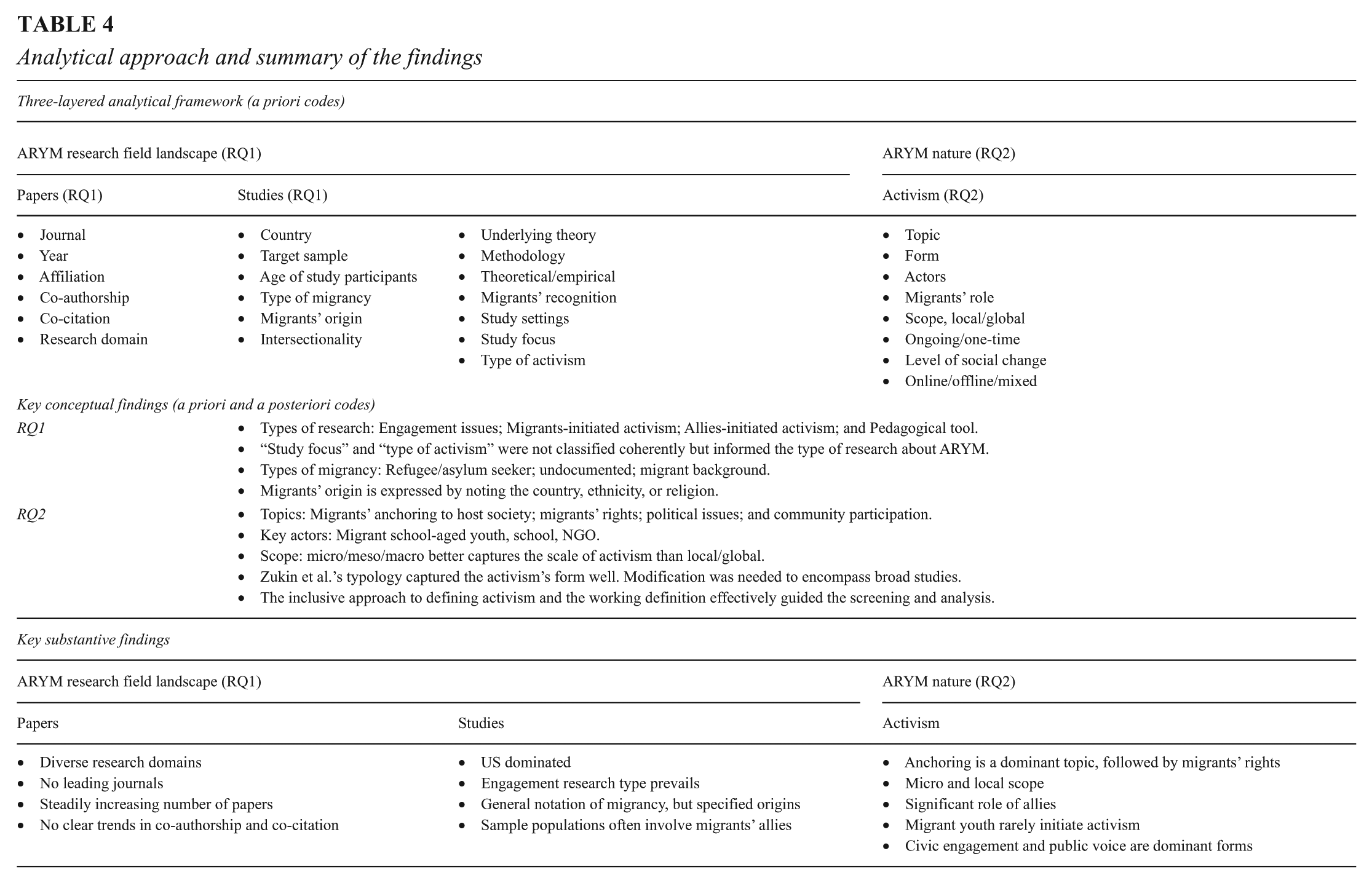
In the following sections, we present the working definition of activism that framed our review. We then explain the rationale for this study, our goals as educational researchers, and what led us to the research questions. The methods section describes the eligibility criteria, search terms, and procedures, supported by the PICOT and PRISMA protocols. This section concludes with delineating the analytical approach. Subsequently, the results section presents the findings, organized around two top-level research questions with thematic blocks at the second level. To aid navigation across the findings, each of the two main sections begins with an introductory paragraph outlining its thematic blocks and concludes with summaries of key findings, situating them within the broader literature. The discussion section first summarizes the findings and then introduces a deeper dialogue between our findings and existing scholarship addressing three themes: amplifying migrant youth voices, activism related to migrants in formal and informal educational contexts, and the conceptualization of the phenomenon. Table 4 further delineates the scope of the entire review, encompassing its analytical approach, key substantive, and conceptual findings. Figure 2 presents the logic underlying the move from research questions to discussion and the cross-references between methods, research questions, results, and discussion. The conclusion brings the entire study to a close and sets the ground for future investigations.
Working Definition of Activism
While acknowledging the existing patchwork of activism definitions and the extensive discussion surrounding youth engagement—its forms and terminology—we recognize the urgency of creating a detailed and encompassing map of the migrant school-aged youth activism research field. Therefore, in this study, we adopt an inclusive approach to what constitutes activism and refrain from setting boundaries before conducting our systematic investigation. Specifically, we employ Taft and O’Kane’s (2024) overarching understanding of children’s activism as a working definition. We further contextualize this broad definition by foregrounding the specificities concerning transnational youth activism, which is our central focus (Levitt & Schiller, 2004).
Embracing the discussions in a wide range of scientific and gray literature, Taft and O’Kane (2024) suggest that activism practices embracing a variety of forms, actors, levels of visibility, etc., are essentially driven by the desire for social change and share three inherent traits: “collectivity,” “challenging expectations,” and “transforming power” (Taft & O’Kane, 2024, p. 752). Importantly, the authors underscore that “activism is a practice being taken up by countless far less visible groups of young people from all around the world, many of whom are personally confronting profound inequalities and forms of structural violence, and thus are organizing with each other to resist and transform these injustices” (Taft & O’Kane, 2024, p. 753). This aligns with research focused on the activism of transnational youth, broadly defined, where it is often mobilized by “lived experiences of oppression and despair” (Nuñez-Janes & Ovalle, 2016, p. 190) and what occurs in “organic and localized spaces for solidarity and diaspora communities” (Dyrness & Sepúlveda, 2020, p. 9). Furthermore, based on their previous work, Taft and O’Kane’s definition suggests that activism can be youth-led, as well as adult-initiated and managed, with varying degrees of youth engagement (see O’Kane, 2020). Additionally, while activism may seek to “transform the power structures that currently exclude or marginalize children” (ibid., p. 753), the degree of transformation can be small-scale. Given the limited presence of research to date examining migrant school students’ engagement with activism (Levitt & Schiller, 2004), this aspect of the definition paves the way for a comprehensive review of migrant school-aged youth activism by recognizing that “networks of caring and kinship among immigrants and allies” are integral to such activism (Nuñez-Janes & Ovalle, 2016, p. 193).
Current Study
Documenting the research in activism related to school-aged youth with migrant backgrounds (ARYM) and identifying key trends and critical blind spots is crucial for furthering our understanding of social justice and equity. Migrant youth populations are vulnerable and subjected to exclusion due to their age, language, legal status, or educational disparities. In surveying the literature, we noticed that there seems to be limited work addressing the voice of school-aged youth populations with migrant backgrounds in research focused on activism, as well as significant gaps in the scholarship to date on how schools foster both knowledge and dispositions regarding young people’s activist engagement. With this in mind, we decided to focus our inquiry on activism related to migrant youth, taking an inclusive approach and examining activism as multifaceted and diverse. This approach embraces scenarios where young immigrants are fully agentic in their activism, as well as situations where they are more passive participants in activism driven or supported by other, less vulnerable actors.
The research questions that guided the SLR are:
How is published research on ARYM characterized theoretically, methodologically, and substantively? What are the dominant migrant populations studied, research foci, sample compositions, and other study characteristics evident in the scholarship?
What does existing research reveal about the nature of agency and voices in ARYM?
Method
Our first objective was to locate a comprehensive collection of peer-reviewed journal publications addressing the theme of migrant youth activism from the start of 2007 to the end of 2023. To focus our research, we used the PICO (population, intervention, comparison, and outcomes) tool, which has gained prevalence in educational research (Polanin et al., 2017). The PICO has been demonstrated to yield comprehensive results and is particularly effective for conducting multifaceted and exploratory reviews (Methley et al., 2014). As time was an important factor, we extended PICO with the additional parameter of time (T, hence PICOT), adjusting for parameters of the publication period. The search strategy and eligibility criteria have been deliberately crafted to encompass a wide scope and capture the widest possible array of existing literature (Ming & Goldenberg, 2021). To facilitate this investigation, our research protocol was designed in accordance with the PRISMA guidelines (Preferred Reporting Items for Systematic Reviews and Meta-Analyses), which delineate the necessary steps for planning, execution, and reporting (Alexander, 2020; Page et al., 2021).
This section outlines the systematic literature review (SLR) methodology employed in this study. First, we provide a thorough explanation of the inclusion and exclusion criteria used for paper selection, including the rationale behind each criterion and the coding process. We then detail our search strategy, including the search terms, limiters, and databases used in the identification stage. The section concludes with an overview of our analytical approach, summarizing the information sought within the selected papers. Finally, we discuss our positionality to transparently illustrate how our sociocultural identities may interact with this systematic review.
Inclusion and Exclusion Criteria
Guided by the PICOT framework (population: migrant and school-age youth; intervention: activism; time: 2007–2023; explained in detail in the next section), we included English-language papers published in peer-reviewed journals within our study timeframe that focused on activism related to or performed on behalf of migrant school-age children and adolescents. Recognizing the ambiguity surrounding activism, migrant background, and school-age youth, we provide a detailed definition of each criterion.
Activism
Informed by Taft and O’Kane’s (2024) understanding of activism, at the screening stage, we checked if the phenomenon described in the paper constitutes a collective practice that challenges the norms and is committed to changing the existing power dynamics. “Collectivity” here does not exclude individual actions but emphasizes that these actions are informed by, or embedded in, some collective discussion or goal. For example, “deportable” children challenged the supposed objectivity of their legal status (e.g., Lind, 2017), and undocumented students’ “coming outs” served as public acts of resistance (e.g., Zimmerman, 2016). These actions were performed by migrant youth individually but were connected and mobilized by a shared vision: the belief that they deserve equal civic rights. The “challenging expectations” feature does not limit the visibility of diverse activities; rather, it highlights how efforts to “disrupt, challenge or operate outside of what is expected” (Taft & O’Kane, 2024, p. 752) vary widely across contexts, particularly in the experiences of marginalized youth. Therefore, in our selection process, we included papers showcasing examples of inside-community or classroom activism and large-scale organized activities. However, we required that they all were challenging in the specific context and performed in unusual or unforeseen ways. Given that the “transformative power” of migrant children’s activism is often bounded by the lack of skills, capacity, self-awareness, and hostile environments, this implies that their activism can lie on a less “active” pole of the continuum. Taft and O’Kane (2024) suggest that activism encompasses any activity aimed at raising awareness, encouraging movement participation, or promoting speaking up, ultimately empowering vulnerable populations. For example, this can include “writing as a sociopolitical tool” (Muhammad, 2015) or an example of a refugee girls’ dance event in the local middle-class cafe encouraged by the art teacher (Bae-Dimitriadis, 2016). These forms of activism could be a local one-time action aimed at drawing attention to how the voice and visibility of refugees are denied (transformative power), which took an unusual and spontaneous form and was neither expected nor usual and easy for participants. Importantly, youth activism often involves, and is even managed by, allies, especially when concerning an underserved population. Therefore, we included papers that described activism where migrant youth participation was implicit or assumed, even if not explicitly stated.
Conversely, studies focusing on activism related to migrants but not involving them as at least engaged recipients were not considered part of the ARYM scholarship. For example, studies on leadership styles and school personnel attitudes toward advocacy, community-responsive school leadership (e.g., Gordon, 2008), and NGO support for parents (e.g., Delgado, 2023) were not included. Furthermore, we excluded studies that focused on academic engagement or active learning, as these terms were often used synonymously with activism but did not meet our definition. Papers presenting pedagogical frameworks or general theoretical or practical considerations, without specific examples of activism (e.g., Doidge et al., 2020), were also excluded. Difficult decisions were discussed among co-authors until a consensus was reached.
Migrant background
Our target population included a wide range of youth with migrant backgrounds. This broad approach was intentionally chosen to reflect the diverse nature of activism within these groups. Our preliminary scoping review and criteria calibration stage highlighted inconsistencies in how migrant populations are described in the literature. Studies frequently used general terms to refer to diverse groups of migrant origin and used specific terms interchangeably. Moreover, many studies include various groups of youth with migrant backgrounds together. Consequently, during the initial screening process, any synonym used to denote migrant origin was considered to fulfill this criterion. Papers that combined the migrant population with other individuals were included. Examples of exclusions based on this criterion represented: studies that mentioned migrants only as one example of marginalized social groups, while focusing on a different primary population, or studies that used the search term synonymously or broadly (e.g., populations displaced due to natural disasters, transnational organizations, levels of government, or sexual minorities).
School-age youth
Papers were eligible for inclusion only if they focused on school-age children or adolescents, either exclusively or as part of a broader population. We intentionally refrained from using the common definition of “minors” as individuals under 18, as this age threshold does not accurately reflect the age range of high school students in many contexts. For the screening process, any synonym for “young people” was considered acceptable. Studies that combined school-age populations with other age groups were also included.
Identification and Selection
PICOT protocol, search terms, and limiters
Following the PICOT approach, we defined our population as “migrant” and “youth of school age” and intervention as “activism” based on the three core elements of our research (Table 1). Then, informed by the working definition of activism and the diverse terminology used in research on young migrants, we developed lists of synonymous terms for both the population and intervention elements to ensure a comprehensive search.
PICOT tool specification, search terms, and search limiters
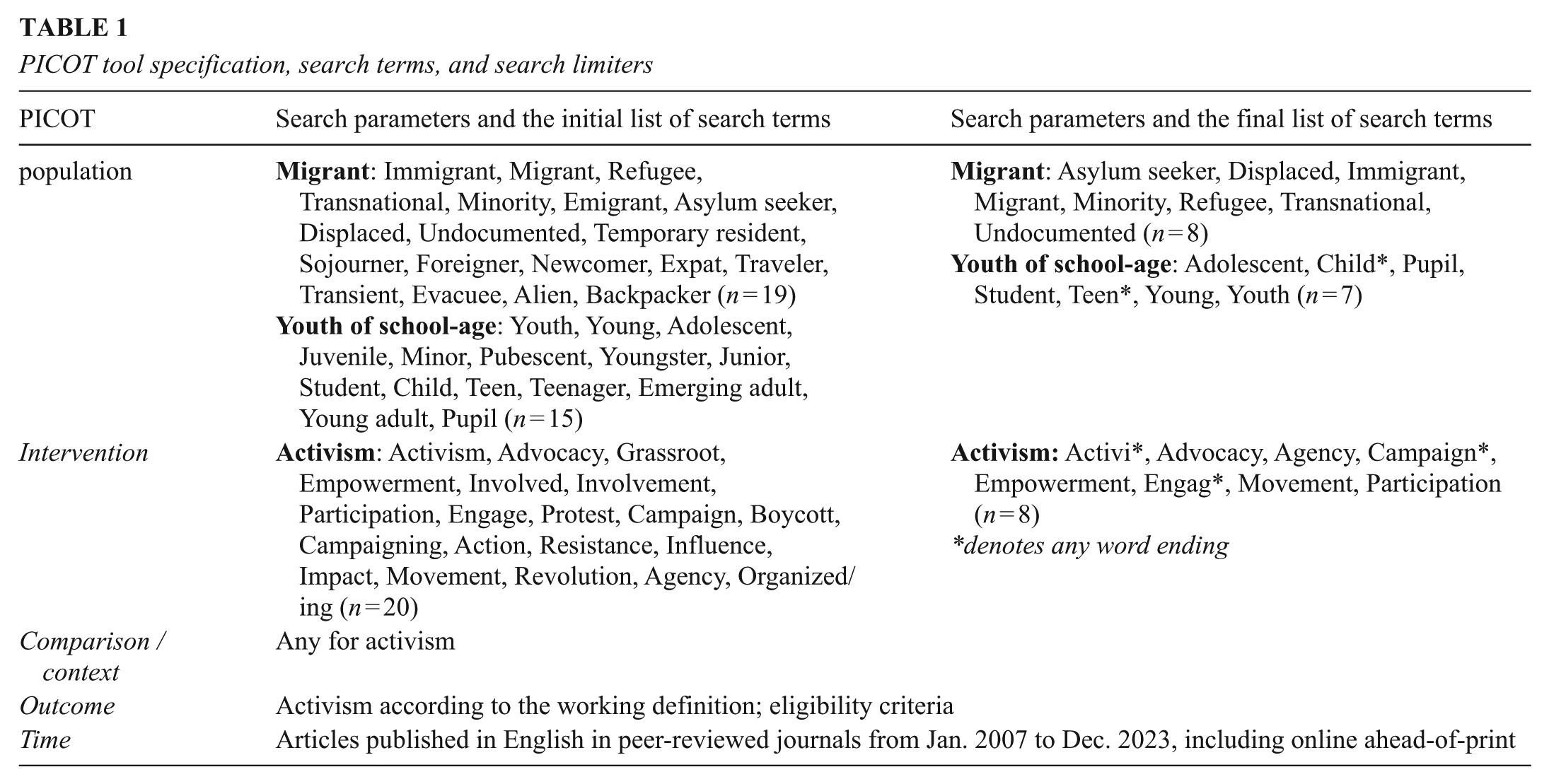
The initial listing of potential search terms was developed by the second author, leveraging her field-specific expertise. After the list was generated, additional synonyms were identified by the team of authors in addition to the first set of words. Further, the first author meticulously reviewed the original list, proposing alterations based on an appraisal of titles, abstracts, and full-texts of papers identified during the scoping search phase. A collaborative discussion between the first two authors led to a consensus on the suggested modifications. The resultant list of search terms at this phase (n = 19, 15, 20 for each of the three themes, respectively) is presented in Table 1 (initial list of search terms). Possible permutations of the search terms (19*15*20) led to the generation of a total of 5,700 search phrases. Executing such an extensive search across three databases was practically unfeasible.
To ensure a contextually guided selection of a more manageable and relevant subset of search phrases, while also upholding our aim to conduct a comprehensive SLR, an expert survey was conducted in September 2023. This survey included seven international experts, one of whom was a paper author not involved in the previous phase. The aim was to elicit expertise by ranking the search terms from each of the three themes (“migrant,” “youth,” and “activism”) according to their likelihood of appearance in peer-reviewed articles in the field. Experts were also prompted to create phrases using terms from all three lists that were coherent, logical, and likely to be present in academic papers. All experts had diverse experiences in the issues related to youth activism or the global citizenship education agenda, though it is worth noting that youth activism itself may be referred to differently depending on the international context. In addition, words associated with activism (e.g., civic engagement, advocacy) can also be context-specific. Experts worked independently, and it took from 20 to 50 minutes to complete the survey. The findings of the survey were only used to guide a process of narrowing the scope around key terms that could be present in the surveyed databases.
All three thematic lists of search terms—namely “migrant,” “youth,” and “activism”—were then separately sorted based on the average rank assigned by the experts. Following this stage, the difference between the average rank of each pair of subsequent words (e.g., second word’s rank–first word’s rank; third word’s rank–second word’s rank, etc.) was calculated. Then, following existing practices established by Chavalarias and Cointet (2008), we set a cut point and included words that preceded the leap in rank. Additionally, all the phrases created by the experts were analyzed, and the frequency of appearance for each word was calculated. We then compared the lists of the most frequent words extracted from the phrases with the lists based on the rankings. Two terms, “Agency” and “Campaign*,” were added to the final list related to “Activism.” The term “Emigrant,” on the contrary, was excluded from the list related to “Migrant,” since, despite having a rather high rank, it appeared only once in search phrases and had two similar synonyms—“Migrant” and “Immigrant”—included in the list. The term “Young adult” was also excluded for two reasons: first, as a search term, it shifts attention toward the older population rather than school students. Second, the papers using “Young adult” to denote the studied population were included in search results for phrases containing the word “Young.” As the final step, eight terms related to “migrant” and “activism” and seven terms related to “youth” (Table 1, final list of search terms) were included in the final lists. All possible combinations of terms from three lists (8, 8, and 7 terms each) were used to create search phrases, resulting in 448 unique phrases.
To define a time frame for the SLR we searched for (“youth” AND “activism”) in the Web of Science database titles or abstracts. This revealed that from 2007, the number of published articles containing this search prompt in the title included at least five occurrences and remained stable onward. Prior to 2007, the phrase “Youth Activism” appeared in article titles and abstracts sporadically. We limited our search to publications between January 2007 and December 2023, which included both a noted upsurge in 2014 as well as earlier scholarship (Alexander, 2020). We acknowledge the debates regarding the inclusion of solely peer-reviewed sources versus widening SLRs to encompass reports, policy papers, or gray literature (Ming & Goldenberg, 2021; Taft & O’Kane, 2024). We opted to include only academic papers to ensure the coherence of the sample and to assess the presence of ARYM in academic scholarship.
Databases, papers screening
The databases selected for our study included Web of Science (WoS) (topic) and EBSCOhost and ERIC (abstract). Searches were conducted during September and November 2023, respectively. To ensure comprehensive coverage, the identification stage involved searching each database with all 448 search phrases (PRISMA flowchart, Figure 1). The search was restricted to peer-reviewed journals and articles published in English from 2007 to 2023, inclusive. The search returned 23,263 papers from WoS and 21,099 from EBSCO & ERIC. To consolidate these results and perform technical cleaning, the first author compiled an Excel spreadsheet from CSV files generated by the searches. Duplicate records, identified by title and DOI, were then removed, leaving 8,110 unique records for title and abstract screening (Figure 1).
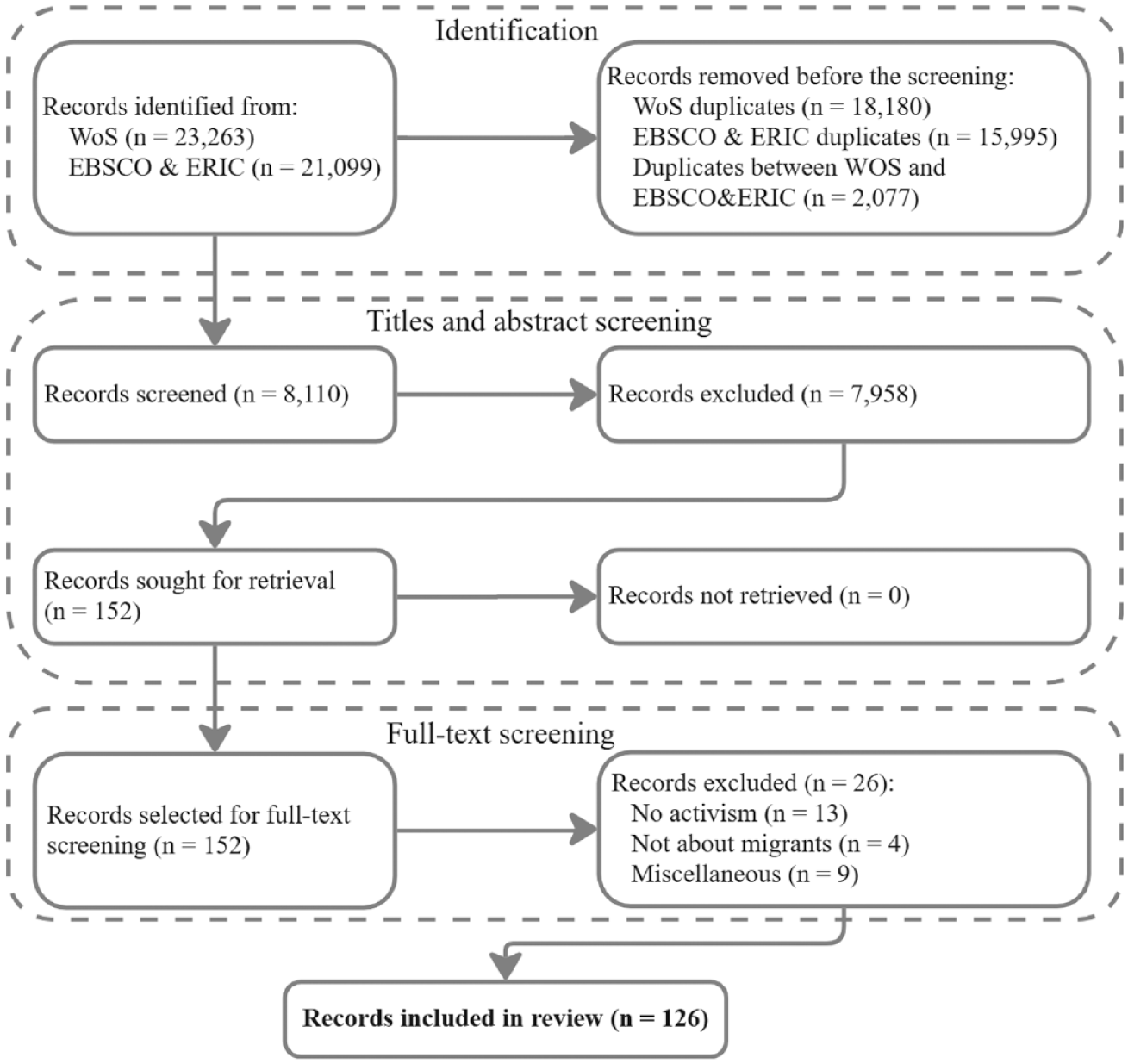
PRISMA flowchart.
To ensure that all the authors agreed in their interpretation of the papers’ titles and abstracts as reflecting the eligibility criteria, all three authors independently reviewed the titles and abstracts of the first 20 articles and then discussed them. This established a baseline, and subsequently, the screening of 8,090 articles was conducted by the first author. During this phase, all cases marked as “Discussed” were then independently reviewed by the other two authors to achieve a consensus. The vetting resulted in 152 papers selected for full-text screening. This last phase led to the exclusion of 26 additional papers, resulting in a final sample of 126 papers analyzed and presented in this paper (see the final list in Online Supplementary Material S1).
Analytical Approach
Given the extent of our review, which aimed to map the contemporary literature encompassing theoretical, methodological, and overarching trends in ARYM research, and the broad scope of the search strategy and eligibility criteria, our analysis extended beyond a quantitative description of the literature (Wilson & Anagnostopoulos, 2021). To address our research questions, we developed a three-layered, mixed-methods analytical framework (see the first part of Table 4), wherein we established several groups of a priori codes considering whether they were related to the papers, the studies described within them (RQ1), or the ARYM nature itself (RQ2) and aligned them with the working definition for activism and the whole review scope. This approach adheres to deductive logic based on the conventions of thematic coding set forth by Clarke and Braun (2017).
The general attributes of the papers included publication year, journal, country, etc. At this stage, the aim was to uncover prevalent trends and dynamics in the context of ARYM research. Subsequently, the team applied coding techniques to tease out the detailed information about the target sample characteristics, issues related to migrants—their countries of origin and host countries—migrants’ recognition in the research field, and others. We also coded and categorized the types of research about activism derived from the studies’ topics, goals, focal sampled populations, and other characteristics (Table 4, column “ARYM research field landscape”). These categories, we believe, showcase the range of perspectives utilized in ARYM scholarship and outline the ARYM research landscape at an overarching level. These two aspects (related to the papers and the studies) collectively served as a foundation for constructing the overall dimensions of the ARYM literature map and addressing the first research question.
However, as previously noted, a third phase of analysis concerning the ARYM nature and voices was also undertaken (Table 4, column “ARYM nature [RQ2]”). In this phase, the research team regarded the identified papers as empirical sources of information to be subjected to identification, categorization, and synthesis rather than extracting the information according to a priori codes. The analysis involved exploring the types of activism, the various themes that emerged in pursuing social changes, how migrants were depicted in the activism, and other information that was identified following both inductive and deductive logic of the analysis. Here, it is vital to acknowledge that the division between these categories is inherently muddled due to their interconnected nature (Clarke & Braun, 2017). This inherent complexity was navigated during the analysis and allowed cross-references between the research questions. The deductive component was inspired by the existing literature. This included coding the characteristics of activism (e.g., regular or one-time; organized or sporadic; online, offline, or mixed mode) as well as adding a “glocal” level to capture activities addressing global issues at a local level to the inductively determined local and global concerns, drawing on Suppers’s (2024) analysis of citizenship activities. The level of social change that activism is directed toward was adapted from the work of Mora et al. (2018). Further, given the various manifestations of activism and the moving terminology around it, we contrasted the established typology of civic engagement with inductively identified forms and traits of activism. In particular, we employed Zukin et al.’s (2006) classification of engagement forms, which distinguishes between “Public voice,” “Civic,” “Cognitive,” and “Political engagement.”
To pilot the a priori codes and ensure that all data required for the analysis could be derived from the papers, and to identify the a posteriori codes, a calibration step was integrated. All three authors comprehensively reviewed the full texts of the first 20 papers. This trial resulted in some modifications in the a priori codes and the development of new a posteriori codes. After all the authors agreed on the entire set of codes, the first author proceeded with the full-text analysis. After coding every 20 papers, the first author compiled a list of papers recommended for exclusion and those requiring further discussion (typically 3–5 papers per set). These papers were then analyzed by either the second or third author, and a consensus decision was reached.
Authors’ Positionality
As social science researchers, our interest is inherently related to our positionalities and life experiences, where each of us brought both our personal and academic background to this particular study, and altogether they shaped our vision. We are a part of a team brought together by a large international project focused on youth activism. We capitalize here on arguments presented by M. Boveda and Annamma (2023), who assert that positioning is an active, ongoing process in which researchers reflect on their relational stance within systems of power, disciplines, and participants over time. Positioning is integral to how we as researchers do our work, as it is central to our theoretical, methodological, and ethical commitments. As currently employed academics, all three authors have had significant migrant experiences and have conducted research with migrant communities. We believe that recognizing and reflecting upon this works to decenter “the authoritative figure of the researcher” and opens up spaces to prioritize “the knowledge of multiply marginalized communities” (M. Boveda & Annamma, 2023, p. 307). The first author is a first-generation recent migrant leaving the home country with her family due to political reasons and a disillusionment with her values, all without clear plans for the mid- or long-term future. The second author is a 1.5-generation migrant who moved to another country with her parents in her childhood. The third author has migrated internationally twice in his adult life, mainly for work purposes. Two of the three authors also experienced economically and socially challenging times that significantly affected their teenage years. Currently, all three of us reside in countries with an intricate web of migrancy and ever-changing flows of migration. We are aware of the sacrifices and benefits attached to migrancy as well as how it can, at times, lead to certain vulnerabilities.
In terms of what M. Boveda and Annamma (2023) refer to as the onto-epistemic nature of positioning lies a continual demand that, as researchers, we engage with our own assumptions about reality, truth, and knowledge—and consider how these shape the research process. This research endeavor was motivated by our social justice principles and desire to understand the injustices migrant populations experience and the obstacles that contribute to their speaking up. Our research and lived experience have fostered a belief that the work of educators could be devoted not only to providing direct support but also to equipping and facilitating migrant youth to have their voices heard. However, as the SLR shows, research on migrant youth and their advocates’ involvement in activism remains limited. Therefore, not only do we hope to make an important contribution to educators and educational researchers, but we also hope the paper will highlight how aspects of power and oppression contribute to how we understand multiply vulnerable young people.
Results
By identifying potentially important and relevant characteristics both inductively and deductively, we sifted existing knowledge and validated findings with data from the surveyed papers. This process enabled us to identify the most prominent aspects and trends in the ARYM scholarship field, revealing key features of migrant school-aged youth activism itself and highlighting the social justice insights. The section is organized into thematic blocks that align with the analytical approach and research questions, with cross-references provided where necessary. Table 4 and Figure 2 present a schematic representation of the findings and discussion sections, summarizing and guiding through the section’s structure.
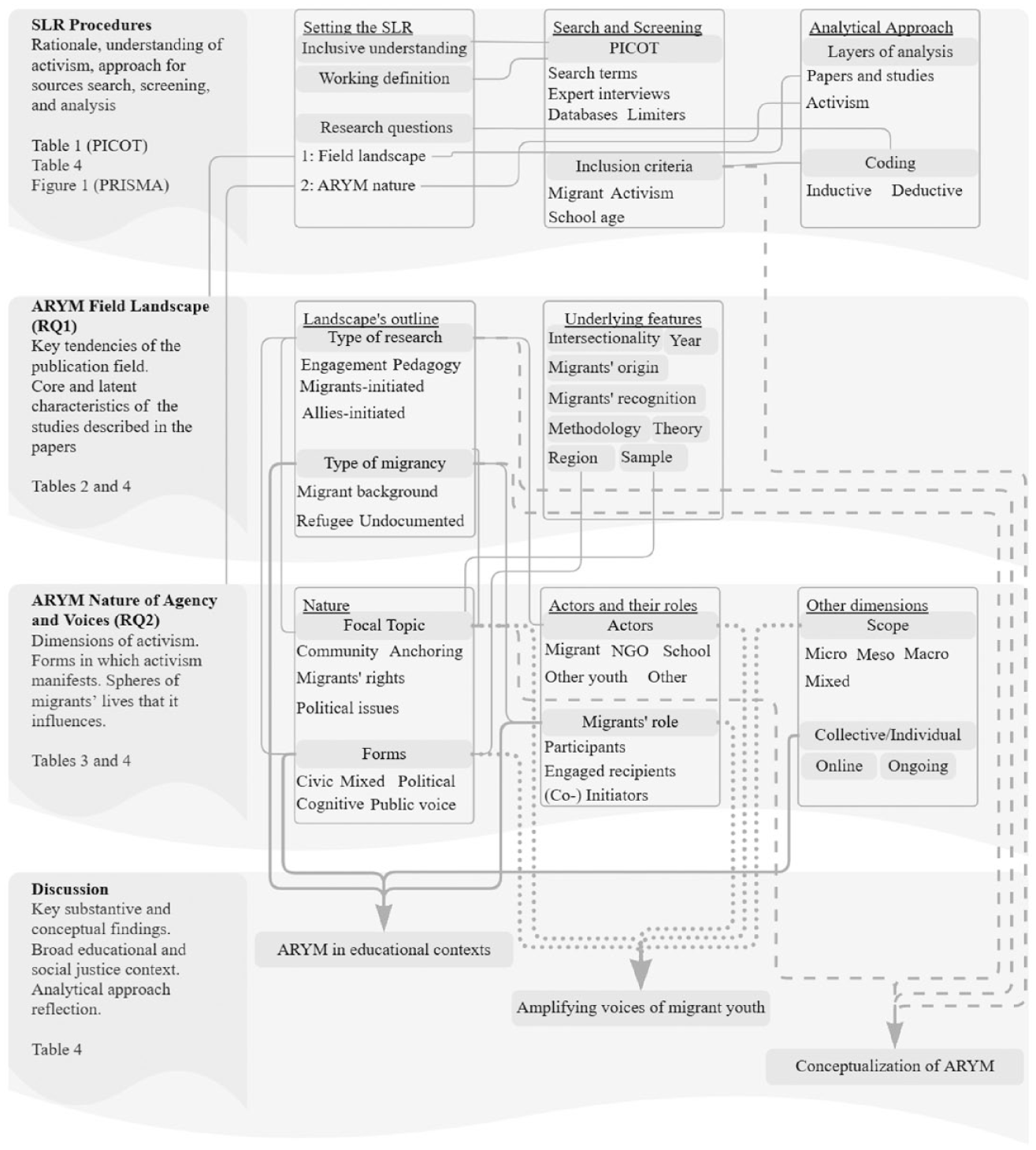
Schematic workflow of the SLR.
ARYM Research Field Landscape
The primary aim of this review is to reveal the theoretical, methodological, and substantive dimensions of research on activism concerning school-age migrant youth (see Table 4, “Key conceptual findings” for the summary). In this section, we present the results of our analysis, identifying prevalent research types, specific migrant populations studied, typical sample compositions, and examining geographical and temporal trends, as well as other salient study characteristics.
Table S1 (online only) captures a mix of countries and regions and the corresponding papers across three publication-year intervals. In presenting the data, our intent is to illustrate the main locations where the research was conducted and to delineate the specifics of each study. The results indicate that the United States takes the lead, followed by continental European studies, which is, however, expected due to the paper selection limited to English-language. peer-reviewed journals. Apart from these two contexts, other regions were present in the scholarship with a smaller number of papers, resulting in six papers stemming from Canadian and UK contexts each, four papers on Australia, two on China, and one paper on each of Algeria, Hong Kong, Malaysia, South Africa, and Uganda (for clearer data presentation in tables, the countries that appeared in fewer than six papers were combined into one category). Eight papers encompassing countries from at least two determined regional categories were assigned to the “Mixed” category.
Type of research about ARYM
It is important to remember that this SLR does not adhere to specific forms of activism; instead, it adopts a broad working definition and includes different types of research documenting ARYM. Rooted in the discussion on the limited engagement of school students in political and civic spheres, the importance of external allies in facilitating migrant activism, and adopting an inclusive definition of activism and analytical approach (refer to the “Introduction” for detailed discussion and references and the “Analytical approach” in the “Method” section), we grouped the presented research into four categories: Engagement, Migrants-initiated activism, Allies-initiated activism, and Pedagogical tool. The categorization encompasses the papers’ topic, goal, focal population, and other characteristics of the studies presented. While accepting some variation within the categories, they ultimately reflect the “ideal types” of perspectives employed to study the lived experience of migrant youth practicing activism and their allies. We now provide a brief description of each category, followed by an extended analysis.
Research concerning why youth of migrant origin are involved or not involved in the civic life of host societies was marked as Engagement. Migrants-initiated activism includes a diverse array of studies documenting various forms of activism in which migrants take a lead or co-initiate efforts. Studies categorized as Allies-initiated activism describe activism that addresses issues affecting migrant populations involving migrant youth, though not being initiated by them. The key distinction between these two types of research is who is indicated as the initiator of activism—migrants or their allies. The last category of research—Pedagogical tool—documents examples of activism within formal and informal educational settings.
Engagement
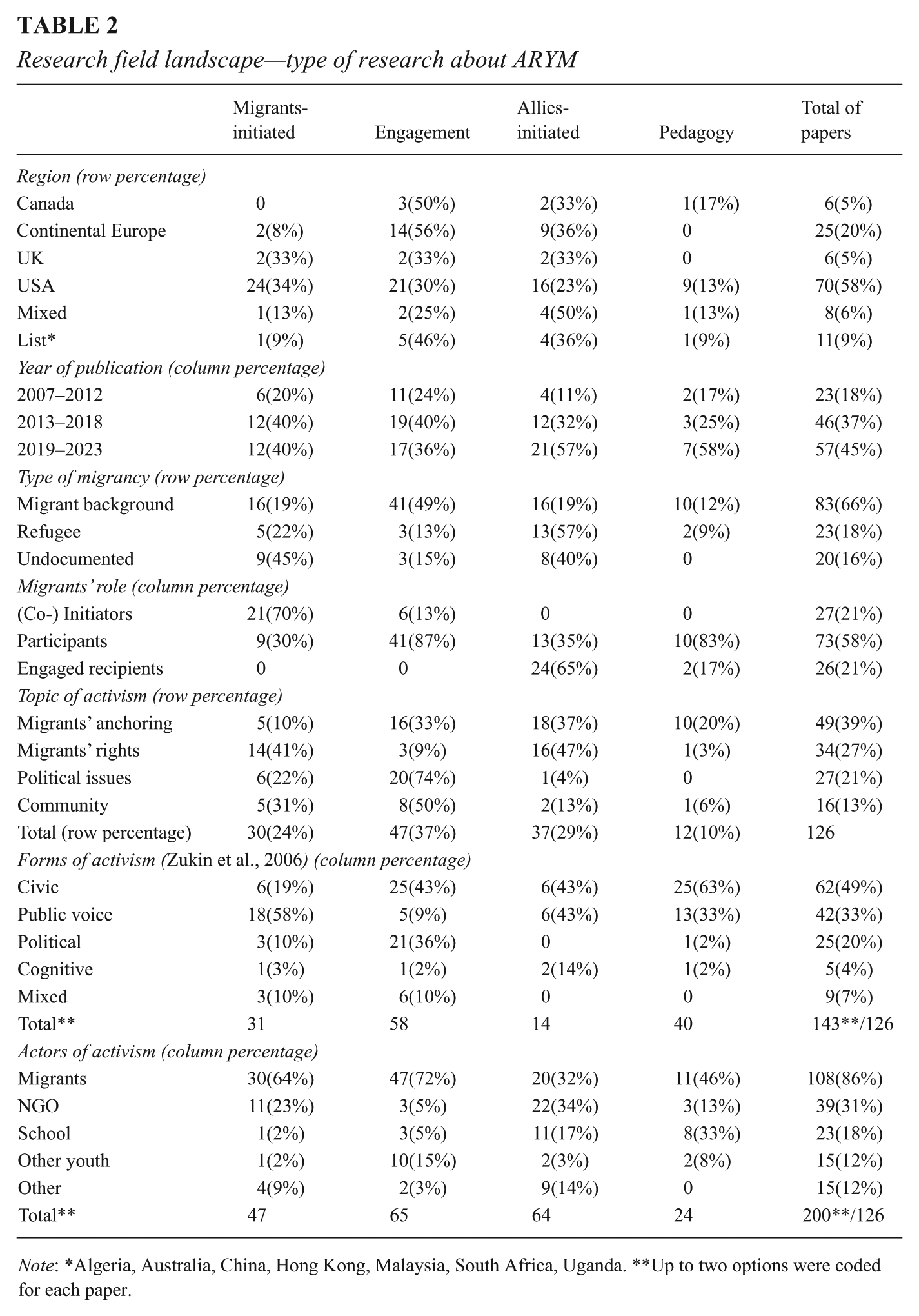
This stream of research primarily focuses on exploring real or potential engagement in social change activities, delving into the motivations, facilitators, challenges, and barriers that may encourage or discourage migrant school-aged students from speaking out, as well as studies investigating the activism available to or preferred by this social group. It provides a broad overview of what conventional and nonconventional forms, themes, practices, roles, etc., of activism migrant school-aged students might be engaged in. Most of the research we surveyed on ARYM is skewed to examining engagement (Table 2). This trend is especially evident in the European context, where there is a significant body of research addressing issues of current and future political [e.g., Allen & Bang, 2015; Quintelier, 2009; Spaiser, 2012] 2 as well as civic behavior and attitudes of ARYM [e.g., Geboers et al., 2015; Valentova & Justiniano Medina, 2020]. Some of these studies adopt a comparative perspective, contrasting migrant and nonmigrant populations [e.g., Azzolini, 2016; Dollmann, 2022] or different types of migrant populations—for example, various migrant generations [e.g., Riniolo & Ortensi, 2021], religions [e.g., Grundel & Maliepaard, 2012], or countries of origin [e.g., Cicognani et al., 2016]. There are examples from a US context that are parallel to migrancy, specifically racial [e.g., Torney-Purta et al., 2007; Wray-Lake et al., 2015], or related to the citizenship status of undocumented students [e.g., Alvarez Gutiérrez, 2014; S. Lee & Pritzker, 2013]. Such studies contrast with other US studies that are ethnographic [e.g., Rodriguez et al., 2023; Sancho-Gil et al., 2021] or what might be deemed participatory studies of migrant youth acclimatization to a host country [e.g., Pienimäki, 2021; Thakurta, 2021].
Research field landscape—type of research about ARYM
Note: *Algeria, Australia, China, Hong Kong, Malaysia, South Africa, Uganda. **Up to two options were coded for each paper.
Migrants-initiated activism. Papers documenting activism initiated and led by migrant youth themselves, as a focal issue of the study, are predominantly written in the United States. These papers showcase a variety of forms, such as protests and campaigns against legislation [e.g., Conley & Shefner, 2020; Nicholls & Fiorito, 2015]; spontaneous activism [Bae-Dimitriadis, 2016]; and organized art-based activism [e.g., Antunes, 2022; Arriaga, 2012; C. C. Lee et al., 2021], among others. Within both European [Farini, 2019; Jacobsen & Andersson, 2012] and UK [Campion & Dieckmann, 2024; Lind, 2017] contexts, discussion of these forms of activism is much rarer.
Allies-initiated activism. The second most prominent category of research in ARYM was activism initiated and led by others while involving migrant youth or being inspired or informed by their vision of social change. In examining this category’s geographic distribution, our review suggests that this lens of studying ARYM is widespread across the globe and a prominent component of both empirical research [e.g., Ashar, 2017; Lanari, 2022] and theoretical scholarship [Häkli & Kallio, 2016]. Papers in this category chronicle studies of migrant youth activism with facilitators [e.g., Bosco et al., 2011]—including school personnel [e.g., McKeon et al., 2024; Rodriguez & Crawford, 2023], parents [e.g., Scribner & Fernández, 2017], community members [e.g., Coombes & Ponta, 2023], or social workers [e.g., Franz, 2012]. Other studies present examples of migrant youth mobilization [e.g., Yu, 2021] and joint activism with varying intensity of migrants’ participation [e.g., Link & Arango, 2019; Shekaliu et al., 2018]. This category of ARYM research exhibits a unique trend of significant growth since 2007 (Table 2).
Pedagogical tool. These papers highlight experiences of how to equip migrant students with the requisite skills and knowledge to become activists, voice their needs, and challenge oppressive systems. This type of activism is rare across all the scholarship we surveyed, but we argue that it deserves its own category. In the limited existing scholarship, “Pedagogical tool” is often portrayed as a form of transformative learning, where the intention is to teach students to be active and agentic, and empowering them “to have voice.” What we see in this category is how ARYM is typically presented in a form of documenting particular projects [e.g., Daniel, 2015; Garcia, 2012; Luchs & Miller, 2016] or via a specific description of teaching practices [e.g., C. R. Kelly, 2012; Mills et al., 2019; Schocker et al., 2016; Yiu & Yu, 2022]. Notably, research of this type rarely focuses on the most vulnerable migrant populations, with two exceptions: one study from Canada [Luchs & Miller, 2016] and a study of a joint project between a US school and a Western European refugee facility [Sánchez & Ensor, 2020].
Type of migrant population
Exploring the type of migrant population involved, as well as the types of research in which activism is studied, is essential to how our SLR can further our understanding and outline the ARYM scholarship at the overarching level. Upon reviewing the studies in Table 2, the focal migrant population group is typically 1.5- or second-generation migrants, comprising 66% of the studies and forming a majority in every location. Undocumented minors form a specific subgroup of migrant populations and are the subject of a significant portion of research conducted in the United States [e.g., Alvarez Gutiérrez, 2014; Flores, 2023; McGovern et al., 2020]. The differentiation lies in the fact that, despite these two distinct groups sharing many traits, undocumented students are significantly more marginalized from a legal perspective, and this fact has significant implications for their ability to make their voice heard (Bjorklund, 2018). Refugees, on the other hand, are a major category in Europe [e.g., Wiseman, 2020] and other contexts [e.g., Bellino et al., 2021]; currently, refugees are less studied in the United States, both compared to their former prominence in the discourse and compared to European studies (McBrien, 2005). When considering the dates when research was conducted, neither cohort—undocumented minors nor refugees—was notably visible in the field of ARYM between 2007 and 2009. The 2015 migrant crisis/influx in Europe likely stimulated studies of this vulnerable population, as well as widespread advocacy efforts, mainly around defending their rights [e.g., Horning et al., 2024; Ideström & Linde, 2019].
In addressing the type of research on ARYM, we see in Table 2 that “1.5/second-generation migrant” would be the leading topic of research covering engagement studies (41 papers), followed by papers depicting migrants as leaders of their own, or participants in someone’s activism (16 papers in each category). This type of migrant population is also the focal point of papers discussing issues related to pedagogy (10 out of 12 pedagogical papers). Unsurprisingly, considering the other end of the spectrum, the scholarship on “refugee/asylum seeker,” ARYM underscores how few examples there are of activism being led by these individuals themselves: one study in Uganda [M. B. Smith et al., 2022], two in the United Kingdom [Campion & Dieckmann, 2024; Lind, 2017] and two in the USA [Bae-Dimitriadis, 2016; Kwon, 2012]. The trend for “undocumented” migrant youth is slightly different—while there is a significant share of “activism by others” for this group, there are also examples of undocumented students’ own activism. From Table 2, it is clear that both trends—more active forms of migrants’ activism and scholarship on undocumented youth—are integral to the American research corpus.
Migrants’ origin
Another dimension of how migrant youth are portrayed in the research on ARYM is the specific attention given to the migrants’ origin. In total, 64% of the papers indicate an exact ethnic group, country of origin, or religion (in the instance of Muslim backgrounds: the concept named “decoupling of ethnic and religious identities” [O’Toole & Gale, 2010]). In the case of migrant youth from Muslim backgrounds, around half of the studies were conducted within Europe, mostly from 2009 onwards [e.g., Pace, 2018; Quintelier, 2009]. Furthermore, the Muslim category is the only one to appear in the studies, uniquely prioritizing this religious group [e.g., Cicognani et al., 2016; Quintelier, 2009]. This contrasts with the rest of the European papers, which focus on mixed ethnic groups [e.g., Pienimäki, 2021; A. W. Smith, 2021] or migrant populations in general [e.g., Farini, 2019; Freedman, 2011]. US research has focused on a wider diversity of different ethnic groups depicting the American migration context, for example, Muslims [e.g., Antunes, 2022], Latinx [e.g., Cahill et al., 2019; Seif, 2011; Torney-Purta et al., 2007], Asian [e.g., Bae-Dimitriadis, 2016; Thakurta, 2021], and many cases including Black youth of non-American origin [e.g., Ashar, 2017; Brownell, 2022].
Intersectionality
Research involving vulnerable social groups has increasingly used intersectionality theory, which has been deepened through Black feminist studies (Crenshaw, 1991) and expanded into various disciplines, emphasizing the convergence of multiple sources of oppression (Boccagni & Hondagneu-Sotelo, 2023; L. Boveda & Boveda, 2023) and examining activism and social justice movements (Fisher & Rouse, 2022; Sperduti et al., 2025; Wilf et al., 2022). However, the results of this review indicate that intersectionality remains an uncommon analytical lens for examining the ARYM phenomenon. Most papers focus on one “vector of identity” that made the population vulnerable—migrant background—without connection to other “vectors of identity” (Nichols & Stahl, 2019). Only 13% (16 papers) explicitly considered other intersectional identity vectors alongside migrancy. When intersectionality is drawn upon, it is often closely aligned with a feminist perspective [e.g., Antunes, 2022; Bosco et al., 2011; Franz, 2012; Lanari, 2022, 2023], or sometimes with a social class perspective [e.g., Marchi, 2012; Spaiser, 2012]. Some discuss how migrant youth experience multiple identities that influence their social or political development [e.g., Karras et al., 2022]. Race/ethnicity is rarely emphasized, perhaps because it is assumed to be inherent in the migrant background, albeit depending on context and population. Yet some papers specifically highlight this aspect [R. Z. Liu et al., 2023; Shin et al., 2023], and some do draw on intersectionality frameworks to deepen their analysis around youth-led movements and their activist efforts [e.g., Terriquez & Lin, 2020]. Overall, while scarce, intersectionality remains an important aspect of the ARYM research literature, even though its application is typically narrow in scope and accounts for just one vector of identity.
Theoretical frameworks
In discussing the theoretical frameworks used by researchers to study the phenomenon of ARYM, it is important to note that we only assigned a particular theory when it was clearly stated and explicitly used as a lens or a framework to shape both the study and its academic contribution. We identified 60 papers using one or two theoretical frameworks. Given the variety, we deliberated as a team and chose to group different theoretical approaches. For example, papers using a psychological approach mostly employ developmental psychology frameworks for the sociopolitical development of young people, to show that activism participation is a natural part of youth development [e.g., Karras et al., 2022; Kennedy et al., 2020], citing work by Roderick J. Watts. Bronfenbrenner’s ecological systems theory of development [Allen & Bang, 2015; Kennedy et al., 2020] and positive youth development [De Jesús et al., 2015; Torney-Purta et al., 2007; Wray-Lake et al., 2015] are also utilized. We also observed that a theory of planned behavior was used in two papers [Cicognani et al., 2016; Jugert et al., 2013] to discuss migrants’ motivation and behavior in activism participation.
We also identified 19 papers (28%) in which authors positioned their research within a defined theoretical framework anchored in the field of education, including both pedagogical and managerial approaches. These included Freire’s critical pedagogy (nine papers) [Link & Arango, 2019; Martin-Beltrán et al., 2020; Myers, 2023, inter alia], critical race theory (four papers) [e.g., R. Z. Liu et al., 2023; Lucko, 2020], leadership [e.g., Rodriguez & Crawford, 2023], and more.
Notably, we found that studies of ARYM drawing on migration theories are rare. Only five studies employed assimilation theory [Burciaga & Martinez, 2017; Ishizawa, 2015] or diaspora [Dollmann, 2022; Fiddian-Qasmiyeh, 2013; Kayaalp, 2022] as their theoretical approach.
The SLR revealed some papers where theoretical approaches are strongly influenced by political theory; here, we noted significant diversity. For example, several papers cite different aspects of Hannah Arendt’s works [e.g., Kayaalp, 2022; Lind, 2017; Pace, 2018], some present literature on political opportunity [e.g., Burciaga & Martinez, 2017; Kwok, 2023], agency [Bosco, 2010], political integration [Dollmann, 2022], and engagement [Nelsen, 2021], among others.
Sociological perspectives took one-third of papers (21 papers, 31%) in which scholars drew on a wide diversity of theories, including social capital [De Jesús et al., 2015; Ødegård & Fladmoe, 2020], citizenship [Bellino et al., 2021; Grundel & Maliepaard, 2012], civicness and civic engagement [Azzolini, 2016; Terriquez, 2015], social justice [Alvarez Gutiérrez, 2014; Mills et al., 2019], and others.
Sample populations
Moving on from overall trends regarding how migrant youth are portrayed, we now present the sample populations included in the studies surveyed. Since there may be multiple samples in one study, we identified one or two focal groups for each paper. A total of 11 papers were excluded from this part of the analysis since they were conceptual or used methodologies not related to humans (media surveys, etc.). While we expected school-aged migrant youth to appear in the sample of papers (83%), we did not expect to see so many studies that also involve school-age adolescents without migrant backgrounds (n = 27), in which researchers either contrasted them against each other using a comparative perspective (e.g., Claes et al., 2009; Hochman & García-Albacete, 2019; S. Lee & Pritzker, 2013) or presented examples of joint projects [e.g., Blanchet-Cohen & Di Mambro, 2015; Sánchez & Ensor, 2020]. Concerning the age of the study’s participants, middle and/or high school students predominate, as expected.
Migrants’ recognition
A further point to consider is the acknowledgment of migrants as co-constructors of knowledge in the research. Most papers (81%) do not mention any explicit form of recognition, but the rest (19%) contained one of two identified forms of recognition: an acknowledgment in the notes section or paper text (23 papers, 18%), with a single example of co-authorship (Fine et al., 2021). These proportions do not increase if we filter by methodology and select only qualitative studies, where it is a more common practice to acknowledge study participants. However, there was a clear trend when we consider the year of publication—a majority (14 out of 24 publications) that recognized “migrants’ recognition” were published after 2019. It is also worth mentioning that in the American context, the paper authors’ positionality statements commonly indicate their origin: as migrants [e.g., Cahill et al., 2019; Kolano & Davila, 2019], or occasionally as young adults, such as university students and/or volunteers [e.g., Flores, 2023; Lucko, 2020; Yeh et al., 2015].
While Muff et al. (2024) documented that participatory research is categorized as “youth-centered versus researcher-centered” and pursues different goals, such as closing the gap between researchers and participants, this SLR revealed that in the context of research on ARYM, migrant school-aged adolescents are still some way from receiving proper recognition in the research, even in participatory studies. Although the authors of these papers on occasion mention in the text that choosing a youth participatory action research approach sought to amplify students’ capabilities (e.g., such as self-efficacy or collaboration skills), they rarely explicitly acknowledge migrant students as knowledge co-creators.
Through a comprehensive and systematic review of the ARYM scholarship, we identified the diverse range of approaches to investigating the issue of activism related to school-aged students of migrant origin (Tables 2 and 4). In outlining the landscape of ARYM, we categorized this tapestry into four major groups of research based on the research focus, sample, study topic, etc. What the SLR captures is that activism involving migrant youth is often presented through a lens of studying their potential or real behaviors, providing a scene for migrants’ allies, while to a lesser extent reflecting the real examples and corresponding issues of activism initiated and led by migrant school students. We also show that sampled papers describe many countries; however, the studies are unevenly distributed across the world, and there are specific trends evident in one region but not in others.
ARYM research literature pays considerable attention to documenting migrants’ origin and vulnerability context, sometimes detailing the intersecting nature of aggravating circumstances—what has been termed “vectors of oppression” (Nichols & Stahl, 2019). In foregrounding this aspect of intersectionality, other “identity vectors” are neglected, and there is a risk of oversimplification and misrepresentation when the lived experiences of migrant youth differ significantly in reality.
The Nature of Agency and Voices of ARYM
Having outlined the research landscape, we now delve into an analysis of the ARYM phenomenon to uncover its nature and the voices addressing the second research question. This section (Table 3) details the focal topics and forms of activism, coded inductively and deductively, respectively; identifies the main actors, specifically highlighting the role of migrant youth; and discusses other characteristics evident in the field (see Table 4 for a summary). Describing the results in this section, we also contextualize them within the findings from the previous section—that is, research field landscape.
ARYM nature and voices—topic of activism
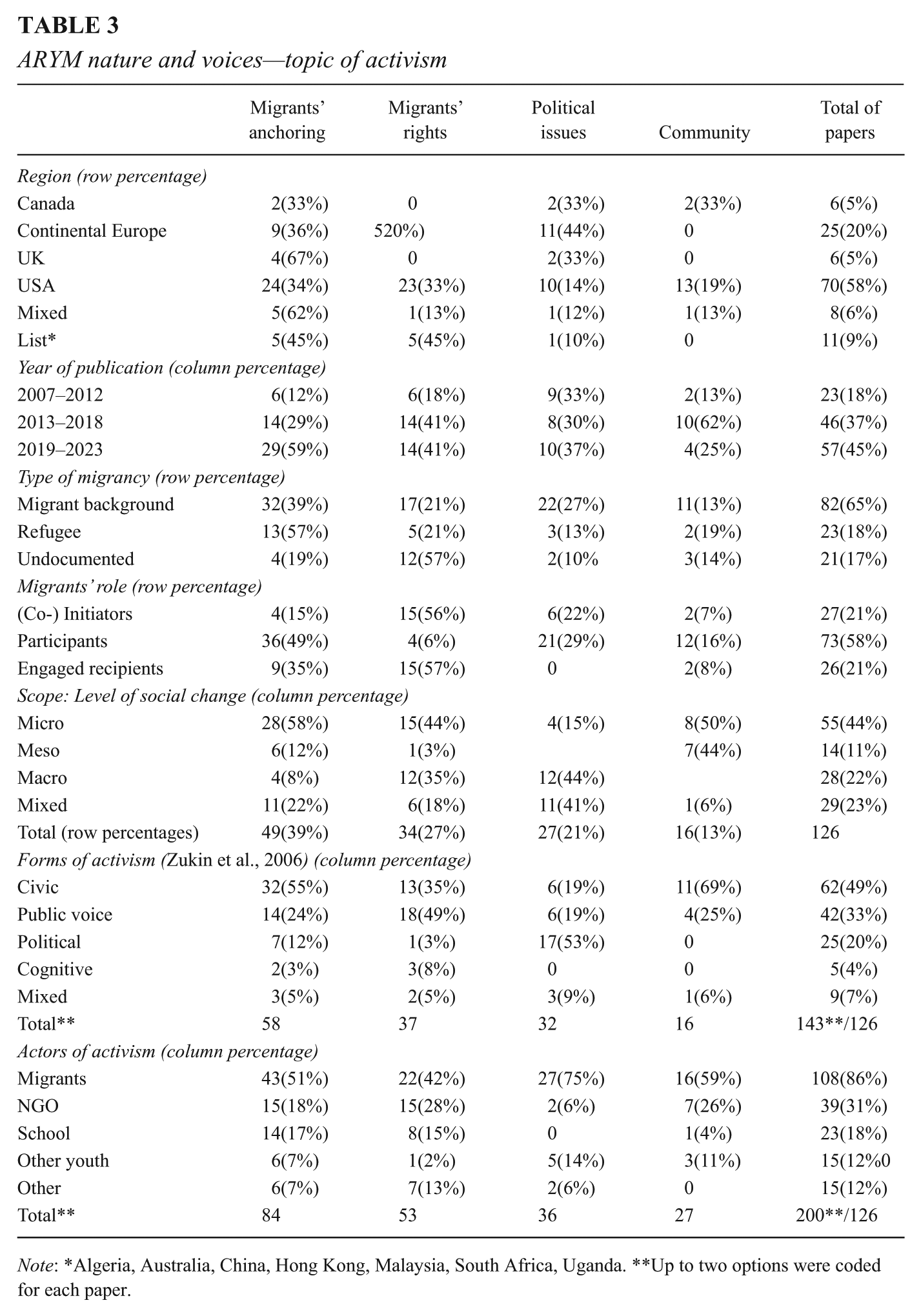
Note: *Algeria, Australia, China, Hong Kong, Malaysia, South Africa, Uganda. **Up to two options were coded for each paper.
Analytical approach and summary of the findings
Key focal topics of ARYM
By analyzing the ARYM scholarship, we identified a range of foci they address. We grouped these range around four core concepts that effectively capture the key distinctions, accurately reflecting the literature while maintaining a concise and manageable typology: Anchoring to the host society, migrants’ rights, political issues, and community participation (Table 4). Recognizing that a particular study could cover several topics, codes’ calibration and full-text reviews usually swiftly revealed the dominant topic, and therefore, we coded one topic for each paper. As with our description of research types within the field, we first provide a brief definition for all four categories before moving to a detailed analysis that cross-cuts with other codes as well.
Anchoring to the host society. The first category comprises articles discussing the topic of migrant populations’ or their allies’ activism aimed at becoming a recognizable cohort within the host society, one with its own voice and identity. We labeled this category as Anchoring to the host society, referring to the concept of social anchoring, which includes traits of identity, security, and integration (Grzymala-Kazlowska, 2016), and underscoring that assimilationism and transnationalism should not be perceived as opposite ends of a spectrum, but rather, each individual shapes their unique mosaic of anchors (Boccagni & Hondagneu-Sotelo, 2023).
Migrants’ rights. The second category lies more in the legal sphere, describing activism mainly spurred by existing or imposed policies restricting migrants’ access to essential public services, or migration-directed laws in general (Levitt & Schiller, 2004; Sperduti et al., 2025). At the same time, in the case of the migrant population, this category inherently merges with the social anchoring process, proving the nexus of legalities and integration opportunities (Boccagni & Hondagneu-Sotelo, 2023; Portes & Zhou, 1993).
Political issues. The third category comprises papers that document how political issues are presented in ARYM research and is mainly concerned with investigations of migrants’ intentions, practices, and manifestations of engagement in political life. Within this category, there was also considerable attention paid to attempts to unleash migrants’ youth political voice and agency, underscoring the emergence of nontraditional fields in which they were mobilizing their activism, as well as spearheading the involvement of broader migrant populations (Arar et al., 2024; Dyrness & Sepúlveda, 2020).
Community participation. While papers in the Community participation category share similarities with others, particularly those in the first category, “Anchoring to the host society,” they offer a distinct perspective that sets them apart: they emphasize community-level action or change and so highlighting an important collective form of civic engagement (Battocchio et al., 2023; Sperduti et al., 2025; Theocharis & Van Deth, 2018).
Issues related to migrants’ anchoring into the host nation, or the activism aiming to facilitate this process, are the most common topic internationally (49 papers), with the proportion increasing over time. Within this group of studies, we see attention given to the “DREAMers” movement [Arriaga, 2012; Nicholls & Fiorito, 2015; and others] or examples in which migrant youth liberate their political agency [e.g., Bosco, 2010; Dollmann, 2022], showcasing that their pursuit of “homemaking” and “future-building” goals is manifested by challenging legal restrictions (Boccagni & Hondagneu-Sotelo, 2023; Levitt & Schiller, 2004). It is followed by migrants and their allies defending their rights or securing equal opportunities (34 papers) and participating in political issues (27 papers) (Table 3). “Community participation” reflects general regional trends, with research almost entirely focused on a US context, with just two exceptions: a Canadian study on noninstitutional civic participation of migrant children [Bélanger et al., 2015] and a study of refugee support programs in Bangladesh and Romania, albeit written by US and European authors [Coombes & Ponta, 2023].
Another regional difference lies in the distribution of studies’ topics across European and US scholarship. The two leading categories in Europe are “Anchoring to the host society” and “Political issues.” The latter includes all studies showing migrants’ intentions or practices of participation, in various aspects of their social and political lives through an “Engagement” type of research lens (nine from 11) with only two documenting an active form of activism [Farini, 2019; Jacobsen & Andersson, 2012]. While the former focused more on the civic aspects of migrant young people’s lived experiences over the political [e.g., Azzolini, 2016; Ødegård & Fladmoe, 2020]. US scholarship tends to focus more on civic participation issues and volunteering [e.g., Godfrey & Cherng, 2016; Lopez & Marcelo, 2008]. Yet, there are US examples of papers discussing issues of being visible political actors within local contexts [e.g., Bosco, 2010; Gilhooly & Lee, 2017; Rubin, 2007] or national contexts [e.g., Cahill et al., 2019; Terriquez et al., 2020].
A general trend observed is that even when migrants are involved in globally themed activism, it remains closely related to the lives of migrant youth—for example, climate issues intertwined with racial/ethnic or class-related environmental injustices [Flanagan et al., 2022]. This is different from the activism of affluent and often better-educated youth, whose foci often include civic education and general global issues, whereas ARYM usually addresses immediate pressing concerns within their communities (Dyrness & Sepúlveda, 2020; Mills et al., 2019).
Forms of activism
The diversity of perspectives on what constitutes activism suggests many researchers have grappled—without complete success—to define activism. We now present our results of a theory-driven or deductive approach to thematic coding, in which we categorized the activism described in the sampled papers according to Zukin et al.’s (2006) typology: Public voice, Civic, Cognitive, Political, and Mixed. We also contrast our inductively identified classification of ARYM’s focal topics and types of research about ARYM with this established typology. Our analysis revealed that a direct correspondence between sampled articles and this typology was unachievable, which is reasonable given the field’s diversity. To address this, we allowed for double coding, attributing two forms of activism’s manifestation to 17 papers. Additionally, nine papers were identified as “Mixed” when two distinct forms could not be clearly determined.
Table 3 shows that “Civic engagement” and “Public voice” (Zukin et al., 2006) are the most evident forms of activism presented in the scholarship, seen in 62 (49%) and 42 (33%) papers, respectively. Naturally, the “Civic engagement” category is inherent to activism, presented in around half of the papers globally, especially in the latter half of the studied period. If we consider type of research about ARYM (see the corresponding paragraph in the first section of the results), this large group of papers includes studies about activism initiated and managed by others on behalf of, in most cases, refugees and undocumented youth (allies-initiated activism), or migrant youth participation in civic life (engagement) (25 papers in each case). The latter presents the papers dealing with migrant youth’s motivation, barriers, facilitators, etc., but with an emphasis on civic aspects, or studies describing particular projects of migrant youth engagement or their “emerging civic identities” [Rubin, 2007] in host societies [e.g., Gilhooly & Lee, 2017; Harris & Roose, 2014]. From the perspective of the focal topic, “Civic engagement” mainly corresponds to the “Anchoring to the host society” and “Community participation” (Table 3). This correspondence, in general, aligns well with the original “Civic engagement” definition, which encompasses individual or group activities seeking to achieve public good. Another interesting example here is papers we attribute to “Pedagogical tools,” which are strongly related to civic engagement and closing the “civic empowerment gap” [Nelsen, 2021; Schocker et al., 2016], including those depicting how education systems educate active citizens, perhaps using real-life scenarios [Daniel, 2015; Shin et al., 2023].
The “Public voice” category, which is also natural to activism, was identified in around one-third of the papers. “Public voice,” which Zukin et al. (2006) consider to be a more agentic form of activism than “Civic engagement,” is more visible in US scholarship (around 40% of the papers were from the United States). Another distinction of this subset of papers is that they are narrowly focused, rarely covering issues other than those in the public voice domain, unlike political and civic engagements, which can easily be studied and discussed together in a single paper. “Public voice” papers include examples of migrants’ own activism (18 papers), including protests and campaigns against anti-immigrant legislation [e.g., Conley & Shefner, 2020; Negrón-Gonzales, 2013; Nicholls & Fiorito, 2015; Patler, 2018; Seif, 2011; Vélez et al., 2008], the media [Marchi & Clark, 2021; Zimmerman, 2016], and scholarship examining migrants’ rights or political issues. These papers also quite extensively present art-based forms of activism (17 papers), especially art-based pedagogical tools in papers that describe the use of pedagogy to teach students to speak up [e.g., Garcia, 2012; C. R. Kelly, 2012; Lucko, 2020; Myers, 2023].
The “Political engagement” category describes migrants’ political voice and agency [e.g., Dar, 2018; Fiddian-Qasmiyeh, 2013; Lind, 2017; A. W. Smith, 2021], their political socialization and youth sociopolitical development [e.g., Claes et al., 2009; Geboers et al., 2015; Karras et al., 2022; Terriquez et al., 2020; Terriquez & Lin, 2020], their integration and engagement in political life [e.g., Sime & Behrens, 2023], including motivation and participative practices in different, predominantly European contexts [e.g., Allen & Bang, 2015; Hochman & García-Albacete, 2019; Ribeiro et al., 2015; Riniolo & Ortensi, 2021], and their political activism [e.g., Kwon, 2012; Ozalp & Ćufurović, 2021].
Being cognitively engaged in activism, according to Zukin et al. (2006), means being interested in and aware of politics, as well as engaging in discussions about news and events with others. This type of engagement, as a separate or focal type of activist engagement, is rarely met in the sample. One reason for this absence could be that this way of expressing opinions is typically reserved for adults rather than youth in civic classrooms (Zukin et al., 2006). A second reason might be that it is not reflected in the research as a separate topic merely because it is not visible in everyday life, or conversely, that it is so embedded in daily discourse that it does not excite remark. However, if we consider the “Mixed” category, there are studies that describe a wide range of aspects of youth’s political and social practices, including those of a cognitive type of engagement [e.g., Ballard et al., 2015; D. C. Kelly, 2009; Torney-Purta et al., 2007].
As it evolves from multidimensional analysis of topics and forms of activism across different types of research about ARYM, the particular form and topic differ substantially depending on the context and the populations involved. For example, Antunes [2022] argues that activism manifests differently in cohorts of Caucasian and Muslim women, Burciaga and Martinez [2017] highlight differences depending on destinations, and Sime and Behrens [2023] propose a broader understanding of activism that captures volunteering, civic and political participation [e.g., Juris & Pleyers, 2009], and cultural practices as well as others forms of citizenship [e.g., Mansouri & Kirpitchenko, 2016].
The role of migrants
Another way of looking at how activism is depicted in ARYM scholarship is to consider how research showcases migrants’ role in activism—the extent to which they are active and agentic. In Table 3, we show that in almost 60% of papers, migrants are depicted as participants, with 20% capturing how they are either initiators of activism (the most agentic role) or engaged recipients (the least agentic role). In considering migrant youth agency, a US-European difference manifests here, too. Only US scholarship depicts migrants as a group initiating or co-initiating and organizing activism, predominantly in relation to their rights [e.g., Fine et al., 2021; Nicholls & Fiorito, 2015]; in European research, youth activists from migrant backgrounds are presented as participants, with the scholarship mainly describing surveys on migrant youth’s current and future behavior in political and civic lives [e.g., Allen & Bang, 2015; Geboers et al., 2015]. Another form of involvement is when migrants are depicted as more or less active participants in activism initiated and/or organized by others. We find that this type of research is prevalent worldwide and is often associated with migrants’ anchoring or topics related to community participation [e.g., Link & Arango, 2019; McGovern et al., 2020; Thakurta, 2021]. When migrant youth’s role is as “engaged recipients,” the corresponding studies mostly document activism engaging refugees and asylum seekers [e.g., Ideström & Linde, 2019; Wiseman, 2020].
In Table 3, we see that globally, migrant youth are presented as actors of activism in 86% of the papers (108 from 126) across the entire period captured, with an increase from 2007 to 2023. Almost half (47) of those 108 papers report migrants’ involvement, scrutinizing their engagement intentions and practices in various aspects of political or civic lives. Some examples include an environmental project for elementary school students in Canada [Blanchet-Cohen & Di Mambro, 2015], marginalized youth activism in the United Kingdom around Brexit [Sime & Behrens, 2023], DIY citizenship for Muslim minorities in Australia [Harris & Roose, 2014], and youth political engagement in Hong Kong [Kwok, 2023]. In about one-third (29), a variety of forms of ARYM are presented, with about half of this subset having migrants as the only actors: examples of “artivism” [e.g., Antunes, 2022; C. C. Lee et al., 2021; L. Lee et al., 2020; Muhammad, 2015]; volunteering [e.g., Ishizawa, 2015; M. B. Smith et al., 2022]; protests and demonstrations [e.g., Conley & Shefner, 2020; Negrón-Gonzales, 2013; Vélez et al., 2008]; civic engagement [Fine et al., 2021; Seif, 2011]; and social movements [e.g., Lind, 2017; Mora et al., 2018; Nicholls et al., 2021].
Interestingly, when combining the involvement of “Migrants” and “Schools,” only one type of migrancy is presented—1.5 or second generation—which suggests researchers have not been very focused on discrepancies between types of migrancy and how such a disconnect might inform the activism. However, the “NGO” and “Migrant youth” case presents a more diverse scholarship, showing both advocacy and pedagogical tools directed toward various types of migrancy—for example, asylum seekers or refugees [Luchs & Miller, 2016; Pienimäki, 2021; Sloane & Wallin, 2013], undocumented youth [McGovern et al., 2020], and migrant background of 1.5 or other generations [De Jesús et al., 2015; Georas et al., 2021; Martin-Beltrán et al., 2020]. When the focus is on both (youth with, and without, a migrant background), there is a high probability that the papers present a comparison of their attitudes and behaviors in either offline civic life [e.g., Godfrey & Cherng, 2016; Rubin, 2007], online [e.g., Cicognani et al., 2016; Jugert et al., 2013], or in political life [e.g., Nelsen, 2021; Ødegård & Fladmoe, 2020].
Furthermore, there are examples of papers documenting joint activism projects designed for both migrant and nonmigrant populations, such as a pedagogical tool for which immigrant students and preservice teachers joined forces [Daniel, 2015], a program uniting refugees and their host country counterparts [Pace, 2018], an activism project initiated by undocumented youth [Quijada Cerecer et al., 2011], or children’s art exhibitions organized during WW2 in London by displaced European artists [Roberts, 2017]. All four examples present various forms of “artivism” that align with a clear trend in which art spaces and artistic forms of activism are more accessible to migrant populations [Cin et al., 2023].
If we consider who is involved in activism in relation to the topic of activism, it is clear that “Political issues” are the most common topic for which migrants—sometimes with other youth—are the primary actors. The exceptions are rare cases in which NGOs [Farini, 2019; Marchi, 2012] or families [Bosco, 2010] focus not on migrants’ rights or integration into society, but on emphasizing the importance of having a political voice. Another example is the study by Fiddian-Qasmiyeh [2013] about the political mobilization of displaced refugees by political representatives in their home country. In other categories, namely “Anchoring to the host society” and “Migrants’ rights,” we see a wider spectrum of the participants (migrants themselves, NGOs, schools, or nonmigrant young) documented. Nevertheless, studies featuring NGOs, as one of the key actors involved with the migrants’ rights agenda, usually showcase advocacy or facilitation efforts for the most vulnerable demographic. For example, lawyers and other legal professionals [Ashar, 2017; Häkli & Kallio, 2016], “civil society activism” [e.g., Barbulescu & Grugel, 2016; Freedman, 2011; Horning et al., 2024], or grassroots migrant or parental organizations [e.g., Scribner & Fernández, 2017; Yu, 2021] have all been documented. “Community participation” follows the pattern of “Migrants rights” advocacy, with the papers presenting not only merely migrant youth activities, but those in concert with NGO efforts [e.g., Bélanger et al., 2015; Kolano & Davila, 2019; Saidy, 2013] or solely through NGO work [e.g., Coombes & Ponta, 2023; Flores, 2023].
The role of NGOs and schools
Our analysis captures how not just migrants themselves but also NGOs, schools, and other actors are involved in various forms of activism affecting migrant youth (Table 3). This observation echoes other research, which highlights that for activist efforts by vulnerable populations, it is often crucial to have an advocate to facilitate their engagement (Bjorklund, 2018; Nuñez-Janes & Ovalle, 2016). Among our initial coding options, we also selected families, social workers, and government representatives. However, only NGOs and schools appeared in our searches, while other players were mostly absent. NGOs are cast as providers of advocacy [e.g., Cox Jr., 2017; Shekaliu et al., 2018], supporters [e.g., Horning et al., 2024; Ideström & Linde, 2019; Yeh et al., 2015], or rights defenders [e.g., Ashar, 2017; Barbulescu & Grugel, 2016; Freedman, 2011]. Schools, as institutions engaged in activism, appeared in eight articles featuring pedagogical tools (we identified 12 such papers in total), primarily conducted in the United States. In some cases, this scholarship documented school leadership and personnel engaged in advocacy for or as facilitators of migrant activism, mostly directed toward securing their educational rights [e.g., Crawford et al., 2019; Johnson, 2013; McKeon et al., 2024], or presented examples of school-organized or school-based programs working to improve the embeddedness, anchoring, or capacity realization of migrant populations [e.g., Brownell, 2022; Link & Arango, 2019; Yu, 2021].
When considering schools’ and NGOs’ involvement in activism from a geographical perspective, papers from occasionally appeared regions and mixed-region studies clearly illustrate the trend of multiple actors involved in activism. There are studies presenting schools [e.g., Mills et al., 2019], NGOs [e.g., Shekaliu et al., 2018], or activism conducted jointly between schools and NGOs [e.g., Mkwananzi & Cin, 2020; Yu, 2021], as well as a paper describing a pedagogical approach to teaching activism [e.g., Yiu & Yu, 2022]. Among the studies in countries less commonly represented in the scholarship, three were based in Australia [Harris & Roose, 2014; Mansouri & Kirpitchenko, 2016; Ozalp & Ćufurović, 2021], one in the Global North, one in Hong Kong [Kwok, 2023], and one from Uganda [M. B. Smith et al., 2022] in which the researchers studied volunteering practices in young refugees and discussed the issues of Global South underrepresentation in the wider research field. In the Global North Canadian context, all six papers included in our analysis mentioned migrants as those involved in activism, although three times in concert with NGOs [Bélanger et al., 2015; Sloane & Wallin, 2013], once with schools taking a leading role in activism [Blanchet-Cohen & Di Mambro, 2015], and two papers in which migrants are depicted alone [Claes et al., 2009; Kayaalp, 2022].
Local and global issues
Our SLR suggests the dominance of the micro-level (43%) in which ARYM addresses issues that are local rather than global, dealing not with problems per se, but seeking to help specific groups of people. This form of activism, what we term the micro-level, is understandable if we acknowledge the vulnerability of this population and the barriers to social justices they must often overcome [McKeon et al., 2024]. There is also a notable subset of papers collated in our SLR that document advocacy seeking to secure access to education in Asian countries [e.g., Shekaliu et al., 2018; Yu, 2021] and the United States for undocumented students with support from NGOs [e.g., Seif, 2011], schools [e.g., Crawford et al., 2019], other youth [e.g., Quijada Cerecer et al., 2013], or families and NGOs together [Lanari, 2023; Scribner & Fernández, 2017]. Within this subset, the majority focus on document advocacy, in most cases on behalf of others, not directly by migrants themselves. Also, the micro-level highlights psychological and social support for refugees and asylum seekers [e.g., Coombes & Ponta, 2023; Roberts, 2017; Wiseman, 2020] or all kinds of individuals with a migrant background [e.g., Bélanger et al., 2015; Daniel, 2015; D. C. Kelly, 2009]. However, when considering the meso-level (the level of organization in the original classification or local or community level according to our coding approach), we see the opposite direction of support—specifically, with migrants volunteering for their community and seeking inclusion into the host society [e.g., Godfrey & Cherng, 2016; Ishizawa, 2015]. These studies of the meso-level of activism occur largely in a US context.
The macro-level (which deals with policy change or prevention or national-level dialogues) is more commonly seen in European studies and generally presents two types of research. First, papers studying political or civic participation and engagement by the young migrant population [e.g., Dollmann, 2022; Spaiser, 2012]. These types of papers are also presented in the mixed-region category [e.g., Valentova & Justiniano Medina, 2020], with issues covered by participant surveys typically having a broader scope. Second, empirical or theoretical papers on legal issues related to migrancy [e.g., Barbulescu & Grugel, 2016; Häkli & Kallio, 2016] or examples of large-scale campaigns [e.g., Freedman, 2011; Jacobsen & Andersson, 2012]. What our SLR highlights are the differences between macro-level research presented in the United States compared to European scholarship. The US context covers issues of migrants’ rights to a greater extent, with expert considerations discussing the phenomenon [e.g., Arriaga, 2012; Garcia, 2012; Nicholls & Fiorito, 2015] and examples of particular campaigns [e.g., Brownell, 2022; Conley & Shefner, 2020; Fine et al., 2021; Kwon, 2012] or movements [e.g., Negrón-Gonzales, 2013; Nicholls et al., 2021].
If we look at the context where the activism occurred from a local versus global perspective, our findings suggest that migrants’ activism is mostly local (74 papers, 59%). A national-level focus accounts for 36 papers (29%) presented by studies of political and civic participation of migrant youth, which are overrepresented in the European scholarship (14 from 25 papers, 59%). The other levels (global, glocal, regional) contain a smaller number of papers, and studies are typically more fragmented in their approach. One paper was markedly global, addressing issues of cosmopolitan belonging [Sánchez & Ensor, 2020], while three other papers discussed glocal transnationalism [e.g., Fiddian-Qasmiyeh, 2013; Häkli & Kallio, 2016; O’Toole & Gale, 2010], which is while being somewhat embedded in migrant lives surprisingly rarely appears as a geographical frame for activism of school-aged youth of migrant origin. Comparing this code with the macro-meso-micro approach discussed previously, we find the former more applicable and efficient when studying ARYM.
Online activism
Contemporary discussion regarding youth activism is hardly possible without a discussion of the digital divide. However, in the case of documented migrant youth activism in our SLR, our survey revealed very few studies of online forms of activism. We observed only four studies focused on online activism, and 14 discussing both online and offline forms. These papers are quite diverse from the perspectives of the attributes discussed previously. The topics of activism concern migrants’ anchoring to society, legal issues, and, to a lesser extent, political issues. Six studies present issues of migrants’ civic [e.g., Jugert et al., 2013] or political participation [e.g., O’Toole & Gale, 2010] in a European context that aimed at a macro [Ribeiro et al., 2015; Spaiser, 2012] level or at multiple levels [A. W. Smith, 2021]. Among the balance of the 16 papers presenting activism, five depict cases where migrants were activism initiators; these all fall under the category of “Public voice” in Zukin et al.’s (2006) typology, speaking in some cases against the host society [e.g., Zimmerman, 2016]. Furthermore, among all 20 papers, there are only three works using social media analysis as a methodological approach [Patler, 2018; Shekaliu et al., 2018; Vélez et al., 2008]. Others use, typically in this field, a qualitative approach such as ethnography or participatory research (Bartlett & Schugurensky, 2024). There are also five papers presenting art-based forms of activism, showing where migrant youth participate with others—for example, NGOs [Georas et al., 2021; Marchi & Clark, 2021], schools [Campion & Dieckmann, 2024], social workers [Franz, 2012], or other youth [Quijada Cerecer et al., 2011].
Collective, individual, and ongoing activism
Our results underscore that the majority of research on ARYM has captured that it is a predominantly collective endeavor, with only eight papers (6%) capturing individualized forms of activism. These examples include personal political participation [e.g., D. C. Kelly, 2009; Quintelier, 2009], a migrant’s own agency [Lind, 2017; Terriquez et al., 2020], or performative citizenship [Dar, 2018; Sime & Behrens, 2023]. A total of 80 (64%) and 38 (30%) papers document collective and mixed (collective and individual, together) forms of activism, respectively. The research further suggests, that even when an individualized form of activism is described, it is realized within a group, for example, family or community settings [Mansouri & Kirpitchenko, 2016]. This finding corresponds to the “collectivity” as an aspect of the working definition of activism and establishes parallels between nonconventional and conventional forms.
This SLR highlights a distinction between ongoing activism (78 papers, 64%) and one-time activism (43 papers, 36%). These characteristics can be easily identified from the description of the activism in the articles. Yet the codes have limited explanatory power: there are many different forms of activism presented. However, based on our SLR, we see an overall tendency for protest forms of activism to mostly manifest as a one-time action emerging in response to a particular catalytic event, usually government-related and typically in which migrant youth act as initiators [e.g., Vélez et al., 2008; Zimmerman, 2016]. This finding supports the argument we have already articulated: when policies restrict migrants’ access to essential public services, it can lead to collective action and protests involving both migrants and their allies (Taft & O’Kane, 2024; Wright & McLeod, 2023).
In this SLR, we incorporated activism’s characteristics originating from various research fields, including youth social and political engagement, migrant studies, and social movements, and discovered inductively during full-text analysis (Tables 3 and 4). Through a multilayered analytical process, we observed the multifaceted nature of ARYM and the voices that are (un)heard. First, activism, especially when led and initiated by migrant youth themselves, is often personalized and intended to promote social change at the micro-level. Second, both migrants and allies frequently focus on securing migrants’ positive anchoring within the host society while recognizing their origins and opposing assimilative and hostile environments. Third, activism is often collective, comprising the voices of multiple actors, which, on the one hand, highlights the importance of others who are less often neglected in their opportunities to speak up and engage migrant youth to participate in or organize and lead activism. On the other hand, this underlined the persistent inequality in engagement across more and less vulnerable groups of young populations.
Discussion
This SLR has not only unpacked and mapped the key trends and gaps in ARYM scholarship but also highlighted underexplored aspects of the research landscape. In conducting the SLR, we have produced a systematic and comprehensive understanding of research to date on ARYM as well as the activism related to migrant school-aged youth. Identifying these key trends and critical blind spots illuminates policy-related failures relevant to institutions such as schools, NGOs, and international agencies. Furthermore, by refining our understanding based on a systematic survey of scholarship, we continue to problematize the overly simplistic narratives in youth activism, which cast them as disenchanted or having a limited voice. Such an investigation, we feel, allows us to better articulate a need for more nuanced context-specific educational policies: ones that more authentically amplify the voices of young activists, particularly within marginalized migrant communities, to promulgate more inclusive and representative paradigms of youth engagement in activism.
In this section (see Table 4 for the summary), we refer back to our research questions by first presenting the key findings related to substantive results and then placing them into the discussion on two key areas of interest to social justice scholars and educational researchers: 1) amplifying the voices of migrant youth for furthering social justice and 2) ARYM in educational contexts. We also reflect on the ARYM conceptualization and lessons learned from the analytical approach and working definition employed.
Following the debate concerning how vulnerable populations often lack the capacity and skills for active involvement, encounter more obstacles on their path to activism, and have often been silenced in the activism literature (Battocchio et al., 2023; McBrien, 2005; Sperduti et al., 2025), this systematic review reveals a few things regarding ARYM. Overall, there is an increase in the volume of published research over the time period studied. We suggest this finding can be attributed to significant events related to migrants (e.g., the European refugee crisis of 2015) and the highly visible global youth protests that may have encouraged other vulnerable youth to speak up. Our SLR suggests that ARYM are mainly focused on local issues directly affecting their rights or issues related to embeddedness into society and, for the most part, avoid activism issues that could be considered globally significant (e.g., climate change). Echoing this, in the surveyed scholarship, we see that the level of social changes that activism is supposed to address in the majority of cases is micro, dealing with individual or small-group concerns.
Much of the research on ARYM has called attention to complexities of voice, which are, of course, interwoven with the inequalities embedded in society and the education systems. Voice can, of course, come in different varieties, and research on voice often foregrounds representation, agency, recognition, and plurality. Despite research generally highlighting the importance of digital forms of youth activism (Wright & McLeod, 2023), the articles we analyzed revealed surprisingly few instances of migrant youth leveraging online space for their activism, even within more recent scholarship. Therefore, our findings point to migrant youth predominantly engaging in physical spaces, with their voices potentially underrepresented in online spheres—a critical insight bearing important implications.
Notwithstanding the identified breadth of research regarding migrant populations with distinctive and discrete agendas, foci, initiators, participants, and other inherent traits in outlining how researchers have approached ARYM, we highlight that the dominant perspective is an investigation of the ways migrant youth are encouraged to participate in terms of their civic and political engagement (Table 3). In contrast, studies scrutinizing the inner processes of activism itself are relatively scarce. Furthermore, the SLR captures how activism related to school-aged migrants is often initiated and led by migrants’ allies and consequently studied from their perspectives, failing to directly investigate the experiences of young individuals with migrant backgrounds. This skewness highlights that not only are migrant voices limited in the broad youth activism scholarship, but also the research on ARYM tends to document the issues around ARYM rather than work to co-construct knowledge where migrant youth voices are central. While this situation can be explained from a methodological perspective—access to the sample population, study settings, difficulties of studying marginalized groups, etc.—it still presents a significant and concerning issue. A lack of focus on voice runs the risk of not seeing school-aged youth with migrant backgrounds as a complex social group, or that the issues that affect them are often tied to the policies of the nation-state.
This SLR also revealed an uneven global distribution of research on ARYM. While the 126 papers surveyed encompass 31 countries, most countries are represented only once (Table S1, online only). Over half the studies focus on activism within the United States, and a significant portion examines activism in Continental Europe. These two regions present distinct research landscapes. European studies primarily document activism engagement behaviors rather than analyzing the inner processes of activism. In contrast, the US research landscape comprises more varied research types, including investigations of migrant-initiated activism and studies that utilize participatory approaches to examine engagement issues. Notably, most papers document single-country studies, with only a limited number of comparative studies between countries or youth groups, which are inherent to European research but not prevalent in the United States. Obviously, this discrepancy in research types and approaches hinders the identification of regional traits in the nature of activism across the globe. Nevertheless, the limited research suggests that variations are based on differing populations or activism causes, while the nature of activism itself and the actors involved are similar.
Furthermore, these results, coupled with the findings related to the localized and personalized nature of ARYM and the micro-level focus of concerns, bring to the fore a significant lack of transnational activism examples in ARYM research and, presumably, in practice (Chudgar & Chavda, 2023; Inguaggiato et al., 2025). Given the inherent role of transnationalism in migrants’ lives, experiences, and identities, this lack of attention to transnational activism in the research illuminates the multiple facets of persistent social injustice. Existing literature has documented that schools often disregard the skills, knowledge, and behaviors of transnational students, diminishing the value of their past experiences and impeding the construction of a holistic identity (Boccagni & Hondagneu-Sotelo, 2023; Dyrness & Sepúlveda, 2020). Apart from providing additional evidence for these tendencies, the SLR also highlights the exclusion of migrant youth from activism on a global scale, both in relation to global issues and involving multiple countries. We argue that these findings provide the impetus for a broader and more nuanced research scope, crucial for informing policies and practices on empowering diverse vulnerable youth to speak up.
Amplifying Voices of Migrant Youth
From a social justice perspective, how a (collective or individual) voice is respected and amplified is often central when considering marginalized or vulnerable populations. Within our SLR, there were a few examples of the co-creation of activist efforts between migrant youth and people holding positions of power. There were also a few examples of school-based activist programs co-created between students and teachers. This finding is important for two main reasons. First, we know schools have the capacity to foster both knowledge and dispositions regarding young people’s activist engagement (Arar et al., 2024; Handy, 2025; Nuñez-Janes & Ovalle, 2016). Second, this finding also echoed the widely discussed thesis that for migrant youth, having a reason for an action is not enough to initiate activism; they need to be equipped with the “resource infrastructures” to overcome the obstacles they may face (Mills et al., 2019; Sperduti et al., 2025). Therefore, the presence of others to facilitate migrant youth activist efforts, especially for the most deprived groups, or to advocate for them, is integral to the ARYM landscape and of crucial importance.
Notably, in most scholarship surveyed, the studied youth were not represented in authorship, even though their inputs were often critical to the collection and interpretation of information, with one exception, which included all the young participants and published the paper with 18 co-authors. This should not be an anomaly, and as previously mentioned, raises some ethical tensions around how research on, or involving, school students of migrant origin attends to voice. Clearly, the representation and recognition of participants are important issues for researchers, and we have seen participatory research grow in prominence within the sample and how it has gained significant traction as an educational approach (Bartlett & Schugurensky, 2024). As the SLR highlights, there is a real need to attend to how voice and agency are central to the full life cycle of research on youth activist efforts, from project conception to publication and later to efforts around knowledge translation or sharing (Muff et al., 2024; Percy-Smith et al., 2023).
While migration literature often delineates the various types of migrant populations and how migrants acclimate is very different depending on their cultural background, migratory experiences, legal status, and the nation-state context. The research surveyed in this SLR revealed an unhelpful tendency to overuse broad, overarching terminology, presenting migrant youth as largely homogenous. This results in what we would argue is a significant blind spot in the landscape where failure to distinguish between different types of migrancy in relation to the nation-state could become a failure to consider differing degrees of vulnerability in educational and broader social and political spheres (Handy, 2025; Vietze et al., 2023).
ARYM in Educational Contexts
We began our paper with a focus on youth participation, highlighting the declining involvement of youth in conventional democratic activities and research that suggests significant political disengagement among school-aged youth. We know educators are often tasked with educating young people to be active citizens, and we recognize a wider scholarship on global citizenship education (Inguaggiato et al., 2025), critical global education (Yoshino, 2024), cosmopolitan education (Dyrness & Sepúlveda, 2020), etc. In terms of how the emerging themes in the SLR may deepen future research on the topic, the review suggests that while research is limited, the efforts of migrant youth to engage in activism (as part of active citizenship) are often not facilitated within a schooling environment (Tables 3 and 4). Instead, the data suggests NGOs and other actors often play a significant role in fostering opportunities for ARYM. The limited attention to migrant youth and their activist efforts within schools could be ascribed to many different factors, and we expect it to be highly context specific. Many teachers, for example, may feel ill-equipped to cultivate activist dispositions in their students, migrants or otherwise, and may feel perplexed when confronting often complex or contentious issues related to migration (Mills et al., 2019; Yoshino, 2024). Migrant students may also see educators as symbols of the host nation-state, which may serve as a barrier if migrant youth have a conflicted relationship with their host nation (Handy, 2025; Levitt & Schiller, 2004; Rosen & Conner, 2021). At the same time, we acknowledge other educational research capturing the important role schools play in the lives of students from migrant backgrounds, helping to set them up for productive futures (Arar et al., 2024; Sperduti et al., 2025).
Scholarship continues to highlight that if we want to encourage activism and active citizenship with young people, there is a need for schools to engage local communities and to think glo-locally (Handy, 2025; Dyrness & Sepúlveda, 2020; Yoshino, 2024). However, while schools should engage the migrant communities—and certainly many do—we recognize it is not simple or straightforward work. When we consider what schools can do to facilitate activism with migrant youth, it can become highly politicized work, given the rise in populism and far-right ideology that consistently portrays immigrants as a threat. Therefore, arguably, how schools empower migrant students and open up opportunities for their voices to be amplified regarding the topics that are important to them remains sensitive work. At this point, we are reminded of the words of Dewey (1916) who observed the danger of schools in “creating an undesirable split” between learning as lived and “what is acquired in school” (Dewey, 1916, p. 5). In considering the work of educators, while our search did compile a set of papers we categorized as “Pedagogical tools,” and these papers indeed depicted how students are taught and empowered to be active citizens, this was only a small subset of papers. This suggests that either more needs to be done to develop effective resources and training for educators working with ARYM or further educational research is required to capture the work that may already exist. It is also worth noting that there is a noticeable lack of research on how ARYM engage with informal learning contexts—such as cultural or religious education, including supplementary schooling, which often plays a vital role in supporting migrant youth outside mainstream education.
Our SLR captures an era in history where there has been a continual and pervasive neoliberal assault on educational spaces—which prioritizes competition, efficiency, and individual achievement—alongside the increasing politicization of education as a whole. We echo the sentiments underpinning the scholarship of this journal, specifically how educational research is embedded in “deep commitments to equity, inclusion and culturally responsive pedagogies” (Maher et al., 2024, p. 6). This is important because while social justice–oriented educators may often feel a strong responsibility to their most vulnerable students, they are often working in systems that frame learning in terms of standards and employability. Reflecting deeply on the complexities associated with ARYM, we believe a democratic curriculum “must restore an embodied and humanizing approach to schooling and knowledge generation” and that curriculum must take “seriously a rights-based perspective as well as liberating the body’s right to move and be moved, to affect and be affected both inside and outside of schools” (Maher et al., 2024, p. 4). Only by embedding such an approach in formal schooling can we take the important first step toward supporting and empowering vulnerable populations, specifically migrant young people.
Conceptualization of Activism Regarding Migrant Youth
At the onset of this SLR, adhering to its goal of comprehensively outlining the ARYM field, we made a crucial decision: to adopt an inclusive approach to what counts as activism (see “Working Definition of Activism” and “Inclusion and Exclusion Criteria” in the Introduction and Methods, respectively). This meant refraining from limiting it based on specific activities or setting thresholds based on the scale of its manifestations. To ensure a clear selection instrument for papers, we adopted Taft and O’Kane’s (2024) broad definition of children’s activism. This definition emphasizes an overall aim of pursuing social changes and highlights three shared features: “collectivity,” “challenging expectations,” and “transforming power.” Employed throughout the literature identification, analysis, and the final findings of the SLR, this framework allowed us to contextualize transnational youth activism in regard to their lived experiences, structural inequalities, and the localized nature of their allies’ networks. It also opened up spaces to capture a wide range of activist practices relating to school-aged migrants. The resulting ARYM landscape (see Table 4) elucidates how the voices of migrants and their allies can manifest differently, spanning from being almost invisible, albeit crucially important and challenging in the case of the former, to requiring involvement and even initiative from others to make the voice more apparent. Adopting a narrow approach to the definition of activism, we argue, would have concealed the nontraditional modes that migrant school-aged youth and their allies find to speak out within the boundaries they face. Furthermore, if we had employed this approach, we would have overlooked the research on intentions, barriers, and hindrances around participating in various aspects of civic and political lives, that of migrants utilizing activism tools, and examples of educational systems equipping and encouraging various migrant population groups. This SLR has shed a new light on all these dimensions within the ARYM scholarship landscape, revealing both salient and less visible components and laying the foreground for further theorization regarding ARYM.
Conclusion
In exploring the underlying theories and substantive themes within the international ARYM scholarship, we see a diverse and interdisciplinary field (encompassing, for example, the fields of psychology, education, migration, and political sociology), using a wide variety of methodologies (artivism, etc.). While it appears that youth activism has been researched from many different angles, there is no coherent research community building a common knowledge base. This may be a contributing factor to why research on ARYM remains quite limited. The SLR captures how a variety of approaches are clearly present, but there are also notable silences. For example, we see a real need for contextual nuance and a deeper engagement with intersectionality, given that these approaches have been used to elucidate the intricate nature of activism in multiple instances with marginalized populations. The lack of attention given to key identity vectors is of concern, given how youth migrancy is shaped by oppression, racialization, legal status, etc. We recognize that research can only capture so much; certainly, not all actual activism activities are researched or published in peer-reviewed journals. In terms of the scholarship produced, it is highly likely that there may be a bias toward specific forms of youth activism, perhaps because certain youth populations are more accessible and therefore easier to study, or because funding is available to incentivize research on specific populations or topics. Therefore, when drawing conclusions from an SLR mapping the landscape of youth activism, we should be cautious, as we may inadvertently infer more about the research focus on the topic rather than the topic itself. To conclude this SLR, we believe the study of research on ARYM is not only particularly timely but of genuine interest to educational researchers. Increasing our understanding of what is important to perhaps our most vulnerable student populations is part of how we advance democratic education and social justice. Furthermore, scholarship that captures some of the ways activism is agentic, embodied, and pedagogical for activism related to school-aged migrants within the structural inequalities and shifting policy contexts in which they live and learn is integral to the educational research agenda.
Supplemental Material
sj-docx-1-rer-10.3102_00346543251384312 – Supplemental material for Whose Voices Are Heard in the Scholarship on Activism Related to School-Aged Youth With Migrant Backgrounds? A Systematic Review
Supplemental material, sj-docx-1-rer-10.3102_00346543251384312 for Whose Voices Are Heard in the Scholarship on Activism Related to School-Aged Youth With Migrant Backgrounds? A Systematic Review by Tatiana Khavenson, Miri Yemini and Garth Stahl in Review of Educational Research
Footnotes
Funding
The authors disclosed receipt of the following financial support for the research, authorship, and/or publication of this article: Funded by the European Union (ERC, STUDACT, 101082917). Views and opinions expressed are, however, those of the author(s) only and do not necessarily reflect those of the European Union or the European Research Council Executive Agency. Neither the European Union nor the granting authority can be held responsible for them.

Notes
AUTHORS
TATIANA KHAVENSON is a research associate at Technion Israel Institute of Technology, Faculty of Education in Science and Technology, Haifa, 3200003, Israel,
MIRI YEMINI is a full professor of education, tenured at Technion Israel Institute of Technology, Haifa, 3200003, Israel,
GARTH STAHL is an associate professor at the University of Queensland, Brisbane St Lucia, QLD 4072, Australia,
References
Supplementary Material
Please find the following supplemental material available below.
For Open Access articles published under a Creative Commons License, all supplemental material carries the same license as the article it is associated with.
For non-Open Access articles published, all supplemental material carries a non-exclusive license, and permission requests for re-use of supplemental material or any part of supplemental material shall be sent directly to the copyright owner as specified in the copyright notice associated with the article.
