




Abstract
This article undertakes a textual analysis of an autobiographically informed novel, American Street, to analyze the process of identity formation of a Black Haitian immigrant youth in the United States. Black immigrant youth remain an understudied demographic in literacy research compared with their Latinx and Asian immigrant counterparts. The goal of this analysis is to provide insights into the role of languages and literacies for Black immigrant youth in (re)constructing their identities in nations like the United States. Analysis revealed the significance of one youth’s resistance to raciolinguistic ideologies, reliance on her Haitian faith literacies, and deployment of multiliteracy practices in (re)constructing her identity. We call for increased research that illuminates the complexity of the language and literacy processes involved in Black immigrant youth’s negotiations with identity in new homelands, and offer textual analysis as an underutilized but promising inquiry method for generating such knowledge. The article also offers pedagogical implications.
Introduction
Moving to a new country is challenging as it typically includes understanding where and how to acclimate oneself into a new cultural and linguistic environment. This is particularly true in the United States, where immigrant youth engage in identity-formation processes connecting them to multiple worlds and languages (McLean, 2010; Suárez-Orozco, 2004). Although Black immigrants have migrated to the United States at increasing rates in the past five decades, there remains an almost exclusive emphasis on Latinx and Asian youth in literacy research focused on immigrant youth (Lam & Warriner, 2012; Márquez Reiter & Martín Rojo, 2015; Rong & Brown, 2002). Black immigrant youth have been described as an invisible population (Dávila, 2015). Their invisibility can be connected to U.S. racial categories that overlook racialized groups’ ethnic and linguistic traits, arising in the need for Black immigrant youth to redefine themselves upon migration to the United States (Awokoya, 2012). Identity (re)definitions can make it difficult for immigrant youth to fully bring themselves to their new social and learning environments. Given the particular growth of Black immigrants in the United States (Kumi-Yeboah et al., 2020), coupled with the underrepresentation of Black immigrants in scholarly literature, it is important to focus on this population. According to the Pew Research Center’s 2016 analysis of U.S. Census Bureau data (Anderson & Gustavo, 2018), the Black immigrant population in the United States rose to 4.2 million in 2016. This was a 71% increase from 2000, with the following countries as the top birthplaces for Black immigrants: Jamaica (716,000), Haiti (662,000), and Nigeria (304,000). The growing Black immigrant population in the United States reflects the diversity of Black identities and Black languages.
In the 1980s, the United States welcomed the largest and most diverse group of immigrants to the country through redesigned policies that supported refugees, undocumented immigrants, temporary workers, and immigrants gaining permanent status (Rolph, 1992). Within this group were Black immigrants who migrated to the United States for reasons similar to other immigrant groups—education and economic opportunity, safety, and reuniting with family members who migrated before them (Svajlenka, 2018). Yet “America’s dark history of slavery and racism” has been, and continues to be, a “roadblock or barrier to incorporation” for Black immigrants (Waters, 2014, p. 143). The lingering effects of the intersection of race and immigration were evidenced in former president Donald Trump’s 2020 travel ban extension that directly prohibited citizens from six Muslim-majority African countries from securing immigration visas to travel to the United States. In total, all six countries account for a quarter of the African population. The National Association for the Advancement of Colored People (NAACP) classified the ban as racist and unconstitutional (Knox, 2020). In addition, H1-B work visas (a visa that allows U.S. employers to temporarily employ foreign nationals in specialty occupations) have been disproportionately issued to Black immigrants, threatening the continuous presence of Black immigrant professionals in the United States (Mosuga, 2020). Not only are these policies deeply rooted in White nationalist and White supremacist ideologies, but they also uphold the racism and xenophobia that have historically characterized the United States. Still, forced and voluntary movements from African and Caribbean countries have contributed to the growing diverse Black population in the United States (Awokoya, 2012). When Black immigrants do arrive in the United States, they must negotiate how they will integrate into a society that privileges monolithic identities and languages.
The same ideologies that frame immigration policies that negatively affect Black immigrants are reflected in U.S. education systems that privilege dominant identities, forms of knowledge, and language expectations. For Black immigrant youth, this further complicates the process of feeling a true sense of belonging in their new nation (Kumi-Yeboah et al., 2020). Hierarchies of cultures, knowledges, and languages also create an incessant tension that compels Black immigrant youth to align themselves with dominant identities and languages (Mwangi & English, 2017). Thus, a great need exists to understand deeply how Black immigrant youth engage in language and literacy practices to identify themselves in ways that differ from who they are in their home countries. Focusing on this population could yield theoretical understandings of intersectional identity-formation processes based on race, ethnicity, and language (Crenshaw, 1989). Expanding the populations—beyond Latinx and Asian immigrant youth—for such inquiries holds the potential to generate more robust and nuanced knowledge that advances literacy research and supportive educational practices for all immigrant youth.
In this article, we use the novel American Street (Zoboi, 2017) to conduct an analysis of the process of identity formation of a Black immigrant youth across home, school, and other spaces in the United States. Our purpose is to provide a textual analysis of the identity-formation processes of the main character of the book, Fabiola, so as to provide much-needed insights into the role of languages and literacies for Black immigrant youth in constructing and negotiating their identities in nations such as the United States. We also hope that this analysis will enable literacy scholars to consider textual analysis as a fruitful method for investigating the intersections among language, literacy, and identity. Our research question is as follows:
Our analysis is primarily informed by theoretical frameworks of microcultures (Mahiri, 2017) and raciolinguistics (Rosa & Flores, 2017), with some attention to multiliteracies theory (e.g., Cope & Kalantzis, 2009; New London Group, 1996).
Ibi Zoboi’s (2017) American Street was purposefully selected for this analysis. While other contemporary young adult Black immigrant literature exists, such as The Black Flamingo (Atta, 2019), Home Is Not a Country (Elhillo, 2021), and Akata Witch (Okorafor, 2011), American Street (Zoboi, 2017) is unique in that it is set in the United States. Unlike in some other countries, Black immigrant youth’s migration to the United States places them in a society where race becomes their most salient identifier (Awokoya, 2012; Bryce-Laporte, 1972). In line with language and literacy studies, American Street (Zoboi, 2017) illustrates how Black immigrant youth’s language and literacy practices help them construct and negotiate their ethnic and linguistic identities when they “become subjected to homogenizing views of Blackness” in the United States (Awokoya, 2012, p. 257). Lakeya read this novel in tandem with theoretical and empirical scholarship, exploring the relationships among Black immigrants, race, literacy, and language for coursework and research projects (see Skerrett & Omogun, 2020). As a result, she began to interpret the text through this body of work and saw the potential for a textual analysis that could contribute to the research literature.
Furthermore, Zoboi’s identity and racial experiences made American Street (Zoboi, 2017) a sound choice. Zoboi’s childhood migration from Port-au-Prince, Haiti, to the United States resulted in several social and school experiences where she felt she wasn’t “Black enough” (Zoboi, 2019, p. xi). These experiences led her to argue that “Blackness is a social construct . . . within the context of American racial politics” (Zoboi, 2019, p. xiii). Her argument comes forth in American Street as she draws on her experience as a young Haitian immigrant in the United States. Although no single text can make a blanket claim of cultural authenticity, Zoboi’s insider status was an important criterion for selecting this book. Each immigrant narrative is unique, so American Street does not represent “the” Black Haitian adolescent immigrant experience. However, the text illuminates a multifaceted Haitian immigrant experience ripe for analysis.
Zoboi’s (2017) American Street documents how a Haitian immigrant adolescent girl integrates—not only into American society but also into a Black American society—through her language and literacy choices. Set in Detroit, Michigan, the novel begins with the separation of a Haitian mother and daughter, named Fabiola, as soon as they enter the United States. The mother is sent to an immigration detention center, which reflects the United States’ recent detainment of Haitian families more than any other immigrant group (“Black Immigrant Lives Are Under Attack,” n.d.). In this book, Zoboi exemplifies the complexities of identity and its intersections with language and literacy (a full summary of the text will be provided in the “Findings” section). Throughout the text, tensions arise, which challenge Fabiola’s desire to hold on to her Haitian culture, language, and literacies. Zoboi offers a window into the phenomenon of identity constructions and negotiations of Black immigrant youth who “try to both solidify an ethnic identity and carve a space in the ‘Black’ communities of the United States” (Doucet, 2014, p. 11). By doing so, Zoboi nuances the immigrant narrative and draws readers’ attention to the diversity of Black languages, literacies, and identities.
Review of the Literature
The Language and Literacy Practices of Black Immigrant Youth
We draw on literature that views language and literacy as multiliteracy social practices—practices that people engage in fluid and dynamic ways as they participate within and across diverse social contexts to achieve varied goals (New London Group, 1996). Research confirms that Black immigrant youth engage in various types of language and literacy practices. For the purpose of this article, we focus on four practices: multilingualism, multiliteracies, religious literacies, and expressive literacies (Bauer & Sánchez, 2020; Bigelow, 2011; Skerrett, 2012, 2018).
Multilingualism, the ability to speak two or more languages, is a practice employed by Black immigrant youth (Bigelow, 2011). Specifically, it is used to create communities that transcend physical and geographic borders and to express feelings of alienation and frustration that often co-occur with immigration (Lev-Aladgem, 2008; Skerrett, 2015). In Lev-Aladgem’s (2008) study, high school Ethiopian immigrant students produced a school play in which two scenes depicted residing in overcrowded housing conditions with their large families and feeling isolated in their Israeli boarding school. Speaking in both Amharic and Hebrew, the youth opened up “communicative channels” between their audience of Ethiopians and Israelis (Lev-Aladgem, 2008, p. 286). Translanguaging, a theoretical perspective and linguistic practice, is also employed by Black immigrant youth. It deprivileges monolingual practices and hierarchies and emphasizes bilingual and multilingual speakers’ possession of “one individual language created from the intersecting cognitive and linguistic interactions within the speaker in a given moment” (Smith, 2020, p. 8; see also García & Wei, 2014). Black languages and vernaculars are additional languages that open up communicative channels for Black immigrant youth, enable them to racially (re)position themselves in the United States, and maintain their ethnic identities (Baker-Bell, 2020; Smith, 2020). Motivated by popular culture, peer pressure, and friendships with dominant Black youth populations (native-born with deep historical lineages in their country), Black immigrant youth speedily learn Black dominant languages and literacies (Ibrahim, 1999). Doing so aids Black immigrant youth’s processes of becoming Black in ways that reflect the expectations of Blackness in their new homelands (Mahiri, 2017). In American Street (Zoboi, 2017), we see the main character, Fabiola, engaging primarily in multilingual practices.
Black immigrant youth also practice multiliteracies. Popularized by the New London Group (1996), but with roots going back to theories of literacy as practice (Street, 1984), this perspective on literacy acknowledges its associations with ideologies, technology, cultural and linguistic diversity, and multimodal text forms. Foundational investigations have contributed understandings about the varied ways in which language and literacy take form and are learned, used, and adapted within and among families, communities, and broader sociocultural contexts such as educational institutions (e.g., Moll & Gonzalez, 1994). Theories of literacy as practice critique the idea of an autonomous perspective on literacy (Street, 1984) that is print- and text-centric and that conceptualizes literacy as an individually acquired discrete set of cognitive skills that can be universally taught and applied across all learners and contexts. Literacy scholars have complicated this autonomous conceptualization of literacy by adding an ideological perspective. The ideological perspective privileges the social, linguistic, and cultural identities and features of particular learners and communities; their literacy goals, values, resources, and practices; and the technologies for making meaning available to them (Moll & Gonzalez, 1994; Street, 1984). Drawing on these understandings, the New London Group (1996) articulated five semiotic modes of meaning-making—oral/aural, visual, gestural, spatial, and linguistic—as well as the multimodal or various combinations of different semiotic modes. Various scholars have also explored the pedagogical implications of multiliteracies theory for teaching and learning in school (e.g., Cope & Kalantzis, 2009; Serafini & Gee, 2017).
Black immigrant youth engage in multiliteracies to address social issues (Bigelow, 2011; Lev-Aladgem, 2008; Shem-Tov, 2013), ground themselves in their original cultures (Doucet, 2014; McLean, 2010), alternatively express themselves (Henry, 1998), and engage with education-related tasks (Kinkead-Clark, 2014). The performing arts provide rich examples of how Black immigrant youth engage multiliteracies in their identity constructions and negotiations as they become members of new nations. Doucet (2014) illustrated how traditional Haitian plays and dance and, in Henry’s (1998) study, drama, served as cultural anchors and forms of empowerment and restoration for Caribbean-originated youth. Other Black immigrant youth have used multiliteracies, including storytelling, digital literacies, writing, and theater-based literacies (Enciso, 2011; Lev-Aladgem, 2008) for these purposes.
Expressive literacies are practices in which Black immigrants assume an agentive stance to reflect on home memories and build emotional connections within their respective immigrant groups. Scholarship on immigrant youth literacies reveals four forms of expressive literacies: humor (Dávila, 2019), speaking out (Henry, 1998), nostalgic language (Henry, 1998; Lev-Aladgem, 2008), and even engaging in silence (Lev-Aladgem, 2008). In Henry’s (1998) study, a Jamaican and a Belizean girl used nostalgic literacies to produce a skit in which they acted out the domestic practices of their home countries. One scene included a conversation about “a labor-intensive dish which often involves simmering down the ‘cow foot’ into a rich stock for 6 to 7 hr before adding other ingredients to make a hearty soup” (p. 245). This scene was crafted as a critique of U.S. fast-food culture and as a simulation of domestic practices that the young women missed dearly.
In addition, Black immigrant youth have been shown to rely on and strengthen their religious literacy practices to process challenges of immigration such as family separation and their own tenuous immigration status, and they also draw on their religious knowledge and sensemaking practices for undertaking academic work in literacy classrooms (Skerrett, 2012, 2018). Skerrett (2018) found that a Black Caribbean-born young man relied on his faith and church community for encouragement after he was refused reentry into the United States, where he had been attending school. The youth expressed the Christian belief that God had a plan that would allow him to achieve his goals although his current situation seemed to threaten his success. He also reengaged with his church community, taking on a leadership role in the church’s music ministry, while forced by U.S. immigration laws to remain in the Caribbean. In this way, religious faith is interwoven with multiliteracies. Having presented broadly on the language and multiliteracy practices of Black immigrant youth, the following section reviews literature that details how Black immigrant youth use language and literacies to construct and negotiate their identities while living in new homelands.
The Role of Language and Literacies in Identity Constructions and Negotiations of Black Immigrant Youth
Identity construction suggests the building of a stable identity, but identity negotiation highlights the continual and evolving nature of becoming (Compton-Lilly et al., 2017). Identity negotiation positions identity as a process and is also recognized as “an issue of social justice for young children from communities that have been historically underserved in schools” (Compton-Lilly et al., p. 118). This thinking applies to Black immigrant youth in U.S. schools. For example, when Black immigrants move to a new country, migration initiates a shift in their academic identity. This is particularly true when the language of their host country differs from the language of their home country, which was evident in Dávila’s (2015) study. Prudence was at the top of her class in the Congo, but the language barriers in the United States prevented her from maintaining her high academic status. By using her native language to express her awareness of her changing academic identity, Prudence constructed a “positive identity in relation to reading” (Dávila, 2015, p. 647). She did so while immersed in contradictory home and school reading expectations.
Established immigrant youth also continue to construct and negotiate their identities through language practices. In Doucet’s (2014) study, second-generation high school Haitian youth were policed by Haitian-born immigrants to determine whether they were “Haitian enough” (p. 24). When a Haitian young man (who migrated to the United States as an infant and “spoke English with no trace of an accent”; p. 24) requested that a story from Plato’s Republic be told in English, his request was followed by chastisement from a Haitian-born peer who said that he should strengthen his Kreyòl. This illuminates the diversity of Black immigrant experiences by illustrating how Black languages offer multiple expressions and negotiations of identities among Black youth who share lineages to particular national, linguistic, and cultural communities (Doucet, 2014; Mahiri, 2017).
In some multicultural U.S. communities, African American Black identities are positioned as higher status than immigrant Black identities (Doucet, 2014; Mahiri, 2017). The literature reveals that Black immigrant youth within such communities use writing and speech styles to construct dominant Black identities, specifically African American ones (Bigelow, 2011). In Bigelow’s study, seventh-grade Somali immigrant boys used African American Vernacular English (AAVE) to construct “youthful urban identities” (Bigelow, 2011, p. 34). Using phrases such as “da right books” (Bigelow, 2011, p. 33) allowed them to become members of the African American speech community while living in the United States. Black immigrant youth also alter their accents and use AAVE in their everyday language practices while keeping their African and Caribbean identities intact (McLean, 2010). Less interested in mastering AAVE, their language choices indicate choosing Blackness. Ibrahim (1999) contended that racially conscious societies require Black immigrants to position themselves racially when they enter those nations. Black immigrant youth respond to this demand through uptaking dominant Black languages and literacies (Baker-Bell, 2020; Mahiri, 2017). In American Street (Zoboi, 2017), Fabiola draws on these aforementioned language and literacy practices to reconstruct and negotiate her identity in the United States.
Theoretical Frameworks
Languages, Literacies, and Identity Constructions
The field of adolescent literacy has experienced three distinct waves of identity theorizations (Lewis & Del Valle, 2009). Lewis and Del Valle (2009) delineated how, in the 1970s and 1980s, identity was conceptualized as cultural affiliations with stable characteristics. This time period replaced deficit cultural views that were reflected in earlier literacy research. It also illuminated school and home culture mismatches, which deviated from former understandings of “deficit in the homes or minds of students from nondominant cultures” (p. 311). In the 1990s and 2000s, identity was theorized as negotiated and performative (Lewis & Del Valle, 2009). Particular attention was paid to the ways people used literacy practices to mediate their identities. From this perspective, individuals’ “negotiated and performed identities shape and are shaped by literacy practices that serve a social function, positioning the individual in relation to family, peers, or institutional authority” (p. 313).
During the past two decades, identity has been conceptualized as “shifting, improvisational, metadiscursive, and hybrid” (Lewis & Del Valle, 2009, p. 307). In this sense, language and literacy practices are conceptualized as networked within flows of local and global activity (Brandt & Clinton, 2002; Leander & Lovvorn, 2006). These practices rely heavily on the affordances of digital and transnational spaces (Skerrett, 2018). As a result of globalism and digital flows that connect cultures across landscapes, identity is “now a matter of self-construction amidst unstable times, mores, and global consumerism” (Bean & Moni, 2003, p. 642). In addition, a sociocultural theoretical perspective of literacy implies that youth “identities come out of acts of negotiation, a range of discourses, and literacy practices across cultures and contexts” (McLean, 2010, p. 14). Thus, employing specific language and literacy practices represents signals of affiliations and enactments of identity (Gee, 1992). For this study, we apply these sociocultural understandings about language, literacy, and identity to examine Fabiola’s language and literacy practices and how these practices are implicated in her constructions and negotiations of her identity as a Black, Haitian, immigrant girl and student in the United States.
Race and Microcultural Identities
To acknowledge the salient role that race plays in identity constructions for Black immigrant youth, we couple sociocultural theoretical perspectives of language, literacy, and identity with conceptualizations of race (Omi & Winant, 1994) and microcultural identities (Mahiri, 2017). Omi and Winant (1994) defined race as “an unstable and ‘decentered’ complex of social meanings constantly being transformed by political struggle” (p. 54). This implies that race is a fundamental axis of social organization, which is maintained by social, economic, and political structures. Although there is no biological basis for distinct human racial groups, Omi and Winant asserted that race plays a critical role in structuring the world and should be viewed as “an element of social structure” (p. 55). Accordingly, Black immigrants are comprehensively inserted into a racialized social structure that is rooted in history, constantly changing over time through politics, science, and contemporary racial structures. We situate Fabiola’s identity-construction process within the racialized social structure of the United States: She is not just an immigrant, but also a Black immigrant.
Microcultures
Mahiri’s (2017) recent theorization of microcultures advances scholarly insights about race as a social construct and the negotiation of multiple identities. Similar to scholars before him, Mahiri problematized the definition of race as “a socially constructed idea that humans can be divided into distinct groups based on inborn traits that differentiate them from members of other groups” (p. 2). He challenged race as a “reductive” (p. 5) concept that obscures the complex identity projects individuals undertake in constructing their unique ethnocultural identities. Mahiri offered the concept of microcultures to capture the “numerous components of positioning, practices, choices, and perspectives that make up the unique identities of each individual” (p. 6). Viewing individuals’ identity constructions through the concept of microcultures enables notice of how people understand and represent themselves in more complex and fluid ways by drawing upon the multiple generations, geographies, and practices to which they are connected. Furthermore, for Mahiri, microcultural identities and practices are “mediated by language, and like language [are] both acquired and learned” (p. 6).
As an example of microcultural identity negotiations, consider an individual born to parents, one of whom is racially categorized as Black and the other as White. Looking deeper, one could find that the “Black” parent is a West African immigrant to the United States, the “White” parent is a Hispanic White from South America, and both parents are multilingual. If the family fosters in their child the rich multilingual and multicultural practices and identities available to them, the child may identify as someone who belongs to multiple cultural and language groups. The child’s microcultural negotiations may include invoking language, knowledge, and cultural perspectives, reflecting their Hispanic heritage when in the company of their White Hispanic parent’s extended family. Growing up in a primarily Black neighborhood where African American culture and language is dominant, the child also begins to identify with African American Black cultural and linguistic identities and practices, and employs these practices primarily with peer groups that include African Americans in school and community contexts. Still, the child may use other languages than the dominant one within particular family and peer group configurations to signal their other identity affiliations.
Raciolinguistics
Although individuals can be considered “free” in many contexts to negotiate with language and literacy practices as they see fit, the language practices of racialized minoritized groups can be heavily policed and marginalized (Flores & Rosa, 2015; Rosa & Flores, 2017). Thus, one must consider race as a social construct (Omi & Winant, 1994) when analyzing people’s negotiations with microcultural linguistic identities and practices. As noted in our literature review, and supported by Mahiri’s (2017) work, language practices play a significant role in Black immigrants’ socialization process in their new homelands. Black immigrants and their language practices are often subjected to linguistic discrimination and racialization by dominant cultural groups in their new homelands (Flores & Rosa, 2015; Rosa & Flores, 2017). We rely on Jonathan Rosa and Nelson Flores’s concept of raciolinguistic ideologies to assist our analysis of the racism and discrimination that Black immigrant youth, like Fabiola, the main character of our textual analysis, experience relative to their language practices.
Flores and Rosa (2015) wrote that raciolinguistic ideologies “conflate certain racialized bodies with linguistic deficiency unrelated to any objective linguistic practices” (p. 150). The authors described how even when particular racialized bodies, such as Black and Latinx persons, speak a form of a “standard” language that would be accepted as appropriate were the speech to emanate from a White speaking privileged subject, racialized bodies’ language practices are still heard and perceived to be nonnormative or deficient. Such linguistic racism operates through the powerful positions of the White gaze and White listening subject “who hears and interprets the linguistic practices of language-minoritized populations as deviant based on their racial positioning in society as opposed to any objective characteristics of their language use” (p. 151). Referring to the linguistic wealth and dexterity that many people of color in multilingual communities develop, Flores and Rosa contended that these resources are devalued because they belong to racialized minorities, but were they to be deployed by White speaking privileged subjects, these practices and persons would be praised for their innovation and intellectual prowess.
Of particular importance to our analysis is Flores and Rosa’s (2015) concepts of the White gaze and White listening subject as an ideological mode of perception and position, respectively. Rosa and Flores (2017) expanded on this idea in part by attending to raciolinguistics operating on a global scale. They explored, for example, how Euro-Western languages, as part of colonization projects, including in the Caribbean, created racialized hierarchies of different forms of idealized standard languages such as English, French, and Spanish. Rosa and Flores (2017) further elaborated on how the White listening and White speaking subject can be located in racially minoritized bodies who occupy positions of power and privilege to evaluate the linguistic practices of other racially minoritized individuals and groups. This concept takes on great significance relative to Black immigrant youth living within and across diverse communities where ethnoracial identities of Blackness and associated linguistic practices are hierarchically organized (Mahiri, 2017; Smith, 2019). In these social worlds, Black immigrant youth’s linguistic practices are often subject to evaluation by other ethnoracial groups that are categorized as Black (Brodkin, 1998, as cited in Mahiri, 2017) and occupy positions of privileged viewers and hearers, sometimes resulting in the perpetuation of linguistic racism. These raciolinguistic ideologies often influence the language choices and identities of Black immigrant youth and other people who claim microcultural identities. For example, to be accepted by the dominant Black cultural group in a community of color, immigrant Black youth who possess microcultural identities often adopt dominant Black language and cultural practices and hide or even shed their original cultural and linguistic practices when outside or even within their family contexts (Bigelow, 2011; Skerrett, 2012).
Method
To address our research question—How does Fabiola, the main character in the text American Street (Zoboi, 2017), construct and negotiate her identity through language and literacy practices?—we utilized textual analysis (Lockyer, 2012), a method for deconstructing texts. We also employed complementary analytic methods such as inductive and deductive coding (Miles et al., 2013). Textual analysis has been used to support researchers’ understanding of how members of cultures and subcultures make sense of who they are and how they fit into the world they inhabit (e.g., McKee, 2001). Our use of textual analysis follows this tradition. As a methodological approach, textual analysis “closely examines either the content and meaning of texts or their structure and discourse” (Lockyer, 2012, p. 865). The goal of this method is not to find a correct interpretation of a text. Instead, meaning is derived from the text’s genre, modality, and context. Meanings derived from textual analysis are not limited to what occurs inside of a text, as this method emphasizes interconnections of meanings inside and outside the text. The social, cultural, and ideological contexts of texts are integral to the analysis and meaning-construction process. In the case of American Street (Zoboi, 2017), for example, multiple meanings outside the text were brought to the analysis of meanings inside the text. These included the researchers’ understandings of the previously discussed research base and pertinent theories related to Black immigrants’ language, literacy, and identity constructions and negotiations.
To understand Fabiola’s identity constructions and negotiations, Lakeya attended to two of the four elements of textual analysis: content and meaning (Lockyer, 2012). To derive meanings within the text, she first selected book passages for content that focused on Fabiola’s language and literacy practices. Selection of these passages was guided by knowledge of the literature on language and literacy practices of Black immigrant youth of color (e.g., Doucet, 2014) and theories of raciolinguistics (Flores & Rosa, 2015) and microcultures (Mahiri, 2017). Raciolinguistics was operationalized to mean any instance or event in which a minoritized or marginalized person of color’s speech was denigrated, criticized, or positioned as problematic by someone in power who appeared to value dominant American Englishes, including certain Black Englishes, over other languages. Microcultures was operationalized to mean any instance or event in which the actions and thinking of a character or characters reflected their belongingness to multiple cultures (and associated language practices) or awareness of multiple cultures at work in a space or event. Lakeya underlined passages in the book related to pertinent research and theory before organizing them in a two-column Word document (see Table 1). Content selected included events that illustrated Fabiola’s use of language and literacy across home, school, and social spaces; dialogue between Fabiola and other characters about language and literacy practices; and Fabiola’s internal dialogue about her language and literacy practices as well as interactions with other characters (Column 1). Lakeya also listed the respective page numbers next to each passage as reference points for subsequent readings. In Column 2, she wrote a description of the type of language and literacy practices being reflected in each selected passage, drawing from the concepts in research and theory reviewed above.
Fabiola’s Language and Literacy Practices.
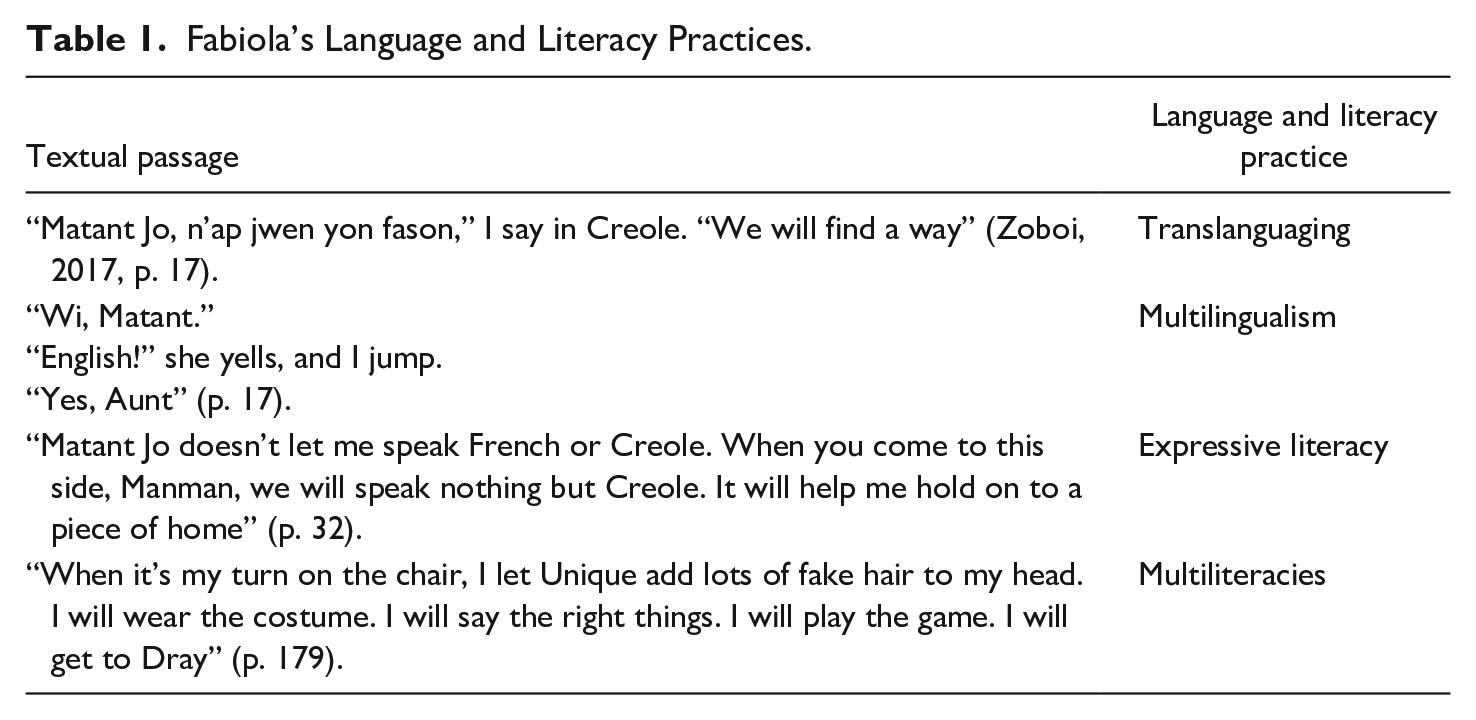
Following this process, Lakeya examined the selected textual content for meaning interpretation. Drawing on external meanings, for example, the scholarly and empirical base on how language, literacy, and identity are deeply connected, she examined the passages to identify how Fabiola drew on language and literacy practices to strategically author herself throughout the text. The process of meaning making was supported by inductive and deductive coding strategies (Miles et al., 2013), which aligns with the textual analysis method of drawing on content both within and external to the text (Lockyer, 2012). Lakeya used inductive codes drawn from the aforementioned extant research and theories to capture instances of identity construction, negotiation, and maintenance. Inductive codes included “acquiring dominant Black language practices,” “using multiple languages and literacies to construct identities across school and other social worlds” (Dávila, 2015; McLean, 2010), and intersectional identity negotiations (race, ethnicity, gender, and class; Compton-Lilly et al., 2017). Using these and other inductive codes, Lakeya looked across all of the textual passages to identify moments in which Fabiola maintained, constructed, and negotiated her identity through her languages and literacies. This examination resulted in the collapsing of multiple codes into three major codes: language and literacy practice for identity construction, language and literacy practice to negotiate identity, and language and literacy practice to resist an imposed identity.
Next, Lakeya used deductive codes to capture ways that Fabiola’s languages and literacies operated within the text itself, which was not particularly reflected in existing literature (Maxwell, 1996). For example, Fabiola styles her hair in a popular style that is unique to Detroit to develop a relationship with her cousin’s abusive boyfriend. In addition, she participates in an ongoing police investigation to help the detective arrest this boyfriend in exchange for Fabiola’s mother’s release from the detainment center. Although not reflected in existing research, these practices are specific and integral to Fabiola’s context and the relationships she develops while living in Detroit and are integral content for meaning making within the text. This analysis process resulted in six additional codes: rejection of dominant culture, assimilation for access and advocacy, language as a marker for social status, cultural knowledge, faith, and hope.
Finally, Lakeya organized the nine codes and selected textual content into a three-column table in a Word document for further data analysis. Column 1 listed the textual content, Column 2 listed the codes, and Column 3 was used to make connections within and outside the text (Lockyer, 2012), including theoretical connections. Allison supported the process of making theoretical connections as operationalized above. Connections included identifying the role that race played in Fabiola’s identity constructions and negotiations (racial formation; Omi & Winant, 1994); capturing Fabiola’s fluid and complex identity representations by drawing on multiple geographies, cultures, and practices (microcultural identities; Mahiri, 2017); and attending to language power dynamics in Fabiola’s identity constructions and negotiations (raciolinguistics; Rosa & Flores, 2017). This process resulted in the generation of three themes: speaking and writing in between worlds, identity for access and advocacy, and defying American ways of knowing. Finally, Lakeya reread portions of the book to lift additional direct passages that reflected each theme.
Positionality
Lakeya was born in the United States to an African American mother and Nigerian immigrant father. Her hybrid identity as an African American and Nigerian woman informs her ethnoracial perspective of this analysis. Lakeya’s research focuses on the identities, languages, and literacies of Black African immigrant youth across home, school, and digital contexts. Allison was born and raised on the Caribbean island of Dominica. She immigrated to the United States as an adolescent and so brings an emic perspective to this analysis. Allison’s research centers on the literacy practices of youth, including those of Caribbean origin, and secondary English education in urban contexts. Our personal experiences with negotiating ethnoracial Black and Black immigrant identities in the United States supported our analysis, for example, in identifying aspects of the story line that we expected would be especially ripe for analysis. At the same time, we held each other accountable so that our analysis was not unduly influenced by personal experience. Working as coresearchers allowed us to serve as critical friends in this regard. In addition, we consistently consulted with pertinent literature and theory, and our analytic procedures, to help ensure that any emergent theme or finding was grounded in empirical and scholarly work beyond our own perspectives.
Findings
Told from the perspective of a teenager, Fabiola Toussaint, American Street (Zoboi, 2017) begins with a mother–daughter journey from Port-au-Prince, Haiti, to the United States. Shortly after they arrive in the United States, Fabiola’s mother is detained by U.S. immigration in John F. Kennedy airport. Fabiola’s U.S. birth citizenship permits her to progress through customs, leaving her to travel the final leg of her flight to Detroit alone. When she lands, she learns from her cousins that her mother has been sent to an immigration detainment center in New Jersey and may possibly be deported to Haiti. As Fabiola begins a new life in Detroit, she struggles to maintain hope for her mother’s return, negotiates cultural and linguistic tensions, and finds herself in the middle of a police investigation as a result of a family member’s relationship with a criminal suspect. She learns that the American Dream is not so dreamy after all. Ibi Zoboi, the author, beautifully interweaves themes of immigration, identity, language, and racial discrimination (although the latter is not itself a beautiful concept) throughout this book. She compels readers to consider the intersection of race and immigrant identities.
Our textual analysis of American Street found that Fabiola resisted oppositional raciolinguistic ideologies (Rosa & Flores, 2017) from her Haitian American family and her English teacher. Her resistance enabled her to strategically honor and hold on to her home languages and literacies. We also found that Fabiola drew on multiliteracy practices and constructed a microcultural identity (Mahiri, 2017) to gain access to dominant Black American spaces for advocacy purposes. Finally, we found that Fabiola defied American/Euro-Western logic as she navigated the terrain of her new homeland, relying on her Haitian spiritual practices for sensemaking (Skerrett, 2012).
Honoring Home Language and Literacies by Resisting Raciolinguistic Ideologies
Fabiola’s language interactions across the book illustrate how similar language ideologies were present in her Haitian American family’s home and at school, which attempted to discourage her use of Creole. This is exhibited the moment Fabiola walks into her family’s house during a conversation among family members about her mother’s detainment. She asks her aunt whether she could help get her mother out of the detainment center: “I will try, but . . .,” she starts to say. “These things, Fabiola . . . they are so complicated, yes?” “Matant Jo, n’ap jwen yon fason,” I say in Creole. “We will find a way.” “English, please.” She stops to stare at me. “I hope your mother really sent you to that English-speaking school I paid all that money for.” “Yes, and I had one more year to graduate. Thank you.” “Good. Leave your mother to me. In the meantime, you finish your junior year with Pri and Donna, okay?” A bit of Haiti is peppered in her English words—the accent has not completely disappeared. “Wi, Matant.” “English!” she yells, and I jump. “Yes, Aunt.” (Zoboi, 2017, p. 17)
Fabiola’s assumption that she could engage in multilingual practices by also speaking Creole to her Haitian family in her family’s house is immediately shattered. This conversation illustrates ways that language symbolizes social status, education, and legitimacy. Her aunt’s reference to the cost of the “English-speaking school” in Haiti positions English as a highly valuable asset (Smith, 2019). It also illustrates ways that immigrant languages and dialects are denounced in exchange for identity and social markers that position them as American (Dávila, 2019). Through enslavement and racism, Haitians were taught to view their own language as inferior (Doucet, 2014; Rosa & Flores, 2017). In contemporary times and their new immigrant contexts, raciolinguistic ideologies (Rosa & Flores, 2017) also create hierarchies of different forms of a particular language associated with microcultural identities (Mahiri, 2017). Fabiola’s aunt’s American English is still “peppered” with her Haitian Creole. At the same time, her aunt takes up the position and perspective of the White listening subject and White gaze (Flores & Rosa, 2015), with the authority to evaluate and denounce Fabiola’s use of a language other than English. Fabiola’s aunt’s value of standard American English conflicted with Fabiola’s expectation and desire to speak the language of their culture in her new home. Fabiola appears to have expected microcultural identities—both Haitian and American, with their associated linguistic and cultural practices—to flourish at home (Mahiri, 2017).
Fabiola also encountered raciolinguistic ideologies at school. Her English teacher, Mr. Nolan, required that she adhere to traditional Westernized forms of writing. Although Fabiola easily navigated the academic rigor of her English school in Haiti, she received a low grade on her first paper at school in Detroit because she “didn’t back up any of [her] claims” (Zoboi, 2017, p. 118). Mr. Nolan tells her, “You were supposed to write a research paper, not a personal essay,” and adds that her “ideas are interesting . . . but unsubstantiated” (p. 118). This leaves Fabiola confused because she wrote essays and poems in English at her English school in Haiti all the time. She reflects, “It doesn’t make sense that my paper isn’t perfect” (p. 119). She wrote everything she knew about the Haitian revolutionary leader Toussaint L’Ouverture, yet her knowledge was discredited. Mr. Nolan’s writing expectations are reflective of traditional notions of literacy and ideologies that overlook the diverse ways of knowing and validation of knowledge of different cultural groups (Tuck & Yang, 2014).
Fabiola’s confusion and frustration led her to play the “American writing game” (Zoboi, 2017, p. 120) to be successful. Writing is a tool that helps immigrant youth move in and between multiple worlds while building and negotiating their identities (Skerrett, 2012). Unfortunately, her teacher’s expectations limited Fabiola’s ability to move between, and reconfigure, her home and school worlds. When her teacher notices her challenges with adjusting to Detroit, he later invites Fabiola to write about her immigrant experience for “extra credit” (Zoboi, 2017, p. 171). The topic is not included in the writing curriculum. Fabiola’s experience of literacy instruction that marginalizes her experiences, knowledge, and ways of knowing reflects the marginalization that children and youth from minoritized communities commonly experience in school (Durand & Jiménez-García, 2018).
Fabiola challenges these language expectations, which is illustrated in her contemplative thinking addressed to her mother. Several times throughout the book, she tells her mother that she will hold on to her language: “Matant Jo doesn’t let me speak French or Creole. When you come to this side, Manman, we will speak nothing but Creole. It will help me hold on to a piece of home” (Zoboi, 2017, p. 32). Fabiola’s declaration deprivileges English and positions her home languages as valuable forms of communicative resources (McLean, 2010). Her negotiations reflect a fluid and intersecting linguistic identity in which she strategically fuses her home language practices with ones expected by her family and school (Compton-Lilly et al., 2017). Furthermore, in these instances, we see Fabiola constructing her unique microcultural identity, with language serving as an essential tool in this project (Mahiri, 2017).
Accessing Dominant Black Spaces Through Multiliteracies and Microcultural Identities
Fabiola’s Haitian American cousins intentionally disassociated themselves from their Haitian identity. This was particularly true at school and in social gatherings. In this way, we notice the ideological influences of other dominant microcultural identities (Mahiri, 2017) in these settings. Fabiola’s cousins summon Fabiola to do the same to help her adjust to Detroit culture. Before her first day of school, one of her cousins speaks with her about it: Big day tomorrow—high school. In America! I hope you been practicing your mean mug in case you run up into some east side girls. And make sure you look ’em dead in the eye ’cause you reppin the west side now. Don’t show weakness, a’ight cuzz? (Zoboi, 2017, p. 21)
In this textual passage, Fabiola is coached to use the gestural mode of multiliteracies (New London Group, 1996), such as facial gestures, to perform an identity as a west-side Detroit girl. Her cousins also alter her physical appearance to construct this identity multiple times throughout the book: “Ready for your fabulous makeover, Fabiola?” “No,” I tell her. “Well, you need one,” she says, and starts with my hair anyway. By the time she’s done, fake hair flows down my back and my new face looks plastic—my eyebrows are perfectly arched and thicker than I’ve ever seen them, my lips are magically fuller, and my eyelashes look like bangs for my eyes. Pri, Aunt Jo, and her friends all cheer and clap when I come down the stairs in borrowed heels that make my legs wobble, and Donna takes a few pictures of me. (Zoboi, 2017, p. 64)
Further in the text, they encourage Fabiola to alter her hair: “Come on, Fab! Step up your hair game. You gotta actually look fabulous for people to start calling you Fabolous” (Zoboi, 2017, p. 135).
Fabiola’s makeovers even result in the construction of a new name, as her cousins and school friends transition to calling her “Fabolous.” Although Fabiola is used to wearing her natural hair and struggles to embrace her cousin’s alterations to her physical identity, she uses her microcultural identity as a west-side Detroit girl as a tool for access that would allow her to engage in a form of advocacy. Here, Fabiola reflects on the access this identity grants her after her cousin completes the makeover: I want to tell Donna not to put them [pictures] on the internet, but maybe this new self will reach my mother and she will come to smack the makeup from off my face and rip the tight dress from my body. (Zoboi, 2017, p. 64)
As such, Fabiola views her consent for the photographs to be uploaded to the internet as a way of advocating for herself so that an adult authority would provide her support in rejecting the regional Black American identity being foisted upon her.
Later in the book, she intentionally styles her hair in a way that will help her get close to her cousin’s abusive boyfriend, Dray. A detective, who is aware of her mother’s detainment, promises Fabiola a brief phone call with her mother and support with setting her free. The detective makes this promise in exchange for information about the person who sold drugs that killed a White girl at a party in the metro-Detroit area. Fabiola sets out to get information about Dray’s drug-dealing hustle for the detective, which requires her to get close to him. She uses her microcultural identity as a Black immigrant girl who can also appropriate a Black American west-side Detroit girl identity, particularly through the styling of her hair, to gain his attention, get information, and hopefully get him arrested. Not only would her success require the detective to keep his promise to connect her to her mother and support her release, but getting Dray arrested would also end her cousin’s emotionally and physically abusive relationship with him. Accordingly, Fabiola’s hope to end the abuse of her cousin reflects a stance of advocacy for her family member. The construction of this identity grants her access to Dray’s exclusive social environment: “When it’s my turn on the chair, I let Unique add lots of fake hair to my head. I will wear the costume. I will say the right things. I will play the game. I will get to Dray” (Zoboi, 2017, p. 179).
These passages highlight underlying motives for the identities that Black immigrant youth construct. Fabiola purposefully practices linguistic patterns, dresses in clothing, and styles her hair in ways that reflect the Black American Detroit culture, the dominant microculture of this portion of the city (Mahiri, 2017). Her Black American literacies position her as socially acceptable by her Black American peers, when she was previously viewed as just an “immigrant” (Baker-Bell, 2020; Ibrahim, 1999). The Black American identity grants Fabiola access to Black American culture in Detroit. Furthermore, her construction of this identity illuminates the social hierarchies that exist within Black communities and the ways that Black immigrant youth construct identities to enter not just American spaces, but also dominant Black American spaces (Awokoya, 2012; Mahiri, 2017).
Defying American/Euro-Western Logic Through Nondominant Faith Literacies
Immigrant youth who claim religious or spiritual lives often engage associated literacies to make sense of their experiences in their new homelands (Skerrett, 2012, 2018). Culture and faith, particularly for those who have already developed spiritual or religious lives, are anchors for Haitian immigrant youth who negotiate their identities (Doucet, 2014). Overall, spirituality or religious faith provides heuristics for making meaning of life and other phenomena for individuals. Religious knowledge and practices (composing religious literacies) have also been described as supporting students’ broad range of ways of making meaning with texts and in other literate engagements, including in school (Juzwik et al., 2020; Skerrett, 2014). We see Fabiola heavily relying on her Haitian spiritual practices to construct self-understandings about her new life. As part of her religious literacy practices, Fabiola even finds a semi-empty shelf in one of her cousins’ rooms to set up as a space for her to pray, sing, and interact with lwas, spirits of Haitian voodoo, to remain hopeful about her mother’s release from the immigration detainment center. Lwas are the intermediate spirits that interact with people on Earth to ground them, offer guidance, and cause good things to happen. Although her cousins and neighbors criticize her faith literacies, Fabiola does not stop practicing them. Setting up her prayer place allows spirits to inhabit her family’s home to comfort her.
Fabiola also develops a relationship with a man in her family’s neighborhood. Although everyone refers to him as “Bad Leg,” Fabiola believes he is Papa Legba, a figure in Haitian culture who serves as a supportive spirit that enables communication between the human and spiritual world. So, Fabiola believes he is an lwas spirit who was sent to guide her with lyrical songs filled with wisdom about her mother’s detainment. While conversing with her aunt about her mother, she says, “Matant Jo,. . . Bad Leg at the corner, he’s not just a crazy man. He is Papa Legba and he is opening doors and big gates. I will show you. I promise” (Zoboi, 2017, p. 166). Her aunt responds, “Child, this is Detroit. Ain’t no Papa Legba hanging out on the corner. Only dealers and junkies. You don’t know shit. But don’t worry. You’ll figure it out” (p. 166). Still, Fabiola continues to seek guidance from the man who stands on the corner. She holds on to her spiritual practices as she asks him to help her navigate the cultural terrain of her new city: “Which road should I take, Papa Legba?” (p. 112). Fabiola’s persistent interactions with Papa Legba exemplify her reliance on her faith literacies as she tries to make sense of, and decisions around, her experience of immigration (Skerrett, 2012, 2018). Fabiola’s prayer area coupled with her opposition to her family’s critiques center her religious ways of knowing, which help her to navigate the challenges that accompany the experiences of immigrants attempting to build microcultural identities (Mahiri, 2017; McLean, 2010).
Discussion and Implications
This article has presented a textual analysis of a novel representing a Black immigrant youth’s experience of immigration to the United States and illuminated the importance of language and literacy practices in her negotiations with existing and newly available identities, and associated languages and literacies, in her new community. The ways in which children and youth, particularly immigrant youth, develop and engage linguistic repertoires to construct identities and fulfill other goals reveal their agency and brilliance. Our analysis contributes knowledge that scholars and educators can draw upon to deepen understandings of the identity negotiations that immigrant minoritized students undertake. Such understandings can enhance theory and pedagogical practices to better support these youth. With the Black immigrant population being an understudied group in literacy research, we hope that this analysis encourages further research and scholarship on this expanding demographic in the United States and other nations. Accumulating greater knowledge about the intersections among immigration, language, literacy, race, culture, and identity, as it relates to individuals and groups who claim microcultural identities, seems a reasonable charge to the literacy field, given rapidly changing demographics and new theories pertaining to race, culture, and language. Textual analysis, to our knowledge, is a less common approach in literacy research for inquiring into those issues. Acknowledging that our analysis and findings rely on a single, although well-chosen, text, we call for future research and scholarship that draw on this method to expand the field’s ways of researching and generating knowledge in this area.
Books like American Street (Zoboi, 2017) provide deep insights into ways that the identities of youth of color “shift in response to local contexts and across generations, requiring nuanced pedagogical approaches” (Durand & Jiménez-García, 2018, p. 4). Through a series of conversations, we considered the findings of the textual analysis, the literature on Black immigrant youth, and the theories we utilized in our analysis to conceptualize pedagogical implications. We acknowledge that our analysis of a single text is limited in its potential to generate a new or complete pedagogical approach. Rather, we recognize existing research and scholarship that attends to how books dealing with race, language, and culture can be productively used in literacy education (Brooks & McNair, 2014; Toliver, 2020). What we add to this work is a call for introducing students to a wider array and number of texts that represent the experiences of minoritized immigrant youth of color. In such efforts, selected texts should provide alternative perspectives to, or challenge, the White gaze (Flores & Rosa, 2015).
Given our focus in this article on Black immigrant youth, we recommend texts that center Black immigrant youth experiences, with teachers facilitating conversations in which students explore the racial positioning of these youth and their use of languages and literacies to construct or negotiate particular microcultural identities and multilingual and multiliterate repertoires of practice. It is also important that a critical lens be applied to these texts to promote students’ understandings about the racial, linguistic, and social status factors that privilege English as a language in nations such as the United States and how other dominant languages, including in communities of color, can similarly work to disenfranchise immigrant youth for whom those languages are new (Baker-Bell, 2020; Smith, 2019). Such conversations can pave the way for intercultural understanding and relationship building among Black immigrant youth and their native-born Black peers.
Of interest in our analysis was the importance of faith literacies to the main character’s navigation and sensemaking of her circumstances. Literacy education has often required students to set aside religious and alternative ways of knowing that diverge from Eurocentric logic when they enter classrooms (Juzwik et al., 2020). Although still an understudied area in literacy research, literacy scholars have been advocating for inviting students to bring their religious or faith literacies into the literacy work they undertake in school (Juzwik et al., 2020; Skerrett, 2014, 2018). Doing so invites cultural ways of knowing of diverse student populations, including the specialized faith literacies of different populations of Black immigrant youth. During textual analyses, students could be invited to consider what kinds of knowledge and understandings characters bring to making sense of the situations in which they find themselves. Students could be encouraged to make connections between the types of knowledge and beliefs that they themselves bring to making sense of texts and their own life circumstances. Scholars of religious literacies have established strong connections between the interpretative tasks students are asked to undertake in the study of literature and the heuristics for making meaning of religious texts and life situations (Juzwik et al., 2020; Skerrett, 2012, 2018). Our analysis contributes to the call for valuing and centering students’ faith-based literacies and knowledge in textual analysis and other literacy work in schools.
Conclusion
In literacy research, which will affect practice, it is important to increase attention to the understudied but growing demographic of Black immigrant youth. Black immigrants represent great diversity, and thus studying this demographic stands to produce unique knowledge that improves empirical understandings and instructional practice related to this diverse population (Skerrett & Omogun, 2020). In research endeavors, and in literacy classrooms, scholars and practitioners should attend to the many microcultures that inform Blackness (Mahiri, 2017). Doing so provides an enriched view of Black languages and literacies.
Supplemental Material
sj-zip-1-jlr-10.1177_1086296X211031279 – Supplemental material for From Haiti to Detroit Through Black Immigrant Languages and Literacies
Supplemental material, sj-zip-1-jlr-10.1177_1086296X211031279 for From Haiti to Detroit Through Black Immigrant Languages and Literacies by Lakeya Omogun and Allison Skerrett in Journal of Literacy Research
Footnotes
Declaration of Conflicting Interests
The author(s) declared no potential conflicts of interest with respect to the research, authorship, and/or publication of this article.
Funding
The author(s) received no financial support for the research, authorship, and/or publication of this article.

References
Supplementary Material
Please find the following supplemental material available below.
For Open Access articles published under a Creative Commons License, all supplemental material carries the same license as the article it is associated with.
For non-Open Access articles published, all supplemental material carries a non-exclusive license, and permission requests for re-use of supplemental material or any part of supplemental material shall be sent directly to the copyright owner as specified in the copyright notice associated with the article.
