



Abstract
This review focuses on students’ perceptions of their rights in elementary and secondary schools. The conceptual framework of rights consciousness was applied to understand how students’ knowledge, experiences, and emotions shape their rights perceptions. The analysis is based on 38 empirical studies conducted in different countries. The findings characterize students’ rights perceptions as intuitive—that is, perceptions that are not grounded in legal rules but in students’ personal insights. The findings also identify key factors affecting students’ perceptions: school context, national context, and students’ individual characteristics. The conclusions underscore that school rights-based practices, student body and school staff diversity, and school relationships influence students’ rights consciousness. However, questions remain concerning how students’ perceptions are affected by cultural repertoires, religion, socioeconomic status, gender, and age. The implications are that future studies should apply a context-based agenda to inform the design and implementation of human rights education programs and rights-based organizational practices.
This review focuses on students’ perceptions of their rights in elementary and secondary schools. It aims to characterize students’ perceptions of their rights in school and explore the factors influencing these perceptions. Since the ratification of the United Nations Convention on the Rights of the Child (UNCRC) in 1989, scholarly interest in students’ rights has grown (see Byrne & Lundy, 2019; Todres & King, 2020; Quennerstedt & Moody, 2020; United Nations, 1989). In the United States, which has yet to ratify the UNCRC, this interest is linked to principles of equal protection and racial justice (Morrill et al., 2010; Preiss et al., 2016) and the pivotal role of children’s rights in American constitutional law (Todres et al., 2006; Woodhouse, 2009). The research on students’ rights is also intertwined with legal narratives that have penetrated school systems in response to several trends. These include semilegal disciplinary procedures concerning school suspensions and expulsions (Kayama et al., 2015; Perry-Hazan & Birnhack, 2018) and the escalating use of education law litigation both by parents and by social movements (Superfine & Thompson, 2016; Zirkel & Skidmore, 2014).
Published systematic reviews on different aspects of children’s rights in school have not focused on students’ perceptions (Mager & Nowak, 2012; Quennerstedt, 2011; Quennerstedt & Moody, 2020; Urinboyev et al., 2016). The reviews of Quennerstedt (2011) and Quennerstedt and Moody (2020) incorporated a general analysis of the research regarding children’s rights in education, including many theoretical and legal studies. Urinboyev et al. (2016) focused on the enforcement of students’ rights. Mager and Nowak (2012) reviewed studies exploring the effects of student participation in decision making at school. Aside from its focus on how students perceive their rights, this review is innovative in its inclusion of a variety of studies from research fields that typically do not interact, ranging from large-scale quantitative psychological studies on perceived discrimination to ethnographies centered on privacy or participation rights.
This review focuses on the school context, recognizing that children perceive their rights differently in the various domains of their life, such as school, family, community, and the political system (Ben-Arieh & Attar-Schwartz, 2013; Khoury-Kassabri & Ben-Arieh, 2009). Ben-Arieh and Attar-Schwartz (2013), who explored children’s perceptions of rights in different domains, argued that an ecological perspective that differentiates between these domains is needed to understand children’s perceptions. They noted in this regard that some of the differences between the domains are so apparent that any claim to understand them in the absence of an ecological perspective “seems almost useless” (p. 104).
The article opens with a section delineating a conceptual background regarding rights in general and children’s rights in particular. The following section reviews the theoretical framework employed in the review, focusing on the socio-legal inquiry of rights consciousness and the factors facilitating the development of rights consciousness. The next section of the article elaborates the research design: the research objectives and questions, the search parameters and procedures, the articles included, and the data analysis. The analysis shows that students’ perceptions of their rights in school typically derive from their intuition rather than from legal rules. The analysis also reveals how different factors influence students’ perceptions of their rights in school; some of these factors relate to the school or the national context, and others stem from student characteristics, such as minority status, religion, socioeconomic status (SES), gender, and age. The final sections highlight the conclusion that students’ perceptions of their rights in school are contextual, influenced by school practices, student body and school staff diversity, and relationships in school. They also address the study’s implications for research, policy, and practice.
This study is interdisciplinary, offering a new perspective to scholars from various fields, including children’s rights, student voice, socio-legal research, childhood and youth studies, and social psychology. The study may also interest policymakers and educators seeking to design human rights education programs, implement rights-based pedagogies, or improve the teaching of rights in civic studies.
Conceptual Background: Human Rights and Children’s Rights
The conceptual definition of the term “rights” is contested in legal, philosophical, and political theory (e.g., Dworkin, 1977; H. L. A. Hart, 1961; Sen, 2004; Sunstein, 1995). The concept of “children’s rights” has been applied even less precisely (Dixon & Nussbaum, 2012; Giesinger, 2019; Lundy, 2014, 2019). The current review is based on two constitutive elements of various definitions of rights. One element is the intersection of rights and duties to respect, protect, or fulfill rights (Alston & Goodman, 2013; Feinberg, 1970; Sen, 2004; Sunstein, 1995). This intersection is highlighted by the Stanford Encyclopedia of Philosophy’s definition of “rights” as “entitlements (not) to perform certain actions, or (not) to be in certain states; or entitlements that others (not) perform certain actions or (not) be in certain states” (Wenar, 2020). Although the sources of rights-related duties are contested (e.g., Beitz, 2009; Dworkin, 1977; H. L. A. Hart, 1961), the current review will focus on legal sources of duties (see Sunstein, 1995). Focusing on a legal analysis of rights is critical with regard to children’s rights as their inquiry is often blended with proximate terms such as “well-being,” which may dilute the content of rights (Lundy, 2014, 2019). Such a focus emphasizes that a child’s rights should not be viewed through the lens of “pity” or “charity” (Lundy, 2019); indeed, it is an entitlement that can be demanded.
Another common element appearing in various definitions of rights is that, in most cases, rights are not absolute. Whereas in certain circumstances, each right trumps competing considerations, in other circumstances, another right having higher priority—or a pressing nonright consideration—determines what may or should be done (Wenar, 2020). Thus, the obligation to protect or promote rights may be “imperfect” in that they are not precisely characterized (Sen, 2004). For example, U.S. students’ constitutional right to free speech is subject to various limits in case law, which restrict speech that infringes on the rights of others, creates a material and substantial disruption of the school’s work and discipline (Tinker v. Des Moines Independent Community School District, 1969), or undermines the school’s basic educational mission (Bethel School District v. Fraser, 1986; Hazelwood School District v. Kuhlmeier, 1988; Morse v. Frederick, 2007). Another aspect of the nonabsolute nature of rights is that some rights set goals and require progressive, rather than immediate, realization. International human rights law requires states to undertake all appropriate measures to implement rights to the maximum extent of their available resources (International Covenant on Economic, Social and Cultural Rights, 1966, Article 2; UNCRC, Article 4). The nonabsolute character of rights is also evident with regard to the interface of children’s rights and parental rights (UNCRC, Article 5; see also Giesinger, 2019) and the requirement to consider children’s age and maturity in realizing participation rights (UNCRC, Article 12).
The global legal discourse on children’s rights emerged in the 20th century, with one of its defining features being the progressive expansion of rights to people once ignored or excluded by the law (Dixon & Nussbaum, 2012). After World War I, the League of Nations (1924) drafted the Geneva Declaration of the Rights of the Child, which included five provisions aimed to protect children (Article 3). The next step was the adoption of the United Nations Declaration of the Rights of the Child in 1959, which expanded the 1924 declaration (United Nations, 1959). Children’s rights were also protected by other international instruments whose focus was not on children, such as the International Covenant on Economic, Social and Cultural Rights (1966).
In 1970, a discussion ensued regarding the prospect of formulating a binding convention on the rights of the child to include the international standards scattered in various human rights instruments (see Hammarberg, 1990). This discussion culminated in the adoption of the UNCRC by the United Nations General Assembly in 1989. The UNCRC incorporates economic and social rights as well as civil and political rights (Quennerstedt, 2010), which are typically classified into three main clusters of rights (see Hammarberg, 1990): (1) Provision—the right to satisfy one’s basic needs, (2) Protection—the right to be shielded from harmful practices, and (3) Participation—the right to be heard on decisions affecting one’s life. Whereas provision and protection rights synthesized standards that already existed in international law, participation rights were an innovation, comprising a crucial dimension in the new approach to children’s rights (Lansdown, 2001; Lundy, 2019). Such rights refer to decisions pertaining to individuals (e.g., placing a child in special education) as well as decisions having collective implications (e.g., school council resolutions; see United Nations Committee on the Rights of the Child, 2009). Another general guiding principle of the UNCRC pertinent to the current review is its nondiscrimination provision, requiring states to respect and ensure children’s rights without discrimination based on race, color, sex, language, or religion; political or other opinion; national, ethnic, or social origin; property; disability; and birth or other status (Article 2(1)).
The UNCRC was ratified by all the world’s countries except the United States, which signed the convention but is yet to ratify it (United Nations Office of the High Commissioner of Human Rights, 2020). During the 1960s and 1970s, long before the emergence of the scholarly discourse on children’s rights in the international human rights world, a diverse group of U.S. scholars, known as the child liberationists, promoted an agenda that classified childhood with race and gender in the quest for a civil rights revolution (see Minow, 1995). In the same period, litigation over children’s rights resulted in landmark cases, two of which related to schools. One case was Tinker v. Des Moines Independent Community School District (1969), which determined that students do not “shed their constitutional rights to freedom of speech or expression at the schoolhouse gate,” in a case involving students disciplined for wearing black arm bands to protest the Vietnam War. The other case was Goss v. Lopez (1975), which ruled that students suspended from school are entitled to rudimentary due process rights, such as notice of the charges, an explanation of the evidence, and an opportunity to present arguments. It should also be noted that the watershed moment of American antidiscrimination laws was the Brown v. Board of Education (1954) case, which addressed school-based racial discrimination.
American objections to ratifying the UNCRC are reflected in two key arguments: one contention is that ratifying the UNCRC would be tantamount to surrendering American sovereignty, and the other focuses on articles that American critics interpret as threatening parental rights (Kilbourne, 1998). Various American scholars have argued that these concerns are ungrounded and the status of children in the United States largely aligns with the approach taken by the UNCRC (e.g., Todres et al., 2006; Woodhouse, 2009). These contentions are all the more pertinent to children’s rights in school, which typically do not conflict with parental rights and are intertwined with American values and the important role children have played in building American democracy and social justice (Kilbourne, 1998; Woodhouse, 2009). However, in the United States, the discourse regarding student participation in school decision making does not derive from a rights framework, and when student participation frameworks exist, they typically emerge from the bottom up (see Mitra et al., 2014). The intersection of the UNCRC and American law will be further elaborated in the section delineating the review’s search parameters.
Theoretical Framework
Legal Consciousness and Rights Consciousness
The law provides cultural schemas that individuals adopt to understand their everyday experiences (Ewick & Silbey, 1998; Marshall, 2005). The study of legal consciousness pursues the meanings of law among lay actors as well as professional legal actors and reconceptualizes the unit of analysis from specific laws to legal ideologies (Silbey, 2005). Many studies exploring legal consciousness have focused on rights consciousness. The term “rights consciousness” connotes individuals’ perceptions of rights, in particular their capacity to define problems and obstacles in terms of rights (see Almog & Perry-Hazan, 2011; Merry, 2003). Thus, developing rights consciousness is crucial for “naming” injuries as a violation of rights (Felstiner et al., 1980–1981). When those suffering a wrong or an injury do not name it as such, it is likely that, with time, they will perceive even highly undesirable states of affairs as natural, inevitable, or at least dauntingly difficult to change (Abrams, 2011). Naming is the first stage in the mobilization of rights process, which also includes “blaming” someone else or an entity for the violation of rights and then “claiming” rights by seeking redress (Felstiner et al., 1980–1981). The legal mobilization process highlights that the actual realization of rights relies heavily on individuals’ initiatives to invoke them in the context of their daily lives (Marshall, 2005). Thus, Young and Billings (2020) conceptualized rights consciousness as a form of cultural capital. Cultural capital refers to the knowledge, skills, tastes, mannerisms, and interactional styles that can be parlayed into social advantage or power, shaping and being shaped by the class structure in societies (Bourdieu, 1984; Young & Billings, 2020).
In addition to its role in mobilizing rights, rights consciousness has significant educational implications. Individuals who are cognizant of their own and others’ rights and are knowledgeable of their underlying justifications will be more likely to avoid violating rights (Covell, 2010; Militello et al., 2009). It should be noted in this regard that human rights education is one of the goals of education in international human rights law (International Covenant on Economic, Social and Cultural Rights, 1966, Article 13(1); UNCRC, Article 29(1)(b)). The justifications for education that fosters rights consciousness concern not only its ability to mobilize rights in society but also its inherent moral value, independent of consequences (McCowan, 2012).
Most studies on rights consciousness turned their attention to disempowered populations (e.g., Blackstone et al., 2009; Engel & Munger, 2003; Merry, 2003), human rights activists (e.g., McCann, 1994; Merry et al., 2010; Perry-Hazan & Perelshtain, 2018), and individuals having a professional obligation to protect the rights of others (e.g., Edelman et al., 1993; Munkres, 2008; Perry-Hazan & Birnhack, 2016; Thompson et al., 2015). Several studies employed the concept of rights consciousness to explore children’s perceptions of their rights (e.g., Birnhack et al., 2018; Morrill et al., 2010; Mulumeoderhwa, 2018; Perry-Hazan & Lambrozo, 2018). Of these studies, those that focused on the school domain are included in this review.
The Development of Rights Consciousness
Knowledge about human rights is essential to the development of rights consciousness (e.g., Hirsh & Lyons, 2010; Merry, 2003). Such knowledge may be acquired through human rights education programs (Bajaj et al., 2017; Barton, 2015, 2020; Hantzopoulos, 2015), but it can also be acquired through other channels, such as personal network ties with lawyers (Cornwell et al., 2017), and workplace training (Munkres, 2008). McCann (2006) noted in this regard that human rights knowledge is not just an instrumental “toolkit,” as it empowers people to think about the world differently, envision new options, and choose between them.
Rights consciousness also evolves in light of previous experiences of rights (Blackstone et al., 2009; Hirsh & Lyons, 2010; Merry, 2003; Nielsen et al., 2015). As Merry (2003) found in her study on battered women, a woman’s willingness to take on rights depends on her experience trying to assert them. Merry averred that when a woman’s experience reflects a fundamental belief that she is a person with a right not to be battered, she will be willing to take on this identity. However, if these rights are treated as insignificant, she may choose to give up and no longer reflect on her grievances in terms of rights. Generally, individuals at higher levels of social status hierarchies have more positive experiences of rights and thus a greater sense of legal and institutional entitlement (Hirsh & Lyons, 2010; Shoshana, 2017), whereas a marginal social location may lead to skepticism as to the law’s ability to provide remedies (Boittin, 2013; Nielsen, 2004). However, marginal social location and negative experiences of rights can also produce conditions that facilitate naming. For example, McElhattan et al. (2017) found that African American respondents perceive more discrimination against African American workers than do other racial groups. They termed this phenomenon the “vigilance theory,” which holds that people of color are more likely than Whites to detect discrimination because they are on alert (or “vigilant”) about recognizing it. Lamont et al. (2016), who examined how minority group members in the United States, Brazil, and Israel perceive discrimination, found that African Americans reported more discrimination experiences, described more types of occurrences, and expressed more confidence in defining these instances as racially based. They concluded that cultural repertoires about American society’s racist character and the legal gains of the civil rights movement (among others) facilitated the inclination of U.S. interviewees to define incidents as race related. “Cultural repertoires” comprise “the set of tools available to individuals to make sense of the reality they experience” (p. 20) and may include global, national, and communal narratives of rights.
Emotions are another related factor that influences the development of rights consciousness. Naming an injury as a violation of rights requires a “moral shock,” reflecting a perception that the injury is not an inevitable state of affairs (Abrams, 2011). Abrams (2011) analyzed the emotions facilitating this process, which may include anger, indignation, hope, and courage, along with self-respect. However, Abrams noted that when an injured person experiences fear, shame, or anxiety, they are more likely to perceive a wrong or injury as natural or inevitable. Furthermore, Abrams argued, the development of rights consciousness is also affected by emotions shared with others or emotions fostered by one’s connection to others. Blackstone et al. (2009), who explored responses to sexual harassment at work, found that close work friends may provide a sense of guardianship that promotes the framing of harassment as a grievance.
Schools have a crucial role in inculcating children’s rights consciousness, as they can provide knowledge about rights, shape structures and practices enabling experiences of rights, and ensure emotional support facilitating the naming of rights. Educators’ knowledge about children’s rights and approaches toward students’ rights are determining factors in schools’ ability to develop students’ rights consciousness. Educators’ knowledge about rights is essential not only to design and teach human rights education programs but also to assist children in mobilizing their rights. However, studies conducted in various countries have noted that school administrators and teachers lack basic legal knowledge about students’ rights (Charmaraman et al., 2013; Militello et al., 2009; Perry-Hazan & Tal-Weibel, 2020; Schimmel & Militello, 2007; Tie, 2014) and in some cases develop legal myths based on inaccurate information and personal perceptions (Perry-Hazan & Birnhack, 2016; Perry-Hazan & Tal-Weibel, 2020; Schimmel & Militello, 2007). The school’s role in fostering children’s rights consciousness is distinctly crucial in cases where children who are victims of abuse, neglect, or discrimination in other life domains may perceive these experiences as normal and inevitable. Being cognizant of the school’s critical role enables a deeper understanding of the educational implications of social inequalities for the development of rights consciousness. As noted, Young and Billings (2020) viewed rights consciousness as a form of cultural capital due to its interconnections with the knowledge and skills that translate into social advantage. This view sheds light on the socialization processes in families and schools that maintain and reproduce social stratification (Calarco, 2018; Davies & Rizk, 2018; Lareau, 2011).
Research Design
Objectives and Research Questions
This review explores students’ perceptions of their rights in schools. It was guided by the following research questions: (1) What characterizes students’ perceptions of rights in elementary and secondary schools? (2) Which factors influence these perceptions? This inquiry’s objective was to provide a robust and diverse understanding of how broad legal frameworks of students’ rights are manifested in students’ rights consciousness. Such contextual understanding is essential for the design and implementation of effective human rights education programs and organizational practices that facilitate the mobilization of students’ rights.
Search Parameters and Procedures
Literature concerning students’ perceptions of their rights in school was collected through searches of three databases: Google Scholar, JSTOR, and ERIC. The following restrictions were applied:
The articles should have been published between 1989 and 2020, inclusive. The earlier temporal limit aimed to cover studies published subsequent to the adoption of the UNCRC in 1989. The year 1969 was another watershed moment for students’ rights, when the U.S. Supreme Court ruled in the Tinker v. Des Moines Independent Community School District (1969) case, declaring that school students are entitled to constitutional rights. However, the decision to begin the current review in 1989 is consistent with its international focus, as one of its aims was to analyze cultural variations.
The articles needed to include the determined keywords in their titles or abstracts. The search included combinations of the word “rights” or words related to specific rights with general words relating to education (see Table 1). The keywords, their combinations, and their location were adapted to each search engine. In Google Scholar, I searched the articles’ titles and used narrower combinations to reach a reasonable number of results. In ERIC and JSTOR, which enable sorting of journal articles, I used broader combinations. In ERIC, I searched the articles’ abstracts, as ERIC is a smaller search engine focusing on educational research. In JSTOR, the broader search terms yielded too many results when I searched the abstracts, so I decided to search only the titles rather than repeat the same search I conducted in Google Scholar. The keywords were selected after carefully reviewing the UNCRC’s vocabulary and the key literature on students’ rights in different countries. Table 2 explains the choice of the keywords and elaborates on their legal frameworks. The searches were conducted initially in August 2019 and updated in May 2020.
Combination of keywords
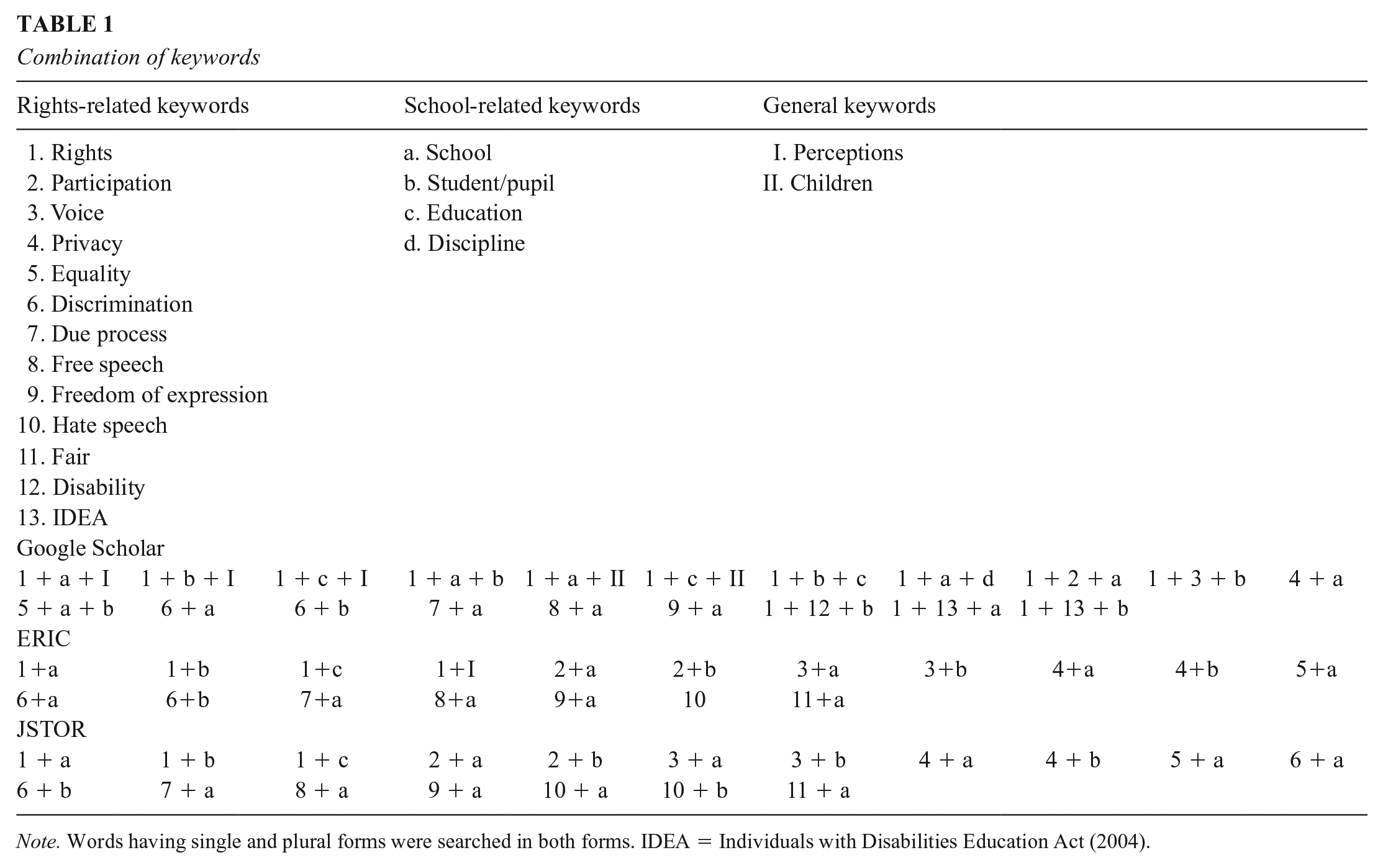
Note. Words having single and plural forms were searched in both forms. IDEA = Individuals with Disabilities Education Act (2004).
Choice of keywords relating to specific rights
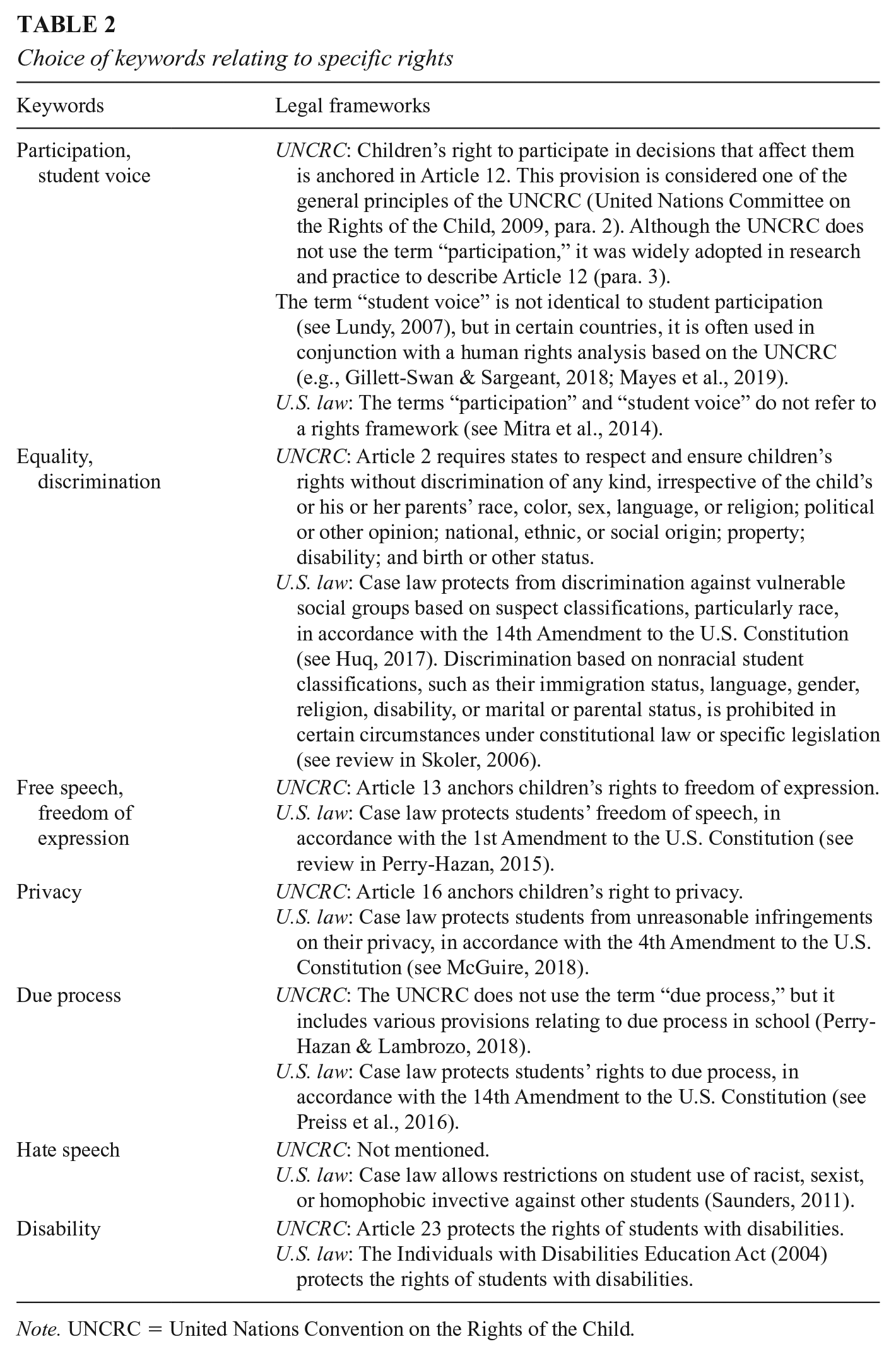
Note. UNCRC = United Nations Convention on the Rights of the Child.
The various searches yielded 2,783 results in Google Scholar, 1,771 results in ERIC, and 657 results in JSTOR. I read the articles’ titles and abstracts, discarded duplicates, and selected the studies that met the following criteria:
Studies published in English
Studies published in peer-reviewed journals ranked in the SCImago journal rank indicator (this criterion excluded sources such as book chapters, dissertations, and conference proceedings)
Studies based on data collected from students in elementary or secondary schools
Empirical studies employing original quantitative, qualitative, or mixed-methods inquiries of students’ perceptions (this criterion excluded theoretical and review studies)
Studies whose abstracts indicated their pertinence to the research questions (thus, studies that focused on the impact of various factors including student discrimination, health, achievements, or delinquency were excluded)
The above restrictions left 75 studies. After reading the full text of the articles, several additional exclusion criteria were applied:
Studies that addressed students’ perceptions of their rights in various domains but did not differentiate between these domains were excluded. This criterion excluded studies that explored students’ general perceptions of their citizenship rights (e.g., Mulumeoderhwa, 2018) and those that explored students’ perceived discrimination and used research tools addressing general rather than school-based perceptions of discrimination. The latter exclusion criterion required a careful examination of the research tools and findings in each study. It resulted in excluding studies that measured students’ perceived discrimination through questionnaire items that did not specifically cite school personnel (e.g., Seaton & Yip, 2009) and studies that used items referring to discrimination by educators but whose findings did not fully differentiate between school-based discrimination and the general society’s discrimination (e.g., Stone & Han, 2005).
Studies that focused on schools but did not analyze students’ perceptions of their rights were excluded: 2.1. Studies that were not explicitly related to rights included the following: 2.1.1. Studies addressing perceived discrimination by items relating only to peer racism rather than educators’ discriminatory behavior (e.g., Seaton et al., 2013) were excluded. Whereas “discrimination” carries several meanings (see Rosenbloom & Way, 2004), this review focused on the legal meaning of discrimination. Thus, the review included studies examining discrimination by school personnel based on a suspect classification, particularly race (see Table 2). Peer discrimination infringes rights when school personnel do not address it or, in severe cases, when it constitutes a criminal offense (Cornell & Limber, 2015), such as hate speech (see Saunders, 2011). The three studies excluded due to this criterion did not address such cases. 2.1.2. Studies that explored students’ moral perceptions without a specific connection to rights (e.g., Levinson, 1998) were excluded. However, studies showing that students’ perceptions of their rights were linked to moral principles were included in the review (e.g., Grover, 2005). 2.1.3. A study addressing student voice or participation, reporting students’ opinions on various issues but not on their rights was excluded (Bourke & MacDonald, 2018). 2.1.4. Studies on student voice in the United States were excluded as participation in school decision making does not constitute a right in the United States. Only a single U.S. article on student participation referred to participation rights—a case study exploring local school councils that were required to include student representatives by dint of the Chicago School Reform Act (Kaba, 2000). Studies’ linkage to rights was determined according to the legal context and the authors’ use of the rights framework. Legal systems and structures, and sources of legal authority vary among countries, and consequently, students’ rights differ. It should be noted in this regard that in some countries, international human rights law is directly incorporated into domestic law, whereas in other countries, its implementation requires specific legislation (Lundy et al., 2014). 2.2. Studies that evaluated the impact of rights fulfillment or rights-based practices and addressed specific programs (e.g., Vanner, 2014) were not reviewed. 2.3. Studies that explored students’ perceptions of human rights education programs (e.g., Bajaj et al., 2017) rather than of actual rights were excluded from the review. 2.4. Case studies of specific student councils that did not incorporate interviews with students regarding their participation activities (e.g., Cotmore, 2004) were not included in the review. 2.5. Studies indicating that students’ rights were violated, or that students felt their rights were violated, but without further analyzing findings related to the research questions concerning the characteristics of students’ perceptions or the linkages between these perceptions and other factors (e.g., Rosenbloom & Way, 2004) were also not included. 2.6. A study that explored students’ hypothetical perceptions of rights in school but did not concern their own rights (Brown, 2006) was excluded.
Whereas Hart et al.’s (2001) summary of international findings was included in the review, the individual national studies that were also published in discrete articles were not reviewed.
At this stage, a further search was conducted based on complementary search methods—follow-up of references, citation searching, and citation pearl growing (i.e., using one relevant source to identify additional relevant sources)—to identify relevant empirical studies meeting the search criteria that had not been captured by the electronic search (see Cooke et al., 2012). I also reviewed the references of articles that conducted systematic reviews on related issues (Mager & Nowak, 2012; Quennerstedt, 2011; Quennerstedt & Moody, 2020; Urinboyev et al., 2016).
Included Studies
Thirty-eight studies met the inclusion criteria and were selected for the review. Due to the small number of included studies, publication in peer-reviewed journals ranked in SCImago was considered evidence of quality (see, e.g., Parkhouse et al., 2019; Sant, 2019). Table 3 presents the studies’ descriptive characteristics. As indicated in the table, 10 studies did not focus on specific rights and 15 studies addressed school-based discrimination. Whereas most of these studies addressed racial and ethnic discrimination in the U.S. context, some studies investigated discrimination in other countries as well. Fewer studies focused on students’ perceptions of their participation rights, due process rights, or privacy. In many of the reviewed studies, the rights were intertwined. For example, studies focusing on due process also explored participation rights. Some studies focused on specific populations, such as minority students or immigrants. Around 39% of the studies were conducted in the United States and about 26% in other English-speaking countries, reflecting an expected dominance in light of the review’s language restriction. Most studies focused on secondary schools, whereas only a few addressed elementary schools or included samples comprising both secondary and elementary school students.
Descriptive characteristics of the reviewed studies
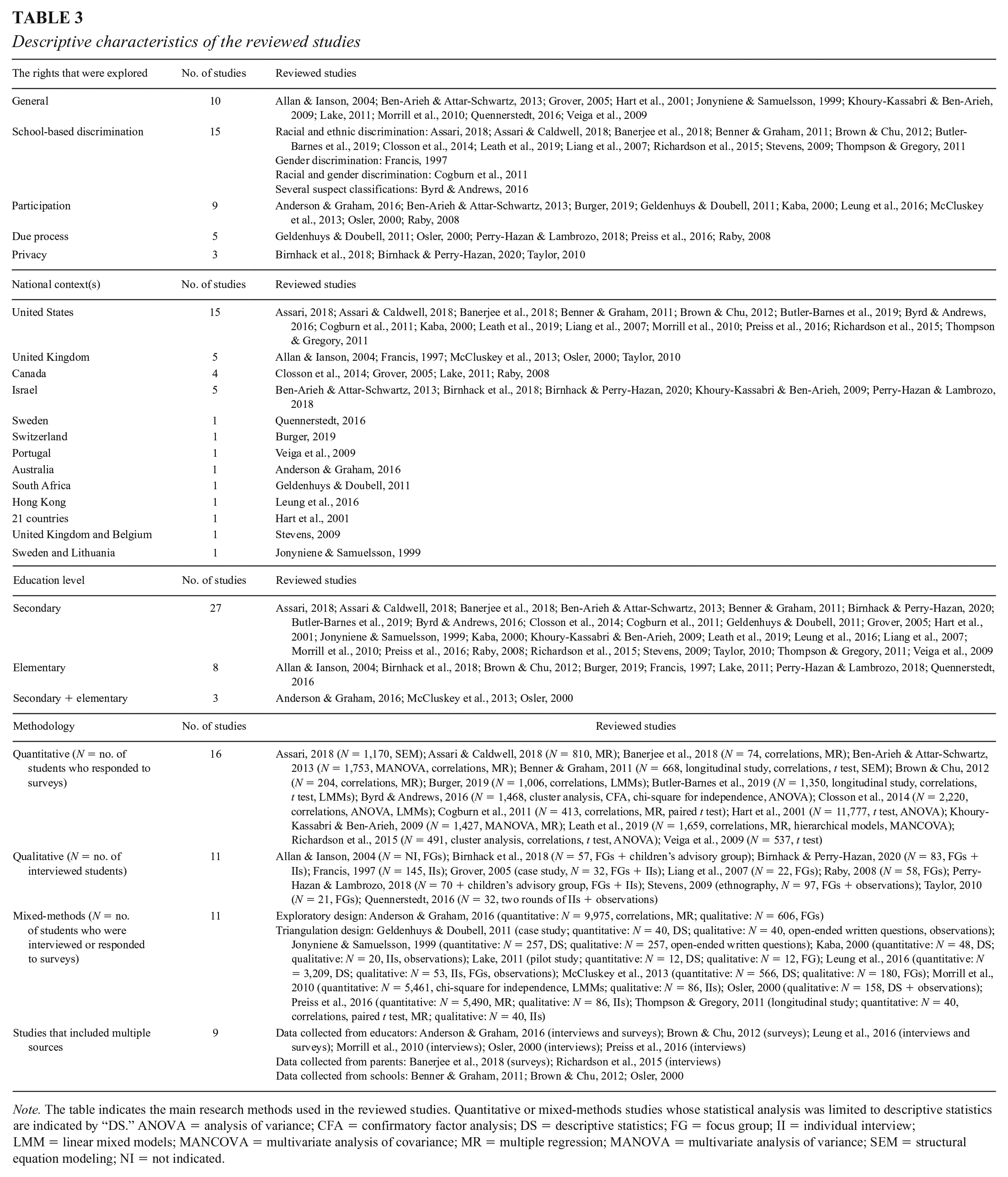
Note. The table indicates the main research methods used in the reviewed studies. Quantitative or mixed-methods studies whose statistical analysis was limited to descriptive statistics are indicated by “DS.” ANOVA = analysis of variance; CFA = confirmatory factor analysis; DS = descriptive statistics; FG = focus group; II = individual interview; LMM = linear mixed models; MANCOVA = multivariate analysis of covariance; MR = multiple regression; MANOVA = multivariate analysis of variance; SEM = structural equation modeling; NI = not indicated.
Regarding the reviewed studies’ methodologies, discrimination-related studies were mostly quantitative, privacy-related studies were all qualitative, and the remainder used various methods. Whereas most of the quantitative studies applied regression-based methods, the quantitative components of most of the mixed-methods studies were limited to descriptive statistics. Table 3 indicates the main statistical methods of the reviewed quantitative studies. Most of the qualitative studies did not cite a particular scholarly approach. The vast majority of these studies were based on phenomenological principles, exploring phenomena through individuals’ experiences and meaning making. Only a single study (Stevens, 2009) conducted an ethnography. The range of perspectives and methods introduced complexities in integrating the findings, a recognized phenomenon in education research reviews (Andrews & Harlen, 2006).
Methodological Limitations
Limitations of the search methodology need to be noted. First, the keywords “bullying,” “harassment,” and “racism” were not used, despite their potential relevance to the study, for two primary reasons: (1) the terms’ legal connotation may substantially differ from other meanings (e.g., colloquial usage) and (2) the terms are not cited in the UNCRC. A pilot review of the studies that examined these concepts highlighted the difficulty of differentiating between studies relating to legal rights and those relating to other meanings. A second limitation is the possible omission of studies concerning students’ perceptions of rights that did not include the term “rights” or any of the rights-related keywords in their titles or abstracts and were not identified in the follow-up search of relevant citations. For example, some studies may have used terms based on national legislation rather than the general keywords chosen for this review. A third limitation of this review is its language restriction. The review was limited to scholarship written in the English language and, consequently, may have missed studies that expand the contextual understanding of students’ perceptions of rights. In light of these limitations, some relevant studies may not have been included in the review.
The possible impact of my own rights consciousness, which is influenced by particular cultural repertoires, may also have limited the study. Researchers’ personal perspectives, informed by their identities and life experiences and by particular social, economic, and political contexts, are intertwined with the process and outcomes of education research (Foote & Bartell, 2011; Milner, 2007). However, I believe that my international university study and my experience in conducting interdisciplinary research on students’ rights in various countries across four continents over the past 15 years contributed to minimizing national and cultural biases. To further reduce biases relating to my own position, I took particular notice of cultural and racial aspects (Milner, 2007). This multicultural sensitivity aligns with many of my studies that have focused on the rights of students from minority or disadvantaged groups and analyzed the political, social, and organizational factors that have an impact on the mobilization of these rights.
Analytic Procedures
The preliminary analysis of the articles included documenting the research questions of each study, methods used, location, sample size, theoretical framework or approach, and key findings. Afterward, to address the research questions, I extracted information from all studies with respect to each research question. This round of analysis differentiated between studies that characterized students’ perceptions of their rights in school and others that examined the factors that influenced these perceptions. During an additional round of analysis, a coding scheme was developed for each research question. The coding of the characteristics of students’ perceptions of their rights in school revealed one common characteristic: intuitive perceptions. The coding of the factors influencing students’ perceptions of their rights in school included the following five factors: (1) the school context; (2) the national context; (3) minority status (including race), religion, and SES; (4) gender; and (5) age.
Results
Intuitive Perceptions of Rights
Various studies have shown that students’ perceptions of rights in school are intuitive—that is, perceptions that are based on their personal insights and not grounded in the content and language of formal legal rules. Some of these studies showed students to be less concerned about rights as formulated in legal parlance and more concerned about the association between rights and moral principles (Grover, 2005; Perry-Hazan & Lambrozo, 2018; Preiss et al., 2016; Stevens, 2009) or well-being and feelings (Anderson & Graham, 2016; Quennerstedt, 2016). A dominant association between rights and moral principles was evident in studies that explored students’ perceptions of due process in school discipline. A study conducted in four U.S. states, which triangulated surveys (N = 5,490) and interviews (N = 86), found that many secondary school students hold vague, inaccurate, or inflated perceptions of their due process rights (Preiss et al., 2016).
Similarly, a qualitative study based on interviews and focus groups with 70 Israeli elementary school students and consultations with a children’s advisory group showed that students defined due process in various ways, taking into account contextual circumstances without necessarily considering formal equality (Perry-Hazan & Lambrozo, 2018). In another qualitative study, Grover (2005) found that Canadian secondary school students (N = 32) expressed no interest in their legal rights and their rights perceptions reflected an egalitarian social philosophy (see also the ethnographic study of Stevens, 2009).
Other aspects reflecting intuition in students’ rights perceptions were shown to be related to well-being and feelings. Based on a mixed-methods study of 606 focus group participants and 9,975 survey respondents, Anderson and Graham (2016) showed that Australian students associate rights, particularly participation rights, with their general feelings at school and their well-being. The students cited examples of the type of informal participation that is important to them, such as having a say in decisions about their own welfare and their relationships with peers (e.g., whom they sit next to). In light of their findings, Anderson and Graham noted the importance of students’ participation in everyday “local” decision making (p. 362). Similarly, Quennerstedt’s (2016) qualitative study, drawing on observations and two rounds of interviews with 38 participants, found that Swedish elementary school students’ perceptions of rights in school go beyond the established rights categories, primarily by anchoring definitions of rights in feelings they experienced in school. These students claimed that feeling cared for at school and feeling unafraid were rights. Accordingly, when they discussed their right to education, they placed the teacher at the core of their analysis, although the teacher is not mentioned in human rights legislation.
Students’ intuitive rights consciousness may relate to their limited knowledge about rights (compare Hirsh & Lyons, 2010; Merry, 2003). Students’ deficient knowledge about their rights in school is not surprising in light of the various studies indicating that school administrators and teachers lack basic legal knowledge about student rights (Charmaraman et al., 2013; Militello et al., 2009; Perry-Hazan & Tal-Weibel, 2020; Schimmel & Militello, 2007; Tie, 2014). Students’ intuitive rights consciousness may also reflect possible gaps between legal concepts of children’s rights, as formulated by adults, and children’s actual needs and preferences (see Lundy et al., 2015). An additional reason for students’ inclination to intuitive rights consciousness may relate to the fact that rights in school, such as due process and privacy, are often ambiguous and subject to multiple interpretations, thus leaving their implementation to school administrators’ discretion (Morrill et al., 2010; Perry-Hazan & Birnhack, 2016, 2018). The ambiguity of these rights, which leaves considerable room for students’ intuition, may lead to conflicting narratives in students’ perceptions. Several qualitative studies showed that students tend to blend criticism of practices that limit due process or privacy rights with an inclination to view such practices as a normal, inevitable part of everyday school life (Birnhack et al., 2018; Birnhack & Perry-Hazan, 2020; Perry-Hazan & Lambrozo, 2018; Taylor, 2010).
Factors That Influence Students’ Perceptions of Their Rights in School
The research literature has identified various factors that influence students’ perceptions of their rights in school. Some of these factors relate to the school or national context, whereas other factors concern student demographics, such as minority status, religion, SES, gender, and age.
School Context
Various studies have shown that students’ rights consciousness is affected by their schooling experiences. A quantitative study conducted in Geneva, Switzerland, found that contextual conditions in classrooms and schools had a weak effect on how elementary school students assessed their participation rights (Burger, 2019, N = 1,006). Burger (2019) noted that these findings are at odds with prior research showing that children’s perceptions of their rights differed along the lines of the school’s features. He speculated that this disparity was partly due to the small overall variation in children’s appraisals of their participation rights and partly the consequence of policy initiatives promoting children’s participation rights in Geneva.
However, as noted, most studies found interconnections between students’ rights consciousness and their schooling experiences. One thread in the literature focused on school rights-based practices. Hart et al. (2001) summarized findings from a quantitative project (N = 11,777) that explored secondary school students’ judgments regarding the existence and importance of children’s rights in 21 countries. Their study’s primary finding revealed a significant positive correlation between the existence of rights and the students’ view of their importance. The rights that students rated to be of the highest importance for school tended to be the same rights judged to exist in the highest degree. These findings imply that when students are cognizant of certain rights being honored at school, they tend to ascribe greater importance to these rights. Khoury-Kassabri and Ben-Arieh’s (2009) quantitative study supported this conclusion: Israeli secondary school students (N = 1,427) who described their teachers and schools as open to their criticism were relatively more likely to be supportive of students’ rights.
Other studies explored the impact of specific pedagogies and practices on students’ perceptions of rights. In a quantitative study (N = 2,200), Closson et al. (2014) found that greater support of diversity in Canadian secondary schools significantly predicted less perceived discrimination. In a quantitative study of U.S. secondary school students (N = 74), Banerjee et al. (2018) highlighted the importance of ethno-racial socialization practices—particularly messages concerning ethnic heritage or cultural pride in the curriculum—for reducing perceived racial discrimination among African American students. Note that studies evaluating interventions, including human rights education programs, were excluded from the current review.
In certain circumstances, the interconnections between rights-based school practices and students’ perceptions regarding the importance of rights in school may be more complex. Preiss et al.’s (2016) quantitative study, which explored U.S. students’ perceptions of their due process rights (N = 5,490), showed that students who were more aware than their peers of their due process rights at school believed that school discipline in their school was less fair. Some aspects of these findings conflict with studies showing positive associations between the fulfillment of rights and the development of students’ rights consciousness (Hart et al., 2001; Khoury-Kassabri & Ben-Arieh, 2009). As discrimination in the United States may relate to dominant cultural repertoires (Lamont et al., 2016), it can be conjectured that students acquire their rights consciousness regarding school-based discrimination from nonschool domains, such as family and the media, which enables them to recognize and criticize unfair school discipline. It may also be that when students believe that they receive worse treatment than their peers, their anger and frustration drive them to seek out flaws in the system, manifested in the naming of rights (see Abrams, 2011). Thus, discrimination may be less prone than the infringement of other rights (e.g., participation or privacy) to being normalized by students due to the existence of cultural repertoires and the intuitive emotions that discriminatory treatment may induce.
Another type of complex interconnections between rights-based school practices and students’ perceptions of their rights was discerned in the distinction between studies exploring students’ perceptions of their participation rights in school and studies focusing on the perceptions of students who participate in student councils. Other than a single qualitative study of young students in Sweden (Quennerstedt, 2016), the literature consistently shows that students tend to criticize the limited scope of participation rights in school (Allan & Ianson, 2004; Geldenhuys & Doubell, 2011; McCluskey et al., 2013; Osler, 2000). However, studies of student council participants indicated that despite the trivial nature of the matters they decided, these students were generally positive about their experience (Kaba, 2000; Leung et al., 2016). One of these studies explored the perceptions of students who participated in Chicago school councils, which included student representatives under the Chicago School Reform Act (Kaba, 2000). Based on surveys (N = 48), interviews (N = 20), and observations, Kaba (2000) found that although students who participated in the councils were severely constrained in their ability to effect any substantial change, they felt valued and supported the “ideology of participationism” (p. 32). By ignoring the objective conditions that limited their actions, Kaba noted, the students developed contradictory consciousness. Similar findings were reported in Leung et al.’s (2016) study conducted in Hong Kong, which drew on surveys (N = 3,209), interviews (N = 53), and observations. The study showed that most students participating in student councils had become “positive and passive” (p. 170). The authors noted that these students had been socialized to accept the status quo of councils that cannot effect genuine changes in important matters. In light of the above, it seems that whereas students not participating in structured participation frameworks are inclined to criticize the insufficient implementation of participation rights in school, student council participants may normalize their participation in these councils, even when it is constrained and tokenistic.
This phenomenon is consistent with Bourdieu’s (1990) notion of “habitus,” reflecting how past experiences shape perceptions, thoughts, and actions and, thus, ensure their retention. The habitus provides “conditioned and conditional freedom” (p. 55) and shapes “aspirations according to concrete indices of the accessible and the inaccessible, of what is and is not ‘for us’” (p. 64). In view of these contentions, students who were socialized into the existing framework of school governance may have learned to accept its shortcomings (see Leung et al., 2016). Such students might have been motivated by extrinsic factors, such as wanting to gain an advantage in college admissions. It could also be that positive experiences, such as organizing social activities at school, blurred the student councils’ goals and presented the students with an incomplete view of their participation rights. Both assumptions align with studies of rights consciousness highlighting the crucial role of previous experiences of rights in its development (Blackstone et al., 2009; Hirsh & Lyons, 2010; Merry, 2003; Nielsen et al., 2015).
Another thread in the literature exploring the interconnections of students’ rights consciousness and their schooling experiences focused on student body and school staff diversity. Two quantitative studies showed that minority students in relatively diverse schools reported more discrimination than minority students enrolled in less diverse schools. Benner and Graham (2011), who explored the perceptions of school-based discrimination among Latino secondary school students in the United States (N = 668), found that these perceptions were greater in schools whose student bodies were more ethnically diverse but whose teaching staff were less diverse. Brown and Chu (2012), based on a smaller sample (N = 204), likewise showed that Mexican immigrant students in the United States in elementary schools with relatively more Latino students perceived more school-based discrimination than Mexican immigrant students in schools with relatively fewer Latino students. Their findings showed that when ethnic groups were evenly mixed, perceptions of discrimination peaked.
Other quantitative studies, based on larger samples, presented different findings. Closson et al. (2014), who explored immigrant secondary school students in Canada (N = 2,220), and Leath et al. (2019), who explored African American secondary school students in the United States (N = 1,659), found that minority students reported more discrimination in schools having lower proportions of minority students. Assari (2018) showed that high-SES minority secondary school students were more likely to be enrolled in schools having a relatively high percentage of White students, a condition associated with more perceived discrimination (N = 1,170). For African American boys (but not African American girls or Caribbean Black boys or girls), the school’s racial composition mediated SES’s effect on perceived discrimination. This study suggested that the proportion of White students may play a role in explaining why high-SES African American boys in more affluent, White-dominated schools reported more discrimination than low-SES African American boys. More research is required to understand the impact of student diversity on students’ rights consciousness. On one hand, Benner and Graham (2011) and Brown and Chu (2012) pointed to the high visibility of discriminatory practices in diverse schools. On the other hand, Closson et al. (2014), Leath et al. (2019), and Assari (2018) concluded that students who feel different or excluded are more likely to perceive discrimination in school.
Both factors discussed in this section—school’s rights-based practices and student body and school staff diversity—relate to relationships at school, particularly to how power is intertwined in these relationships. A qualitative study that examined Israeli students’ perceptions of their privacy in the context of school CCTV (N = 83) found that the ways high school students conceptualize school surveillance and resolve the potential conflict between their privacy and security concerns align with their perceptions of their overall schooling experience (Birnhack & Perry-Hazan, 2020). In this study, the students adopted various metaphors to describe these experiences. Their own relational position in these metaphors—as part of a “family,” as “prisoners,” or as “soldiers”—highlighted that their CCTV experiences had become part of their organizational-educational experience that formed their concept of self. These findings imply that students’ interpretations of surveillance relied not only on previous usages of CCTVs but also on the broader history of the school’s use of power. In other words, these perceptions mirrored the established relationships and levels of trust in school.
National Context
International comparisons of students’ perceptions of their rights in school are scarce. One reason for the lack of research may relate to the close interconnectedness between children’s nationality, the school context, and individual factors. In their international study, Hart et al. (2001) revealed that the examined countries’ findings differed widely. However, they noted, it was not the country that influenced the findings but factors relating to the children’s environment, religion, SES, and gender. Therefore, they asserted, no country has an “average child,” and thus, one cannot identify a uniform position of children in a given society.
Although Hart et al.’s (2001) study was the largest ever conducted on students’ perceptions of their rights in school, it may have missed national cultural repertoires. An alternate perspective was reported by Jonyniene and Samuelsson’s (1999) study, which compared students’ perceptions of rights in two Swedish and two Lithuanian secondary schools (N = 257). Drawing on a questionnaire that included open questions, they found students’ values and school policies to be influenced by the national context. Swedish students were relatively much more concerned about their rights to freedom and to have a say regarding their own learning, whereas Lithuanian students were more concerned about the opportunity to receive a good education. Jonyniene and Samuelsson noted that the idea of a real student council was quite new in Lithuanian schools at the time of the study and democratic structures had still not taken root in the students’ minds.
The impact of the national context is evident in studies examining children’s perceptions of their rights beyond the school context, showing that such perceptions rely on the legal framework of human rights and children’s rights, particularly on how the legal framework is manifested in policy documents, in public discourse, and in the media (Barton, 2015; Torney-Purta et al., 2008). National cultural repertoires, then, may explain the noted differences between studies that revealed the influence of school context on students’ perceptions of their rights (Assari, 2018; Banerjee et al., 2018; Benner & Graham, 2011; Birnhack & Perry-Hazan, 2020; Brown & Chu, 2012; Closson et al., 2014; Hart et al., 2001; Khoury-Kassabri & Ben-Arieh, 2009; Leath et al., 2019; Preiss et al., 2016) and Burger’s (2019) study, which did not report these contextual variations in the Geneva schools examined. National cultural repertoires may also explain the discrepancy between studies reporting students’ dissatisfaction regarding insufficient participation rights in school (Allan & Ianson, 2004; Geldenhuys & Doubell, 2011; McCluskey et al., 2013; Osler, 2000) and Quennerstedt’s (2016) findings regarding the Swedish students’ appreciation of these rights in school. Additionally, national cultural repertoires may explain why U.S. students who experienced discrimination did not normalize the discriminatory practices but instead named them as rights infringements (Preiss et al., 2016; compare Lamont et al., 2016).
Minority Status, Religion, and SES
Several studies compared the rights consciousness of minority students with that of majority students in the same country. Two of these studies focused on racial minorities in the United States, both reporting similar findings. Byrd and Andrews’s (2016) quantitative study indicated that students of color were more likely than their White counterparts to report discrimination in secondary schools (N = 1,468). A study by Morrill et al. (2010), which was based on a triangulation of surveys (N = 5,461) and interviews (N = 86), found that African American and Latino students were more likely than White and Asian American students to perceive rights violations in secondary school and more likely to claim that they would take formal legal action in response to hypothetical rights violations. Morrill and colleagues explained that as U.S. youth come to self-identify as African American or Latino, they become aware of the historical legacies of the minority rights revolution and the civil rights movement. Within this legacy, Morrill et al. noted, schools played an important role as vehicles for teaching about and attaining ethno-racial equality. The findings of Byrd and Andrews (2016) and Morrill et al. (2010) align with those of studies showing that African American students in the United States are exposed to harsher school discipline than White students (e.g., Losen & Martinez, 2020; Welsh & Little, 2018).
Different patterns were reported by Veiga et al.’s (2009) quantitative study, which explored students’ perceptions regarding the existence of rights in Portugal’s secondary schools (N = 537). The study found no substantial differences between students of Portuguese and immigrant mothers. The author noted that these findings may indicate Portuguese students’ general acceptance of students who are the offspring of immigrants. However, it may also be that students of immigrant mothers overestimate the existence of rights in school due to the lesser importance they attribute to these rights compared with native Portuguese students. The latter suggestion explains the difference between Veiga et al.’s study and those conducted in the context of race in the United States (Byrd & Andrews, 2016; Morrill et al., 2010). As noted, cultural repertoires concerning racial discrimination among African Americans in the United States may facilitate their naming of equality-focused rights (Lamont et al., 2016; Morrill et al., 2010). Immigrant students in Portugal and other countries may experience no less discrimination in school, but they have not been socialized with the same cultural repertoires that promote naming as African American students in the United States.
Two other quantitative studies conducted in secondary schools in Israel focused on the impact of religiosity and culture on students’ rights consciousness, yielding conflicting findings. Khoury-Kassabri and Ben-Arieh (2009) explored Jewish and Arab students’ perceptions regarding children’s rights in several domains, including schools (N = 1,427). They found that Jewish students were more likely to support children’s rights in school than their Arab peers. The authors explained this finding by the cultural differences between the Western values characterizing Jewish Israeli society and the traditional and authoritarian values characterizing Arab Israeli society. Ben-Arieh and Attar-Schwartz (2013) similarly explored children’s perceptions of rights in various domains, focusing on participation rights (N = 1,753). They found that Arab students reported higher levels of participation in their schools than their Jewish counterparts. Explanations of these findings included the political education offered in Arab schools and Arab youth’s inclination to support rights and participation in spheres distant from the family. Ben-Arieh and Attar-Schwartz called for further investigation into the role of religion in children’s perceptions of their rights, in light of a scarcity of research in this area and in recognition of the various ways by which ethnic and religious group affiliations operate at different ecological levels, such as schools, families, and communities.
Race, immigration, religion, and other minority statuses are often intertwined with SES. However, there is almost no knowledge of how SES influences students’ rights consciousness. This gap in the literature may relate to the fact that SES is typically not considered a suspect classification in antidiscrimination laws (see Table 2). Some of the cited quantitative studies offer preliminary insights. Assari’s (2018) study revealed a positive association between SES and perceived discrimination among Black secondary school students in the United States. Hart et al.’s (2001) international study reported that secondary school students’ perceptions of their rights were distinguished by SES differences, but they did not analyze these differences. Ben-Arieh and Attar-Schwartz (2013) found that Israeli students’ perceptions of their families’ SES did not significantly affect their participation level in secondary schools.
Gender
Exploring the studies addressing the influence of gender on students’ rights consciousness yielded conflicting evidence. Most of these investigations examined minority students’ perceptions of discrimination. Two quantitative studies in the United States found that African American boys and girls reported comparable levels of perceived teacher discrimination (Assari & Caldwell, 2018, N = 810; Cogburn et al., 2011, N = 413). However, three other quantitative studies found that African American boys reported experiencing more racial school-based discrimination than African American girls (Butler-Barnes et al., 2019, N = 1,350; Richardson et al., 2015, N = 491; Leath et al., 2019, N = 1,659). These latter findings are consistent with data showing that African American boys experienced harsher school discipline than African American girls (Losen & Martinez, 2020). Benner and Graham’s (2011) quantitative longitudinal study found a similar pattern among Latino students in the United States (N = 668). Conversely, in a qualitative study, Liang et al. (2007) revealed that Chinese American girls in secondary school reported experiencing more racial discrimination than their male cohorts (N = 22 focus group participants). Liang et al. found that the girls viewed their exclusion experiences as deriving from large systemic problems, whereas the boys’ understanding of exclusion remained on a concrete and individual level. Liang and colleagues’ explanations of these findings referred to girls’ enhanced social-cognitive functioning during early adolescence and their dual exposure to both racial and gender discrimination. An alternative explanation suggests that boys, due to their self-assurance or need to protect their male ego, feel freer to blame actors in their immediate environment, including teachers, for violations of rights.
Whereas the latter studies focused primarily on gender differences in racial discrimination perceptions, conflicting findings are also evident regarding gender differences in gender discrimination perceptions. Cogburn et al.’s (2011) quantitative study, focusing on African American secondary school students in the United States (N = 413), found that boys reported more gender discrimination experiences in school than girls; conversely, Francis (1997) and Byrd and Andrews (2016), who did not address particular subgroups, found girls reporting more experiences of gender discrimination than boys. Notably, Francis’s (1997) qualitative study comprised elementary school students in the United Kingdom (N = 145), whereas the participants in Byrd and Andrews’s (2016) quantitative study were secondary school students in the United States (N = 1,468).
Several studies conducted in different countries identified gender differences in students’ perceptions of their rights in school beyond the context of discrimination. None of these studies focused explicitly on gender issues. Two quantitative studies (Hart et al., 2001, N = 11,777; Khoury-Kassabri & Ben-Arieh, 2009, N = 1,427) and one pilot study (Lake, 2011, N = 12) reported that girls attribute more importance to their rights in school than boys. Whereas the latter studies explored a broad range of rights, two other quantitative studies distinguished between rights, concluding that boys attribute more importance to rights related to their autonomy in school than girls (Burger, 2019, N = 1,006; Jonyniene & Samuelsson, 1999, N = 257).
These latter findings concerned students’ perceptions of the importance of rights. Hart et al.’s (2001) international study found that girls in secondary school ranked their schools as offering more rights than boys in secondary school (N = 11,777). Similarly, in a study focusing on participation rights in secondary schools, Ben-Arieh and Attar-Schwartz (2013) found that Israeli girls reported higher participation levels than boys (N = 1,753). Both Hart et al. (2001) and Ben-Arieh and Attar-Schwartz (2013) were large-scale quantitative studies. Lake (2011), based on a qualitative study (N = 12), reported different gender patterns, finding that Canadian girls viewed their rights in elementary school as being at lower levels than Canadian boys.
Age
The reviewed studies explored different age-groups, but due to disparities in methodologies and research questions, comparing their results by age presents a considerable challenge. Only a few quantitative studies compared age-groups, and their conflicting findings are insufficient to allow a robust understanding of the development of students’ rights consciousness over time. Two of these studies showed that students’ perceptions of rights violations increased with age, but these studies’ methodologies were inadequate to reveal a developmental process; moreover, their findings revealed a change between only two age-groups (Benner & Graham, 2011, N = 668, longitudinal study; Veiga et al., 2009, N = 537). Similar methodological limitations characterize Thompson and Gregory’s (2011) mixed-methods longitudinal study in the United States, which showed no significant changes in the reports of school-based discrimination by African American students from 9th to 10th grade (N = 46). In contrast, Byrd and Andrews (2016) found that high school students in the United States reported less discrimination than middle school students (N = 1,468).
Among the studies whose sample incorporated both elementary and secondary school students, only McCluskey et al. (2013) offered some preliminary insights regarding age differences in students’ perceptions of their rights in school. Based on a triangulation of surveys (N = 566) and focus group (N = 180 participants), they found that U.K. secondary school students were more critical than elementary school students regarding the lack of participation rights in school. However, this finding may not be age related but may be associated with the disparate school climates and teacher-student relationships in secondary and elementary schools.
Discussion and Conclusion
The review of the literature on students’ perceptions of their rights in school indicates that students tend to ground their perceptions in their personal intuition, including their moral principles (Grover, 2005; Perry-Hazan & Lambrozo, 2018; Preiss et al., 2016; Stevens, 2009), and the association they make between rights, well-being, and feelings (Anderson & Graham, 2016; Quennerstedt, 2016). These insights are intertwined with the review’s primary finding that students’ rights consciousness is affected by contextual factors. Hereinafter, I will expand on this conclusion, analyze its implications, and summarize the issues requiring further research.
The literature examined various factors that influence students’ perceptions of their rights in school. The most prominent factors lay in the school’s context. Aside from a single study (Burger, 2019), all the studies that explored how students’ rights consciousness differs across schools indicated that the school context matters, particularly its rights-based practices (e.g., Banerjee et al., 2018; Birnhack & Perry-Hazan, 2020; Hart et al., 2001; Kaba, 2000; Khoury-Kassabri & Ben-Arieh, 2009; Leung et al., 2016; Preiss et al., 2016) and the diversity of the student body and school staff (Assari, 2018; Benner & Graham, 2011; Brown & Chu, 2012; Closson et al., 2014; Leath et al., 2019).
The dominance of school-related factors in shaping students’ perceptions of their rights in school highlights the conclusion that school practices constitute a “hidden human rights curriculum,” from which students learn about human rights and their importance (see Perry-Hazan & Birnhack, 2018). The interconnections of rights-based school practices and students’ perceptions as to the importance of rights in school imply that students who experience the fulfillment of rights in school learn to value these rights (Banerjee et al., 2018; Birnhack & Perry-Hazan, 2020; Closson et al., 2014; Hart et al., 2001; Khoury-Kassabri & Ben-Arieh, 2009). They also imply that students are more likely to normalize rights violations if these violations become rooted in the school’s habitus (Birnhack et al., 2018; Hart et al., 2001; Khoury-Kassabri & Ben-Arieh, 2009; Perry-Hazan & Lambrozo, 2018), that is, if they are embedded in the ways power and culture influence institutional action (Bourdieu, 1990; Byrd, 2019). It seems that students who participate in tokenistic practices whose declared aim is to fulfill rights but whose implementation does not reflect these aims (see R. A. Hart, 1992) are particularly inclined to normalize rights infringements (Kaba, 2000; Leung et al., 2016; compare Allan & Ianson, 2004; McCluskey et al., 2013). These interconnections between students’ rights consciousness and the school habitus align with the results of various studies highlighting the importance of practices that fulfill human rights in developing rights consciousness (Blackstone et al., 2009; Hirsh & Lyons, 2010; Merry, 2003; Nielsen et al., 2015).
The dominance of school-related factors also concerns the role of relationships in shaping students’ perceptions of their rights in school, particularly how power is intertwined in these relationships. Studies exploring the influence of student body and school staff diversity on perceived discrimination indicate that factors relating to school relationships contribute significantly to students’ rights consciousness (Assari, 2018; Benner & Graham, 2011; Brown & Chu, 2012; Closson et al., 2014; see also Birnhack & Perry-Hazan, 2020, regarding privacy). Other studies highlighted that relationships, rather than formal definitions and structures, play a dominant role in students’ intuitive perceptions of their rights (Anderson & Graham, 2016; Quennerstedt, 2016).
Along with underscoring the impact of the school context on rights consciousness, the current review revealed that students’ race may also carry implications for their perception of rights. These implications are complex and may be subject to cultural repertoires relating to the group and to specific rights. In the U.S. context, the dominant cultural repertoires about racism (see Lamont et al., 2016) may explain why African American students develop rights consciousness when they experience discrimination at school (Morrill et al., 2010; see also Byrd & Andrews, 2016) and do not normalize violation of rights (compare Veiga et al., 2009). However, cultural repertoires that facilitate the naming of discrimination in the United States may differ among racial groups. Different groups may be exposed to distinct antidiscrimination narratives, ranging from majoritarian narratives of equal opportunity to counterstories of radical resistance (see Love, 2004).
A more robust understanding of the characteristics of U.S. students’ perceptions of discrimination requires comparative knowledge of national cultural repertoires regarding students’ rights. Of the international studies that compared students’ perceptions of their rights in schools (Hart et al., 2001; Jonyniene & Samuelsson, 1999), only one study discussed national cultural repertoires (Jonyniene & Samuelsson, 1999). Such repertoires may explain the disparate findings reported in studies conducted in different countries. This review presented outlier studies whose findings revealed a lack of impact of school context (Burger, 2019) on students’ positive view of their participation rights at school (Quennerstedt, 2016). The results of these single studies may be explained by the particular national contexts of Switzerland and Sweden, respectively, which are characterized by relatively high and egalitarian implementation of student rights. National cultural repertoires are also evident in comparative studies on children’s perceptions of their rights beyond the school context (Barton, 2015; Torney-Purta et al., 2008).
Further study is needed to understand how different national and communal cultural repertoires that influence students’ perceptions of their rights in school interact with school-related and student-related factors. Methodologies of such studies can be informed by quantitative research about legal socialization, examining whether and how communal characteristics underlie the variations in normative orientations toward laws, beyond what can be attributed to individuals’ sociodemographic characteristics (e.g., Antrobus et al., 2015; Sampson & Bartusch, 1998).
This review left open questions concerning the impact of several individual factors on students’ perceptions of their rights in school. Further study is needed to identify whether and how students’ SES, which is often intertwined with their minority status, affects their rights consciousness. Such research is crucial as various sociological studies have revealed that high-SES students carry a sense of entitlement (Calarco, 2018; Lareau, 2011) and that they are granted better treatment by educators than low-SES students (e.g., Calarco, 2018; Welsh & Little, 2018). Calarco (2018) found that these inequalities are generated not only by teacher bias but also by middle-class children’s efforts to secure advantages for themselves and their relative ease with authority figures. Her contentions highlight the prominent role of students’ rights consciousness in maintaining and reproducing educational inequalities.
Further study is also needed to understand how gender and age influence students’ rights consciousness. The literature concerning the influence of gender offers conflicting evidence, and in most of the studies, the gender issue was not at the core of the analysis. Future study may expand on Liang et al.’s (2007) findings regarding gender differences in how students explain discrimination against them. Exploring gender differences is likely to have particular significance in the contexts of sexual harassment and the #MeToo movement and in the context of LGBT students’ rights, specifically with regard to contemporary conflicts regarding the rights of transgender students (see Adams v. School Board of St. Johns County, 2020; Grimm v. Gloucester County School Board, 2020). Such research is also crucial in contexts of intersectional discrimination based on gender and race/ethnicity (compare Haynes et al., 2020).
The literature exploring how students’ perceptions of rights in school may shift with age is scant and limited to the context of school-based discrimination. Theories relating to moral development may provide a useful framework for analyzing this issue (for a review, see Krebs & Denton, 2005). Methodological considerations may be informed by developmental studies comparing children’s perceptions of rights in different age cohorts that did not address the school context (e.g., Melton, 1980; Ruck et al., 1998).
Furthermore, it is vital to design more studies that link students’ naming of rights to the more advanced stages in the legal mobilization process—blaming and claiming (Felstiner et al., 1980–1981). The vast majority of studies in this review focused on the naming stage and explored how students conceptualize their rights in school, whether they think these rights are important, and whether they feel that these rights were fulfilled or violated. More comprehensive studies, such as Morrill et al. (2010), are needed to fully understand the various cultural, institutional, and individual mechanisms lying at the interconnections of naming, blaming, and claiming (see also Byrd & Andrews, 2016).
Implications
One implication of this review is that studies on students’ perceptions of their rights should formulate a context-based research agenda and rely on context-sensitive theories and methods to facilitate a nuanced understanding of students’ perceptions. For example, it would be crucial to explore collective cultures, as most studies to date have focused on Western societies. Although such studies may have been conducted, they were not included in the review due to their not being published in the English language or not meeting the criterion relating to journal quality. Studies should also adopt more robust theoretical frameworks to understand how context informs rights perceptions. In this review, theories relating to the development of rights consciousness were used to understand how students’ knowledge, experiences, and feelings may shape their perceptions of rights in school. Context-based findings are vital to delineate when, where, and why students maintain inaccurate perceptions of rights, which might impede rights claims. Context-based evidence may also help compare students’ perceptions of their rights in school with those of their teachers and explore explanations for disparities between students’ and teachers’ perceptions. Such a contextual analysis may facilitate more effective human rights education programs, teachers’ professional development courses, and rights-based institutional practices that address local needs and are adapted to cultural constructions. As human rights are embedded in a vision of universality, they are often translated to template frameworks for implementation, such as student councils. However, these templates might not fit into certain cultural contexts. It is also critical to design programs targeting specific factors impeding students’ rights consciousness. These factors may relate to student characteristics and specifically to inequalities in students’ cultural capital (see Calarco, 2018; Davies & Rizk, 2018; Lareau, 2011). They may also relate to the features of specific rights, such as those that are vaguely defined or are less familiar to children due to these rights’ lack of grounding in strong cultural repertoires.
Other implications for policy and practice concern the centrality of the school climate and relationships in students’ rights consciousness. As a positive school climate and high-quality teacher-student relationships contribute to various educational goals (Kincade et al., 2020; Quin, 2017), their impact on students’ perceptions of their rights in school is not surprising. Additionally, as noted, schools’ routine practices are part of their hidden human rights curriculum. Thus, human rights education programs should adopt a whole-school approach (Covell, 2010; Hantzopoulos, 2015), considering that rights are intertwined with everyday experiences.
Finally, this review indicates that students may subscribe to their own discourse of rights. It is important to understand this discourse and integrate it into human rights education programs in ways that acknowledge students’ perspectives but do not dilute the content of rights. Student participation in the design of human rights education programs and rights-based organizational practices may contribute to adapting the rights discourse to students’ needs, preferences, and languages in various contexts and in changing times.
Footnotes

Author
LOTEM PERRY-HAZAN is a senior lecturer (associate professor) and head of the Educational Management Program and the Center for Jewish and Democratic Education at the University of Haifa, Abba Khoushy Ave. 199, Haifa 31905, Israel; email: