




Abstract
Children’s entitlement to education about their human rights is affirmed by various United Nations treaties and emphasised in scholarly literature. However, the field of rights education for children is hindered by fragmented research and inconsistent terminology, resulting in conceptual confusion that obstructs the development of effective rights education practices. This article tackles these challenges by presenting an innovative theory of Children’s Human Rights Education (CHRE) along with a systemic model. By integrating principles from children’s rights, human rights education, and insights into educational processes, the CHRE theory presents a systemic framework that consists of six interconnected components: aims, ends-in-view, the learner, the educator, content and educational processes. This article outlines the development process and interdisciplinary foundations of the CHRE theory and presents a visual systemic model along with a detailed explanation of each of its six components. The conclusion assesses the theory’s contributions, emphasising its potential to promote conceptual clarity for scholars and practitioners, fostering a more comprehensive and impactful approach to CHRE. The theory also holds the potential to identify research gaps and point to several new research paths, ultimately enhancing the effectiveness of CHRE in supporting children to learn about, through and for their human rights.
Keywords
Introduction
Children’s entitlement to education about their human rights is affirmed by various United Nations treaties, such as the Universal Declaration of Human Rights (United Nations, 1948), the International Covenant on Economic, Social and Cultural Rights (United Nations, 1966b), and the Convention on the Rights of the Child (United Nations [UNCRC], 1989). This entitlement is also underscored in scholarly literature (Gerber, 2013; Struthers, 2020). It is widely acknowledged that human rights education should encompass the development of knowledge about rights, education through rights-respecting and rights-based processes, and education for rights by supporting learners in claiming, exercising, and defending rights (Bajaj, 2017; Osler, 2016). This ‘soft consensus’ on rights education has been formalised internationally in the Declaration on Human Rights Education and Training (United Nations [UNDHRET], 2011).
Research is crucial in constructing and developing societal phenomena such as rights education for children: phenomena are defined and framed with vocabulary and concepts that new research can relate to and use, while central problem areas and known solutions can be built upon and discussed. Up to now, research fields focusing on education and rights (i.e. educational children’s rights research and human rights education research) have developed as relatively distinct and non-porous entities. Previous work on the subject by the authors shows that connections, dialogue and cross-fertilisation between these fields remain scarce, although they are crucially needed (Quennerstedt, 2022). Also, various concepts to label and describe rights education for children (e.g. children’s rights education, children’s human rights education, human rights education for children, etc.) coexist and are sometimes used interchangeably (Jerome et al., 2015; Rinaldi et al., 2020). A recent systematic review highlights that the concepts are often poorly defined and lack conceptual clarity, leading to term conflation and subsequent confusion (Gillett-Swan et al., 2025). These studies support the claim that the current separation between research fields and the conceptual confusion surrounding rights education for children hampers scholarly work on the topic. Researchers do not seem to share a basic understanding of core terms and what they mean, and there are indications that scholars are largely unaware of this lack of common ground for studying and discussing rights education for children. In the long run, this is likely to affect children’s rights education negatively: children may not be educated about, through and for, their human rights.
This article presents a theory of Children’s Human Rights Education (CHRE). The theory integrates principles of children’s rights and human rights education research with insights into children’s development and learning, educational processes, and teaching strategies to provide a systemic framework for understanding CHRE. The academic literature often highlights three key characteristics of theories: their abstract nature, their capacity to offer a specific lens through which to view phenomena, and their explanatory power (Gillett-Swan et al., 2023). The theory proposed here offers a logic and vocabulary that can help develop a shared understanding among researchers working on rights education for children, ultimately enhancing the effectiveness of CHRE practice.
This paper first presents the background and development process of the CHRE theory, outlining its interdisciplinary conceptual foundations. The CHRE theory is then defined and explained, along with a systemic model that visualises and describes its six components. The conclusion discusses the value added by the proposed theory and its limitations.
Rights education for children
Two neighbouring research fields are significant for understanding the development of rights education for children: educational children’s rights research and human rights education research. Quennerstedt (2022) illustrates how the founding assumptions and guiding principles–such as the framing and positioning of the learner and/or the child–affect the research conducted in these fields.
In educational children’s rights research, the elemental assumption is that the child is a subject of rights and the guiding principles are based on a children’s rights perspective and the related vocabulary rooted in the United Nations Convention on the Rights of the Child (1989). Education and related institutions are viewed as settings where children, first and foremost, are to be respected as rights holders in the present and where the Convention should be implemented. The UNCRC mandates that states deliver human rights and children’s rights education (Articles 29(b), 42), but this objective is not one of its central principles or cross-cutting standards (Hanson and Lundy, 2017). In contrast, human rights education (HRE) research begins with the topic of rights education, using human rights terminology and general human rights documents as references. This field of research examines and discusses the aims of such education (HRE) and other fundamental educational issues. However, an important part of HRE scholarship is on areas where participants are typically not children, such as initiatives by non-governmental organisations (NGOs) aimed at adult populations. There is little consideration of how a learner’s age or the institutional setting might influence the purpose, content or pedagogical design of HRE (see Moody et al., 2024). Quennerstedt (2022) concludes that neither children’s rights research nor HRE research offers a strong foundation for a comprehensive discussion about rights education for children: the former lacks attention to rights education, while the latter is unsystematic in addressing child-related issues.
Gillett-Swan et al. (2025) confirm that there is a lack of shared understanding regarding rights education for children. The authors examined how rights education for children is labelled and defined in existing research that uses concepts other than HRE. They found that the most commonly used term is children’s rights education (CRE). However, in some papers, CRE, HRE, and/or children’s human rights education (CHRE) are used interchangeably, often without detailed explanations. CRE is consistently framed with legal and policy documents, most frequently referencing the UNCRC (1989). Sometimes, the relationship between children’s rights and human rights is explored and serves to frame the conceptualisation. In agreement with Gillett-Swan et al. (2025), more clarity is needed in defining rights education for children. Hereafter, the concept of CHRE is used to cover children’s rights education and human rights education for children.
Approach to theory development
The theory developed hereafter is the result of deliberative discussions carried out within an international network of researchers specialising in children’s human rights education. The process of theory development is outlined below, along with the conceptual foundations on which it is built. Finally, an overview of the modified Delphi approach adopted is provided.
Process of theory development
The theory proposed in this article was developed as a result of extensive discussions and deliberative conversations over a three-year period within the Children’s Human Rights Education Network. The network brings together 22 researchers from 12 countries (Australia, England, Iceland, Ireland, Israel, Italy, Poland, Scotland, Sweden, Switzerland, Turkey and the USA). The aim of the network is to strengthen CHRE research through long-term collaborations between both established and emerging researchers. In a series of scientific network meetings and publications (Gillett-Swan et al., 2025; Moody et al., 2024; Quennerstedt et al., under review) from 2022 onwards, the members reflected on questions relating to CHRE. Both common and divergent grounds were identified and discussed, such as the debate within the field on whether children’s rights are the same as or distinct from children’s human rights.
From the outset, theorisation in CHRE was problematised, and areas of interest for further investigation of theorisation were identified. Network members searched for and discussed a range of previous theories and perspectives that could offer entry points and support in a strengthened theorisation of CHRE. In conceptual mapping, drawing on three selected theories–John Dewey’s educational philosophy, Continental and North European Didaktik theorising, and theorising on rights consciousness–the network created an initial design to piece together the theory described in this article.
Conceptual foundations
From Dewey’s (1916/2024, 1938) writings emerges the fundamental idea of education as growth along with the subsequent elaboration of aims in education, and his insistence on experience as central to learning. Dewey (1916/2024) opposed a conception of child and human development as the unfolding of latent powers towards predefined goals and spoke instead of continual growth through the reconstruction of experience. Growth and education are more or less defined as similar processes, in Dewey’s (1916/2024) work, and experience is emphasised as the core of the educational process (1938). Accordingly, neither growth nor education can be subordinated to an outside end–the aim of education is to enable individuals to continue their education (Dewey, 1916/2024). On this foundation, Dewey elaborated on the topic of aims in education. Although his conceptualisation endeavour was not always consistent–varying between the terms aims, goals, purposes, ends and ends-in-view–he made it clear that educational aims are of different kinds and may serve different purposes. This thinking structure became essential to our theory–the aims of CHRE need to be formulated at different levels.
Alongside Dewey (1930), general aims are here regarded as overarching formulations that guide and organise action towards a distant objective. This involves a distinction between aims and ends-in-view, with the latter being concrete, specific and integrally connected to a given situation. Rather than acting as endpoints where an action terminates, ends-in-view serve as a means to ongoing action towards an aim. They represent specific activities undertaken in the present towards future accomplishment. Once achieved, such an accomplishment becomes a means for another end-in-view, thus creating a sense of coherence and order among activities (see Visalberghi, 1953).
Ends-in-view give meaning and direction to actions that may otherwise seem random (Dewey, 1930, 1958). Dewey’s conceptualisation of the different types of aims supports refining the distinction between the general, overarching intentions of CHRE and the more specific ambitions of educators in the present. The former, referred to as the aims of CHRE in this theory, indicate an overall direction in which rights education develops, whilst the latter, the CHRE ends-in-view, relate to short-term objectives embedded in concrete educational situations. Ends-in-view connect everyday practice and education to the abstract aims of CHRE.
Didaktik theory anchors this CHRE theory in more contemporary conceptualisations of educational processes and teaching. In continental Europe and Scandinavia, Didaktik is a well-established theoretical framework for educational practice and research, even understood and established as an academic discipline: the science of teaching and learning. Didaktik theorises the teaching process and its related elements and circumstances: (i) the content of education–what is taught/learned, (ii) the mediation of a particular content – how the content is taught/learned and (iii) the rationale/aim for the education–why this should be taught/learned (Hopmann, 2007; Künzli and Horton-Krüger, 2012). 1 A specific aspect of Didaktik theory is the inseparability of the ‘what’ questions of education and the ‘how’ questions. Thus, content and pedagogy are perceived as a unified whole, producing the meaning students derive from education, namely, learning (Muller and Hoadley, 2021). This relational thinking also characterises the perspective on teaching. Three elements are deemed essential for an educational situation to be classified as a teaching situation: the teacher, the student, and the content (Friesen, 2021). The relationships among these three elements are visualised in the Didaktik triangle (see Figure 1). A foundational principle in the theorising of CHRE is rooted in Didaktik theory’s emphasis on viewing all core elements in the teaching situation and process as systematically interconnected, forming a complete whole.
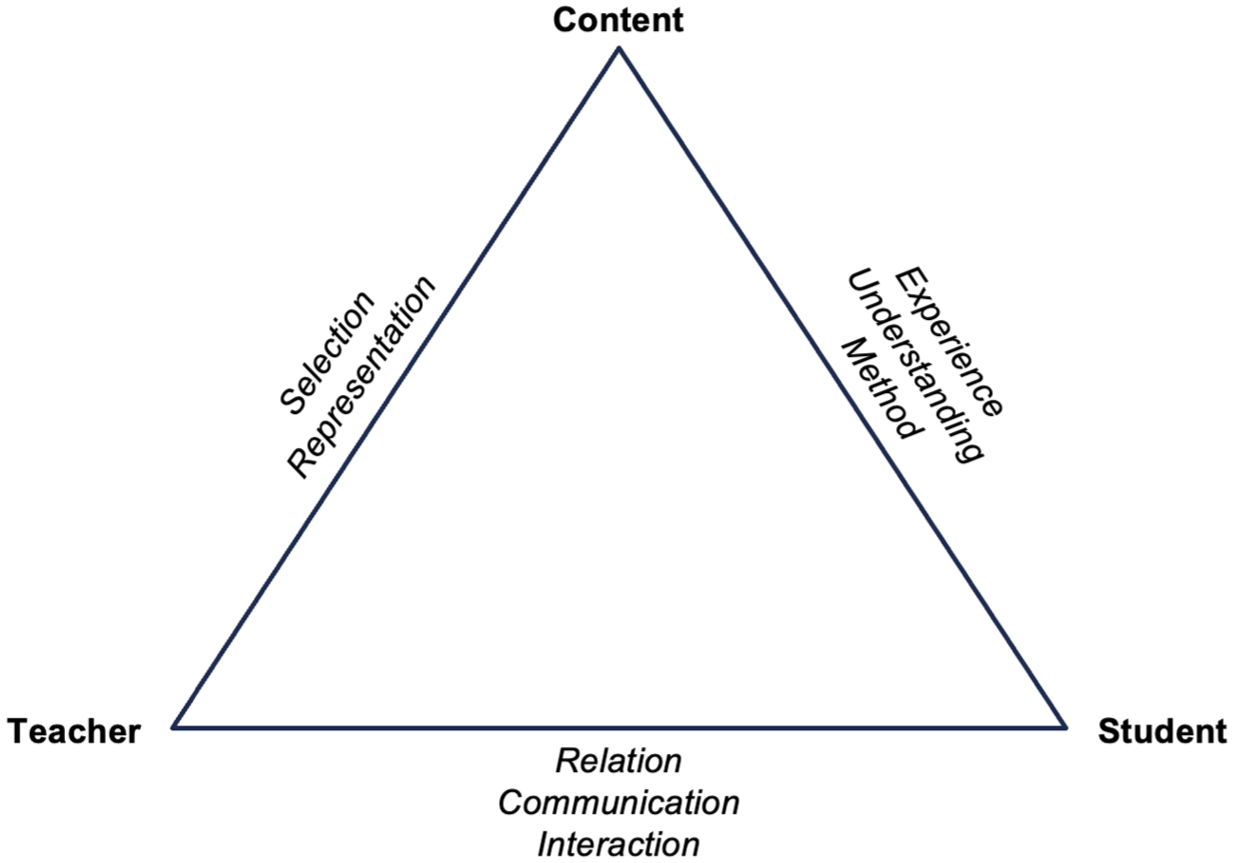
The Didaktik triangle–visualising the core dimension of the teaching situation (specification of triangle segments developed from Friesen, 2018; Hudson, 2007; Willbergh, 2021).
Finally, rights consciousness, a subfield of the study of legal consciousness, explores how individuals adopt law and legal ideologies as cultural frameworks that assist them in understanding their everyday experiences (Ewick and Silbey, 1998; Marshall, 2005). The concept of ‘rights consciousness’ refers to an individual’s ability to define problems and obstacles in terms of rights (see Merry, 2003). Research indicates that the growth of rights consciousness depends on disseminating knowledge about the existence of rights, engaging in practices where rights are experienced, and on affective dimensions such as anger and hope (Abrams, 2011; Engel and Munger, 2003; Merry, 2003; Perry-Hazan, 2021). These processes are deeply interconnected with individuals’ social locations and cultural characteristics (Lamont et al., 2016; Morrill et al., 2010).
Developing rights consciousness is crucial for ‘naming’ certain occurrences as rights violations (Felstiner et al., 1980). When individuals suffering an injustice do not name it as such, they are likely to perceive even highly undesirable states of affairs as inevitable over time (Abrams, 2011). Naming is the first stage in the rights mobilisation process, which also includes ‘blaming’ someone or an entity for the violation and then ‘claiming’ rights by seeking redress (Felstiner et al., 1980). This legal mobilisation process highlights that the realisation of rights depends significantly on individuals’ initiatives to invoke them (Marshall, 2005). The state of being rights conscious, along with the progression leading to this capacity, is central in considering CHRE actors, content and processes.
Drawing on the network’s initial conceptual mapping and further elaboration of the aforementioned theoretical perspectives, five network members developed the theory of CHRE presented in this paper. The authors are located in different countries across three continents, and while they all specialise in children’s rights and education research, their educational and scholarly backgrounds vary, encompassing pedagogy, law, psychology and sociology. A modified Delphi technique was employed during a 5-day intensive workshop. The Delphi method structures a group communication process to allow a group of experts to collectively address a complex problem and propose potential future developments (Profillidis and Botzoris, 2019). The idea is to systematically generate consensus by discussing until an agreement is reached (Olsen et al., 2021), under the assumption that group decisions will be more reliable than individual judgments (Calleo and Pilla, 2023). The main modification of the Delphi method was that contributions were not anonymous.
Based on earlier discussions within the network, it was understood that each group member held slightly different positions regarding key debates in the field. The differences within the group and the lack of anonymity in contributions were not issues, as the group had collaborated in various capacities over several years, with no member hesitant to argue an opposing viewpoint. Each aspect was thoroughly discussed until a consensus emerged. When reaching an agreement proved more challenging, a change in perspective or entry point sparked new ideas, resolving any differences. The strength of this process lies in uniting contrasting viewpoints to achieve a position where all members feel assured that their individual stances on specific issues are not significantly compromised. Following the modified Delphi process, the dimensions of the CHRE theory were determined and meticulously elaborated. The draft manuscript was subsequently provided to the entire CHRE network for review and critique.
A theory for CHRE
Theories are abstract sets of assumptions and assertions that help interpret and explain situations and processes (Dimitriadis and Kamberelis, 2006). A theory’s broad perspective on the empirical or social world transcends the singular and is therefore transferable to other situations. Theories possess explanatory power—they offer tentative explanations for phenomena that are not fully understood, proposing a logically coherent system to account for various aspects of the phenomenon and reasons for why things are as they are (Abend, 2008; Collins and Stockton, 2018).
Along those lines, the theory developed here aims to create a logically connected system that encompasses the various dimensions of CHRE and explains how this system operates. It integrates and expands upon principles of children’s rights and human rights education research while incorporating insights about children’s development and learning, educational processes, and the processes of legal mobilisation. The theory offers a definition of CHRE, establishing a foundation for its core dimensions. Additionally, it introduces a novel holistic explanatory model of CHRE, detailing its components and their interrelations. Although the theory leans towards general abstraction, its primary goal is to create a logic with strong explanatory power.
A definition of CHRE
Definitions provide conceptual clarity about terms, ensuring that readers, users and in this case, researchers comprehend their meanings. For new or emerging terms, conceptual clarity encourages a shared understanding of key vocabulary and fosters further development, testing, critique, evolution, and application in research and beyond.
To contribute to increased clarity about rights education for children (Gillett-Swan et al., 2025), the theory proposed here is based on the following definition: CHRE is the formal and informal teaching and learning of children’s rights, as a part of and distinct from general human rights; its aims, content and pedagogy take into account the distinctiveness of children as rights holders and learners.
A theoretical model
Based on existing research and the three theories mentioned above, the CHRE theory presents a logically connected system encompassing the various dimensions involved in CHRE. It provides a model that outlines the components of CHRE as a whole and explains how the system functions, detailing what is included in CHRE and how it can be implemented.
CHRE educational situations are characterised by: (a) being directed towards specific aims derived from an international legal framework and literature on rights education–which need adapting into pedagogical ends-in-view; (b) requiring rights consciousness to be developed by educators and learners before, during and after the occurrence of a CHRE education situation and (c) largely integrating the ‘how’ and the ‘what’ (content and processes) of rights teaching and learning.
From a systemic perspective, the theoretical model defines and explains the six interdependent components of CHRE: CHRE aims; Rights-oriented ends-in-view; Rights-holding learner; Rights-conscious educator; Content about, through and for rights; Rights-based educational processes (see Figure 2).
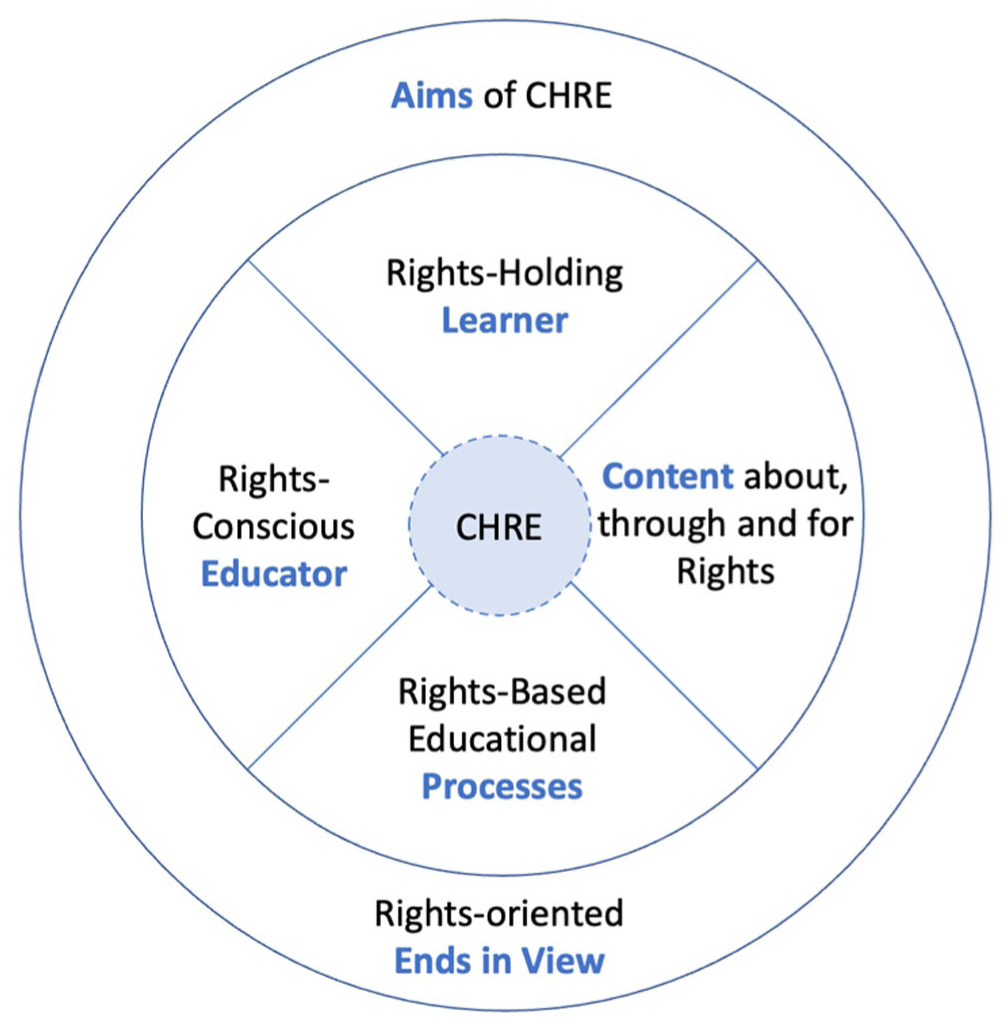
The CHRE wheel–six interdependent components of CHRE.
In the following sections, each component of CHRE is defined and connected to international legislation and relevant research on the topic. However, it should be noted that the six components of CHRE are interrelated; CHRE is compromised if any one component is missing or partially considered. For instance, if CHRE is planned and executed by a non-rights-conscious educator or through non-rights-based processes, it will lead to only ‘declarationist’ or ‘unreflexive’ teaching of international treaties or moral principles, as critics have already noted (Coysh, 2014; Keet, 2012).
The proposed model primarily focuses on classroom and group settings, reflecting one of the most widely, if not universally, spread environments in which children’s learning is currently organised and takes place. The model has the potential for scalability; however, explaining how CHRE works at a whole-school level or in more informal settings requires further analysis of all the components and their interrelations. Additionally, context must be carefully considered in CHRE scenarios, as its components may be intertwined with various cultural, political or socio-economic factors. Such developments go beyond the scope of this initial theoretical endeavour.
Components of CHRE
Below, each component of CHRE is defined, both narrowly and by unpacking its attributes. Relevant conceptual foundations are then provided, either by connecting the component to other theories (including frameworks, models, literature and data) or the broader UN framework. When appropriate, examples from the authors’ own previous research or the broader literature are provided to illustrate and explain in greater detail the various forms each component of CHRE can take in school settings. Examples also improve comprehension of the specifics of each component in relation to one another.
Aims of CHRE
Along with Dewey (1916/2024), the aims of CHRE are foreseen and desired endpoints, providing direction for the continuous everyday planning, design and undertaking of education. Although abstract and distant, rather than concrete and contextualised, aims serve to configure the sequence of steps taken to achieve them, acting as beacons towards which to orient. In international law, the overarching goal of CHRE is to promote and foster respect for a culture of human rights (UNCRC, 1989; UNDHRET, 2011). In line with the UNDHRET, three additional aims of CHRE for children can be formulated:
A developed children’s human rights consciousness;
Inner motivation and abilities to live peacefully and respectfully with others; and
Empowerment to claim, exercise and defend one’s own and others’ rights.
The first aim–to ensure children’s human rights consciousness–is developed by every child and concerns children’s capacity to use knowledge and awareness about rights as a cultural scheme through which they interpret their daily lives and events in the society in which they live, as well as in other locations. Rights consciousness also includes the ability to identify and define problems and obstacles in terms of rights and an awareness of societal mechanisms for rights protection (Merry, 2023; Perry-Hazan, 2021). This aim is anchored in the UNCRC, Art. 29(1b) and UNDHRET, Art. 4(a).
The second aim, regarding children’s inner motivation and ability to live peacefully and respectfully with others, stresses the need for rights-based coexistence. This aim brings baseline values of human rights to the forefront–equality, freedom, non-discrimination, tolerance, friendship among people, pluralism and an inclusive society–along with the ability to put these values into practice and respect the rights of others (Lile, 2020). Inner motivation to respect and live peacefully with others is accordingly closely connected to the ability to do so. This ability encompasses handling potential conflicts between the different aims of CHRE education, in particular, an interculturally sensitive approach to clashes concerning cultural identity. This aim is anchored in the UNCRC, Art. 29(1a, c, d) and in UNDHRET, Art. 4(b, c), (see also Moody, 2021; Renteln, 2013).
The third aim of CHRE, that children become empowered to claim, exercise, and defend rights for themselves and others, concerns children’s willingness, self-confidence and capacity to do this in concrete action. CHRE should cultivate agency in the learner while acknowledging the risks of indoctrination and manipulation by adults. In educational settings, empowerment is a process that may include optional elements of collective action, for example, to promote social change. This aim is anchored in the UNCRC Art. 12 and 13 and UNDHRET, Art. 4(a, c, e) (see also Perry-Hazan and Bauml, 2023).
Rights-oriented ends-in-view
The aims of CHRE, as outlined above, indicate a general direction. To assist educators in making decisions about their day-to-day activities, they need to be translated into tangible, concrete instructional or learning objectives. This is where Dewey’s (1930, 1958, 1916/2024) conceptualisation of ends-in-view as tools for guiding action proves helpful. Rights-oriented ends-in-view align with the aims of CHRE. While these are determined outside a specific learning situation–as well as enshrined in the UNDHRET (2011) and the UNCRC (1989)–ends-in-view emerge from within a situation established by an educator. Therefore, if general CHRE aims are abstract and somewhat distant from the situation at hand, ends-in-view are context-specific.
The development of ends-in-view depends on an educator’s professional capacity to identify the potential for learning towards general aims in a given situation while considering the particular circumstances. The circumstances may include, among others, children’s abilities and potential, as well as their prior learning experiences and attainments (ends-in-view will thus vary for students of differing age groups), interpersonal relationships and group dynamics, and the situation in the local community, region or country. Thinking in terms of rights-oriented ends-in-view additionally entails recognising order and continuity when working towards larger CHRE aims. The attainment of the abstract aim of empowering children to claim their rights is predicated on first reaching more immediate ends, such as learning about what rights are, what rights one has and how to protest when an injustice or rights infringement occurs.
The relationship between CHRE aims and ends-in-view can be illustrated by the case of an educator who attempts to identify ends-in-view for the more overarching aim of promoting rights-based coexistence, embedded in peaceful relationships and equality, while working in a context where children, who are concerned by a geopolitical conflict, re-enact international tensions and/or conflicts. Ends-in-view could then take various forms, such as teaching learners to express their own emotions and recognise others’ feelings, familiarising children with the cultures and languages present in the classroom, or working on understanding different positions during an argument. Ends-in-view may also concern educators; perhaps they need training in working with multicultural groups in conflict situations. This could also change how the school functions to make these ends attainable. The ends-in-view, as stepping stones, will gradually support the achievement of the aim of promoting rights-based coexistence.
Rights-holding learner
In CHRE, the child learner is the holder of rights and is recognised as such in the educational context and throughout the learning process. As rights holders, children have inherent rights to protection from all forms of discrimination, violence, and threats to their development or dignity in education (UNCRC, Art. 2, 6, 19; Moody, 2020). Simultaneously, children are also recognised as progressively acquiring autonomy in exercising their rights, including the rights to express their own views (participation) and freedom of expression, thought, religion, and association (UNCRC, Art. 12-17). Balancing special protection rights with the progressive autonomous exercise of rights acknowledges that CHRE child learners are developing individuals on cognitive, affective, social, and biological levels; therefore, their capacities are constantly evolving and should be continuously reassessed by rights-respecting and rights-conscious. CHRE educational processes should also be designed to enhance child learners’ knowledge and capabilities throughout childhood and adolescence.
Favouring a dynamic understanding of children as individuals who are progressively growing out of the need for protection while acquiring new capacities to exercise their rights and take an active part in society is crucial to CHRE. It enables the overcoming of pitfalls related to solely sequential and/or cognitive views of child development. CHRE approaches learning as embedded in context and individual and interindividual experiences, drawing on the works of Dewey (1916/2024) and Vygotsky (1978) works (see also Moody et al., 2024). Children’s socio-emotional development influences how they learn about their rights and use them in interactions with others (Naser et al., 2020; Zembylas, 2017). Therefore, children’s cultural and socioeconomic backgrounds, gender, ethnicity, religion, abilities, as well as previous and present experiences, should be considered in the course and outcomes of CHRE (de Almeida Santos and Barros, 2020; Parker, 2018) and child learners should see their lived experiences taken into account in CHRE (Moody et al., 2024).
Children’s personal direct or indirect experiences of rights infringements are also vectors for learning and, therefore, may be included in CHRE (see also Lundy and Martínez-Sainz, 2018). This suggests that CHRE could occur in non-rights-respecting contexts, even though children may not be able to fully exercise their rights beyond the learning situation. For example, when children are taught about their rights to participation and freedom of expression (art. 12-13) and attempt to express an opinion that is not accepted by adults, with help from a rights-respecting and -conscious educator, students may identify which rights are infringed, thereby gaining awareness of the experience of having one’s rights violated and finding ways to influence the situation for change.
Rights-conscious educator
In this theory, a CHRE educator should be rights-conscious. This means the educator is rights-knowledgeable, demonstrates respect for the rights of others, and intends to teach CHRE. Being rights-knowledgeable means having substantial insight into the individual’s rights and their meaning, relevant law and legal structures, rights instruments, and the relationships between them–such as the connection between the UNCRC (1989) and the two international covenants for general human rights (United Nations, 1966a, 1966b). Rights-knowledgeable educators also possess relevant interdisciplinary knowledge, including human rights philosophy, an understanding of intergroup relationships, political knowledge, and a broad awareness of global issues such as climate change, poverty, migration, peace, and security (United Nations, 2024). Additionally, rights-knowledgeable educators can independently search for information on basic legal issues related to children’s rights (Perry-Hazan and Tal-Weibel, 2020). The rights-knowledgeable CHRE educator uses their insights in selecting educational content and designing teaching materials.
Rights-respecting educators show respect for the child’s human rights by fulfilling their obligations as duty bearers under the UNCRC and demonstrating belief in the inherent human dignity of all individuals. They also act in accordance with human rights principles, which state that all rights are equal, indivisible, inalienable, interdependent and universal. These values and actions provide a foundation for their own and others’ rights experiences in education. In particular, rights-respecting educators plan and create an educational environment where children experience being respected and are encouraged to respect the rights and dignity of others. CHRE educators intend to teach children’s human rights. Their motives may vary, such as enhancing children’s knowledge about children’s rights, as a part of and distinct from general human rights, increasing their participation and involvement, developing capacity for action and agency, cultivating a human rights culture through rights awareness, building citizenship capability, cultivating respect for rights and raising awareness about collective action for social change.
Being a rights-conscious educator means respecting the human rights of both learners and teachers (UNDHRET, 2011). Acknowledging power relations is essential for rights education. A rights-conscious educator’s relationships with children are influenced by their willingness to involve them and share power in various decisions, such as those about curriculum, discipline, and assessment. An educator’s readiness to do so may depend on their conceptualisations of children’s capacity, autonomy, power, and agency (Gillett-Swan and Sargeant, 2019). It may also be influenced by their perceptions of children’s rights as encroaching on their authority (Isenström and Quennerstedt, 2020; Perry-Hazan and Neuhof, 2021). Rights-conscious educators should be able to adequately balance rights (Gillett-Swan and Lundy, 2022) based on human rights and educational principles rather than out of fear of losing power. This task may be more difficult in countries where teachers’ social status is low and they feel disempowered.
Content about, through and for rights
The selection of content is a central element of planned education. CHRE represents intentional, structured, and planned education, involving content choice. Educational content refers to the substance of education, including the topics addressed and the matters studied. The relationship between content and educational aims is close—the substance and material chosen guide learners towards these aims. Content addresses the what-questions in educational planning: what should be taught and what should be learned? The perception of educational content in CHRE combines disciplinary knowledge defined in a curriculum with content inherent in pedagogical processes.
The United Nations’ (2011) description of what HRE (and, by extension, CHRE) should include states that education should be given:
About human rights: knowledge and understanding about the norms, principles and values, and the mechanisms for their protection,
Through human rights: teaching and learning in a rights-respecting way, and
For human rights: empowering learners to enjoy and exercise their rights and to respect and uphold the rights of others.
Considering content as discipline-based knowledge supports the first element of CHRE–education about rights–represented, for example, in Young’s powerful knowledge approach to content selection (Young and Muller, 2013; see also Parker, 2018). Anchoring selected knowledge and understanding in academic disciplines helps prevent the dilution of content. For example, classroom work often emphasises rights violations but overlooks the more complex understanding of foundational norms and values of human rights (Quennerstedt et al., under review). The key question guiding the selection of about content is: What knowledge and understanding should learners receive as part of CHRE?.
However, CHRE encompasses not just cognitive and intellectual development but also affective and practical growth, as highlighted in the elements of education through and for human rights. Concerns have been raised that a strong emphasis on knowledge acquisition can be problematic in rights education: it risks downplaying education through and for rights (Sen, 2020). Moreover, a vocabulary for through and for content is lacking. Education through and for rights is closely tied to the learners’ experiences of human rights and their opportunities to claim, exercise and defend rights. Therefore, content in education through and for rights also needs to be approached and worded as embedded in pedagogical processes. In Didaktik theory, pedagogical practices and processes encompass educational content, which is the combination of pre-selected subject matter and the meaning that emerges when the learners engage with the subject during the educational processes established by the teacher (Friesen, 2021; Hopmann, 2007).
The primary pedagogical process in education through rights is experiencing. For example, experiencing respect or disrespect for one’s own or others’ rights is a powerful learning source. When designing education through rights, it is essential to consider the experiences children need to have in order to learn about these rights as educational content. The guiding question for selecting this content is: What experiences should be provided to learners as part of CHRE?
Education for rights should empower learners to claim and exercise their own rights while protecting those of others through capacitation. This capacitation can be continually enhanced by practising how to express viewpoints and participating in role-play exercises to intervene in bullying. Designing education for rights involves identifying the skills children need to develop in order to exercise, claim, and defend their rights. The guiding question for selecting the for content is: What capacitation should learners receive as part of CHRE?
Rights-based educational processes
In CHRE, educational processes are based on and conducted according to children’s human rights as outlined in the UNCRC and the larger human rights framework. While all educational processes should be rights-respecting, CHRE emphasises the need for intentionality in making sure these processes are also rights-based. For a process to be rights-based, it ought to incorporate and embed the aims of CHRE into teaching as well as throughout daily school life experiences. It is important to note that rights-respecting processes can occur even without an intentional rights-based motive. For example, consider the common situation where a student insults another in the corridors. An educator may unintentionally intervene in a rights-respecting way by explicitly condemning hurtful words and possibly requiring an apology as a form of redress. This could be viewed as a typical kind of moral or educational intervention in schools, along with recalling school rules and policies. A rights-based response to the same incident focuses on ensuring that individuals feel defended and acknowledges each person’s responsibilities. By explicitly framing the event as a rights violation (as outlined in UNCRC, Art. 19, along with broader principles of human dignity and integrity), the intervention process transforms into a rights-based educational practice rather than merely a method of correcting behaviour.
Educators can plan rights-based processes, including participatory learner-responsive pedagogies that are active and cooperative. These processes support the articulation of instrumental, communicative and emancipatory knowledge. They can be informed by various learning theories such as cognitivism, (socio-)constructivism, behaviourism or experiential learning, which are common in foundational teacher education courses (Cranton, 2006). Pedagogies that engage children as genuine social agents and recognise all forms of learning—cognitive, social and emotional—are preferable in the context of CHRE because they reflect rights principles (Moody et al., 2024; see also CASEL, 2024; Gillett-Swan and Sargeant, 2018).
Rights-based processes should encompass all aspects of teaching, including planning (which involves selecting content, scheduling and assessment), instructional methods, classroom implementation, feedback and the evaluation of educators. These processes could also be integrated into the drafting of class rules or working procedures by facilitating discussions on the purpose of rules, encouraging individuals to express their views (as outlined in UNCRC, Art. 12 and 13), experiencing democratic processes (such as voting), and being regarded as equal partners in the development of these rules.
Concluding discussion
This paper presents a theory of Children’s Human Rights Education (CHRE), defining foundational concepts and organising them into a logical system to foster a shared understanding among researchers focused on rights education for children. By transcending the boundaries of two fields of research–educational children’s rights and human rights education–this work introduces an innovative integration of conceptual foundations from both areas into a new theory and model. Six interdependent essential components of CHRE have been identified, extensively defined, and illustrated where necessary. In summary, CHRE requires careful consideration of the following:
Specifying the overarching goal of HRE to promote and foster respect for a culture of human rights, the aims of CHRE for children are threefold: (a) a developed children’s human rights consciousness; (b) an inner motivation and corresponding abilities to live peacefully and respectfully with others and (c) the empowerment to claim, exercise, and defend one’s own rights as well as those of others.
The aims of CHRE need to be translated into tangible, concrete learning goals, which are here conceptualised as ends-in-view. These ends-in-view emerge from within a situation established by an educator. They are context-specific and may notably be influenced by children’s abilities and potential, prior learning experiences and achievements, interpersonal relationships and group dynamics.
The child learner is recognised as a holder of rights. Balancing special protection rights with progressive autonomy rights allows to view the child as a developing individual with agency in the present. Recent insights into the cognitive, social and emotional aspects of child development, along with their interactions with the cultural and social environment, should be taken into account.
CHRE educators should be rights-conscious, meaning they are knowledgeable about rights, demonstrate respect for the rights of others and intend to teach CHRE. By adhering to the UN Convention on the Rights of the Child (UNCRC), they fulfil their role as duty bearers. They plan and create an educational environment where children experience being respected and are encouraged to respect the rights and dignity of others.
The content in CHRE should support education about, through and for children’s human rights. When selecting content to achieve this, this education should draw on the questions: (a) What knowledge and understanding about rights should learners develop? (b) What experiences of rights should learners be provided with? and (c) What capacitation for rights should learners meet?
CHRE processes should be both rights-respecting and rights-based. To be rights-based, the aims of CHRE should be integrated into both teaching and daily school life experiences. Rights-based processes encompass all aspects of teaching, including planning, instructional methods, classroom implementation and feedback.
This CHRE theory presents several benefits. First, it establishes a solid foundation for research on rights education for children, offering a scholarly alternative to the United Nations’ main terminology by integrating theoretical insights from both educational children’s rights research and human rights education research. Second, the theory supports educational thinking and research on CHRE, aiming to enhance the profile and quality of CHRE research while increasing attention to essential educational issues, such as content, processes, aims, and the actors in teaching and learning situations. Third, as a research framework, it may support policymakers by providing directions for developing curricula and teaching materials, which can ultimately help educators apply CHRE in their daily activities with children.
Some limitations should nonetheless be acknowledged. Notably, the theory of CHRE is primarily intended for researchers and, therefore, is not meant to measure the effectiveness of the CHRE educational situation or to serve as a teaching method for CHRE educators. Future developments could, however, build on the theory as the foundation for such assessments or teaching methods. While it indicates what CHRE should be, it also provides a reference point for policymakers to ensure they consider all components of CHRE while developing CHRE programmes and for educators to guide the development of their work. A second limitation to emphasise is that the theory does not initially target children. Although the ultimate aim is to improve the effectiveness of CHRE for children, they are merely secondary beneficiaries and were therefore not involved in its development. Future studies may create CHRE programmes and activities for children, informed by the theory. Another limitation concerns the authors’ positionality, which may necessitate adapting the theory to non-Western contexts. The authors recognise that context must be carefully considered in CHRE situations, as the components of CHRE may be intertwined within various cultural, political or socio-economic aspects. The importance of context for CHRE is, however, embedded in the view that the global children’s rights discourse should be meaningful for children in all contexts and interact with diverse constructions of childhood (Liebel, 2023).
In conclusion, several research paths are now available for consideration. Empirical testing of the CHRE theory could yield robust studies that develop it, particularly when the context is taken into account. Future studies could also further elaborate on each component of the theory, both in isolation and in interaction with other components. Finally, practical developments of the theory, co-created with educators and children, could establish an implementation framework for professionals.
Footnotes
Acknowledgements
We are indebted to the Children’s Human Rights Education Network members for their input in identifying the core elements of the theory presented in this article and for their valuable feedback and constructive comments on previous drafts of this article. We also thank the reviewers for their detailed evaluations and helpful insights, which have greatly improved the quality of this manuscript. The first author conducted the research and wrote this article while affiliated with the University of Teacher Education Valais and the Centre for Children’s Rights Studies of the University of Geneva, Switzerland. The support of both institutions is gratefully acknowledged.
Data availability statement
No data.
Declaration of conflicting interests
The authors declared no potential conflicts of interest with respect to the research, authorship, and/or publication of this article.
Funding
The authors disclosed receipt of the following financial support for the research, authorship, and/or publication of this article: The Swedish Research Council supported this work under grant 2021-04307.
Ethical approval and informed consent statements
No data.
