




Abstract
Primary school approaches to student voice and leadership rarely change, despite concerns about manipulation and tokenism. This single case study investigated an approach to student voice and student leadership in an Australian primary school that was very different to a traditional student council. Thematic analysis of school documents and staff and student interviews found that informal pathways, such as daily teacher/student interactions, consultation with students and students collaborating with teachers in learning contributed to elevating the power of student voice in the school community. However, building leadership in a formal program was problematic for staff and students. The disruption of traditional school structures placed primary school students at the forefront of school leadership and teachers and students working together to build a democratic and inclusive learning environment was a greater challenge than anticipated.
Keywords
Introduction
A pressing issue in education is that more students are disengaging from school at an early age (Organisation for Economic Co-operation and Development (OECD), 2011). In response to higher levels of student disengagement, many countries are embracing a personalisation agenda in an attempt to tailor education to the learning needs of each student (Ministerial Council for Education, Early Childhood Development and Youth Affairs (MCEECDYA), 2008). Personalising learning can have a positive impact on student engagement, as it provides opportunities for students to develop greater influence and control over their learning (Quinn & Owen, 2014; Roberts & Owen, 2011). Central to the philosophy of personalisation is curriculum choice and voice, as a way of involving students in making decisions regarding their learning (Sebba et al., 2007).
The United Nations has stated that it is a child’s legal right to participate in decisions which affect their lives (United Nations Convention on the Rights of the Child (UNCRC), 1989). The UNCRC (1989) states that all children have the right to express their views freely in all matters affecting the child (Article 12), and to free expression; ‘to seek, receive and impart information of all kinds, regardless of frontiers’ (Article 13). In the past, children’s voices have tended to be silenced in decisions about the way their education is provided (Fielding, 2004a, 2004b; Rudduck & Flutter, 2004; Smyth, 2006, 2007, 2010). Recognition of these rights has placed a greater emphasis upon student voice and participation in individual and collective decision making in schools both in Australia and internationally (Holdsworth, 2013; Lundy, 2007; Mockler & Groundwater-Smith, 2015).
Student voice has a long educational history and is a term used for a body of practices which include student consultation, participation, collaboration, leadership and intergenerational learning (Fielding, 2011; Fleming, 2012; Mayes, 2013; Mitra & Gross, 2009). These school practices offer students the opportunity to make informed decisions regarding their learning and learning environments, as well as issues which will affect them as individuals and within society. Schools play a vital part in preparing them for their future roles as ‘active and informed citizens’ (Fielding, 2004a; MCEECDYA, 2008, p. 4; Robinson & Taylor, 2007). Arguably, children and young people will be better equipped for this if they experience a democratic environment throughout their schooling (Mitra, 2006; Mitra & Gross, 2009; Mockler & Groundwater-Smith, 2015).
A broad base of Australian student voice research has shown that whole school student voice have been successfully utilized through informal pathways to make improvements in teacher–student relationships, teaching practice and pedagogical approaches, curriculum change and improvement (Griebler & Nowak, 2012; Mitra, 2008; Rudduck & Flutter, 2004). Programs that are formally designed for student voice (such as student councils or SRCs) enable students to participate as representatives to consult, to collaborate in or lead formal decision making on behalf of their collective peers (Apple & Beane, 2007). SRCs are not a new educational practice. However, these traditional measures are not seen as innovative forums for student voice, as often they are purely consultative and opportunities for students to ‘collaborate with others; or to ‘build leadership capacities’ (Mitra & Gross, 2009, p. 523).
Building an effective program for student voice can be problematic in schools. Efforts to engage students in developing their student voice programs can quickly dwindle into tokenism if school leaders and teachers are not genuine and committed in their approach (Fielding, 2004a; Quinn & Owen, 2014). Genuine commitment and value towards student voice, as well as educators acting on student opinions has been termed ‘teacher authenticity’ (Rudduck & Fielding, 2006, p. 226). Teacher authenticity is considered crucial for the possibility of a successful student voice, as it has been noted that even in school environments which promote student voice opportunities, students still tend to act passively, rather than as active leaders for change (Mitra, 2009). Tokenistic participation often serves to alienate further the student body from teachers, especially if the processes are seen as exclusionary (Hart, 2008; Quinn & Owen, 2014). This is an issue which is especially pertinent for disengaged or disadvantaged students (Sinclair, 2004). Indeed, it is those voices which need to heard, so educators can better understand their views and how to re-engage them in positive learning experiences (Fielding, 2004a).
Recent research has followed school communities which transform pathways for student voice and move away from traditional teacher-lead SRCs to student-run initiatives. Through innovative approaches it has been found that student leadership in school decision making can generate exciting opportunities (Mitra, 2006, 2008). These innovations can offer a range of benefits for educators and the school community, as student voice is also personally and socially beneficial for students, increasing self-esteem, self-efficacy and school connectedness for those involved (Beaudoin, 2005; Griebler & Nowak, 2012; Kirby et al., 2003). Benefits have also been shown to students’ conceptions of citizenship, civic efficacy and sense of social justice (Kirby et al., 2003; Mitra & Serriere, 2012).
Fielding (2004a) considers that successful approaches to student voice require a ‘rupture of the ordinary’ regarding power relations between teachers and their students (p. 296). Educators must be open to ‘seeing students differently’, as valued, equal and active citizens in the school and wider community (Cook-Sather, 2006, p. 366). This requires a transformation of teacher and student relationships, so that students genuinely share power with teachers and are empowered as a result (Fielding, 2004a, 2004b). Promoting respectful relationships where educators and students engage in open dialogue can create opportunities for digging deeper; to deeper engagement, deeper learning and more meaningful participation in everyday school life (Cook-Sather, 2006; Kirby et al., 2003; Mockler & Groundwater-Smith, 2015; Rudduck & Flutter, 2004).
The current study is based on the premise that students are capable of greater involvement in their educational decisions; indeed it is their right to do so. While the current literature has attentively investigated this area with older students, whole school student voice approaches with primary school children in particular is a neglected area (Mitra & Serriere, 2012; Quinn & Owen, 2014). Current understandings of alternative student voice approaches with primary school children and how this impacts upon their learning need to be extended, as well as the impact on teachers and school community (Mockler & Groundwater-Smith, 2015).
This article explores an approach to student voice, drawing on research conducted in a primary school that had recently undergone a transformation to a personalised learning environment. The school and its leadership were highly committed to student voice as a pillar of their approach and were situated in a community which can face difficult social and economic conditions, with a high proportion of disadvantaged students. As previously stated, the voices and views of disadvantaged students in Australian schools, whether it is Indigenous students, students from a low income background or students for whom English is a second language could provide valuable insight into how to improve their schooling experiences and educational engagement (Rudduck & Fielding, 2006). This article aims to highlight the power student voice can have for these children as individuals, for the students as a collective and for the school community.
Method
The research was conducted collaboratively with a school which had already selected as a case study site through a state-based research project. The school was situated in a metropolitan area with approximately 250 students. A significant proportion of the students were from low socio-economic backgrounds as well as students from Indigenous backgrounds or who spoke language other than English (LOTE) at home.
A qualitative case study was chosen as the methodology. Although a single case has limitations, the strength of this methodology was that it allowed for the exploration of student voice in the school environment in depth, using multiple methods of data collection.
Data sources
Multiple data sources assisted the researcher to incorporate a variety of perspectives on student voice and leadership, thus forming the basis for triangulation and corroboration of the data and improving the reliability and trustworthiness of the findings (Basit, 2010; Yin, 2003). School documents relating to the school context and structure of the student leadership program were sourced for document analysis. A semi-structured interview was conducted with the school principal to provide background information about the school’s approach and leadership’s attitude towards student voice. Observation of the school was also conducted by the researcher during visits to the school in a three-week period and recorded in field notes.
Four focus group interviews were conducted with staff and students over the course of three weeks. These interviews provided an avenue for discussion between participants and helped to explore topics known to them in depth, with little input from the researcher (Basit, 2010). The participants were selected through a mixture of purposive and convenience sampling (Basit, 2010). The age of students in the focus group ranged from 10 to 13 years. Participants included three class teachers who also acted as staff advisors in the school’s leadership program since its inception. The staff advisors were able to provide information about the exact structure of the school and student leadership program as well as their perceptions of success and areas of challenges for student voice at the school.
Focus groups conducted with student participants included five student members of the school’s leadership program. Three of the students had participated in the leadership program since it began and two students were new members in the year of this study. Two focus group interviews were held with student leadership. The first was a pilot interview which was then repeated the following week. Student leadership members were invited to express their opinions regarding the importance of student voice in their school both at individual and collective levels and their perceptions of the positive and negative outcomes which resulted from their participation in student leadership. Student members also identified factors which motivated them to participate in the program.
A separate focus group was conducted with three students who were not members of the leadership program. The focus group discussed their perceptions of student voice and the leadership program, as well as the perceived positive and negative outcomes it produced in the school. These students also expressed their views of the possible opportunities to participate in the program from a position of the wider school body.
Data analysis
A theoretical framework drawn from Pawson and Tilley (2000) was used to guide the formation of study propositions and data analysis (see also Quinn & Owen, 2014; Wilson, 2008). The framework, known as the context + mechanism = outcome (CMO) method, considers that ‘programs are about people’. Programs have successful outcomes when people use agency, the appropriate structures, ideas and opportunities (mechanisms) in the right social and cultural conditions (context). The framework searches for contextual conditions and causal mechanisms which turn (or fail to turn) into an outcome, or in short ‘what works for whom under what circumstances’ (Pawson & Tilley, 2000, p. 69).
Data analysis was guided by a grounded theory approach, with data categorically indexed and compared according to themes based on theoretical propositions drawn from the current research literature and the CMO method. Initial index categories consisted of contexts and mechanisms which lead to either positive or negative outcomes for student voice. Context categories were broken down into subcategories of value and commitment on the one hand and power relations on the other hand. Mechanism categories were divided into structure on the one hand and ideas, opportunities, and agency on the other hand. Outcomes were split into either benefits or negative effects. Data were coded through the use of axial coding and placed within these CMO categories. Evidence supporting theoretical propositions was coded as a positive CMO occurrence. Any evidence of a negative CMO occurrence was coded as such. Evidence which did not support the theoretical propositions were added as further themes or categories which added to current knowledge, or to address rival explanations to the study propositions (Yin, 2003).
Findings and discussion
The school context
Value and commitment to student voice
From 2007 to the time of this study in 2012, the whole school had undergone a transformation which saw considerable changes to its organization, curriculum and extra-curricular activities. Classes consisted of small groups of students across multiple year levels from Reception to Year 7 and two class teachers for each class. Each day, the whole school followed the same timetable, beginning with whole school fitness, followed by student learning plan study, literacy and numeracy and then discovery study. In discovery, students could choose from a variety of subjects or inquiry based topics offered in cycles throughout the term.
The pillars of the approach to the school transformation, ‘student choice and voice’ were evidenced in both the flexibility of the curriculum and teachers embedding an attitude towards listening to student voices every day (Mitra & Gross, 2009; Quinn & Owen, 2014). Student voice occurred individually through determining the focus of individual learning plans and the choice of activities offered for discovery learning. Students were able to express themselves regarding their own learning, as well as being actively encouraged to voice their opinions regarding school issues. Collaboration with adults occurred in classroom learning, as students and teachers worked together to incorporate experiential, inquiry or project-based learning pathways into the curriculum. Each day students were able to exercise responsibility in their individual learning topics and plans, engaging in ‘pedagogical dialogue’ with their teachers (Mockler & Groundwater-Smith, 2015, p. 57). The following statement from the school’s principal explains the personalised learning philosophy: For me, it’s having a level of self-direction or exploration of learning, having will to inquire and a sense of wonderment… It does have that greater element of students choosing what, when and how they are going to be learning… But taking a greater amount of responsibility… the teacher shouldn’t be working harder than the kids when it comes to learning. It should be about teachers facilitating that process for the children.
Power relations
The personalised learning environment invited students to participate in learning opportunities which were traditionally thought of as the teacher space (Mitra, 2006). As teachers and students collaborated around these new enterprises, students were engaged on deeper levels and became heavily invested in learning. In time, children were able to develop the capacity for making informed decisions about their learning (Mitra, 2008; Mockler & Groundwater-Smith, 2015). The following student comment indicated the impact this approach has had for their learning: Most of the schools I’ve been to we could only choose what we wanted to do on one day of the week. But here, we can do it nearly every day. Having that sort of freedom helps the students to grow as people … so they can have a better idea of what they want [in the future]. It empowers them and helps them to get involved in everything that is going on. (Student 1)
It became apparent in staff interviews that the participating adults have made the conscious decision to put children first (Beaudoin, 2005; Kirby et al., 2003). On a daily basis, teachers and school leadership, such as the principal, listen to student views, make decisions with them about their learning and encourage students to act as equal partners with teachers in their education (Quinn & Owen, 2014).
Mechanisms
The structure of the student leadership program
A full model of the structure of the school’s formal student voice program is presented in a visual diagram in Figure 1. The program has been applied to the ‘Pyramid of Voice’ framework (Mitra & Gross, 2009, p. 523; Quinn & Owen, 2014) which serves to illustrate possible opportunities that arise through the elevation of student voice in the school. In contrast to Mitra and Gross (2009) in the case study school the ‘Pyramid of Voice’ has been turned on its head, to represent that the students are its foundation.
The student governance model and the ‘Pyramid of Voice' (adapted from Mitra & Gross, 2009).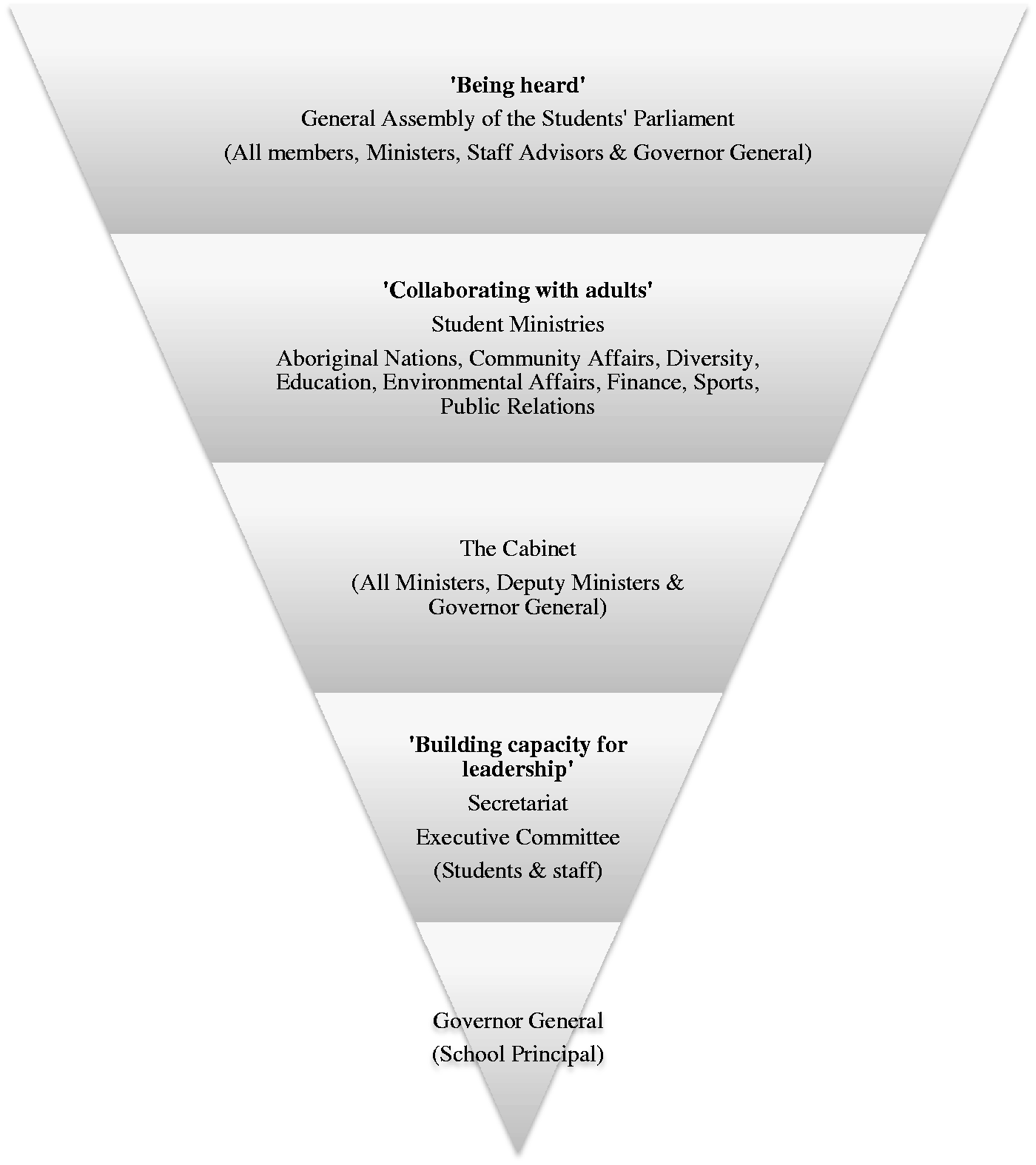
Student leadership impacted on participation in many areas of the school environment. The structure, incorporating eight ministries with wide ranging topics, enabled learners to present ideas and be involved in a variety of school aspects. The students were directly involved in determining curriculum content, generating ideas for extra-curricular activities, developing initiatives for school sustainability and anti-bullying policies and maintaining a budget for the leadership program. In contrast to a traditional SRC, the wide range of areas’ students were able to be involved in contributed to heightening the presence and power of student voice and student leadership in the school (Cook-Sather, 2006).
Ideas, opportunities and agency
Leadership and teachers in the school were clearly open to student opinions; they actively listened to student ideas and shared decision making processes with children (Lundy, 2007). In the same vein the student participants held the strong belief that their articulated views would ‘be heard’, they had opportunities to ‘collaborate with adults’, building their ability to respectfully question authority (Mitra & Gross, 2009, p. 523; Mitra & Serriere, 2012). It became evident that ‘teacher authenticity’ is an important factor in developing trust between teachers and students, which lead to student empowerment, autonomy and a sense of agency (Mockler & Groundwater-Smith, 2015; Rudduck & Fielding, 2006). The following comment from the school’s principal demonstrates an approach to ‘teacher authenticity’: For me it was…. talking to the students in terms of what the opportunities are. Putting up almost… setting myself up for trying to spark some rebellion in them. Working in a sense of responsible rebellion, that understanding that they really can do some stuff. That this isn’t just a facade, that it can actually have meaningfulness in the school.
Staff involvement in the student leadership program strived to be more than tokenistic. As expressed in the student focus group, participants believed that leadership and staff were genuinely interested in students' views and focused on involving them in the decision making process from start to finish (Lundy, 2007; Rudduck & Fielding, 2006). Students worked alongside adults step by step, even in more complex areas, such as school policy, school finances and newsletter and website publications. Staff and leadership encouraged students to act with a sense of freedom to make decisions in their own ministry (Rudduck & Flutter, 2004). The student participants who were members of the program expressed that this balance of authority and freedom enabled them to develop their own ideas for school change (Freire & Freire, 2004; Mitra & Gross, 2009).
Outcomes
Benefits
Involvement in the student leadership program resulted in multiple benefits. In their ministries, members learned to work collaboratively with their advisors and with peers. In turn, students were able to develop the skills of communication, negotiation, active listening, facilitation of discussions and delegation of responsibilities to accomplish their goals. Leadership members engaged in dialogue, discussion and debate before deciding on an avenue to solve problems. This contributed to developing thinking and reasoning skills as well as the ability to critically reflect upon past decisions for improvement or find new solutions (Lodge, 2008). The following students' comments highlighted the benefits of being involved in student leadership: If there’s something you don’t like, you can change it … Say, I don’t like the way this is going, we can try to make it work in a better way. It could be more fun for the kids or more educational … Instead of just sitting down and doing nothing. (Student 2, Leadership member) It’s a good opportunity. You might be somebody on the outside, but if you join [the program], you actually become somebody. You become more, and you get a say instead of being a person on the outside. You get to learn more things. (Student 3, Leadership member)
For these students, being a part of the leadership program has been beneficial not only to their school connectedness, but also to their sense of self-esteem and civic efficacy (Mitra & Serriere, 2012). Participants who were members of the leadership program felt a sense of belonging to their school community and believed they are able to make a difference to it.
Negative effects – Digging deeper
Power
At the time of this research, all the participants identified areas of improvement for the leadership program. Leadership and staff advisors would advocate for the program and actively sought out students to act as leaders in the school community. The staff participants indicated that motivating all members to participate actively in student leadership was still a challenge. The school’s principal commented: I want them to not just accept what is. I want them to notice and I want them to do something about it. It’s not easy to get people to think in the teacher space. But I think there’s scope for students to be digging deeper, more deeply living that notion of student voice in the school and the community.
It was the opinion of all participants that traditional power relationships had been transformed, with students having a greater power in formal school decision making (Fielding, 2004a). Staff advisors expressed their willingness to see students differently but believed that there was some block towards students taking on a leadership role. However, they could not pinpoint a possible cause for this phenomenon.
Popularity voting
Delving into this issue with students revealed the perception that the leadership program’s voting processes were unfair. Each year, the processes by which students were nominated and elected as representatives became competitive. The staff and students perceived that these elections would turn into a popularity contest. The focus group interview with students who were members of the leadership program revealed the belief that popularity voting was unfair and also put pressure on them to only vote for their friends: This year it was a little bit weird, it was a little bit hard. Because some people had their friend looking over their shoulder, saying “Oh, pick that person, pick that person.” And people were like “Oh, pick me because I’m your best friend”. Cos they were looking over your shoulder and you don’t know what to say and do. (Student 3, Leadership member)
The phenomenon of popularity voting also resulted in the impression for students that leadership candidates needed to be of a certain socio-metric status or ‘perceived popularity’ within the peer group to be elected (Asher & McDonald, 2009, p. 229). One student comment reflected the views of non-members about voting procedures: It’s rigged… only the people who ever get in are the popular kids. Me and [another student] would have no chance… it’s only the popular kids who get in which is unfair… all they’ve done is try to make themselves look good, I don’t think they’ve done anything really smart. (Student 1, Non-member)
These findings are consistent with various issues raised by Rudduck and Flutter (2004), who highlight the necessity of fairness. For this student leadership program, competition and popularity voting have contributed to creating perceptions of an unfair structure, therefore alienating some students and excluding them from participating. If students who do not perceive themselves as popular choose to nominate as a representative for leadership programs and fail to be elected, then it can impact negatively on their self-esteem (Rudduck & Flutter, 2004). To safeguard fairness and to minimize the chance of competitive popularity voting, changes to the election processes needed to be made. Beaudoin (2005) advocates the abolition of elections to be more inclusive of all students and promote equal opportunity to participate. Lodge (2005) strongly advocates directly involving children in dialogue regarding elections and voting, to increase student ownership and assure fairness. These perspectives are consistent with conditions in the case study school; not all class groups had a representative as the voting processes would not always work out equally. This unequal distribution of student representatives limited opportunities for participation for non-member students.
‘Representativeness’
In many instances student leadership had improved conditions for learners considerably. The students collaborated in drafting the school anti-bullying policy. Hence, they were able to define specific behaviours which for them constituted bullying and how students who bully should be handled. A club was organized so children who missed breakfast would have somewhere to go and eat before school. The students were also responsible for recycling and received financial benefit by doing so, which resulted in more money for school events throughout the year.
However, in some instances student ideas for improvement or events were actively rejected by members of student leadership. This was perceived by some children to be directly linked to anti-social peer relationships, as evidenced by the following comment: Can I say that half of my ideas have to go to the [Ministry] and you know who’s in charge of that? Someone who hates me. We have to write our names on the sheets we put into the mailbox. I bet you the only reason that half of my ideas don’t get looked at it because it has my name on it. (Student 2, Non-member)
Similarly, Cox and Robinson-Pant (2006) found in their research that new power relationships between students emerged as council members were seen to have similar authority to teachers. As a result, the power which was assumed by members would lead to students imposing their own views rather than listening and incorporating the views of their peers. Indications were that, for some students, trust between their student leadership ‘representatives’ and the school cohort was broken and was affecting student voice. As a result, some students had become disenchanted with student leadership, but still wanted a strong student voice: Even though they have a hundred million meetings, they don’t do anything. What is the point of having it? Why don’t they just have something where people can say what they want? I don’t really see the point of having it. I used to but I don’t see it anymore…. It has nothing to do with me. (Student 1, Non-member)
The wider context is important to consider as Smyth (2006) points out, schools are intricate relational organisations. In this school’s personalised learning environment with a student-led leadership program, pro-social peer relationships and a sense of community is vital for positive social and academic development (Wentzel, 2009). In the same way that Rudduck and Fielding (2006) identify ‘teacher authenticity’ as critical for student voice work, in this environment developing ‘student authenticity’ on the part of representatives will be fundamental for the continued success of the governance program. Teachers and students alike must be encouraged to protect and cultivate the views of their peers, take them into account and act on those suggestions when making decisions.
Fielding (2004a) associates these difficulties with ways adults encourage children to ‘speak about others’ and ‘speak for others’ (p. 296). He considers that adults involved with ‘student voice’ should encourage children to address marginalisation directly, exploring which groups are left out of decision making processes. Many studies cite the tendency for student governance to be accessible only for the well behaved, articulate or academically minded learners (Cook-Sather, 2006; Cox & Robinson-Pant, 2006; Flutter, 2007; Rudduck & Fielding, 2006; Wilson, 2008). What is clear from this study is that any person involved in student voice or leadership must be mindful of excluding voices and encourage students to ‘speak with others in supportive ways’ (Fielding, 2004a, 2004b, p. 301).
Conclusions and recommendations
Despite the limitation of a single case study methodology (Bell, 2010; Yin, 2003), the context and mechanisms found in this primary school’s approach to student voice and the benefits and negative effects it produced for students, provide useful information and guidance for schools and teachers when designing their own programs.
Despite some of the emergent issues with the student leadership program, the power of student voice was seen as beneficial for the school and its community. The impact student voice has had upon learning and engagement for children as individuals was evident in their increased commitment to learning (Rudduck & Flutter, 2004). The impact of involving students in making decisions at a whole school level opened up opportunities for participation in areas not previously available to them.
School policy, organisation and curriculum planning are all traditional teacher spaces, but this research has shown that in a ‘rupture of the ordinary’, primary school children can and will collaborate in and lead student voice to enrich the school community (Fielding, 2004a, p. 226; Mitra & Gross, 2009). However, as emphasised by all research participants – educators and students alike – the transfer of power to children can create new and complex issues not easily understood (Arnot & Reay, 2007). If educators want to hear the voices of the truly disengaged or disenchanted students the people who are representing these students must be under scrutiny.
As a result of this research, students, advisors and leadership began to consult and collaborate with one another to explore possible avenues for more inclusive voting structures, to ameliorate the prospect of popularity voting. To strengthen the leadership program further, a greater level of involvement was also required from students and teachers at an individual classroom level. In addition to voting for student representatives, the participants recommended that teachers and students would negotiate for an equal amount of leadership members for each ministry, from each class which could be shared over the school year. This measure was aimed at increasing opportunities for participation and sharing of the workload but also helped to develop more informal pathways for student voice to be heard by teachers and students alike. These student-led changes to the voting processes helped to ensure that regardless of their perceived popularity, or member/non-member status, all students believed they could actively participate in student leadership.
In the case study school, adults and children firmly believed that given the opportunity, primary school students can and should have the opportunity to make logical, rational decisions which enrich their community. What was truly innovative about this school and its students was the constant view that leadership and teachers continuously looked for methods for improvement while keeping student voice integral to the process, as was the case of this research. The case study school transformation continues through consultation, collaboration and student leadership, keeping students’ views and active participation as central to a creative and vibrant school community.
Footnotes
Declaration of conflicting interests
The author(s) declared no potential conflicts of interest with respect to the research, authorship, and/or publication of this article.
Funding
The author(s) received no financial support for the research, authorship, and/or publication of this article.