



Abstract
This theoretical review examines how democratic education is conceptualized within educational scholarship. Three hundred and seventy-seven articles published in English language peer-reviewed journals between 2006 and 2017 are discursively analyzed. Democratic education functions as a privileged nodal point of different political discourses. Two discourses against (elitist and neoliberal) and six discourses pro democratic education (liberal, deliberative, multiculturalist, participatory, critical, and agonistic) construct its meaning. It is argued that the different versions of democratic education respond to various (a) ontological and epistemological assumptions, (b) normative approaches to democracy, and (c) conceptions of the relationship between education and politics. For educational policy, the review provides a critique of elitist and neoliberal policies and support for participatory decision making across discourses. Recommendations for educational practice are made by identifying pedagogies across democratic education scholarship as well as specific pedagogies for each discourse.
Since Dewey wrote “Democracy and Education” in 1916 much has been written about democratic education in education scholarship and theory. A work initially subtitled “An Introduction to Philosophy of Education” (MW.9) 1 inspired theory and research not only in philosophy of education but also in education scholarship more generally (Doddington, 2018). For a long time, “democratic education” has functioned as a nodal point (Laclau, 2007; Mannion, Biesta, Priestley, & Ross, 2011) within educational theory and research, serving as a place of encounter for different educational disciplines, discourses of democracy and education. But democratic education has been recently disputed, with some authors warning about crisis (Okoth & Anyango, 2014) and others openly positioning themselves against democratic education (Pennington, 2014). This review aims to examine how democratic education is conceptualized within contemporary educational scholarship to support ongoing debate about its viability.
The question of democratic education is particularly relevant in our moment. Although there are different historical and philosophical accounts of democracy, existing Western democracies have their roots in both liberalism and democracy (Macpherson, 1977). Liberalism is often defined as a political doctrine that aims to guarantee separation of powers, individual liberty, and the rule of the law. Democracy is more frequently associated with equality and popular sovereignty. In liberal democracy, the liberal and the democratic tradition merge. From this perspective, democracy is both morally and instrumentally appealing. It offers dignity to its citizens and it is often advantageous in terms of providing stability, prosperity, and peace (Runciman, 2018). During most of the 20th century, democracy—or more precisely, liberal democracy—was presented as a universal aspiration. After the democratic crisis of the 1930s (see Runciman, 2018), different international organizations such as the United Nations explicitly committed themselves to the promotion and defense of democratic values and practices (United Nations, 2005) and this commitment spread following the end of the Cold War. At the close of the 20th Century, approximately half of the population lived under the rule of some form of electoral democratic system (Isakhan & Stockwell, 2012).
The events of September 11, 2001, first evidenced that liberal democracy was not as dominant as some predicted (Fukuyama, 1992). It became apparent that ideological rivalry remained across the globe and that, in a number of countries, democracy was de facto threatened by semiauthoritarian organizational structures and values, interethnic conflicts, politically motivated violence, and structural racism (Isakhan & Stockwell, 2012; Okoth & Anyango, 2014; Waghid, 2009). More recently, the democratic aspirations of some of those participating in the Arab spring uprisings have been crushed by civil wars reflecting geopolitical dynamics that question the transnational relevance of democratic principles (Tausch, 2019).
Simultaneously, the 2008 financial crisis fueled a “crisis of democratic faith” (Asmonti, 2013, p. 143) even within well-stablished, institutionalized and normalized (i.e., consolidated) liberal democracies such us those of Western Europe, the United States of America, or Canada. The hopes in the modernization and widening of democratic politics represented (among others) by the election of Barak Obama in the United States and Synaspismós Rizospastikís Aristerás SYRIZA (The Coalition of the Radical Left) in Greece were (at least) partially thwarted by the global market-led politics of austerity. The erosion of state sovereignty and the reduction of “the capacity of government parties to implement effective policies and fulfill voters’ expectations” were evidenced (Martinelli, 2016, p. 13). The perceived distance between political elites and the electors, and the increase of socioeconomic disparities have contributed to high levels of frustration, alienation, and cynicism toward conventional politics, particularly among young people and some marginalized groups (Gibson & Grant, 2012; Ho, Sim, & Alviar-Martin, 2011). At one extreme, some argue for more (elitist) technocratic forms of governance, where “nonpartisan experts” commit themselves to pragmatic solutions to political problems (Runciman, 2018). The other extreme, found in the so-called “populist” movements and parties, defines “the people” in opposition to the technocratic elites who are considered both corrupt and illegitimate (Runciman, 2018). This is not a crisis of democracy but, rather, a crisis of liberal democracy (Martinelli, 2016). This is not liberal democracy’s first crisis, but it is distinctive insofar as liberal democracy “is no longer young. It lacks the heady sense that existed a century ago of vast, unfulfilled potential” (Runciman, 2018, p. 71).
The links between democracy and education are implicit in most historical and philosophical accounts of democracy. The theoretical founders of liberal democracy conceived education to be instrumental for the ideal society in which citizens would develop their own potential (Barber, 1994). This conception had a strong influence in the design of worldwide education systems, particularly in the universalization and the purposes of formal education (Biesta, 2007). After Dewey inaugurated the debate on “Democracy and Education” (MW.9), the struggle for democratic education has been central to key approaches and philosophies of education such as child-centered and critical pedagogies. The question of democratic education has expanded to the extent that education as a discipline is shaped by questions such as: Who, in a democratic society, should decide educational policies? (Gutmann, 1996) And what would a democratic curriculum look like? (Apple, 2011).
Democratic education scholars currently draw on these previous debates to examine potential “antidotes” to present challenges. Different versions of democratic education permeate educational scholarship, suggesting possible ways in which education could address democratic threats and/or contribute to the democratization of countries. With different (and sometimes competing) democratic aspirations in mind, democratic educators examine and make recommendations for educational policy and practice. Also, perhaps in a long time, critical voices have been raised against democratic education and its contemporary perils (Pennington, 2014). This theoretical review provides a detailed examination of how the meaning of democratic education is presently shaped in the literature, considering different normative approaches to democracy and their proposals for policy and practice in education. The purpose is not to determine the effectiveness of democratic education practices and policies but rather to provide a map for examining how theories shape scholarship on democratic education policy and practice, and to identify possibilities for future discussion.
The review begins with a description and justification of the selected method. The methodological approach, the sampling, and the analytical procedures are examined, and the main characteristics of the selected articles and the limitations of the review are then described. This is followed by a section presenting the eight versions of democratic education that emerged from the analysis. In the discussion, the main differences and trends are identified. The review concludes by making recommendations for further theory, policy, practice, and research.
Method
This study takes as its starting point an interpretivist understanding that social realities are constructed through “discourses,” understood in terms of Ernesto Laclau and Chantal Mouffe’s discourse theory (Jorgensen & Phillips, 2002; Laclau & Mouffe, 2001). A discourse is a system of meanings and values including linguistic exchanges and the actions in which these exchanges are embedded (Laclau, 2007). This definition is not a denial of the existence of (extradiscursive) materiality, but rather an acknowledgement that, even if this material reality “exists independently of any system of social relations” (Laclau, 1990, p. 101), humans give meaning to this through a “specific discursive configuration” (Laclau, 1990, p. 101). Thus, it is assumed that while theory and research on democratic education might be built on political and/or educational nondiscursive or material data, the meaning of this data is still constructed in relation to particular ontological, epistemological, and axiological assumptions.
Discourses are constructed around nodal points or signs (Laclau & Mouffe, 2001), places of arrival of several discourses (Mannion et al., 2011, p. 444). Some of these nodal points operate as “floating signifiers” (Laclau, 2007) or critical but contested “horizons”: aspirational “signs that different discourses struggle to invest with meaning in their own particular way” (Jorgensen & Phillips, 2002, p. 28). For instance, within the political field, “democracy” operates as a floating signifier of different political discourses. Although liberal democracy is the dominant version within Western democratic politics, the meaning of democracy is not fixed and there are other discourses struggling to gain predominance (i.e., hegemony), presenting their version of democracy as the “real” one (Laclau & Mouffe, 2001). This review begins from the presupposition that democratic education functions as a floating signifier in education scholarship, receiving structural pressure from rival projects. Conceptualizing democratic education in these terms provides us with the methodological and theoretical tools to examine democratic education as an overarching but contested moral aspiration.
This theoretical review maps out democratic education as a potential floating signifier. The contested meanings of democratic education, their associated political project, their philosophical foundations, and their recommendations for education are examined. The exclusions and critiques of these versions are also analyzed. Specifically, the research questions ask: (1) What are the versions of democratic education emerging from educational theory and research published in English language journals? (2) What are the political discourses associated with these versions? (3) What are the philosophical assumptions underpinning these discourses? (4) What are the recommendations/critiques of educational policy and practice emerging from these discourses?
Search Parameters
The search and selection of articles took place in three stages (see Figure 1). In the first stage (September to October 2017), Web of Science, ERIC, Google scholar, and Scopus databases were reviewed with the search term democratic education in the fields of abstract, descriptor, and title. As democratic education was assumed to be a floating signifier, the search was limited to articles explicitly discussing the term and aiming to invest it with their own meaning. Sources published between 2006 and 2017 were included. The year 2006 was chosen as it marked the publication of three influential reviews on citizenship (Abowitz & Harnish, 2006; Osler & Starkey, 2006) and social justice education (North, 2006) with extended overlaps with the present review. 2 The search returned 1,598 sources. After deleting duplicates, 1,046 sources remained.
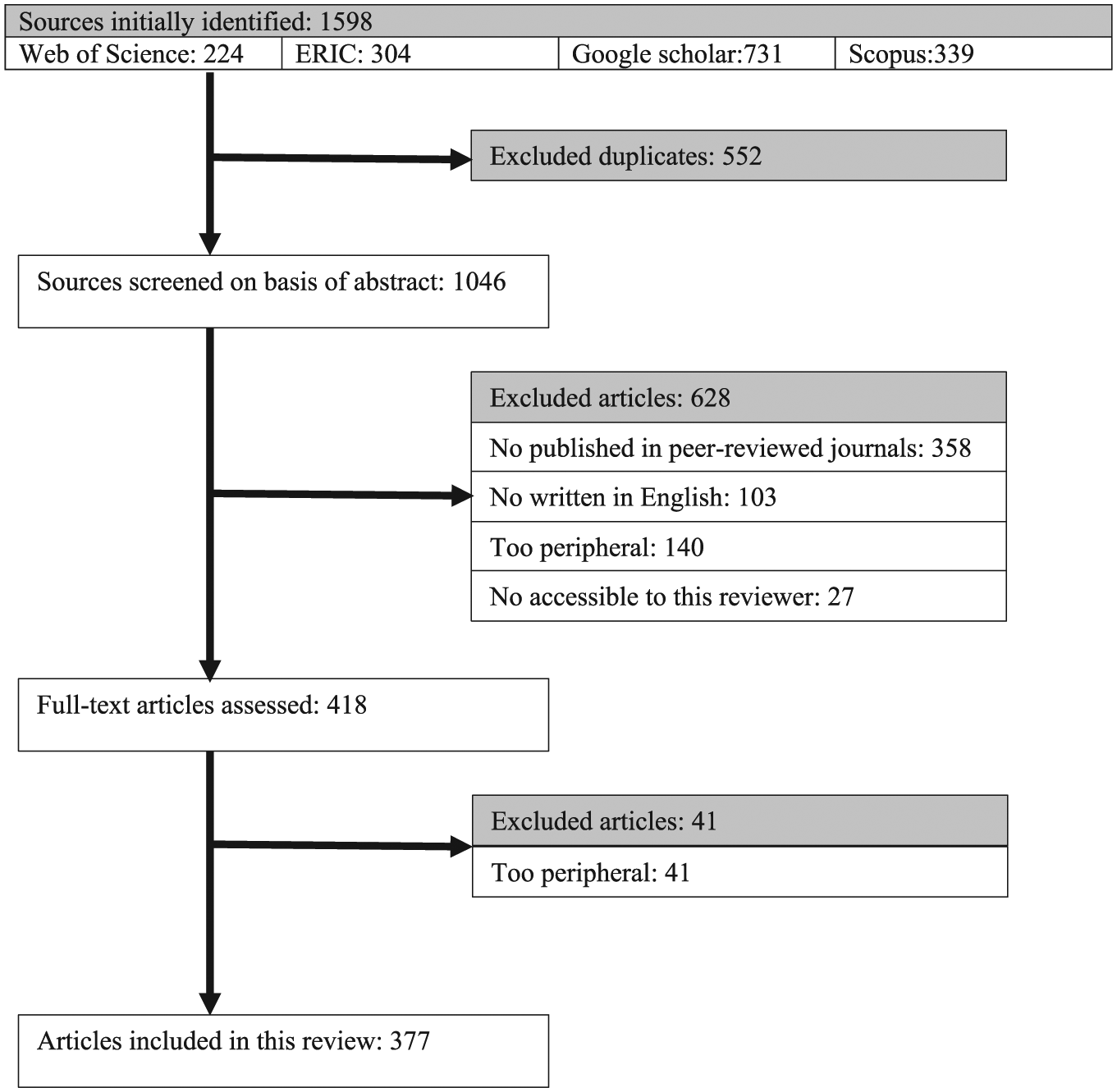
Diagram of the review inclusion process.
Four criteria of inclusion/exclusion were used in the second stage. The first was a quality criterion. Following the example of Ahmad (2017), publication in peer-reviewed journals was considered evidence of quality. Thus, only articles published in peer-reviewed journals were selected. Second, there was a language criterion. Only articles published in (or translated to) English language were selected. Third, a focus criterion was applied. The abstracts of all articles were reviewed and, following the example of Wenner and Campbell (2017), peripheral articles were excluded. An article was considered “peripheral” when democratic education was a secondary issue in relation to a clear focus on another topic of discussion. For instance, Grimes, Sayarath, and Outhaithany (2011) examine inclusive education within the Lao People’s Democratic Republic. Besides discussing an educational policy in a Democratic Republic, no other mention is made of democratic education in this article. Fourth, there was an accessibility criterion. Only the articles accessible to the researcher via open source or via library or interlibrary loans were included. After applying these four criteria, 418 articles remained.
In the third and final stage, the whole corpus of articles was read and reevaluated. Some articles initially included on the basis of their abstract were rejected when the article itself did not fulfill the focus criteria. This process resulted in a total of 377 articles being included in this review.
Included Articles
There are some contextual trends within these 377 articles. The articles were mainly written by academics based at English-speaking, Western institutions. Approximately 66% of the articles were written by academics affiliated to American, British, Australian, or Canadian institutions (see tables in the supplemental information available online). The focus of the articles, nevertheless, was mostly “generic” with almost 60% of the articles discussing democratic education in universalistic—rather than state-based—terms. Democratic education was, in some instances, contextualized in relation to particular forms of education. Discussion privileged formal education, particularly within secondary (23%) and primary (19%) institutions. As expected, different educational disciplines and approaches merged within debates on democratic education. It is worth noting that the fields of philosophy of education (26%), pedagogy and curriculum studies (37%, including social studies and citizenship), and policy and politics in education (12%) proved to be particularly prominent. Unsurprisingly, the reviewed articles were more often published in specialized journals (Democracy & Education, 7.2%) or philosophy of education journals (Educational Philosophy and Theory, 4%; Studies in Philosophy, 3.4%; and Education and Educational Theory, 3.2%).
Data Analysis
Following the principles of discourse theory, data were qualitatively interrogated with the set of research questions in mind (Jorgensen & Phillips, 2002; Willig, 2013). Procedurally, the analysis took place in three stages. In the first stage, all 377 articles were uploaded to NVivo 11. Each article was considered a sampling unit. A coding frame was created containing four categories related to the study’s research questions. These are political project, philosophical assumptions, policy, and practice. Within these categories, analysis was data driven, with codes emerging from the data. For each category and code, a memorandum was created defining the name, a description, examples, and decision rules. This was then followed by the creation of matrix nets and schemes showing the four categories and codes related to each of them.
In the second stage, all texts were revised and recoded considering the emergent codes. At this stage, some initial discursive patterns of consistency became apparent. These patterns comprised articulations of codes across the four different categories, with academics repeatedly arguing for and against normative approaches to democracy, their philosophical grounds, and their respective educational projects. Nine major versions emerged from this second stage, each of them associated with a distinctive political discourse: seven pro democratic education (liberal, deliberative, participatory, multicultural, cosmopolitan, critical, and agonistic) and two against (elitist, neoliberal). After careful examination, the decision was made not to include the cosmopolitanism as an independent version. In brief, cosmopolitanism emphasizes the global context—beyond nation-state borders—of democratic education (Abowitz & Harnish, 2006) but in the reviewed articles, “cosmopolitan” or “global” appeared always within another reference framework (liberal cosmopolitan, multicultural cosmopolitan, critical cosmopolitan). It was concluded that, within the reviewed literature, cosmopolitanism could be considered another nodal point (Mannion et al., 2011) of different discourses rather than a version of democratic education itself.
In the third and final stage, all articles were codified in relation to the resulting eight versions and associated political discourses. It is worth emphasizing that perspectives for and against each version were used to generate each discursive pattern and therefore are presented as such. For clarity, if an article is used to illustrate a particular version, this does not necessarily mean the article favors the particular version of democratic education of this discourse. Rather, it may be that the proposals or critiques within the article have been used to draw the limits of the discursive construction or it might be that, two or more versions of democratic education coexist in the article. However, to fulfill the mapping intention of this review, some clear proponents of each version are explicitly identified. Considering word-count limitations, only 137 of the 377 articles are presented in this review 3 to illustrate the discussion. A few articles clearly aligned with each of the eight versions that were selected. In addition, some (less clearly aligned) articles were included for their rich and detailed discussion, which provided new possibilities to consider the nuances of the topic.
Limitations of This Study
Limitations to the methodological approach and the empirical procedures need to be considered. Methodologically, Laclau and Mouffe’s discursive theory has been challenged for privileging hegemony and antagonism over other potential discursive logics (Erman, 2009; Jorgensen & Phillips, 2002). More generally, discourse theories have been criticized for placing too much emphasis on the discursive nature of reality (Lather, 2016). While acknowledging these critiques, it is assumed that all methodological approaches might have their own strengths and drawbacks and that the rigor of the research project needs to be considered within the limits of each particular methodological understanding (Lincoln, 1995).
Empirically, only English-written journal articles and not dissertations, conference proceedings, books, and so on, or articles written in any other languages, were included in the search. Although the language criterion is commonly used in reviews, it is still important to acknowledge that this criterion might have conditioned the perspective of the reviewed articles. However, the review includes articles from authors working in academic institutions across 38 different countries. In order to maintain the focus of the study, contextual information is provided only when the context is essential to understand the nature of the authors’ claims.
The criterion of selecting only journal articles was taken for accessibility and quality-assurance reasons. This decision facilitated the systematization of the search, collection, and analysis process but limited the scope of this review. Acknowledging this limitation, this review does not profess to map out versions of democratic education on all education debates but rather explicitly limits its findings to democratic education within theory and research published in English language journals. 4
The Contested Meaning of Democratic Education
This section presents the eight versions of democratic education that emerged from the analysis. For each version, the associated political discourse and its philosophical principles, the educational implications for policy and practice, and the debates and critiques are examined.
Elitist Democratic Education
Key Principles
The elitist version of democratic education is linked to elitist discourses of democracy. Advocates of democratic elite theory follow Joseph A. Schumpeter’s and Walter Lippmann’s understandings of elitist democracy (Buck & Geissel, 2009; Fallace, 2016), and propose that politics should be in the hands of a small elite who would guarantee the stability of democratic societies. In this perspective, elites are conceived as more politically active and, consequently, to have a greater understanding and commitment to democratic values (Ho, 2012). Organized in competing groups, these political elites are periodically accountable to the masses who evaluate their performance through voting (Buck & Geissel, 2009).
Underpinning the elitist discourse is the belief that elites are necessary for the functioning of any society. The social space is here understood as a complicated and conflicted reality, underneath which there is a Platonic absolute structural “truth” (Covaleskie, 2006). Knowledge of this truth, Plato assumes, brings “virtue” but it is not easily accessible. It demands levels of ability, self-sacrifice and commitment only available to a minority. In the elitist ideal society, only the elites —the aristocracy or the philosopher-king in Plato’s Republic—should rule the polis and be involved in politics. The elites are the only ones who have access to knowledge and consequent virtue, and, as a consequence of this knowledge, they are more likely to know how the social space should be organized.
Educational Implications
Elitists recommend different educational practices for students conditioned by the social role that each student will pursue. For instance, in Singapore, three distinctive citizenship programs exist, one for the elite of cosmopolitan leaders, one for mid-level workers, and one for “local” followers (Ho, 2012). More generally, authors describe two different forms of democratic education: one orientated to the elites and another orientated to the masses. For the elites, cosmopolitan forms of knowledge and values are particularly relevant. Upper-class students learn other languages and cultures, study abroad, and engage with the Western canon (Duarte, 2016). For the masses, alternative curricula are proposed. In some occasions, these students are not expected to be educated to participate (Wisler, 2009). It is assumed that “nonelite” students will automatically learn about democracy because schools are embedded within democratic systems (Hawley, Hostetler, & Mooney, 2016). In other instances, participation is reduced to the act of voting (Buck & Geissel, 2009) and nonelite students are expected to gain knowledge on formal political structures (Pike, 2009; Zyngier, Traverso, & Murriello, 2015) so they can evaluate the elites’ performance.
Debates and Critiques
Elitism is not a strong discourse framing democratic education. Indeed, among the reviewed articles, only Bai (2011) appears to favor this version. Elitism is more often a discourse against which democratic education is constructed. The elites are not perceived as virtuous but rather as potentially undemocratic (Ho, 2012). Ching-Sze Wang (2009), for instance, cites Dewey’s point that “the world has suffered more from leaders and authorities than from the masses” (LW.4.365). 5 Education in democracy, as discussed by elitists, is considered to be minimally democratic (Pike, 2009).
Liberal Democratic Education
Key Principles
Liberalism is likely the most powerful discourse shaping the meaning of democratic education. Liberal democracy is often considered to be the dominant version of democracy (Carr, 2008). Liberal democracy functions as a tacit social contract between individuals and the state in which representativeness and plurality are key features (Buck & Geissel, 2009; Schoeman, 2006). As elitists, liberals argue for the division of society into those who govern and those who are governed (Feu, Serra, Canimas, Làzaro, & Simó-Gil, 2017); however, in contrast to elitist views, they defend the equality of citizens as the starting point and affirm the primacy of the individual over the social (Walzer, 2012).
Liberals privilege freedom over any other democratic value (Buck & Geissel, 2009; Walzer, 2012). The question of freedom, however, is controversial even within this framework. Democratic educators often use Isaiah Berlin’s distinction between negative and positive liberty (Alexander, 2007; Carleheden, 2006; Covaleskie, 2006). Negative liberty is defined in relation to Thomas Hobbes’s work as the absence of external impediments (Carleheden, 2006; Corngold, 2011; Fraser-Burgess, 2012). From this perspective, democracy is instrumentally valuable as it is effective in guaranteeing individual liberty. But it is the notion of positive liberty that has attracted the attention of most liberal democratic educators. For them, as for Immanuel Kant, liberty is the freedom to be ruled by one’s own rationality (Fraser-Burgess, 2012; Hanson & Howe, 2011). Rationality and aspiration for freedom are conceived as part of the natural “makeup” of human beings (Alexander, 2007; Biesta, 2007). Thus, “through strict, unswerving adherence to the dictates of reason” (Corngold, 2011, p. 73), all humans are expected to have the capacity to access social truth. This truth is understood as being attentive to universal “moral law” (Corngold, 2011; Sünker, 2007). Liberals assume that rational citizens will use their freedom to act for the common good (Buck & Geissel, 2009; Covaleskie, 2006; Evans, 2010). From this point of view, democracy is morally valuable: It functions as a political expression of the liberal value of self-fulfillment and it fosters (political) equality by providing equal rights to participate in political and social life.
Educational Implications
Proponents of liberal democratic education include Duarte (2016), Msila (2013) and Şanlı and Altun (2015). For them, education is essential for political, epistemological, and moral reasons. Political equality can only be guaranteed in a society of knowledgeable and rational citizens, and so democracy demands the universalization of education (Msila, 2013) to guarantee equal opportunities of self-realization (Belcastro, 2015). Mass schooling policies worldwide, currently acknowledged in the Declaration of Human Rights and in the UNESCO’s Education For All program (Okoth & Anyango, 2014), have (at least partially) their roots on this conception (Duarte, 2016).
Liberal educators also advocate for an education for democratic citizenship based on knowledge and reason (Biesta, 2007; Gibson & Grant, 2012). In terms of knowledge, liberal educators worldwide recommend that students should acquire knowledge of democratic institutions and procedures. Particularly, they emphasize knowledge of local and national political and juridical systems and governments (Biseth, 2009; Burgh & Yorshansky, 2011; Sabia, 2012; Walzer, 2012), of democratic values (Sabia, 2012), and of individuals’ rights and duties (Gibson & Grant, 2012; Waghid, 2009). Liberal educators also recommend that students study the history of democratic institutions and practices (Burgh & Yorshansky, 2011; Gibson & Grant, 2012; Walzer, 2012) and examine the potential strengths and weakness of democratic systems when compared with other forms of government (Biseth, 2009). Cosmopolitan liberals advocate the need for a cosmopolitan democratic education that examines the ethical basis of human rights (Aguilar & Molina Zavaleta, 2012; Ho et al., 2011). History and social studies are identified as subjects that are particularly helpful for these examinations (Duarte, 2016; Gibson & Grant, 2012; Şanlı & Altun, 2015).
Rational citizens, in this liberal framework, also require the ability to think critically (Abowitz & Harnish, 2006; Duarte, 2016). Since social ills are considered to arise from irrational living (Sibbett, 2016), the content of democratic education programs, Şanlı and Altun (2015) argue, “should be based on scientific truths and should reflect scientific knowledge correctly” (p. 5). Liberal educators recommend that teachers should focus on helping students develop an ability to weigh evidence, evaluate views and potential truths, detect contradictions, form and articulate opinions, and respond to those who disagree (Abowitz & Harnish, 2006). Educating these critical thinking abilities becomes an educational purpose across all curricular areas including mathematics education (Aguilar & Molina, 2012).
Debates and Critiques
Liberal democratic education is perceived in two different ways. Some authors critically identify the potential deficits of their present or past systems when compared with the principles of liberal democracy. This is the case, for instance, of authors writing from South Africa (Msila, 2013) or Spain (Aubert, Villarejo, Cabré, & Santos, 2016). From this perspective, liberal democracy is considered as aspirational and democratic education a vehicle toward this possible outcome. Others, writing from consolidated liberal democracies such as the United States or the United Kingdom, often discuss the deficits of liberal democratic systems and liberal democratic education. In this respect, most versions of democratic education could be considered as a reaction to liberal democratic education. From a deliberative perspective, for instance, Lim (2011) discuss how the Kantian conception of (individual) rational autonomy undermines the potential role that communication and the public sphere can play in democratic education. From a participatory perspective, Biesta and Lawy (2006) criticize the lack of participation in liberal democratic education programs.
Neoliberal Democratic Education
Key Principles
Neoliberalism is connected with aggregative theories of democracy. Aggregative theorists define democracy as the aggregation of individual preferences (Biesta, 2011; Feu et al., 2017) regulated through procedures similar to those of the market (Meens & Howe, 2016). Competition is a key feature here (Abowitz & Harnish, 2006; Meens & Howe, 2016). Citizens are conceived as rational consumers who, through voting, compete so that their views and private interests prevail. Political candidates are expected to compete for people’s votes and democracy itself becomes the political equivalent of the economic market.
There are four main differences between the underlying assumptions framing liberal and neoliberal discourses. First, in contrast with liberals, neoliberals privilege the negative approach to liberty. Freedom is conceived as the absence of external coercion (Carleheden, 2006; Corngold, 2011). Second, democracy is denuded from any moral aspiration. It functions as a political system that effectively guarantees individuals’ freedom and prevents social violence and fraud (Pennington, 2014). Third, where if liberals aim to balance societal rights and responsibilities between individuals and the state, neoliberals swing the balance toward the former. Following Friedrich Hayek (1952; see also Pennington, 2014), objective truths might exist, but individuals are unlikely to have access to them. Under this situation of permanent ignorance, toleration of individuals’ perspectives and the protection of the private sphere are needed against uncheckable universal claims that attack individuals’ liberty. Fourth, markets are understood to exceed the economic sphere and operate as a forum where individuals’ views compete (Ichilov, 2012). Markets perform three main social functions: they create spaces where producers and consumers bid for all kind of resources, they “perform a public learning function ( . . . ) determining which goods are in fact valued” (Pennington, 2014, p. 8), and they increase the diversity and the quality of opportunities. Markets, therefore, are understood as better organizers of the social space. The expectation is that, if all individuals pursue their self-interest, the total sum of “rational choices” will result in better social and economic organization (Sung, 2010).
Educational Implications
Neoliberals recommend the replacement of public education with free market practices (Ichilov, 2012). Following Mill, the freedom of individuals to form their ideas will be inevitably conditioned in state schools (Covaleskie, 2006) and thus, neoliberals reject any form of curriculum for education for democratic citizenship (Evans, 2010; Pennington, 2014). They do, however, support educational policies in the line of aggregative democracy they conceive to be less invasive for the individual. The neoliberal discourse is articulated around two main principles. First, discussions about school choice (Meens & Howe, 2016; Menashy, 2007; Perry, 2009), parental choice (Hantzopoulos, 2015; Pennington, 2014; Sung, 2010), and students as consumers (Carr, 2008; Menashy, 2007) are embedded within this framework and can be found worldwide. The “Choice in School” governmental bill in Sweden, charter schools in the United States, academies in the United Kingdom, and private schools in Australia and Argentina (Arreman & Holm, 2011; Zyngier et al., 2015) are only a few examples. The logic supporting these policies is both moral and economic (Sung, 2010). Insofar as no educational practices can be proved to be universally desirable, students or their parents should have the individual liberty to decide (Pennington, 2014). Simultaneously, it is expected that choice would generate more diverse and higher quality educational opportunities (Pennington, 2014) and that the total sum of rational choices will equate “with the structuration of an effective education system as a market scenario would expect” (Sung, 2010, p. 74). Second, standards, assessments, and accountability are emphasized (Menashy, 2007). Neoliberals recommend that educational institutions need to be accountable to the public. Establishing common standards, such as the Common Core State Standards in the United States, reflects a commitment to the idea of quality education for all, because it fosters transparency of practices and more efficient procedures (M. Levinson, 2011). Independent audits like the Organisation for Economic Co-operation and Development’s Programme of International Student Assessment (Belcastro, 2015), the English Quality Assurance Framework for the Higher Institutions (Bacon & Sloam, 2010), or the High stakes testing under the US “No Child Left Behind” policy (Meens & Howe, 2016), help prevent fraud and allow citizen-consumers to make more informed choices (Pennington, 2014).
Debates and Critiques
If liberalism initially framed formal education within democratic societies, neoliberalism appears to be a dominant discourse in current educational policy almost worldwide. However, the extent to which aggregation, choice and accountability can be framed as democratic education is, nevertheless, questionable. As with citizenship educators (Abowitz & Harnish, 2006), democratic educators rarely explicitly identify themselves with neoliberal principles. Rather, neoliberal educational practices are often presented as antagonistic to democratic education even by proponents of neoliberalism themselves (Pennington, 2014). Indeed, democratic educators often write about how neoliberalism represents an attack on equality as a democratic value (Menashy, 2007). 6 Research conducted in Australia, the United States, and the United Kingdom suggests that “choice” practices privilege the middle and the upper classes (Meens & Howe, 2016; Perry, 2009). Some parents might struggle with the information, resources, and time to conduct the so-called rational choices required to identify “higher status” schools (Perry, 2009; Sung, 2010). They also might fear weaknesses in the capacity of their children to adjust to the demands of these schools (Sung, 2010) or they might simply not find better options available (Meens & Howe, 2016). Simultaneously, schools populated with low-income children more often appear to be prone to budget cuts (O’Donnell, 2018) or to be considered in need of improvement in accountability audits (Meens & Howe, 2016). Standards and assessment procedures do in themselves contribute to inequality by “sorting” students into different groups (M. Levinson, 2011). Social cohesion is also damaged by neoliberal discourses on democracy and education. Aggregative forms of democracy restrict the spaces for public deliberation on the common good (Biesta, 2011; Hanson & Howe, 2011; Meens & Howe, 2016), while the practices of choice undermine social cohesion and the sense of education as a public good (Perry, 2009).
Neoliberalism, democratic educators argue, also undermines the possibility of democratic educational policies and practices. In a number of Western societies, school choice policies have taken the process of decision making from the hands of communities and school boards, and increasingly concentrated the power in the hands of business interests or other unelected institutions (Bindewald, Tannebaum, & Womac, 2016; Perry, 2009). Simultaneously, processes of accountability have evolved into authoritarian and technocratic models in which teachers’ professionalism is questioned by expert bureaucrats (M. Levinson, 2011; Sabia, 2012). Neoliberalist educational practices have also limited the diversity of opportunities that the same neoliberalists recommend (Pennington, 2014). Individuality and competition are fostered through choice (Sung, 2010) and accountability practices (Gibson & Grant, 2012; Sabia, 2012), creating a hegemonic discourse that limits individuals and communities’ choices outside of these discourses. The lack of diversity also affects curricula and students’ learning (Bickmore & Parker, 2014; Menashy, 2007). Accountability procedures have limited the diversity of provision (M. Levinson, 2011). With a focus on what is quantifiable, nonquantifiable outcomes are marginalized from the curriculum (Apple, 2011; Menashy, 2007). With minor exceptions, worldwide teaching has become test based, with students having to look for the single “correct” answer (B. Levinson & Brantmeier, 2006; Menashy, 2007). In this context, opportunities for critical dissent—which for some is considered essential to democratic practices—are minimized (Bickmore & Parker, 2014) and compliance with the dominant system is promoted (M. Levinson, 2011; Tannock, 2017).
Deliberative Democratic Education
Key Principles
Deliberative democrats, such as Seyla Benhabib, Amy Gutmann, and Dennis Thompson, propose the existence of public forums where all citizens can provide reasons that will be discussed under conditions of equality (Abowitz & Harnish, 2006; Lefrançois & Ethier, 2010). In contrast with neoliberal, liberal, and elitist discourses, deliberative democrats conceive all citizens as de facto coauthors of public decisions (Sabia, 2012), reducing the gap between the public and actual decision-making processes (Lefrançois & Ethier, 2010). Reason and inclusivity are key features. Deliberative democrats argue that participants in deliberative processes can commit themselves to the values of rationality and impartiality, seeking the best collective reasons (Biesta, 2011; Hanson & Howe, 2011). The most compelling reasons will operate as the moral imperative that needs to be accepted by those who are bound by it (Bindewald et al., 2016; Fraser-Burgess, 2012). The legitimacy of deliberative democracy relies on the inclusiveness of the deliberation processes (Boone, 2007). The perspectives of all who are governed by public decisions need to be considered (Camicia, 2009; Hanson & Howe, 2011).
In deliberative democracy theory, rationality is constructed using both pragmatist and liberal claims. Following Kant, liberals understand that reason and morality are unavoidably connected. Deliberative democrats, in contrast, follow John Rawls and Jürgen Habermas and argue for a consensual rationality described as an “overlapping consensus of citizens committed to diverse conceptions of the good” (Ferkany & Whyte, 2013, p. 8; see also Carleheden, 2006; Corngold, 2011; Johnston, 2012). Thus, rationality moves from being subject centered to being intersubjective (Biesta, 2007; Dotts, 2016; Johnston, 2012). To “deliberate” is not so much a matter of finding universal solutions for universal problems, but rather a public inquiry to make decisions in relation to contextualized problematic situations (Johnston, 2012). The role of communication is essential. Following Dewey, deliberative democrats believe that communication fulfils socializing, rhetorical, and epistemological functions (Burgh & Yorshansky, 2011; Dotts, 2016). Through communication we influence and are influenced by others and we create meaning through these interactions. Furthermore, deliberative theorists understand that regulated communication processes can create the necessary conditions for inclusive decision making (Freedman, 2007; Jónsson, 2012). In a situation of free, open, and symmetrical communication, fair consensus in public decisions can be achieved (Lefrançois & Ethier, 2010).
Educational Implications
Influential proponents of deliberative democracy educators, such us Parker (2010), Hess (2008), Lefrançois and Ethier (2010), Carleheden (2006), and Hanson and Howe (2011), discuss both educational policy and practice. Deliberative educators advocate for educational policies framed through deliberative decision-making processes. Following Gutmann, deliberative educators examine who should have the authority to make decisions in education and what should be the limits of such authority (Fraser-Burgess, 2012). Questions such as how the content of the curriculum is determined are particularly relevant (Freedman, 2007; Kessel, 2009). According to Gutmann and others who take up her work, decisions in education should be taken in a process of deliberation involving parents, citizens, and professional educators (Corngold, 2011; Fraser-Burgess, 2012; Kessel, 2009). Hinchliffe (2013) examines the case of School Boards in England (1870–1902) as a historical example of this co–decision-making process. Professionals, but also “[l]ocal businesses, universities, elected officials, and especially parents all have stakes in the future of their community and its children” (Bradshaw, 2014, p. 2). The authority of these groups, nevertheless, should be morally bound to ensure the inclusiveness of the deliberative process (Fraser-Burgess, 2012). Gutmann identifies here two principles to guarantee inclusive deliberation. The first is nonrepression. Citizens cannot be excluded from the deliberation process because of their conceptions of the good (Boone, 2007; Corngold, 2011; Fraser-Burgess, 2012). The second is nondiscrimination. Citizens cannot be denied participation in deliberative processes on the basis of group differences (Fraser-Burgess, 2012; Meens & Howe, 2016; Perry, 2009). Deriving from this second principle, deliberative educators emphasize the need of a democratic threshold (Corngold, 2011; Fraser-Burgess, 2012; Meens & Howe, 2016). The Mozert v. Hawkins case in 1987, in which a group of fundamentalist Christian parents in Tennessee filed a suit against the Hawkins County schools for not allowing their children to opt out from the character education curriculum, is still used as an example of this principle (Kessel, 2015). Here, deliberative educators favor the Hawkins schools. Although all moral conceptions are welcome, the plurality of options for all children needs to be guaranteed. Thus, public education “for” democratic citizenship is essential (Bindewald et al., 2016).
Deliberative educators understand education for democratic citizenship as the education of skills and values for public deliberation (Fraser-Burgess, 2012; Haav, 2008; Lefrançois & Ethier, 2010). Multiple pedagogical strategies have been suggested. Deliberative educators drawing on the work of Dewey suggest that students and teachers should be organized in communities of inquiry (Burgh & Yorshansky, 2011) to examine real problems such as the challenges that can appear in everyday school life (Gibson & Grant, 2012; Lefrançois & Ethier, 2010). Here, problem-solving activities become a key feature (Haav, 2008), with researchers identifying certain curricular content such as mathematics (Aguilar & Molina Zavaleta, 2012; Allen, 2011) or social studies (Schoeman, 2006) as being particularly amenable areas to work within.
Those drawing on deliberative democracy, as constructed by Habermas and Rawls, recommend deliberative pedagogies, including generic deliberative pedagogical strategies (Kessel, 2015; Parker, 2010; Waghid, 2009), working with controversial issues (Camicia & Dobson, 2010; Hess, 2008; Tannebaum, Peterson, & Tierney, 2015), and with structured academic controversies (Bickmore & Parker, 2014; Lo, 2017; Parker, 2010). In all these strategies, students engage with academic evidence from multiple perspectives to interrogate a particular issue and then look for consensual solutions (Camicia, 2009; DiCamillo & Pace, 2010; Lan, 2013; Lo, 2017; Stitzlein, 2011). Deliberative democrats, as liberals, identify social studies, geography, and history as the key curricular subjects providing historical and current content to interrogate these controversies (Fallace, 2016; Payne, 2017; Tannebaum et al., 2015).
Communicative education, such as rhetoric (Carleheden, 2006; Sabia, 2012) or media education (Ho et al., 2011; Stoddard, 2014; Lan, 2013), are also essential. Language (Payne, 2017), arts, dance, and drama (Catalano & Leonard, 2016) and philosophy education (DeCesare, 2012) are also particularly fruitful.
Debates and Critiques
Deliberative democratic education has had a strong influence on the way contemporary democratic education is conceptualized (Ruitenberg, 2015), been one of the most highly supported versions of democratic education in journals on educational philosophy and pedagogy, particularly in English-speaking countries. Yet, it is not exempt from critique. Multiculturalists have argued that deliberation—in both policy and practice—might be discriminatory in itself, since language and communication is never neutral (Backer, 2017; Fraser-Burgess, 2012; Lo, 2017). Social groups or students who believe that they do not have the right to speak might be easily excluded (Lo, 2017). As an example, Sibbett (2016) discusses the case of Amanda, a high-achiever Black student in a majoritarian White U.S. high school, 7 whose voice was silenced by other students. Deliberation, agonistic democrats argue, is also repressive. It values consensus over conflict and plurality (Lo, 2017; Ruitenberg, 2015), and it generates a false rational–emotional binary that weakens the possibilities of affective political engagement (Backer, 2017; Lo, 2017; Ruitenberg, 2009).
Multicultural Democratic Education
Key Principles
In the context of this article, multiculturalist democracy includes a wide range of theories and perspectives from difference multiculturalism to transfigurative multiculturalism (T. McDonough, 2008). Although various disagreements have arisen within this group, all multiculturalists have in common an understanding that debates on plurality and diversity should be prioritized (Haav, 2008). Similarly to liberal pluralists such as Robert A. Dahl (Belcastro, 2015; Lan, 2013) and John Gray (Alexander, 2007; Fraser-Burgess, 2009), multiculturalists advocate a multiplicity of spaces (i.e., formal, informal) where democratic practices might take place (Gibson & Grant, 2012; T. McDonough, 2008; Todd, 2011). Diversity, nevertheless, is the primary democratic feature. If, for Gutmann (Fraser-Burgess, 2009; Gibson & Grant, 2012), Green (Nesbitt & Trott, 2006), and Gray (Alexander, 2007; Fraser-Burgess, 2009), democracy is grounded on the values of freedom and diversity, for multiculturalist scholars, diversity and freedom are not easily reconcilable (Kessel, 2015). What happens, they wonder, if communities do not share the liberal value of freedom? Multiculturalists argue that, in a democratic context, diversity and plurality—even if they undermine freedom—must be protected (Kessel, 2015). More than in any other discourse, the focus here is on questions about “who” is the democratic subject and the consequences of intersectionality between race/gender and citizenship. According to multiculturalists, a democratic society is a society that guarantees the plurality of ways of being.
The underling distinction between multiculturalist, liberal, and deliberative perspectives is that, while liberal and deliberative take, to some extent, a universalistic position, multiculturalists position themselves as particularists. Liberal and deliberative authors operate within a dominant cultural framework of reference that they understand to be universal—that is, liberal institutions, communicative rationality. Multiculturalists, in contrast, deny the universality and priority of any frame of reference (Fraser-Burgess, 2009). Within multiculturalist scholarship, the key disagreement is the extent to which this particularism applies (Fraser-Burgess, 2009; T. McDonough, 2008). For instance, difference multiculturalists challenge the universality of any moral and cultural framework (Alexander, 2007; Fraser-Burgess, 2012; Kessel, 2015). As posed by Fraser-Burgess (2009) in her discussion of Gray, “In some cases even reasonable people cannot provide hierarchical ordering of values” (p. 5). Critical multiculturalists go farther and challenge the primacy of social and political institutions. The priority of the liberal state and liberal institutions are here directly questioned and other communities, and social and political organizations are considered to have the same democratic legitimacy (Alexander, 2007; T. McDonough, 2008). Taking account of postcolonialist and new materialist debates, transfigurative multiculturalists challenge the primacy of any ontological and epistemological framework and argue for a multiplicity of epistemologies that challenge dominant conceptions of being and knowing (Cooks, 2007; Darder, 2016; Sibbett, 2016).
Educational Implications
Proponents of multiculturalist democracy include Alexander (2007), Cooks (2007), Camicia and Dobson (2010), Fraser-Burgess (2009), and Osler and Starkey (2006). Multiculturalist educators have made recommendations for democratic educational policy and practice. Whether the state should have the authority to make educational decisions over communities is often a matter of discussion. The views on policy of multiculturalists vary in relation to their relative position in the universalist–particularist spectrum. On the particularist side, some argue that parents must be free to raise their children within their own way of life, even if this implies excluding them from the education system (Kessel, 2015). In the previous example of the Mozert case, for instance, multiculturalist democrats argue that fundamentalist Christian parents in the Hawkins County should have been allowed to “opt out” from school curricula (Kessel, 2015). Homeschooling or non-schooling become a clear alternative (Álvarez, 2011). On the universalist side, other scholars argue for schools with a heterogeneous school body that allow students to interact with those different to themselves. Writing from Israel, Ichilov (2012) proposes that “public schools must be a meeting place for male and female students of diverse socioeconomic, racial, and cultural backgrounds” (p. 285). Students, however, could be exempt from attending specific classes or activities (Álvarez, 2011). In between these two perspectives, others argue for the existence of religious or ethnic schools that allow parents to educate their children in their own values (Alexander, 2007; Fraser-Burgess, 2009).
Multiculturalist educators also pay particular attention to democratic curricula and pedagogies. Multiculturalists advocate for students to have opportunities to better understand their own culture (Alexander, 2007), where they might be able to learn in their native language(s) (Mutekwe & Sedibe, 2015) and engage with indigenous knowledge systems (Mutekwe & Sedibe, 2015; Okoth & Anyango, 2014). Darder (2016), for instance, defends the banned Mexican American Studies within Arizona secondary schools. Students should be given opportunities to reflect to better understand themselves and to comprehend the nature of the stereotypes they hold (Alexander, 2007; Camicia & Dobson, 2010). Religious education has been considered a key curricular subject where this process of inquiry can take place (K. McDonough, 2011). This process of inquiry should also allow students opportunities to engage with multiple identities (Kumi-Yeboah & Smith, 2016) and to examine and disrupt essentialist understandings of culture (T. McDonough, 2008). Students should also be confronted with the Other. They should learn of other traditions and experiences (Alexander, 2007; De Lissovoy, 2018), which should be made visible and normalized in the curriculum (Feu et al., 2017). The curriculum should reflect the cultural history, present expectations, and aspirations of different cultures (Camicia & Dobson, 2010; Fraser-Burgess, 2009). The understanding of oneself and the encounter with the Other should facilitate students’ abilities to communicate with others through what has been described as intercultural, translation, or dialogue competency (T. McDonough, 2008; K. McDonough, 2011).
Critical and transfigurative multiculturalists also argue for a curriculum that exposes the relations between power and culture (Darder, 2016; De Lissovoy, 2018). They are particularly concerned about institutional racism within educational institutions including teachers’ lack of knowledge of students’ cultural, social, and language backgrounds. Teachers in the United States, for instance, appear to lack relevant knowledge on the experiences of Black immigrant students (Kumi-Yeboah & Smith, 2016). Critical and transfigurative multiculturalists propose pedagogies that challenge Eurocentric understandings (DiCamillo & Pace, 2010) and recommend that students should engage with non-Cartesian epistemologies (Cooks, 2007; Gibson & Grant, 2012). As an example, Cooks (2007) describes an intervention to question the Cartesian binary of body/mind in the context of an American HE institution.
Debates and Critiques
Multiculturalist proposals on democratic education are critiqued for their stand on particularism. First, there is a question about the coherence of particularism itself. As Fraser-Burgess (2009) describes, “[a]pproaches to the problem of pluralizing education that privilege the particular over the universal fail because their demands for equality are premised on universal principles” (p. 14). Second, it can be argued that denying universality might privilege the status quo. Barbour (2010) wonders if, without a demand for universality, conformity with the status quo is unavoidable. Third, particularist educational policies might foster the isolation of communities. In faith and/or ethnic-based schools, students might be isolated from others. Intercultural dialogue might require educational spaces where students have opportunities to interact with others different to them (Waghid, 2009).
Participatory Democratic Education
Key Principles
Different political and philosophical traditions that consider participation as the key democratic feature converge on participatory democracy. This includes John Stuart Mill’s and Thomas Hill Green’s liberalism, Jean-Jacques Rousseau’s, Benjamin R. Barber’s and Hannah Arendt’s civic republicanism, and John Dewey’s pragmatism (Kessel, 2009; Narey, 2012; Nesbitt & Trott, 2006; Sabia, 2012). Participatory democrats understand elitism to be against democracy itself, restricting the participation of most citizens (Feu et al., 2017; Lan, 2013). Participatory democrats argue for a strong democracy based on an “aristocracy of everyone” (Barber, 1994; see also Feu et al., 2017; Lan, 2013; Meens & Howe, 2016; Zyngier et al., 2015), where democratic practices are not limited to politics (Evans, 2010) but rather, as posed by Dewey, they become the general way of “associated living” (MW.9.94). 8 There are numerous overlaps between deliberative and participatory understandings of democratic education—likely deriving from Dewey’s defense of both principles (Bacon & Sloam, 2010; Lim, 2011; Narey, 2012). But whereas deliberative democrats privilege communication and consensus, participatory democrats privilege action and praxis.
The relevance of participation, within the participatory democratic discourse, is justified in relation to normative and functionalist principles. Normatively, participation is understood to be the prime responsibility of the citizenry (Bacon & Sloam, 2010). Following Pateman and Barber, Buck and Geissel (2009) explain that a “good citizen is a citizen who participates in politics” (p. 226). Drawing on the work of Dewey and Arendt (Bacon & Sloam, 2010; Biesta, 2007), participatory democrats argue that participation fulfils four main functions. First, according to Dewey, action is epistemologically relevant. There is no assumed distinction between the human and the world, and knowledge itself is intralinked with experience (Heilbronn, 2017). Through action—interacting with others and the environment—we become who we are (Bacon & Sloam, 2010; Biesta, 2007; Schutz, 2011). Second, participation humanizes us. Arendt writes that (political) action is one of the three basic activities of human beings (Biesta, 2007; Kessel, 2009; Todd, 2011). It is what makes each human distinct (Schutz, 2011; Todd, 2011) to the extent that if “people [are] leading more private lives, they are becoming less human” (Lo, 2017, p. 3). Third, through our active engagement with the “outside world” we are able to modify this world. Participatory democratic educators emphasize Arendt’s notion of natality: “The potential for renewal that every birth of a child brings into the world” (Burgh & Yorshansky, 2011, p. 448; see also Biesta, 2011). Fourth, participation is also educative. Learning is conceived as experiential (Bacon & Sloam, 2010; Fallace, 2016) and thus, only by participating in democracy can one learn about it (Biesta, 2007; Bradshaw, 2014; Sünker, 2007). Participation and education are intrinsically connected.
Educational Implications
Participatory democratic educators, including Bacon and Sloam (2010), Brough (2012), Kahne, Hodgin, and Eidman-Aadahl (2016), Pearl and Knight (2010), and Zyngier et al. (2015), often advocate for action-centered pedagogies. Generally, students are expected to be able to openly participate in educational activities, raising their voices and having their views taken into account (Brough, 2012). In the literature, this is often defined as open class, climate, and ethos pedagogies (Bacon & Sloam, 2010; Zyngier et al., 2015). Participation in class, school, and youth councils is often emphasized as a priority (Engel, 2008; McCowan, 2010). Worldwide and across all educational stages, students are also encouraged to participate in other activities such as curriculum codevelopment (Biesta, 2007), student unions (Rautiainen & Räihä, 2012), and student media (Helfenbein & Shudak, 2009). Opportunities also need to be created for students to engage in activities outside institutions such as service learning, community learning (Kahne et al., 2016; B. Levinson & Brantmeier, 2006; Zyngier et al., 2015), and media production activities (Kahne et al., 2016; Lan, 2013).
Debates and Critiques
Participatory democratic educators disagree on whether participation, in the educative context, should foster social reproduction or social reconstruction. At one extreme, progressive educators, following the work of Jean-Jacques Rousseau, Alexander Neil, Maria Montessori (among others), and certain interpretations of Dewey, endorse child-centered (Burgh & Yorshansky, 2011), student-centered (Brough, 2012), or learner-centered pedagogies (Mncube & Harber, 2010). Students are here expected to “recover knowledge from within” themselves (Goldstein, 2013, p. 311) to create new worlds (see also Michaud, 2012). Examples of this often relate to particular schools such as Summerhill (Osler & Starkey, 2006) or Dewey’s Lab schools (Engel, 2008). At the opposite extreme, advocates of the social reproduction approach argue for an education for (future) citizenship. In the line with what Westheimer and Kahne have described as participatory citizenship education (Lan, 2013; Sibbett, 2016; Zyngier et al., 2015), participatory pedagogies are expected to allow younger generations to engage with participatory values that have been defined by the previous generations (Belcastro, 2015; Buck & Geissel, 2009; Zyngier et al., 2015). The curriculum for civic studies in British Columbia (Canada), for instance, explicitly specifies its aim in relation to active citizenship (Ruitenberg, 2015). Considering the main function of students’ participation is an educative one, “nonreal” participatory pedagogies such as mock elections, parliaments (Burgh & Yorshansky, 2011; Ching-Sze Wang, 2009; De Groot, 2017) and other simulations (B. Levinson & Brantmeier, 2006; Nesbitt & Trott, 2006; Stoddard, 2014) are recommended.
In between these two approaches, those who favor Dewey’s pragmatism—neither traditionalist nor progressive—(Bacon & Sloam, 2010), argue for an education “through” democracy (Biesta, 2007). Education is not considered child-centered or a preparation for life, but rather as social life itself (Biesta, 2007; Bradshaw, 2014). Through social action, both education and politics are conceived as a continuous reconstruction of experiences and subjectivities (Biesta, 2007; Evans, 2010; Mutekwe & Sedibe, 2015). In this later line of thought, Biesta (2007, 2011) recommends a democratic education in which students have real opportunities to take initiatives in and beyond schools and to reflect on those situations in which action is (not) possible.
Critical Democratic Education
Key Principles
In the context of this article, proposals for democratic education made by the critical pedagogy school are defined as critical democratic education. 9 Emerging from the Marxist-orientated Frankfurt school, the writings of Antonio Gramsci and Paulo Freire and, to some extent, from Dewey’s work on democracy and education (Brent Edwards, 2010; Hantzopoulos, 2015; Veugelers, 2007), critical educators pursue equality and social transformation. Critical democrats are concerned with the deficits of aggregative and liberal systems as they reproduce inequality and existing power relations. Most present-day democracies, they argue, function as “thin” versions of democracy where the society is atomized into individuals whose voice is confined within the market system, limiting the possibilities for real social change (Carr, 2008; Lim, 2011; Menashy, 2007; Veugelers, 2007). Against this thin democracy defined in terms of choice, individualism, and the status quo, critical democrats defend a “thick” normative democracy in which all humans have equal and real opportunities to be agents of social transformation (Carr, 2008; Hantzopoulos, 2015; Lim, 2011). Social transformation is not conceived as neutral, but rather it is committed to the value of equality that underpins critical democratic educators’ ethical demands.
Critical democrats take a universalist standpoint. Following Marxist theory, critical democratic education is grounded on the assumption that universal material relations structure the social fabric (Walsh, 2008). To change this structure one first needs to gain knowledge about its functioning. However, this knowledge is not easily accessible as it is hidden by dominant (hegemonic, in Gramsci’s term) ideologies (i.e., capitalism, neoliberalism) that enslave human bodies and communities (Freedman, 2007; Stevenson, 2010). Only if humans are emancipated from these dominant ideologies (Hantzopoulos, 2015) can they become empowered to challenge hegemonic ideologies and the material conditions underneath (De Lissovoy, 2018; Perry, 2009; Veugelers, 2007). It is worth noting here that, in contrast with orthodox Marxists, critical democratic educators do not limit their analysis to the category of social class. Their analysis expands to all potentially marginalized social groups and emancipation and solidarity among these groups is conceived as a requirement to materialize social transformation (Sibbett, 2016; Stevenson, 2010).
Educational Implications
Influential scholars of critical democratic education include Apple (2011), Carr (2008), Darder (2016), McCowan (2010), and Stevenson (2010). Within this discourse, education can be understood as both contributing toward democratic and antidemocratic principles. Following Freire, critical educators make a distinction between two different forms of education: “humanizing” and “dehumanizing” (Stevenson, 2010, p. 71; Walsh, 2008, p. 67). Deriving from Louis Althusser’s work, “dehumanizing education” functions as an antidemocratic ideological state apparatus, socializing students into dominant ideologies and perpetuating existing inequality and power relations (Menashy, 2007; Mncube & Harber, 2010; Walsh, 2008). Democratic education, in contrast, is a humanizing project. In line with positive (Kantian) conceptions of liberty, critical democratic educators argue for a humanizing education that fosters self-empowerment and social transformation by creating opportunities for emancipation from hegemonic ideologies (Carr, 2008; Howard & Turner-Nash, 2011; Stevenson, 2010; Veugelers, 2007). “To exist, humanly,” Freire writes, “is to name the world, to change it” (Freire, 2000, p. 88; see also Freedman, 2007). Humanizing education is therefore understood to be essential in promoting democratic tendencies in society (Payne, 2017).
There are few examples of enacted policies that are informed by the critical discourse. Among them, Duffy (2015) examines the Venezuela Education Missions, local and flexible educational settings run by and for the community that aimed to educate “with socialist values” (p. 184), including excluded sectors and redistributing resources. Critical democratic educators favor discussions about the democratic deficits of neoliberal policies. Darder (2016), for instance, explains how social mobility is limited for Latino students in United States as the liberal education system undermines the cultural strength these students bring to schools. Similar arguments have been made in relation to working-class students in English universities (Bacon & Sloam, 2010).
Pedagogies of critical democratic education aim to achieve personal and collective emancipation of students and the transformation of their social reality (Brant Edwards, 2010). For those following Ivan Illich, emancipation can only take place if education happens outside educational institutions. Institutions are compromised by their role as ideological state apparatuses and, therefore, deschooling (Rodney, 2013) or homeschooling (Morrison, 2008) would be encouraged. For others, following Freire, emancipation is possible within educational institutions if there is a constant dialogue between teachers and students over particular problems (McCowan, 2010; Stevenson, 2010). In contrast with deliberative perspectives, this dialogue does not aim for consensus and reconciliation but rather for the intersubjective understanding of students’ and teachers’ experiences (Brent Edwards, 2010; De Lissovoy, 2018; Hantzopoulos, 2015). As described by Hantzopoulos (2015), “This dialogue occurs through problem posing and inquiry that involve a constant ‘unveiling of reality’, one that ultimately leads to a conscientiousness that challenges and obligates all parties to respond to that reality” (p. 347). In this dialogue, teachers are not expected to be neutral (as would be associated with child-centered pedagogies) but facilitators—in line with Freire—or organic intellectuals—in line with Gramsci (Freedman, 2007; Snir, 2017; Stevenson, 2010; Walsh, 2008). They are required to help students “uncover” existing structures of domination (Apple, 2011; Hantzopoulos, 2015; Lim, 2011; De Lissovoy, 2018; O’Donnell, 2018; Veugelers, 2007). Educators are also expected to challenge what it is socially valued as “legitimized” (in contrast with “popular”) knowledge (Apple, 2011; Brent Edwards, 2010; Duffy, 2015). Simultaneously, following Gramsci, Pierre Bourdieu, and Basil Bernstein, some critical educators also emphasize the need for educators to become “bridge builders” (Schutz, 2008, p. 435) and help students gain technical–scientific and social–humanistic knowledge, so they can overcome existing cultural inequalities (Schutz, 2008).
Together with emancipation, critical educators argue for a dialogical relationship of reflection and action leading to social transformation (Bickmore & Parker, 2014; Howard & Turner-Nash, 2010). Schools are considered sites of struggle with students ideally becoming activists in the struggle for the public good (Apple, 2011) and, more generally, for the betterment of their society and the common good (Carr, Pluim, & Howard, 2015; Perry, 2009). For instance, Carr et al. (2015) recommend that student teachers should develop their own media to critically intervene in their communities. Links between schools and communities are encouraged (Veugelers, 2007). Stevenson (2010) explains that “there is no radical politics that is confined to the classroom” (p. 78). Critical educators defend the need for communities and schools to work together in solidarity to reduce inequality within and outside educational institutions (Aubert et al., 2016; Duffy, 2015; Feu et al., 2017; Schutz, 2011).
Debates and Critiques
Critical educators see an intrinsic link between critical pedagogy and democratic education (Payne, 2017). Yet, concerns have been raised about the democratic perils underlying the assumptions and pedagogies of critical pedagogy. Liberals have questioned the democratic legitimacy of democratic educators who “enter the classroom with preformulated political objectives” whose goal “is not to bring out students’ independent thoughts ( . . . ) but to alter students’ ways of thinking to conform with a preconceived notion of what constitutes critical thought” (Freedman, 2007, p. 444). Drawing on poststructuralist analysis, agonistic and participatory scholars have challenged the universalist and rationalist assumptions underneath the critical democratic education discourse (Hantzopoulos, 2015; Pearl & Knight, 2010). Pearl and Knight (2010) write, “[c]ritical pedagogues claim a truth; after having defined it, they then impose it on others. In a democracy, truth is determined through open and thorough debate of opposing views” (p. 246). Critiques have also been formulated within the critical pedagogy school itself. The usual primacy of social class at the expense of other forms of oppression have been brought into question (Hantzopoulos, 2015). In addition, critical educators have identified different pedagogical challenges of a critical democratic education. The difficulties of working through a Freirean equalizing dialogue between students and teachers have been highlighted (Hantzopoulos, 2015). This includes the risk that White middle-class academics and educators, who aim to empower their students, might fail in a decontextualizing of students’ cultures and values (Seher, 2013), and/or in taking patronizing attitudes toward them (Schutz, 2008).
Agonistic Democratic Education
Key Principles
Agonistic democracy is constructed in relation to the principles of openness, dissent, and agonism. In contrast with critical democratic education and influenced by Jacques Derrida’s post-structuralism and Dewey’s pragmatism, agonistic educators argue that democracy cannot be defined in relation to any predetermined account (Friedrich, Jaastad, & Popkewitz, 2010; Leonard, 2014; Mårdh & Tryggvason, 2017; Snir, 2017). Democracy and its meaning here is contingent, always in construction, and changes with time and space (Ching-Sze Wang, 2009; Feu et al., 2017). Agonistic democracy is constructed as the only political logic open to critiques of itself (Bastrup-Birk & Wildemeersch, 2013; Friedrich et al., 2010). In contrast with deliberative democrats, agonistic democrats welcome dissent. Dissent is considered constitutive of any democratic enactment, rather than provisional (Wildemeersch & Vandenabeele, 2013). To an extreme, Jacques Rancière and his followers endorse the principle of “democratic exceptionality” (Barbour, 2010, p. 260), where democracy is only possible in moments of disruption of existing social forces (Bastrup-Birk & Wildemeersch, 2013; McDonnell, 2017). Agonistic educators, nevertheless, appear to be mostly committed to the “less” radical framework developed by Chantal Mouffe. Democracy is here named “agonistic” to illustrate a double commitment to provisional agreements in a context of unavoidable dissent 10 (Biesta, 2011; Todd, 2011).
Agonistic educators ally with poststructuralist assumptions. Like multiculturalists, agonistic educators argue for an ontology of plurality (Mårdh & Tryggvason, 2017; Snir, 2017). As described by Narey (2012), “Divergence and conflict are seen as manifestations of human uniqueness, not simply as failures of communication or understanding” (p. 152). But in contrast with multiculturalists, agonistic educators privilege conflict over diversity. Following Mouffe and Laclau, they argue that antagonism cannot be eliminated from the social fabric (Mårdh & Tryggvason, 2017; Todd, 2011; Tryggvason, 2017). For agonistic democrats, all forms of knowledge and their related value criteria are considered socially constructed. Following Rancière, and on some occasions Alain Badiou, equality is understood as a presupposition rather than a goal or an empirical claim (Barbour, 2010; Biesta, 2011; Friedrich et al., 2011). Agonistic educators assume the “equality of intelligences”: “An equal ability to think—a universal power to be struck by a truth” (Barbour, 2010, p. 254). What might often be accepted as social knowledge, structures, and groups are just social constructions sedimented through hegemonization processes (Snir, 2017). This has two main consequences. The “we” and the “them” are considered to be continuously subject to renegotiation (Jónsson, 2012; O’Donnell, 2018; Snir, 2017). Exclusions are expected (Biesta, 2011; Jónsson, 2012; O’Donnell, 2018), but humans are also expected to be able to articulate in solidarity with others to create new social groups and meanings (Snir, 2017; Wildemeersch & Vandenabeele, 2010). Agonistic democrats also challenge the liberal and deliberative primacy of reason (over emotion) (Backer, 2017; Ruitenberg, 2009; Zembylas, 2015). Emotions are a legitimate and necessary political response (Zembylas, 2015).
Educational Implications
Agonistic educators such as Ruitenberg (2015), Snir (2017), Tryggvason (2017), and Zembylas (2015) have mainly published in philosophy of education journals. This explains why, within this framework, proposals for policy making are unusual. The Council of Youth Research in Los Angeles—where high school students explicitly question different political authorities—is one of the few policy recommendations explicitly discussed (Ruitenberg, 2015). It also explains the abstraction of some of their pedagogical proposals. Agonistic scholars have made five distinctive recommendations for democratic educational practice. First, they propose the creation of spaces where it is safe to dissent and to disagree with others (Jónsson, 2012). Drawing on Rancière, McDonnell (2017) argues for supporting students to reflect on and to learn from moments of disruption. Second, an agonistic democratic education provides students with opportunities to “enact and practice their equal capacity as speaking beings” (Ruitenberg, 2015, p. 8) inside and outside educational institutions (see also, De Groot, 2017). As explained by Wildemeersch and Vandenabeele (2010), “This is not a question of ‘identity’, but of ‘singularisation’ in the sense of becoming a singular person searching for an individual, unique response” (p. 499). Leonard (2014), for instance, argues that through dance, students can realize their own individuality and can discover and perform deep personal meanings. Third, education for agonism is also fostered through “educating political adversaries” (Ruitenberg, 2009, p. 269). That is, educators should help students understand that others might be political adversaries over a determinate political conflict, but that this does not mean they are moral “enemies” that need to be questioned for their conceptions of reason, truth, or morality (Lo, 2017; Narey, 2012; Ruitenberg, 2009). Fourth, in line with Laclau and Mouffe, educational institutions, as with any other social spaces, are considered spaces where the meaning of democracy and politics are constantly constructed and reconstructed (Mårdh & Tryggvason, 2017). Students and teachers can “articulate” themselves with others—inside and outside educational institutions (Ruitenberg, 2015; see also, De Groot, 2017)—to create new hegemonies (Snir, 2017; Tryggvason, 2017). “[T]he radical teacher,” Snir (2017) explains, “is first and foremost another element—albeit a rather dominant one—in the field of differences undergoing articulation” (p. 360).
The education of political emotions (Ruitenberg, 2009) is the fifth recommendation. In contrast with deliberative pedagogies, agonistic educators would like to see environments where students can articulate their emotions (Backer, 2017; Ruitenberg, 2009). In the field of dance education, for example, some have suggested that emotions can be expressed through affective mapping of body movements (Catalano & Leonard, 2016). Others, within social studies or civics, argue that educators might encourage agonism by helping students bring their emotional stories. Thus, rather than asking students to engage with rational or evidence-based arguments to support a particular view on a debate, educators could request students to consider the wide emotions they feel as a member of a community (Zembylas, 2015) or the feelings they experienced in particular situations of injustice (Backer, 2017; Lo, 2017).
Debates and Critiques
Although the proposals of agonistic educators are relatively new when compared with more consolidated frameworks, critiques have already been developed. Some have criticized the antagonistic assumptions underneath agonistic democracy. According to Wildemeersch and Vandenabeele (2010), Mouffe and her followers overvalue conflict and underestimate solidarity. There is also a question of whether the assumption of a universal antagonism is essentially framed by Western binary logics (Bastrup-Birk & Wildemeersch, 2013; Stevenson, 2010). The movement from a “moral enemy” to a “political adversary” has also been challenged. Within the agonistic framework itself, Tryggvason (2017) defends agonistic democratic educational projects that incorporate and explore the notion of the enemy. Finally, others, perhaps anticipating a new emerging version of democratic education—one that could be named “posthumanist” or “postdemocratic”—have challenged the anthropocentric nature of the agonistic—and all other—discourses, and have argued for a democratic education that considers potential associations with nonhuman partners (Bastrup-Birk & Wildemeersch, 2013; Shephard & Brown, 2017).
Discussion
Political and Philosophical Tensions
The analysis above outlines eight major versions of democratic education. As suspected, democratic education operates as a floating signifier in education scholarship. With very limited exceptions, democratic education is claimed to be a normative aspiration guiding the proposals for educational policy and practice of numerous educators. This is particularly significant—democratic education functions as an entry point for conversations. But as a floating signifier, democratic education is contested. This review suggests that educators imagine this critical horizon in (at least) eight different ways. Academics often present their educational project as a universal form of democratic education constructed against competing discourses. As they aim toward different horizons, proposals for educational policy and practice diverge. Democratic education is a disputed terrain that elicits plurality of educational alternatives.
Each version of democratic education is associated with a rival political discourse. Among them, liberalism appears to be the prevalent discourse, functioning as a point of reference for broader discussions. In new democracies, liberal democracy is conceptualized as an aspiration toward which democratic education should contribute (e.g., Msila, 2013). In more consolidated democracies, liberal democratic education might be in crisis. Numerous articles written in Western countries challenge liberal assumptions and propose educational alternatives based on deliberative, participatory, multicultural, critical, and agonistic discourses.
These alternatives respond to distinctive normative frameworks. Within liberalism, democracy is instrumentally and morally valuable. Representative democracy functions as a desirable social contract, securing individual liberty and guaranteeing equal civil and political rights. However, the ability of liberal democracies to contribute toward this normative aim is challenged by deliberative, multiculturalist, and participatory scholars. For some deliberative and multiculturalist educators, the liberal framework does not bring political equality because it does not guarantee inclusive processes of decision making (Lefrançois & Ethier, 2010). Participatory educators criticize the lack of citizen’s engagement within liberal democracies and argue that wider and deeper participation is needed to legitimize the system (Feu et al., 2011; Lan, 2013). Critical educators and critical multiculturalist educators pursue different democratic ideals. The tacit social contract between individuals and the state, they argue, might well foster (liberal) individual freedom but it does not contribute toward equality. Endorsing Marxist and identity politics’ critiques, critical educators question the possibility of political equality in a context in which economic redistribution and cultural recognition are not guaranteed (Apple, 2011; Sung, 2010). Power, they argue, is not equally distributed within liberal democratic society and thus equal opportunities is a liberal myth (Darder, 2016). More radically, for transfigurationist multiculturalist and agonistic scholars, if democracy is valuable, it is precisely because the normative aim is not fixed, but rather is open to multiple interpretations (Friedrich et al., 2010).
These distinctive normative aims are grounded in different ontological assumptions. The eight versions can be placed on a first spectrum from individualism to communitarism. In the liberal and neoliberal discourses, the individual has ontological primacy. It is through tacit social contracts that individuals are constituted in organized communities. Multiculturalist, deliberative, and agonistic scholars, in contrast, challenge the primacy of the individual over the community and argue that individuals are, from the beginning, shaped by their communities (Covaleskie, 2006; Gibson & Grant, 2012). The different versions can also be placed in a second spectrum from universalism to particularism. At the universalist end, liberal, elitist, and critical democratic educators assume that there is a universal structure organizing the social sphere, and there is a universal way for society to be better organized (Biesta, 2007). The difference here is in defining the universal. For deliberative democratic educators, the universal is pragmatically conceived. There might not be (or it might not be possible to discover) a universal way of better organizing society, and thus deliberative communication itself can provide a universal procedure to decide the particular ways in which societies may be organized (Carleheden, 2006). In contrast, multiculturalist and agonistic educators assume an ontology of plurality (Todd, 2011). The distinction here is that, whereas multiculturalists mainly defend the need to maintain and respect the status of plurality, agonistic democrats attempt, to a certain extent, to construct provisional alliances (Barbour, 2010). Neoliberals appear to play a double game in this respect. While appealing to individualism and individuals’ choices, neoliberals argue for the universal principles of competition and individualism.
These versions also appear to be different insofar as they respond to alternative epistemological claims. Following the principle of plurality, agonistic and multiculturalist democratic educators also appeal to a plurality of epistemologies (Sibbett, 2016). Knowledge and its access are also particular. In contrast, liberal, neoliberal, and elitist conceptions of democratic education are primarily grounded in idealistic and/or rationalistic principles deriving respectively from Kant and Plato. Access to knowledge is here expected through rational consideration “without direction from another” (Biesta, 2007, p. 746). Deliberative democratic educators take a constructivist standpoint and understand knowledge to be intersubjective (Johnston, 2012), with meaning created through the interactions of individuals with each other. For participatory democratic educators, knowledge is experiential (Heilbron, 2017). Through participation, we gain access to the outside world. The position critical democratic educators take on this debate is up for discussion. They are simultaneously committed to individual rationality (Veugelers, 2007), intersubjective dialogue (Brent Edwards, 2010), and praxis (Howard & Turner-Nash, 2010) as ways of accessing and modifying reality.
Educational Policy
The educational policies discussed in the reviewed articles fall into three distinctive groups with different conceptions of the relationship between education and politics. The first approach is education for democracy (Biesta & Lawy, 2006; M. Levinson, 2011). Liberal, and on some occasions critical, deliberative, and participatory, scholars recommend policies that follow this approach. This perspective interprets democracy as a universal normative imperative and education as an “instrument” for achieving this goal. The logic is that education can contribute to the betterment of future societies, but this betterment is conceived from the present (Buck & Geissel, 2009). Thus, it is not surprising that this approach has for long time dominated state-led educational policies and is implicit in most current education systems (Biesta & Lawy, 2006). The education of the citizenry is a curricular aim (and sometimes a curricular subject) embedded in the education system of most liberal democracies (Buck & Geissel, 2009). Liberal educational policies set up the conditions and requirements for students to master elements of democratic character (i.e., knowledgeable and rational citizens; Meens & Howe, 2016). In new democracies, education for (liberal) citizenship is expected to foster “democratization” (MnCube & Harber, 2010). In existing liberal democracies, deliberatory and/or participatory–orientated curriculum policies emphasize the need for a more deliberative and active citizenship, respectively. An example of this convergence is the curriculum for civic studies in the British Columbia where students “deliberate individually and with others on civic matters—local to global—for the purpose of becoming informed decision makers empowered in civic action” (Ruitenberg, 2015, p. 6). Education is also expected to be an essential “tool” for social mobility. Arguably, the most powerful education for democracy policies are mass schooling policies that are at the roots of most liberal democracies and have had a strong influence in how education is conceptualized worldwide (see, e.g., UNESCO’s Education For All in Okoth & Anyango, 2014).
The second approach is education within democracy (Bradshaw, 2014; M. Levinson, 2011). This approach, essentially connected with neoliberal and elitist discourses, is defined by Levinson as the situation in which “‘adults’ democratically legitimate control over education within a democracy” (M. Levinson, 2011, p. 125). Both democracy and education are instrumental rather than normative. The logic here is that democracy is not a normative imperative but rather a political system that effectively secures the rule of the elites (elitism) or (negative) individual freedom (neoliberalism). Within the latter, education should be denuded of moral aspirations and needs to respond to the demands of individual citizens (Ichilov, 2012). With minor exceptions (Duffy, 2015), neoliberal policies appear to be currently dominant worldwide (Camicia & Franklin, 2010). Policies of choice, standardization, and accountability, such as the Swedish “Choice in School,” the U.S. “Common Core State Standards,” or the international Programme of International Student Assessment, can be found in numerous countries and educational levels. However, democratic educators are particularly critical of this approach. The individualist and rationalist epistemology underpinning these policies is challenged by intersubjective constructions of knowledge such as the one encountered in Dewey’s account (Biesta, 2011; Meens & Howe, 2016). It is also argued that, under the appearance of normative neutrality, neoliberal policies do indeed create an alternative normative framework based on individualism and competition (Sung, 2010). Furthermore, although these policies can function within an aggregative or elitist democratic system, there is an apparent academic consensus that, overall, neoliberal policies do not respond (or do not attempt to respond) to democratic principles or aims (M. Levinson, 2011; Pennington, 2014).
The third approach is what Biesta and Lawy (2006) define as education through democracy. This approach appears to be the preferred framework for most democratic educators writing from consolidated liberal democracies. Participatory, deliberative, multicultural, agonistic, and critical scholars coincide in their views on its democratic benefits. This approach is different in its conceptualization of the relation between education and democracy. As mentioned, the education for democracy approach conceptualize education as a tool for future democracy, and the education within democracy approach understands education and democracy to be independent of each other. In contrast, under the education through democracy approach, education and democracy are imagined together (Stevenson, 2015). Here, policy making itself is conceptualized through a democratic ethos involving the members of the community in the process of decision making. In contrast with the two previous approaches, education through democracy policies are grounded in particularist and communitarian ontologies and intersubjective and experiential epistemologies. Gutmann’s principle of nonrepression and the commitment to involve parents, citizens, and professional educators in educational decision making appears to be commonly accepted as democratically fostering equality, inclusion, and participation by different discourses (Ichilov, 2012; Kessel, 2009). Academics discuss why liberal and neoliberal policies challenge these democratic principles when not allowing spaces for participatory and inclusive practices. The alternative is illustrated using historical accounts such as the system of locally controlled school boards in England (Hinchliffe, 2013), examples from socialist orientated localities or countries such as the participatory budgets on Porto Alegre (Apple, 2011), or particular schools such as Summerhill (Osler & Starkey, 2006).
The convention appears to be that the education for democracy approach is (more or less successfully) sedimented in most education systems, for instance, through mass schooling policies. Democratic educators worldwide rarely challenge these structural policies. However, whether most scholars (particularly in consolidated democracies) would prefer the education through democracy approach to shape other policies, presently the education within democracy approach prevails.
Educational Practice
Recommendations for democratic education practice also fall into two of the approaches mentioned above. It is worth noting here that, since the education within democracy approach (associated with elitism and neoliberalism) conceives education and democracy independently, there are little or no recommendations for practice associated with this approach. In contrast, the education for democracy approach can be found across the six pro democratic education discourses and has been very successful influencing educational practices worldwide. From this perspective, practical proposals define the qualities of a democratic citizenry and examine the pedagogies that might better contribute to the learning of these qualities. Students here are citizens in process, getting “prepared” with the knowledge and skills they need to perform as democratic citizens (Biseth, 2009). Pedagogies and particular curricula areas are here recommended insofar as they appear to be effective in fostering these democratic learning. In this respect, results from empirical research are often used to identify relevant pedagogies.
Humanities and social sciences curricula are particularly suited to the implementation of this approach (Carleheden, 2006). Across these subjects, liberal educators have conceived a curriculum aiming to promote political knowledge and critical thinking (Gibson & Grant, 2012). Deliberative democratic educators recommend teaching and learning of deliberation (Parker, 2010), problem solving (Haav, 2008), and communication skills (Boone, 2007) via controversial issues (Carleheden, 2006). Participatory democrats recommend that students need to learn participatory skills (Schoeman, 2006). Opportunities to participate in class and school governance structures, in service-learning activities, and simulations and games are proved to contribute toward this aim (Kahne et al., 2016; Stoddard, 2014). Multicultural democratic educators argue for students having opportunities to engage with their own and other cultures (Alexander, 2007). Critical democratic educators aim to examine social problems so that students can gain knowledge to uncover structures of domination (Darder, 2016), and cooperate with communities to reduce inequality (Schutz, 2011). Agonistic democratic educators recommend to educate political emotions (Backer, 2017), and to help students understand the differences between political and moral claims (Ruitenberg, 2009).
In the education through democracy approach, “Students have the opportunity to learn as part of a community in which they have a voice and can participate in making decisions with one another” (Allen, 2011, p. 3). Students are de facto acting as citizens, and democratic learning is enacted through democratic participation with both education and politics being understood as interlinked (Biesta, 2007). In this perspective, democratic participation is unavoidably educative and education is expected to generate new possibilities for democracy. What matters is not the curricular aim, which is left open, but the pedagogical experience, which is also considered a political one.
Only three of the identified discourses make explicit proposals for education through democracy. Child-centered or student-centered pedagogies, while once consensually recognized as clear examples of democratic education (Engel, 2008), presently take a contested role in defining the meaning of democratic education (Biesta, 2007; Michaud, 2012). Besides this, other proposals for education through democracy have been made. Postcolonialist multiculturalists defend the need to create opportunities so students can engage with non-Cartesian epistemologies in a process of reconstructing the relations between knowing and being (Cooks, 2007). Participatory democratic educators argue for action-centered pedagogies that offer real opportunities to democratically participate. Examples of this can be curriculum codevelopment (Biesta, 2007) and community learning (Helfenbein & Shudak, 2009) activities. Agonistic democratic educators recommend the creation of channels for expression of political dissent (McDonnell, 2017), for the singularization of subjectivities (Wildemeersch & Vandenabeele, 2010), and for the political articulation of students and teachers (Snir, 2017). The logic here is that educational institutions are also political spaces and therefore places where political discourses and alliances might emerge.
Conclusions
This theoretical review has identified eight distinctive versions of democratic education, namely, elitist, liberal, neoliberal, deliberative, multiculturalist, participatory, critic, and agonistic. Democratic education appears to function as a floating signifier, a critical aspirational horizon within education scholarship that is interpreted differently by distinctive political discourses. It has been argued that the conjunction of the normative value given to democracy, the position along two ontological spectrums (universalism/particularism and individualism/communitarism), and the epistemological claims about access to knowledge (individual rationality, intersubjectivity, or experiential), influence the meaning attributed to democratic education. The review has also pointed out the relevance of the liberal discourse in the wider democratic education debate. Whereas in new democracies liberal democracy is conceptualized as an educational aspiration, in more consolidated democracies, liberal democratic education is in crisis but it does serve as starting point for theoretical and practical alternatives.
These alternatives have been classified into three distinctive approaches to democratic educational policy and practice, with different conceptions of the relation between politics and education. The education for democracy approach understands democratic education as social reproduction. Liberal, deliberative, and some participatory, multiculturalist, and critical educators have fostered policy and research on educational pedagogies aiming to contribute toward their normative conceptions of democracy. Deliberative and participatory discourses appear to be well positioned in this struggle to define a new dominant democratic education to replace liberal democratic education. The education through democracy approach, in contrast, conceives democratic education as social reconstruction. The struggle here is not to fix the meaning attributed to democratic education but rather to open the possibilities for new meanings. Mainly associated with antagonistic, and certain conceptions of critical, multicultural, and participatory, discourses, this approach offers various practices in which politics and education can be interlinked. The review has also pointed out a third approach, which is highly criticized by the academic community. The education within democracy approach challenges the relevance of democratic education and conceives of democracy and education independently. Neoliberal policies that dominate education policy globally challenge the view that education should contribute toward or should function through democratic principles. Rather, neoliberals conceive both democracy and education as tools within the market society.
This research has certain limitations that need to be acknowledged and which suggest the need for further research on democratic education. First, this theoretical review aimed to map out versions of democratic education within educational scholarship. To what extent these versions have also affected educational policy and practice outside academic discussions has not yet been examined. Other researchers might want to consider the existence or influence of these academic discourses on practice, for instance, through an examination of gray documentation, policies, and so on. Second, this review is limited to scholarship written in English language, and its scope does not allow for more depth of examination in particular contexts. Researchers might want to consider the influence of these versions in different contexts. Third, the review has explored some ideas that require further development. The potential associations between cosmopolitanism (or other globally related educational discourses) and democratic education could be examined. In addition, this study has identified some post-humanist and neo-materialist critiques of existing versions of democratic education. Future theory and research could explore what a post-humanist democratic education framework could look like.
The results of this review point toward opportunities for further academic discussion on educational policy. With few exceptions, there is an apparent consensus on the democratic deficits of education within democracy (neoliberal and elitist) policies, and on the democratic value of education through democracy processes. Researchers interested in educational policy could aim to generate opportunities for participatory decision-making processes and explore the potential impact of these on existing educational (elitist or neoliberal) policies. At the time of completing this review, there were few studies available examining the functioning of current alternative democratic educational policies. More research along the lines of Duffy (2015) and McCowan (2010), examining the democratic possibilities of policies emerging from nondominant discourses, could be helpful in this regard. In addition, not all frameworks presented here have yet made explicit proposals for democratic educational policy. This is particularly the case for the emerging agonistic perspective on democratic education. It is possible that the minimal policy discussion in this area is caused by the commitment of agonistic democratic educators to dissent, and to view democracy as escaping institutionalization (McDonnell, 2017). But, if this is not the case, scholars working within this discourse could consider how educational policies mirror their democratic principles.
The theoretical map presented here might be also be helpful to academics concerned with pedagogy and curriculum studies. This review points out that there are a number of pedagogies grounded in transfigurative multicultural and antagonist discourses that have not yet been empirically investigated. Researchers might want to examine the possibilities and challenges of these proposals. In addition, and without any intention of suggesting “best practices,” this study has identified several pedagogies that appear to be recommended across the scholarship on democratic education. The discussion of controversies, conflicts, or problems, the participation of students in decision-making processes, and the strengthening of the links between educational institutions and communities, appear to be key features for democratic education practice across the six pro democratic education versions and the two practical approaches (education for/through democracy). However, this review also shows how different pedagogies predominantly recognized as democratic education (e.g., critical thinking fostering activities, deliberation pedagogies, participatory simulations) are grounded in controversial ontological, epistemological, and ethical claims and, therefore, are susceptible to critique (see, e.g., Lim, 2011). It also suggests how different democratic pedagogies might position students as in process or de facto democratic citizens, depending on whether the democratic education is respectively conceived as education for or education through democracy (Biesta & Lawy, 2006). Democratic educators should consider and acknowledge their knowledge assumptions, and their democratic and educational aspirations, when making recommendations for educational practice. Good examples of this include the recent works of Lo (2017) and Backer (2017).
One hundred years after Dewey wrote “Democracy and Education,” the debate on democratic education is still alive. Arguably, there are multiple challenges. Politically, the democratic nature of our societies is constantly challenged by threats such as the ones identified in the introduction of this review. Educationally, the dominance of neoliberal and elitist policies appear to hinder democratic policies and practices. Nevertheless, these challenges should not lead to academic despair. Rather, within educational scholarship, there are reasons for cautious optimism. Democratic education, as conceived within the liberal discourse, might be in crisis in some contexts but, as in the political field, this is a crisis of liberal democratic education rather than of democratic education all together. Democratic education is still a commonly held aspiration within the education field. Most academics working in different disciplines, considering different philosophical grounds, supporting different educational and political projects, all debate and make recommendations for democratic education. Democratic education functions as a floating signifier, a privileged nodal point in educational scholarship, with different discourses struggling to give meaning in their own way (Jorgensen & Phillips, 2002). The same work of Dewey (MW.9), as a key point of reference within democratic education, is cited and utilized in different ways. Whereas others would see here a potential theoretical contradiction or misunderstanding, this author wonders whether the plurality of meanings and aspirations responds to the “opening” of the democratic education project that Dewey, among others, would likely welcome.
Supplemental Material
DS_10.3102_0034654319862493 – Supplemental material for Democratic Education: A Theoretical Review (2006–2017)
Supplemental material, DS_10.3102_0034654319862493 for Democratic Education: A Theoretical Review (2006–2017) by Edda Sant in Review of Educational Research
Footnotes

Notes
Author
EDDA SANT, PhD, is a senior lecturer at Manchester Metropolitan University, Faculty of Education, 53 Bonsall Street, Manchester M15 6GX, UK; email:
References
Supplementary Material
Please find the following supplemental material available below.
For Open Access articles published under a Creative Commons License, all supplemental material carries the same license as the article it is associated with.
For non-Open Access articles published, all supplemental material carries a non-exclusive license, and permission requests for re-use of supplemental material or any part of supplemental material shall be sent directly to the copyright owner as specified in the copyright notice associated with the article.
