



Abstract
Concerned about the limits of normative deliberative pedagogies, we designed and organized a workshop to explore to possibilities of an agonistic pedagogy for global citizenship education. We brought together a range of participants including national and international primary and university students, researchers and curriculum developers and we created pedagogical activities in which disagreement was fostered. We aimed to normalize conflict, create channels for the expression of political emotions and generate opportunities for the emergence of new subjectivities. Our findings suggest that the plurality of participants and the conflict-orientated pedagogies facilitated the normalization of conflict, the participants’ affective engagement with Others and the creation of new subjectivities. They also indicate that older participants had less positive attitudes towards conflict-orientated pedagogies and discussions on abstract topics did not foster ‘affective’ engagement. We examine potential implications for further educational research and practice considering the singularities of this project.
Keywords
Pedagogies of agonistic democracy and citizenship education
In the autumn of 2016, a group of lecturers engaged in research and teaching, 1 we had the opportunity to design and host a half-day exploratory workshop bringing together primary, undergraduate and postgraduate students, educators, and researchers to discuss the key points of contention relating to what it means to be a citizen in today’s global world. The workshop was funded as part of seed support towards developing a programme focused on global citizenship and education for an undergraduate Education Studies programme. As we were designing the programme, we were also engaging theoretically with literature on agonistic and radical approaches to democratic education. The workshop provided the opportunity to bring together practice and theory in order to explore the pedagogical possibilities of hosting a diverse group of participants to discuss citizenship issues. We were drawn to agonistic and radical approaches due to concerns about the limits of normative deliberative approaches that focus on consensus. We wanted to explore the possibilities of a pedagogical approach that would elicit viewpoints, enable conflict, and resist consensus. The aim of this paper is to reflect on an activity designed as a central part of the workshop and which was purposefully intended to apply an agonistic approach centred on productive conflict. We begin by briefly locating our work in relation to United Nations Sustainable Development Goal 4.7. We then review our theoretical grounding, outlining the rationales and critiques of deliberative approaches aimed at consensus, particularly those informed by the work of Mouffe, Laclau and Rancière. We go on to set out an alternative, ‘agonistic pedagogy’ based on the uptake of these authors in the field of education (see, e.g. Biesta, 2007, 2011; Ruitenberg, 2009, 2010; Snir, 2017 among others). Finally, we draw on data collected from participants of the activity to analyse the extent to which the approach met our aims and reflect on key lessons from the project.
Citizenship education in a global context
Citizenship education is marked by on-going complexities and tensions. For example, Abowitz and Harnish’s (2006) discourse analysis of theory and policy/curriculum texts related to citizenship and citizenship education in contemporary Western democracies (with a focus on the U.S.) found various citizenship discourses coexisting with contradictions and paradoxes. A key tension was the resurgence in nationalism and patriotism at the same time as a growing awareness of transnational or global perspectives. They found that despite growing attention to global issues, bounded membership, as in the nation, remains the most prevalent way citizenship is both taught and understood. Their findings are consistent with similar work by Evans et al. (2009), Marshall (2009, 2011), Pashby (2015), and Richardson (2008a, 2008b) who assert global orientations to citizenship education are tied directly to local issues of inequality and are framed by national priorities. Global orientations to citizenship exist alongside or even in support of national orientations. It is particularly timely to consider the pedagogical possibilities inherent to teasing out some of these contradictions and paradoxes through an agonistic approach. In 2015 members of the United Nations adopted the Sustainable Development Goals (SDGs). Goal 4 focuses on ensuring quality and inclusive education for all and promoting lifelong learning, and Target 4.7 states, ‘By 2030, ensure that all learners acquire the knowledge and skills needed to promote sustainable development, including, among others, through education for sustainable development and sustainable lifestyles, human rights, gender equality, promotion of a culture of peace and non-violence, global citizenship and appreciation of cultural diversity and of culture’s contribution to sustainable development’ (UN, n.d.).
There is thus a need to consider what approaches might support pedagogies that takes up rather than stepping over key issues of justice and citizenship among diverse populations. In this project, we were inspired by the prospect of planning a new course of study around global citizenship to consider a non-traditional and multivocal approach to citizenship education and to take up a novel approach to meeting the challenges of citizenship education in today’s global context. As Marshall’s (2009, 2011) research demonstrates a key tension inherent to discussing global citizenship in formal education settings is the existence of several overlapping and even contradicting conceptualisations and agendas. For this reason, education about global citizenship has been described as a discursive field in which different genres and topics regarding globalization, citizenship, and schooling connect with different prognoses of what is wrong with the world and calls for action (Camicia and Franklin, 2011: 313). Similarly, Mannion et al. (2011) find the concept of global citizenship education is a ‘floating signifier that different discourses attempt to cover with meaning.….[and converge] within this new nexus of intentions’ (p. 444). In reflecting upon how global citizenship could be a programmatic focus for an undergraduate programme critically examining issues about education, we organized our workshop around provoking discussions about citizenship among a diverse group. We found global citizenship as a central topic is not only an increasingly important within the context of the SDGs more widely, it is a particular policy and programme aim in higher education and at our university as it is more broadly (see e.g. Jorgenson and Shultz, 2012; Shultz et al., 2011). Precisely because it is not conceptually fixed and because it evokes divergent and distinct political values, we were also particularly interested in the extent to which it could be an ideal topic to facilitate from an agonistic and multivocal approach. In other words, we wondered whether global citizenship along with key debates related to citizenship could function as an agonistic content to be discussed (Backer, 2017a). While global citizenship served mainly a topic for the exploration of an agonistic approach to citizenship education in the activity upon which we focus our reflection in this paper, we hope that our analysis will contribute to discussions about the need to highlight critical approaches in support of work towards SDG Target 4.7 that focus on rather than stepping over complexities.
Critical issues on deliberative democratic education
One key area of focus for activity in citizenship education has been democratic education. ‘Democratic education’ is commonly defined in relation to deliberative approaches to democracy in the citizenship education and social studies literature (Ruitenberg, 2015). The work of Jürgen Habermas is cited by a number of authors (e.g. Carleheden, 2006; Lefrançois and Ethier, 2010; Johnston, 2012), including Camicia and Franklin (2011) who frame ‘democratic’ global citizenship education within a Habermasian deliberative democracy. Against aggregative forms of democracy, in which democracy is defined as the accumulation of individual preferences, those promoting a deliberative democratic approach argue that fair and reasonable debates among citizens should precede political decisions (Biesta, 2011). In these debates, participants commit themselves to the values of rationality and impartiality, seeking the best collective reasons. Further, there is an expectation that the most compelling reasons will be consensually accepted (Biesta, 2011; Fraser-Burgess, 2012; Johnston, 2012; Narey, 2012). According to Habermas (1984), the fairness of the deliberative process can only be guaranteed if certain communicative preconditions are met: participants need to interact as equals, without coercion and are willing to listen to the arguments of others. Under this situation, ‘reasoning [is] possible’ (Habermas, 1973: 168) and pragmatic ‘consensus [can be] achieved through argumentative reasoning’ (Habermas, 1973: 169). Such a view prioritises a limited view of rationality, that is, the application of dispassionate logic and reason within democratic debate (Biesta, 2007; Ruitenberg, 2009).
Pedagogical approaches derived from this perspective often emphasize deliberation as a key educational practice. Deliberative communication, Englund (2016) explains, ‘implies communication in which (a) different views are confronted with one another and arguments (.…), (b) there is tolerance and respect for the concrete other (.…), (c) elements of collective will formation are present (.…), (d) authorities or traditional views (.…) can be questioned (.…) and (e) there is scope for students to communicate and deliberate without teacher control’ (p. 62)
‘Controversial issues’ (see, e.g. Sant et al., 2013; Deuchar, 2009; Hess, 2008) have been emphasized as an example of pedagogical deliberation. Parker (2011), Lo (2017) and Avery et al. (2013) particularly recommend ‘Structured Academic Controversy’ (SAC). In SAC, students are assigned to discuss one side of a particular controversial issue and then requested to prepare and present their arguments and listen to others. After the presentations, students come together and try to reach a consensus on the issue. All these pedagogies have in common an understanding that by regulating communicative processes, (pragmatic) rational consensus can be achieved.
Theories of radical democracy have, however, challenged such deliberative assumptions. The work of Laclau (1990, 2007), Mouffe (1999; 2005), and Rancière (1999, 2006) is particularly instructive here. All these writers emphasise that conflict and disagreement are essential to democratic politics, and destabilise familiar notions of democracy. This is particularly clear in Rancière’s (2006) characterisation of democracy as a disruptive movement. Despite this ephemerality or in Rancière’s terms, ‘rarity’ (2009: 118) of democratic politics, it also has a lasting impact and therefore a productive dimension because it leaves ‘traces’ in the given (police) order. As Rancière writes, ‘there is a worse and a better police’, the better one being, ‘the one that all the breaking and entering perpetrated by egalitarian logic has most ‘jolted’ out of its natural logic’ (1999: 31).
An insistence on conflict as a constitutive element is shared by Laclau and Mouffe via the related concepts of antagonism and hegemony. For these authors, antagonism and hegemony can be seen as the two sides of the political coin (Laclau and Mouffe, 1985). According to Laclau (2007), ‘not only is antagonism not excluded from a democratic society it is the very condition of its institution’ (p. 121). But antagonism can also be productive, leading to the construction of new political projects. For Laclau (2014), the shared opposition to a powerful Other allows the existence of the group itself. Similarly, Mouffe writes, ‘[o]ne also needs to grasp the crucial role of hegemonic articulations and the necessity not only of challenging what exists but also of constructing new articulations and institutions’ (2013: 11). Conflict, therefore, can imply both, ‘confrontation against’ and ‘articulation with’ others to construct new hegemonic political projects.
Mouffe argues for a radically altered view of democracy based on ‘the creation of a vibrant, “agonistic” public sphere of contestation, where different hegemonic political projects can be confronted’ (2005: 3). ‘Agonism’ here re-frames ‘antagonism’ in explicitly productive terms. Two important elements characterise Mouffe’s concept of agonism. The first is democratic hegemony. Mouffe (2005) stresses that an agonistic public sphere would be grounded on the ethico-political democratic principles of liberty and equality but would simultaneously allow for disagreement over the very foundations of these principles. For Mouffe, these are not fixed or universal values but are themselves subject to contestation and hegemonization At the national level, contestation over these ‘ethico-political’ principles is bounded by commitment to a common law; at the international level, Mouffe envisages a ‘multipolar’ world ‘where different vernacular models of democracy will be accepted’ (Mouffe, 2005: 129). Though differently inflected, pluralism and contestation over the ethico-political principles of democracy are central to both. The second is affect. For Mouffe, passions and emotions play an important role in the agonistic sphere and it is crucial to, ‘mobilize passions through democratic channels’ (2005: 70).
These perspectives from radical democracy also have important implications for democratic education. From this perspective, pedagogical deliberation strategies inevitably result in three main problems. Firstly, an over-emphasis on rational consensus dismisses the relevance of disagreement within politics. In a pluralist society, conflict is unavoidable (Lo, 2017) to the extreme that Ruitenberg (2010) argues, ‘I would consider it a failure of democratic political education if young people learn to avoid conflict or regard it as a breakdown of democracy’ (p. 49). Secondly, the emphasis on rational consensus also generates a reason-emotion binary. Under this binary, the repression of emotions – for instance, requesting students to defend views they do not agree with – weakens the possibilities of ‘affective’ political engagement (Backer, 2017b; Lo, 2017; Ruitenberg, 2009, 2010). A third, related, problem is that such strategies are premised on imposing a view of democratic education where, as Biesta (2007: 9) has described, ‘some are already inside the “sphere” of democracy and where it is up to them to include others into their practice.’ The problem here, is that the nature of the democratic sphere is itself taken-for-granted and there is no possibility for new political subjectivities to emerge or for contestation over what counts as democratic engagement to take place.
An agonistic pedagogical project
These critiques of deliberative pedagogies, incorporating theory from radical democracy, have also resulted in a number of suggestions for pedagogy in citizenship. For example, Ruitenberg (2009, 2010) has outlined how political education might contribute to Mouffe’s project of the creation and maintenance of a vibrant agonistic public sphere by educating young people into the role of political adversaries (see, e.g. Snir, 2017; Szkudlarek, 2011), in an educational reading of Laclau’s work, have explored how teachers and students might engage in the articulation and re-articulation of political identities through reaction to new discourses in educational settings. Also, Biesta (2011) has compared a ‘socialisation conception’ of democratic citizenship education (associated with deliberative approaches) to a ‘subjectification conception’ more closely aligned with the work of Mouffe and Rancière. He writes,’[w]hile the first focuses on the question how ‘newcomers’ can be inserted into an existing political order, the second focuses on the question how democratic subjectivity is engendered through engagement in always undetermined political processes’ (Biesta, 2011: 142).
Whilst this literature sets out a range of pedagogic principles and strategies, there are very few recorded examples of the application of these in practice (Backer, 2017a; Underhill, 2019). Our purpose in the project then, was to experiment with principles and strategies drawn from the theoretical application of agonistic and radical democracy in practice. Thus, we were interested in exploring the possibilities of agonistic workshops as forms of agonistic speech (Backer, 2017a). In agonistic workshops, we sought to do so firstly, via the ’normalization’ of conflict and disagreement, secondly, via the creation of channels for the expression of political emotions, and thirdly, via the creation of opportunities for new subjectivities to emerge. Whilst our approach was inspired by educational readings of Mouffe, Rancière and Laclau, we have framed this as an ‘agonistic pedagogy’ of democratic education centred on productive conflict as found in the work of Mouffe.
In the first and second aims, we were particularly inspired by Ruitenberg (2009, 2010). She argues that, in order to contribute to the creation and maintenance of an agonistic democratic sphere, political education needs to perform different interrelated tasks. We chose to focus on two. Firstly, embracing disagreement as an enactment of democracy. Here, embracing disagreement is not about fostering moral animosity or about the elicitation of conflict for its own sake. Rather, she argues for a ‘positive’ conflict, one in which there is a ‘a confrontation of serious commitments to conflicting views of hegemonic social relations’ (Ruitenberg, 2009: 276). Secondly, engaging in the education of political emotions. Ruitenberg argues that identification with political projects requires an affective force that ‘arises from within’ (Solms, 2002, cited in Ruitenberg, 2010: 46), and which is, ‘bound up with basic human drives and desires, such as the need for collective identifications’ (2010: 46). For Ruitenberg, this emotional identification is crucial to political education, in which, ‘opportunities should be created for youth to engage passionately with existing and alternative social imaginaries’ (2010: 53). Towards this purpose, Ruitenberg (2010) argues for the discussion of concrete, contemporary disputes and perceived injustices as a pedagogic strategy because these, ‘may well reveal how apparently apolitical identifications have, at their core, a desire or fantasy that can also be channelled in political ways’ (Ruitenberg, 2010: 53).
We also wished to create opportunities for new subjectivities to emerge. This third aim relates to Biesta’s (2011) work on the ‘subjectification conception’ of democratic education. To do so, we drew upon educational readings of Laclau and Mouffe’s work (Mårdh and Tryggvason, 2017; Snir, 2017; Szkudlarek, 2011), particularly through the notion of articulation. According to Laclau and Mouffe, we understand that power differences are not fixed but rather constantly created and re-created through articulation practices. Laclau (1990) explains, any social subject ‘is nothing but the unstable articulation of constantly changing positionalities’ (p. 92). When an individual subject encounters a new discourse (understanding discourse in its wide perspective that might include collective subjects, signifiers, practices, etc.), she positions herself in relation – positive or negative – to this discourse in a process of articulation. The act of identifying with or against the discourse – the process of articulation – does in itself ‘fill’ the individual subject, who is modified (Laclau and Zac, 1994). ‘Neither the totality [the discourse] nor the fragments [the individual subject]’, Mouffe (1993) wrote, ‘possess any kind of fixed identity, prior to the contingent and pragmatic form of their articulation’ (p. 7). Articulation – the ‘performance and reshaping of experience itself, of the way one senses the world and makes sense of it’ (Snir, 2017, pp. 358−359) -becomes an essential aspect of agonistic democratic education (Mårdh and Tryggvason, 2017; Snir, 2017; Szkudlarek, 2011). Here, the task of both teachers and students, is to ‘react’ to new discourses, connect and disconnect with others and to create new group identities through this process (Snir, 2017; Szkudlarek, 2011).
Methodology
The empirical exploration took place in the form of a pedagogical experience. This experience provided us the opportunity to put agonistic theory into practice through the organization of a Global Citizenship Workshop delivered in a Higher Education institution from the North West of England. Despite the fact that the agonistic workshop was contextualised within formal educational settings, the aim was to create unusual encounters between a plurality of educative agents. The exploratory workshop brought together 44 participants including: local primary students, national and international students of undergraduate and postgraduate programmes, researchers from different nationalities and institutions, teachers and teacher educators and representatives from international organisations for cultural relations and educational opportunities. Participants were invited via professional networks. The workshop was designed to facilitate diverse forms of encounters and interactions between the participants.
Participants were organized in seven mixed tables of discussion. Each table included, at least, one representative of each of the groups previously described and a researcher taking the role of facilitator with the responsibility of enabling multivocality. A consensual orientated ice-breaking activity in which participants had to rank together the purposes of education preceded the main agonistic activity. In the central activity, eight statements for discussion were presented to the tables (see below). The participants expressed their position in relation to the statement by showing either an agree or a disagree card (see Figure 1). Participants then repositioned themselves on the table so that those ‘agreeing’ and those ‘disagreeing’ were each on opposite sides of the table. In these sub-groups, participants discussed their views, provided arguments to support their stance captured on post-it notes (see Figure 2). Then they presented their views to others. After discussion about the conflicting views, the facilitator introduced a new statement and the process began again. At the end of the activity, each table presented a summary of the discussion to the whole cohort who would then also show their agreement or disagreement with the views presented. Facilitators were asked not to seek consensus on any of the statements but to allow the articulation of different views on these.
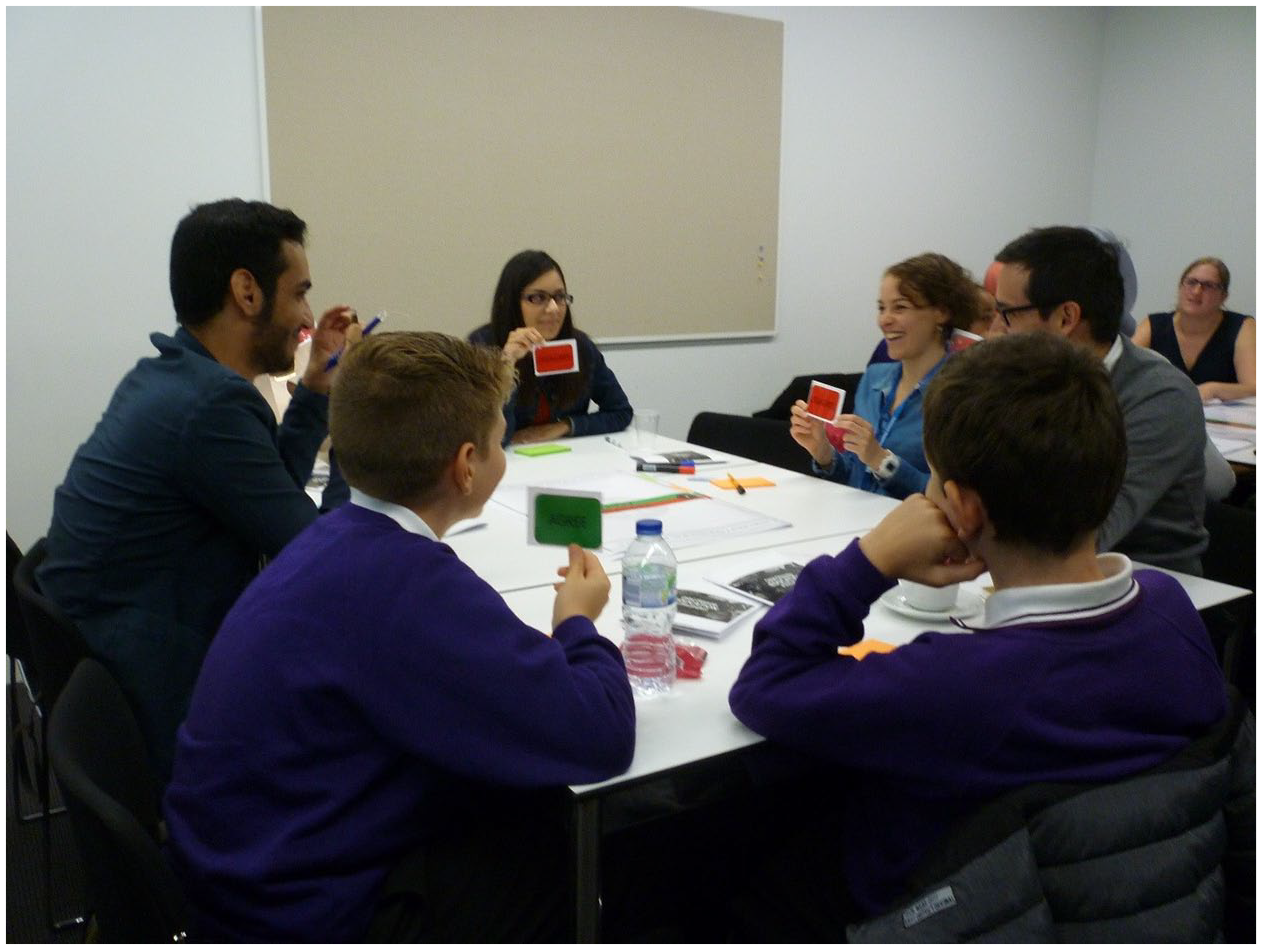
Participants showing an agree or disagree card.
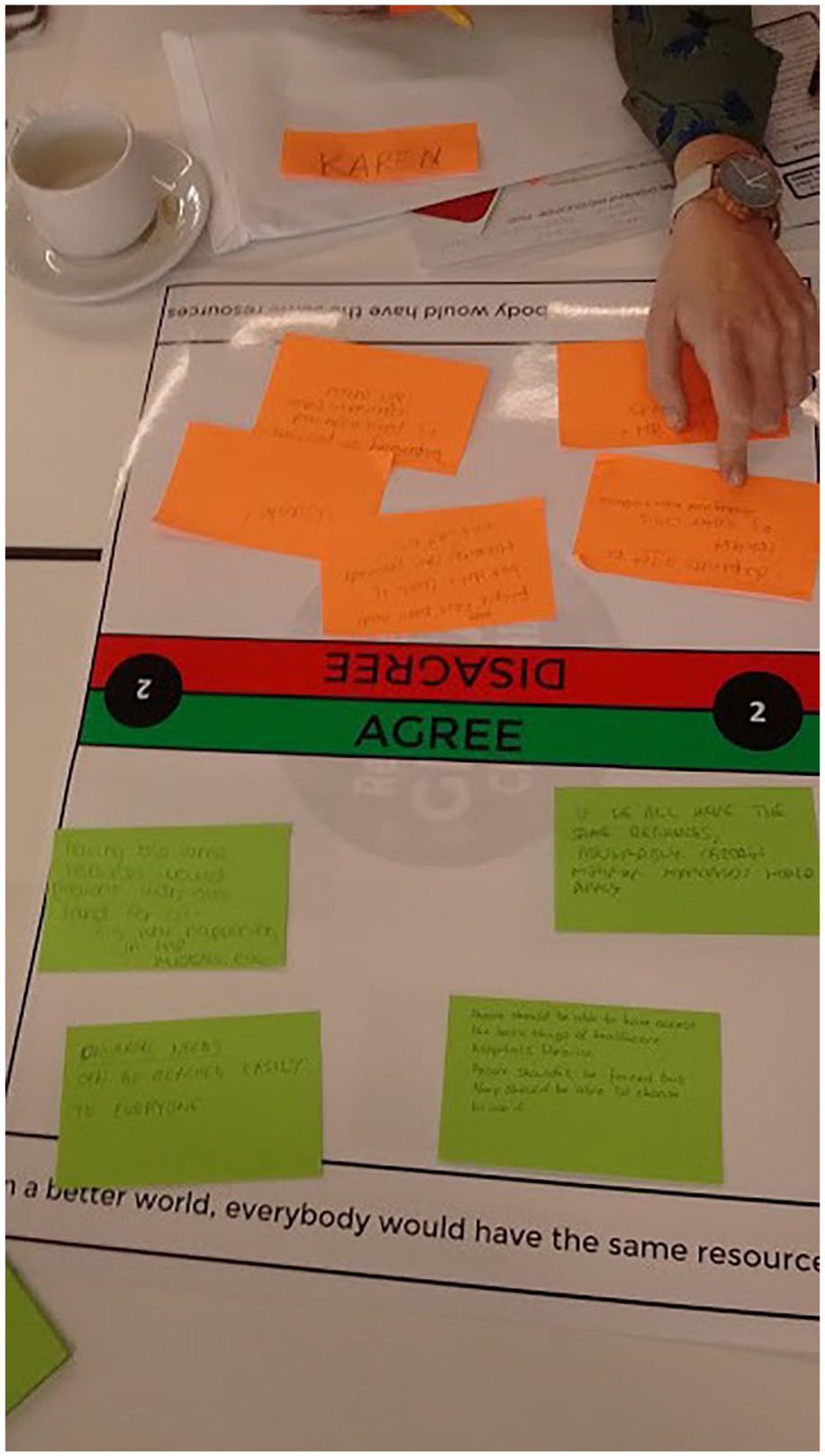
Arguments ‘agreeing’ and ‘disagreeing’ with one of the statements captured in the post-it notes.
This activity was specifically created in relation to our three main aims. The idea of putting together different people in the same table responds to the intention of creating a sense of plurality that could facilitate the expression of political emotions via the encounter with ‘alternative social imaginaries’ (Ruitenberg, 2010: 53). In contrast with most deliberative pedagogies, the emphasis was here on conflict and disagreement. Our aim was to encourage the participants to embrace disagreement and conflict as necessary and unavoidable. Our intention on discussing different statements was also to allow articulation and re-articulation of differences, creating opportunities for new and multiple subjectivities to emerge.
The central agonistic activity assumed the controversial nature of global citizenship as a topic of discussion. As a tool for evaluation of curriculum designed to promote global citizenship in the UK, Oxley and Morris (2013) created a typology to identify and distinguish different conceptions (e.g. political, moral, economic). While it is outside the scope of this paper to go into the details of the typology, we applied it to ensure we had statements representing different versions of global citizenship. The eight statements presented to tables were:
In a better world, we all would have the same rights and responsibilities.
In a better world, everybody would have the same resources
In a better world, we all would share a similar culture
Everybody should be able to say what it means to be a ‘global citizen’
I can feel part of a community that includes all human beings
Some people are more ‘citizens of the world’ than others
Schools should educate children and young people to be citizens of the world
I think I could help others to discuss about ‘global citizenship’
These statements were used primarily for the purpose of discussion and application of the agonistic approach. The focus of this paper is therefore not on the content (Backer, 2017a) of the discussions nor on mapping different understandings of global citizenship but, rather, on pedagogical reflections about the form of the activity. The construction of the statements via this typology was somewhat in tension with an agonistic approach centred on the discussion of concrete disputes about the social and political order (Ruitenberg, 2009). This is particularly the case given the fact that Ruitenberg’s (2009) suggestions are based on a reading of Mouffe (2005), for whom such disputes are discussed primarily at the national level, with any conception of global politics existing in a ‘multipolar’ world of different, regional versions of democracy. These tensions are discussed more fully in the analysis and reflections that follow. However, in terms of the aims of the intervention, the statements were balanced enough both to provide for sufficient disagreement and to address the activity toward the overall topic of global citizenship.
A number of research strategies were used to transform the experiences of the workshop into textual representations. The research strategies included two research assistants taking field notes, photographs and carrying out informal interviews during the breaks. At the end of the workshop, the participants (including the facilitators) were required to provide a written account of their experience. During the workshop, participants were also invited to put in a box short notes with personal thoughts on the activities or topics discussed. The final source of data came 6 months later when participants were requested to provide an additional written reflection on the event.
The analysis of the data obtained from the workshop was inspired by the theoretical ideas previously discussed and grounded on the notion that social phenomena are a discursive construction. Originated in a discourse analysis approach (Phillips and Jørgensen, 2002), our analysis and discussion consists of working data through theory to open it up to interpretations. The process is articulated around three guiding questions that emerge from our attempt to engage with pedagogies of agonistic democracy: (1) what where the challenges and/or successes in ’normalising’ conflict and disagreement?, (2) what were the challenges and/or successes in creating channels for the expression of political emotions? and (3) what were the challenges and/or successes in creating opportunities for new subjectivities to emerge?
The sample did not attempt to be representative, and this research does not aim to show conclusive responses. The overall motivation of this research is to present an illustrative and explorative account of the possibilities of implementing agonistic approaches in education that might be of interest to practitioners, researchers and other educative agents.
Results and discussion
What where the challenges and/or successes in ‘normalising’ conflict and disagreement?
Our data suggests that agonistic conflict was only partially created. Against the instructions guiding the activity, several tables ended up seeking consensual agreement. This was particularly fostered by older participants. We found a considerable resistance to conflict from a number of older participants. They reported a greater feeling of comfort during the more consensual-orientated icebreaker activities. In our later field notes, one of us wrote, ‘I was interested to hear that Adrian [an invited international researcher] - also on my table - had enjoyed the first activity [the ice breaker] more than the second, as he found it more collaborative and creative (I think his words were that it involved creating something together). I expressed my opposite view - that I enjoyed the second, ‘agree/ disagree’ task more (.…). In the conversation with the PI researcher [author 1], we discussed how this related to some of the theories informing the project, e.g. Mouffe’s theory of ‘agonistic’ democracy (2005). At the time, I remember thinking that this made sense to me because I have long been an admirer of Mouffe’s work’ (Researcher, field notes)
Another older participant manifested in one of the informal interviews, ‘My favourite part was when we had to compile a pyramid [the icebreaker activity] and we had to put, er, different words into category of which one is the most important and which one is the least important and I really enjoyed working with the kids from the school because they contributed so much and they were so confident. So it was really nice.’ (MA student, informal interview)
In contrast, younger participants were more likely to engage with conflict. One of the facilitators wrote in his field notes, ‘The children were able to escalate these debates more than was possible for the adults on the table’ (lecturer, field notes)
Similarly, a research assistant reported, ‘Primary students seem more able to discuss their opinions in a calm way and seem less bothered about adhering to the structure’ (Research assistant, field notes)
The field notes appear to correspond with the younger participants’ own views. In two of the informal interviews, two of the primary students explained, ‘[I enjoyed the] disagree and agree things. It was really fun doing that and listening to each other’s opinions and working together’ (Primary student, informal interview). ‘[I] like seeing what other people think about statements and seeing different statements of what people think. Whether I agree with it or not’ (Primary student, informal interview).
There are different reasons that can explain the observed differences between older and younger participants. There is a possibility that older participants, many of whom with a background in education (e.g. teachers, lecturers), felt that looking for consensus is ‘safer’ than engaging with conflict. Teachers’ resistance to engage with conflict pedagogies has been widely documented (see, e.g. Bickmore and Parker, 2014; Hess and Avery, 2008). Researchers have acknowledged that teachers often do not feel comfortable raising questions that might be challenging/uncomfortable to (some of their) students or/and to themselves (Bickmore and Parker, 2014). In contrast, previous research also suggests that students often have positive attitudes towards discussing controversial issues (Hess and Avery, 2008). In this respect, it is possible that some of our tables of discussion just reproduced this more general pattern, with the ‘educators’ feeling the activity was ‘risky’ and the ‘students’ feeling more comfortable with it.
It is also possible that the differences can be attributed to the participants’ approaches to education and democracy. Adrian, in the first quote, refers to ‘collaboration’, ‘creativity’ and ‘creating something together’. These principles resonate with deliberative approaches to democratic education that emphasize the relevance of collaboration and problem-solving (see, e.g. Dotts, 2016). In contrast, the researcher, also in the first quote, identifies herself with agonistic approaches to democracy (Mouffe, 2005) and found particularly valuable the agree/disagree activity. Therefore, it is possible that older participants were already committed to particular approaches. In the case of younger participants, perhaps by having less clear commitment to a particular discourse of education and/or democracy, it was easier for them to open to alternative approaches such as the ones this project was aiming to generate.
Despite these challenges, opportunities for agonistic conflict were generated in some of the tables. Participants from these tables wrote comments such as, ‘What [global citizenship] means to me is different than what it means to you’ (undergraduate student, quote recorded on the research assistant’s field notes) ‘It depends what a better world means’ (unknown participant, post-it)
It appears to us that, on these tables, the participants did engage in an agonistic (conflict orientated) rather than a deliberative (consensus orientated) debate. Mouffe (1993) explains, ‘within the context of the political community, the opponent should be considered not as an enemy to be destroyed, but as an adversary whose existence is legitimate and must be tolerated. We will fight against his ideas but we will not question his right to defend them. The category of the 'enemy’ does not disappear but is displaced; it remains pertinent with respect to those who do not accept the democratic 'rules of the game'’ (p. 4).
In our analysis, we understand that the participants of these tables became political ‘adversaries’ rather than ‘enemies’. The disagreement was a political one, over the particular conflict presented, rather than a moral question of reason, truth or justice (Ruitenberg, 2009). The lack of reference to a specific, political dispute in the statement itself (as a result of the tensions in the design noted above) in fact prompted speculation on what the political specifics of a ‘better world’ might be and brought the discussion within an agonistic frame. Our data suggests that, outside the instructions facilitated, a common ground – the rules of the game – were implicitly agreed. There was an assumption of plurality (e.g. different meanings) that helped to legitimate the different participants’ views. Whilst they maintained different positions in relation to the topic of discussion, they did agree that the Other’s perspective was legitimate. In contrast with the other tables, they were keen to keep on ‘fighting’ against each other’s ideas and to accept that, the Other would not disappear, and that plurality would prevail also after the discussion. Conflict, indeed, did not disappear but rather was understood as a necessary part of the democratic process. One of the participants explained in an interview,
[.…] some people don’t like one thing, some people like it and agree with it, some people disagree. Then you have to like try and find a way to make them get it to one side.
Brilliant. And if there was one word from today, that comes to mind. What would it be?
Er.…Democracy!?
(Primary student, informal interview).
What were the challenges and/or successes in creating channels for expression of political emotions?
Our data suggests that participants felt they were able to engage with a plurality of views and perspectives. One of the invited lecturers explained, ‘So, I guess the most significant part was to meet very different people. It was really, it was great to see so many different opinions. Er.…. Yes, it was really nice to see that. I guess that was the most, the most significant. (.…) Some people have lived a lot, being very young, and they have a lot to say as well.…[laughs from both] that’s it!’ (Invited lecturer, informal interview)
Similarly, one of the primary students explained,
Erm, I really liked when we did all the discussions and stuff. Because everyone had their own .… like ideas about everything that we did. And I thought that was really fun and then I learned a lot because everyone has like different backgrounds here and I thought it was really cool to learn about them and things like that. (Primary students, informal interview)
Apparently fulfilling our second aim, participants were able to passionately engage with alternative imaginaries (Ruitenberg, 2010). Participants were not required to provide rational compelling arguments to justify their views but rather, their emotional stories or the emotions felt in a particular situation were welcomed to justify whether or not they would agree with a particular statement (Backer, 2017b).
However, our analysis also suggests an interesting dynamic that arose from the tensions inherent in our activity design, as noted above. Data from two different field notes (one of the facilitators and one of the research assistant) reveals a particular situation in one of the tables of discussion. In this table, participants were discussing the statement ‘people should have the same rights’. Conflictive arguments were put forward but in abstract not experiential ways: ‘I think in a better world, we should all have the same rights and responsibilities, because poorer people don’t have the right to do as much things as we do and that’s not right.’ (unknown participant, post-it in agreement with the statement) ‘Everyone is different and have different needs.’ (unknown participant, post-it in agreement with the statement)
But the topic of the discussed rapidly shifted. One of the lecturers of this table explained, ‘I was surprised to find that children brought up the topic of tax evasion when discussing issues of inequality and lack of money for schools. It was a Year 6 [10 year-old] child who brought this up and the subject resurfaced over the progression of the session’ (lecturer, fieldnotes)
As a result of this shift, the participants engaged in a passionate critique of tax evasion. These data could be interpreted as an illustration of Ruitenberg’s (2010) point about the importance of engaging in discussions specific, concrete examples of political injustices within an agonistic approach to democratic education. She writes, ‘an inductive political education, then, would begin not with political theories or the abstract request to, ‘imagine a desirable society’ but with discussions of concrete perceptions of injustice’ (Ruitenberg, 2010: 52) and goes on to argue that, ‘[I]n political education worthy of the name, we have to engage students in these difficult discussions’ (2010: 53). Whilst the topics for disagreement in our activities were not completely abstract or theoretical, it is possible to see in the data above a greater willingness amongst participants to discuss the specific and concrete perceived injustice of tax evasion rather than the more abstract concepts of rights and responsibilities. The passionate critique of tax evasion here can also be interpreted as a moment in which such difficult discussions, ‘reveal how apparently apolitical identification have, at their core, a desire or fantasy that can also be channelled in political ways’ (Ruitenberg, 2010: 53).
What were the challenges and/or successes in creating opportunities for new subjectivities to emerge?
Our analysis suggests that, at least, some opportunities for new subjectivities to emerge were created. In her memories, one of the research assistants wrote, ‘Rather than viewing the participants as groups (Primary School Pupils, [.…], Undergraduates, etc.) and expecting their responses to the activities to be similar based on these groups as I originally expected, I experienced individuals coming to conclusions based on personal life experiences or their own individual understanding of the world.’ (research assistant, memories) (extract from Author et al., xx)
Our visual data illustrates the research assistant’s statement. Figure 3 shows a sub-group of discussion within a table. The three participants (an invited lecturer, an undergraduate and a primary student) had positioned as ‘agreeing’ with the statement. In the disagreement sub-group (not visible on the image), there was one of us and a second primary student.
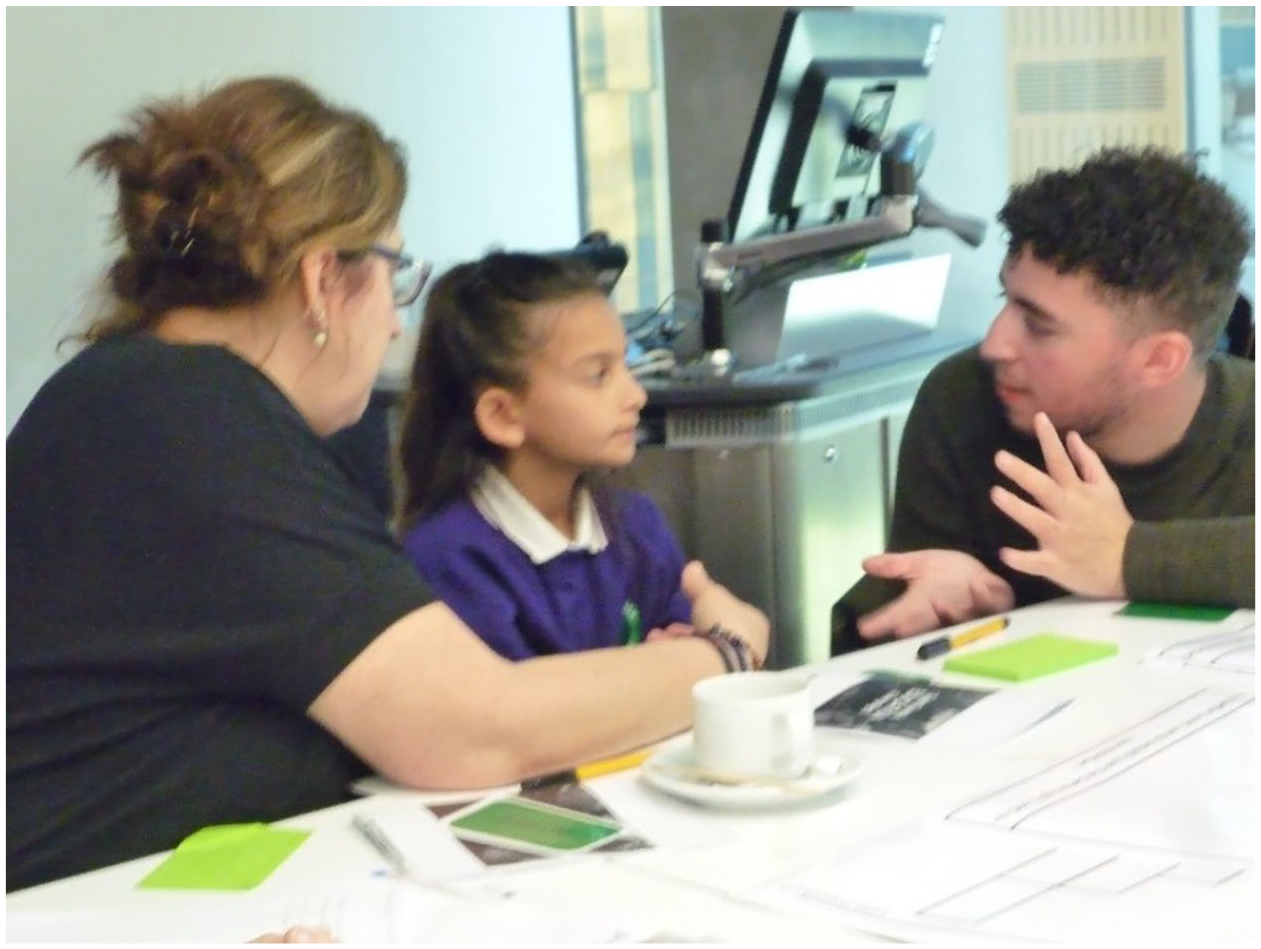
Table of discussion.
In contrast with the research assistant’s expectations, the participants did not appear to ascribe themselves to any pre-determined group. They did not respond to the statement in group ‘(Primary School Pupils, [.…], Undergraduates, etc.)’ but rather, each of them, singularly, came to ‘conclusions based on personal life experiences’. We read this as a potential moment of subjectification. Mouffe (1993) explains that the subject does not possess an a priori or fixed identity. Laclau (2000) adds, ‘the Subject is the distance between the undecidability of the structure and the decision itself’ (p. 79). For our participants, the confrontation with the statement and the public performance of (dis)agreement with it became the moment in which, as Snir (2017) discusses, our participants made sense of the world itself.
Political differences were not only articulated but also re-articulated. The participants changed their positions throughout, and on some occasions, after the educational experience. Some memories of the activity include: ‘Really worthwhile day and set of activities – enjoyed the agree/ disagree activity in particular. Impressed with student’s capacity to justify opinions and our ability to disagree well. Some arguments changed my view.’ (unknown participant, post-it) ‘On the ‘agree/ disagree’ task, the discussion was much more free ranging. (.…) I felt that this task allowed us to get into ‘meatier’ discussions about our thinking and to be involved in collective reasoning. Paradoxically, despite - or because - we did not have to come to a decision, on this task, there were more examples of people being persuaded by others’ views’. (researcher, field notes) ‘It is surprising how the discussion changed some of the participants’ views. A couple of weeks after the activity, I was told that one of the primary students has mentioned that, after thinking carefully about arguments putted forward, she thought she should change her mind’ (researcher, memories)
Participants were asked to ‘react’ not only to the statements presented but also to others’ views. And, since the activity was ‘free ranging’, there was nothing stopping participants from changing their perspectives if persuaded by others. With that, we obviously do not mean that conflict was in itself resolved – this would be against agonistic conceptions of democracy. Rather we want to emphasize how avoiding consensus facilitated the emergence of alternative subjectivities. This resulted in participants changing their positions during and after the activity itself, illustrating the contingent nature of the process of articulation or what Laclau (1990) describes as ‘the kaleidoscopic movement of differences’ (p. 92).
The re-articulation of positions suggests that both the individual, but also the collective subjects, were constantly reshaped. During the activity, the collective change is obvious in our visual data. We can see how after reading each particular statement, participants would change the group they were ascribing themselves to. As previously described, participants were first requested to discuss their views with the members of the table they agreed with and later with those they did not agree. This operation was repeated after each of the statements discussed. Overall, each participant’s movement resulted in a constant flow of bodies who would move to different sides of the table to discuss their views. Each act of (non) identification with the statement destabilized the identity of the groups themselves (Laclau and Zac, 1994), necessarily creating new groups. In line with what Snir (2017) describes, ‘no performance is merely a repetition of a given pattern; all necessarily involve unpredictable interactions’ (p. 354).
Conclusion
Agonistic pedagogies might offer a democratic alternative to overcome some of the problems emerging from deliberative pedagogical strategies (Backer, 2017b; Biesta, 2011; Lo, 2017; Ruitenberg, 2009). In this article, our purpose was to explore the possibilities of an agonistic pedagogy aimed to normalize conflict and disagreement, create channels for the expression of political emotions and generate opportunities for the emergence of new subjectivities. Our findings appear to indicate that the conflict-orientated nature of the activities – with facilitators explicitly being given the instruction to move from one topic of discussion to another without reaching consensual agreements - opened the doors to the normalization of conflict in some of the tables of discussion. This is not to say that participants behaved as ‘enemies’ or even ‘competitors’ ‘to be destroyed’ (Mouffe, 1993: 4), but rather that they participated as opponents whose ideas –although legitimate – could be fought. Our analysis also suggests that the plurality within the tables of discussion (with primary, undergraduate and postgraduate students, academics and other educational agents) facilitated participants’ affective engagement with other social imaginaries and experiences (Ruitenberg, 2010). Simultaneously, this plurality of views, together with the multiplicity of discussions, fostered opportunities for new subjectivities to emerge. ‘Forced’ to make immediate and multiple decisions over political controversies, individual participants drew upon their singular experiences to make sense of the world. As a consequence of this, new groups of interest were created and re-created, articulated and re-articulated, after every response.
However, we also identify two major challenges related to both, form and content. Regarding form, we found a particular resistance from older participants to engage in productive conflict. In agreement with previous research studies (Bickmore and Parker, 2014; Hess and Avery, 2008), our results suggest that educators or even older participants might have less positive attitudes towards conflict-orientated pedagogies than younger counterparts. We wonder whether this is influenced, among other possibilities, by the participants’ age, status (teacher-student) or even by the participants’ owns views on education and democracy. Regarding content, our project presented participants with different statements related to global citizenship. The focus of such theories on concrete disputes in politically bounded contexts (even when operating at the global level, as for example in Mouffe’s vision of a ‘multipolar’ world of regional differences) adds a further complication to this. It is very possible that more concrete statements or cases – within or outside the topic of global citizenship – would have been more ‘suitable’ agonistic content and have provided more opportunities for participants to ‘affectively’ engage in passionate discussion and disagreement (Ruitenberg, 2010).
We feel it is relevant to re-emphasize the exceptional and exploratory nature of this project. Our research findings might be (likely) conditioned by the different pedagogical and practical decisions we made to bring this project to reality, and they may be highly dependent on the characteristics of our participants. The participants, invited via professional networks, were highly committed to participate in the project. Our professional experience in primary, secondary and tertiary institutions tell us that this is not always the case. Also, it is possible that our exploratory results are conditioned by the topics we discussed. As mentioned, we found global citizenship to be a key topic of discussion not only for its primacy in educational policy and practice but also for being a ‘floating signifier’ (Mannion et al., 2011; also, see Laclau, 2007) open to competing conceptualizations. But we wonder whether we focused on ensuring the statements reflected different conceptualisations of global citizenship (Oxley and Morris, 2013) but could perhaps have been more directly targeted at the tensions. Perhaps also, the topic of global citizenship itself had limitations for antagonistic purposes that might need to be explored by others.
The context in which this project took place was also exceptional. The situation of plurality we generated, bringing together local, national and international students and researchers, responded to a condition of exceptionality only allowed by the resources and funding available to us in that moment. We are entirely aware that, unfortunately, schools, universities and other educational institutions rarely have the resources to facilitate these types of activities. Similarly, although the project took place within a HE institution, it was not strictly linked to any official programme of study. It was not a ‘class’ nor a ‘module’ in any traditional sense. Thus, we assume that neither the educators nor the students felt the time and assessment constraints often related to more institutionalized forms of education. This could signal the need to support more such nonformal, multivocal opportunities.
Even considering these limitations, we feel our results can offer some insights to the question of democratic education that might be of interest to researchers, practitioners and other educative agents. For educators, we would like to emphasize the value and need of (outside class) plurality on the discussions on controversies. As mentioned, we are entirely aware that opportunities such as the ones we describe here are rare, but less ambitious projects brining different age/course level students together or involving family or community members as ‘equals’ could have similar effects. Intergenerational projects such as that recommended by Wyness (2012), who has highlighted the importance of bringing adults back into conceptions of children’s participation, could be considered. Intergenerational learning is a growth area related to the SDGs focus on lifelong learning and is important to SDG Target 4.7, so these findings are particularly relevant to pedagogical work in support of this aim (see e.g. Kaplan et al., 2016). Further support and research is required to further explore how intergenerational differences shape citizenship understandings through lifelong learning.
We feel practitioners should also consider the educational and democratic value of conflict-orientated pedagogies that explicitly avoid agreement. In this respect, we agree with Lo (2017) and Ruitenberg (2009) that agonistic pedagogies do not necessarily need to replace deliberative ones but rather they can offer alternative opportunities for democratic enactment. These authors do not suggest abandoning deliberation altogether but rather highlight how more conflictual approaches based on disagreement might help to compliment and expand the deliberative pedagogic repertoire. Our findings suggest that, by bringing open-ended controversies into discussion, conflict might be normalized and students might learn to understand conflict as part of the everyday reality of living together in a plural world. The multiplicity of discussions might also foster several and competing alliances (including non-dominant alliances between students and educators) offering opportunities for students to see that an ‘adversary’ in a particular political cause might not necessarily be an ‘adversary’ in another. However, for this to happen, educators might need to become more accepting of in-class conflict. We feel the role of teacher education is here essential. In line with Biesta (2014), we argue for a teacher education that help teachers ‘deal with’ the everyday risk of education.
The Sustainable Development Goals apply to all signatory nations unlike the previous Millennium Development Goals which focused on action in so-called ‘developing countries’. Thus, it is important to consider to what extent teachers and learners in the ‘Global North’ (in our case the UK) are resourced to engage critically in democratic discussions about pressing issues of local and global concern (Pashby et al., 2019). While our study does not presume to provide answers to the question of ‘how to teach’ for SDG Target 4.7 more broadly or for education for global citizenship more specifically, it does raise the importance of working towards concrete pedagogies that take up the important critiques of existing approaches. It also raises the importance of supporting intergenerational learning opportunities.
Considering the exploratory and experimental nature of this project, we also would like to invite other researchers to consider the challenges and possibilities that agonistic pedagogies can offer. In contrast with most well studied deliberative strategies, we feel there is a long way to go to understand how agonistic pedagogies can contribute towards democratic education practices. Those scholars particularly involved on philosophy and politics of education have already made their pedagogical recommendations, we feel it is now time for those researchers of curriculum and pedagogical studies to take these proposals on board.
Footnotes
Declaration of conflicting interests
The author(s) declared no potential conflicts of interest with respect to the research, authorship, and/or publication of this article.
Funding
The author(s) received no financial support for the research, authorship, and/or publication of this article.
