




Abstract
Teacher–child interactions are the most important factor that determines the quality of early-childhood education. A systematic review was conducted to gain a better understanding of the nature of teacher–child interactions that multilingual children are exposed to, and of how they differ from teacher–child interactions of monolingual children. Thirty-one studies were included. The included studies (a) mainly focused on multilingual children with low language proficiency in the majority language and (b) hardly compared between monolingual and multilingual children. The review shows that teacher–child interactions of multilingual children are comparable to the interactions of monolingual children, although teachers do adopt different strategies to facilitate the development of multilingual children, such as the use of the home language and nonverbal communication to support understanding. Worryingly, several studies indicate that multilingual children are exposed to unequal learning opportunities compared with their monolingual peers.
Contemporary changes in Western societies, like globalization and immigration, have contributed to an increase in the numbers of multilingual children in early-childhood classrooms. We define multilingual children as those who predominantly speak at home a language that is different from the majority language of instruction and who often start to learn the majority language systematically when they enter early-childhood education. Multilingual children often enter and leave primary school with lower language levels in the majority language than their monolingual peers (Reardon & Galindo, 2009). Furthermore, multilingualism is often paired with ethnic or cultural diversity and with low socioeconomic status (Veenstra & Kuyper, 2004). Because multilingual children potentially bring different sources of diversity to the classroom, it is plausible that teachers establish different interactional practices with multilingual children—as compared with their practices with monolingual children. Because learning is a sociocultural process and children develop through interaction with the environment (Bronfenbrenner & Morris, 2007), it is important to define learning opportunities in light of their interaction with their teacher. Earlier research has shown that high-quality teacher–child interactions are positively related to a broad range of academic and social-emotional outcomes (Cadima, Leal, & Burchinal, 2008; Curby, Rimm-Kaufman, & Ponitz, 2009; Luckner & Pianta, 2011). The present study therefore aims to gain a better understanding of the characteristics of teacher–child interactions that multilingual children are exposed to.
Teacher–Child Interactions
According to the bioecological model of human development (Bronfenbrenner & Morris, 2007), development occurs as a function of the continuous interaction between the child’s characteristics and the close context—the so-called proximal processes of development. These proximal processes with the primary caregivers and teachers affect, in a positive or negative way, the development of a child. A child has a broad range of characteristics that both influence and are influenced by the interaction with the close environment (Bronfenbrenner & Morris, 2007). When we consider this model in an educational setting, the main proximal process is the interaction between teacher and child. The extent to which a teacher is able to adjust the learning opportunities to an individual child and his or her specific characteristics is a crucial factor in promoting the child’s development of academic, cognitive, as well as social skills (Connor et al., 2009; Hamre & Pianta, 2007; Vandenbroucke, Spilt, Verschueren, Piccinin, & Baeyens, 2018).
The quality of teacher–child interactions has been profusely studied from diverse research traditions. One such tradition has focused mostly on classroom talk as the main tool for creating learning opportunities. This research shows that teacher–child interactions during more “traditional” educational activities often follow the initiation-response-feedback pattern (IRF, also known as IRE, initiation-response-evaluation; Sinclair & Coulthard, 1975), in which the teacher initiates the interactional sequence, followed by a child response and closed by the teacher’s follow-up (Howe & Abedin, 2013). There can be a large variation in how the IRF sequence is established, such as the role of the student in the interaction, the complexity and goal of the teacher’s follow-up, and the place of the IRF-sequence in the classroom discourse (Howe & Abedin, 2013). More cognitively challenging conversations, making use of abstract, decontextualized talk, are considered to promote child language, cognitive, and—depending on the topic—social-emotional development (De Temple & Snow, 2003; Gonzalez et al., 2014; Mascareño, Snow, Deunk, & Bosker, 2016). Besides the IRF sequence, teachers might thus encourage a more dialogic interaction in the classroom that moves beyond this hierarchical structure, offers a more active role to children, and creates more space for reasoning and discussion (Michaels & O’Connor, 2015). The use of dialogic interactions in the classroom seems to be more beneficial for a child’s language development compared with nondialogical classroom interactions because it creates more opportunities for extended discourse (O’Connor, Michaels, & Chapin, 2015; Snow, 2014; Van der Veen, De Mey, Van Kruistum, & Van Oers, 2017).
Another research tradition focuses on the classroom interaction and activity at a more general classroom level. High-quality teacher–child interactions are typically characterized by emotionally supportive expressions that stimulate concept and language development in well-organized classrooms (Hamre & Pianta, 2007; La Paro et al., 2009; Mashburn et al., 2008). These findings have been combined into the Teaching Through Interactions framework, in which three domains of effective teacher–child interactions are distinguished (Hamre et al., 2013). First, emotional support includes the enthusiasm and emotional connection between the teacher and the child in the classroom and the teacher’s sensitivity to the academic and social needs of children. In these classrooms, children are able to take risks in their learning because of the safe environment that is created. Second, classroom organization entails the way a teacher monitors behavior and the productivity of a classroom. Teachers with high-quality classroom organization promote positive behavior and prevent negative behavior. In addition, they spend minimal amount of time on basic management activities and transitions, and they actively engage children in instructional activities through interesting activities and materials. As a result, in well-organized classrooms, children are aware of classroom behavioral expectations; they occupy their time efficiently and are engaged in the activity and are therefore more likely to learn from it. Third, instructional support focuses on how a teacher stimulates higher-order thinking and problem solving and provides high-quality feedback and thus maximizes learning opportunities. A teacher provides high-quality instructional support when he or she creates opportunities for children to understand, apply, evaluate, and build knowledge. Other indicators of high-quality instructional support are feedback on a child’s learning process that goes beyond the correctness of a response, and the provision of interactions that stimulate the development of language skills (Hamre et al., 2013; Hamre & Pianta, 2007).
The Teaching Through Interactions framework finds empirical support in a wide range of studies. Children in well-organized classrooms where the teacher is warm and supportive and provides behavioral and instructional support show better language development (Cameron, McDonald Connor, Morrison, & Jewkes, 2008; Curby, Rimm-Kaufman et al., 2009; Pianta, Belsky, Vandergrift, Houts, & Morrison, 2008), math development (Cadima et al., 2010; Curby, LoCasale-Crouch et al., 2009), and behavioral development (Luckner & Pianta, 2011; Mashburn et al., 2008).
Multilingualism
Multilingualism is a broad term that has been used in multiple situations that involve two or more languages, including children who speak two languages from birth and also children learning a foreign language at school. For the purpose of this review, we decided to focus only on children who speak a minority language at home and are learning the majority language in early-childhood education. The developmental patterns of multilingual children appear to differ from those of monolingual children. They often have a smaller vocabulary in both their home language as well as the majority language (Bialystok & Feng, 2011; Bialystok, Luk, Peets, & Yang, 2010) and lower math scores throughout the primary school years (Reardon & Galindo, 2009). There are suggestions that multilingualism also has positive effects, apart from the ability to speak multiple languages: Multilingual children appear to have similar or even better phonological awareness (Bialystok, Majumder, & Martin, 2003; Bruck & Genesee, 1995) and better executive functioning skills (Adesope, Lavin, Thompson, & Ungerleider, 2010; Barac, Bialystok, Castro, & Sanchez, 2014) as compared with monolingual children. Evidence for these positive effects is still under debate (Paap, Johnson, & Sawi, 2015).
Even though it has been often argued that multilingual children have lower language skills, there are large individual differences among multilingual children. When studying the academic development of multilingual children it is important to take into account the child’s age of acquisition of the majority language (Luk, De Sa, & Bialystok, 2011; Struys, Mohades, Bosch, & van den Noort, 2015), exposure to all languages (Barac & Bialystok, 2012), proficiency in all languages (Prevoo, Malda, Mesman, & van IJzendoorn, 2016), immigrant status (Johnson De Feyter & Winsler, 2009), and family’s socioeconomic status (Calvo & Bialystok, 2014). Struys et al. (2015), for example, evidenced that children who were multilingual from birth outperformed children who became multilingual later in life on cognitive control, even though their proficiency in all their languages was equal. Barac and Bialystok (2012) showed that the language of schooling affects language development. Multilingual children had equal language skills as monolingual children when their language of schooling was the same as the language of testing. They did not match the language skills of monolingual children when their schooling was in another language. Furthermore, in a meta-analysis by Prevoo et al. (2016), it was found that the use of the home language in education is important for the school success of multilingual children. Finally, children from families with low socioeconomic status often have lower language skills (Calvo & Bialystok, 2014). Because many multilingual children are from families with a low-socioeconomic migration background, it is important to take their socioeconomic status into account when considering school outcomes. Language delays could be explained by both their socioeconomic status and their language background. In sum, researchers should be careful in considering multilingual children as one homogeneous group and should be clear about the background of their multilingual participants.
Multilingual Children’s Teacher–Child Interactions
Although children can clearly benefit from high-quality teacher–child interactions, most of the research on teacher–child interactions has been conducted on monolingual samples; hence, it is unclear what “high quality” entails for multilingual samples. As the effectiveness of interaction depends on the match between a child’s characteristics and the environment (Bronfenbrenner & Morris, 2007), multilingual children might benefit from different teacher–child interactions. It may also be the case that they are involved in different types of interaction regardless of whether this is more beneficial for them.
Recent research suggests that the interactions that teachers engage in with multilingual children might differ from the interactions established with monolingual children. The meta-analysis of Tenenbaum and Ruck (2007) showed that teachers addressed children from ethnic majorities with relatively more positive and neutral speech than children from ethnic minorities; the authors found no differences in negative speech (it should be noted that although ethnic minority students are often multilingual, they are not necessarily multilingual). The review of Howe and Abedin (2013) on classroom dialogue in primary and secondary classrooms indicated that ethnic minority students in general seem to participate less in classroom discourse and feel less comfortable when participating. Leseman and Slot (2014) found that high-quality teacher–child interactions are especially effective for multilingual children, as they reduce the gap in language development between monolingual and multilingual children. Likewise, Morrison and McDonald Connor (2002) and Curby, Rimm-Kaufmann, et al. (2009) found that children with lower language proficiency (i.e., decoding and vocabulary)—as is often the case with multilingual children—benefited mainly from teacher–directed, explicit instruction for their language development, whereas children with better language skills benefited more from child-led interaction. In addition, teachers might engage in interactions of lower complexity with multilingual children from families with lower socioeconomic backgrounds because of their actual or perceived lower language skill levels (Keels & Raver, 2009; Ready & Wright, 2011).
The potential difference in teacher–child interactions between monolingual and multilingual children could be explained by the expectations of the teacher. Teachers tend to have more positive expectations of children from ethnic majorities than of children from ethnic minorities (Tenenbaum & Ruck, 2007). Other researchers reason that all children, regardless of individual differences, are in need of and benefit equally from rich and engaging teacher–child interactions. Ewing and Taylor (2009) showed that the relation between teacher–child interactions and behavioral outcomes was the same for children from different language backgrounds. The same was shown for academic outcomes in a study of Downer et al. (2012), in which they compared Hispanic and non-Hispanic, White young children. It should be noted that the children from the studies of Tenenbaum and Ruck (2007) and Downer et al. (2012) were from an ethnic minority but not necessarily multilingual. Furthermore, these potential differences in teacher–child interactions could be explained by cultural differences between home and school. Many multilingual children are not only learning multiple languages but are also growing up in two or more different cultures. These cultures can have different norms and expectations for child socialization and development (Bossong & Keller, 2018; Greenfield, Quiroz, & Raeff, 2000), which makes it complicated for a child to know what is expected of him or her in the classroom.
Present Study
Teacher–child interactions are key to effective early-childhood education. As multilingual children enter early-childhood education with a different linguistic background and show different developmental patterns in diverse academic skills, there is a need for more insight into the nature of the interactions between multilingual children and their teachers. Previous research on this topic is scattered, using different research methodologies, in diverse multilingual populations, and focused on different aspects of teacher–child interactions. The present study involves a systematic review that aims to integrate the results of previous research to gain a better understanding of the nature of the teacher–child interactions that multilingual children are exposed to and how they differ from the teacher–child interactions of monolingual children.
Method
Inclusion and Exclusion Criteria
We formulated four inclusion criteria to determine which studies would be eligible for the systematic review. The studies had to be (1) empirical and had to focus on the (2) teacher–child interactions of (3) young (up to 7 years) (4) multilingual children. We were interested in studies that presented direct assessment of teacher–child interactions and thus had to include empirical interaction data. The review focuses on studies in early-childhood education but includes a rather wide age range. As school systems differ around the world in their age range for early-childhood education and our aim was to be as inclusive as possible, children in the studies could be up to 7 years old. Furthermore, because the review focuses on interactions that are specific to multilingual children, included studies should at least include interactions with multilingual children or should distinguish between interactions with monolingual and multilingual children. Furthermore, we only focused on children who speak a different home language and learn the majority language at school. Our search included the entire scope of classroom activities, including both academic and play activities. Only studies published in the period between 1990 and 2016 were included. This scope was chosen as we aimed for a complete overview of previous research, but the results still needed to be applicable for present-day education.
Articles were excluded when (1) teacher–child interactions of multilingual children were not differentiated from those of monolingual children, (2) the article focused on foreign language education, (3) it focused on sign language for deaf children as a form of multilingualism, (4) teacher–child interactions were not used as direct data in the study (e.g., interviews about interactions), (5) the article was a position paper with no data rather than an empirical article, and (6) it was published in a language other than English or Dutch.
Search Procedure
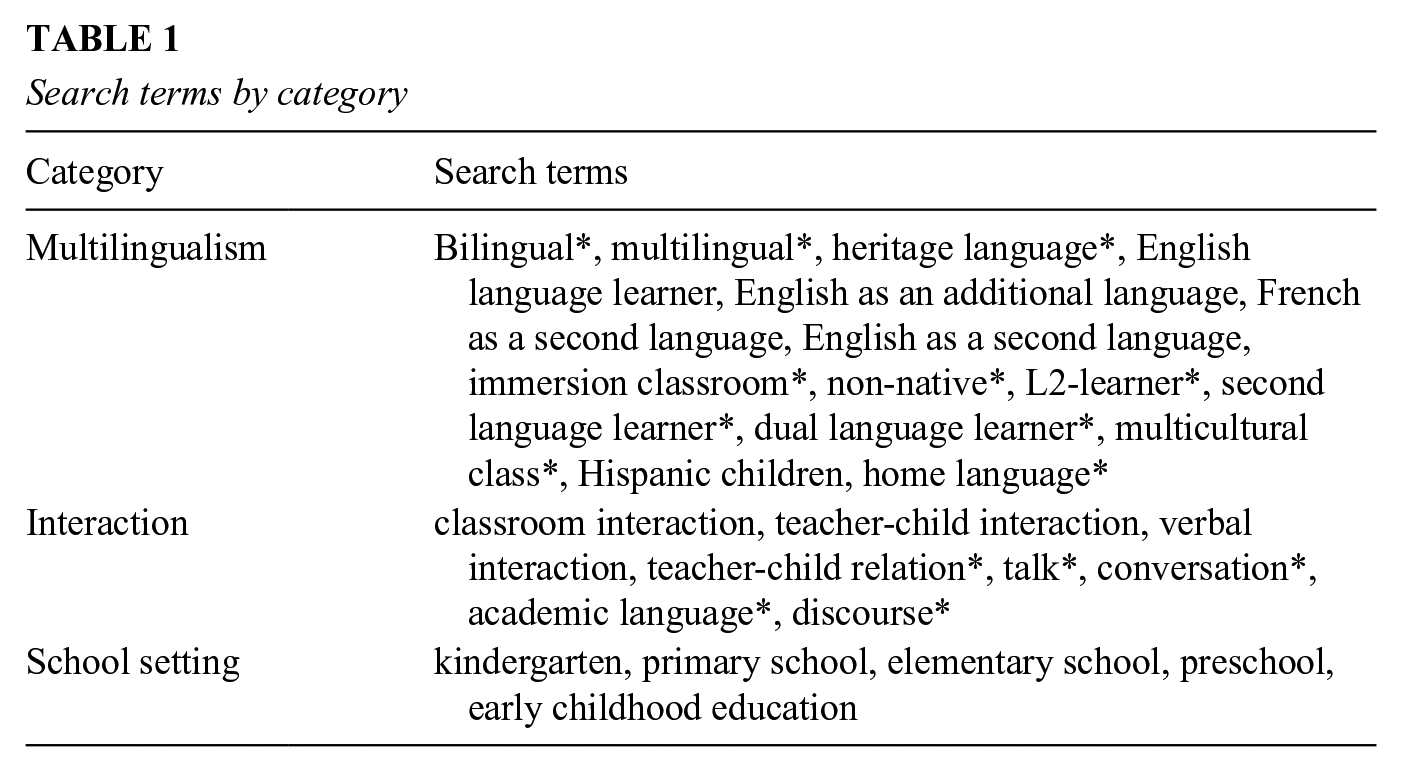
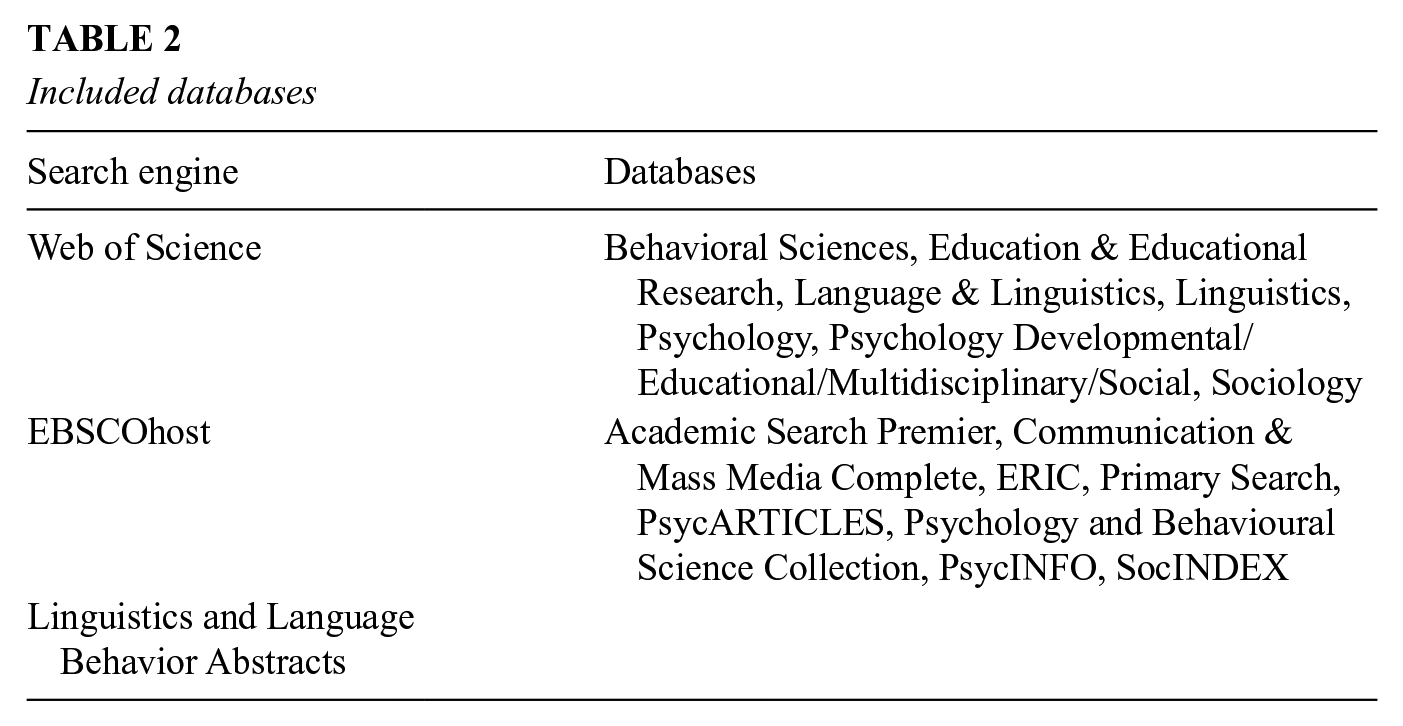
Search terms were defined to cover our three topics of interest: multilingualism, interaction, and school setting (Table 1). Databases that included research on linguistics, psychology, or the educational sciences were searched (Table 2) with all possible combinations of search terms from the three topics. This search resulted in 2,302 articles. The first 100 articles were split up into four partly overlapping sets of 50 (1–50, 25–75, 50–100, 1–25/75–100), and each set was judged on the inclusion criteria by one of the first four authors. This way the inclusion criteria could be tested, evaluated, and ultimately discussed by the research group, thereby developing the final inclusion criteria as previously reported.
Search terms by category
Included databases
Subsequently, the fourth author screened the title and abstract of each article. This resulted in the exclusion of 2,137 articles. Of the remaining 225 articles, 57 articles were identified as relevant, whereas for 108 articles, it was still unclear whether they should be included. The first author therefore also judged the relevance of these 108 abstracts and titles. She used the same criteria as the fourth author but also included all articles that seemed to address the research topic but needed further examination to determine whether they adhered to the inclusion criteria. This resulted in the inclusion of an additional 55 articles. In total, 112 articles were identified as relevant. The full text of these articles was retrieved for further examination. The full text of 6 articles could not be retrieved (even after contacting the authors) and were therefore excluded. The full text of the remaining 106 articles was scanned, and the inclusion criteria were checked in a standard order: age, empirical data, multilingual, teacher–child interactions. As soon as one of the criteria was not met, the article was excluded from the analyses. This resulted in the exclusion of 71 articles in total due to a different age-group (N = 31; e.g., Anderson & Loughlin, 2014), the lack of empirical data (N = 2; e.g., Watts-Taffe & Truscott, 2000), not focusing on multilingual children (N = 23; e.g., Dorner & Layton, 2014), or not focusing on teacher–child interactions (N = 9; e.g., Aarts, Demir, & Vallen, 2011). Six articles were excluded for other reasons. Five of these were not published in Dutch or English (e.g., Gajo, 1997). The sixth article appeared to be published twice in two different journals but with the same content, and therefore it was decided to only include the article that was published first (i.e., Jule, 2005). During the coding of the articles, an additional 4 articles were excluded as they did not focus on teacher–child interactions of multilingual children (e.g., Aukrust, 2008). The final sample therefore consisted of 31 studies. A complete overview of the search and inclusion process is shown in Figure 1.
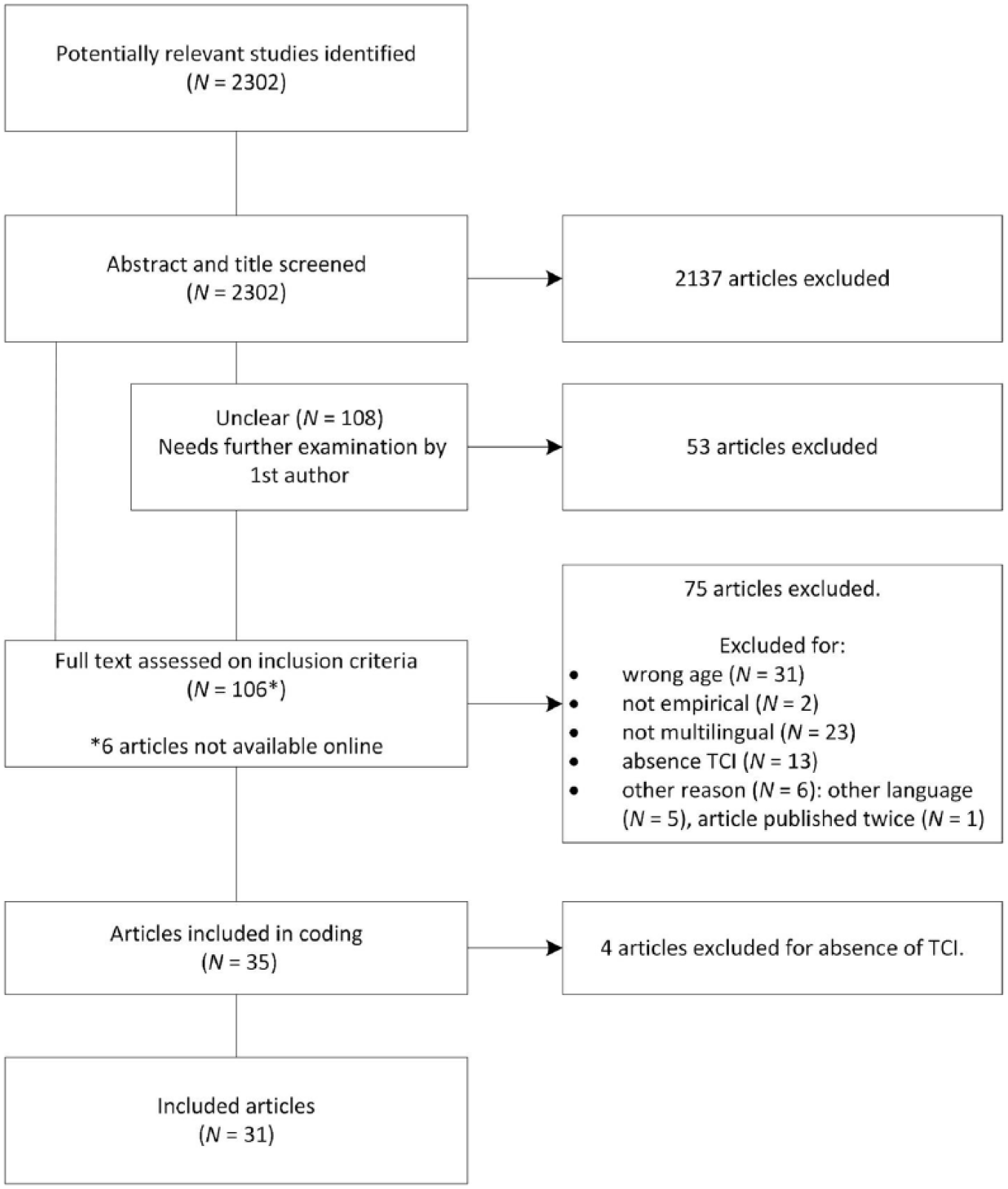
Flow diagram of study selection process.
Informational Value Assessment
Detailed reading of the articles that met the inclusion criteria revealed that some articles were not completely transparent about their data collection and analysis methods. For example, some articles referred to teacher–child interactions with multilingual children but did not mention how the classroom observations took place or how the segments of interactions were selected for analysis. Furthermore, some articles, although adhering to all the inclusion criteria, only marginally related to the focus of this review, that is, the nature of teacher–child interactions among multilingual children. This includes articles based on teacher interviews that mention classroom interaction generally and articles that study a monolingual sample but also briefly address the interactions with multilingual children. It was therefore decided to do an assessment of the transparency and focus (i.e., relation to the aims of this review) of all the included articles. First, to assess the transparency of the included studies, the CASP Qualitative Checklist (Critical Appraisal Skills Program, 2018) was adapted so that it could be used for both quantitative and qualitative studies (see the Appendix). This resulted in five yes/no questions on the clarity of the aims, methods (i.e., participants, data collection, and analysis; see the Appendix for the full checklist), and results of the study. When three or more questions were answered with a yes, a study was judged transparent. Second, the focus was judged by comparing the aims of the study with the aims of the current review. Studies that had more overlap with the aims of the review (i.e., focusing primarily on teacher–child interactions of multilingual children) were judged as having a major focus on the aims of the review. Studies that had less in common were judged as having a minor focus on the aims of the review. This includes studies that only addressed the teacher–child interactions of multilingual children in one paragraph or studies that mainly focused on data sources than interactions.
As a result of the informational value assessment, all the included articles were divided over four categories (Table 3). Articles in Category A are both transparent and have a major focus on the aims of the review. Nineteen of the 31 studies are in Category A. In Category B are studies that do have a major focus on the aims of the review but are less transparent. Two studies belong to this category. Eight studies are in Category C, which are studies that are transparent but only have a minor focus on the aims of the review. Finally, two studies are in Category D; these studies are less transparent and have a minor focus on the aims of the review.
Informational value, study characteristics, and domains in the included studies
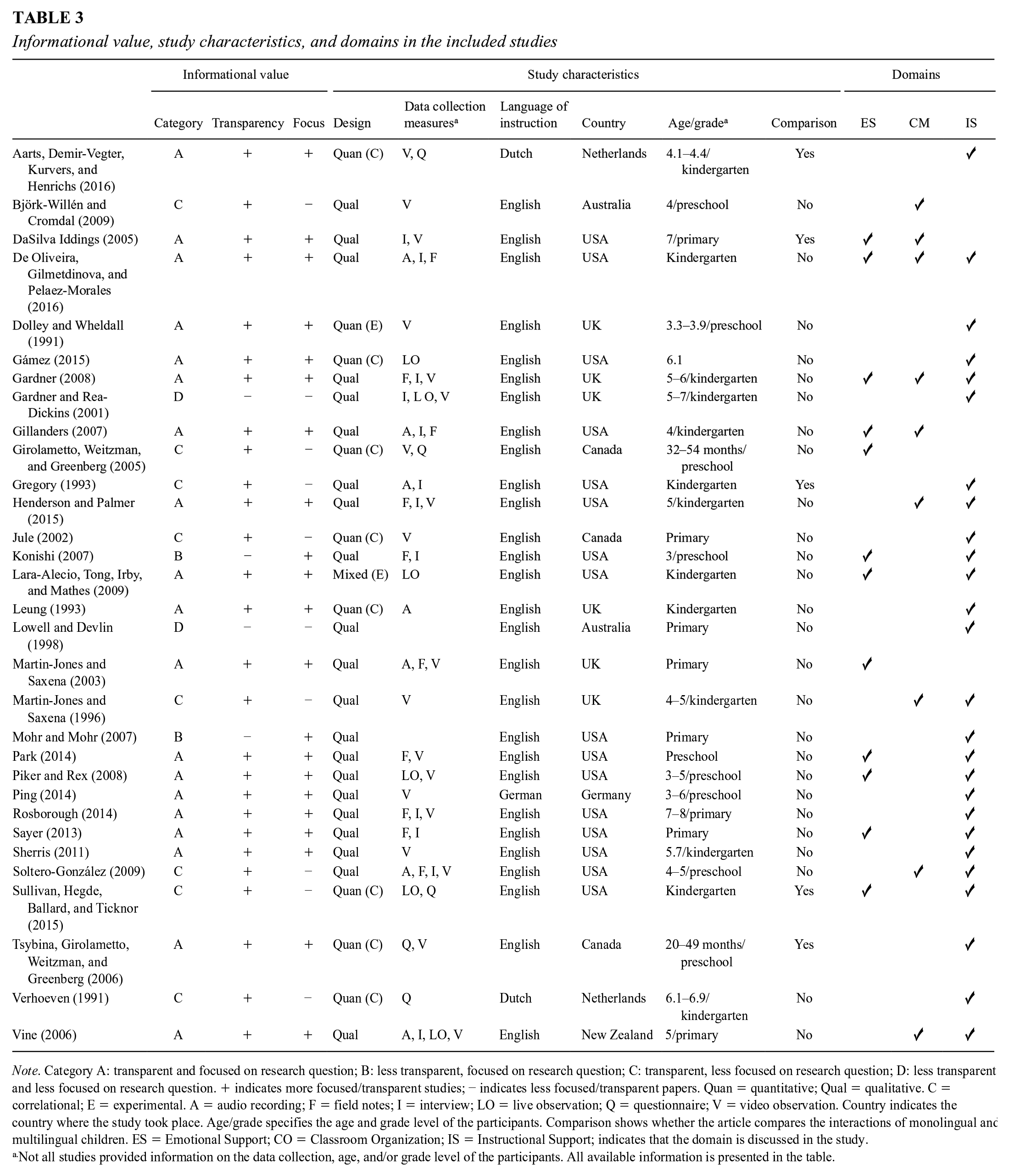
Note. Category A: transparent and focused on research question; B: less transparent, focused on research question; C: transparent, less focused on research question; D: less transparent and less focused on research question. + indicates more focused/transparent studies; − indicates less focused/transparent papers. Quan = quantitative; Qual = qualitative. C = correlational; E = experimental. A = audio recording; F = field notes; I = interview; LO = live observation; Q = questionnaire; V = video observation. Country indicates the country where the study took place. Age/grade specifies the age and grade level of the participants. Comparison shows whether the article compares the interactions of monolingual and multilingual children. ES = Emotional Support; CO = Classroom Organization; IS = Instructional Support; indicates that the domain is discussed in the study.
Not all studies provided information on the data collection, age, and/or grade level of the participants. All available information is presented in the table.
Analysis
Coding
All the included articles were coded by the first author on five aspects: (1) characteristics of the article (i.e., authors, title, journal, year of publication, aim and/or research question, and design), (2) participant characteristics (i.e., number of participants, number of multilingual participants, age, language background, operationalization of multilingualism, and comparison between monolingual and multilingual children), (3) study context (i.e., country, early-childhood context, classroom type, and activity studied), (4) data collected (i.e., type of data, instruments, studied dimensions of teacher–child interactions), and (5) results. When it was unclear how to code certain aspects of an article, the second and third authors were consulted to discuss the ambiguity, leading to a joint decision.
Key Sentences
With this review, we aim to synthesize the results of both qualitative as well as quantitative studies. Therefore, key sentences were extracted (i.e., direct quotes) or formulated for each article to reflect the main outcomes of the study. When possible, these were direct quotes from the article. Key sentences were generally extracted from the Results or Discussion sections of the articles and were mainly summarizing or concluding sentences. Apart from reflecting the main outcomes of the study, they had to be related to the aims of the review. Examples of key sentences are “EL2 children with the lowest expressive language skills demonstrated fewer uptakes of their educator’s recasts in comparison to EL2 children with higher expressive skills” (Tsybina et al., 2006, p. 177) and “The use of a consistent routine in the classroom allowed the Latino children to become participants in the community despite not having a full understanding of the language” (Gillanders, 2007, p. 50). Each article would typically have multiple key sentences. In total, 91 key sentences have been included in the analysis. The key sentences were determined by the first author. The second and third authors conducted an audit on this process, in which it was carefully described and discussed how key sentences were determined.
Thematic Analysis on Domains of Teacher–Child Interactions
This analysis was conducted based on the three domains of the Teaching Through Interactions framework (i.e., emotional support, classroom management, and instructional support). All key sentences were categorized as focusing on one or more of the domains. This categorization was based on the detailed description of the three domains in the Classroom Assessment Scoring System manual (Pianta, La Paro, & Hamre, 2008). The results of the included studies were synthesized separately for each of the three domains of teacher–child interactions—emotional support, classroom organization, and instructional support—first for the 19 category A articles, followed by the findings from the other categories.
Thematic Analysis on Comparison of Monolingual and Multilingual Children
We were especially interested in studies that made a comparison between monolingual and multilingual children as this shows how the interactions with monolingual and multilingual children might actually differ. The same key sentences were used for this specific comparison analysis. Studies that involved both monolingual and multilingual children and made an explicit comparison between the teacher–child interactions of monolingual and multilingual children were included in this analysis. Only five studies were identified that made such a comparison.
Results
Study Characteristics
In total, 31 studies were included in this review. Table 3 shows the study characteristics. The majority of the articles used a qualitative research design (N = 21). Most of the studies were conducted in English-speaking countries (i.e., the United States, the United Kingdom, New Zealand, and Australia; N = 28), of which 10 studies focused on multilingual children in the United States with Spanish as their home language. Other studies focused on a wide range of languages. The participants in 11 studies spoke one particular home language (e.g., Turkish, Chinese, Djambarrpuyngu, Hebrew, Samoan) or a group of languages (e.g., Indian languages, such as Punjabi, Urdu, Gujarati), whereas the participants of the other studies spoke a mixture of languages in their home environment. Unfortunately, information on the multilingualism of the participants in the included studies was limited. Seven studies only reported that the children were multilingual, and only 5 of these 7 studies reported the home language of these children. Of the remaining 24 studies, 21 included the home language(s) of the children, whereas 3 did not. Information on the proficiency of the participants in all their languages is also limited in most articles. Only 12 articles reported something about the language skill level of the participants, with (N = 4) or without (N = 8) proficiency scores. Ten of these studies reported that the children had low language skill levels in the majority language. The participants of the remaining 2 studies had a mix of language proficiency levels. Most other articles also focused mainly on children with low language proficiency in the majority language. Eight articles focused on children who had primarily been exposed to the home language and were starting to learn the majority language. Furthermore, 4 studies focused on recently arrived immigrants, and in 2 studies the children were labeled by the school as language minority students. The remaining 5 articles were unclear about the language background and proficiency of the participants. The participants in the studies were between 1.5 and 7 years old. In most studies (N = 18), the children were between 4 and 6 years old. The grade levels ranged from preschool to the first years of primary school. The studies were conducted in either special multilingual classrooms (N = 12) or regular classrooms with both monolingual and multilingual children (N = 19).
Domains of Teacher–Child Interactions
Each domain of the Teaching Through Interactions framework—emotional support, classroom organization, and instructional support—is known to be an important aspect of classroom interaction (Hamre et al., 2013), and results will therefore be separately discussed for each of these domains. Furthermore, because the classroom practices described could have implications for multiple domains, depending on the focus of a specific study, some classroom practices will be covered in more than one domain. Each subsection first discusses the results of the 19 Category A articles (i.e., transparent and major focus), followed by the results of the other categories. Whenever we talk about children, we mean multilingual children, unless otherwise specified. Table 4 shows an overview of all the classroom practices found per domain and informational value category.
Summary of findings for each domain per informational value category
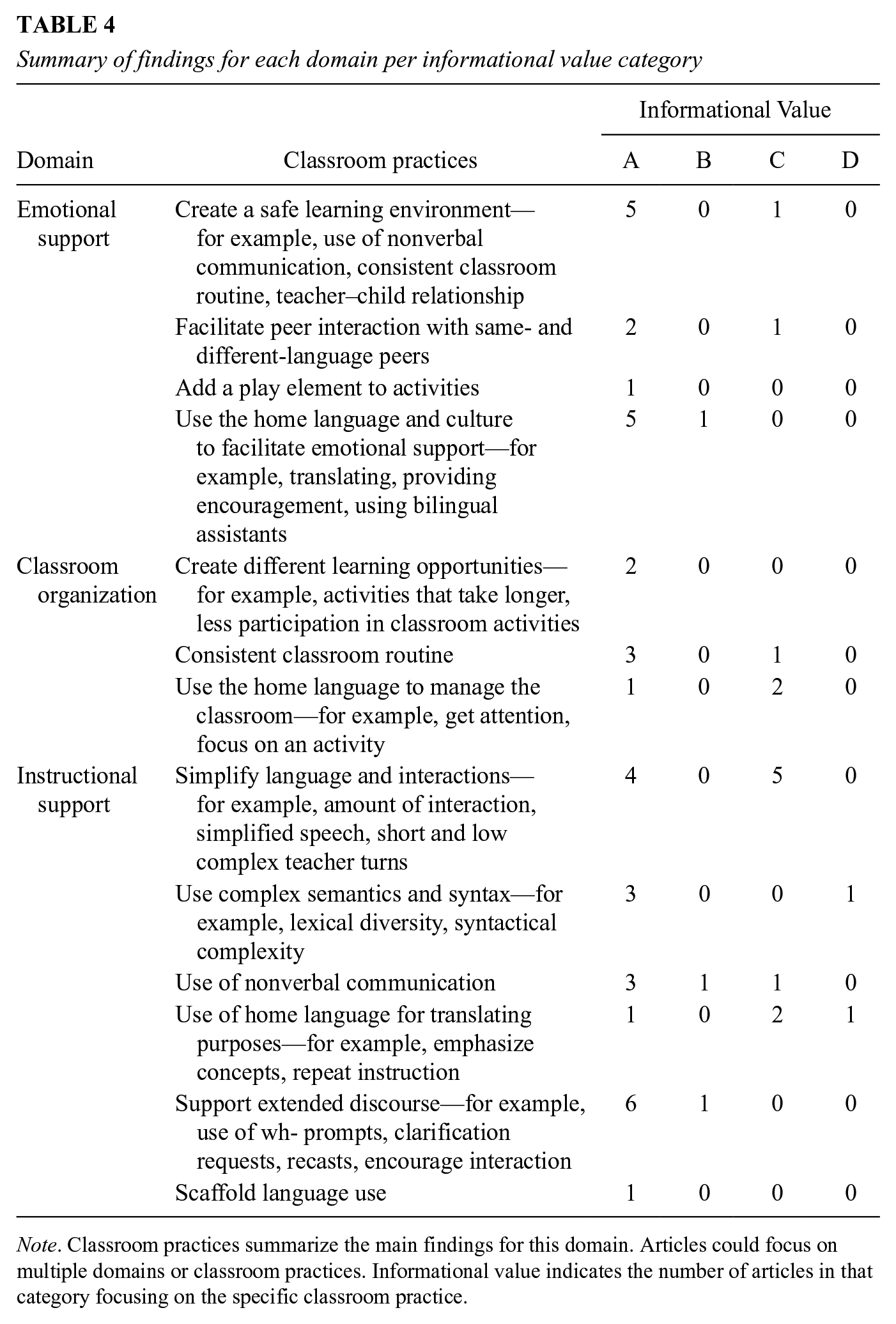
Note. Classroom practices summarize the main findings for this domain. Articles could focus on multiple domains or classroom practices. Informational value indicates the number of articles in that category focusing on the specific classroom practice.
Emotional Support
Nine Category A studies described practices related to teachers’ emotional support. We identified four classroom practices related to emotional support that appeared at least once in the included studies: (1) creating a safe learning environment, (2) facilitating peer interaction, (3) adding a play element to activities, and (4) use of the home language and culture (Table 4).
Five studies described the strategies that teachers used to create a safe learning environment for their multilingual students (DaSilva Iddings, 2005; Gillanders, 2007; Lara-Alecio et al., 2009; Park, 2014; Piker & Rex, 2008). Nonverbal communication and consistent classroom routines were strategies used to establish safe communication with the children and give them the chance to fully participate in the classroom, even though they might still have limited knowledge of the majority language (Gillanders, 2007; Park, 2014). These strategies are also used for classroom organization and instructional support and will therefore be described in more detail in those sections.
Two studies (DaSilva Iddings, 2005; Piker & Rex, 2008) showed how teachers created a safe learning environment by facilitating peer interaction between multilingual children and their classmates with the same home language. Peer interaction with same-language peers can act as a resource for understanding and participating in classroom activities.
Gardner (2008) aimed to raise child engagement by adding a play element to a literacy activity. This gave children more control over the activity as they were treated as knowledgeable actors in the interaction with the teacher. The children were also more motivated and showed more interest in the language.
The use of the multilingual child’s home language and culture plays a role in all three domains of teacher–child interactions and was covered in several articles belonging to Categories A, B, and C. Five Category A articles described how teachers used the cultural and linguistic background of multilingual children to facilitate emotional support (De Oliveira et al., 2016; Gillanders, 2007; Martin-Jones & Saxena, 2003; Piker & Rex, 2008; Sayer, 2013). There was a wide variety in the way the teachers used the children’s backgrounds. They used the children’s home language for translating purposes (Piker & Rex, 2008), for creating a safe teacher–child relationship and providing encouragement (De Oliveira et al., 2016), or for creating a classroom environment in which the multilinguals could become full participants (Gillanders, 2007). Sayer (2013) described in a case study how a teacher in a bilingual education program not only used the home language of the children to encourage their language learning in all their languages but also talked with the children about their ethnicity and their multilingual background to form a multiethnic identity. The inclusion of bilingual assistants in the classroom could also be a way to use the child’s home language at school. The study of Martin-Jones and Saxena (2003) showed that bilingual assistants used culture-specific cues in their interaction with multilingual children and in that way related the learning activities to the home context, making the activities more accessible for multilingual children.
One of the two Category B articles focused on emotional support. This study also focused on integrating multilingual children’s home language in the school setting. In this case study, a teacher with the same language background used the child’s home language and culture to create safety and comfort for a recently arrived immigrant child while the child was still learning the majority language (Konishi, 2007).
Emotional support was covered in two Category C articles. Although interaction with same-language peers can be helpful to create a safe learning environment (see the Category A articles by DaSilva Iddings, 2005; Piker & Rex, 2008), Girolametto et al. (2005) found that teachers hardly supported multilingual children when engaging in peer interaction. Another study found that teachers also seem to have better teacher–child relationships with monolingual children than with multilingual children (Sullivan et al., 2015). No articles in Category D focused on emotional support.
Classroom Organization
Six Category A studies described findings related to classroom organization. In these articles, three classroom practices were described: (1) creating different learning opportunities, (2) consistent classroom routine, and (3) use of the home language and culture (Table 4).
Two studies mention that because of the multilingual background of children, it might be hard for teachers to create the same opportunities in the classroom as for monolingual children. Gardner (2008) found that language activities took much longer in a linguistically diverse classroom, as multilingual children needed longer time to read, translation might be necessary, and the teacher took more time for word meanings. This created a tension between the requirement to cover the curriculum and the need to invest time in extended conversations with all students. Furthermore, DaSilva Iddings (2005) found that multilingual children often participated less in classroom activities than their monolingual classmates and had a hard time fully understanding instruction.
Three studies mention the importance of a consistent classroom routine. This makes it possible for multilingual children to understand what is going on in the classroom in spite of not fully understanding the language (Gillanders, 2007; Henderson & Palmer, 2015; Vine, 2006). Vine (2006) observed how a child with very low proficiency in the majority language learned the curriculum content in a language- and resource-rich classroom. However, the child’s focus in interactions with the teacher and peers was primarily on classroom routines and procedures. This might have been more important to that child at that point as understanding classroom practices gives access to participating in them (Vine, 2006).
De Oliveira et al. (2016) furthermore exemplifies a teacher who not only used children’s home language for emotional or instructional purposes but also sporadically used children’s home language to manage the classroom, such as getting their attention and focusing them on an activity. In this way, the teacher ensured that all children in the classroom understood the instruction and knew the classroom routines.
Three Category C articles focused on classroom organization. Soltero-González (2009) supports the previous findings from Category A of the importance of having consistent routines in the classroom. The teacher in this case study used predictable routines to make it easier for multilingual children to understand what was happening in the classroom. Björk-Willén and Cromdal (2009) studied the use of the child’s home language at school and found that although children were free to choose which language to use, the classroom practice of the teacher determined what language the children were speaking. Children would mirror the behavior modeled by the teacher, including the language choice, even if the modeled language was their less developed language. Finally, although the use of the child’s home language might be beneficial for multilingual children, Martin-Jones and Saxena (1996) found that teachers have difficulties organizing this in the classroom, as the teachers in their study constrained the contributions that bilingual assistants could make to the learning activities. None of the Category B and D articles focused on classroom organization.
Instructional Support
Instructional support was covered in 16 Category A articles. We identified six classroom practices that appeared at least once in the included studies: (1) simplify language and interactions, (2) use complex semantics and syntax, (3) use nonverbal communication, (4) use the home language for translating purposes, (5) support extended discourse, and (6) scaffold language use (Table 4).
Ten articles focused on how interaction can foster the language growth of multilingual children. Children in classes of teachers who used more lexically diverse and syntactically complex interaction showed more language growth (Aarts et al., 2011; Gámez, 2015). Ping (2014) found that children would give the same level of responses as the teacher prompts even though they were still acquiring the language. In the study by Gardner (2008), the teacher challenged the children to explain and justify their answer, rather than giving a yes/no answer. Furthermore, the use of nonverbal communication, such as gestures (Park, 2014; Rosborough, 2014), and materials (e.g., tangible examples, classroom attributes; Vine, 2006) in the interaction was found to be useful in helping multilingual children in their language development. The use of nonverbal communication was found to help create joint attention and made it easier for a child to understand the interaction. Finally, De Oliveira et al. (2016) found that teachers also used the child’s home language to support the meaning-making process, for example, by emphasizing an important concept or repeating an instruction in the home language to avoid confusion.
Six studies described strategies to create extended discourse and support language development (Dolley & Wheldall, 1991; Gardner, 2008; Ping, 2014; Sayer, 2013; Sherris, 2011; Tsybina et al., 2006). The teachers in the study by Ping (2014) primarily used wh- prompts (i.e., use of “what,” “where,” and “why” questions) to encourage children to contribute to the interaction. Sherris (2011) explored the spontaneous interactions between a multilingual child and the teacher. This teacher used a wide variety of strategies to extend the interaction. She used simple yes/no questions to open up the conversation but moved on by asking for clarification to let the child explain more and for repetition to check for understanding. Likewise, in the study by Gardner (2008), the teacher challenged the children to explain and justify their answer, rather than giving a yes/no answer. In the study of Dolley and Wheldall (1991), the teachers successfully encouraged the children to interact by creating learning activities that could only be completed by interacting with each other. The children in their study initiated more interactions and used more complex words in interaction with their teacher. The teachers also supported grammar learning through implicit corrections in interaction with the child (Ping, 2014; Sayer, 2013; Tsybina et al., 2006). This way the teacher corrected a mistake without explicitly mentioning it but still keeping the flow of the interaction. Finally, Henderson and Palmer (2015) described the use of process scaffolds, that is, teacher modeling of the expected language use and behavior in an activity, and found that this facilitated pair work between children from diverse language backgrounds.
Four studies showed that multilingual children were not always exposed to high-quality teacher–child interactions. For examples, teachers tended to give limited language support to multilingual children (Piker & Rex, 2008), and teacher turns were often of low complexity (Ping, 2014). Children tend to mirror this low complexity level of teacher turns (Lara-Alecio et al., 2009), and they also tend to give short one-word or one-clause responses to teacher initiations (Leung, 1993).
Both Category B articles focused on instructional support. Konishi (2007) described the value of using gestures and materials (e.g., communicating through a toy puppet) to help the multilingual child understand what was being said. Mohr and Mohr (2007) showed that teachers were persistent in having conversations with multilingual children in which the teacher valued the child’s efforts to respond and scaffolded elaboration.
Six articles in Category C focused on instructional support. Again, they showed that teachers made use of materials to support the interaction with multilingual children (Soltero-González, 2009). Teachers, for example, used visual aids to teach basic concepts, such as shapes, colors, and numbers. The amount of teacher–child interaction that multilingual children have with their teacher during a day was found to be limited (Sullivan et al., 2015), especially for girls (Jule, 2002), but the amount was still found to be a positive predictor of child language outcomes (Verhoeven, 1991). Soltero-González (2009) found that teachers used simplified speech in interaction with multilingual children. Teachers were most often the initiators of interactions, and children often only gave short responses (Martin-Jones & Saxena, 1996). Finally, Gregory (1993) found that children from a different cultural background had difficulty understanding interaction and instruction because of the different rules in the majority culture.
Two studies focused on the use of the home language in the classroom. Martin-Jones and Saxena (1996) found that teachers mainly used the home language as long as the child’s knowledge of the majority language was not yet sufficient to understand the instruction, and Soltero-González (2009) found that teachers did not encourage the use of the home language.
Both Category D articles focused on instructional support. Lowell and Devlin (1998) showed similar strategies for teacher–child interactions as were reported in Categories A, B, and C articles, namely use of the home language and teacher scaffolding. Finally, Gardner and Rea-Dickins (2001) showed that in language assessment of multilingual children, teachers take different approaches depending on the expertise of the teacher and the language support needed by the child.
Comparing Monolingual and Multilingual Young Children
As many classrooms have both monolingual and multilingual children, it is important to know how the teacher–child interactions of monolingual and multilingual children might differ. We therefore also specifically focused on the five articles that made this comparison; three in Category A (Aarts et al., 2016; DaSilva Iddings, 2005; Tsybina et al., 2006) and two in Category C (Gregory, 1993; Sullivan et al., 2015). The articles in Category A all focus on different age-groups (in the range of 2–6 years), different language populations, and different aspects of teacher–child interactions. One article focused on the classroom organizational domain (DaSilva Iddings, 2005) and the other two on the instructional support domain (Aarts et al., 2016; Tsybina et al., 2006).
The research of DaSilva Iddings (2005) focused on the learning opportunities of multilingual and monolingual second graders. It showed that the teachers in this classroom organized the classroom activities for monolingual and multilingual children differently and invested much effort in adapting learning opportunities in the classroom for both monolingual and multilingual children; however, this also led to unequal opportunities in the classroom activities. The teachers, for example, used separate reading activities that primarily focused on decoding for the multilingual children in the classroom, whereas the reading activities of the monolingual children included discussions and making connections with their own lives.
The studies of both Aarts et al. (2016) and Tsybina et al. (2006) focused on the linguistic aspects of teacher–child interactions. Aarts et al. (2016) compared the academic language use of teachers with monolingual and multilingual children. Their study shows that teachers used shorter sentences with a less diverse vocabulary when talking to multilingual children compared with monolingual children. Yet the content of these sentences was often more abstract (i.e., beyond the directly perceptual context) than in the interactions with monolingual children. Tsybina et al. (2006) studied the use of recasts by teachers of monolingual and multilingual children. Recasts are responses to child turns that include a linguistic correction of the child turn. Tsybina et al. (2006) observed that teachers used an equally low amount of recasts with monolingual and multilingual children. They also studied the amount of uptake, which are child responses that include (a part of) the recast. Multilingual children with the lowest language skills showed more difficulty with the uptake of the recasts than monolingual children and multilingual children with better language skills. This might be explained by the fact that children with low language proficiency levels often did not respond at all to a teacher prompt.
The remaining two articles were both in Category C. Sullivan et al. (2015) explored the teacher–child relationship and teacher–child interactions of both monolingual and multilingual children in the same classroom and found that teachers had a closer relationship, with more affection, with monolingual children than with multilingual children; however, they also had more conflict with monolingual children. They found no differences between monolingual and multilingual children for most types of interactions, such as extended discourse and routine interaction. They only found a difference for what they called minimal interaction, which includes giving short directives or responding to direct requests from the child. Monolingual children had less minimal interaction with their teacher than multilingual children. Finally, Gregory (1993) conducted a case study on how interaction evolves during a reading lesson. It was shown that children who understood the content and structure of the discourse in a reading lesson had richer interactions with the teacher that involved more finely tuned feedback. Multilingual children had more difficulties with understanding the reading lesson conventions, which resulted in less rich interactions with their teacher.
Summary of the Findings
The narrative analysis of the included studies showed that all the studies combined covered the three domains of the Teaching Through Interactions framework (Hamre et al., 2013). Most of the studies focused on instructional support, followed by emotional support, and finally classroom organization. Table 4 shows an overview of the main findings for each domain. In the emotional support domain, the studies emphasize the importance of creating a safe learning environment and teacher–child relationship for both monolingual and multilingual children to facilitate peer interaction. In the domain of classroom organization, the studies found that multilingual children might receive unequal learning opportunities in the classroom, as compared with monolingual children. Multilingual children, like their monolingual peers, benefit from consistent classroom routines to understand and participate in classroom practices. In the domain of instructional support, the studies focused on the complexity of the interactions, the use of nonverbal communication, and the facilitation of peer work through process scaffolds. Many studies focused on encouraging extended discourse to support language development through, among others, the use of recasts and wh- prompts. Some studies found that teachers gave limited language support to multilingual children. Finally, several studies showed that teachers use the child’s home language and culture as a means to promote all three domains of classroom interaction, that is, (1) for emotional supportive purposes, (2) to facilitate classroom organization, or (3) to provide effective instruction.
We only found five studies that made a comparison between the interactions of teachers with their monolingual and multilingual children. It was found that multilingual children received different opportunities in the classroom. Furthermore, teachers had different interactions with monolingual and multilingual children in terms of linguistic complexity and vocabulary.
Discussion
In this systematic review, we aimed to gain a better understanding of the teacher–child interactions to which multilingual young children are exposed. Our search resulted in 31 included studies. The findings were organized per domain of the Teaching Through Interactions framework, that is, emotional support, classroom organization, and instructional support (Hamre et al., 2013). These domains are all known to be important aspects of classroom quality and are found to be related to developmental outcomes. We found that the studies mainly focused on multilingual children with low language proficiency in the majority language and that only 5 of the 31 studies made a comparison between monolingual and multilingual children. The results showed that multilingual children, just like monolingual children, have high-quality interactions with their teacher that encourage them to take an active role in the interaction. In addition, teachers do adopt specific strategies to create effective learning opportunities for multilingual children, such as the use of the home language and culture.
The majority of the studies focused on classroom practices that support multilingual children in their academic development. Several small-scale studies, included in the review, described detrimental practices; that is, multilingual children received fewer opportunities (DaSilva Iddings, 2005; Gardner, 2008) and limited language support in the classroom (Piker & Rex, 2008). These outcomes should be taken seriously as many multilingual children enter early-childhood education with a delay in academic skills (Reardon & Galindo, 2009); hence, limited support in the classroom would only enlarge this achievement gap instead of closing it. The limited support that multilingual children may receive in the classroom could be partly explained by teacher expectations. Previous research on teacher expectations has focused on ethnic minorities, but similar effects could be expected for multilingual children, as many children from ethnic minorities have a different language background. A meta-analysis on primary and secondary classrooms showed that teachers often have lower expectations of children from ethnic minorities (Tenenbaum & Ruck, 2007). Similar results are found for expectations by early-childhood teachers; that is, children from ethnic backgrounds that are favored by the teacher perform better on academic skills (Peterson, Rubie-Davies, Osborne, & Sibley, 2016).
Many of the classroom practices that have been described in the included studies are in line with the existing approaches to effective teacher–child interactions. Teachers should have a warm and trusting relationship with the children in their classroom and should be sensitive to children’s academic and emotional needs to create a safe learning environment in which children can develop. Consistent classroom routines are important so that children know what is expected of them and can participate in learning activities. Furthermore, teachers should provide high-quality instruction that stimulates higher-order thinking (Hamre et al., 2013) and supports children in taking an active role in the interaction (Michaels & O’Connor, 2015). All these topics have also been addressed in this review as important classroom practices when teaching multilingual children. In addition, we found some strategies teachers use specifically in interactions with multilingual children.
A strategy that is specific to teaching multilingual children—and has been mentioned in several studies included in this review (N = 9)—is the use of the home language and culture. In most of these studies (N = 7), the teacher worked in classes where only one other (home) language was being spoken, next to the majority language. This makes the use of the home language in the classroom more feasible. In the remaining two studies (Martin-Jones & Saxena, 1996, 2003), the multilingual assistants were able to speak most of the language varieties spoken in the classroom. However, in Europe, for example—with the high influx of immigrants over the past couple of years—many classrooms have a wide variety of home languages (Leseman & Slot, 2014). This might make it harder for a teacher to adopt this strategy, as teachers cannot be expected to speak all those languages or to include all those languages in their teaching. Because many studies in this review showed that the use of the home language can be beneficial to create a safe learning environment and support language learning in both the home and the majority language, more research should be conducted on how this strategy can be used in classrooms where multiple languages are being spoken. Leseman and Slot (2014) suggest that a solution could be found in engaging parents in the education program and letting multilingual children work on activities at home in the home language parallel to the activities at school in the majority language. Such an approach in the Netherlands with Turkish Dutch preschoolers showed positive effects for both Dutch and Turkish language development (Leseman & Van Tuijl, 2001).
Several studies in the review (Gillanders, 2007; Park, 2014; Rosborough, 2014; Vine, 2006) also emphasized the use of nonverbal communication to support verbal communication and to facilitate multilingual children’s understanding of the interaction. Previous research showed that the use of gestures in interaction offers a child a simpler way to express and understand something (Goldin-Meadow, 2000). The use of gestures in classroom interaction could be especially helpful for children who show difficulty expressing themselves nonverbally and have lower language skill levels (Daniels, 1997). This suggests that the use of gestures in communication is mainly a good practice for teaching children with low language proficiency, which is often the case for multilingual children. Almost all participants in the studies included in this review had low language skill levels in the majority language and therefore either benefited (or could have benefitted) from the use of gestures in interactions with their teacher.
Limitations
We recognize several limitations in our study. First, the included studies show that multilingual children cannot be considered a homogeneous group. Multilingual children differ on many characteristics that might partly explain their school success, such as their socioeconomic status, language exposure, and proficiency in all their languages (Cummins, 1979). Unfortunately, information on their language background and proficiency was limited in the included studies. Furthermore, almost all participants in the included studies had low language skill levels in the majority language. As was shown in a previous review on the mathematics education of primary school multilingual children (De Araujo, Roberts, Willey, & Zahner, 2018), most studies on multilingualism take a deficit perspective when studying multilingual children, assuming that these children have a delay. It should be noted that this limits the generalizability of the present study, as the included studies only cover a small part of the multilingual population. There are also many multilingual children with high language proficiency in all the languages that they are speaking. As many of the studies seemed to focus on how to interact with children who are in the early stages of learning the majority language, it remains unclear what teacher–child interactions with highly proficient multilingual children look like and if they are any different from the interactions the teacher has with their monolingual peers.
Second, only six of the included studies presented direct measures of language proficiency, whereas most other studies only implicitly mentioned the language background of the participants. As multilingual children are not a homogeneous group when it comes to language proficiency, this is important information to consider when interpreting research findings. To acquire a more nuanced understanding of the school experiences of a wide range of multilingual children, future research should report more extensively on the background of multilingual children, including, among others, their language proficiency in all their languages, socioeconomic status, and age of language acquisition and exposure in all their languages.
Third, although we identified a range of classroom practices that are used by teachers in interaction with multilingual children, we cannot make claims about the effectiveness of these classroom practices. Most of the included studies focused on exposure to certain classroom practices rather than the effectiveness of those classroom practices. It might be tempting to make a direct comparison between the classroom practices that we found multilingual children are exposed to and the classroom practices considered effective in a general (monolingual) population. However, one core consideration behind this study is that, because of their unique blend of background characteristics, multilingual children might need and benefit from different classroom practices from those of monolingual children. Thus, we refrained from drawing such conclusions from the present study.
Fourth, the included studies varied widely in the aspects of the teacher–child interactions that were examined and the data collection methods used. Both quantitative and qualitative methods were used, for example, questionnaires, video and audio recordings, and field notes. Whereas several studies focused on specific classroom activities, other studies focused on interactions throughout the day. Certain classroom practices might only have been identified because of the focus and/or method chosen in a particular study.
Suggestions for Future Research
Although the current review expanded our insights into teacher–child interactions of multilingual children, some questions remain for future research. First, there were only five studies that directly compared the teacher–child interactions of monolingual and multilingual children. Although several previous studies investigated the relationship between teacher–child interactions and child development (Aukrust, 2008; Aukrust & Rydland, 2011; Bowers & Vasilyeva, 2011), these did not differentiate the teacher–child interactions that monolingual and multilingual children are exposed to in the same classroom. Hence, many questions remain on how teachers manage their interaction with monolingual and multilingual children in one classroom. Second, we found that some multilingual children had difficulty following the cultural norms in the classroom because they were different from the norms of their home culture. It should be acknowledged that multilingual children are not only learning multiple languages but are also often living in two cultures. Therefore, more attention should be paid to how family and cultural norms play a role in a child’s development in early-childhood education.
Implications
The results of the present study have several implications for practice. First, when interacting with multilingual children with low skill levels in the language of instruction, teachers face the need to support the understanding of verbal interaction. This review sheds light on some practices that can facilitate this task, such as using nonverbal communication, creating consistent classroom routines, or, when possible, using the child’s home language in the classroom. Second, in their quest to adapt classroom activities to the needs of diverse children, teachers need to avoid downward biases in the creation of learning opportunities for multilingual children. If multilingual children are consistently exposed to relatively less challenging and less engaging classroom activities, learning and developmental gaps between monolingual and multilingual children will only be enlarged. Third, inclusion in a linguistically diverse classroom requires teachers to be aware of the potential differences between the majority culture and the home culture of multilingual children. Differences between home and majority cultures play a role in multilingual children’s adaptation to the school culture and classroom practices and are therefore critical in the creation of inclusive learning environments.
Conclusion
In sum, this systematic review showed that much of what is known about the teacher–child interactions that multilingual children are exposed to is in line with what is known about effective teacher–child interactions in general. In addition, several studies point toward specific strategies that the teacher should adopt to facilitate the development of multilingual children. The worry that multilingual children might be exposed to unequal learning opportunities compared with their monolingual classmates remains, and therefore this important issue should be investigated deeper. The current review has shown that it is of importance to study the teacher–child interactions of multilingual children to ensure that the learning opportunities of this growing group of children can be optimized and to create equal opportunities in early-childhood education for all children.
Footnotes
Appendix
Authors
ANNEGIEN LANGELOO graduated from the Research Master Behavioural Science at the Radboud University Nijmegen, the Netherlands. She is a PhD student in the Department of Educational Sciences in the Faculty of Behavioural and Social Sciences at the University of Groningen, Grote Rozenstraat 3, 9712 TG Groningen, the Netherlands; email:
MAYRA MASCAREÑO LARA is an assistant professor in the Department of Educational Sciences in the Faculty of Behavioural and Social Sciences at the University of Groningen, Grote Rozenstraat 3, 9712 TG Groningen, the Netherlands; email:
MARJOLEIN I. DEUNK is an assistant professor in the Department of Educational Sciences in the Faculty of Behavioural and Social Sciences at the University of Groningen, Grote Rozenstraat 3, 9712 TG Groningen, the Netherlands; email:
NIKOLAI F. KLITZING graduated from the Research Master Behavioural and Social Sciences at the University of Groningen, Netherlands. In his master’s, he specialized in education and development and ultimately focused on researchers’ citation and literature practices. He is currently working as an academic advisor at the Faculty of Science and Engineering of the University of Groningen, Grote Rozenstraat 3, 9712 TG Groningen, the Netherlands; email:
JAN-WILLEM STRIJBOS is a full professor of learning and instruction in the Department of Educational Sciences in the Faculty of Behavioural and Social Sciences at the University of Groningen, Grote Rozenstraat 3, 9712 TG Groningen, the Netherlands; email: