




Abstract
This article examines how joint attention episodes constitute a core feature of relational pedagogy for infants and toddlers. It draws on social interactionist approaches to language and cognitive development to propose that joint attention may afford significant current and future potential for young children’s learning. However, most joint attention research has taken place within experimental settings, so current definitions of joint attention do not take into account the dynamic group-based nature of the infant-toddler room. In this article, the author presents findings from a study of the language environment of infant-toddler rooms to examine the characteristics of joint attention episodes as they naturally occurred in infant-toddler programs. The author illustrates how qualitatively different episodes of educator–infant joint attention support both language and cognitive development. In doing so, she proposes a theoretical model to represent the learning potential of these shared experiences with the aim of enhancing current understandings of what it means to learn collaboratively in infant-toddler group settings.
Keywords
Introduction
The proposition that children learn through relationships is now firmly established in early childhood curriculum theory. Ten years ago, Brooker summed up the state of play when she wrote: Learning is now seen to be very much the outcome of relationships: between children and their friends and classmates, between children and the adults who care for them in every setting, and between the professional educators and the families and communities who have provided children’s earliest experiences. (Brooker, 2007: 14)
While Brooker wrote of learning in general terms, shortly afterwards, Emma Pearson and I critiqued the available literature on relationship-based approaches to teaching and learning in infant-toddler rooms for its predominant focus on social-emotional development and well-being (Degotardi and Pearson, 2009). While we did not discount the important contribution to be made by attachment theory, we argued that the relative absence of cognitive-representational theoretical perspectives positioned infants and toddlers as emotional beings, rather than as thinkers and knowers – a trend that, some have argued, continues to be at the forefront in the thinking of early childhood educators today (Cheeseman et al., 2015; Salamon and Harrison, 2015).
In this article, I approach learning from a representational rather than a social-emotional perspective. I build on Papatheodorou’s (2008: 10) argument that learning through relationships involves ‘reciprocal and multivoiced exchanges of ideas that direct the path of learning’ to consider how qualitatively different episodes of educator–infant shared experience have the potential to support both language and cognitive development. In doing so, I present a theoretical model which, I propose, represents the language and cognitive learning potential of shared experiences as they occur naturally in infant-toddler early childhood education and care (ECEC) settings. My aim is to enhance current understandings of what it means to learn collaboratively in these settings.
Collaborative learning
When a representational focus is applied to relationship-based pedagogies, the emphasis is placed on the collaborative construction of new knowledge and understandings through the reciprocal expression and interpretation of perspectives (Degotardi and Pearson, 2014; Van Oers and Hännikäinen, 2001; White, 2016). The positioning of learning as collaborative thus raises the question: ‘How does the individual connect with the minds of others?’ (Gauvain, 1995: 27). Gauvain adopts a social-experiential approach to cognitive development to argue that the social world provides individuals with dynamic contexts which, by virtue of shared goals and mutual contributions, allow connections to be made between individual thinkers. She explains: Involvement with others, either at play or at work, creates opportunities for individuals to evaluate and refine their understanding as they are exposed to the thinking of others and as they participate in creating some form of shared understand with others. (39)
In early childhood education, the topic of collaborative learning has been applied variously through approaches such as guided participation (Rogoff, 1998) and scaffolding (Wood et al., 1976). Most recently, it has gained prominence in the concept of sustained shared thinking, defined by Sylva et al. as occurring when two or more individuals work together in an intellectual way to solve a problem, clarify a concept, evaluate an activity, extend a narrative, etc. Both parties must contribute to the thinking and it must develop and extend the understanding. (2004: 5)
Sustained shared thinking revolves around joint activity which includes the exchange and ultimate extension of knowledge and ideas. Siraj-Blatchford (2009) explains how the concept was derived qualitatively from video data of pedagogical interactions in high-quality preschool classrooms. The classification of sustained shared thinking emerged, at least in part, from the descriptive teaching strategy of ‘dialogue’. As such, the occurrence and maintenance of sustained shared thinking is reliant on conversation and, therefore, if its learning potential is to be realised, ultimately on children’s ability to verbally express their ideas.
Given its origins and communicative focus, it is, perhaps, unsurprising that the majority of research about sustained shared thinking involves interactions between educators and preschool-aged children (e.g. Peters and Davis, 2011; Siraj-Blatchford and Manni, 2008; Wild, 2011). The occurrence or characteristics of sustained shared thinking in the infant-toddler years is largely unexplored, raising the question of the applicability of this pedagogical concept for the younger age group. Siraj-Blatchford (2007: 3) acknowledges this difficulty when she admits that ‘the pedagogic form that “Sustained Shared Thinking” takes with children under age two is quite different from that most appropriate for three to five year olds’. She identifies emotional communication with caregivers as the beginning of the progression of sustained shared thinking in early infancy. This, she argues, then progresses to object-centred joint activity, defined as involving the symbolic activities which begin to emerge in late infancy and predominantly feature in the play of children over two. Therefore, while Siraj-Blatchford concurs with others (e.g. Stern, 1985) in emphasising the importance of emotional communication for infants’ developing awareness of self and other, what is less apparent is how these predominantly emotionally focused interactions develop into more informational-based, representational means of communicating about and understanding the world.
Joint attention episodes
In this article, I propose that joint attention episodes play a significant role in bridging the gap between emotional communication in early infancy and symbolic collaborative-learning interactions which rely on language proficiency. Joint attention episodes are defined by Tomasello (1999: 97) as ‘social interactions in which the child and the adult are jointly attending to some third thing, and to one another’s attention to that third thing’. Joint attention episodes therefore involve shared experience on both activity and perceptual levels, as infants and educators come together to interact around an object or event of joint interest. Importantly, they are defined intentionally, comprising contexts of shared motivations and goals, and thus gain their identity from a shared appreciation of ‘what we are doing’ (98) and create an intersubjective context in which individual meaning can be shared.
Tomasello (1999) argues that joint attention provides a rich context for learning during mid to late infancy. To begin with, joint attention episodes serve to establish infants’ attention on a particular object or event of interest. As it is impossible to focus on everything within one’s perceptual field, joint attention episodes, through the establishment of shared intentions and goals, draw infants’ attention to objects, actions and events that are socially significant and culturally valued. Second, both Tomasello (1999) and Gauvain (1995) agree that the mutual responsiveness that exists in joint attention episodes draws each partner’s awareness to the perspectives of the other, the cognitive implications of which include ‘opportunities for individuals to evaluate and refine their understanding as they are exposed to the thinking of others’ (Gauvain, 1995: 39). Thus, episodes of joint attention potentially include dialogic cognitive representations (Fernyhough, 1996) which, when situated within a shared experience with shared intentions, enable children to gain and gradually refine knowledge and understandings about their world.
Finally, and significantly, joint attention episodes establish a common communicative ground which provides the context for infants to learn language ‘within the flow of naturally occurring social interactions in which both adult and child are attempting to get things done’ (Tomasello, 1999: 95). The mutual relevance that is established in joint attention supports infants in their efforts to extract conventionalised meaning from the communication that occurs within the joint attention context. The potential of shared reference and relevance for infants’ language development is well documented, with experimental research demonstrating predictive links between joint attention participation and both receptive and expressive language abilities, particularly for children in their second year of life (for a comprehensive overview, see Tomasello, 2008).
Joint attention episodes therefore have two defining characteristics which indicate potential as a context for sustained shared thinking in mid to late infancy. First, episodes of joint attention represent contexts for the sharing of perspectives through means that do not necessarily rely on language proficiency, hence creating opportunities for the collaborative construction of knowledge. Second, joint attention supports infants’ emerging language skills, which will progressively increase their ability to engage in more mature forms of sustained shared thinking as they advance towards their preschool years. In short, joint attention episodes potentially motivate and support learning in the present while simultaneously providing infants with opportunities to develop a language capacity that will enable them to engage in collaborative-learning interactions in the future.
Joint attention in infant-toddler ECEC settings
Traditionally, joint attention research has been conducted in laboratory settings, in situations where one adult, usually the mother, is asked to engage one-on-one with her infant for a short, uninterrupted period of time (Carpenter et al., 1998; Husdedt and Raver, 2002). Given the considerable differences between this context and the group-based context of the early childhood classroom, questions need to be asked about the applicability of dyadic, uninterrupted joint attention in ECEC contexts.
The small amount of research that has explored joint attention in ECEC settings has raised similar questions. In an early study, Smith (1999) undertook naturalistic observations of 200 infants in New Zealand infant-toddler rooms to detect episodes of shared reciprocal activity with an educator. She found that one-third of the children experienced no joint attention during that time, and another third experienced only one episode. A more recent US study, however, suggests that joint attention in ECEC classrooms may be qualitatively different than that experienced in experimental settings (Cain et al., 2007). Also finding that sustained, or ‘stable’, episodes of joint attention were relatively rare, Cain et al. (2007) suggest that modifications need to be made to the operationalisation of joint attention. They propose a category of ‘dynamic’ joint attention to represent episodes in which educators interact with more than one infant as they move around the classroom. ‘Dynamic’ joint attention, they explain, is characterised by educators engaging in short bouts of joint attention, often interspersed with interruptions by other events or people in the room. ‘Dynamic’ joint attention, they argue, may be more characteristic of interactions in group contexts, where educators need to share their attention between multiple infants and coordinate their interactions to engage more than one infant at the same time. However, while Cain et al.’s observations illustrate some of the complexity of engaging in joint attention in ECEC classrooms, it has to be noted that their data was all derived from low-quality centres, where structural conditions and interaction quality were assessed to be relatively poor. The authors admit that, under such conditions, educators’ ability to sustain their interactions with infants was compromised, and this potentially contributed to their identification and definition of ‘dynamic’ joint attention. Further analyses are therefore needed to determine whether the constructs of ‘stable’ and ‘dynamic’ joint attention can apply more broadly to centres that are not classified as being of low quality. Furthermore, while Cain et al. provide some information about how these different joint attention subtypes may support infant language development, the question of the representational and collaborative-learning potential of these episodes remains unexplained.
The present study
The analysis presented in this article aimed to examine the qualitative dynamics of joint attention in infant-toddler ECEC classrooms to determine the validity of the construct as a context of sustained shared thinking during mid to late infancy. In particular, the study addressed two questions:
How can joint attention episodes, as they occur naturally in infant ECEC classrooms, be categorised?
What are the experiential, interactive and representational characteristics of these different types of joint attention?
By addressing these questions, my aim was to construct a model to represent the language and cognitive collaborative-learning potential of joint attention, thus contributing theoretically to current understandings of relationship-based pedagogy with infants and toddlers.
The data
The analysis was conducted on data drawn from a study of the language environment of infant-toddler early childhood rooms. This larger study generated three hours of video-recorded data of one focus educator and one focus infant in each of 57 participating ECEC infant-toddler rooms, all of which had been assessed as meeting Australian standards for education and care quality. The focus educators in the study volunteered to participate after receiving an invitation, via their centre director, from the investigators. Each focus educator was video-recorded for two 90-minute periods across two days, during which they were asked to conduct their normal activities with the children in their room (for full recruitment details and ethical considerations, see Degotardi et al., 2016).
The aim of the present analysis was not to make comparisons between educators, nor to examine the frequency of joint attention episodes, but instead to conduct a detailed qualitative analysis of educator–infant joint attention interactions to determine and describe their dynamics and theorise about their collaborative-learning potential. Hence, a case-study approach which afforded a close and thorough analysis of the phenomena of interest (Vasconcelos, 2010) was deemed appropriate. A subset of six focus educators was selected at random from the larger sample so as to permit an in-depth analysis of the qualitative features of the joint attention episodes. In this randomly selected cohort, one educator had a vocational certificate qualification, three had attained a vocational diploma, and two had a Bachelor’s degree in Early Childhood Education.
The qualitative analysis was conducted in three phases. First, the three hours of video footage of the six educators was watched repeatedly, and notes were made to characterise episodes where educators and infants were engaged, even briefly, in a shared interactional experience. Tomasello’s (1999: 97) definition of a joint attention episode as ‘the child and the adult … jointly attending to some third thing, and to one another’s attention to that third thing’ provided the starting point for this analysis. However, as Tomasello’s experimentally derived definition focused on joint attention with a singular child, in recognition of the naturalistic group context, his definition was expanded to include occurrences where the focus educator was interacting with more than one infant. In this analysis step, the focus was on the experiential characteristics of the different types of shared interactive experiences. Repeat viewing of the videos, accompanied by a gradual synthesis of detailed notes, permitted the refinement of emerging categories of joint attention and the determination of defining characteristics.
Studiocode video-analysis software was then used to code each of the six focus educator videos according to the resultant categories, thus segmenting the start and finish time of each category as it occurred during the footage. This allowed the video data coded as each separate category to be extracted from the full video for further analysis. In this next step, the interactive and representational characteristics predominantly associated with each distinct category were identified.
Results
The analysis revealed three distinct categories of joint attention, and one category which, while it contained educator–infant interactions, was nonetheless categorised as non joint attention. I will begin with this latter category to describe and discuss each joint attention category in turn.
Non joint attention
Non joint attention occurred when there were brief instances of an educator and infant attending to the same object but there was no evidence of mutual awareness of this shared attention. As illustrated in the example below, while there were instances of educator talk, this was generally not maintained beyond educator input: The educator is busily setting up the playdough table. She allocates lumps of dough around the table. One infant is present, and pokes his finger into the dough. He looks up, but the busy educator does not notice and continues to allocate resources. ‘There you go’, she says, as she puts scissors next to each lump. The original infant wanders away. The educator notices one toddler near to the table who is trying to pick up a basket of blocks. ‘Thanks Mia’, she says, taking the basket from Mia. ‘I’ll put those in the cupboard, OK?’ She walks away with the basket, calling over her shoulder, ‘Come and play with the playdough. You want to play with the playdough? I’ll get you all a chair so you can sit down’. Mia approaches the table and pokes the dough without looking at the educator, who is gathering chairs. A few other infants approach. ‘Let’s sit down so we’re safe’, she says, and puts a chair behind each infant, who then sits and begins to play with the dough.
Episodes of non joint attention tended to have a pragmatic focus, often occurring during transitions when the educator was busy organising either the environment or the infants. Not surprisingly, they were characterised by regulatory language, used to provide instructions and regulate the infants’ behaviours. Infant responses, other than at a behavioural level, rarely occurred, and appeared not to be expected by the educator. While it is possible that the interaction created a moment of shared reference to an external entity, such as the playdough, the focus was more on individual behaviour rather than on the sharing of meaning beyond a behavioural level.
Fragmented joint attention
The second category was coded as ‘fragmented joint attention’ because, while the presence of brief periods of shared attention between educator and infant met the broad definitional criteria for joint attention (Tomasello, 1999), the interactions were brief and disjointed. Competing demands meant that the educator’s attention and her communications were divided between different children and their different individual experiences and agendas: The educator is on the mat with an infant who is holding a small book. The educator looks over her shoulder at a toddler some distance away who is holding his shoes. The infant leans forward with book in hand and vocalises in an animated fashion. The educator, still looking at the distant toddler, calls out: ‘Make sure you put them in your locker please’. The first infant looks at the book and vocalises briefly, and also momentarily follows the educator’s gaze to look towards the toddler. The educator then returns her attention to the infant, who immediately notices her attention and gives her the book. He vocalises again. The educator begins to chat about the book: ‘Where are her wellies? She’s left her wellies on the beach!’ The infant looks on with interest, and the educator turns the book and points: ‘See? It’s in the puddle’. The infant leans towards the book and gazes at the page. The educator’s attention is drawn to another passing child: ‘Eric, darling, you dropped your sock on the ground’. Simultaneously, the infant utters ‘in puddle’, but when he gets no reply from the educator, he returns to look at the book.
The category of fragmented joint attention closely aligned with the ‘dynamic’ joint attention category described by Cain et al. (2007), although it was not characterised by the educator moving from one infant to the next. Instead, the educator usually remained in one place, yet competing demands meant that she did not maintain joint attention with one infant. In some instances, such as the one above, the educator’s attention was drawn to a managerial task that entered her perceptual field. In others, when in the presence of multiple infants, her attention was drawn from one infant to the next as they made individual bids for attention. The result was the occurrence of very brief periods of joint attention which included short pragmatic or information-based interactions around a topic of shared interest. Interactions, however, were rarely sustained past two turns and, while there were infant contributions to the interactions, these overtures were frequently missed. When combined with the fragmented attention of the educator, the interactions occurring within this type of joint attention were not sustained, and any communicative exchanges of information were not extended.
Fluid joint attention
Fluid joint attention shared some of the characteristics of fragmented joint attention in that the educator’s attention was divided between the individual agendas of more than one infant. Two features, however, distinguished fluid joint attention from the fragmented joint attention context: (1) the location of the interactions within the context of a broader activity context and (2) a clear awareness of participating infants of each other’s activity and interactions within that context. The result was a sense that the infants responded to, and were perceptually engaged in, collective rather than individual experience: An educator is sitting in the sandpit, surrounded by four infants and toddlers. One toddler approaches her and points, and the educator translates: ‘You want to shovel? Oh, look [leans forward and points]. There’s one here’. A second infant, Ellie, who has crawled into a large upright box, follows the educator’s point to briefly watch the toddler. The educator, noticing Ellie, asks: ‘Ellie, are you OK?’ Ellie vocalises and wriggles into the box. The educator responds, ‘The box is really little’, while glancing at the toddler and maintaining her point towards to shovel. She emphasises her point to the first infant: ‘See?’ Ellie begins to grizzle, and the educator asks: ‘Do you want help?’ Ellie replies ‘Yeah’, to which the educator replies ‘Hold on’. Ellie manages to shift her bottom into the box, and the educator acknowledges: ‘Oh, you got it!’ The educator retrieves a shovel and turns to the first infant, saying ‘This one?’, but the infant holds up a shovel he has found. ‘Oh, you got one. OK, well I’ll use this one’, says the educator, and she begins to dig around Ellie in the box. ‘Ellie, was it hard work? Was it hard work getting in?’ Ellie replies ‘Hard’. The educator continues: ‘Can I dig around you?’ Ellie nods and watches from the box as the educator digs. The toddler also watches on with interest.
Fluid joint attention episodes included short but reciprocal interactions around a shared topic, which was either pragmatic or informational in nature. Infant initiations were usually perceived and responded to by the educator, who encouraged and waited for responses. The interaction was therefore sustained, albeit usually for a short time, as information was exchanged in both non-verbal, such as through pointing and physical movement, and verbal means. Due to the close proximity of multiple children and educators, the infants’ attention was frequently directed to the interactions occurring between the educator and their peers. Fluid joint attention thus demonstrated the capacity of both the educator and infants to attend to, and potentially derive meaning from, interactions that took place within the broader shared experiential context.
Stable joint attention
The final category aligned closely with the stable joint attention type described by Cain et al. (2007) in that it was characterised by shared and sustained mutual attention to both the experience and each other: An educator is sitting with one infant on a mat with a train set. The infant looks and says ‘Choo ooo’. The educator echoes the infant’s vocalisation and picks up two carriages: ‘Look, you can join them together’. The infant looks up at the educator, who responds ‘See?’ She holds the connected carriages up to show how they are joined, and the infant responds by pointing at the carriages and vocalising. The educator smiles and says ‘Magic!’ She pulls the carriages apart and says ‘Magnets … see, they stick’. The infant looks at the carriages, watches, then looks up, establishes eye contact and smiles. He tries to put his train on the track and says ‘Choo oo’. ‘Choo choo’, echoes the educator again, and puts her train on a slope. It rolls down and the infant looks up with mouth open wide. The educator responds with an animated ‘Oh! … It went down the hill’. A toddler joins the infant and educator on the mat. ‘Hi!’ says the toddler, and the educator says, ‘Hi darling. Do you want to come and play with the trains?’ ‘Yeah’, replies the toddler. The first infant continues to play while the educator now draws the toddler into the conversation. Both children are soon initiating and responding to the discussion about the trains.
Stable joint attention was thus characterised by mutual contributions by infants and educators to the interaction. As the interaction was sustained for some time, it became a context in which information was not only shared, but also extended. For example, the educator took the opportunity to explain and demonstrate how the carriages were joined, and provided additional input about the motion of the train. Significantly, while Cain et al. (2007) and most experimental joint attention researchers describe stable joint attention as occurring between an adult and one infant, the example above demonstrates the potential for it to involve multiple peers. The skill of the educator is apparent in how she responds to brief interruptions and then draws the attention of other attending children to the focus of the existing shared attention. The result is a multi-person conversation in which each interactant contributes to and extends meaning-full, sustained dialogue.
Discussion: learning language and learning through language
This article aimed to determine the dynamic characteristics of joint attention episodes as they naturally occurred in ECEC infant-toddler rooms. Not including the category of non joint attention, three distinct types of joint attention were derived, demonstrating a progression from largely pragmatic, short, non-reciprocal interactions characteristic of fragmented joint attention to the information-rich, sustained and mutually responsive interactions found in stable joint attention. It is likely that the specific and varied demands and opportunities associated with these group-care contexts, and the naturalistic nature of the data, resulted in the more nuanced classification of joint-attention episodes than previously derived in experimental or early childhood contexts. Regardless of the overall quality of the setting, in group ECEC contexts, educators are called on to respond to multiple children and manage often competing requests and bids for attention. The existence of fragmented joint attention in this data should therefore not necessarily be regarded as characteristic of low-quality provision, but instead seen as one part of the naturally occurring continuum of interactional experiences for educators and young children.
The inclusion of fluid joint attention is unique to this study, demonstrating that joint attention episodes are more varied and dynamic than those described in experimental studies (e.g. Carpenter et al., 1998) or in Cain et al.’s (2007) analysis of low-quality ECEC centres. Fluid joint attention is reflective of the kinds of interactions described in studies of older children’s play experiences in group settings, where single educators employ their pedagogical skills to respond to and extend multiple children’s play engagement (Singer et al., 2014). In episodes of both fluid and stable joint attention, it was seen that educators could coordinate their attention between more than one infant, and sustain interactions to maximise these infants’ learning opportunities. This capable sharing of attention during joint experiences also created a sense of ‘us’ which extended past the educator–infant dyad to support these young peers’ mutual awareness of and involvement with each other (Degotardi and Pearson, 2014; Rayna, 2001).
In the introduction of this article, I proposed that joint attention, during infants’ second year of life, could form part of a continuum of contexts for sustained shared thinking – one that could bridge the gap from emotional communication in early infancy to the symbolic joint activities of over-two-year-old children (Siraj-Blatchford, 2007). For this to be the case, evidence was needed to demonstrate that joint attention episodes (1) involved the sharing and extension of knowledge and thinking, and (2) contained interaction elements which would foster language development. If these elements were present, infants’ participation in joint attention would simultaneously foster cognitive development and support their progression to more language-dependent forms of sustained shared thinking in their later toddler and preschool years. While each of the three forms of joint attention described in this study did demonstrate language and cognitive learning potential, the opportunities were qualitatively different in each context.
Figure 1 illustrates the learning potential of each type of joint attention. Fragmented joint attention largely involved short interactions around individual infant needs or perceptions with little opportunity for mutual response or extension. While these interactions revolved around a shared external reference point, thus involving the brief sharing of meaning, their non-sustained nature provided infants with limited opportunity to derive conventional linguistic meaning from the interaction. Fluid joint attention involved reciprocal short interactions, but this time within a collective context in which infants used their emerging language skills to express their ideas and intentions. There were short bursts of mutual responsiveness and a sense of collaboration attached to the context, the significance of which for language development is explained by Nelson (2007: 117), who argues that ‘[t]he infant constructs a beginning lexicon in collaboration with at least one other user of the language, in shared activities where the two may interpret each other’s collaborative intentions’. Stable joint attention further capitalised on the shared nature of the experience to afford sustained interactions in which perspectives were expressed and ideas were extended. The sustained shared focus of the interactions thus provided infants with opportunities to use their emerging language skills, and the presence of dialogue provided opportunities for the gradual refinement of meaning, as well as the extension of learning (Fernyhough, 1996; Gauvain, 1995; Nelson, 1996).
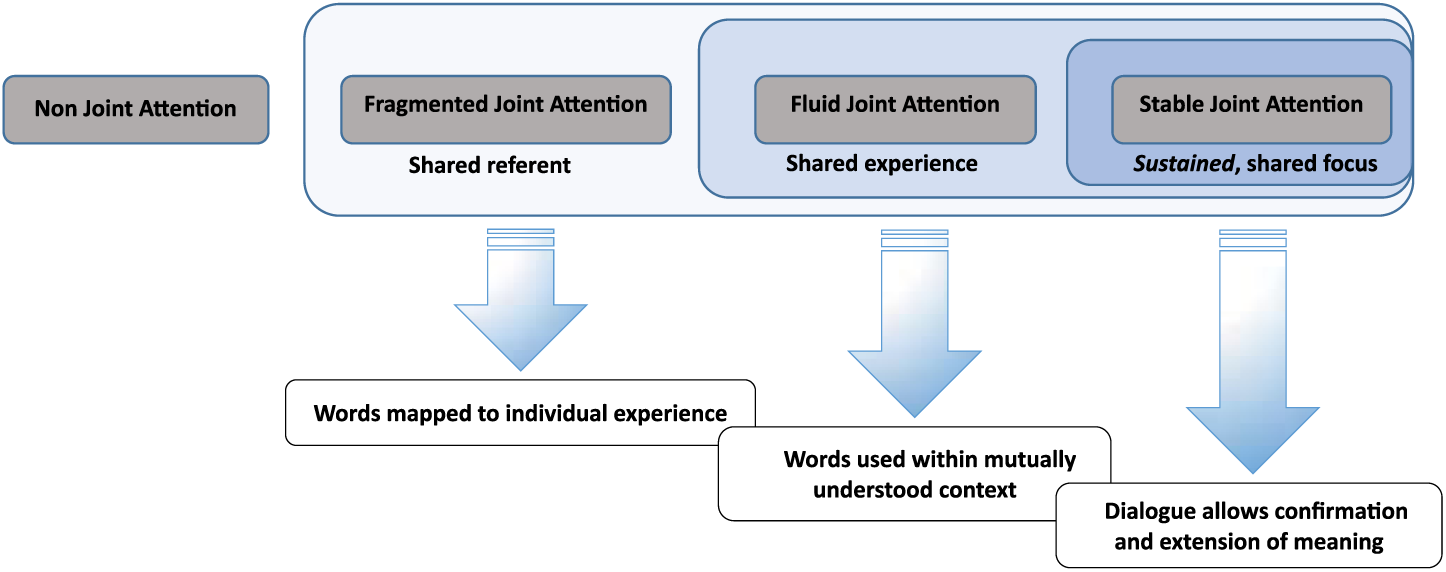
The language-learning potential of fragmented, fluid and stable joint attention.
This model of learning potential through joint attention thus proposes that shared experience and mutually responsive language-based communications jointly constitute a learning context that supports both language and cognitive development during mid to late infancy. The significance of language cannot be overlooked in this process. Vygotsky explains: The relation of thought to word is not a thing but a process, a continual movement backward and forth from thought to word and from word to thought. Thought is not merely expressed in words: it comes into existence though them. (Vygotsky, 1986: 218)
Not only does language permit the sharing of ideas and intentions that would otherwise be opaque, but language, as it develops, also provides young children with the means to represent, negotiate and therefore extend their understandings (Nelson, 1996). Halliday stresses the central role that language plays in learning when he argues that meaningful social interactions provide children with means both to learn language and to learn through language: When children learn language, they are not simply engaging in one kind of learning among many; rather, they are learning the foundation of learning itself … Language is the essential condition of knowing, the process by which experience becomes knowledge. (Halliday, 1993: 93–94)
Conclusion
The analysis presented here proposes that qualitatively different forms of joint attention provide varying opportunities for both language and cognitive development. Most importantly, returning to the topic of relationship-based pedagogies, I propose that sustained reciprocal interactions, most evident in stable joint attention episodes, constitute an important collaborative-learning context for infants. The model represented by Figure 2 illustrates how increasingly interactive forms of joint attention both intensify opportunities for infants to develop language and represent a relationship-based learning continuum from individual to collaborative learning.
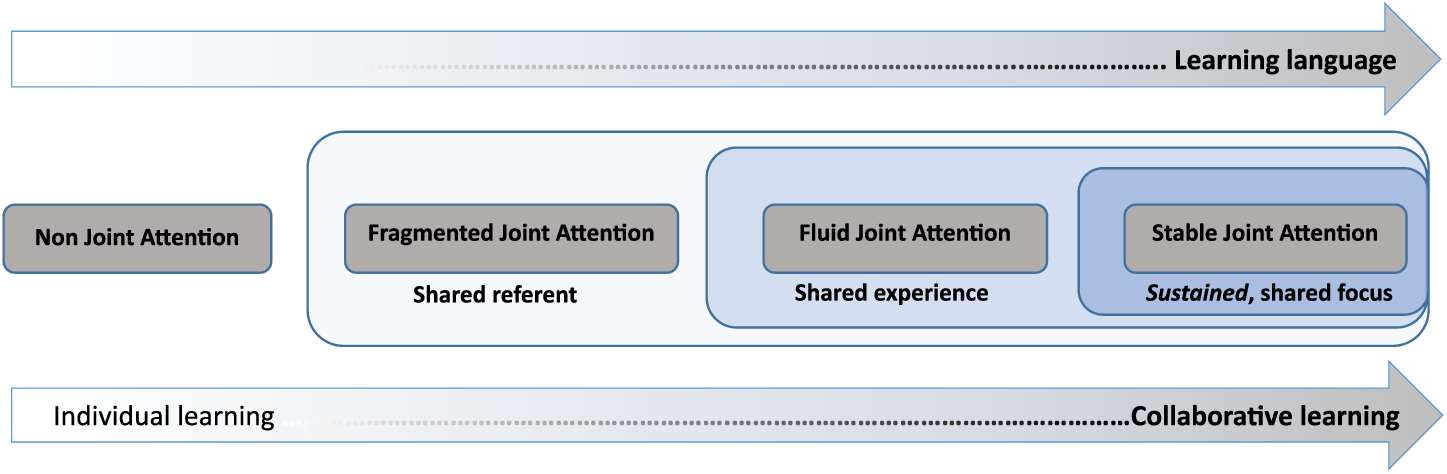
The language and collaborative-learning opportunities of each type of joint attention.
The ideas contained within this article should not, however, be interpreted to suggest that educators should seek to engage constantly in stable joint attention with infants and toddlers. Young children do demonstrate lengthy engagement in play when educators are not in close proximity (Singer et al., 2014), and there are strong merits associated with such individual learning, such as the cognitive gains associated with self-directed exploration (e.g. see Needham, 2016). Interactions between peers are also recognised as affording rich learning opportunities in infancy (e.g. Brownell et al., 2006; Shin, 2012). However, if language learning and shared thinking are the pedagogical goals, then contexts of fluid and stable joint attention provide collaborative-learning opportunities that are not realised in contexts where experiences and reference topics are not shared and discussed. The significance, therefore, of sustained reciprocal interactions around topics of mutual interest cannot be overlooked when conceptualising learning through relationships for infants and toddlers.
Footnotes
Acknowledgements
The author would like to thank the educators and infants who generously allowed us to observe their interactions, and the team of research assistants who undertook the collection and management of the data.
Funding
The author disclosed receipt of the following financial support for the research, authorship, and/or publication of this article: The research reported here was part of a larger project funded by an Australian Research Council Discovery Grant (project number DP140101238).