




Abstract
Pathological thinking surrounding disenfranchised and marginalized communities remains a problem in education policy, popular discourse, and research on marginalized communities. Scholars employ a host of frameworks to challenge such pathological thinking, often through the language of deficits. We argue that in an effort to refute pathological thinking about marginalized communities, counter-deficit frameworks potentially rely on a different logic of pathology through an overreliance on person-centered rationales for educational success and educational inequity. Specifically, this essay demonstrates how scholars, if they are not careful, can fall into two different pathology traps: (a) the “high achievers trap” and (b) the “blaming teachers trap.” We offer guidance of how to avoid such traps through careful attention to structural forces of oppression.
The concept of deficit thinking is entrenched in education research, advocacy, and policymaking. Deficit-based approaches locate negative educational outcomes and inequalities at the individual level (Valencia, 1997). One adopting a deficit perspective, for example, might suggest that students of color who do not graduate from high school have deficient cultures, have families that fail to prioritize education, or lack intrinsic motivation. The necessity of challenging deficit thinking has even made its way into statewide policy. California, for example, will no longer refer to students as “at risk” because the phrase is based on deficit thinking (McKenzie, 2019). Informed by research on deficit thinking, California education law now refers to students placed at the margins as “at promise.” This language is asset oriented, focusing on students’ strengths and potential. In response to deficit-based ideology shaping research and policy, more critical scholars have adopted asset-based orientations to their work. Asset-based frameworks challenge deficit frameworks, highlighting how students’ individual, cultural, and familial characteristics are assets to be tapped into for positive educational outcomes.
Attempts to challenge deficit thinking are powerful, shaping discourse across research, pedagogy, and policy. Similar to other critical scholars, we agree that deficit thinking should be named and refuted. A problem, however, lies in how critical scholars define and thereby challenge deficit thinking. Beneath the widespread adherence to refuting deficit thinking, we suggest, lie unresolved, problematic tensions, or traps.
In this essay, we explore how scholars challenge deficit thinking through what have been named “counter-deficit frameworks” (Kolluri & Tichavakunda, 2023). These frameworks have been published countless times across academic journals in education, offering a corrective to pathological constructions of students marginalized because of their race, class, gender, sexuality, and/or disability status. The reach of the counter-deficit lens necessitates that scholars assess and employ such frameworks with a critical eye. In this essay, we highlight how scholars, if they are not careful, can fall into two traps of unwittingly pathologizing the very groups they hope to support in their research—the “high achiever trap” and the “blaming teachers trap.”
The Argument: Challenging Pathology
“Pathology,” originally, is a medical term referring to the study of illnesses, their causes, and their effects. When used to refer to educational inequity or social problems more broadly, the logic of pathology suggests that people who are marginalized and facing negative educational outcomes are “sick” or pathologic and a risk to the society’s “health”’(Büchs, 2007). The logic of pathology suggests that oppressed groups face negative life and educational outcomes because something is wrong with them—be it their attitude, personality traits, genetics, or culture. For the purposes of this essay, we understand pathological thinking as thought that places the cause of social problems in individuals and/or their cultures. We argue that scholars employing counter-deficit frameworks, in attempting to deny pathology for specific communities, sometimes adopt pathological thinking in crafting their arguments.
Certainly, as junior scholars of color, we are indebted to the scholars who have laid the foundation for generative work challenging pathology in education. Yet as fellow critical scholars, we have noticed some perennial issues in this school of thought. Other critical scholars (e.g., Hinton, 2015; Lubienski, 2003; Patton & Museus, 2019; Rios-Aguilar et al., 2011), in different ways, have noted the challenges of defining deficits and limitations of the counter-deficit approach. Scholars have noted both the limitations (Hinton, 2015) and potential (Rios-Aguilar et al., 2011) of using “capital” as a framework of understanding marginalized students and communities. Scholars have also highlighted how counter-deficit research sometimes neglects to offer structural analyses of oppression (Kolluri & Tichavakunda, 2023; Lubienski, 2003, Rios-Aguilar et al., 2011). Rios-Aguilar and colleagues (2011), for example, noted that much “theoretical and empirical scholarship on funds of knowledge has not explicitly or thoughtfully addressed issues of power, social class, ideology, and racism” (p. 171). Furthermore, over 20 years ago, Lubienski (2003) cautioned scholars about the risks of only highlighting positive aspects of racially marginalized students’ educational experiences and potential assets: “By avoiding problems that many underserved students and their teachers face daily, education research is becoming removed from, and alienating to, those populations it seeks to serve” (p. 30). As such, research alludes to critical scholars being concerned about their research being perceived as deficit-oriented simply because their research analyzes oppressive realities students navigate (Patton & Muses, 2019). We contribute to this conversation in three unique ways. First, we center our essay around pathology, highlighting how pathology can emerge in counter-deficit framing. Second, we employ the work of Richard Valencia (1997), one of the progenitors of anti-deficit research, and his concept of endogenous theorizing to demonstrate how some counter-deficit research might fall into pathology traps. Lastly, beyond naming problems in this body of work, we offer guidance and directives through our discussion of pathology traps for scholars to avoid.
Identifying the Counter-Deficit School of Thought
Central to recent scholarship challenging pathological narratives is Richard Valencia’s (1997) work. Valencia’s work is often cited in counter-deficit research and is foundational to articulating what deficit thinking is. In short, Valencia likens deficit thinking to “blaming the victim.” Central to Valencia’s argument is that deficit thinking is an “endogenous theory—positing that the student who fails in school does so because of internal deficits or deficiencies” (p. 2). It is worth highlighting Valencia’s description of the deficit paradigm, one resting on pathology, at length: The deficit thinking paradigm, as a whole, posits that students who fail in school do so because of alleged internal deficiencies (such as cognitive and/or motivational limitations) or shortcomings socially linked to the youngster - such as familial deficits and dysfunctions. Given the endogenous nature of deficit thinking, systemic factors (for example, school segregation; inequalities in school financing; curriculum differentiation) are held blameless in explaining why some students fail in school. (p. xi)
Through the logic of deficit thinking, those in power locate societal problems in oppressed groups themselves at an individual or cultural level. In this manner, structures (e.g., policies, laws, discrimination, legacies of systematic oppression) are rendered blameless. For the purposes of this essay, we grouped the following frameworks under the counter-deficit banner because of each framework’s explicit goals of countering deficit thinking: community cultural wealth, funds of knowledge, and the antideficit achievement framework.
Challenging Deficits While Implying Pathology? Two Pathology Traps
Although counter-deficit work was created to challenge pathology, pathological thinking, in a subtle way, remains the operating logic of much counter-deficit research. We are not suggesting that all or even most counter-deficit research inadvertently pathologizes groups they intend to support. We do not intend to offer a detailed accounting of inadvertent pathologizing across all educational literature. Rather, we aim here to construct the concept of the “pathology trap”—a framing of educational inequality that although intended to reject pathology, implicates individuals in schools as pathological. We argue that in the process of denying pathology for some groups, counter-deficit research can unwittingly pathologize other groups.
Although we are not investigating the scope of the problem here, the problem of pathology is potentially far-reaching and significant. In our collective experience at conferences, reviewing papers, and reading counter-deficit research, we continue to identify instances of pathology. Furthermore, through our systematic review in another piece (Kolluri & Tichavakunda, 2023), we found that the majority of counter-deficit research neglected a structural analysis of oppression. Certainly, research lacking a structural analysis will not always or even most of the time be pathological. Yet it might be easier to fall into a pathology trap without an eye on structure in the calculus of educational inequity.
Here, we highlight two pathology traps—analyses of educational inequality that appear to be consistent with the objectives of the counter-deficit scholarship but actually pathologize marginalized people working in oppressive systems. The first, the high achievers trap, considers how focusing on the educational achievements of some students can pathologize others. The second, the blaming teachers trap, considers how criticizing teachers for deficit assumptions can result in unfairly pathologizing teachers attempting to educate in unfair circumstances. In outlining these traps, we encourage scholars to focus on root causes of inequality rather than individual students and teachers operating in them, thus heeding Valencia’s (1997) call to avoid “endogenous” theorizing of social inequality.
All of the studies we critique here have equity and justice as a central goal. In the spirit of solidarity, we do not include the names or other identifying information of the specific articles we critique at length. The practice of anonymizing studies has been used by scholars to prioritize evidence or data for arguments rather than focusing on specific researchers (Harper, 2012). Harper (2012) suggested anonymity might compel readers to ask themselves, “‘Could this be my study that is being written about here?’” (p. 16).
The High Achievers Trap
Much counter-deficit work focuses on high-achieving or academically successful students of a marginalized group to challenge narratives centering on academic challenges and obstacles facing the same groups (e.g., Harper, 2010; Howard & Associates 2017; Jayakumar et al., 2013; Kim & Hargrove, 2013). Scholars primarily offer two reasons for focusing on high-achieving students: (a) to amplify the factors that aided students in their persistence to counter negative stereotypes and (b) to construct achievers and their experiences as models or pathways for other schools. Studying high-achieving students is not inherently problematic. Yet if they are not careful, scholars can easily fall into the high achiever pathology trap.
The high achiever trap can be seen in research that singularly focuses on high-achieving students without a critique of oppressive structures. Much research falling into the high achiever trap, for example, points to person-centered factors leading to a student’s success—personal characteristics, motivation, and family support. Person-centered rationales for success beget person-centered solutions. In other words, if students are successful because of individual effort and family support, then students who are less academically successful must not be working as hard and must have less supportive families. This is never stated in such articles, but the pathological, person-centered reasoning for highlighting high achievers undergirds such scholarship.
Consider the following hypothetical case.
King High School is in an urban neighborhood. The student body is predominantly Black, Latinx, and low-income. The school system’s metrics classify King High School as underperforming. On average, 15% of students from each graduating class matriculate to a 4-year college in the fall semester after graduation.
Counter-deficit work suggests that by studying the 15% of graduating students—about what made them successful—education stakeholders might better understand and support students to create learning environments that foster success. The premise of focusing on high achievers is not inherently based on pathology. Indeed, students from underresourced schools persist and achieve academically. Using this case as an illustrative example, however, we identify how a scholar might fall into the high achiever trap of pathology and then demonstrate how scholars can avoid this trap.
According to Valencia (1997), “Deficit thinking is a person-centered explanation of school failure among individuals as linked to group membership” (p. 9). The high achiever trap employs the other side of the pathological coin by luring a scholar into using person-centered rationales of success. If the study on King High School graduates enrolled in college singularly highlights the personal and familial attributes of participants as the reasons for their success, then the study has fallen into the high achiever trap of pathology. One might canvas counter-deficit research and identify the high achiever trap when research narrowly points to person-centered assets that lead to educational achievement, such as student agency, self-efficacy, intrinsic motivation, individual mindsets surrounding education, and family support. In narrowly centering on person-centered assets as primary factors for academic success, students who do not succeed are implicitly pathologized.
Counter-deficit frameworks are liable to produce person-centered analyses of student success. Leveraging Shaun Harper’s (2010) “anti-deficit achievement framework,” one such study focused on young men who had earned higher than a 3.0 grade point average in their college classroom, citing intrinsic motivation as a primary determinant of student success. The implication, however, could be that students receiving under a 3.0 are simply not intrinsically motivated. Academic success (or failure) lies in the student themselves. Another scholar suggests that what separates successful from unsuccessful students is a “prove them wrong attitude.” Although this concept acknowledges the existence of oppression for marginalized students, it again emphasizes a person-centered vision of academic achievement, leaving systems of oppression largely unaddressed. Explaining academic success by way of personal assets has pathological implications for students who do not experience the same success.
The counter-deficit research falling into the high achiever trap leads one to the following question: If students succeed because of their positive culture, family, individual characteristics, and networks, then do other students fail because of their negative cultures, families, characteristics, or networks? The implication of person-centered assets leading to positive educational outcomes is that those who do not experience positive outcomes lack assets (see Figure 1). Although employed with good intentions, the logic of counter-deficit frameworks falling into this trap implicitly pathologizes the groups the frameworks intend to defend.
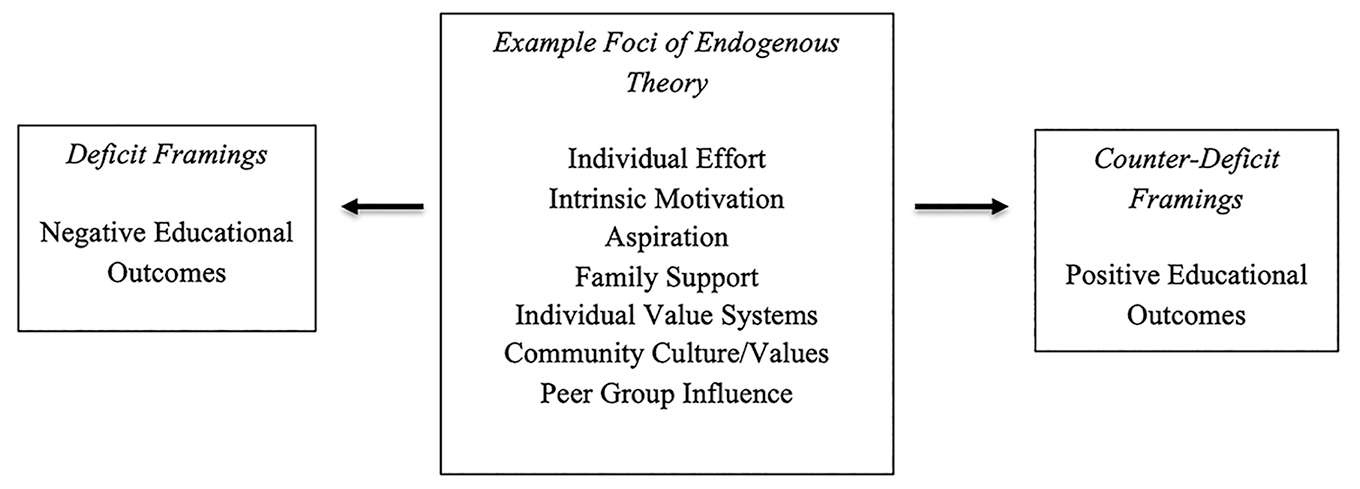
The endogenous theory of deficit and counter-deficit research.
Avoiding the high achievers pathology trap
Education scholars have long noted that a narrow focus on achievement and isolated success stories can divert attention away from oppressive structural forces shaping educational inequality (Kozol, 1991; Lubienski, 2003). As a test of sorts, one might look at the logic underlying their project and ask themselves, “Could my work potentially imply that if some students succeed academically because of their cultural wealth, funds of knowledge, or assets, then other students struggle because they are culturally poor, have limited funds of knowledge, or few assets?” A second question the critical scholar might ask themselves is, “How is my study of high achievers also a critique of oppressive structures?” If the study includes an analysis of oppressive structures that reproduce inequality, then the scholar can avoid this pathology trap.
Critical scholarship problematizes the factors that were necessary to surmount the odds to begin with (Love, 2019; Valencia, 1997), indicting a system that requires an inordinate amount of effort and luck to persist to college. The critical scholar, then, will also set their analytic gaze on the oppressive structures that students—with extreme ingenuity, effort, family support, or luck—surmounted to matriculate to college (or attain any other academic success against unlikely odds). In highlighting the circumstances necessary for students to achieve, scholarship can critique oppressive structures that reproduce inequality.
The Blaming Teachers Trap
Teachers are easy to blame for issues of educational inequality. In counter-deficit research on the educational experiences of youth placed at the margins, educators are commonly identified as perpetrators of deficit-based, oppressive ideologies. Much research examines how teachers hold deficit ideologies (e.g., Baker, 2019; Jimenez-Castellanos & Gonzalez, 2012; Koyama & Desjardin, 2019). Although certainly teachers who hold deficit ideologies about students deserve admonition, teachers in marginalized contexts might also be viewed as victims of scholarly pathologizing. We argue that educators are pathologized in much counter-deficit research that labels them as deficit for noting challenges they face in the classrooms, many of which stem from structural foundations.
Consider the following hypothetical case: A math teacher serving Black and Latinx high school students is frustrated by their students’ academic performance. They seek to teach them algebra, but their students’ multiplication knowledge creates barriers to learning the course content. They blame their inability to guide the students towards proficiency on state math standards on the math instruction from prior math teachers and lack of supplementary math guidance from the students’ parents.
Some counter-deficit analyses of this case would criticize this teacher’s deficit mindset. The teacher notes an academic challenge and views that challenge through the lens of individual deficiency. The students are deemed problems beyond repair, and families are also inadequate. In the deficit mindset of the teacher, their own practice remains unexamined, and there exists an inevitability of urban student failure. Certainly, this mindset is harmful for students of color. Instead of applying a lens of deficiency to their students, counter-deficit scholars would recommend the teacher consider student assets. The teacher might leverage students’ community cultural wealth (Yosso, 2005) or learn of students’ funds of knowledge (Moll et al., 1992) in student households that can support students in meeting the expectations of high school algebra. The counter-deficit school of thinking chides this teacher for their inability to identify the strengths of students and apply those strengths in their curriculum.
The challenge of the counter-deficit analysis of this case and other cases like it is its penchant for pathology. Counter-deficit analyses, in rejecting pathology among racially minoritized students, pathologize the teachers of these students. Educators are viewed as harmful, and the implication is that they are individually responsible for their students’ mathematical misunderstandings. The resulting analyses are a version of the endogenous theorizing that Valencia (1997) sought to challenge in his treatise against deficit thinking. This teacher may face very real challenges that limit their capacity to enact the pedagogies that can build on student strengths and enhance their math skills. They are expected to prepare their students just as well as students in schools with abundant resources whose parents have nearly limitless time and money for academic enrichment beyond school hours. Counter-deficit literature, however, often locates blame in teacher practices as if in a vacuum (see Figure 2). Teachers serving students in marginalized contexts are often navigating their own sets of marginalization—underfunded schools, low pay, and inadequate preparation. In addition, the teacher is chastised for acknowledging the oppressive systems that are impacting their students.
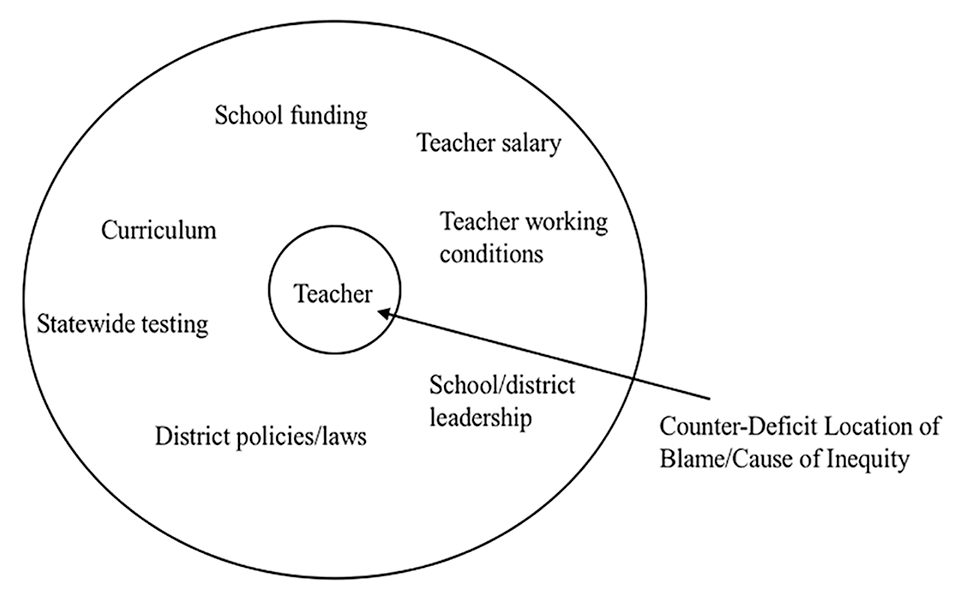
Stopping short of blaming structure: an example of attributional distortion.
The language of assets and deficits often clouds the very real structural realities teachers and school leaders face. One study, for example, identified how preservice teachers carry deficit-based perspectives of their students, suggesting that words such as “lack” are deficit oriented. In another article, the author suggested that teachers’ use of phrases about students such as “dealing with” or “going through” indicated deficit-based beliefs. To call on teachers to avoid words like “lack,” “going through,” or “dealing with,” however, may limit their capacity to analyze the lack of opportunity in urban communities or the fact that years of disinvestment may cause their students to be dealing with very real trauma. Certainly, some teachers indeed hold deficit perspectives concerning students, yet labeling any teacher as deficit-oriented for expressing such concerns constrains their capacity to address systemic racism or to empathize with concerns from students and their families. Criticizing teachers who bring up systemic challenges is a redirection of pathological thinking from students to teachers.
Avoiding the pathology trap
Certainly, deficit ideologies of some teachers warrant naming, analyzing, and critiquing. Yet to avoid falling into the blaming teachers pathology trap, the scholar might ask themselves, “Is the teacher describing oppressive realities or blaming communities and students for their oppressive realities?” In considering this pathology trap, it is essential for researchers to consider whether teachers are pathologizing their students or simply expressing frustration with systemic inequality and multiple oppressions. A second question scholars might ask themselves is, “How might structures be shaping teacher agency, practices, and realities?” Engaging with this question does not absolve teachers of responsibility. Rather, the question prods the scholar to question how teachers are nested in a web of oppressive and constricting structures. In other words, in addition to naming oppressive ideologies, scholars can do the work of naming oppressive structures.
Much social-justice-oriented research treads the line of being critical of teachers without pathologizing them (e.g., Kumashiro et al., 2004; Settlage, 201l). Kumashiro and colleagues (2004) from across the globe, for example, theorized how to prepare teachers to engage in anti-oppressive education. In doing so, they noted that “theories and recommendations continue to proliferate in the educational research literature on what it means to teach towards social justice, so do concerns that these theories fail to account for the realities of teaching” (p. 258). In a like manner, we suggest that solely locating blame on teachers without accounting for structural forces at play can lead one to falling into a trap of pathology.
The Way Forward
The field of education has greatly benefited from both naming and critiquing deficit thinking (Valencia, 1997). Certainly, we are not suggesting that we abandon counter-deficit approaches. The counter-deficit frameworks scholars have put forth to combat deficit thinking and highlight students’ assets have pushed the field forward. Yet in attempting to combat pathology for some students, scholars pathologize other students, families, and teachers. We build on the work of other scholars who have noted deficiencies and limitations in the counter-deficit school (Hinton, 2015; Lubienski, 2003; Rios-Aguilar et al., 2011). In what follows, we provide recommendations for scholars, critical educators, and teacher educators to consider when engaging in education research pertaining to the counter-deficit school of thought.
In short, we encourage scholars and educators to move from a “counter-deficit” framing—a framing that we envision as resisting naming deficits of individual students—to a “counter-pathological” approach that rejects pathology of all well-meaning participants in educational systems. We contend that the move is more than just semantic. Although deficits and assets exist in individuals, pathology is a concept that permeates society writ large. Additionally, a rejection of pathology more generally was at the heart of Valencia’s (1997) original conception of a counter-deficit framework. This work offers guidance of how to avoid the pathology traps we outline previously and advocate for altering systems that produce educational and social inequalities. In so doing, we aim to redirect all educational and scholarly effort toward systems rather than individual pathologies in schools and classrooms. If scholarly and teaching communities supplement a rejection of deficits with a decision to center systems and structures that produce injustice, we might increase the likelihood of structural change.
Counter-Pathological Researching
Certainly, some marginalized students have strong assets that propel them to academic success, and some teachers underserve their students. However, as we demonstrate previously, some counter-deficit work that centers a rejection of student deficit can reinforce broader notions of pathology. Thus, we call on education researchers to broaden their rejection of deficit thinking to consider educational actors that are beyond the gaze of the individuals in their study. Might students who are successful be endowed with certain privileges systemically denied to their peers? Might deficit-oriented teachers themselves be victims of systems of oppression? In strident efforts to reject deficits, scholars fall into pathological traps of social analysis.
To avoid such traps, we encourage scholars to see the complexity of social actors. Counter-deficit scholars can fall into the trap of constructing the world into binaries. In an effort to combat narratives centering student failure, counter-deficit research can potentially “overcorrect” by overemphasizing aspects of individual student success (e.g., industriousness, self-efficacy, creativity). These scholarly visions obscure the messiness inherent in the social world and absolve the systemic oppressions that underlie social processes. Hinton (2015) even questioned the use of metaphorical capital as a generative framework for social justice research. Instead, Hinton suggested studying marginalized communities through the lenses of resistance, trust, love, and spirituality to better analyze the dynamic, complex experiences of subjugated communities. Additionally, in an effort to absolve students of any academic struggles they endure, counter-deficit scholars castigate teachers for allowing student failure. However, framing students or the structures they navigate as faultless and teachers as failures has pathological implications. Echoing other scholars (e.g., Lubienski, 2003), we argue here that to resist pathology in education scholarship is to see all people in their full humanity—to capture moments in which they excel, make mistakes, and try to figure out life in oppressive societal structures.
We suggest that scholars might employ counter-deficit theories in different ways or couple them with other frameworks and tools to tackle structural analyses. For Valencia (1997), challenging structural oppression was a core component of nondeficit work. A structural analysis allows us to see the social processes that drive individual struggles in schools. Attending to structures, however, calls for theoretical dexterity. In different ways, scholars have provided novel ways of engaging in asset-based work while also engaging with structure. For example, Ladson-Billings’s (2006) work on educational debt provides a useful reframing of blame-the-victim rhetoric around the achievement gap, putting the burden squarely on structures. Scholars might recruit other frameworks in tandem to provide a structural critique often obscured in counter-deficit analyses of education.
Counter-Pathological Teaching
Furthermore, this essay has implications for educators in the K–12 setting and teacher educators alike. Teacher educators sometimes view preservice teachers from a deficit view, potentially leaving teacher candidates demoralized (Settlage, 2011). Our work encourages teacher educators to reflect on how they might construct both in-service and preservice teachers and their students. For example, teacher educators might consider how they are, implicitly or explicitly, placing undue blame on teachers without appropriate attention to structural constraints. As mentioned, we find usefulness in counter-deficit frameworks. Yet with attention to the aforementioned traps, teachers and teacher educators might be better equipped to avoid the person-centered blaming, or pathologizing, of themselves as teachers, students, and students’ families that might come from using such frameworks.
The work here also suggests a potential powerful reframing for even the most asset-oriented of educators. Instead of merely celebrating the strengths of some of their students or criticizing the ineffectiveness of some of their fellow teachers, teachers will have to consider advocating for change beyond the immediacy of their classrooms and schools. With students, instead of attempting to endow some students with the assets they see in other students, they might help students think about how to democratically alter the systems of oppression that hold all marginalized young people back. Instead of shaming fellow teachers for their shortcomings, they might organize with colleagues for more resources, more training and time to develop professionally, and better conditions in their schools and communities. Rejecting deficits in students is good, but encouraging teachers to look beyond their immediate contexts to produce the conditions of success for all will do far more toward creating a more just world.
Yet we must acknowledge a tension in our call for counter-pathological teaching, lest we fall into the same person-centered trap we caution against. One might suggest that we are blaming teacher educators without taking stock of the larger, systemic forces at play in teacher education. We need teacher educators challenging oppressive ideologies and scholars studying this work. We also need research studying the structural forces that shape the conditions and experiences of teacher educators, preservice teachers, and students alike. No one study can capture the web of forces shaping education. Rather, we hope our call for counter-pathological research/teaching might attune stakeholders to how we might unintentionally place blame on individuals rather than systems.
Conclusion
Valencia and Solórzano (1997) argue, “The at-risk notion, as does deficit thinking, holds structural inequalities absolved in creating problems for the so-called at-risk child and family” (p. 197), pointing out that the notion of being “at risk” neglects to acknowledge the assets of individuals, their families, and their communities. Scholars and policymakers, it seems, have done work to acknowledge people’s assets. However, replacing “at risk” to “at promise” will mean little if structural conditions remain the same. Advocates can potentially fall into the trap of locating problems in the label and not in structures. Similarly, if one is not careful, then the counter-deficit scholar might fall into a similar trap of analyzing participants’ words and sentiments without a like analysis of structures. Our charge here is to focus on structures and reject pathology in all its forms.
