




Abstract
Racial literacy has contributed powerful advances in multiple disciplines about how race and racism are understood. Many education scholars use the concept to refer to antiracist practices and ideologies, a definition that casts some people as either racially literate or illiterate. In this essay the author draws on examples from education literature to argue that this interdisciplinary conceptual norm hinders scholars’ attempts to reveal the dominance of race-evasiveness, however unintentionally, for two reasons. First, describing people as racially literate or illiterate implies that those who adopt race-evasive or racist ideologies are not interpreting racial ideas, which overlooks that all people who live in a racist society engage in literacy practices that make meaning of race. Second, construing racial literacy strictly as antiracist obscures that making meaning of race can be done through hegemonic ideologies. This accepted conceptualization may stymie useful analyses of hegemonic ideologies that predominate in U.S. society and schools. The author presents a continuum of racial literacies to differentiate between hegemonic and counterhegemonic racial literacies. The continuum’s exposure of hegemonic racial literacies encourages scholars to capture the hidden ideologies in literacy practices that may not exhibit an explicit racial focus but nevertheless perpetuate racism. Furthermore, the author suggests eschewing the labels “racially illiterate” and “racially literate” and instead affirms that people become racially literate through both racist and antiracist literacy practices. Instead of racially illiterate or literate, the author submits consciousness as a more apt term and connects the continuum’s counterhegemonic end to developing critical-racial consciousness, an antiracist lens.
Scholars across disciplines (e.g., law, sociology, psychology, anthropology) and diverse areas in education (e.g., literacy, history, critical race studies) actively research and theorize racial literacy. Given this interdisciplinarity, it is unsurprising that conceptualizations and emphases in the definition of racial literacy vary. Generally speaking, however, racial literacy refers to ideas and practices that lay bare racial injustices and encourage people to understand racial history and its impact on contemporary society, which are essential for working toward ameliorating injustices.
Taking into account the importance of what is commonly defined as racial literacy, I complicate two common practices found in some of the education literature that addresses racial literacy: first, the tendency to describe some people as racially literate and others as racially illiterate and, second, the notion that racial literacy refers solely to antiracist practices and consciousness. I contend that these framings are counterproductive to exposing racist ideologies such as race-evasiveness, 1 because they obscure that (a) all people make meaning of racial ideologies and are racially literate, including those who adopt and perpetuate racist ideologies, and (b) race-evasive and other racist interpretations are themselves a kind of racial literacy, albeit one that perpetuates racism. In inviting scholars across disciplines to reconceptualize racial literacy and take up education’s theoretical contributions of the concept, I present a framework called the continuum of racial literacies for differentiating among distinct racial literacies and relating these to the development of critical consciousness.
In pursuing these aims, I start by briefly describing the interdisciplinary works that introduced racial literacy to the education field and that education scholars cite as foundational pieces. I also discuss the education field’s uptake of racial literacy. Then I unsettle the description of people as either racially literate or illiterate, a binary that ignores the fact that people who espouse hegemonic racist ideologies are making meaning of race. Next, I present examples that illustrate the limitations of conceptualizing racial literacy as solely antiracist, showing that this conceptualization ignores the racial learning of race-evasiveness that predominates in U.S. society and schools. As alternatives to the concepts I critique, I conceptualize racial literacies as the sociocultural practices around reading, writing, and discourse that people use to make meaning of race and racial issues. 2 I present a continuum of racial literacies as a framework that encourages specificity in how literacy practices relate to advancing antiracism and the progression of racist ideologies. To end, I connect these concepts to the development of critical-racial consciousness, an antiracist lens.
Racial Literacy
Early educational scholarship on racial literacy refers to legal scholar Guinier’s (2004) conceptualization of the term 3 . Guinier defined racial literacy as people’s capacity to interpret the “racial grammar that structures racialized hierarchies and frames the narrative of our republic” (p. 100), in other words, people’s capacity to understand and critique how race works in society. Guinier emphasized the structural legal elements of race and racism, calling for readers to abandon liberal conceptions of justice and acquire, instead, racial literacy to work toward social reforms. Soon after Guinier’s article, sociologist Twine (2004) referred to racial literacy as a tool that “racism-cognizant” White parents in the United Kingdom use to teach their biracial (Black/White) children how to survive in a racist society that would racialize them as Black. Twine theorized the parents’ labor as a micro-cultural project of antiracism. Both Guinier and Twine marked counterhegemonic ideas and practices as racial literacy. A distinction between Guinier’s and Twine’s conceptualizations of racial literacy, as Laughter et al. (2021) described, is that the former focuses on the institutional level and the latter on individuals. 4 Laughter et al. found in their literature review of educational studies using racial literacy that regardless of whom authors cited, 43 of 50 of the studies focused on racial literacy at the individual level (12 of the 43 touched on both levels). (Because much of the work focuses on the individual, my critiques also are situated at that level.)
One of those focused on the individual level is literacy scholars Rogers and Mosley’s groundbreaking 2006 article, along with various other pieces (Mosley, 2010; Mosley & Rogers, 2011; Rogers & Mosley, 2008). Rogers and Mosley (2006) conceptualized racial literacy as the discourses people engage in about race that influence individuals’ identities and meaning-making. As a researcher-teacher team, Rogers and Mosley used critical-literacy practices to guide students’ thinking about racial issues with the goal of fostering antiracist ideas. They showed that “young white children can and do talk about race, racism, and anti-racism” (Rogers and Mosley, 2006, p. 463). The authors noted that the children took a “journey toward becoming racially literate: noticing whiteness, enacting white privilege, and transforming whiteness into liberatory alliances” (p. 483). Crucially, though, Rogers and Mosley emphasized that this was not a journey of progressing “stages,” whereby children “enacted white privilege and then moved to disrupt white privilege. Rather, their development of racial literacy was characterized by hybrid discourses of whiteness enacted and whiteness disrupted” (p. 473). Becoming racially literate, for Rogers and Mosley, meant making meaning about race, which could display both racist and antiracist ideologies.
In contrast, other scholars use racial literacy in a way that is more closely akin to Guinier’s and Twine’s practice of marking counterhegemonic ideas and practices (e.g., Allen, 2019; Brown, 2016; Flynn et al., 2018; King, 2016; Kohli et al., 2018; Pabon & Basile, 2019; Villenas, 2019; Wills, 2019; Winans, 2010). These theorizations contribute important insights into the teaching and learning of racial literacy, and construe racial literacy as ranging from personal skills to characteristics to be developed. For example, Sealey-Ruiz (2011) conceptualized racial literacy as an essential skill that “requires reading our racialized world in an analytic way in order to offer problem-solving strategies to counter the racism that exists” (p. 118). Sealey-Ruiz (2013a, 2013b; Sealey-Ruiz & Greene, 2015) also posited that racial literacy is a capacity that can be developed, one that enables us to engage in honest conversations about race and racism without becoming defensive or confrontational.
These scholars’ works critique racism and rightly argue that educators should explicitly teach about the underlying systemic oppressions tied to race. Their work contributes to lessening the ways in which race goes unnoticed as a factor of injustices, provides counterhegemonic understandings about the teaching of racism, and paves the way for other theorizations. Having different theorizations of racial literacy is constructive for the education field, and I recommend, along with Grayson (2019), that scholars examine the various nuances.
Having done so, I complicate labeling individuals as racially il/literate, and I build on Laughter et al.’s (2021) review, which exposed some of the inconsistencies with how education scholars use racial literacy (specifically, the structural vs. individual and the conflation of racial literacy as theory and as practice). Building from their critique that the racial-literacy framework as it is commonly used fails to explore the “complexities of race and racism in education” (p. 11), I argue that using racial literacy to look only at explicit racial lessons helps obscure hidden racial lessons. I add that education research should provide studies of both the explicit and the hidden lessons about race and racism and label these “racial.” Thus, I support Laughter et al.’s call for a “critical racial literacy” as a needed differentiation to ease the inconsistencies and lack of nuance in the literature. I share my observations as a Chicana educator and scholar committed to advancing justice, who joins other scholars’ efforts to challenge racism by contending that for education to serve as a public good, education institutions need to contribute to the development of people’s critical assessments about their lives and our society (Chávez-Moreno, 2021, in press; Pacheco & Chávez-Moreno, 2022).
The Problem With “Racially Illiterate”
Before racial literacy attained its antiracist meaning, the term racial literacy gap was commonly used to compare “functionally illiterate” students from racialized communities with their White peers. Contemporary scholars have opposed using “illiterate” as a metaphor to describe individuals because of its inherent deficit focus (St. Clair & Sandlin, 2004), noting that deciding whether someone is literate or illiterate is not an objectively neutral decision but a political one (Kearns, 2016; Street, 1984). Its deficit, racist connotations have helped the descriptor illiterate mostly fall out of favor in academic critical-literacy circles.
The label has resurfaced in some work by scholars using racial literacy to mark some individuals as racially illiterate (DiAngelo, 2016; Stevenson, 2013). For example, DiAngelo (2016) observed that “the vast majority of whites are racially illiterate” (p. 4), and called for “white racial literacy” for advancing antiracism.
More often than using the term racially illiterate, however, scholars write about individuals who are or become racially literate by virtue of holding antiracist ideas (e.g., Allen, 2019; Blaisdell, 2018; Colomer, 2018; King, 2016; Philip et al., 2016; Sealey-Ruiz & Greene, 2015; Skerrett, 2011; Vetter & Hungerford-Kressor, 2014). For example, Skerrett (2011) wrote that people who are “racially literate” discern the “structural, political, and economic circumstances or antecedents that underlie racism and disadvantage” (p. 314). In another study labeling some teachers as racially literate, Blaisdell (2018) examined teachers’ racial discourse around school equity work and found that “less racially literate white teachers influenc[ed] more racially literate white teachers to fall back on” (p. 333) racist ideologies. These allusions to “less” or “more” “racially literate teachers” avoid the term illiterate yet imply that racial illiteracy exists.
Some scholars who equate racial literacy with antiracism describe the need to develop racial literacy through, for example, critical reflection (Colomer, 2018), on the basis of the idea that racial literacy is a critical consciousness (e.g., Brown, 2016; Pabon & Basile, 2019; Villenas, 2019). For example, in a study examining teacher candidates’ race-evasive rhetorical strategies, Pabon and Basile (2019) noted that some White teacher candidates may not have reckoned with their own Whiteness, and “may never previously [have] had the opportunity to develop racial literacy” (p. 643). In effect, scholars propose that one can become racially literate with an antiracist education. Marking teachers’ racial consciousness is useful for learning how to promote antiracist teaching but nonetheless implies that some people are racially illiterate.
The political decision to mark people racially literate or illiterate may come from a determination that this framing creates an urgency for combating society’s racist and race-evasive ideologies. Perhaps redefining literate and illiterate helps oppose a White-normative definition of literacy that excludes racial literacy. Such a redefinition may be seen as empowering people from racialized communities by elevating the knowledges they obtain from living in a racist society. I argue, however, that using literate and illiterate is still problematic for two reasons.
First, the label illiterate serves as a political tool to stigmatize certain people and their literacy practices, which causes scholars to use the term inconsistently. Notably, scholars have reserved the descriptor racially illiterate for Whites, possibly sensing that explicitly calling racialized people 5 “illiterate” invokes racist ideas and policies that used the label as a means of subjugation (e.g., administering voter literacy tests, relegating them to menial jobs). However, racialized people may themselves subscribe to racially hegemonic ideas. Thus, if scholars do not use it for racialized people, questions surface about essentializing and incorrectly assuming racialized people all have an antiracist consciousness.
Second, characterizing individuals as racially literate or illiterate is ultimately counterproductive because calling race-evasiveness a type of illiteracy unintentionally obscures that race-evasiveness is a way of making meaning of our world. A destructive kind of racial literacy is still a type of literacy. By living in a society structured by racism, people are socialized racially and become racially literate even at a young age; that is, as Colomer (2018) rightly noted, “racial socialization . . . leads to racial literacy” (p. 4). Consequently, we are racially conscious and literate whether we adopt hegemonic or counterhegemonic ideas. Even scholars who describe individuals as racially illiterate inadvertently attest to the above claims when providing examples of “illiterate” individuals who engage in literacy practices concerning race. DiAngelo (2016), for instance, demonstrated teacher candidates’ racial illiteracy by pointing to essays they had written, which espoused narratives that deny racism’s existence (e.g., “racism is in the past”). She also asserted that Whites are conscious of race and discuss it “somewhat freely among ourselves, albeit often in coded ways” (p. 6). DiAngelo’s examples describe making meaning of race, in this case by communicating hegemonic ideologies.
I maintain that racial illiteracy is a misleading metaphor because it gives the impression that those who learn race-evasiveness and Whiteness from society suffer from an incomprehension of racist ideology. On the contrary, they “read” racial ideologies, just in a way that perpetuates White supremacy. Thus they are racially literate because they engage in racial meaning-making, even if we label their racist decoding as “a certain misunderstanding of the world as it is” (Leonardo & Manning, 2017, p. 24). The notion of racial illiteracy is also antithetical to critical race scholarship’s convincing claim that race-evasiveness is normalized in the United States (and other places) and that to avoid noticing race, people make purposeful moves, which maintain White supremacy (e.g., Annamma et al., 2017; Crenshaw, 1997). These points should persuade scholars to embrace Rogers and Mosley’s theorization that people become racially literate in both childhood (Rogers and Mosley, 2006) and adulthood (Rogers and Mosley, 2008) through literacy practices that develop both racist and antiracist ideas. Consequently, I agree with their conclusion that all people, including those who adopt racist ideologies such as race-evasiveness, make meaning of racial ideologies by virtue of their living in a racist society and thus are racially conscious and literate.
I urge scholars to eschew describing people as racially il/literate, because even those learners who espouse racist ideas are adapting, internalizing, and/or interpreting race-evasive ideologies and also, importantly, perpetuating racist ideologies. This reframing recognizes active purposeful learning rather than the passive innocent image that illiteracy evokes. It also marks status quo schooling practices as imbued with racial lessons and thus helps expose race-evasiveness.
If racially illiterate, as I argue, is an unproductive term for the purposes of advancing antiracism, then we should also question whether the term racial literacy limits other understandings. I next argue that defining racial literacy as necessarily antiracist masks race-evasiveness.
Complicating Racial Literacy
Many scholars operationalize racial literacy to refer to when people actively make meaning of issues in a counterhegemonic manner and move toward antiracist dispositions and practices, a framing I submit aligns with Guinier’s and Twine’s conceptualizations (e.g., Allen, 2019; Epstein & Gist, 2015; Flynn et al., 2018; King, 2016; Kohli et al., 2018; Pabon & Basile, 2019; Sealey-Ruiz, 2011; Wills, 2019; Winans, 2010). Fewer scholars opt for Rogers and Mosley’s understanding of the term, which refers at once to racist and antiracist ideas (for an example, see Skerrett, 2011). I urge scholars to cleave to the latter concept because schooling predominantly transmits race-evasive and racist ideas, and not recognizing people’s meaning-making of these ideas as racial literacy stymies useful analyses of hegemonic ideologies.
One might ask, if scholars define racial literacy as an inherently critical orientation, then what is lost in not defining “racial literacy” as possibly also hegemonic? I argue that this labeling limits calling out other literacy practices (e.g., those that implicitly or unintentionally teach racist ideologies) as also being “racial,” which, importantly, undermines the project of exposing racist and race-evasive ideologies. It does so by neglecting to name these literacies as racial; that is, a narrow definition misses marking racist ideologies. Defining racial literacy as solely antiracist also supports a logic that indirectly overlooks the overwhelming research showing that the learning and teaching of racism and race-evasiveness is dominant in U.S. society and schools (e.g., Brown & Brown, 2010; Milner, 2020). If scholars do not describe as “racial” the literacy practices that teach people to uphold Whiteness, enact White privilege, and further White supremacist ideologies, then they miss an opportunity to mark these for what they have the potential to be: vehicles for transmitting race-evasive and other racist ideologies, effectively leaving them to be seen as “race neutral.”
Here I offer an example from the literature that demonstrates how an expansion of racial literacy could serve to spotlight status quo teaching as a mode of developing racial literacy. In a study of how history teachers taught about racism and the U.S. civil rights movement, Wills (2019) found that teachers constructed racism as individual beliefs instead of as institutional policies yielding material benefits to some. Wills critiqued this construction, concluding that the teachers’ lessons were “not successful in developing students’ racial literacy” (p. 417), because they did not foster antiracist ideas or teach U.S. racism as structural and continuous. I agree with Wills’s assessment of the teachers’ hegemonic understandings and teaching of race and racism. I argue, though, that by teaching students to understand racism as individual beliefs and actions, the teachers did indeed develop students’ racial literacy—hegemonically. Teachers did this by concealing, however inadvertently, the larger power structures that enforce racism and thereby aiding in those structures’ continuance. If scholars acknowledge this as a type of racial literacy, it would name this meaning-making (which predominates in U.S. schooling) and paint students as the learners of racial ideologies that they are. My expansive framing of the lessons as developing racial literacy names and thus can contest race-evasiveness and the myth of mainstream schooling’s race neutrality, exposing it as a cover for race-evasiveness.
Some scholarship conceptualizes racial literacy as teachers’ focus on, successes with, and challenges in explicitly planning for teaching about race and racism (e.g., Allen, 2019; Epstein & Gist, 2015; Rogers & Mosley, 2006; Wills, 2019). For example, Epstein and Gist (2015) observed lessons that teachers designated as centering issues of race and racism. Their research presents teachers helping youth confront internalized racism and thus develop critical consciousness. As Epstein and Gist showed, concentrating on the practices that openly teach about race and racism and move toward antiracism has many merits, including how it highlights effective practices and helps scholars theorize and find implications for how to improve this instruction.
However, one limitation of viewing racial literacy as only the literacy events that have explicit racial lessons is that this definition does not account for racial-literacy practices that happen in lessons that do not name racial issues. After all, many teaching practices that advance racist ideologies are not, on the surface, concerned with race at all, and transmit their ideological content dysconsciously (for dysconscious racism, see King, 1991). Scholars should label these practices for what they are—racial. Naming them as a type of hegemonic racial literacy facilitates spotlighting how racist ideologies are silenced and conveyed in curriculum and instruction, which can lead to important theorizations and implications. For example, rarely do history teachers’ units, outside of the civil rights movement, attend to race and racism (Wills, 2019). Lessons on the New Deal that do not acknowledge how that program’s benefits excluded racialized people paint the program as if it were race neutral and thus fail to historicize the current racial-wealth differences the New Deal exacerbated. Naming the practices of this kind of unit on the New Deal as racial literacy, albeit hegemonic, would support theorizing about and exposing race-evasiveness in pedagogy and curriculum. I submit that providing nomenclature for hegemonic teaching about race and racial or racist ideas is important if we are to make status quo literacy practices visible and political instead of invisible and neutral and to change them.
Because it can be difficult to notice the racial-literacy practices in teaching lessons that do not have an explicit racial focus, naming these lessons as vehicles of racial literacy captures their hidden hegemonic ideologies and recognizes the literacy practices that help perpetuate ideologies such as race-evasiveness. This naming also exposes that our society’s dominant narrative paints status quo race-evasive schooling practices as unbiased, thereby disparaging antiracist practices as “indoctrinating” students.
To contend with this issue of naming, the next two sections offer a framework that expands the construct of racial literacy and connects it to consciousness.
The Continuum of Racial Literacies
Building on calls for exposing racism and racial ideologies, I propose a continuum of racial literacies framework, which can be used to examine a broad range of literacy practices in and outside of schooling environments. I conceptualize racial literacies as the sociocultural practices around text and discourse that people use—consciously or not, hegemonically or not—to make meaning of racial ideologies.
The continuum of racial literacies framework allows the analyst to conceive of all literate practices as conveyors of racial literacies, whether from a race-evasive or an antiracist orientation, and it encourages specificity by differentiating between racial literacies. This differentiation helps highlight racial ideas in literacy practices, even though the normalization of race-evasiveness may obscure the racial dynamics in a particular practice. By positioning racial literacies in a continuum with distinctions between hegemonic and counterhegemonic racial literacies (see Figure 1), an analyst can uncover nuances among various racial-literacy practices (e.g., multicultural vs. antiracist). As a continuum suggests, the extremes are very distinct, but the adjacent racial literacies (e.g., racist vs. anti-Black) may be similar to each other, thus the continuum explicitly opposes binary uses of racial literacy.

Continuum of racial literacies.
Hegemonic racial literacies are literacy practices that support making meaning of race and racism through oppressive ideologies and that preserve inequity by maintaining a racial hierarchical structure that advantages Whites symbolically and materially over racialized people. Racial-literacy practices that fall on the hegemonic end of the continuum interpret racial events ahistorically, thereby limiting what people can imagine as democratic solutions for ameliorating inequities. In scholastic contexts, hegemonic racial literacies explicitly or implicitly teach these ideologies. The continuum’s differentiation of hegemonic racial literacies from other forms of racial literacies supports scholars and educators in noticing the racial-literacy practices in lessons that do not have an explicit race focus, capturing their hidden hegemonic ideologies and recognizing how these help perpetuate such ideas.
Practices on the counterhegemonic racial literacies side of the continuum counter dominant racial ideologies. Some recent scholarship already distinguishes between racial literacies by calling some practices “critical racial literacy” (Gardner, 2017; Nash et al., 2017). The continuum of racial literacies builds on this delineation by suggesting counterhegemonic racial literacies as an umbrella term for approaches such as antiracism. Racial-literacy practices on the counterhegemonic end of the continuum oppose hegemonic logics of power, language, race, imperialism, and/or colonialisms. An analyst might focus on the counterhegemonic-racial-literacy practices that are critical of, yet possibly also complicit in, racism and linguicism. Another might highlight the relationship of racialization to issues of sovereignty and land. In education, for example, an approach at the counterhegemonic-racial-literacy end of the continuum could aim to scaffold learning about and moving beyond the misunderstanding that racism is an individual prejudice correctable through interracial contact. Ultimately, counterhegemonic racial literacies center the importance of knowing America’s racist histories, which is a necessary foundation for understanding our present. Thus, they aim to contribute toward a self-determined, just future.
Differentiating between hegemonic and counterhegemonic racial literacies not only provides specificity, it also helps scholars consider how different racial literacies relate to the goals of advancing antiracism, self-determination, epistemological decolonization, and other liberatory ideas and practices. Although these goals may be elusive in a society structured by racial capitalism, imperialism, and colonialisms, pursuing them is essential. Importantly, the continuum of racial literacies refers to ideologies, not people, so it does not suggest attaching levels of racial literacy to people. The next section connects racial-literacy practices, consciousness, and the continuum.
Critical-Racial Consciousness
Having argued against implying that people are racially illiterate, I submit consciousness as a possible replacement, given its intellectual roots and variety (e.g., dysconsciousness, false consciousness) and the importance of associating literacy to consciousness without conflating the two. Figure 2 illustrates the development of a person’s critical-racial consciousness, a term I coin by drawing from Freire’s (1973) critical consciousness and adding racial because America’s normalization of race-evasiveness compels explicit attention to racial issues. Critical-racial consciousness refers to an antiracist lens that identifies racist inequities and resists hegemonic ideas and practices (similar to how Brown, 2016, conceptualized “critical racial literacy”). The spiral depicting critical-racial consciousness suggests development and growth overtime toward the ideal of individuals understanding race in ways that advance antiracist policies and ideologies.

Critical-racial consciousness.
Figure 2 also reflects that we never achieve critical consciousness, because our consciousness and the sociopolitical context are always changing. Rather, as Guerra (2004) suggested, we “engage in social practices and experience social conditions that lead to various forms of consciousness . . . that follow no predetermined sequence” (p. 10) and that depend “on the social circumstance of the moment and the way an individual elects to position herself in relation to those circumstances” (p. 13). Thus, consciousness does not move in stages, as Rogers and Mosley (2006) pointed out, but is a continuous journey of making meaning about race that at times displays both racist and antiracist ideologies and a journey in which schooling plays a role.
The relationship between the continuum of racial literacies and critical-racial consciousness is very intertwined. In Figure 3, the critical-racial-consciousness spiral around the continuum depicts a developmental conceptualization. That is, it suggests development and growth toward the ideal of individuals’ understanding race in ways that advance antiracist policies and ideologies and to illustrate the interconnectedness between literacy (meaning-making) and consciousness.

Continuum of racial literacies and critical-racial consciousness.
Because of the urgent need for literacy practices to develop antiracist ideas, I spotlight the relationship between the continuum’s counterhegemonic end and consciousness in Figure 4.
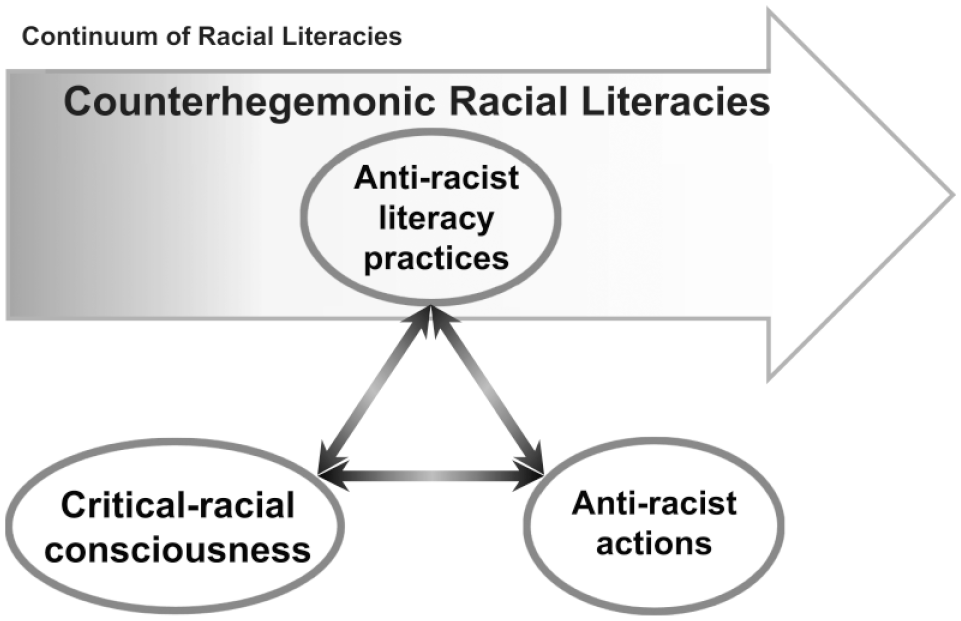
Schematic representation of the relationship between the counterhegemonic end of the continuum and critical-racial consciousness.
In the example in Figure 4, antiracist actions and literacy practices both emanate from and help produce critical-racial consciousness; thus their relationship is not unidirectional but reciprocal, as the smaller arrows indicate. In other words, critical-racial consciousness can develop—before and in tandem with—thoughtful antiracist actions, and, as our racial-literacy practices change, they may affect our consciousness. Figure 4 illustrates an example of a counterhegemonic-racial-literacy practice that aims to develop a person’s critical-racial consciousness. Importantly, people who receive an antiracist education may still fail to act in antiracist ways, as Figure 4 suggests by separating action from consciousness. (For further discussion on the connections and differences among literacy, consciousness, and action, and for an example of the continuum’s use in an empirical study, see Chávez-Moreno, in press.)
Conclusion
Educational institutions play an important role in providing people with formal and informal lessons about race and justice, even in lessons that do not explicitly focus on racial issues. Thus, in this essay, I have contested describing people who make meaning of race in hegemonic ways as racially illiterate and viewing racial literacy as exclusively antiracist. I have argued for the merits of making use of education scholarship’s contribution that all people living in a racist society are racially literate. I also provide an alternative framework to expand the conception of racial literacy and connect it to consciousness. Researching both the racist and antiracist perspectives that emerge in classrooms adds to scholarly knowledge about how students and teachers come to understand, maintain, and disrupt structural racism, which is knowledge that social movements can use in calling for radical changes to education institutions.
Although I have focused on examples of racial literacy in education, all scholarship, of course, is inscribed with certain narratives and logics that it helps sponsor and sustain. Education and noneducation scholars alike contribute to public understandings about how to interpret racial ideologies, and these constrain and enable scholarship (and movements) as they seek to expose race-evasiveness. By considering education’s advances toward theorizing the practice and learning of racial literacy, and by expanding conceptions of racial literacies by placing them in a continuum, scholars can strengthen interdisciplinary and public understandings of race-evasiveness and other racial ideologies.
