




Abstract
This brief analyzes 4-year graduation rates among students ever classified as English learners (ever-ELs) and those never classified as English learners (never-ELs) at the intersections of gender, race/ethnicity, and neighborhood income. We follow two cohorts of New York City students who entered ninth grade in 2013–2014 and 2014–2015 (N = 127,931). We find substantial variations in 4-year graduation among these subgroups, with differential predicted probabilities depending on the student’s ever-EL status, race/ethnicity, and neighborhood income. These findings reveal important intersectional disparities in this diverse group of ELs—nuances that are lost when analyzing across a single social dimension and that push us to adopt an intersectional lens in quantitative research on ELs.
Keywords
Calls to attend to complex intersections of student identity have rarely been applied to students classified as English learners (ELs), 1 a growing and diverse group of students (National Center for Education Statistics, 2023). The present study addresses this gap by exploring how the overlapping social positions formed by gender, race/ethnicity, and socioeconomic status (SES) may differentially shape ELs’ high school graduation in New York City. In so doing, we hope to highlight relatively neglected aspects of heterogeneity in the EL population and begin to develop a quantitative intersectional approach (e.g., Bauer & Scheim, 2019; Codiroli Mcmaster & Cook, 2019) for studying this diverse group of ELs.
Background
Intersectional frameworks emphasize that single social identities, such as race/ethnicity or gender, are insufficient for explaining inequality. Intersectionality instead focuses on how overlapping social identities, in their respective social contexts, combine to create “complex inequalities,” which are difficult to disentangle and are different than the additive effects of holding each individual identity (McCall, 2002). These approaches, which to date have been largely qualitative, have been pivotal in identifying ways language status intersects with other aspects of student identity to reproduce inequalities in the education system. Raciolinguistic and LangCrit researchers, for instance, have pushed to recenter racial dynamics when analyzing linguistic interactions, arguing that racialized multilingual students and teachers are particularly at risk for discrimination due to simultaneously being multilingual and people of color (e.g., Blanchard & Muller, 2015; Crump, 2014; Rosa & Flores, 2017). Scholars have also focused on how gendered social roles influence language acquisition in the classroom (Menard-Warwick et al., 2014; Tong et al., 2010). And other work has gone beyond the classroom to explore how our education structure creates systematic barriers at the school level that are particularly difficult for low-income, racially and linguistically minoritized students to overcome (Ek et al., 2013; Garver, 2020). Intersectional frameworks have primarily been used in qualitative research because these methods typically illuminate the nuanced experiences at many intersections of identities in their specific contexts more accurately than quantitative methods (Bowleg, 2008).
More recently, quantitative adaptations of intersectional frameworks have worked to highlight the combined effects of multiple social categories, often by using interaction analyses (Codiroli Mcmaster & Cook, 2019). These analyses identify unique and multiplicative effects for belonging to multiple social categories and reveal nuanced disparities between and within groups (Bauer & Scheim, 2019; Jang, 2018). Despite acknowledgment of heterogeneity in the EL population (see e.g., Johnson, 2019; Thompson et al., 2023), there has been relatively little effort to quantify how race/ethnicity, gender, and SES differentially and jointly shape ELs’ high school graduation, in part because researchers are often limited to a relatively small or homogeneous sample of ELs, especially when it comes to racial/ethnic diversity of ELs (e.g., Kanno & Cromley, 2015). In this study, instead of studying ELs as a singular group, we highlight the heterogeneity within the EL group by exploring how other social categories—race/ethnicity, gender, and SES—interact with ever-EL status to shape high school graduation. We do so by analyzing a large sample of students in the most diverse city in the country.
In New York City, in the years represented in this study, current ELs constituted about 13% of ninth graders, with former ELs who demonstrated English proficiency prior to ninth grade making up another 20%. We focus on the combined group of current and former ELs, which we refer to as “ever-ELs,” because they are more representative of the entire academic life cycle of ELs (Kieffer & Thompson, 2018; Thompson et al., 2023) and allow us to investigate how overlapping social categories may be shaping student outcomes over many years. As others have argued, this kind of descriptive intersectional work represents a first step in revealing where such intersectional disparities exist (Bauer & Scheim, 2019) and thereby provides better guidance on serving the most marginalized groups.
Method
Our data come from the Research Alliance of New York City Schools, which contains student-level administrative data for all students in the New York City public school system. A full description of the data can be found in the online supplemental materials. Our analysis focuses on two cohorts of high school students who began ninth grade in 2013–2014 and 2014–2015 (N = 127,931; ever-EL n = 42,478; never-EL n = 85,453) in New York City public, noncharter schools. Our sample of ever-ELs is 26% Asian/Pacific Islander (PI), 58% Latine, 2 6% Black non-Latine, and 9% White non-Latine students. 3 We follow them for 4 years through their expected on-time graduation. We also draw on 10 years of earlier longitudinal records to identify not only students who are currently classified as ELs in high school but also those who were ever classified as ELs at any time since kindergarten. We use logistic regression with clustered standard errors to assess how race/ethnicity, gender, 4 and average median neighborhood household income interact with ever-EL status to shape high school graduation rates. Because between-school segregation may be a function of larger social disparities, we refrain from partialing out the effects of schools and instead use clustered standard errors that account for student nesting within high school without removing school-level effects from our student-level regression coefficients. In line with other quantitative intersectional work, we use effect coding in our logistic models, which calculates the intercept as the unweighted average of all interacted group means rather than assigning one category to be the normative reference group (e.g., Mayhew & Simonoff, 2015). See online supplemental materials for an extended explanation.
Findings
Figures 1 and 2 illustrate the results, expressed in predicted probabilities, of four separate logistic regression models predicting 4-year high school graduation from the main effects 5 of EL status plus one additional social identity and the interaction between them. We find that the difference in predicted probabilities within gender and racial/ethnic groups are all statistically significant and provide further information about these dimensions in the online supplemental materials. We can see in Figure 1, Model 1 that when we fit our model using only ever-EL status, never-ELs have about a 0.04 higher predicted probability to graduate within 4 years than ever-ELs. Figure 1, Model 2 shows that when we fit our model using ever-EL status, gender, and their interaction, there are small ever-EL status gaps within the two gender groups. Table 1, expressed in log odds, shows that the interaction between ever-EL status and gender is statistically nonsignificant (Table 1, Model 2; b = 0.02, p = .079); however, given the larger coefficient for gender (b = 0.25, p < .001) compared to ever-EL status, Figure 1b shows that ever-EL young women have a higher predicted probability (0.82) than never-EL young men (0.77).
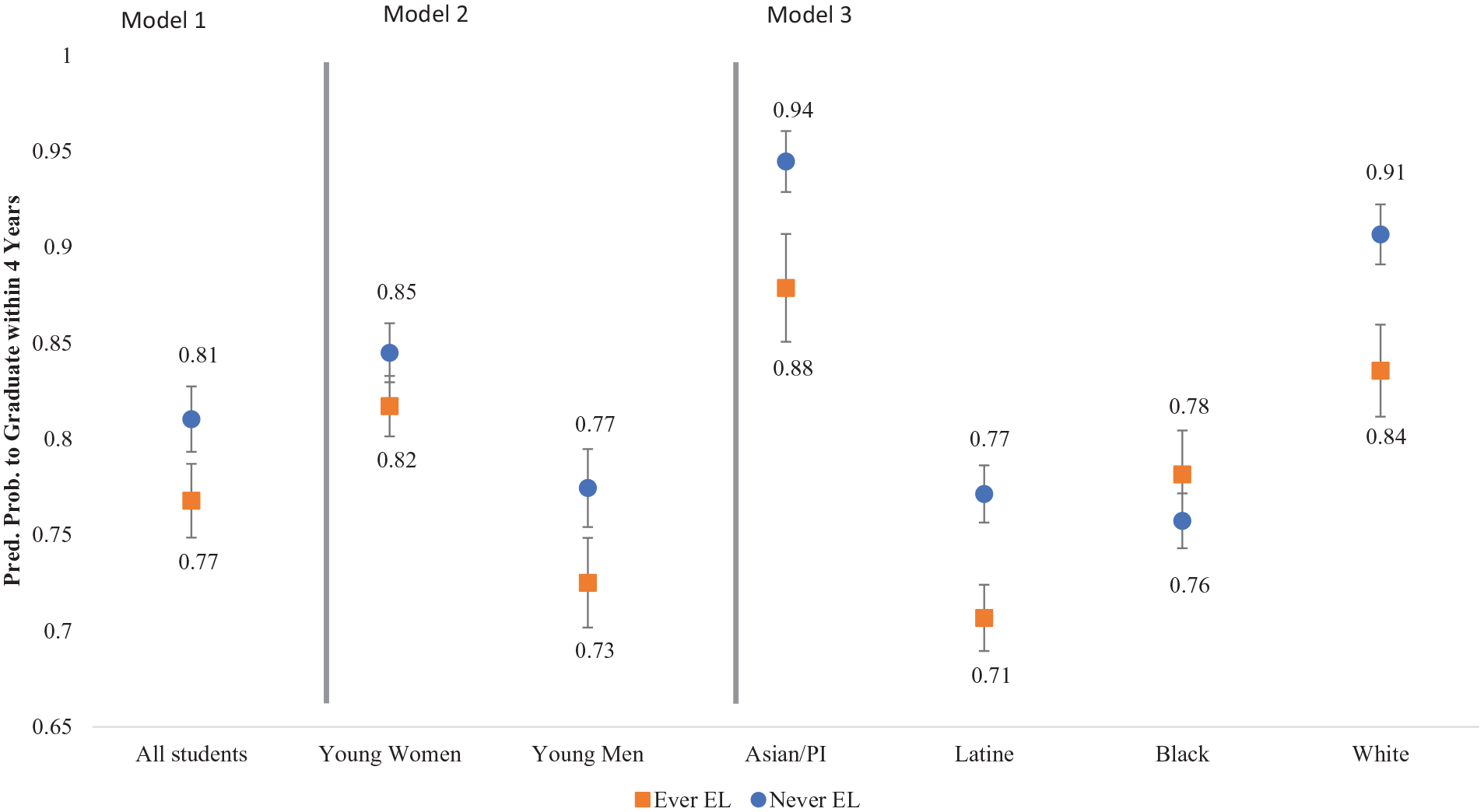
Ever and never English learner status predicted probabilities of 4-year graduation by gender and race/ethnicity.
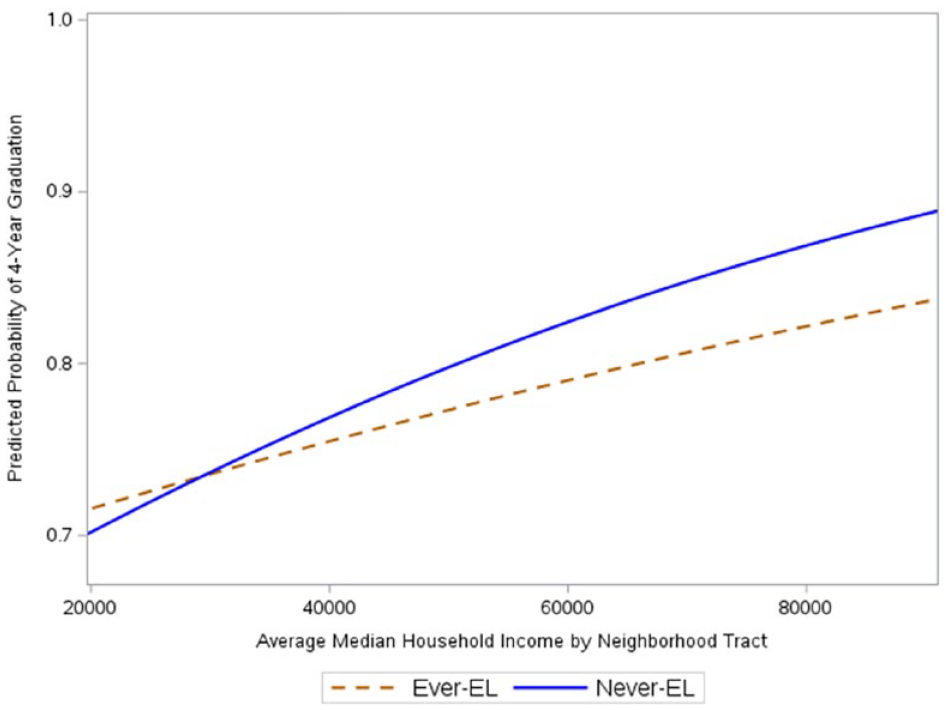
Ever and never English learner status 4-year graduation predicted probability curves by neighborhood income.
Logistic Regression Estimate Table for All Models
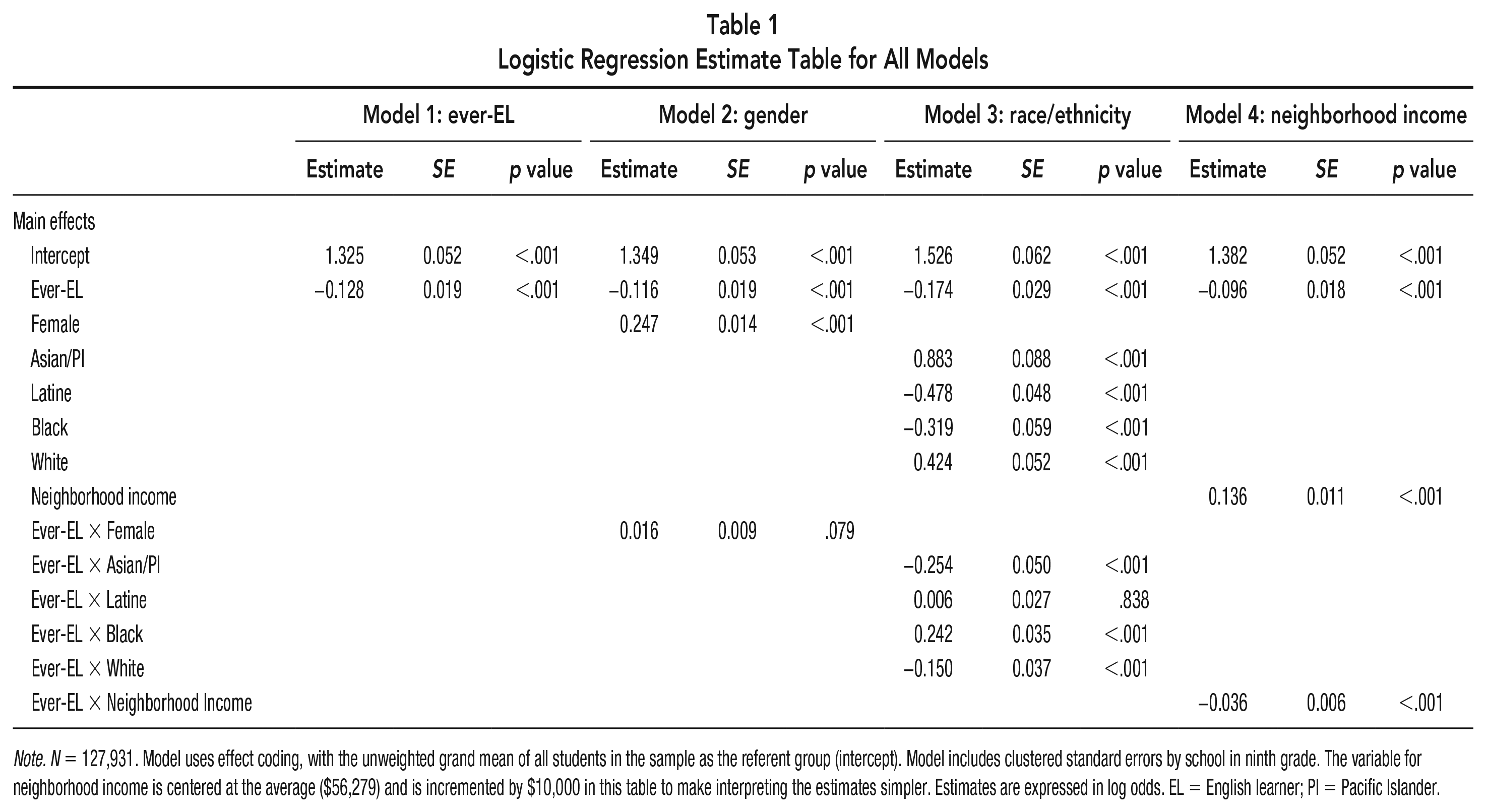
Note. N = 127,931. Model uses effect coding, with the unweighted grand mean of all students in the sample as the referent group (intercept). Model includes clustered standard errors by school in ninth grade. The variable for neighborhood income is centered at the average ($56,279) and is incremented by $10,000 in this table to make interpreting the estimates simpler. Estimates are expressed in log odds. EL = English learner; PI = Pacific Islander.
Figure 1, Model 3 displays the predicted probabilities for ever-EL status with race/ethnicity and their interaction, and Table 1, Model 3 shows the estimates expressed in log odds for this model. Figure 1, Model 3 shows that there is considerable variation by race/ethnicity and that not all racial/ethnic groups have the same patterns for ever-EL status. For example, Black students are the only racial/ethnic group for which the ever-EL group has a higher predicted probability to graduate in 4 years than the never-EL group. Additionally, looking at the estimates for the interactions, we see that there is considerable heterogeneity among these terms’ magnitudes and directions. For example, the interaction for Asian/PI ever-ELs is a large negative estimate (b = −0.25, p < .001), whereas for Black ever-EL students, it is a large positive estimate (b = 0.24, p < .001). Despite these interactions, we still see large differences between these two groups’ predicted probabilities, given that ever-EL Asian/PI students have 0.10 greater predicted probability to graduate than ever-EL Black students (see Figure 1). Additionally, although Latine ever-EL students have the lowest predicted probability to graduate in 4 years (0.71; see Figure 1, Model 3), their interaction term is statistically nonsignificant (b = 0.01, p = .838). Figure 1, with all three models, exemplifies how misleading it is to only model ever-EL status. When we analyze our outcome using these intersectional groups, it is obvious that other social dimensions differentially moderate ever-EL status and that ever-ELs are not a monolithic group.
Figure 2 illustrates the results for ever-EL status moderated by students’ neighborhood income, centered at the average median household income by neighborhood tract ($56,279). The ever-EL probability curve begins slightly higher than the never-EL curve, but the never-EL curve is steeper, overtaking the ever-EL curve and increasing the gap between never- and ever-ELs as the average median household income by neighborhood tract. This figure suggests that overall, ever-ELs may benefit less from living in higher income neighborhoods than never-ELs, evidenced by the flatter curve for ever-ELs relative to the never-EL curve. This becomes clearer when we look at the estimates in Table 1, Model 4, which shows the estimates for the neighborhood income variable and the interaction with ever-EL status incremented by $10,000 to make interpreting the estimate simpler. We see a positive estimate for the neighborhood income variable (b = 0.14, p < .001) but a negative estimate for the interaction between ever-EL status and neighborhood income (b = −0.04, p < .001). With the negative estimate for the interaction, we see that this model predicts a larger increase in the probability of graduating as the neighborhood income increases for never-ELs compared to ever-ELs.
The predicted probability difference for these two groups becomes statistically significant around $40,000. In other words, the difference between never- and ever-EL predicted probability in Model 4 is nonsignificant until the neighborhood income is $40,000. These estimates show the complicated relationship between ever-EL status, neighborhood income, and high school graduation.
Discussion
These findings highlight important variations in graduation outcomes among ever-ELs, supporting that we need to account for their multiple identity dimensions to serve this group more equitably. As previous studies have discussed, descriptive quantitative intersectional work is key to pinpointing disparities on large scales for groups formed by intersecting social categories (Bauer & Scheim, 2019). Previous studies have pointed out that traditional social categories tend to use umbrella terms that can obscure the large within-group heterogeneity (Codiroli Mcmaster & Cook, 2019) and have shown that when analyzing groups at the intersection of identity dimensions such as race/ethnicity, gender, and SES, we may reveal disparities hidden by traditional quantitative methods (Jang, 2018). Our findings show that race/ethnicity, gender, and neighborhood income differentially moderate ever-EL status for 4-year graduation. We see this especially through the sign and size of the interaction terms for race/ethnicity and ever-EL status, with large negative terms for Asian/PI ever-ELs, a trivial and nonsignificant estimate for Latine ever-ELs, and a large positive term for Black ever-ELs. These findings support the need for more nuanced, targeted policies and practices to support those students who are most marginalized.
Although this study cannot tell us what mechanisms are driving these disparities, the narrower attention to interaction effects does allow us to triangulate these findings with previous qualitative research. For instance, previous researchers have focused on the specific discrimination against multilingual Latine students, the lowest performing group in our sample (Blanchard & Muller, 2015; Garver, 2020). It would be erroneous to assume that the barriers ever-EL Latine students face would be experienced by other intersectional groups in the same ways. For example, there is evidence to why ever-EL Black students in our sample might outperform their never-EL Black peers but still be underserved compared to the general population of students (e.g., Agyepong, 2017; Awokoya, 2009; Wallace, 2023). We believe our findings point to the need for more robust intersectional research in two directions: qualitative work to unpack how student self-conceptions align with the relatively broad social categories we use here and more quantitative work that might uncover the mechanisms driving these disparities.
This study does not account for all intersections of these identities and cannot fully account for how these students themselves experience their own unique identities in their own neighborhood and school context. Still, we believe these findings do reveal important intersectional disparities that have been understudied, and we hope to continue to push ourselves and other researchers toward developing an intersectional approach in quantitative studies. Above all, these findings demonstrate that ever-ELs are not a monolith. They challenge us to reckon with the many social forces that may shape ELs’ educational outcomes and focus our attention on students who are most vulnerable.
Supplemental Material
sj-pdf-1-edr-10.3102_0013189X241246747 – Supplemental material for Ever English Learner 4-Year Graduation: Toward an Intersectional Approach
Supplemental material, sj-pdf-1-edr-10.3102_0013189X241246747 for Ever English Learner 4-Year Graduation: Toward an Intersectional Approach by Ben Le, Kristin E. Black, Coleen Carlson, Jeremy Miciak, Lindsay Romano, David Francis and Michael J. Kieffer in Educational Researcher
Footnotes

Notes
Authors
References
Supplementary Material
Please find the following supplemental material available below.
For Open Access articles published under a Creative Commons License, all supplemental material carries the same license as the article it is associated with.
For non-Open Access articles published, all supplemental material carries a non-exclusive license, and permission requests for re-use of supplemental material or any part of supplemental material shall be sent directly to the copyright owner as specified in the copyright notice associated with the article.
