



Abstract
Using 7 years of administrative data from North Carolina public schools (NCPS), we track changes in teacher and principal attrition and mobility during the COVID-19 pandemic and assess how attrition is related to characteristics of educators and schools. We find that educator attrition and mobility increased sharply between Fall 2020 and Fall 2022. Data from the pandemic period indicate that educators of color and more effective educators have experienced larger increases in attrition than their White and less effective peers. Gaps in teacher attrition have narrowed between schools educating many versus few historically marginalized students.
Since the start of the COVID-19 pandemic, K–12 educators have faced a multitude of challenges that raise concerns about stress, burnout, and attrition. Studies have documented high levels of educator stress throughout the pandemic (Hirshberg et al., 2023; Pressley, 2021), with a growing number of educators reporting that they are planning to leave K–12 education (Steiner & Woo, 2022; Zamarro et al., 2022). More recent work has shown an increase in teacher attrition across multiple states (Bacher-Hicks et al., 2023; Camp et al., 2023; Goldhaber & Theobald, 2022).
In this brief, we leverage statewide administrative data from North Carolina to add to the growing scholarship on the COVID-19 pandemic and its impact on the educator workforce in K–12 public schools. 1 We address the following research questions:
Research Question 1: How does educator attrition and mobility during the pandemic compare to prior years?
Research Question 2: How is attrition related to the characteristics of educators and schools?
Our work makes several important contributions to the evidence on postpandemic educator attrition. These contributions include providing data from an additional state, focusing on the attrition and mobility of teachers and principals, examining attrition and mobility within and between school years, and extending analyses into the 2022–2023 school year. Our work is relevant to state and local education officials as they work to understand and strengthen educator pipelines and has implications for key policy goals, such as student recovery, the development of educators, and the diversification of the educator workforce.
How Does Educator Attrition and Mobility During the Pandemic Compare to Prior Years?
Figures 1 and 2 display educator attrition and mobility rates in North Carolina public schools (NCPS) between 2016 and 2022. We define attrition as a teacher or principal leaving their respective role in NCPS; 2 mobility is a teacher or principal returning to the same role but in a different school. These figures show the percentage of teachers and principals leaving their role in NCPS or switching schools between September of a given year and September of the following year. We further decompose total attrition and mobility into within- and between-year components. Within-year attrition is working as a teacher or principal in NCPS in September of a given year and no longer working in that role in NCPS in May; between-year attrition is working as a teacher or principal in NCPS in September and May of a given year but no longer working in that role in NCPS in the subsequent September. Within-year mobility is switching schools between September and May, and between-year mobility is switching schools between May and the subsequent September. 3
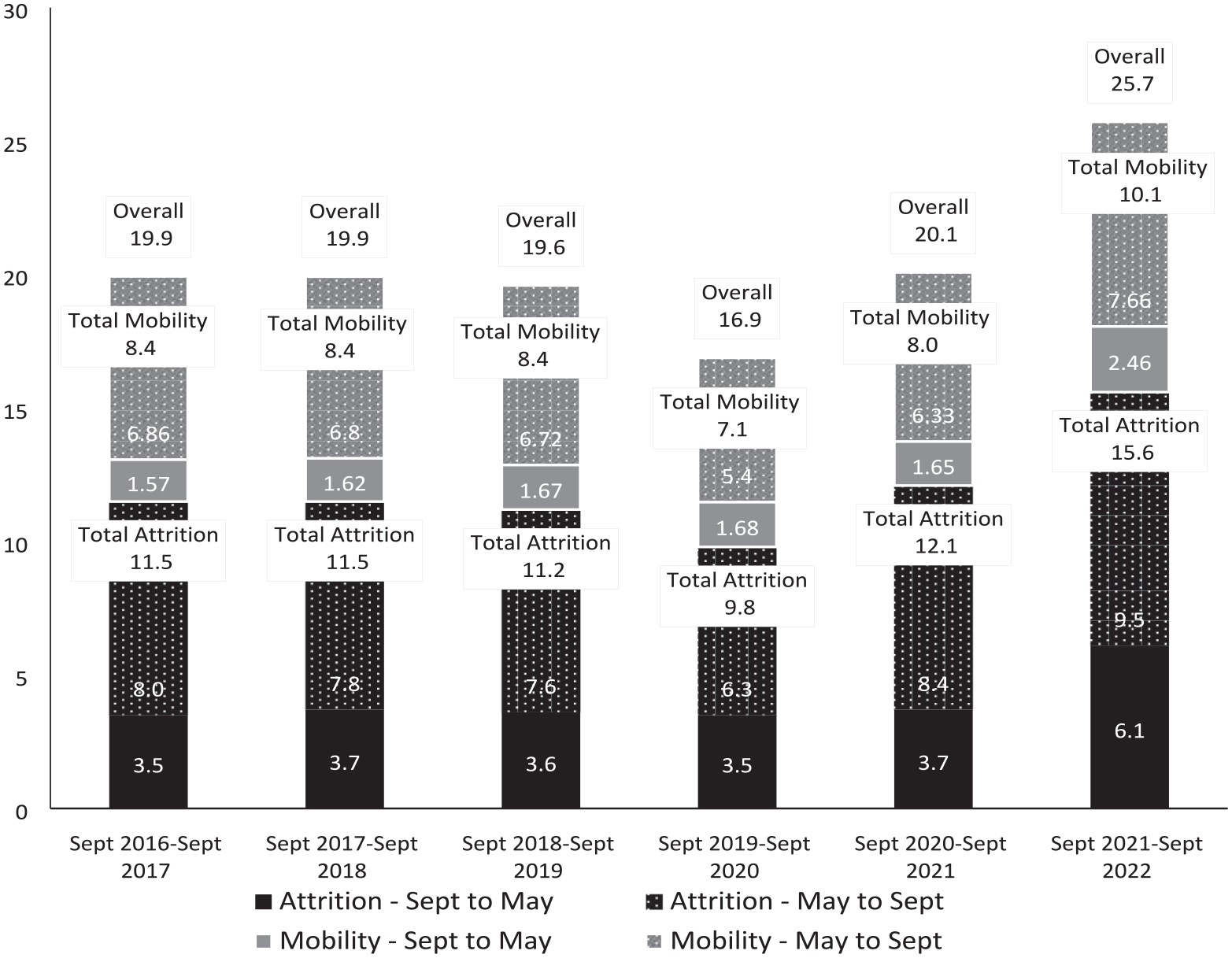
Teacher attrition and mobility in North Carolina public schools—September 2016 to September 2022.
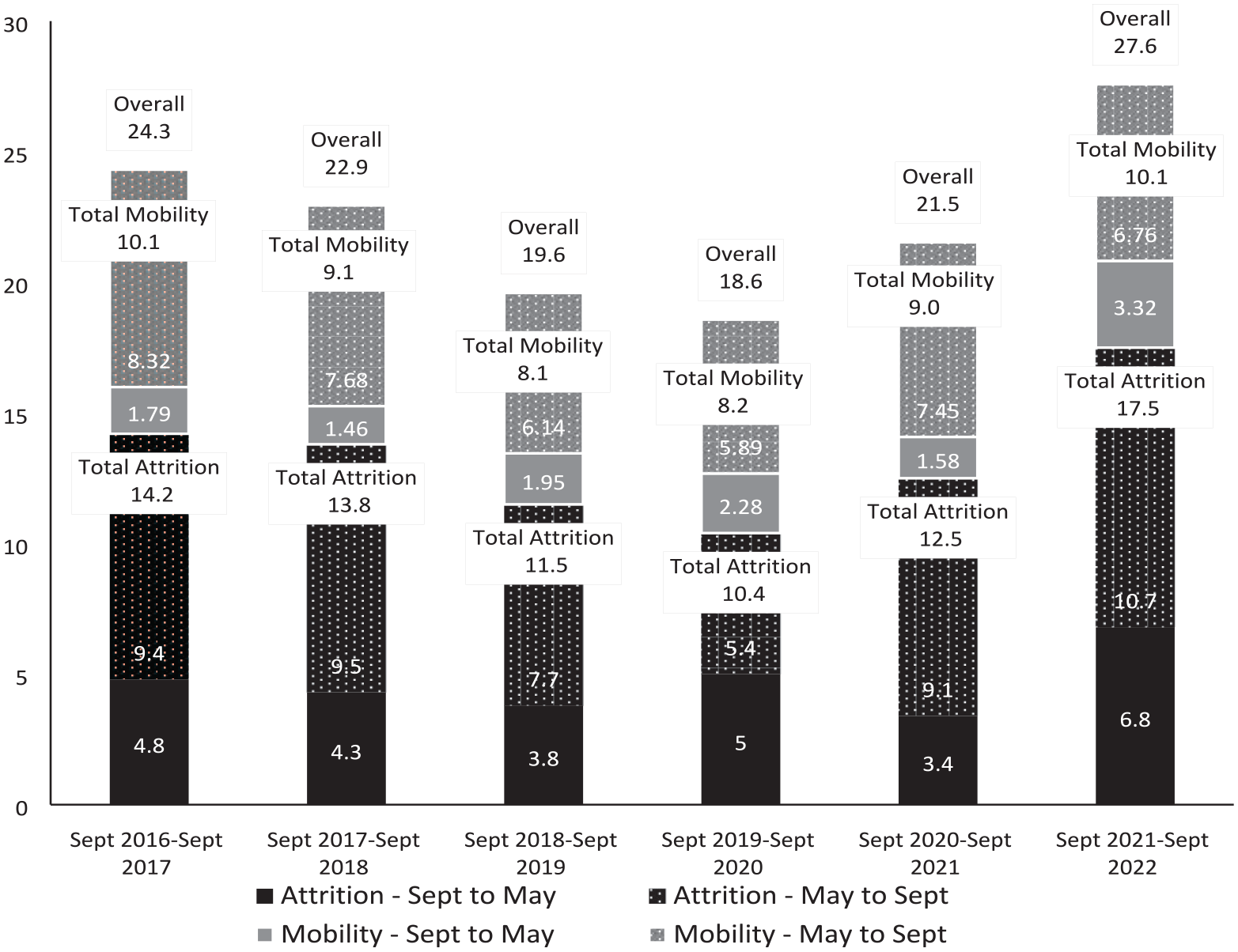
Principal attrition and mobility in North Carolina public schools—September 2016 to September 2022.
Educator attrition and mobility were either relatively stable (teachers) or on a downward trajectory (principals) prior to the COVID-19 pandemic. During the initial months of the pandemic—September 2019 to September 2020—teacher attrition and mobility fell to 9.8% and 7.1%, respectively. Principal attrition also dropped to 10.4%. This drop is consistent with data from other states showing a modest decrease in teacher turnover in the early pandemic period (Camp et al., 2023; Goldhaber & Theobald, 2022).
Since September 2020, educator attrition and mobility in NCPS has been on the rise. For teachers, attrition and mobility rates increased to 12.1% and 8.0% between September 2020 and September 2021 and further increased to 15.6% and 10.1% between September 2021 and September 2022. 4 These increases are consistent with recent patterns from other states where teacher attrition and mobility are also on the rise. Although recent attrition and mobility rates in North Carolina are comparable to rates in Arkansas, they remain much higher than those in Massachusetts and Washington (Bacher-Hicks et al., 2023; Camp et al., 2023; Goldhaber & Theobald, 2022). 5 For principals, attrition and mobility rates increased to 12.5% and 9% in September 2021 and 17.5% and 10% in September 2022. More than 25% of NCPS had a principal who was new to the school at the start of the 2022–2023 school year. Of particular note is the sharp rise in within-year attrition and mobility for teachers and principals during the 2021–2022 school year. These within-year exits are especially challenging for school stability and student achievement (Henry & Redding, 2020). 6
How Is Attrition Related to the Characteristics of Educators and Schools?
Table 1 displays attrition rates—leaving their respective role in NCPS—for teachers and principals with certain characteristics. We present average attrition data for three prepandemic years (September 2016 to September 2019) and three postpandemic years (September 2019 to September 2022) and test for statistically significant differences in average attrition rates between time points. Overall, comparing the pre- versus postpandemic periods, attrition increased 1.1 percentage points for teachers and less than 0.4 percentage points for principals. Across nearly all teacher characteristics, attrition from NCPS is significantly higher after the start of the pandemic. Postpandemic increases in teacher attrition from NCPS are particularly noteworthy among retirement-eligible teachers (up 1.7 percentage points), novice teachers (up 3.5 percentage points), and teachers of color (up 1.5 percentage points). We also find that teachers with higher levels of prior performance experienced a larger increase in attrition rates. 7 For example, attrition rates increased by 1.2 percentage points for teachers earning high evaluation ratings versus 0.2 percentage points for those earning low ratings. Many of the attrition results for principal characteristics are statistically insignificant but consistent in direction and magnitude with the attrition findings for teachers. Specifically, since the start of the pandemic, attrition rates are up 3.9 percentage points for retirement-eligible principals, 1.6 percentage points for principals of color, and 1.5 percentage points for principals earning high evaluation ratings.
Characteristics of Educators Leaving North Carolina public schools
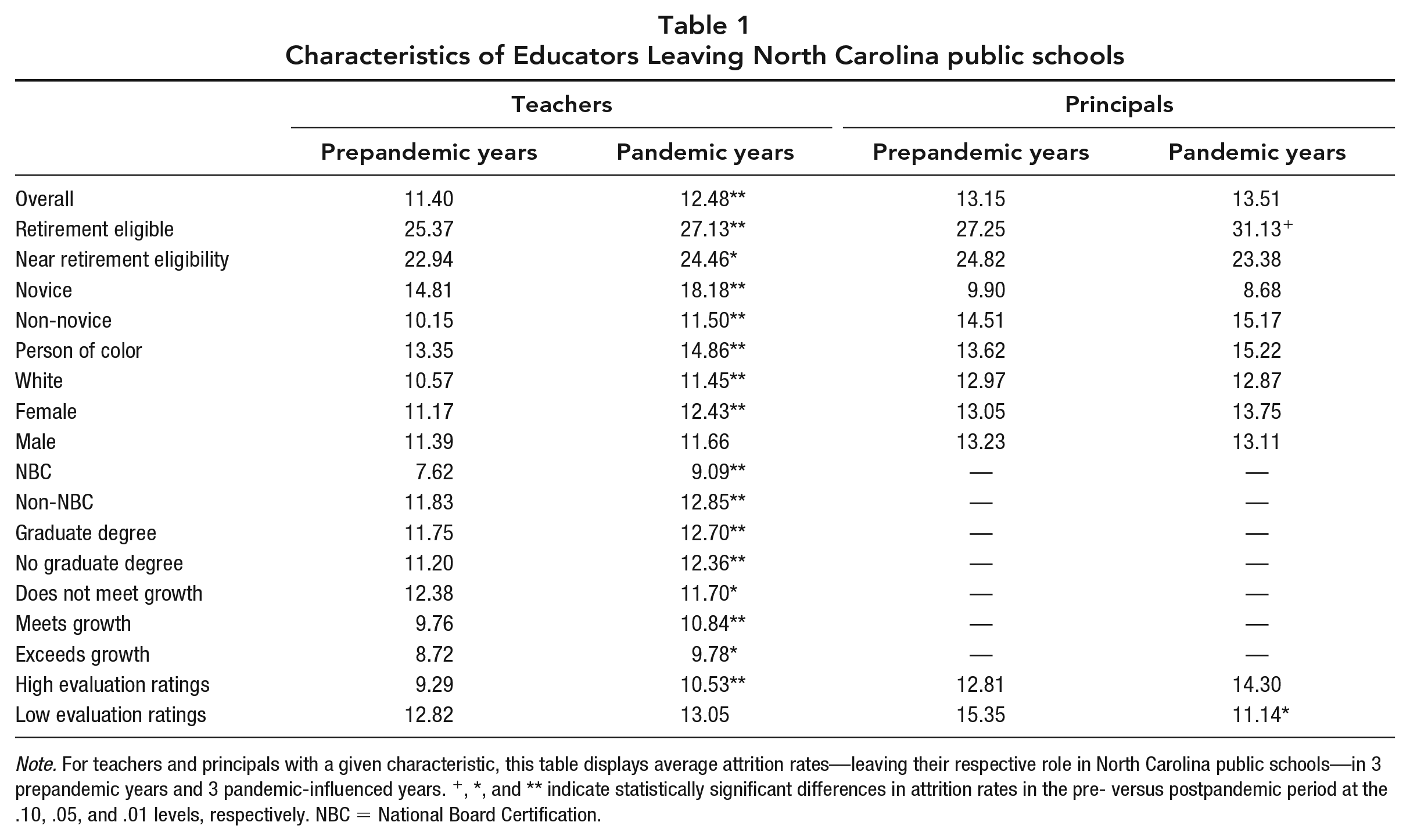
Note. For teachers and principals with a given characteristic, this table displays average attrition rates—leaving their respective role in North Carolina public schools—in 3 prepandemic years and 3 pandemic-influenced years. +, *, and ** indicate statistically significant differences in attrition rates in the pre- versus postpandemic period at the .10, .05, and .01 levels, respectively. NBC = National Board Certification.
Table 2 displays the percentage of teachers and principals leaving schools with certain characteristics. For these analyses, we define attrition as educators leaving their role at a particular school—either exiting NCPS or moving to another school—and we present average attrition rates for 3 prepandemic years and 3 postpandemic years. Overall, teacher attrition from a particular school is up 1 percentage point in the postpandemic period, with larger attrition increases in middle schools and schools located in urban areas. Schools educating many historically marginalized students—that is, schools in the top quartile for percentage of students of color and low-income students—still have much higher teacher attrition rates than schools educating relatively few marginalized students. However, gaps in these attrition rates narrowed during the pandemic. Principal attrition from a particular school is similar (i.e., down 0.2 percentage points postpandemic) between the pre- and postpandemic periods. Exceptions to this include a decrease in principal attrition from high schools and an increase in attrition in urban areas.
Characteristics of the Schools Educators Leave
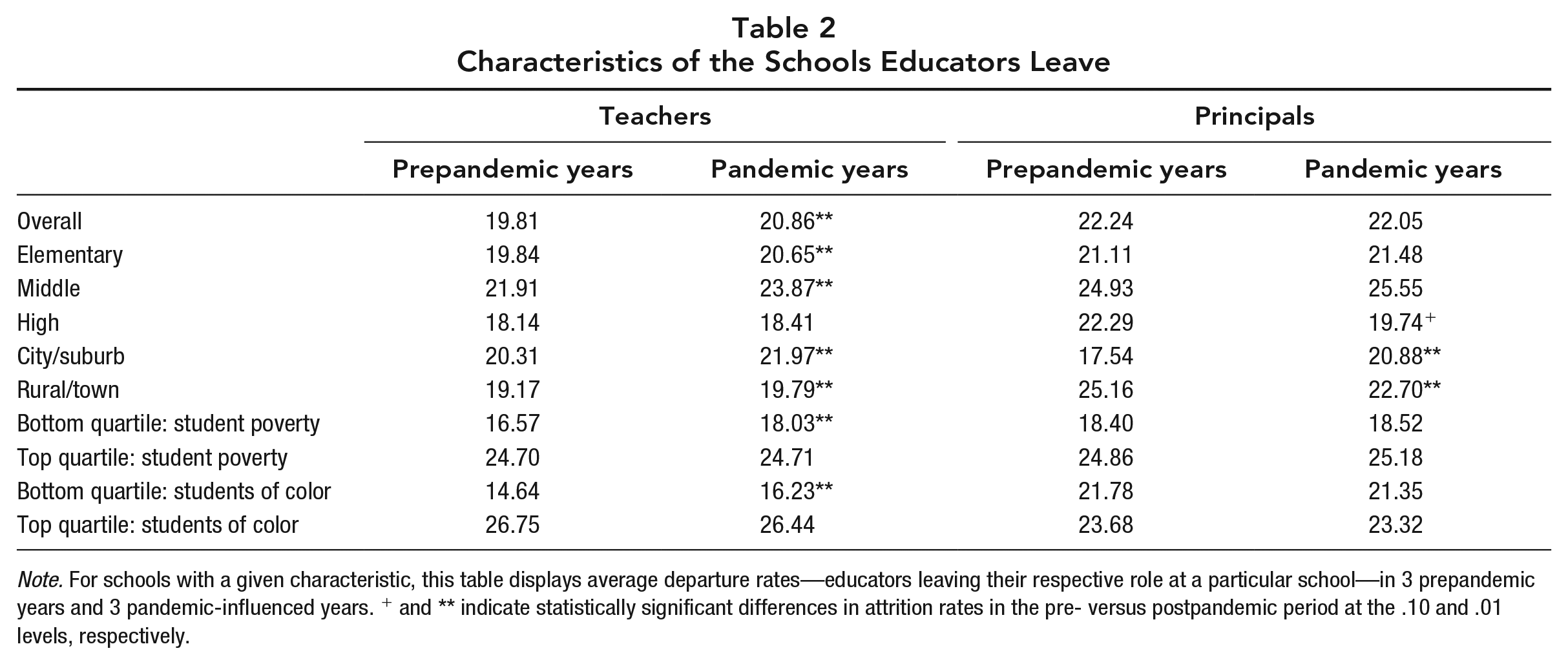
Note. For schools with a given characteristic, this table displays average departure rates—educators leaving their respective role at a particular school—in 3 prepandemic years and 3 pandemic-influenced years. + and ** indicate statistically significant differences in attrition rates in the pre- versus postpandemic period at the .10 and .01 levels, respectively.
Discussion
Educators play a critical role in helping students reengage with school and recover academically. As such, it is important to understand how the COVID-19 pandemic has influenced educator attrition and mobility. From our analyses, there are three key takeaways.
First, educator attrition and mobility rates in North Carolina increased sharply between Fall 2020 and Fall 2022. This finding is similar to those in other states and introduces significant concerns regarding how churn in the educator workforce may adversely impact student academic and social-emotional recovery. A key question is how states and districts can further support educators and strengthen educator pipelines so that attrition lessens in coming years.
Second, data reveal concerns with who is leaving teaching and school leadership in North Carolina. NCPS is losing more retirement-eligible educators. Like Massachusetts (Bacher-Hicks et al., 2023), NCPS is also losing many more novice teachers (who would be expected to teach in NCPS for many years to come). Intensive support for early-career teachers may be especially important to teacher development and persistence during pandemic recovery. Relative to White peers, educators of color were more likely to exit NCPS prior to the pandemic and had larger increases in attrition from NCPS during the pandemic period. This finding is consistent with data from Arkansas (Camp et al., 2022) and Massachusetts (Bacher-Hicks et al., 2023) and is especially concerning given state efforts to diversify the educator workforce. Results also show that higher-performing educators—based on value-added or evaluation ratings—had larger attrition increases during the pandemic. Losing effective educators will further challenge learning recovery efforts.
Finally, gaps in teacher attrition rates narrowed during the pandemic between NCPS in the top and bottom quartiles for the percentage of students of color and low-income students enrolled. These gaps have also narrowed in Massachusetts and Washington (Bacher-Hicks et al., 2023; Goldhaber & Theobald, 2022). While encouraging, this outcome is generally due to attrition rates remaining constant in high-priority schools and increasing in schools educating fewer marginalized students. Longer term, states need to narrow these gaps by increasing teacher retention in schools educating many marginalized students.
Supplemental Material
sj-pdf-1-edr-10.3102_0013189X231187890 – Supplemental material for Educator Attrition and Mobility During the COVID-19 Pandemic
Supplemental material, sj-pdf-1-edr-10.3102_0013189X231187890 for Educator Attrition and Mobility During the COVID-19 Pandemic by Kevin C. Bastian and Sarah C. Fuller in Educational Researcher
Footnotes

Notes
Authors
References
Supplementary Material
Please find the following supplemental material available below.
For Open Access articles published under a Creative Commons License, all supplemental material carries the same license as the article it is associated with.
For non-Open Access articles published, all supplemental material carries a non-exclusive license, and permission requests for re-use of supplemental material or any part of supplemental material shall be sent directly to the copyright owner as specified in the copyright notice associated with the article.
