



Abstract
This field study examined factors that might influence hand raising in students with high levels of shyness. Data were assessed using student self-reports of shyness and social relatedness factors (student-teacher relationship and peer relationship), observations of instructional factors (wait time, warm calling, class size, and school subject), and behavioral measures of hand raising among 204 middle school students during a school week. Multilevel analyses show that student-teacher relationship and warm calling facilitate hand raising of highly shy students, but also that they less likely raise their hands the better their peer relationship. Thus, the results suggest that both social relatedness and instructional factors can promote hand raising in highly shy students, opening the gateway to their oral participation.
When looking at classrooms around the globe, a large part of class time is characterized by class discussions and interactive dialogic sequences of teachers asking questions and students answering these questions (Alexander, 2008; Hiebert et al., 2003; Sacher, 1995; Seidel & Prenzel, 2006). There is consistent evidence that the oral participation of students in such situations is important for student learning and academic achievement (see Howe & Abedin, 2013; Rocca, 2010, for reviews). This strong link can be explained by various functions that oral participation fulfills for classroom learning. For example, it provides teachers with important insights into the learning progress of their students and enables them to interact with their students, for example, by praising students’ accomplishments or revising errors (Hennessy et al., 2021; Mello, 2010). Thus, oral participation allows students to elaborate more on their ideas, which has been shown to have a positive effect on learning (e.g., Fassinger, 1995; Howard et al., 1996; Wang & Eccles, 2012).
Oral participation is embedded within the broader framework of student engagement (Christenson et al., 2012; Fredricks et al., 2004), which divides engagement into cognitive (e.g., cognitive effort to learn, understand, and acquire knowledge), emotional (e.g., affective reactions in class and attitudes toward school), and behavioral engagement (i.e., all visible forms of student engaging behavior, such as oral participation but also taking notes or completing worksheets).
Recent research shows that of these three forms of engagement, behavioral engagement, and especially oral participation, is more predictive for academic achievement than the other two forms (Bae & DeBusk-Lane, 2019; Sedova & Sedlacek, 2023). Therefore, creating opportunities for students to participate orally in class has been consistently proclaimed as an important goal for teachers (Mercer & Dawes, 2014; Sedova & Sedlacek, 2023). However, there are also recent studies that show that not every student needs to participate orally in class, but that there is another form of behavioral engagement that has been linked to learning: hand raising. More specifically, before contributing orally, students around the globe are asked to raise their hands to indicate their willingness to participate (Dixon et al., 2009). Some authors have argued that students’ hand raising must be preceded by their cognitive and emotional engagement. Consistent with this notion, in a series of three studies, Böheim and colleagues could show that hand raising is associated with students’ motivation as a form of emotional engagement as well as with cognitive engagement and school achievement (Böheim, Knogler, et al., 2020; Böheim, Urdan, et al., 2020). More importantly, in a study by Decristan et al. (2020), students’ hand raising predicted their posttest achievement, but the authors found no differences in learning outcomes when they compared students with raised hands who were called to students who raised their hands but were not called. Thus, it can be argued that student hand raising is not only an observable indicator of behavioral engagement but also “represents an important gateway to create … learning opportunities in classrooms” (Böheim, Knogler, et al., 2020, p. 2). This is particularly true for German classrooms, the context in which this study is conducted and where students usually only talk after they have raised their hand and have been called on by their teachers (Sacher, 1995). Therefore, in the following study, we consider hand raising as an important proxy for oral participation and, thus, as a form of behavioral engagement that can open the gateway to student learning.
The benefits of oral participation are seen by both teachers and students (Fassinger, 1995; Fritschner, 2000). However, although many students report that they would like to participate more (Wade, 1994), research shows that only a handful of students participate orally on a regular basis (Decristan et al., 2020; Howard & Henney, 1998; S.Kelly, 2007; Schnitzler et al., 2020). For instance, both Jones (1990), who studied oral participation, and Sacher (1995), who studied hand raising, found that nearly a third of all students observed remained completely silent (i.e., did not participate orally at all or never raised their hands). Several reasons for students’ silence have been discussed, including being tired, bored, or unprepared (Reda, 2009); cultural reasons (X. Chen, 2019); and language barriers (Tatar, 2005). However, consistent evidence shows that one of the main reasons for students’ in-class silence is their trait shyness (see Kalutskaya et al., 2015, for a review).
Given the important role of oral participation within student learning and achievement (Rocca, 2010), the silent and passive in-class behavior of shy students causes them to miss important learning opportunities (Crozier, 2020) and may explain their poorer school attainments, even though they are no less intelligent (Hughes & Coplan, 2010). However, not much is known among either educators or researchers about how to help shy students participate orally (Nyborg et al., 2020). Therefore, as “students’ active verbal participation is a key element of the teaching and learning process, … factors that impede this participation ought to be addressed in research into classroom management” (Crozier, 2020, p. 156). In assessing students’ hand raising during a regular school week as well as two social relatedness factors (i.e., student-teacher relationship and peer relationship) and four instructional factors (i.e., warm calling, wait time, class size, and school subject) and by using a multilevel and multi-informant analytic approach, the present study follows this call and sought to examine whether these factors can facilitate hand raising as a proxy to oral participation in students with high levels of shyness.
Shyness, Hand Raising, and Oral Participation
Shyness can be defined as a temperamental wariness in the face of social novelty and/or self-conscious behavior in situations of perceived social evaluation (Coplan & Rubin, 2010). In such situations, shy people typically respond with silence and passivity (Coplan & Arbeau, 2008; Crozier, 1995; Rubin et al., 2009). In this regard, school is considered particularly problematic for shy children (Crozier, 2020; Kalutskaya et al., 2015). For example, it has been found that they speak less in school than their less shy peers, whereas no differences were found for familiar situations at home (Asendorpf & Meier, 1993).
The main cause of these problems is thought to be an inner conflict: In contrast to purely introverts, shy people do want to approach others but at the same time are afraid of humiliation, failure, or rejection (Asendorpf, 1990, 1991). This inner conflict is also evident in classroom discussions. That is, unlike unmotivated or purely introverted students who are generally comfortable with their silent role (Poole & Schmidt, 2020), shy students report that they would like to participate more orally but are reluctant to do so because of their socio-evaluative concerns, self-consciousness, and state anxiety (Mundelsee & Jurkowski, 2021; Russell & Topham, 2012). Furthermore, they are assumed to be concerned not only about the likelihood and consequences of public failure, but also about the social costs of correct responses (e.g., standing out as a nerd or geek) (Crozier, 2020). In line are a number of studies showing that shyness is associated with lower levels of oral participation and hand raising (e.g., Y.Chen et al., 2022; Mundelsee & Jurkowski, 2021).
In this respect, three problematic mechanisms come into play for shy students. First, given the important role oral participation plays in student learning and achievement, shy students miss out on important learning opportunities through their silence. In line are studies linking student shyness to lower scores in expressive and receptive tests (see Crozier, 2020; Evans, 2010, for reviews). Second, hand raising and oral participation are often included as part of the final grade (e.g., Crosthwaite et al., 2015; Krieger, 2003; Rogers, 2011, for teacher surveys in Asia, Germany, and the United States, respectively). The in-class silence of shy students can thus have a negative impact on their overall grade. This fits with surveys of teachers who found it challenging to accommodate shy students (Bosacki et al., 2011), particularly in terms of their in-class participation, as they often do not come to the attention of teachers until they have to grade their oral participation (Krieger, 2003).
Third, shy students’ lower oral participation is problematic because it appears to affect teachers’ perceptions (Maldonado-Carreño & Votruba-Drzal, 2011). More specifically, teachers not only suspect a lack of interest and insufficient motivation behind shy students’ passive attitude and poorer oral participation, but they also underestimate their academic abilities and intelligence (Coplan et al., 2004, 2011; Deng et al., 2017). For example, when exploring the association between shyness, oral participation, and academic attainment in 125 students from 9 to 13 years old, Hughes and Coplan (2010) found that oral participation was not only negatively linked to shyness, but also partially mediated the relationship between shyness and teacher-rated math and reading skills, while it was unrelated to standardized test scores. Furthermore, this perception attribution bias of their teachers is thought to initiate a self-fulfilling prophecy in which teachers’ expectations negatively influence shy children’s self-evaluations (Stöckli, 1999), which in turn triggers a downward spiral in their emotional engagement, in-class participation, and academic performance (Kalutskaya et al., 2015; Stöckli, 2007).
Therefore, considering the impact of shy students’ silence in the classroom, it can be summarized that research on factors that promote shy students’ hand raising has the potential to open the gateway to their oral participation and, thus, to support their academic learning and achievement. This seems to be especially important for adolescent students. In this age group, some subtypes of shyness reach their peak (Cheek et al., 1986; Schmidt & Poole, 2019). Moreover, students of this age group have been found to be more self-conscious and, thus, more reluctant to reveal themselves to an audience than younger or older students (see, e.g., Elkind & Bowen, 1979; Ryan & Kuczkowski, 1994), which might contribute to the desire of shy students to stay out of the spotlight at this age in classroom situations (Levine & George, 1992). This was the starting point of the present study to examine contextual factors that may promote hand raising in shy middle school students.
Potential Facilitative Contextual Factors in the Association Between Shyness and Students’ Hand Raising
In search of possible contextual factors that facilitate hand raising in shy middle school students, we found some frameworks proposing contextual factors that influence the more general construct of student engagement (Appleton et al., 2006; Lam et al., 2012). For example, in their contextual model for student engagement, Lam et al. (2012) proposed that both instructional factors (e.g., challenge, curiosity, and autonomy) and social relatedness factors (e.g., support of teachers, peers, and parents) influence students’ general school engagement.
As mentioned above, the present study, however, focuses on hand raising as the decisive gateway to oral participation, which is a specific subtype of students’ in-class behavioral engagement. To our knowledge, there is not yet an overarching theoretical framework for oral participation, but in his comprehensive review, Rocca (2010) categorizes contextual factors associated with students’ oral participation similar to the classification of Lam et al. (2012). More specifically, Rocca (2010) finds both instructional factors (e.g., class size, schedule, seating arrangements, cold calling, and course subject) and social relatedness factors (e.g., student-teacher relationship and peer relationship) influencing students’ oral participation.
Some of these factors were also found to be relevant in hand-raising research, which, compared to the other constructs, is the least researched in-class engaging behavior. The few studies that explicitly examined student hand raising found some instructional factors (e.g., school subject and instructional method) and, with perceived teacher emotional support, also one social relatedness factor (see Böheim, 2020, for an overview).
Importantly, all these models focus on main effects, that is, factors that directly affect the respective outcome (i.e., school engagement, in-class engagement, oral participation, or hand raising), whereas the aim of the present study was to find interaction effects, that is, factors that moderate the association between shyness and hand raising. In this regard, current literature on shyness suggests that reducing shy students’ anxiety and increasing their safety should be the main goals of teachers in enhancing shy students’ oral participation (Crozier, 2020; Nyborg et al., 2020). Therefore, we focused on such social relatedness and instructional factors that could be assumed to reduce shy students’ state anxiety, insecurity, and socio-evaluative concerns and, in turn, increase their hand raising (Crozier, 2020).
Some of these factors have also been explicitly proposed in the shyness literature as factors that should help shy students with their oral participation (Coplan & Rudasill, 2016; Evans, 2010), but they have rarely been tested empirically (cf. Archbell & Coplan, 2022, for a study on socially anxious university students). See Figure 1 for a process model presenting the assumed factors and relationships tested in the present study. Next, we review theoretical assumptions and empirical results that support the factors in the process model used in this study.
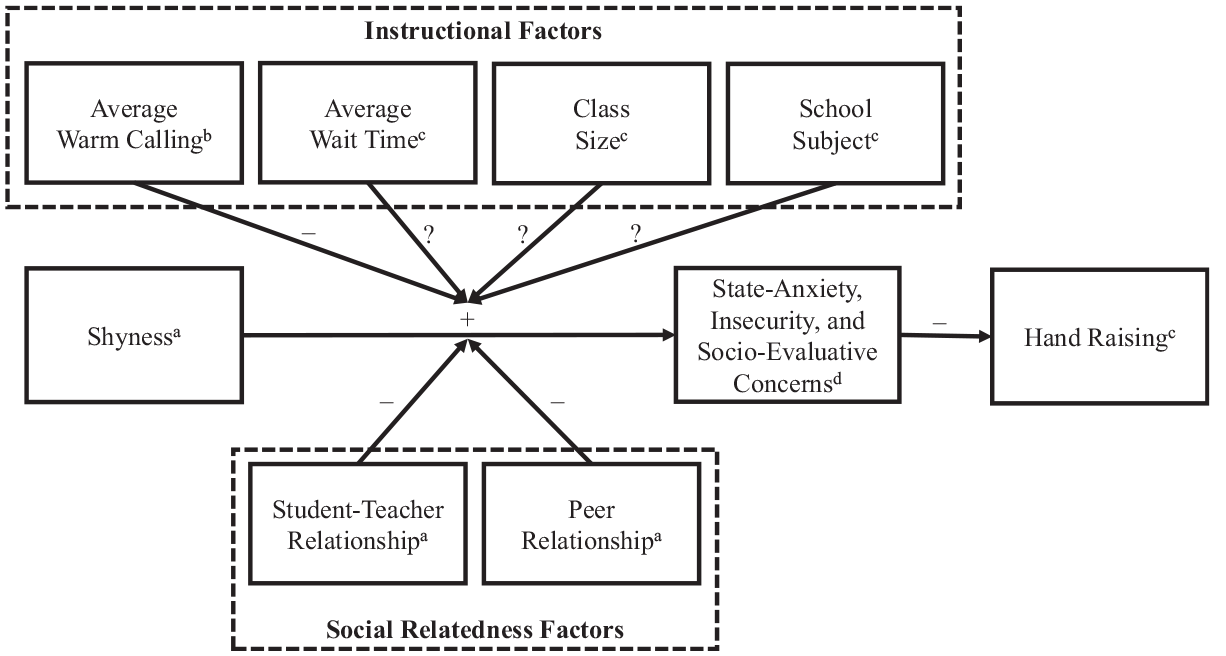
Process model of instructional and social relatedness factors thought to influence hand raising in highly shy students.
In terms of social relatedness factors, relationships both between the students and their teachers (i.e., student-teacher relationship) and between the students themselves (i.e., peer relationship) should affect shy students’ hand raising. Based on teacher interviews about strategies to promote shy students’ oral participation, Evans (2001) suggested “to establish a personal relationship and trust, providing a chance for one-on-one work with the teacher” (p. 167). In line with this, Buhs et al. (2015) observed that shy students in classes with highly sensitive teachers showed higher classroom engagement, and Wu et al. (2022) found that teacher-child closeness mediated the relationships between shyness and in-class engagement.
Moreover, because shy students, when compared to their less shy peers, are more sensitive to less positive peer relationships (Gazelle, 2006), it has been suggested that teachers should create a warm and supportive class climate to increase shy students’ oral participation (Coplan & Rudasill, 2016; Evans, 2001). So far, this assumption has not been directly tested, but the study by Hughes and Coplan (2018) points in the assumed direction. The authors investigated different forms of behavioral engagement and focused on children high in anxious solitude, a construct that has been used to denote social wariness displayed particularly in familiar peer contexts (Gazelle & Ladd, 2003), and that can be seen as functionally equivalent to shyness (Coplan et al., 2020). Hughes and Coplan (2018) found a strong positive relationship between peer relationship and engagement for children with the highest levels of anxious solitude. Therefore, both the peer relationship and the student-teacher relationship were thought to reduce state anxiety, increase safety, and, thus, increase shy students’ hand raising.
Instructional factors, and teacher behavior in particular, also seem to play an important role in shy students’ oral participation (Evans & Bienert, 1992). More specifically, teachers’ average wait time and their use of the so-called warm calling strategy have been discussed as possible supporting contextual factors. Hand raising is typically initiated by a teacher question (Böheim, 2020). However, the average wait time between a teacher question and calling on the first student with a raised hand ranges between just 1.0 and 2.5 seconds (Heinze & Erhard, 2006). This offers little time for students to elaborate on their initial thoughts, formulate their answer, and, finally, decide whether to raise their hand (Mundelsee & Jurkowski, 2021). This lack of time seems particularly problematic for shy students who may have good ideas to share but hesitate to raise their hands (Evans, 1987). Thus, a longer wait time may help shy students formulate their answer internally, reduce their uncertainty, and finally raise their hands. In a recent study by the authors (Mundelsee & Jurkowski, 2021), an additional 1-minute think phase prior to hand raising increased hand raising for all students, but did not specifically increase hand raising in shy students. As a possible explanation, we suspected that a longer wait time could lead to students fearing that teachers would then expect more detailed answers, and that this could lead to shy students having a greater fear of failure, so that they would raise their hands less often. Overall, it remains speculative whether a longer wait time increases hand raising in shy students due to increased thinking time or even decreases hand raising due to increased fear of failure.
Furthermore, some teachers do not solely call students with raised hands (i.e., warm calling), but also students who have not raised their hand (i.e., cold calling). The cold calling strategy has been proposed to be an effective practice for enhancing oral participation for students in general (e.g., Dallimore et al., 2013), but the opposite may be true for shy students. That is, the anxiety of being called upon may suppress their active, but silent, participation (Shi & Tan, 2020). As Coplan and Rudasill (2016) noted, “Pushing shy children to speak up … appears to only have the effect of increasing their reluctance to speak” (p. 58). Consistently, the warm calling strategy has been reported as one of the most common strategies used by teachers to decrease the anxiety of shy students (Archbell & Coplan, 2022; Nyborg et al., 2022). Thus, the predominant use of the warm calling strategy should increase shy students’ safety and, thus, their hand raising.
Another possible instructional factor contributing to shy students’ hand raising is class size, but this could have an influence in either direction. While there is strong evidence that students in smaller classes are generally more willing to participate orally (Auster & MacRone, 1994; Berdine, 1986; Howard & Henney, 1998) as they feel less anxious (Smith, 1992), one can also speculate about detrimental effects for shy students. Since smaller classes also mean that it is less easy to hide (Weaver & Qi, 2005), the obvious likelihood of being called increases. In turn, shy students might direct their attention away from relevant cues (e.g., a teacher’s question) to the anxiety stimulus (e.g., not to attract attention of the teacher; Bilz, 2017; Downing et al., 2020), increasing their self-consciousness and thus reducing their hand raising even more.
A fourth potential instructional factor for shy students’ hand raising may be the school subject. Disciplinary differences across school subjects are known to influence instructional practices and thus student-teacher interactions, such as the use of cooperative forms of learning, the types of questions asked, the relation of subject content to everyday life, or the typical amount of oral participation (Grossman & Stodolsky, 1995; Rocca, 2010; Stodolsky, 1993). These different instructional practices may also influence the hand raising of shy students, but previous findings suggest effects in both directions. For students in general, Böheim, Knogler, et al. (2020) found a subject specificity for students’ hand raising, namely, their self-concept, a construct negatively linked to shyness (Leary, 2001), which predicted hand raising in mathematics but not in language arts. Based on these findings, it is possible that natural science subjects such as mathematics are more likely to increase shy students’ anxiety, concerns, and self-consciousness, causing them to raise their hands less in these subjects. On the other hand, in natural science subjects, teachers typically ask more closed-ended questions which allow for shorter answers when compared to more open-ended questions in social science subjects (Grossman & Stodolsky, 1995). As shy students have been found to speak in shorter utterances (Evans, 1987), it could be that shy students in natural science subjects are more willing to participate orally and are therefore more likely to raise their hands in these subjects.
The Present Study
Even though shyness is unrelated to intelligence, shy students underperform in school. Increasing evidence links this underachievement to shy students’ lower levels of oral participation, which in turn has been shown to be linked to student learning and achievement. However, not much is known about the conditions under which shy students (do not) participate orally in the classroom. Therefore, the goal of the present study was to contribute to a deeper understanding of the oral participation in highly shy students, as we refer to students with high levels of shyness in the present study, by exploring moderators of highly shy students’ hand raising as a decisive gateway to their oral participation. We formulated seven research questions: (1) How does shyness influence student hand raising? How is this association moderated by (2) student-teacher relationship, (3) peer relationship, (4) warm calling, (5) wait time, (6) class size, and (7) school subject? Based on findings and suggestions from the literature, we had specific expectations for Research Questions 1 through 4: We expected lower levels of hand raising in highly shy students when compared to less shy students (i.e., students with lower levels of shyness) (Hypothesis 1 [H1]). Furthermore, we expected the association between shyness and student hand raising to be positively moderated by their student-teacher relationship (H2), peer relationship (H3), and warm calling (H4). Since the influence of the three factors average wait time, class size, and school subject could have gone either way, we investigated these research questions exploratively.
Materials and Methods
All experimental procedures were in accordance with the ethical standards of the institutional research committee and with the 1964 Helsinki declaration and its later amendments or comparable ethical standards. The study was approved by the ethics committee of the University of Erfurt (#20210210) and preregistered in the Open Science Framework (https://osf.io/bt84w).
Participants
The sample consisted of 204 students from 4 sixth- and 4 eighth-grade classes in a secondary school in Germany (110 females; Mage = 11.85, SDage = 1.05) for whom their parents had given written informed consent. Participation was on a voluntary basis. Students and teachers could withdraw from the study at any time. The selection of the sixth and eighth grades was based on our assumptions regarding several moderators (in particular, student-teacher relationships and peer relationship) and their effects on highly shy students’ hand raising. In Germany, students and teachers usually stay together in fifth and sixth grade and in seventh and eighth grade, respectively. Thus, student-teacher relationships and the peer relationship had time to develop for more than 1 year. Moreover, research indicates that social comparisons as a key driver of highly shy students’ self-consciousness, anxiety, and socio-evaluative concerns, play a smaller role with younger students than with older students, and a relatively strong change in this context occurs roughly between fifth and eighth grade (Rubin et al., 2006). This corresponds exactly to our targeted sample.
Design and Procedure
The study was composed of three data sources: First, students’ self-reported data (i.e., trait shyness, student-teacher relationships, peer relationship, gender, and prior course grades) was collected using validated, commonly used questionnaire instruments. Second, during the so-called test week, teachers’ wait time and use of warm calling were measured through observations; and third, students’ hand raising was assessed through behavioral measurements.
A few weeks before the test week and after having received the consent of all parties (students, school administration, teachers, and parents), all classes were visited for four purposes: First, students were asked to fill out a questionnaire to record personal and school characteristics. Second, students were introduced to the gadgets that were used in the study as a behavioral measure of hand raising. To become familiar with the gadget, each student was given one gadget and was instructed to raise his or her hand with it to show his or her willingness to participate orally during that school day. Third, each participant got an individual code to later merge self-report, observational, and behavioral data. Fourth, students and teachers were roughly informed about the purpose of the study. More specifically, the study was labeled as a study on the relationship between oral participation and classroom events. A reference to shyness was not mentioned at any point so as not to increase self-awareness in shy students.
A few weeks later, classes were visited over the course of 1 regular school week (test week) in seven different subjects (mathematics, English language arts, German language arts, biology, history, geography, and religion/ethics). Each subject was visited at least twice per class, resulting in a total of 116 lessons taught by 27 different teachers. The teachers were instructed to carry out their lessons as planned. As a result, there were several lessons (N = 36) in which tests were written or in which only silent work or group work took place without a single hand raising from students. These lessons were excluded from the analyses in this study.
During this test week, one of four trained assistants accompanied each class throughout the relevant lessons and collected information about the teacher’s instructional behavior (e.g., teacher questions and teacher calls to capture warm calling and wait time). At the beginning of each day, each student was given the hand-raising gadget. The assistants checked for proper use of the gadgets and reminded students if they forgot to use them. Since the latter was the case only in the first two lessons of the first test day, these two lessons per class were also excluded from the analyses resulting in a total of 72 lessons for the present study.
Taken together, the study captured variables at three different levels (see also Figure 1): (a) students’ trait shyness (as independent variable), students’ individually perceived relationships with any of their teachers and their peers (as potential facilitative social relatedness factors) at the student level; (b) sum of hand raising per student (as dependent variable), school subject, average wait time, and class size at the lesson level, and (c) the average use of warm calling (as potential facilitative instructional factors) at the teacher level.
Measures
Student Self-Reports
All the following scales consisted of items that could be rated on 5-point Likert scales (1 = I do not agree at all; 5 = I totally agree), and an average score was calculated for each scale for further analyses. To examine students’ trait shyness, eight items from the Children’s Shyness Questionnaire (CSQ; Crozier, 1995; sample item: “I feel shy when I am the centre of attention” and “I find it hard to talk to someone I don’t know”) were selected based on the highest factor loadings in the study of Spensieri et al. (2019). Cronbach’s alpha coefficient of the scale was .71 in this study. Item wordings and factor loadings can be found in Supplement 1 in the online version of the journal.
Student-teacher relationships can include several dimensions, such as closeness, trust, provisions of clear expectations, classroom safety, instrumental help, and emotional support (for a review, see Wentzel, 2016). As teachers report emotional support, fairness, and how to respond to mistakes as their most common strategies in their interaction with shy students (Evans, 2001), we also concentrated on these dimensions. Therefore, student-rated quality of student-teacher relationships were assessed in relation to specific teachers by means of the following three items used in other studies on student-rated student-teacher relationships (Obsuth et al., 2017; Valdebenito et al., 2022): “I get along with my teacher”; “The teacher is fair to me”; “The teacher supports me.” Based on the aforementioned strategies used by teachers with shy students, we created another item (“The teacher reacts calmly when I say the wrong answer”) and added it to the student-teacher relationship scale. Cronbach’s alpha of the various teachers ranged from .82 to .91. A confirmatory factor analysis (CFA) yielded satisfactory fit statistics (.94 ≤ CFI [comparative fit index] ≤ .99; .01 ≤ SRMR [standardized root square mean residual] ≤ .03). Individually perceived peer relationship was assessed using four items from the subscale “class climate” of a German instrument measuring social experiences in school (FEESS; Rauer & Schuck, 2003; sample item: “In my class, we all stick together”). Cronbach’s alpha was .75. As peer relationship is more predictive on the individual level (Rathmann et al., 2018), it was neither group-mean centered nor aggregated and remained on the individual level for the latter analyses.
In addition, as control variables, students reported on their gender (coded as 0 = male and 1 = female) and their prior course grades for every relevant subject (reverse-coded; note that grades in the German school system range from 1 to 6, with lower numbers indicating higher performances). For the analyses, the grades were group mean centered around the respective class means. Both variables have been shown to be strong predictors of oral participation (see Rocca, 2010), but they do not count as instructional or social relatedness factors.
Observation of the Lessons
Four trained assistants logged various events (e.g., “warm call,” “cold call,” and “student contribution”) that we had defined prior to the study, via a mobile time-tracking app. The app offers the possibility to predefine events and automatically tracks them whenever they are clicked on and stops them when a new event is started, resulting in time series data with timestamps of various classroom events. These observations were used to define both the relevant phases in class and to identify the potentially facilitative instructional factors: class size, school subject, wait time, and warm calling. Based on the system of classroom categories of Seidel (2005), our coding scheme included the following events: (a) organization of classroom interaction (coded as 0 = lecture by the teacher, 1 = class discussion/question-and-answer, 2 = rest), (b) teacher questions (coded as 0 = no teacher question, 1 = start of a teacher question, 2 = end of a teacher question), (c) teacher calls (i.e., both the individual number of the student being called and the way the teacher called this student coded as 0 = without raised hand after a teacher question [i.e., cold call], 1 = with raised hand after a teacher question [i.e., warm call], 2 = with raised hand but without previous teacher question [i.e., student contribution]), and (d) other/rest category (i.e., interruptions to lessons, e.g. due to loudspeaker announcements or breaks; as well as for other unforeseeable events). To support the assistants in coding teacher calls, the student numbers were written in large numerals on the hand-raising gadgets, and teachers were asked to call these numbers in addition to the student’s name. Whenever a predefined event happened, the assistants only clicked the respective button in the app and at the same time noted the respective number of the called student on a sheet of paper. Additionally, the assistants noted the class size, school subject, and teacher of each lesson. Following the findings of Böheim, Knogler, et al. (2020), we grouped the school subjects into two categories: (a) social sciences (German and English language arts, history, and religion/ethics; coded as 0); and (b) natural sciences (i.e., mathematics, biology, and geography; coded as 1).
The assistants were trained during a 2-day workshop with the help of video recordings of lessons used for teacher education. We checked for the interrater reliability of the observational coding in two ways: First, all video recordings in the workshop were rated by all four assistants. Second, 10% of all lessons in the field study (i.e., 12 lessons) were accompanied by two of the assistants. Both the lessons and the pairing were based on random selection. Cohen’s kappa revealed adequate interrater reliability (κ organization of classroom interaction = .89, κ teacher question = .88, κ teacher calls = .86, κ number of called student = .83, κ rest category = .77) with an interrater agreement between 88% and 95% in both settings and across all relevant coded categories.
Both the average wait time and the average use of the warm calling strategy were calculated using the observational data. After a single teacher question, it is unpredictable to students how long the teacher will wait to call the first student with a raised hand or whether he or she will call a student with or without a raised hand (i.e., a warm or cold call). Therefore, it makes little sense to consider these two measures on a single occasion. For warm calling, we followed Dallimore et al. (2013) and assumed that the predominant use of either warm or cold calling is a rather constant teacher trait. Thus, teachers’ average use of warm calling was calculated by dividing the sum of all observed warm calls by all their calls. Similarly, the average wait time could be expected to be a teacher characteristic. However, it has been shown that wait time also depends on the school subject (see, e.g., Heinze & Erhard, 2006). Since some teachers in our study taught lessons in different subjects, we decided against calculating a teacher average score for wait time and calculated a mean value for each lesson instead. Therefore, the timestamps of the end of each teacher question and the first student being called (regardless of whether the hand was raised) were used to obtain the wait time for each teacher question. Subsequently, the average wait time was calculated from all the wait times for each lesson.
Hand-Raising Events
Studies of student engagement are typically based on student self-reports or teacher reports. Because of their questionable validity, there has been a strong call for increased implementation of behavioral measures (Fredricks et al., 2019). Therefore, we used a gadget developed recently to assess students’ hand raising in real-time via accelerometry (the Bodymonitor Hand Raising Gadget; https://bodymonitor.de/elektronische-stimmkarte). There is a growing body of research showing that wearable accelerometers can be used to detect a wide range of activities, such as everyday activities of adults (Bao & Intille, 2004), physical activities of children (e.g., Roscoe et al., 2019), and also students’ activities in classrooms (Albinali et al., 2012). The accelerometer installed in the gadget of the present study automatically logs, processes, and analyzes hand-raising events every 10th of a second. An included algorithm uses moving averages and thresholds to determine whether the gadget is raised (i.e., a binary response coded as 0 = no hand-raising event and 1 for a hand-raising event). Like the observational data of the mobile time-tracking app, this also resulted in time series data with timestamps representing hand-raising events.
The present study focused on classroom interactions that are typically characterized by student hand raising, that is, lectures by the teacher, question-and-answer sessions, and class discussions. Therefore, only hand-raising events within these phases of classroom interaction were included to calculate students’ hand-raising events. These events were accumulated for each participant per lesson.
Due to the novelty of the gadget, we checked its validity in three ways: Prior to the study, we videotaped our assistants during the 2-day workshop and asked them to raise their hands in various ways using the gadget (e.g., fast, slow, low, semi-high, waving, etc.). A statistical comparison of the video-recorded hand raises (N = 376) and the algorithm data revealed a very high correlation (r = .96, p < .001). In addition, to test validity in the field, students in our study answered one item in their self-reports before the test week about their hand raising for each relevant subject (sample item: “In general, I raise my hand often in math class”). Hand raising measured by the gadget was significantly correlated with self-reported hand raising (r = .23, p < .001). Third, we examined whether students with high or low self-reported levels of hand raising (± 1 SD) raised their hands in response to (observed) teacher questions. Bivariate correlations produced convincing results, i.e., students with relatively high levels of hand raising raised their hands frequently when teachers asked questions (r = .56, p < .001), whereas students with relatively low levels did not (r = .04, p = .52).
Analyses
All analyses were conducted using R 4.0.5 (R Core Team, 2021). More specifically, the R packages dplyr 1.0.5 (Wickham et al., 2021), lubridate 1.7.10 (Grolemund & Wickham, 2011), and mice 3.13.0 (van Buuren & Groothuis-Oudshoorn, 2011) were accessed for data preparation (merging the data of the hand-raising gadgets and the observations; imputing missing values via predictive mean matching, respectively). The R packages lme4 1.1-27.1 (Bates et al., 2015), jtools 2.1.0 (Long, 2020), and interactions 1.1.0 (Long, 2019) were used for hypotheses testing (i.e., modeling linear mixed models, calculating p values for fixed effects as well as marginal pseudo R2, and calculating as well as visualizing Johnson-Neyman intervals).
Given the multilevel structure of the data (lessons nested in students, which were nested in classes), we ran generalized linear mixed models with random effects (GLMM; Poisson specification with log link) to account for variability across the levels. However, grouping variables should consist of more than 10 cases (Hox, 2010). Since this was only the case for the grouping variable “students” (N = 204), but not for “classes” (N = 8), we ran two-level models with lessons nested in students. Variables were centered following the guidelines of Enders and Tofighi (2007; i.e., prior course grades were group-mean centered around the respective class mean, while all other variables were grand-mean centered). The regression coefficients reported thus represent standardized estimates (Hox, 2010).
We ensured that the entered data fulfilled their assumptions, that is, no collinearity and no overdispersion existed, and level-one residuals were distributed approximately normally (Field et al., 2012; Tabachnick & Fidell, 2013). As expected, data on hand raising were not normally distributed in the present study, which led to overdispersion in our models. Therefore, we followed the recommendations by Harrison (2014) and specified Poisson-lognormal GLMMs (i.e., placing an observation-level random effect in the model formula).
For all hypotheses, a basic model with all parameters fixed was tested against several random effects models by examining the Akaike’s information criterion (AIC) and the Schwarz’s Bayesian criterion (BIC). The best-fitting model was selected for the main analyses, which in all cases was a random intercept fixed slope model that included students’ hand raisings during each lesson as the dependent variable and shyness as an independent variable in the model testing H1, as well as shyness, one of the six possible moderators at a time, and its interaction with shyness as independent variables in all other models. Gender and prior course grades were entered as covariates in all these models. In addition, to account for uneven opportunities for hand raising, we also entered the sum of the teacher questions per lesson into the model formula.
Results
Preliminary Analyses
Outliers and Number of Observations
Variables were screened for univariate and multivariate outliers, as proposed by Tabachnick and Fidell (2013). In addition, it was ensured that students were observed at least once in each of the seven school subjects. Therefore, six participants and 161 observations (i.e., single lessons on the participants’ level) had to be excluded. Thus, the final sample consisted of 1,819 lessons on student level and 198 participants. On average, each participant was observed during nine lessons in the final sample (min = 7; max = 11).
Descriptive Results on Classroom Interactions
Table 1 reports on the absolute and relative frequencies of the observation data on organization of classroom interaction, teacher questions, and teacher calls as well as student hand raisings. As mentioned earlier, the present study focused on classroom interactions that are typically characterized by student hand raising (i.e., teacher lecture, class discussion, and question-and-answer). As seen in the table, about half of the total class time was spent on these phases. Moreover, most teacher calls were warm calls after teacher questions, followed by calls of students without a previous teacher question (i.e., student contributions), while cold calls occurred least frequently.
Absolute and Relative Frequencies of Organization of Classroom Interaction, Teacher Questions, Hand Raisings, and Teacher Calls

Contributions were not categorized and therefore may have been contributions to a classroom discussion, content clarifying questions, or content unrelated questions.
Descriptive Results of All Main Variables
Table 2 summarizes the main variables means, standard deviations, number of imputations (predictive mean matching), and intercorrelations in the following analyses. Two students were not present when self-reported data was collected a few weeks before the test week, and some students did not know their prior course grades. These missing values were imputed.
Means, Standard Deviations, Number of Imputations, and Intercorrelations of All Variables of Interest

Note. Imp. = imputed; rel. = relationship.
Measured as sum of hand raisings per student per lesson.
Coded as 0 = social sciences and 1 = natural sciences; standard deviation was not calculated due to dichotomous data.
cReverse coded since grades in the German school system range from 1 to 6 with lower numbers indicating higher performances. For intercorrelations, prior course grades were group-mean centered around the respective class mean.
Coded as 0 = female and 1 = male; standard deviation was not calculated due to dichotomous data.
p < .05, **p < .01.
As seen in Table 2, hand raising was significantly negatively correlated with shyness, average wait time, and class size; it was positively associated with prior course grade and school subject (i.e., more hand raisings in natural sciences than in social sciences); it was not associated with student-teacher relationship, peer relationship, and average warm calling. Moreover, it was linked to student gender; that is, boys raised their hands more often than girls in the present study. Between shyness and the possible moderators of student hand raising, prior course grade and peer relationship correlated significantly negatively with shyness, whereas the student-teacher relationship was linked significantly positively. On average and on a lesson level, students raised their hands 10.78 times, but with a wide range (SD = 8.16). The intraclass correlation of the null model was .35, indicating that the student level accounts for most of the variance in students’ hand raising.
Main Analyses
Table 3 reports on the two-level GLMM (Poisson specification with log link) predicting students’ hand raising. Marginal pseudo-R2 (i.e., the proportion of variance explained by the fixed factors) of all models was between .13 and .14, corresponding to medium to large effect sizes of .39 > f > .40 according to Cohen (1992). In support of H1, shyness significantly predicted hand raising. As seen in Table 3, this negative relationship remained significant in all other models testing H2 through H4 and Research Questions 1 through 3.
Results of GLMMs for Predicting Student Hand Raising
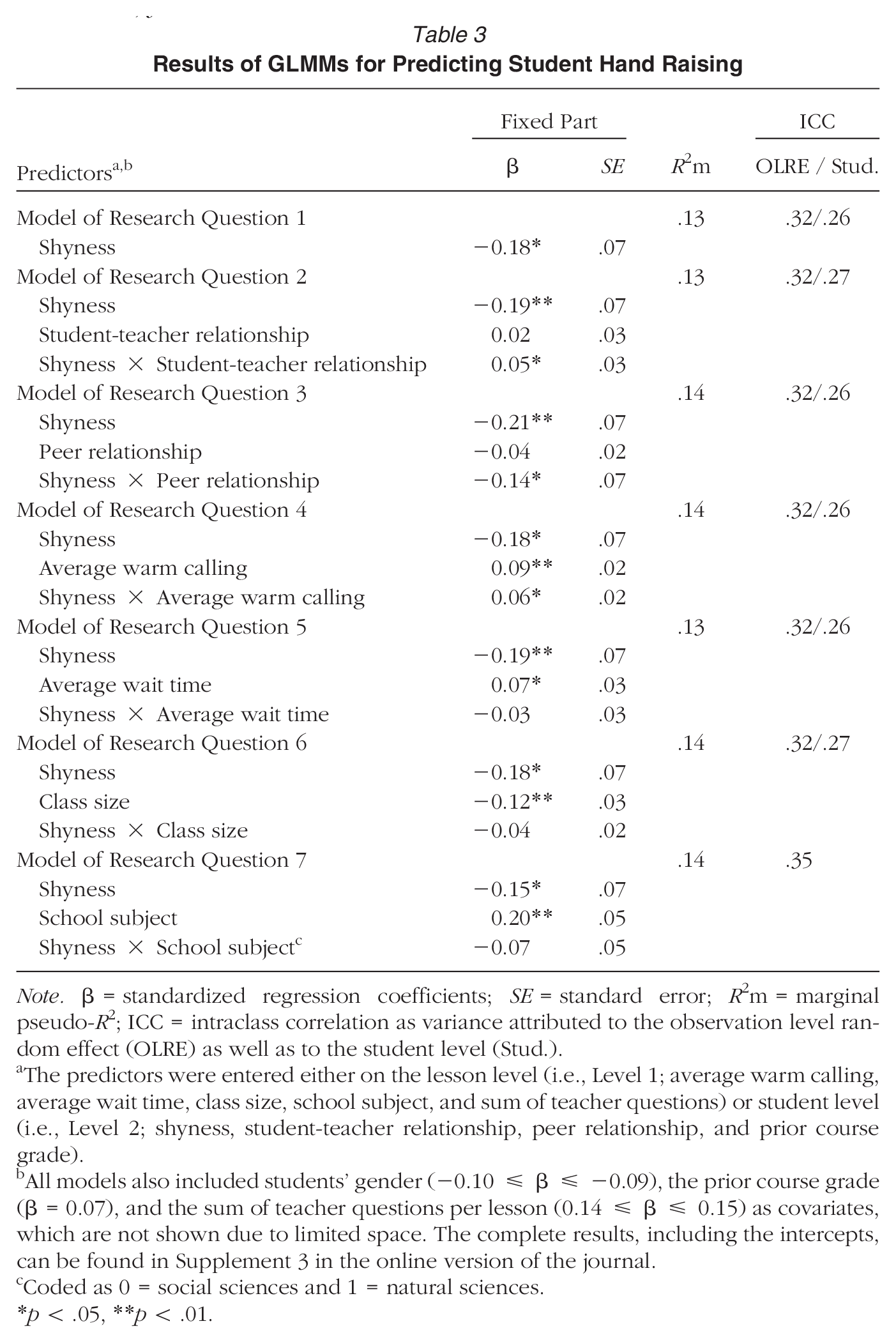
Note. β = standardized regression coefficients; SE = standard error; R2m = marginal pseudo-R2; ICC = intraclass correlation as variance attributed to the observation level random effect (OLRE) as well as to the student level (Stud.).
The predictors were entered either on the lesson level (i.e., Level 1; average warm calling, average wait time, class size, school subject, and sum of teacher questions) or student level (i.e., Level 2; shyness, student-teacher relationship, peer relationship, and prior course grade).
All models also included students’ gender (−0.10 ≤ β ≤ −0.09), the prior course grade (β = 0.07), and the sum of teacher questions per lesson (0.14 ≤ β ≤ 0.15) as covariates, which are not shown due to limited space. The complete results, including the intercepts, can be found in Supplement 3 in the online version of the journal.
Coded as 0 = social sciences and 1 = natural sciences.
p < .05, **p < .01.
To test the influence of the six potential facilitative factors on hand raising of students with higher levels of shyness, we calculated six additional GLMMs in which we regressed trait shyness, each potential factor, and its interaction with trait shyness on hand raising per lesson while we controlled for student gender, prior course grades, and sum of teacher questions per lesson. Besides shyness, we found significant main effects for average warm calling, average wait time, class size, and school subject. More specifically, all students were more likely to raise their hands in natural science subjects, as well as the shorter the average wait time, the smaller the class size, and the more a teacher uses warm calling. On the contrary, the main effects of the student-teacher relationship and peer relationship failed to reach significance. 1
Furthermore, we found significant positive interaction effects of shyness with the student-teacher relationship and average warm calling, while we found a significant negative interaction effect of shyness with peer relationship. In addition, the interaction effects with average wait time, class size, and school subject failed significance. To facilitate interpretation of these effects, we have visually depicted all models using interaction as well as Johnson-Neyman plots (see Supplement 2 in the online version of the journal) and report below the estimates and p values at low (−1 SD) and high (+1 SD) values of each moderator in parentheses.
For low levels of student-teacher relationship, shyness was significantly negatively related to student hand raising (β = −0.14, p < .05); while for high levels of student-teacher relationship, the association slightly failed significance (β = −0.14, p = .05). By contrast, for low levels of peer relationship, shyness was not significantly related to student hand raising (β = −0.07, p = .43); while for high levels of peer relationship, shyness was significantly negatively related to student hand raising (β = −0.34, p < .01). For low levels of warm calling, shyness was significantly negatively related to student hand raising (β = −0.24, p < .01); while for high levels of warm calling, shyness was not related to student hand raising (β = −0.11, p = .10).
Discussion
A characteristic of shy students is their passive, silent behavior in classroom discussions. This causes them to miss important learning opportunities and may explain their poorer school attainments, even though they are no less intelligent (Crozier, 2020; Kalutskaya et al., 2015). Several contextual factors have been shown to support all students’ oral participation and its observable indicator, hand raising (see Böheim, 2020; Rocca, 2010, for overviews). This study went a step further by examining possible instructional and social-relatedness factors that may promote hand raising in sixth- and eighth-grade students with high levels of shyness (i.e., highly shy students). Therefore, the goal of the present study was to contribute to a deeper understanding of what supports highly shy students in their hand raising and, thus, open the gateway for them to participate orally in class.
In line with previous findings, shyness was negatively related to hand raising (Y. Chen et al., 2022; Hughes & Coplan, 2010). Talking and interacting with the teacher or classmates, asking questions, and contributing to classroom discussions are activities that affect shy students’ core characteristics. A student who contributes orally in class is not only listened to by all other students (Abdullah et al., 2012), but the quality of what he or she says is also often included as part of the final course grade (e.g., Krieger, 2003; Rogers, 2011). Thus, these phases are both particularly public and characterized by a high evaluative component, which is exactly what shy people fear the most (Coplan & Arbeau, 2008; Kalutskaya et al., 2015). As predicted in our process model (see Figure 1), the lower levels of hand raising in highly shy students indicate that these students have a tendency to feel anxious, insecure, and embarrassed in classroom situations and have thus responded with silence and passivity like in other research (e.g., Mundelsee & Jurkowski, 2021). In addition, our study also confirms previous findings that shyness is correlated with lower school performances (i.e., prior course grades) (see Evans, 2010, for a review). This highlights the importance of further investigating how to design the instruction and support the academic adjustments of highly shy students.
In search of conditions under which highly shy students raise their hands more often, the present study examined two social relatedness factors (i.e., student-teacher relationship and peer relationship) and four instructional factors (i.e., average warm calling, average wait time, class size, and school subject). These factors were selected from shyness literature as well as from literature on student in-class engagement and student hand raising, and we assumed that they were associated with hand raising in highly shy students. More specifically, for the first three factors (i.e., peer relationship, student-teacher relationship, and average warm calling), we hypothesized that they would reduce the anxiety, insecurity, and socio-evaluative concerns of highly shy students in classroom situations involving oral participation. Consequently, these factors were thought to increase highly shy students’ hand raising. For the second three factors (i.e., average wait time, class size, and school subject), the influence could have gone either way, so we tested their effects on hand raising in highly shy students exploratively. In addition, although it was not the primary focus of the study, it is worth looking at the main effects of the contextual factors on all students’ hand raising, given the paucity of studies to date that have examined student hand raising in relation to contextual factors.
We found positive interaction effects with shyness for student-teacher relationship and average warm calling as well as a negative interaction effect for peer relationship. In addition, we found positive main effects for average warm calling, average wait time, and school subject (higher levels of hand raising in natural sciences than in social sciences) as well as a negative effect for class size. In the following, these results are discussed in more detail.
Social Relatedness Factors
In line with our assumptions, the better the student-teacher relationship of highly shy students, the more likely they were to raise their hands. However, when analyzing this relationship more closely using the Johnson-Neyman method, we found that the positive effect on highly shy students weakens and tends to be no longer significant (p = .05) at high values (+1 SD) of student-teacher relationships. This extends previous research on the relationship between teachers and shy students, which has almost exclusively examined kindergarten- or preschool-aged children (see Kalutskaya et al., 2015, for an overview). Interestingly, this former research has also yielded double-edged results. On the one hand, close student-teacher relationships have been found to promote the academic adjustment of shy children (e.g., Birch & Ladd, 1997). On the other hand, shy children tend to develop more dependent relationships with their teachers (Arbeau et al., 2010), which puts them at risk of appearing to their peers as those who need the teacher’s support and limits their social interaction with peers (Arbeau et al., 2010). Our results suggest that the student-teacher relationship is also important for adolescent students with high levels of shyness and that it has a positive effect on their hand raising. But if the relationship is too positive, the beneficial effect weakens similarly to the results of Arbeau et al. (2010). We did not directly test why this was the case by assessing process data, but we can speculate about it based on our student-teacher relationship measure. For example, students with high levels in student-teacher relationship have rated their teachers as that they are fair to them and that they react calmly when they say the wrong answer. Thus, it can be assumed that an emotionally supportive student-teacher relationship increases safety in shy students and increases their intrinsic decision to raise their hand. However, the results also suggest that when teachers are perceived as highly fair and friendly, highly shy students are less likely to raise their hands. Perhaps these students assume that teachers accept them in their reticence and expect less oral participation from them. The findings complement those of Wu et al. (2022), who found that teacher-rated teacher-child closeness mediates the relationship between mother-rated shyness and teacher-rated general engagement in preschool, and extend them to hand raising, student-rated emotionally supportive student-teacher relationship, and the middle school setting.
The nonsignificant main effect for student-teacher relationship contradicts previous research (e.g., Dotterer & Lowe, 2011; Engels et al., 2016). However, this former research did not examine hand raising but behavioral engagement, which is a wider concept and includes many different student behaviors like doing homework and silent in-class behaviors (e.g., paying attention to class). Thus, in light of the present results, the student-teacher relationship may have a positive influence on non-shy students’ overall behavioral engagement, but not on their hand raising. More specifically, in contrast to other forms of behavioral engagement, hand raising is often integrated into the course grade (e.g., Krieger, 2003; Rogers, 2011). With this in mind, it can be assumed that raising one’s hand is generally viewed as more of an everyday classroom behavior that carries clear expectations for both teachers and students. Therefore, the student-teacher relationship may play less of a role for non-shy students. Taken together, the present findings suggest that while the student-teacher relationship does not facilitate student hand raising in all students, it does for highly shy students, at least as long as it is not too close.
In contrast to our expectations, for high values of peer relationship shyness was negatively associated with hand raising. At first sight, these findings also contradict previous research linking higher behavioral engagement in shy students to a better classroom climate (Hughes & Coplan, 2018). However, these authors used a measure of engagement that also included silent in-class activities such as reading, writing, and listening and not only hand raising as in our study. Still, the question remains, why do highly shy students raise their hands less when they are in classes with peers they like? One possible explanation comes from other studies investigating peer status and behavioral in-class engagement. As these studies show, a positive peer relationship reduces the risk of being excluded by peers (Spangler Avant et al., 2011), and students who are well-liked and popular in their class also engage less behaviorally (Engels et al., 2016). Schnitzler et al. (2021) argued that this may be particularly the case for silent students who may not want to stand out as overachievers and risk their positive peer status, making them less likely to raise their hands. Interesting in this regard is the concept of fear of positive evaluation (FPE). Research suggests that social anxious individuals and, possibly to a somewhat smaller degree, also shy people not only fear negative but also positive evaluations (Weeks, Heimberg, & Rodebaugh, 2008; Weeks, Heimberg, Rodebaugh, & Norton, 2008). More specifically, the concept proposes that shy people fear doing well because it might draw attention to them and bring them in direct competition with classmates who might be upset that they are “stealing their show.” Similarly and in terms of oral participation, Crozier (2020) argued that shy students may not only fear the consequences of public failure, but also the social costs of correct responses when participating orally (e.g., standing out as a nerd or geek). Thus, it is possible that highly shy students in classes with a positive peer relationship feel safe as they are accepted by their classmates in their role as quiet students, but they do not want to risk this status by participating orally. This relationship should be investigated in more detail in future studies to back up our findings.
Instructional Factors
In line with previous research on oral participation (see Rocca, 2010, for a review), average wait time was positively associated with hand raising for all students in the current study. Though we did not find an interaction effect between shyness and average wait time, it can be assumed that highly shy students benefit from this factor to a similar extent as their less shy peers. Notwithstanding, the absence of the interaction effect is partly in line with previous research. For instance, in another study, we found positive effects of an extra thinking phase prior to the teacher’s call of the first student on all students’ hand raising, but highly shy students did not particularly benefit from this instructional design (Mundelsee & Jurkowski, 2021). We attributed these results to a possible mediating effect of state anxiety. More specifically, the longer the wait time, the more highly shy students may ruminate on their initial thoughts and believe that teachers expect more detailed answers. As a result, this may increase their uncertainty about their answer, making them less likely to raise their hands. Given the present findings, it appears that there is no linear relationship between wait time and hand raising in highly shy students but perhaps a quadratic relationship explaining the nonsignificant interaction effect. For example, there might be a kind of “sweet spot” in the wait time for highly shy students, that is, a wait time that is not too long and not too short, which was not reached often enough in the present study. Or some shy children may respond very quickly to “get it over with” and tend to need short wait times, while other shy children may need more time to find the courage to raise their hands. Furthermore, this may also depend on other variables, such as the difficulty of the teacher question. In the future, an experimental study may investigate this hypothesis of a quadratic relationship.
Average warm calling was positively associated with hand raising in all students, which adds to the body of contradicting research on how warm and cold calling affect students’ oral participation. For example, while Dallimore et al. (2013) found that in classes with high levels of cold calling, students reported higher levels of oral participation, Auster and MacRone (1994) found higher levels of students’ self-reported oral participation in classes with professors who regularly use warm calling instead of cold calling. Importantly, these studies examined college students (Auster & MacRone, 1994) and university sophomore students (Dallimore et al., 2013) and assessed student participation frequency using student self-reports, the validity of which may be questioned when assessing behavioral engagement (Fredricks et al., 2019). Therefore, the differing results on the effects of warm calling may be partly attributed to the more direct measure used to assess hand raising in the present study as well as to the age group and learning environment studied, that is, middle school students. Students at this age have been found to be more self-conscious than younger or older students, and therefore more reluctant to reveal themselves to an audience (i.e., imaginary audience phenomenon; see, e.g., Elkind & Bowen, 1979; Ryan & Kuczkowski, 1994). As a result, it can be assumed that students in middle school are particularly afraid of cold calling and get passive when teachers use this calling strategy more often, while this effect could weaken or even disappear at elementary schools or at colleges and universities when students are considerably younger or older than in the present sample.
As the imaginary audience phenomenon is associated with social anxiety (K. M. Kelly et al., 2002) and social comparison as a key driver of shyness is a major concern for students particularly between fifth and eighth grades (Rubin et al., 2006), highly shy students at this age seem to be particularly negatively affected by cold calling, which is diametrically opposed to their desire not to be at the center of attention in classroom discussions (Levine & George, 1992; Mundelsee & Jurkowski, 2021). Moreover, as another recent study by the authors indicates, cold calling highly shy students would often not have the desired effect of getting them to give correct answers and thus gain self-confidence (Mundelsee & Jurkowski, 2024). More specifically, in this study, which had the same age group as in the present study, we found that highly shy students not only have problems with their oral participation, but also with their nonverbal attentiveness in class. In situations of class discussions, these students seem to divert their attention from relevant cues (e.g., a teacher question) to the anxiety stimulus (e.g., not to attract the attention of the teacher; Bilz, 2017; Downing et al., 2020), which then impairs their ability to concentrate (Shi & Tan, 2020). Cold calling would then often only expose these students as they are unable to answer the teacher’s question, which in turn might increase their reluctance to speak (Coplan & Rudasill, 2016). Consistently, it has been reported that the opposite strategy of warm calling is one of the most common methods used by teachers to reduce the anxiety of shy students (Archbell & Coplan, 2022; Nyborg et al., 2022). As we found a positive interaction between shyness and warm calling on student hand raising, our study is the first to empirically back up this strategy as a possibility to increase hand raising in students with high levels of shyness.
However, when inspecting this interaction more closely via the Johnson-Neyman method, we found that the positive effect of warm calling on highly shy students vanished for teachers with very high levels of warm calling. This indicates that highly shy students may benefit when teachers rarely use cold calling, but at the same time they may suffer when teachers only use warm calling. In this context, other authors have suggested that the teacher’s strategy of allowing highly shy students to remain silent during classroom discussions, and thus not cold calling them, may be temporarily beneficial, especially when the student is new in class or with an unfamiliar teacher (Nyborg et al., 2022). In the long term, however, this strategy “runs the risks of reinforcing the child’s reticence and having the child miss out on the positive feelings of self-confidence that can ensue from a contribution that is praised by the teacher or appreciated by peers” (Nyborg et al., 2022, p. 19). In light of the results of the present study, it therefore seems most promising for teachers not to force highly shy students to participate orally at first (Schnitzler et al., 2021; Shi & Tan, 2020). But once they have established a good relationship with them, it might be helpful for teachers to cold call them from time to time, for example, for simple questions where the teachers can be sure that the highly shy students know the answer, so that they can gain confidence in their answers and start raising their hands on their own. That being said, it may take several years to build up such a relationship of trust. In the study by Nyborg et al. (2022), for example, primary school teachers in Norway were interviewed, some of whom had taught the pupils for 7 years consecutively.
To avoid making our results even more complex, we looked at all the facilitative factors separately. However, another interesting explanation for the not consistently positive effect of cold calling on highly shy students emerges when we look at the bivariate correlations between average warm calling and student-teacher relationship. That is, warm calling correlates negatively with the student-teacher relationship, or in other words, students have a more negative relationship with teachers who use warm calling very often. Since we were able to demonstrate that a good student-teacher relationship is also important for the willingness of highly shy students to participate orally, there may have been an interaction effect of both individual effects. More specifically, it is possible that the positive effect of warm calling on the hand-raising frequency of highly shy students is not significant for teachers with particularly high levels of warm calling because these teachers do not (yet) have established good student-teacher relationships. These more complex relationships should thus be examined more closely in future studies. In particular, it should be investigated which teachers use cold calling and which do not, as this study is, to our knowledge, the first to reveal a correlation with teacher characteristics, but a detailed investigation was not within the scope of this study.
In terms of class size, we did not find any interaction effect with shyness on hand raising. We had speculated that this factor could influence hand raising in highly shy students in both directions. For highly shy students, it may be beneficial that smaller classes reduce the number of listeners and thus the public pressure to say something inappropriate (Abdullah et al., 2012; Smith, 1992). This should increase their hand raising. At the same time, smaller classes increase the likelihood of being called upon or required to participate, which may lead to increased levels of socio-evaluative concerns and self-consciousness for highly shy students. This should decrease their hand raising. Given the nonsignificant interaction, these two effects may have counteracted each other. However, as a recent study shows, there also appears to be a group size and group composition where the positive effects of a smaller number of listeners outweigh their negative effects for highly shy students. That is, when together in small groups of up to seven students and when with close friends, highly shy students were more likely to participate orally (J. Chen et al., 2021). Thus, there could be some sort of threshold for group or class size below which shy students participate more. This awaits further empirical inverstigation.
Moreover, in line with previous research on oral participation (see Rocca, 2010, for a review), class size was negatively associated with hand raising for all students in the current study. It has been argued in other research that smaller classes decrease the number of possible other hand raises, increasing the likelihood that a student with a raised hand will be called and motivating some to do so (Weaver & Qi, 2005). The same could be true for all students in the present study, and, as with average wait time, highly shy students should therefore benefit from smaller classes to the same extent as their less shy peers.
In terms of school subject, no interaction effect was found with shyness on student hand raising. However, the significant main effect of school subject on hand raising, which indicates higher levels of hand raising in natural science subjects than in social science subjects in all students, suggests that school subjects differed in some respects. In fact, when inspecting the correlations of school subject with other variables (see Table 2), it appears that teachers in the natural science subjects revealed better student-teacher relationships and waited longer after their questions. While the first factor was positively associated with hand raising in highly shy students in the present study, the second factor was positively associated with hand raising in all students and may explain the significant main effect. At the same time, teachers in natural science subjects used more cold calling, being a factor negatively associated with hand raising particularly in highly shy students. Therefore, it may be that the effects of student-teacher relationship and cold calling on highly shy students offset each other in different school subjects, resulting in a nonsignificant interaction. Moreover, it is also possible that other factors play a role that were not included in this study, such as the types of questions asked, the relation of subject content to everyday life, teacher characteristics (e.g., gender, age, and personality traits), or the role oral participation typically plays in these subjects (Grossman & Stodolsky, 1995; Rocca, 2010; Stodolsky, 1993). These factors could be investigated in the future regarding their moderating effect on highly shy students.
Limitations and Future Directions
The study is not without limitations. First, the proposed process model on which the present study is based assumes that the factors studied will reduce highly shy students’ state anxiety, self-consciousness, and socio-evaluative concerns and, thus, increase their hand raising (see Figure 1). However, the mediating effect of the mentioned emotions has not been tested in the present study and remains speculative. Given findings on reasons why highly shy students (do not) raise their hands (Mundelsee & Jurkowski, 2021), and against the background of some of the findings in the present study (e.g., the significant interaction effects of average warm calling and student-teacher relationship), it seems plausible that these emotions played a role in the present study and either increased or reduced highly shy students’ hand raising. However, it is difficult to validly assess affect during learning or instruction. To date, studies have almost exclusively used learner self-reports as a source of information, but their limited validity has been debated (Goetz et al., 2016; Moeller et al., 2018; Schneider et al., 2016). For hand-raising events, it would be particularly important to use measures that allow for immediate access to students’ spontaneous and especially involuntary emotional responses. The so-called ambulatory assessment offers a methodological solution to this problem by which subjective, skeleto-motor, and physiological components of emotional reactions can be recorded in situ (Bussmann et al., 2009; Wilhelm & Grossman, 2010). Therefore, future studies of shy students’ hand raising may incorporate such ambulatory assessments to fully test the proposed process model as well as some of the speculated interactions of behavioral, emotional, and cognitive engagement of highly shy students.
Second, students reported on their perspective of the student-teacher relationship. On the one hand, this poses a limit to this study’s results because students’ perspectives could be skewed. In particular, according to research on social information processing (Crick & Dodge, 1994; Dodge & Crick, 1990), highly shy students’ perception of the student-teacher relationship might be biased due to their insecurity in social interactions. On the other hand, research shows that students’ perspectives overlap with observational data and teachers’ perspectives on the teacher-student relationship (Donker et al., 2021). Furthermore, students’ ratings of the teaching quality have been shown to be associated with their engagement, interest, and achievement in school (Fauth et al., 2014; Quin, 2017). For the link between teachers’ emotional support and the peer ecology in class, student ratings are even more relevant than observational data or teachers’ reports for students in general (Hendrickx et al., 2016), and also for highly shy students (M. Chen et al., 2021). Therefore, the students’ perspective seems to be most relevant for student behavior in class, including their oral participation.
Third, while we found medium to large effect sizes of the variance attributed to all fixed effects in the models, the single regression weights were rather small. This may be partly due to the fact that the measures in the present study derived from three different sources (i.e., student self-reports, classroom observations, and behavioral measurements). Thus, the measures do not share common method variance, and the effect sizes might be smaller (Podsakoff et al., 2003). Nevertheless, although the regression weights are at levels similar to those found in other hand-raising studies (see, e.g., Böheim, Knogler, et al., 2020; Böheim, Urdan, et al., 2020), we do not want to conceal the fact that some of the effects are only marginally statistically significant and may thus not be very robust. Therefore, we have reported standardized regression coefficients and effect sizes. In addition, we have created the Johnson-Neyman plots to facilitate the interpretation of the significance ranges, and we discussed our results with caution wherever the results are closer to the significance threshold. Nevertheless, replication studies would be needed to confirm the effects and, for example, to shed further light on the complex dynamics discussed between student-teacher relationships and cold calling.
Fourth, the chosen sample of this study limits the generalizability of the findings. We observed the classrooms for 1 school week, which is significantly longer than many other studies that only examine one or two school lessons. However, a more comprehensive longitudinal study would be required to analyze whether the effects found can also be confirmed over the course of one or more school years. Moreover, while in Western, individualistic contexts, shyness tends to be viewed as an unfavorable, maladaptive trait; Eastern, collectivistic countries view shyness as a positive, adaptive characteristic (M. Chen et al., 2019; Nurmi, 2012). In addition, oral participation is handled differently in Asian countries; for example, it is uncommon to question what teachers or classmates say or to ask questions on one’s own (Crosthwaite et al., 2015). Furthermore, as discussed, the age group studied could also play a role, particularly regarding the effects of warm and cold calling. Therefore, it will be interesting whether future research in other samples (e.g., other cultures and age groups) and over a longer period of time will yield similar results.
Conclusions
This study draws on empirical evidence on the importance of student oral participation and hand raising for learning and academic achievement, as well as the negative effects of highly shy students’ low oral participation. While previous research used teacher interviews to determine possible strategies to enhance highly shy students’ oral participation (Bosacki et al., 2014; Nyborg et al., 2020), the present study extends this research by examining the students themselves and six possible contextual factors that may enhance student hand raising. It thus contributes to filling the existing research gap on shyness and its relationship to in-class participation as an important learning variable in particular (Crozier, 2020).
The results show that highly shy students are more likely to show their willingness to participate orally when they have a good student-teacher relationship and when their teachers rarely use cold calling, while they are less likely to raise their hands, the better their peer relationships (i.e., interaction effects). Moreover, like all students in the present study, they may benefit from a longer wait time after teacher questions and smaller class sizes (i.e., main effects). Thus, the results suggest that there are both social relatedness and instructional factors that promote hand raising in highly shy students, opening the gateway to their oral participation.
Supplemental Material
sj-pdf-1-aer-10.3102_00028312241278585 – Supplemental material for Opening the Gateway to Oral Participation: Exploring Facilitative Contextual Factors in the Association Between Student Shyness and Hand Raising
Supplemental material, sj-pdf-1-aer-10.3102_00028312241278585 for Opening the Gateway to Oral Participation: Exploring Facilitative Contextual Factors in the Association Between Student Shyness and Hand Raising by Lukas Mundelsee and Susanne Jurkowski in American Educational Research Journal
Supplemental Material
sj-pdf-2-aer-10.3102_00028312241278585 – Supplemental material for Opening the Gateway to Oral Participation: Exploring Facilitative Contextual Factors in the Association Between Student Shyness and Hand Raising
Supplemental material, sj-pdf-2-aer-10.3102_00028312241278585 for Opening the Gateway to Oral Participation: Exploring Facilitative Contextual Factors in the Association Between Student Shyness and Hand Raising by Lukas Mundelsee and Susanne Jurkowski in American Educational Research Journal
Supplemental Material
sj-pdf-3-aer-10.3102_00028312241278585 – Supplemental material for Opening the Gateway to Oral Participation: Exploring Facilitative Contextual Factors in the Association Between Student Shyness and Hand Raising
Supplemental material, sj-pdf-3-aer-10.3102_00028312241278585 for Opening the Gateway to Oral Participation: Exploring Facilitative Contextual Factors in the Association Between Student Shyness and Hand Raising by Lukas Mundelsee and Susanne Jurkowski in American Educational Research Journal
Footnotes

Notes
L
S
References
Supplementary Material
Please find the following supplemental material available below.
For Open Access articles published under a Creative Commons License, all supplemental material carries the same license as the article it is associated with.
For non-Open Access articles published, all supplemental material carries a non-exclusive license, and permission requests for re-use of supplemental material or any part of supplemental material shall be sent directly to the copyright owner as specified in the copyright notice associated with the article.
