




Abstract
The purpose of this article is to raise awareness of how the varied form and responsive and response-able use of teacher questions can invite and direct not only more student talk in classrooms but elicit specific and varied features of student talk that enhance comprehension building and provide evidence of student engagement and high-level thinking. I examine one teacher’s questioning patterns and their relationship with types of student talk and learning in an elementary English language learning (ELL) classroom. I focus on two lessons, purposefully selected for differing student talk outcomes. I present a comparative look at descriptive statistics detailing teacher questioning patterning (in terms of typology, contingency, convergence-divergence, textual, extra-textual). I then illustrate how patterns of teacher questioning influence student talk and learning across these two lessons through close discourse analysis of representative classroom talk excerpts. I show how this teacher’s questions are varied in form but consistently contingent on and responsive to students’ talk contributions, even though in one lesson students struggle to make sense of surface meaning in the focal text and in the other lesson, students easily relate to the focal text. This teacher’s willingness to listen, and wield questioning to follow and selectively support student ideas, purposes, and lines of reasoning, supports dialogic talk for thinking and learning. Student talk for thinking and learning is present, but looks different, in both lessons.
If we can change the quality of classroom talk we can change the quality of education.
From theory, research, and anecdotal experience, we know talk mediates learning. We know that teacher talk shapes types of talk that occur in a classroom. Furthermore, kinds of classroom talk students experience shape type, scope, and quality of learning likely to occur. Understanding ways types of student talk mediate learning of language and content, and ways teachers can invite and support student contributions are of central importance to English language learning (ELL) communities (Blackledge & Creese, 2009; Boyd, 2012a; Boyd & Kong; 2015; Boyd & Maloof, 2000; Echevarria, Short, & Powers, 2006; Haneda & Wells, 2008, 2010; Johnson, 2006; Rubin & Kang, 2008; Vaish, 2013; Valdés, 2004; Verplaetse, 2000). Student talk in the target language, as an individual contribution of comprehensible output (Swain, 1995) and as collaborative dialogic interaction (Haneda & Wells, 2008; Pica, 1994; Purdy, 2008), develops discursive, communicative, and academic competencies. If students articulate their best guess responses, elaborate thinking, and reason together, then talk performs a metalinguistic function for students, provides necessary feedback for teachers to guide student learning, and adds to the learning collective.
This study examines relations between teacher and student talk and attendant teaching and learning in one fourth- and fifth-grade ELL pull-out classroom. It is grounded in a dialogically organized approach to teaching and learning (Alexander, 2008; Aukerman, 2007; Haneda & Wells, 2008; Nystrand, Gamoran, Kachur, & Prendergast, 1997; Van der Linden & Renshaw, 2004; Wells, 2001), which values teachers who listen to and make space for student understandings and then rigorously engage them as they draw out and from students’ knowledge and language. These practices are not limited to mainstream classrooms, but little research on dialogic teaching and learning has been published on ELL classrooms and, as Valdés (2004) notes, there needs to be conversation across educational fields of studies. This ELL study focuses on the teacher’s most used and arguably most powerful discourse move, the teacher question, as it elucidates how it is not only simply what the teacher says that directly affects student learning but also how learning scope is mediated through teacher patterns of questioning. How, what, when, and to whom questions are wielded indicate instructional stance, pedagogical expertise, and attentiveness to students (Boyd, 2012b; Boyd & Rubin, 2006; Gutierrez, 1993; Lee, 2007; Purdy, 2008). This article sheds light on dialogic interaction patterns in an ELL classroom and how they are instantiated as I home in on, and challenge the hardy notion that wielding a particular form of teacher question (e.g., open or closed questions) necessarily engenders particular student talk outcomes or automatically expresses a monologic or dialogic instructional stance. In this study, a dialogic stance is characterized by a teacher’s willingness to listen, follow, and selectively support student ideas, purposes, and lines of reasoning; it is instantiated through the varied form and contingent use of teacher questions and not tied to the use of a particular form of question. Dialogic questions are designed to bring out strengths in their students’ classroom talk, to engender coherence across their experiences, and to connect student contributions to particular educational and pedagogical activities.
In ELL classrooms, as in all classrooms, the teacher’s discursive move of choice is the question. Mohr and Mohr (2007) report elementary classrooms with 100 teacher questions an hour and Juzwik, Nystrand, Kelly, and Sherry (2008) report an average of 60 questions per hour in their middle school literature study (and an average 70 questions per hour in the larger corpus). The ubiquitous teacher question functions to explicitly cue expectations for student responses and because classroom norms presume students’ complicity, their uses signify and regulate what it means to be a student, a learner in a particular classroom community. Although a teacher question can guide, push, or squelch student reasoning and articulation as it mediates the flow and substance of classroom learning through talk, it does not stand alone. It is both received and responded to as part of an interaction and understood and heeded in light of expected patterns of interactions (Boyd & Markarian, 2011, 2015). Patterns of teacher questions (recurring forms, functions, contingency, and relations between them) cue which types of knowledge and student responses are valued and expected, and a student hears and heeds a teacher’s question in light of sociohistoric patterns and expectations. Examining teachers’ questioning across time sheds light not just on immediate pedagogical goals but also on instructional stance to learning as questions regulate access to the floor, the scope of talk, and whose intentions are valued and explored. This can be illustrated in classroom learning related to texts. In transacting meaning with text, a reader/listener applies linguistic, personal, and world knowledge to understand information both explicitly presented and implicitly inferred. Teacher questions can support deep and active meaning making processes as they focus on linguistic information such as vocabulary and syntax and support and direct inferential reasoning and problem solving (Boyd & Kneller, 2009; Florit, Roch, & Levorato, 2011; Purdy, 2008). However, in addition to checking for understanding and creating common vocabulary, questions also simultaneously allow (or squelch) a personal, agentive response as speakers do something unique, something personal with what they learn. The linguistic competencies needed for personalizing and elaborating are targeted sought after learning outcomes in an ELL classroom, and teachers’ questioning patterns govern the direction and degree to which these competencies grow.
For this study, I purposefully selected two pull-out ELL lessons from a 6-week literature-based instructional unit. The focal lessons are outliers in terms of production of a particular type of student talk: the student critical turn (SCT; Boyd & Rubin, 2002, 2006). SCTs are linguistically extended, socially engaged, and structurally coherent turns of student talk. As such, SCTs are markers of individual cognitive activity and of sought after student contributions to the classroom collective. Using this marker as the dimension to select outliers allows me to consider lessons with differing amounts of student talk and to unpack patterns of talk therein. The selection of lessons representing two different kinds of classroom interaction, both important, offers opportunity to identify, situate, and contrast teacher questioning patterns and resultant ELL student talk in this deliberately constructed dichotomy of teaching and learning repertoire. This comparative look does not suggest that one type of student talk is superior to the other or that one questioning pattern promotes more learning. Rather, it points to the range and interdependence of teacher questions, and their relationships with kinds of student talk and different pedagogical activities relevant in relation to choice of participants’ communicative behavior. Specifically, these two lessons illustrate ELL classroom talk when focal texts were difficult for students to make sense with and there were few elaborated contributions and when focal texts were easy to understand and connect with and students made elaborated contributions. The relations among types of student talk and teacher questions were examined. Teacher questions were coded in terms of open and closed form, contingency on previous contributions, and divergent and convergent directedness. The research question that guides this study is as follows:
Teacher Questioning and Student Learning
A key indicator of classroom learning intentions and expectations is the teacher question. Although materials, tasks, and abilities shape learning experiences, expectations for student performance are routinely signaled and instantiated by patterns and kinds of teacher questions. Relationships between teacher questioning and student learning are long and complex (Applebee, Langer, Nystrand, & Gamoran, 2003; Burbules, 1993; Dillon, 1982; Mehan, 1979; Mohr & Mohr, 2007; Nystrand, 2006; Nystrand, Wu, Gamoran, Zeiser, & Long, 2003; Purdy, 2008; Wells, 1993). Questioning is a teacher’s most used, and arguably most powerful, talk move. Questions serve to regulate and direct the immediate scope of classroom talk, to open up or shut down student contributions, and to support student comprehension or stunt student inquiry. Teacher’s use of particular question patterns prompts and instantiates particular kinds of student talk (e.g., recitation, inquiry). Questions have traditionally been classified by their form. For example, authentic, genuine, or open questions portray teachers’ inquiry and invite more than one answer. Display, test, or closed questions with expected responses are asked so the teacher can assess students’ learning. This useful typology addresses whether the questioner is inviting multiple divergent possibilities of response. Mostly, research findings valorize authentic questions and vindicate display questions, but this should not automatically be the case. Authentic or open teacher questions are associated with increased student talk as they invite a wider range of responses, including what students think, feel, and know and have become associated with high-level reading comprehension (Elizabeth, Anderson, Snow, & Selman, 2012; Juzwik, Borsheim-Black, Caughlan, & Heintz, 2014; Nystrand, 2006) and language learning (Haneda & Wells, 2008; Mohr & Mohr, 2007). However, teacher display questions are disparaged as typically producing short, choppy exchanges such as “filling in the blanks” of a teacher’s predetermined answer and are tightly associated with default norms of classroom discourse, the IRE or IRF (teacher initiation, student response, teacher evaluation or follow-up; see seminal works: Cazden, 2001; Mehan, 1979; Nystrand et al., 1997; Wells, 1993), and the convergent nature of questioning (Burbules, 1993; Dillon, 1984) in pursuit of the questioner’s agenda. Open questions invite students to take class talk in new directions and are necessary markers of collaborative learning. However, sometimes an open question alone is not enough (Beck & McKeown, 2001; Purdy, 2008), and students need support of closed questions to guide further articulation. Leading closed questions can beckon new understanding especially if contingent on previous contributions and in service of shared understanding (Boyd, 2016a; Boyd & Rubin, 2006).
To be sure, if an ELL teacher asks questions to enact a script that limits student talk to recitation or predetermined talking points with predetermined outcomes, learners are less likely to explore expressive and critical response and less likely to develop discursive, social, and academic competencies. However, if an ELL teacher’s questions do not ensure that students can construct at least surface meaning of a text, then students forgo a necessary foundation to further connect their responses and understandings. As this study illustrates, there are times in classrooms when participants grapple with meaning, focusing only on what is right at hand, and times when talk easily reaches across ideas, experiences, and texts. In both scenarios, the teacher question can be the responsive tool of the thoughtfully adaptive ELL teacher as it functions to contingently direct, build on, and invite dialogic inquiry and student exploratory talk. The function and contingency of the question, rather than form, shape the scope and degree of dialogism of the talk. Consequently, this study considers relations between teacher questioning and student talk in one elementary ELL classroom, and question codings are considered within context of patterns of questioning and local discourse conditions.
When a teacher focused on dialogic teaching wields questions, its power lies less in initial questions (the first move of the default IRE/IRF instructional move—teacher Initiation, student Response, and teacher Evaluation/Follow-up) than the contingency of the follow-up third move and attendant sociohistoric patterns of questioning. This is demonstrated in both first language (Boyd, 2016a; Collins, 1982; Myhill, 2006; Nystrand et al., 1997; Wells, 1993) and second language classrooms (Boyd, 2012b; Boyd & Rubin, 2006; Haneda & Wells, 2008; Lee, 2006, 2007; Purdy, 2008). Indeed, much research on questioning has been conducted in mainstream classrooms, and this study attempts to bring this research in conversation with L2 classroom research.
Teacher’s talk provides “a cumulative, continuing contextual frame to enable students’ involvement with the new knowledge they are encountering” (Mercer, 2008a, p. 37), and teacher talk is delineated, in large part, by the contingent, convergent, or divergent nature of teacher questioning and how such questions are delivered and received. Questioning patterns in concert with discourse features such as turn-taking, time holding the floor, and uptake are markers of instructional stance: the underlying ontological and epistemological view a teacher has toward her teaching and learning (Blackledge & Creese, 2009; Chinn, Anderson, & Waggoner, 2001; Gutierrez, 1993; Johnson, 2006). Patterns of teacher questioning signify the degree to which student talk is valued through its responsiveness to and support for student talk. For example, students recognize a teacher who asks authentic or open questions but never follows up with either a contingent question or comment that extends, deepens, or challenges student responses. They are aware of this pattern and its significance, as they decide whether to explore or elaborate on an idea. Students also recognize when a teacher, who routinely builds on student contributions, poses a series of closed display questions to create a groundwork of knowing to further students’ elaborated turns of talk. Students might then perceive display questions as supportive rather than dismissive of student reasoning. That is because students respond to how they perceive the function of the question to be, and that perception is shaped in response to and in anticipation of teacher question patterning. In other words, students hear and heed according to their classroom community discourse norms (and degree to which instructional stance is dialogic) in addition to the syntax of the actual question (see Bakhtin, 1981; Boyd & Markarian, 2011, 2015). Because teachers and students propose, hear, heed, and respond to specific interactions in light of what they have come to expect, if we make patterns of talk within a class transparent across lessons, we can better understand the local sociohistoric context. This study of sociocultural discourse analysis of two outlier lessons in fourth- and fifth-grade ELL classrooms does exactly that. Furthermore, it extends ELL research on relations between teacher questions and learning as it considers how structures of questions function in varied ways to support different student talk outcomes. For example, a closed or display question can prompt recitation, remind students, or imply answers in the moment. But, if it is part of a questioning spell (Nystrand et al., 2003) that engenders speculation and hypothesis making, that same closed question could further exploration and articulation of reasoning. Only by considering context and attendant discourse can we understand how questions function to be supportive or corrective (Burns & Myhill, 2004; Turnstall & Gipps, 1996) and result in student elaboration or shut down. By considering questions and question patterning in light of their function in a particular context (as in this study), we look beyond notions of good or bad types of questions based on syntax or a single occurrence and better understand how teacher questioning can promote shared understanding and coherence across time or disrupt student thinking and knowing to impose disjointed displays of information (Boyd, 2016a; Boyd & Markarian, 2011). We can better understand how teacher questions can engender dialogically organized classroom talk practices that grow ELL students’ discursive, social, and academic competencies.
Student Talk and Student Learning
The important role of student talk to build and make visible language learning (Haneda & Wells, 2008; Lantolf, 2002; Swain, 1995), mediate reasoning and academic competencies (Boyd, 2012a; Mohr & Mohr, 2007; Purdy, 2008; Valdés, 2004), nurture engagement, and inform identity (Boyd & Maloof, 2000; Gutierrez, 1993; Johnson, 2006) has been well documented in ELL classrooms. Classroom research calls for not just more classroom student talk but also for varied kinds of student talk as learners talk to understand, reason, share, elaborate, and perform what they know across different pedagogical activities.
Although student talk can build and make visible communicative competence, substantive engagement, cognitive thinking, and high levels of comprehension, such talk in the classroom does not happen by itself. Nor can it be imposed or assumed. It is a gradual building up of knowledge, confidence, expertise, and trust and requires contextual anchoring; rich student talk occurs when the context is supportive, conversants are attentive, material is engaging, and student dialogue is supported (Boyd & Galda, 2011). For dialogue and discussion to occur, teacher and students must listen and build on each other’s contributions. Even this does not automatically yield coherent elaborated student contributions such as SCTs: extended student utterances that are structurally coherent and have evidence of substantive engagement and are the criteria for outlier lesson status in this instructional unit. There is a need for exploratory talk, for students to “try out ideas, to hear how they sound, to see what others make of them, to arrange information and ideas into different patterns” (Barnes, 2008, p. 5). Student exploratory talk provides feedback on the learning process for students as they negotiate talk interactions and understanding of content (Swain, 1995) and includes hesitant and incomplete reasoning exchanges (as students risk thinking aloud together) that do not necessarily result in elaborated contributions. Student talk also provides necessary data to which teachers can respond both in the moment through classroom talk and in their lesson planning (Boyd, 2012b). If teachers want to perpetuate purposeful and dialogically organized instructional practices then ongoing student talk should inform instructional decisions, including questions that function to prompt and nurture substantial and relevant inquiry and elaboration and accountability to reasoning, content, and community (Michaels, O’Connor, Sohmer, & Resnick, 2009). Furthermore, teacher contingent questions should be asked in response-able ways (Boyd, 2016b; Rubin, 1990).
Method
Mercer (2008a) argues for a sociocultural discourse analysis of classroom talk patterns to consider “the role of long term constancies and how they constrain, afford and intrude into moment by moment activity” (p. 38). When we consider patterns of talk across time, we have insight into how patterns may predispose students to heed talk in particular ways. This is necessary because
Methods for analyzing discourse in which the analyst simply attends to the relationships between contributions made by participants in one recorded conversation, without applying available information about previous related interactions and historically contextual knowledge shared by participants . . . will not work. The use of coding schemes in which utterances with the same syntactic form and/or explicit content are taken to have the same pragmatic or semantic value, regardless of their location in the temporal sequence of communication, is also inappropriate. (Mercer, 2008a, p. 56)
In this sociocultural discourse analysis, I examine two lessons (with similar lesson plans and from the same 6-week instructional unit) taught at different times by the same teacher to the same participants. Lessons were selected for their differing student talk outcomes. This comparative analysis of patterning of questions and their relationships with student talk across both lessons is contextualized within a larger data bank. This study is ethnographic (the big picture gives weight to the micro analysis), qualitative (focusing on the relationship between particular interactions which occur at different times in the data), and quantitative (utilizing descriptive statistics on types and functions of questions and comparing their incidence in data subsets). I present extended exchanges illustrating discourse features working together to represent discourse as both emergent and predictable, and to unpack teachers’ in the moment linguistic choices (such as questions, uptake) in light of sociohistorical patterns of talk, and related varied opportunities and supports for student learning.
Context for Study
This research takes place in a public elementary school in the southeastern United States. The six students (four boys and two girls) in this fourth- and fifth-grade pull-out ELL class were from China, Pakistan, and Mexico. These students knew each other well; five of them had been in ELL class together with this teacher for nearly 2 years. There were two sets of siblings (PD and Lucy; Zach and Rosey; all names are student-selected pseudonyms), and the two girls were best friends. Student family backgrounds ranged from parents not being able to read or write in any language to parents going to graduate school and studying in their second (or third) language, English. Only three students considered themselves able to read and write fluently in their first language. Each student had been studying English for at least a year and could communicate ideas and thoughts in English.
Students received 50 min “pull-out” ELL instruction daily from Ms. Charlotte, an experienced ELL teacher bilingual in English and Spanish. Lessons were of similar length; any variability was because students arrived early or had to be shepherded to lunch. Despite district policy, students were encouraged to use their first language if needed, but this rarely occurred during this instructional unit at the end of the school year. The ELL classroom was shared with a reading specialist and her students. Curriculum was articulated through instructional units, and content and structure for each lesson were planned using purposefully selected literature. Literature talk provided opportunities for students to learn content and explore ideas as they practiced English: real talk in real situations for relevant purposes (Boyd & Galda, 2011). Furthermore, the instructional unit on whales aligned with the mainstream fifth-grade curriculum. The typical lesson format was such that Ms. Charlotte read a picture book and implemented a talk focused literacy activity (e.g., constructing a collaborative graphic organizer such as a KWL chart (what students
Data Collection
I spent almost a year observing this ELL pull-out class, initially once a week, then daily before and during the 6-week unit from which the two lessons are drawn. My extended entrée included audio and video taping lessons prior to intensive data collection so students would become used to the camera. I audio and videotaped each lesson and a corresponding daily informal interview and lunch debriefing with the teacher.
Data Bank
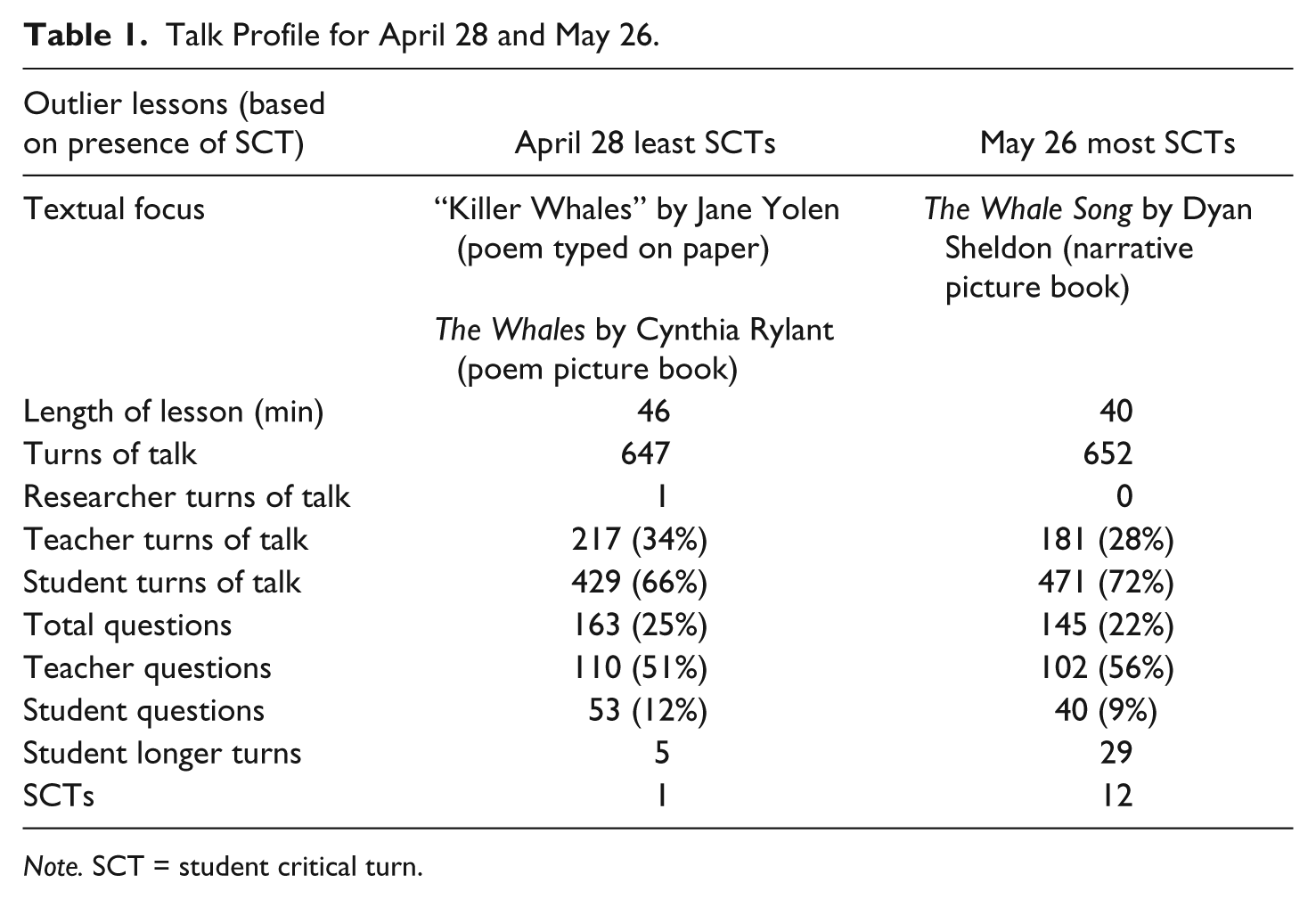
The data bank for this study was an intact 6-week literature-based instructional unit on whales gathered toward the end of the school year when classroom norms had been established. Although 6 weeks of data were collected, only the 14 days when all students were present were analyzed. This data set is 10.5 hr of video and audiotaped classroom talk practices, 3.5 hr of teacher interviews, teacher lesson plans, and charts, student artifacts, field notes, and analytic memos. Before transcribing, I profiled the larger data set in two ways: (a) narrative lesson profiles noting content of lessons (e.g., literature focus, task, grouping) and observed talk patterns (e.g., scope of talk: about text, home experiences) and (b) identifying all student turns of talk that were 7 s or more, imposing topical episodes, and transcribing this talk, determining if student turns were SCTs. These contextual profiles informed my purposeful selection of both lessons for transcription and contrastive analysis. After transcriptions, I generated descriptive statistics and tables to represent explicit markers in this systematic and comprehensive look at longer turns of student talk (e.g., see Table 1 for frequency of teacher and student turns of talk, questions, SCTs) in a succinct manner across a larger data set.
Talk Profile for April 28 and May 26.
Note. SCT = student critical turn.
Selection of lessons for contrastive analysis
These two focal lessons were selected because my previous analysis revealed these two lessons to be outliers in terms of incidence of SCTs.
Coding for SCTs in the larger data set
The criterion positioning these two lessons as outliers is the SCT. An SCT is at least 10 seconds of uninterrupted student talk (uninterrupted/unacknowledged interruption by teacher or student). Relative to typical student utterances in classrooms, SCTs are quite lengthy, nearly twice as long as a typical conversational turn for first language speakers. Although Scardamalia and Bereiter (1992) posit seven words as a typical turn of talk (TOT) for fourth and fifth graders, Van den Branden (2000) reports an average student response of 5 seconds and typically three words or fewer. However, long utterances were not uncommon in this focal classroom. In this data bank of 14 lessons, there were 156 student utterances (range of 3-29 in a lesson) that were 10 seconds or more in length. To qualify as an SCT, these utterances had to be classified as coherent and contain evidence of substantive engagement. The coherence criterion means that the utterance makes sense within the episode (Carrell, 1982); it is not merely some idiosyncratic interpolation. The substantive engagement criterion, adapted from Nystrand, Gamoran, and Heck (1992; Nystrand et al., 1997) means that evidence of uptake by another class member was apparent. To assess these characteristics, I established ipso facto boundaries for the topical episodes of which longer turns of talk (>10 s) were a part. Longer turns of talk that initiated an episode were discounted (as a first TOT, it could not be building on talk within the episode), and 52 longer turns of student talk across the 14 lessons were classified as SCTs. Using Scott’s pi, inter-coder reliability was indexed by more than 90% agreement between four analysts at each stage (see Boyd & Rubin, 2002). Analysis of SCTs and local conditions engendering them revealed a particular finding for the teacher talk: her extensive use of contingent questioning, questions that build on, extend, or respond to previous contributions within three preceding student utterances (Boyd & Rubin, 2006). The notable pattern across her questioning was not whether they were closed/display or open/authentic, but rather, the regularity with which her questions were contingent on prior student contributions. This pattern of contingent questioning often yielded an SCT.
All data examined in earlier analyses which yielded information regarding the teacher’s efficacious pattern of questioning (with respect to engendering SCTs) were selected post hoc and were marked by presence of an extended student turn. Previous findings therefore focused on local discourse conditions that engender SCTs. That earlier analysis never called for examination of intact lessons. This study broadens the focus of analysis to examine both outlier lessons entirely, the lesson with the least and the most SCTs in the 14 days when all six students were present in this 6-week literature-based instructional unit on whales. By examining the lessons in their entirety, not just topically defined episodes with SCTs, I can discern interactional dynamics that inhibited SCTs, as well as those that fomented them. The purposeful selection of lessons with the least and most number of SCTs (1 and 12, respectively) enables this contrastive analysis and provides a way to show teacher questioning and accompanying interactions (elaborated and brief student utterances) along a continuum of teaching and learning practices in this classroom. Through this contrastive analysis, I unpack dimensions of questions and prototypical features and their relation to kinds of student talk illuminating a range of talk practices. Taken together, these lessons provide understanding of teaching and language use at particular moments in time. However, seen in conversation with the instructional unit, they illustrate how features work together and hint at productivity and more balanced lessons (in terms of kinds of student talk) within the continuum they delineate.
These data (see Table 1) show in both lessons students talking but in different ways. Although class schedules ensure these lessons are similar in length, they were also similar in total turns of talk (April 28: 647; May 26: 652) and, contrary to most classrooms, students dominated the talk in terms of time on floor and scope of talk (as determined by number of student turns of talk: April 28: 66%; May 26: 72%). Yet, these lessons differed in number of student extended utterances and SCTs. On April 28, there were five long student utterances (>10 s) one of which met the tripartite criteria (length, substantive engagement, coherence) associated with SCTs. The May 26 lesson produced 29 long turns of student talk, 12 meeting SCT criteria. A simple tally of number of questions does not explain these different student talk outcomes. These lessons were similar in terms of total questions (April 28: 163; May 26: 145) and number of teacher questions (April 28: 110; May 26: 102) and student questions (April 28: 53; May 26: 40).
Context for Focal Lessons
Each lesson was structured around a teacher selected shared read aloud about whales. In both classes, students sat with Ms. Charlotte at a kidney shaped table and talked together for the entire lesson.
April 28: The lesson with the least SCTs
The teacher’s expressed purpose for this lesson was to present two poems to support differing perspectives of whales as hunters and nurturers. Ms. Charlotte typed one poem, “Killer Whales” by Jane Yolen (1996) and selected a computer generated illustration to adorn the poem. This illustration was not of a killer whale, and students informed her of this. The other text was a poem in picture book format, The Whales by Cynthia Rylant (1996). Three quarters (76%) of class time was spent on “Killer Whales.” Much of the talk was instructional in nature as students grappled to make sense of the poem narrative. They had problems figuring out referents for pronouns, and Ms. Charlotte supported their struggle rather than ending it by providing answers (see Boyd, 2012b). Student utterances were consistently short, though their intentions for work to be done around text (expressed through student questions and by their lack of uptake on particular teacher questions) determined the scope of talk.
May 26: The lesson with the most SCTs
Ms. Charlotte shared that The Whale Song by Dyan Sheldon (1991) was selected to further develop content knowledge about whales and their relationship to mankind (essential question; McTighe & Wiggins, 2004 for this unit). The story revolves around whether a young girl, Lily, heard a whale calling her name or whether it was her imaginings after listening to her grandmother’s tales of whales. Students easily made meaning and less than a minute was spent explicating the meaning after reading. Classroom talk was inspired by the text as opposed to about the text as Ms. Charlotte explicitly invited students’ opinions and experiential narratives.
On completing the lengthy process of transcribing classroom talk in these lessons and becoming deeply familiar with the data, a first level of analysis (Rymes, 2009), it was apparent that the degree to which these students talked about focal literature differed between both lessons. This difference is relevant to analysis. The presentation and genre of focal literature differed, one lesson was mostly text focused (the one page typed up poem contained no images) and the other was image supported (narrative picture book).
Coding
My research interest in patterns of questioning and their relationship with types of student talk informed four codings: first, whether stream of talk was text based or text inspired; then my selection and application of three questioning frameworks—typology, contingency, and convergence-divergence. Transcriptions and codings were entered into NVivo relational software to facilitate comprehensive retrieval of all incidences of codings (NVivo, 2012). Inter-coder reliability (simple agreement) between the author-researcher and a doctoral student was established for all codings across all transcriptions (ranging from 83% to 98% agreement).
Textual or extra-textual
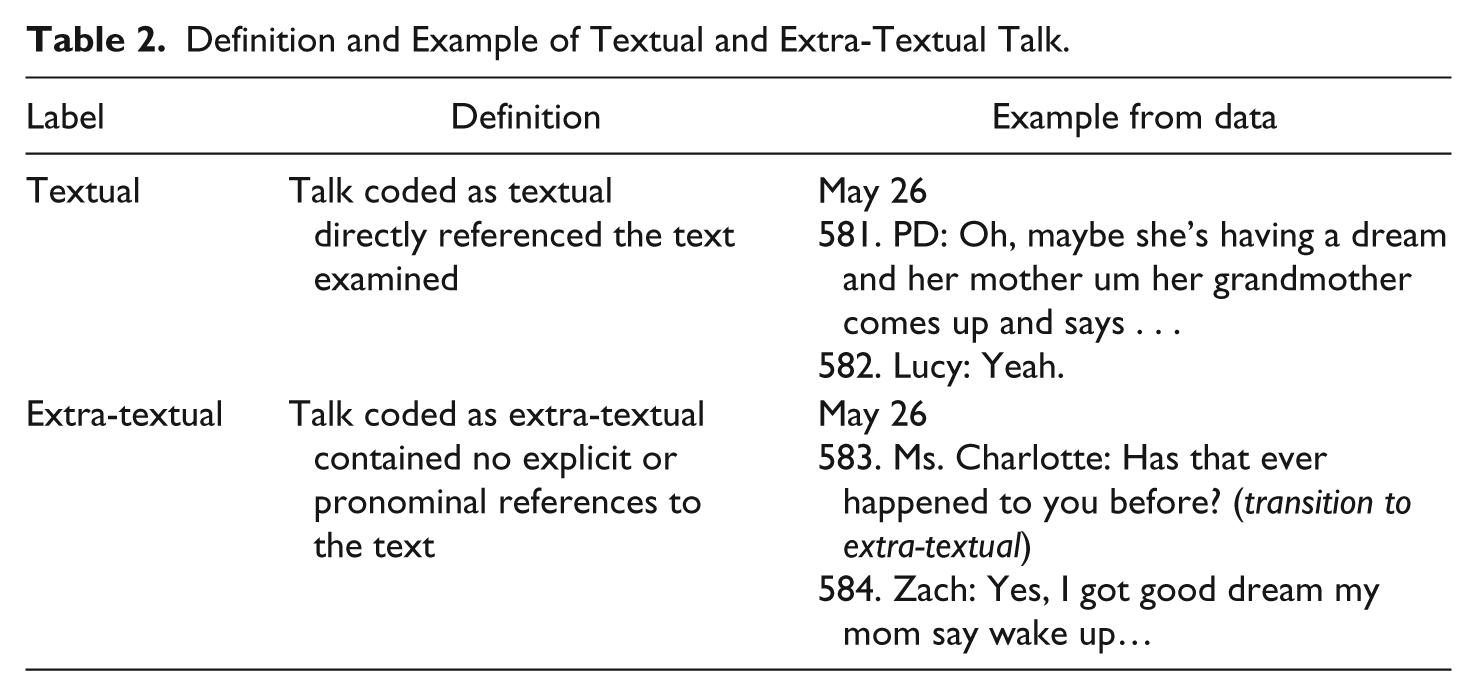
Student accessibility to the discussed text appeared to influence class time spent on talk directly about the text and the interactional form of classroom talk toward instructional talk. To unpack and understand this pattern further, I coded talk episodes as text based (textual references to focal or other texts) or text inspired (students entextualized as they wrote themselves into the text, the scope of talk was extra-textual). I determined that if a vocabulary word emanating from the text was discussed then talk was coded as text based.
In Table 2, examples for textual and extra-textual are contiguous. We also see a researcher-imposed episode transition. TOT 583 marks the beginning of a new episode, teacher instigated (TOT 583) from text-based talk (student PD’s textual reference to Lily and her dream in The Whale Song) to text-inspired talk (Zach responds with his dream in turn 584).
Definition and Example of Textual and Extra-Textual Talk.
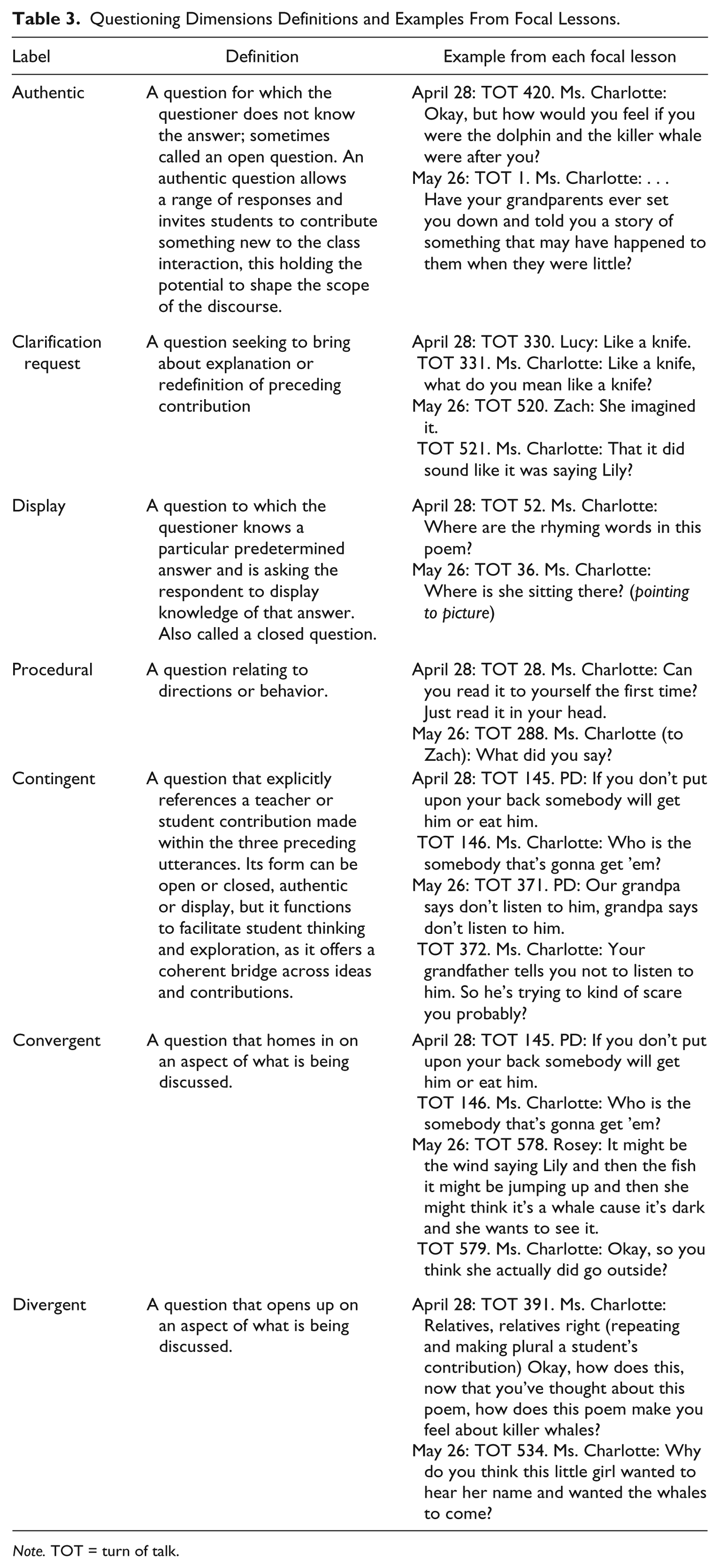
Coding for teacher questioning. Using a conversational TOT as the unit of analysis, all questions were coded for type (display, authentic, clarification request, procedural), contingency (building on a teacher or student contribution made within three preceding turns), and divergence-convergence (opening up or honing in on aspects of what is discussed). Analysis of coded TOT dimensions (textual or extra-textual focus; questioning typology, contingency, convergence-divergence) identified characteristics of prototypical teacher questioning patterns for each lesson. Table 3 displays definitions and examples from each lesson for questioning dimensions.
Questioning Dimensions Definitions and Examples From Focal Lessons.
Note. TOT = turn of talk.
Typology
I looked closely at types of questions in these lessons. All teacher questions were coded as display, authentic, clarification request, or procedural. All student questions were coded authentic as I assumed a student would only ask a question if he or she wanted to know the answer. I judged it unlikely that these students would wield questions to showcase their knowledge or test the teacher. The typology analysis therefore focused on teacher questions.
Contingency
Contingent questions refer a teacher or student contribution made within three preceding utterances (Boyd & Rubin, 2006). Through coding for contingency, I considered whether the questioner was building on previous propositions or initiating new inquiry. Contingent questions extend the notion of uptake (Collins, 1982; Nystrand et al., 1997) considering both building on previous contributions and forwarding and directing their influence on the scope of future discourse.
Convergence or divergence
In addition to noting whether a question was contingent on previous contributions, coding for convergence or divergence allowed us to see whether a question was posed to open up the scope of the discourse (the answer is not settled) or home in on a particular facet (expecting a specific, definite answer). Dillon (1984) declares questioning the “presumptive practice” as teachers presume they are inviting contributions while in fact questioning converges on questioner’s (often the teacher’s) agendas. Burbules (1993) asserts that the challenge of pedagogical questioning is to frame questions in ways that divergent questions are not “limitless” and “floating” and convergent questions do not “restrict the possibilities of generating original and creative insights” (p. 97). Advocates of authentic and open questions in ELL classrooms (such as Haneda & Wells, 2008; Mohr & Mohr, 2007) value their ability to open up discourse to contribute something new to class interaction; thus, they have the potential to shape the scope of discourse beyond the questioner’s (typically the teacher’s) agenda. Although previous L1 or L2 studies have not coded for convergence-divergence, documenting such patterning across each lesson provides a useful marker to trace the role questioning (and the questioner) plays in determining scope of talk.
Together, codings provide a framework to systematically consider relations between teacher questions and contrasting student language use and the range of language use in two literature-based ELL lessons.
Findings
Findings unpacking relations between teacher questioning and student talk are organized into three sections. First, I review the scope of talk in both lessons (text based and text inspired). I then present descriptive statistics for teacher questioning patterns (in terms of typology, contingency, convergence-divergence, textual extra-textual) and identify the teacher prototypical question type for each focal lesson. Through close discourse analysis of selected classroom talk excerpts, I address how patterns of teacher questioning influence student talk and learning across both lessons (my Research Question).
The Scope of the Talk in the Two Focal Lessons
On April 28, the day with fewer SCTs, talk was text based (93% of talk episodes) as students publically and collectively grappled with making meaning with the poem. On May 26, the day with more SCTs, talk was mostly text inspired (63% of talk episodes) as students elaborated beyond the text to discuss likelihood of reported events and to share their own experiences. In both lessons, students made more than two thirds of the turns of talk, talk about the focal literature drove the conversation, and when the teacher talked, more than half the time she asked a question.
Teacher Questioning
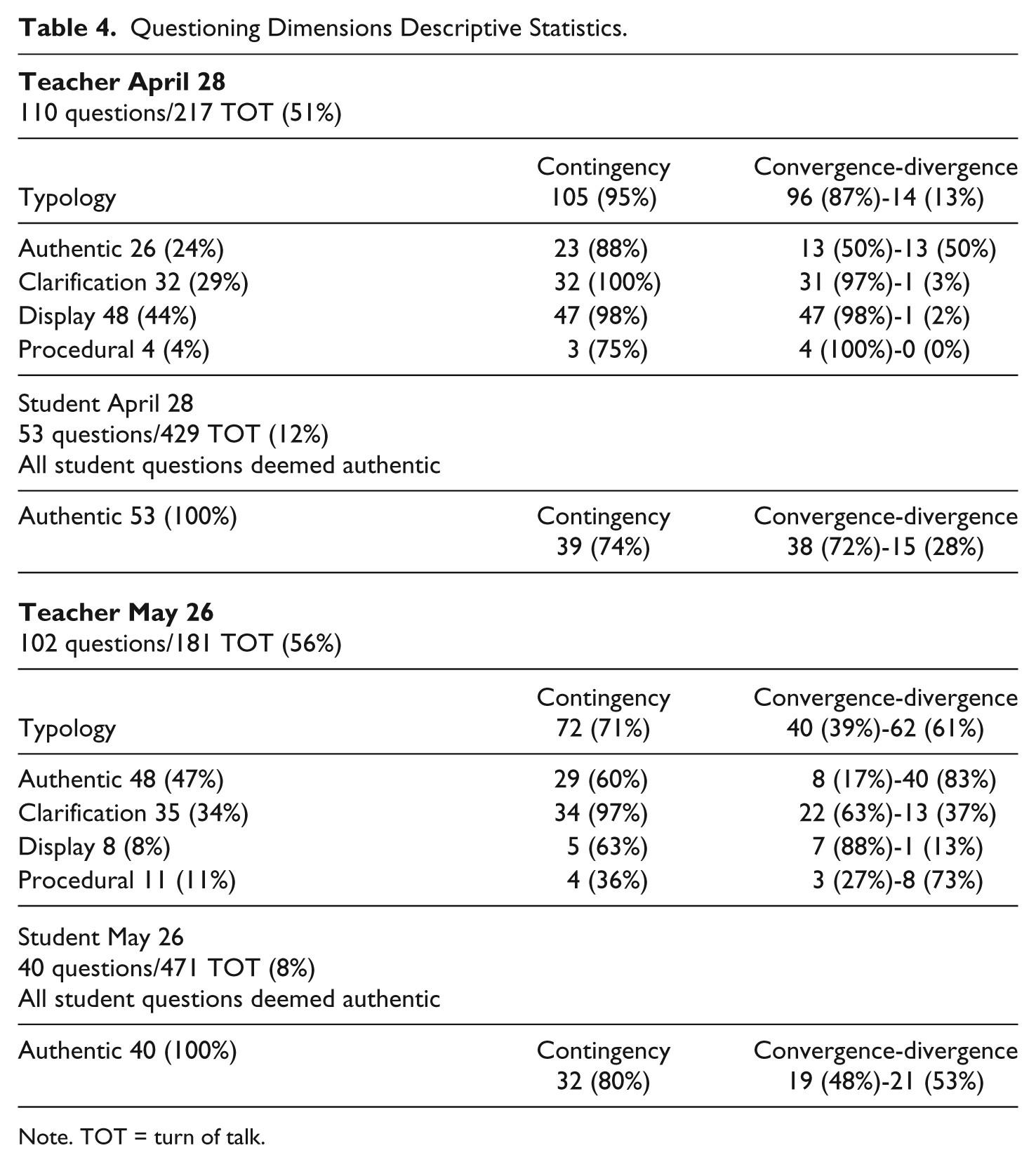
Table 4 displays descriptive statistics for teacher questioning dimensions. I note relationships across questioning dimensions and prototypical questioning patterns for each lesson. As noted, both lessons were similar in number of questions posed overall (April 28: 110 questions or 51% of teacher turns; May 26: 102 questions or 56% of teacher turns). Both lessons were consistent in that the teacher asked about twice as many questions as students. We note that Ms. Charlotte asks a lot of questions, slightly more than almost 100 questions per hour recorded by Mohr and Mohr (2007) in an elementary classroom and considerably more than the average 60 questions per hour (reported by Juzwik et al., 2008 in their middle school literature study). Questioning was this teacher’s dominant communicative function, making up more than half of her turns of talk. Student questioning was not uncommon as questioning made up about 10% of student utterances (April 28: 53 or 12%; May 26: 40 or 9%).
Questioning Dimensions Descriptive Statistics.
Note. TOT = turn of talk.
Typology
Although in both lessons questions made up more than half of this teacher’s utterances, there were marked differences in frequencies of types of teacher questions between lessons. On April 28, when students struggled to make sense of the poem, display questions dominated, contributing 44% of teacher questions. Clarification and authentic questions during that lesson were roughly equal (32 or 29% and 26 or 24%). On May 26, when students elaborated beyond the text, display questions contributed only 8% of teacher talk, and authentic questions dominated at 47%. Clarification requests were also common at 34%. For both lessons, procedural questions were minimal (4% and 11%). To unpack differences in teacher questioning signaled by questioning typology findings, all questions were coded for contingency and convergence qualities.
Contingency
Questions posed were mainly contingent. In both lessons, student questions were contingent three quarters of the time. However, lessons differed in the degree to which teacher questions were contingent. As befitting their definition, clarification questions are tightly contingent. On April 28, when talk was mainly text based, teacher display and authentic questions were tightly contingent (98% and 88%, respectively). In contrast, on May 26, about six out of 10 display and authentic questions were contingent (63% and 60%, respectively). On May 26, the teacher wielded questions to initiate a new topical idea or return to a previous topical idea (outside the three TOT contingency criteria).
Convergence or divergence
Teacher questions were mainly convergent in the April 28 lesson (87%) and convergent about a third of the time in the May 26 lesson (39%). Coding revealed that although teacher display questions were consistently built on and narrowed in on student contributions (convergent: April 28: 98%; May 26: 88%), the expectation that teacher authentic questions built upon and broadened scope of discourse was fulfilled with differing degrees of consistency (divergent: April 28: 50%; May 26: 83%). In other words, when talk was text based, authentic questions functioned to open up talk half the time, but when talk was text inspired, authentic questions broadened scope of talk most of the time. Clarification requests remained tightly convergent in the April lesson but less so in the May lesson.
Note that even though I had chosen to code all student questions as authentic, the textual and extra-textual coding revealed a convergent-divergent pattern that resonated with presence of mainly display or authentic teacher questions. On April 28, when talk was mostly text based and teacher display questioning dominated, student questions were convergent 72% of the time. During the May 26 lesson, when talk was mostly extra-textual and teacher questioning was mainly authentic, student questions were both convergent (48%) and divergent (53%; see Table 4).
Prototypical questions
This examination of questioning dimensions uncovered the prototypical teacher question for each lesson (see Table 5). In the April 28, the text-based lesson with the least number of SCTs, the prototypical teacher question (a) was text based, (b) was grounded in previous contributions (contingent), (c) homed in on focal content (convergent), and (d) included a particular answer (display). In fact, a remarkable 43% of teacher questions in this lesson met all four criteria. In other words, in the April 28 lesson, almost half of the time (47/110) Ms. Charlotte used the question to learn more detail about a textual particular currently being discussed. This is illustrated in the prototypical teacher question (TOT 146) in Table 5. Ms. Charlotte was clearly listening, and her contingent, convergent, display, and text-based question is guiding student exploratory talk and pushing forward students’ group thinking processes. In 16 turns following TOT 146, Ms. Charlotte makes three contributions, and all three are prototypical questions for this lesson indicating she is listening to student contributions and directing their reasoning as students figure out referents. This poem is difficult for these ELL students precisely because of its exophoric language. Ms. Charlotte’s questions respond, restate, and support students’ suggestions and reasoning, for example, “Okay, so who are they talking to? Are they talking to other killer whales or are they talking about sharks coming to get them?” and “Would people put their babies on their back?”
Prototypical Teacher Question for Each Focal Lesson.
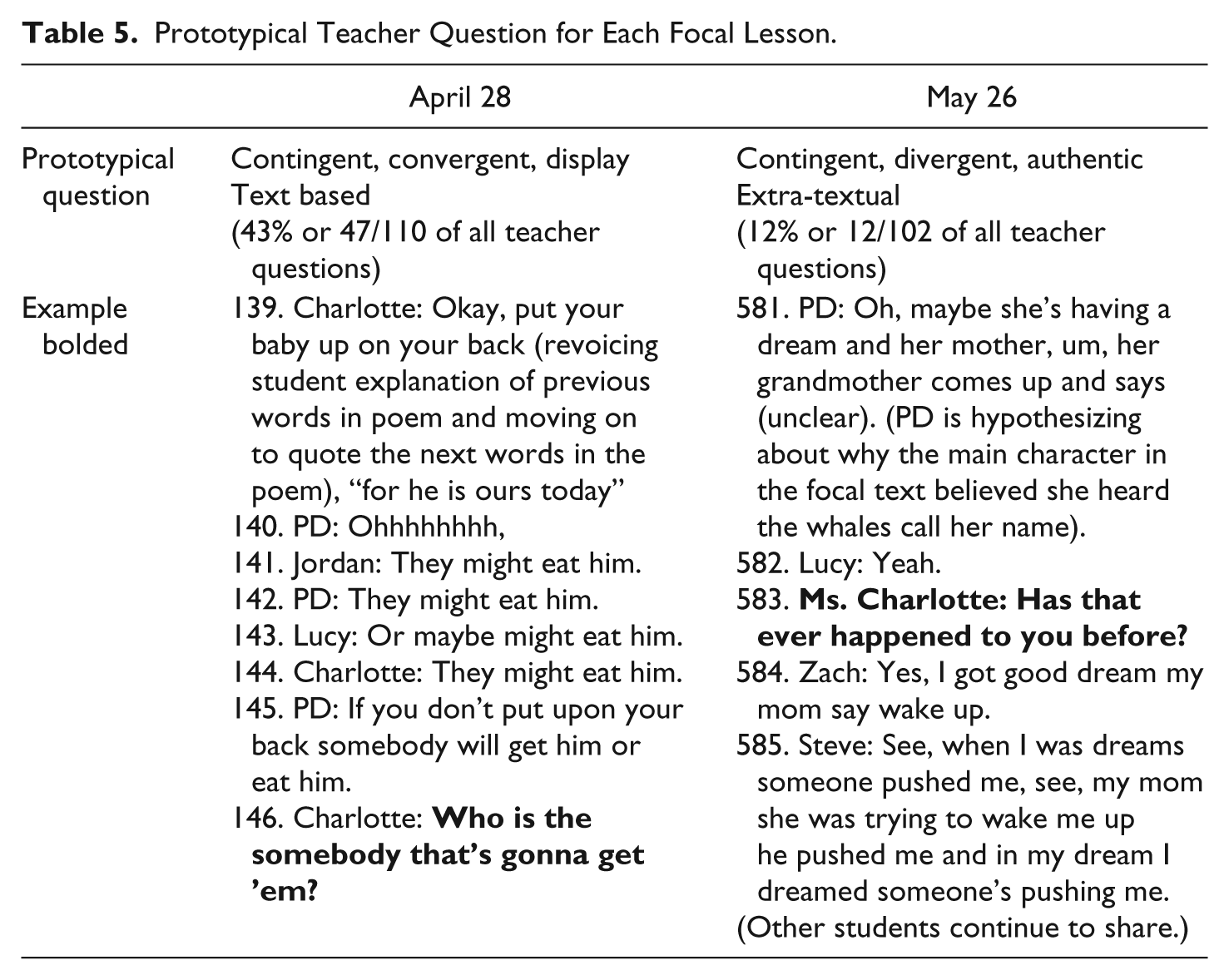
In contrast, in the May 26 lesson, when talk was mostly extra-textual and there were many SCTs, the prototypical teacher question (a) was extra-textual, (b) was grounded in previous contributions (contingent), (c) opened up scope of talk (divergent), and (d) was an authentic question without an expected response.A robust 12% of teacher questions (12/102) met all four criteria (20/102 or 20% excluding extra-textual criterion). In TOT 583 (Table 5), we see Ms. Charlotte’s prototypical question supporting students in connecting familial experiences to the focal text, a story with unclear plausibility. We see students co-narrating and as authorities in the telling.
Ms. Charlotte included questions in more than half her turns of talk, and examination of those questions revealed specific teacher behaviors across lessons: restraint in directing class discussion and judicial and particular, but unexpected use of teacher display questioning. Furthermore, although it was not a great surprise to document that contingent, convergent, text-based display questions were associated with shorter student utterances and that contingent, divergent, extra-textual authentic questions were associated with elaborated, coherent, engaged student utterances such as SCTs, it was of great interest to note how BOTH lessons, with their distinct questioning patterns and different student talk outcomes contributed to productive teaching and learning. A closer look at talk excerpts illustrates how Ms. Charlotte employed prototypical questions in each lesson and how she positioned and supported students through consistent and supportive questioning patterns.
A Closer Look: Questioning to Support Students’ Understanding
The following five talk excerpts contextualize the prototypical teacher questions for each lesson. The first two excerpts show how contingent convergent display text-based teacher questions (the prototypical question for the April 28 lesson) supported student construction of surface meaning for “Killer Whales” (Yolen, 1996). Remember students struggled to make sense of the poetic language in this poem. Both silent reading and Ms. Charlotte reading it aloud were insufficient support for understanding for these ELL students, so Ms. Charlotte agreed to read it one line at a time and together explore, “What would that mean? What could that mean?” (TOT 94). As Talk Excerpts 1 and 2 illustrate, Ms. Charlotte’s questioning supported students’ understanding as they worked to figure out meanings to produce exploratory talk as they tried out ideas and talked to learn (Barnes, Britton, & Torbe, 1969).
Talk Excerpt 1: April 28: Knifing through the ocean’s blue.
The numbers indicate their turns of talk (TOT) sequence within the lesson.
“Knifing through the ocean’s blue.” What does that mean, knifing through the ocean?
Night is nighttime and then the wind blew.
It’s not night, it’s knifing, knifing . . .
. . . Oh they go killing.
Like a knife.
Like a knife, what do you mean like a knife?
The teeth.
Okay, their teeth are like knives.
Or it might be like the thing and it goes like . . .
What do knives do?
Cut.
Hurt.
Okay, Okay, so what could be another word we could put there instead of “knifing” then?
Teeth.
Cutting.
Sword.
Cutting “through the ocean’s blue,” like going. If you have ever seen a fish or an animal go through the water this is like more like he’s kind of [gesture like knife] . . .
. . . He’s like cutting.
Yeah, his fin his . . .
. . . Shark.
The top thing goes like that . . . and it looks like he’s cutting the ocean’s blue.
In this 21-turn exchange, we see five of six students grappling to make sense of one line (five words) of the 12-line poem. Ms. Charlotte made seven turns (a third of the exchange), four of which included questions (slightly more than half), and all seven turns were consistent across both lessons and across the larger 6-week data set. Ms. Charlotte’s questions (TOTs 326, 331, 335, 338) converged on the literal meaning of phrases, while explicitly encouraging students to explore and further articulate possible meanings aloud. When not questioning, this teacher revoiced, extended, and validated student contributions (TOTs 333, 342). In other words, all of Ms. Charlotte’s turns supported and directed student talk. Her contingency was selective as she selected and incorporated in her subsequent turns the most promising student contributions (a substitution for the problematic word “knifing”) to move talk in profitable directions (TOTs 331-342). Ms. Charlotte’s direct questions, this “leading from behind” (Wells, 1993) is manifest in the contingent, divergent-convergent dimensions to her closed questions and comments as she prompted and moved students’ thinking toward specific (student) goals; in this instance, understanding the meaning of the line of poetry under discussion, a student articulated goal for this lesson. (Students ignored Ms. Charlotte’s attempts to shift talk from a close reading; see Boyd, 2012b.) Excerpt 1 also illustrates a rare explicit evaluation as she corrected Zach’s hearing of “knifing” as “nighttime” (TOT 328). We also see overlapping and unelaborated student exploratory talk as students offer best guesses (Mercer, 2002), publically thinking together in the target language of English. To be sure these fourth- and fifth-grade ELL students had adopted an efferent stance to this poem (Rosenblatt, 1978) and allowing time for her students to direct making sense of the poetic language of this poem appeared to have resulted in deep understanding, for we see Lucy’s appropriation of the poetic language “ocean’s blue” in her restatement (TOT 346) “The top thing goes like that . . . and it looks like he’s cutting the ocean’s blue.” In the next excerpt, we witness students eager to apply what they just learned to a new textual context. Excerpt 2 occurred toward the end of the lesson, after Ms. Charlotte completed a read aloud of the picture book The Whales (Rylant, 1996). Student Rosey directed the talk.
Talk Excerpt 2: April 28: Using what you just learned.
The numbers indicate their turns of talk (TOT) sequence within the lesson.
Ms. Charlotte I have two things to say.
Okay.
One thing is could you flip back just a few pages? No, not that one.
Well tell me.
Well maybe . . .
You flip it.
Okay, I guess over here. They say, out in here, like, “keep your baby on your back” thingie (a reference to “Put your babe upon your back” Line 3 in the poem “Killer Whales” the poem they read before the poem they are currently discussing)
Okay, all right, what is he doing here? (pointing to picture).
I think protecting, I guess they’re protecting your, um . . .
Ok, is that a way of protection?
I guess, um, they won’t like go by, I guess, and just, like stare at it, big one will. [looking at illustration]
Under ’em. Well if they’re under them, if they’re under them, they can.
I’m still talking!
They’ll still have disgusting stuff on them. [looking at illustration]
I guess they’re like, I guess they’re like, um, protecting it. If, like, if someone gets it, the mother baby, well mother, will, like, um get it or something.
In this excerpt, we see illustrated how Ms. Charlotte’s turns of talk functioned to loosely manage the floor (TOTs 559, 561, 563,) and to indicate listening to and support for students’ contributions with contingent, display, convergent questions (TOTs 565, 567). Certainly, Rosey did not hear her teacher’s questions as functioning in traditional display question ways to invite performance talk. Instead, Rosey responded to them as requests to support and explain her claim as she demonstrated appropriation of conceptual understanding and language from the poem on killer whales. After more than 300 turns of talk in this lesson spent deconstructing the exophoric language such as “your” in the “keep your baby on your back thingie” in the Yolen “Killer Whales” poem, without prompting Rosey and Lucy evoked the phrasing, “Put your babe upon your back or he is ours today” that proved difficult to understand at the beginning of the lesson and used it in a discussion of this text. Student talking to learn generated deep understanding and confidence in knowing.
By contrast, in the May 26 lesson, the students were not constrained by struggling to make sense of the text. Almost no time was spent co-constructing a public meaning for the text or discussing vocabulary. Instead, students incorporated other knowledge and “lived through experiences” (Langer, 1995) into their discussions of text. As befitting their outlier selection, there were 29 longer turns of talk, many in which students shared and entextualized (Boyd & Galda, 2011), they wrote themselves and their experiences into the text sharing experiences of home and family life and other texts (books or TV). In some cases, these tellings occurred in a series, as individual students told, or students who were siblings co-told, an experience, a story from home, or something seen on TV (see Excerpt 4). Teacher questions about these tellings were classified as authentic because the content positioned students as experts, and the teacher did not necessarily know the answer. Most teacher utterances contained a question and 2 times out of 3 Ms. Charlotte asked the prototypical teacher question for this lesson (authentic, contingent, divergent, beyond the text). We see this illustrated in the following Excerpts 3 and 4.
Excerpt 3 occurs after the read aloud of The Whale Song (Sheldon, 1991) where after hearing whale stories from her grandmother, Lily claimed the whales sang her name. Lily’s uncle and Grandfather ridiculed her. The talk excerpt opens with Ms. Charlotte inviting students’ similar experiences (asking an open divergent question, coded as non-contingent because it opens the talk episode, and researcher-imposed criteria required contingency within the episode). PD responded (TOT 368), and his sister Lucy interrupted him (TOT 369) attempting to co-tell his story. Zach overlapped with Lucy as he attempted to tell his own story. PD continued (TOT 371), and Ms. Charlotte demonstrated she has been listening to him and asks if Grandfather’s son was trying to scare PD (TOT 372). Rosey concurred, and Ms. Charlotte then cued Zach to tell his story (TOT 374). During Zach’s story, we see his sister Rosey clarifying facts, and another student Steve helping with English terms for relatives. In turns 377 and 385, we see Ms. Charlotte’s prototypical question (extra-textual, authentic, contingent, divergent) as she asks for more. This is real talk (Boyd & Galda, 2011) as conversants adopt varied participant roles speaking extemporaneously to connect with what they already know to build knowledge together.
Talk Excerpt 3: May 26: Student entextualizing
The numbers indicate their turns of talk (TOT) sequence within the lesson.
Have your, um, grandparents ever shared a story with you? Or your mom or dad? or someone?
Yeah, my, no it’s my grandma’s son, he always tells me scary stories.
Oh yeah, at night, at night when we were little . . . (Lucy is PD’s twin sister)
Yeah, my little cousin tells me funny story . . .
Our grandpa says don’t listen to him, grandpa says don’t listen to him.
Your grandfather tells you not to listen to him. So he’s [grandpa’s son] trying to kind of scare you probably?
Yeah, we have a nightmare when . . .
Okay, Zach. (Cueing Zach to continue with his story)
My little cousin, he told me like a story about like a stupid king that hang his flag up in a tree and nobody can see it and then my little, um I think its my uncle or something, he say don’t hear it.
Um, um, uncle.
Which uncle, which uncle? (Rosey is Zach’s sister)
Oh . . .
. . . Well it doesn’t really matter.
He thinks he’s um uncle so I’m just trying to check.
His brother father.
The cousin’s father.
Okay and were you going to say something Lucy? (connecting back to TOT 373)
No.
About your uncle’s story, what do your parents say when, when they, when he, tells you these scary stories?
This lesson is replete with family stories as individuals share family experiences paralleling Lily’s (the protagonist in the focal text) dilemma of being believed or not. Cascades of student sharing follow prototypical (open, contingent, divergent, extra-textual) teacher questions for this lesson such as “Has that ever happened to you before?” (TOT 583). Many of these sharings are what Mercer (2000) calls cumulative talk, uncritical sharing, and elaborating. We see cumulative talk illustrated in Talk Excerpt 4 with two consecutive turns by Lucy and Zach (TOT 588, 589).
Talk Excerpt 4: May 26: Student Cumulative Talk
The numbers indicate their turns of talk (TOT) sequence within the lesson.
Ah, um, in my country we didn’t had any alarm clocks and what my brothers do wake me up they get a glass of water and splash it on people so they could wake up.
Um when I’m like sleepy and watch like scary movie like somebody jump off the like climb the mountain and then I dream that I was that guy, and Ahhhhh! And—that’s why my mom don’t let me watch scary movies.
Across this lesson, there were several cascades of students sharing stories, indeed, 23 of the 29 longer turns of talk in this class were in cascades of students’ sharings. Many of these longer turns of talk did not qualify as an SCT (there were 12 SCTs in this lesson) because (as in TOT 375) although they might be built upon, they themselves were not building on a previous contribution; they were another example of a student sharing (see TOTs 588, 589). Nevertheless, these sharings were markers of individual linguistic competence (notably so for English language learners) and contributed to this classroom’s collective understanding of the topic. Ms. Charlotte validated sharings as she modeled attentive listening to students’ contributions and her questions functioned to initiate (TOT 367, 383), clarify (TOT 372), inquire further (TOT 385), or to align the sharing more tightly with a learning purpose. In Talk Excerpt 5, we see there was an educational purpose to all sharing beyond just talking in the target language as Ms. Charlotte redirected the premise of whether-amazing-things-relatives-tell-us-could-actually-happen back to the read aloud text.
Talk Excerpt 5: May 26: Could this actually happen?
The numbers indicate their turns of talk (TOT) sequence within the lesson.
Do you think, what do you think about this story, do you think this is something that actually could . . . ?
It was a lie.
It could happen.
Could happen?
Yeah, yeah, no.
OK.
Yes, no.
You don’t, you don’t.
Part of yes, cuz someone’s grandmother could have told his grandfather a story and then his great uncle doesn’t agree but when the whales saying their names it’s not true.
Ok, so you don’t think that could actually happen?
Yeah, yeah it can.
No, no I mean.
You can because um because the whale might make a sound well, it might be sounded but.
Oh Ok. So it could be a sound? Have you ever . . .
Ms. Charlotte initiated the topic shift while careful not to dominate the discourse. She made five of 14 turns, including revoicing (TOT 489) and minimal back channeling (TOT 491). Ms. Charlotte invited students’ opinions with her initial teacher authentic, contingent, divergent, and (unusual for this lesson) text-based question (TOT 486) and appeared sufficient scaffolding for student elaboration. Teacher questions (TOTs 486, 489, 495, 499) invited students to make judgments. In the Brittonian sense (Britton, 1982), Ms. Charlotte was positioning her students as spectators to their experiential narratives and the read aloud attending and evaluating while actively discussing. Talk in this excerpt is text based, though students are not struggling with making sense of the narrative. They grapple with the plausibility of a central premise of the story: Did Lily actually hear her name spoken by the whale/did the whale utter her name? Typical in this lesson, students’ wonderings are not limited to text such as when Ms. Charlotte shifts (TOT 499) to consideration of other animal sounds taken to be words. In this lesson, discourse content moves from students’ experience stories to examination of shared text to a teacher-related experience facilitating further exploration of textual meaning.
Discussion
Teacher talk shapes the what and how of classroom talk, and teacher questions are the dominant discursive tool of choice in both language learning and mainstream classrooms. This is certainly the case in this ELL classroom community for although this teacher talks less than traditional teachers, she asks a question every other TOT. But to what end? To understand how this teacher’s patterns of questioning influence student talk and learning, we must recognize that questions do not stand alone. Ms. Charlotte’s questions are in dialogue with and thus contingent on her students’ contributions, attendant discourse conditions, the scope and purposes of her immediate lesson, and established classroom norms and expectations. Furthermore, her questions were response-able (Rubin, 1990) and were asked in ways that could be answered and supported authentic commentary on the topic explored together (Boyd, 2016b).
As a discursive management tool, questions can function as supportive or corrective (Myhill, 2006), to broaden or narrow the scope (Burbules, 1993), and to validate and extend student thinking (Boyd & Rubin, 2002; Haneda & Wells, 2010). They can function as signaling “this is important, let’s explore and clarify further,” as establishing and validating shared knowledge, and offering a platform to venture further. They can also function as display accountability authority shutting down exploration because of attendance to one right answer. Because a teacher’s question does not stand alone, the function cannot be discerned from syntax or singular use. Questions are received and responded to in light of recurring discourse conditions, sociohistoric patterns that predispose conversants to hear and heed in response to what has been said and previously expected and in anticipation of that pattern continuing.
Ms. Charlotte’s questions necessarily varied in form as they responded to unfolding discourse. She listened attentively and selectively prompted, directed, invited, challenged, and recast student contributions through her questions in response to and in support of her students’ work with the focal text. In one lesson, students struggled to make sense of the focal poem’s narrative, the scope of classroom talk was text based, and student utterances were short and overlapping. Ms. Charlotte’s prototypical question for this lesson was contingent, display, convergent, and text based as she homed in on text engaging students in a sequence of questions that guided their talking to learn inquiry. In the other lesson, students easily made sense of the picture book narrative, the scope of classroom talk was text inspired, and many student utterances were elaborated. In this lesson, Ms. Charlotte’s prototypical question was contingent, authentic, divergent, and extra-textual as she prompted for clarification and connections across student contributions. In both lessons, there were features of student talk that enhanced comprehension building and provided evidence of student engagement and high-level thinking, but the teacher questions necessarily looked different as they responded and reflected the work students were doing around the focal texts.
Weathering and Navigating the Sea of Classroom Talk
In the sea of classroom talk (Britton, 1970), the April 26 lesson documents the choppy wave experience of exploratory talk as students tread water, grappling with surface meaning, and the May 26 lesson documents ways these ELL students navigate hidden depths stretching beyond text connecting to lived through and other textual experiences. To be clear, this study does not suggest that exploratory talk only happens as students construct surface meaning or that elaborated student utterances or SCTs are the only deep connecting kinds of student talk in classrooms. Having purposefully selected two outlier lessons on the basis of incidence of SCTs, I have positioned my findings so that exploratory talk and SCTs may appear in opposition. They are not. The hesitant, incomplete, reasoning nature of exploratory talk can precede an engaged, coherent, and elaborated SCT. Explication of these two lessons reveals two poles of a teaching and learning continuum along which a teacher must guide student talk. Literal understanding of text is prerequisite, or at least a hand-in-hand requisite to deeper understanding, and an attentive teacher uses convergent, display questions to assess whether the student is prepared to move toward deeper understanding. The distinct kinds of talk in this study hint at the range of productive talk that occurs throughout instructional talk and the distinct kinds of teacher questioning hint at the range of productive questions that support instructional talk.
It has been asserted that both SCTs (Boyd & Rubin, 2002) and exploratory talk (Mercer, Wegerif, & Dawes, 1999) thrive only in classrooms where students feel safe to take risks; they were not afraid to elaborate and “give it a go.” As teachers and researchers, we want to encourage such talk in ELL classrooms where student talk is considered a learning outcome in and of itself. However, student volition is cultivated and cannot be required. Trust and involvement is earned as teachers listen, consistently validate, expect more, and refrain from evaluation where students feel their contributions are held against them. Effective ELL teachers listen carefully and attentively provide what is needed for further student articulation. And that articulation takes different forms.
Within this classroom culture, three local and sociohistoric discourse conditions shaped the different kinds of talk: (a) students’ facility with the focal texts, (b) the patterned and consistent nature of teacher talk that supported student intentions for work to be done around text, and (c) local classroom norms shaping student predispositions toward teacher questioning.
Student facility with text
In most classrooms, there is a range of materials and delivery and an expectation that teachers will pace and adapt instruction so students can make sense. A less accessible text (with poetic phrasing and exophoric pronouns such as in the “Killer Whale” poem) could result in all students (but especially ELL students) grappling with surface meaning. An easily accessible text (supported by illustrations such as the picture book Whale Song) could result in students telling how their thoughts and experiences related to the text. In both these focal lessons, remarkably, students dominated schooling talk through choppy exploratory talk as they co-established a narrative for the poem and through extended cumulative and exploratory talk as they shared personal and other textual stories inspired by the picture book to illustrate differing opinions about plausibility. The relationship of teacher questioning to different schooling talk outcomes in these two lessons appears (a) related to stance of the discussion, and further related to student comfort with content and with the classroom culture and (b) contingent on and responsive to student contributions and their cues for the scope and pacing of talk around text.
Patterned and consistent nature of teacher talk
By April and May, talk norms were established in this classroom. Students understood they were expected to participate and that Ms. Charlotte would seek, support, and build on their contributions mainly by asking questions. We see this in each lesson and across both types of prototypical questioning. Ms. Charlotte listened attentively to students and wielded her questioning to deepen, narrow, or broaden the scope as she deemed best to scaffold student exploration and articulation. She posed both responsive and response-able questions. This is not to say that teachers’ awareness of question typology is not helpful. Purposeful use of display questioning effectively directs students to review material or prepare groundwork for further exploration. Display questions were slightly more dominant in local discourse conditions preceding 52 SCTs made within the 6-week instructional unit (see Boyd & Rubin, 2002). Authentic questions can open up scope of talk to include student resources and student intentions for classroom work; analysis of both lessons indicates that authentic questions engendered longer student turns. However, it was the consistent contingent nature of Ms. Charlotte’s questions (not their typology) and her pedagogical expertise as she animated and included her student responses in her questioning (the “third turn” move; see Lee, 2006, that was critical to shaping a classroom discourse culture that invited student reasoning and elaboration.
Local classroom norms shaping student predispositions toward teacher questioning
Teacher questions do not simply invite student talk, they are a means for teachers to direct classroom talk and support students in a particular line of inquiry and induct students into particular ways of thinking and using language. This teacher’s consistent practice of contingent questioning and “leading from behind” (Wells & Chang Wells, 1992), or alongside, teacher and students to figure out meaning required listening, patience, and skill. In each of these focal lessons, we see both the “third turn” imposing connectedness as the teacher follows up, and contingent questions honed and effectively scaffolding student elaborations of detail and thinking. These elaborations take form of extended exchanges with short choppy student utterances in the April 28 lesson and elaborated utterances in the May 26 lesson. However, when students provide answers that are incorrect or going in a direction that is contrary to what Ms. Charlotte would prefer, we do not see many instances of explicit teacher evaluation that Mehan (1979) dubs the “terminal act,” because it closes down student thinking and the exchange. (See exception in Talk Excerpt 2, when Ms. Charlotte clarifies the homonym blue/blew and confusion over night/knife.) Instead, we see Ms. Charlotte consistently steering talk in a preferred direction. When several students contribute, she sometimes chooses what seems best to incorporate into her subsequent turn directing talk toward a goal of student understanding without negatively evaluating less preferred answers. Student intentions for work to be done around text are given time, and we see Ms Charlotte’s pedagogical expertise as student contributions are related to instructional goals.
Student talk in this classroom is not shut down. Past classroom community practices have led students to expect that their contributions will be heard and incorporated into shared class references. These students do not expect teacher talk to shut them down. And indeed, Ms. Charlotte’s talk consistently functions to extend and clarify students’ explorations, pushing them to further elaborate. This has been the case all year long. Thus, we see that the impact of questions in opening up or shutting down student inquiry results not from whether the teacher knows the answer, but from how students interpret the teacher’s intention behind the question.
The patterned and consistent nature of Ms. Charlotte’s talk, and student confidence that their ideas would be valued, shaped student predispositions toward teacher questioning. Students knew their contribution would be heard, and they trusted Ms. Charlotte’s follow-up questions would be productive. In this study, we glimmer the contingent and accretive quality of classroom talk.
Conclusion and Significance of Study
This study presents use of teacher questioning in an ELL classroom where students talk. It extends the literature on teacher questioning as it nuances and contextualizes (a) how researchers consider syntax and function of teacher questions and patterns and (b) how different patterns of teacher questions cultivate different patterns of classroom talk and student learning. Furthermore, (c) L1 and L2 questioning research are in conversation as this study adds to research on dialogic teaching and elucidates what a dialogic stance looks like in the enacted teaching and learning practices of an ELL classroom.
In these two outlier lessons, we see two distinct student talk patterns both necessary in our classrooms. In ELL classrooms, language learning goes hand in hand with learning content across texts varying in accessibility. All learners, including English language learners, deserve the experience of rich dialogue. As teachers, we need to know how to wield questions to support and direct students as they connect with materials and struggle to construct meaning together. Different patterns of questions yield differing talk outcomes. If teachers sought only one type of student talk but not the other, then student language and content learning would be compromised. This study explicated a range of questioning patterns supporting and directing varied student talk. Students will explore ideas through classroom talk whether in choppy, incomplete utterances or extended responses, in classrooms where teachers ensure there is time, curricular and semiotic space, guidance (such as contingent questioning), and a safe environment. Although it may be easier to rush to the next text, connection, or activity without allowing opportunity to explore and query ideas and connections, to do so squanders opportunities for meaningful and productive learning. This is not to espouse a laissez faire acceptance of all kinds of talk, or to suggest that any question, any time, will elicit engaged student talk. To the contrary, the teacher is very involved in the process; her task is to take what is said and reflect it back in a question that directs talk toward instructional goals. The students’ task is to take up her question (and in this classroom, it is okay that this is not always the case). Allowing students time for making textual, personal, and contextual sense (even if it involves struggle) and finding ways to align lessons with student contributions is difficult but effective. In such ways safe and supportive classroom communities develop; in such contexts dialogic teaching and learning results and effective teaching blossoms.
As researchers and teacher educators, we need to study classrooms where students are talking. We want to increase the number of ELL classrooms contexts that invite active substantial student participation and engagement because we consider them places of effective instructional practice and enhanced student language learning. This study offers a systematic application of a method that takes context into account on multiple levels with rich detail that captures the complexity of real life in the classroom. However, while there is not a silver bullet solution, attention to classroom talk can direct efforts.
Limitations
Although contrastive analysis of two purposefully selected lessons taught by the same teacher to the same students in the same instructional unit is of value, this class size is small, only six students.
It is important for researchers to impose clear, methodologically consequential protocols. However, such protocols may be less useful when moving from a large data bank of an instructional unit to a 40-min lesson. For example, imposing topical episodes and disqualifying the first turn of the researcher-imposed episode as an SCT ensured a conservative number of SCTs in a data bank. However, an analysis of lessons shows the presence of other structurally coherent and socially engaged turns of student talk. Similarly, limiting the number of turns of talk to three within which a question should build on a preceding utterance, ensures a conservative number of contingent questions. However, analysis of these two lessons shows that contingency can be traced and located in utterances beyond three preceding turns of talk, especially because interruptions often occur and count as a preceding turn. These limitations, however, only suggest these data to be richer in extended turns and teacher contingent questioning.
Future Study
In both lessons, there is ample evidence of student reasoning. Researchers on mainstream classroom talk (Mercer, 2008b; Soter et al., 2008) documented the presence of particular words (commonly used conjunctions, modals, and adverbials) as a useful index of student reasoning and a marker of student exploratory talk. In another article (Boyd & Kong, 2015), I have examined the presence and context for these markers of reasoning across these two lessons with different but equally productive types of ELL student talk.
Footnotes
Declaration of Conflicting Interests
The author(s) declared no potential conflicts of interest with respect to the research, authorship, and/or publication of this article.
Funding
The author(s) received no financial support for the research, authorship, and/or publication of this article.