




Abstract
In response to economic distress, schools are increasingly serving as providers and distributors of social service resources. However, even when schools offer resources that respond to needs, they struggle to attain high levels of uptake. We examine the family-level correlates of participation in school-sponsored resources during the early months of the COVID-19 pandemic and find that uptake increases with economic need. In addition, net of need, families who report maintaining communication with parents of their children’s classmates take up more resources; and take-up of key meal and digital technology resources is associated with higher levels of take-up of other resources. These findings contribute to efforts to reposition schools as social service hubs by highlighting promising practices to improve resource uptake.
In response to rising levels of economic inequality, turbulence associated with public health crises, and other dramatic social changes, K–12 educational systems across the United States have launched extensive new efforts to provide material, emotional, and health supports to children and families in need (Dryfoos & Maguire, 2019; Duncan & Murnane, 2014; Griffith, 2000; Oakes et al., 2017; Sanders & Galindo, 2020). A growing body of empirical research indicates that the most ambitious of these efforts can have substantial positive consequences for students’ academic success and wellness (e.g., Walsh et al., 2014) and yield sizable returns on investment (e.g., Bowden et al., 2015). The Covid-19 pandemic accelerated this burgeoning movement, as schools responded to the profound disruptions of remote schooling by creating new systems to distribute services and resources to students and their families.
The effectiveness of resource provision efforts hinges on program uptake; the services and resources that schools provide can have little effect if schools cannot get them to students and families in need. Achieving successful uptake is no trivial task for school officials overseeing myriad programs such as nutrition, counseling, social work, and other student-wellness services. Social service and support providers in a wide range of contexts struggle with low rates of program participation (Moffitt & Zahn, 2019). For example, less than a quarter of U.S. families in poverty receive the cash assistance for which they are qualified under the federally funded Temporary Assistance for Needy Families (TANF) program (Floyd et al., 2017); and in 2019, less than 60% of those eligible for the Special Supplemental Nutrition Program for Women, Infants, and Children (WIC) received program benefits (Gray et al., 2022). Uptake is also a challenge to successful implementation for a range of school-based interventions, including tutoring (Nickow et al., 2020), vision screening (Neitzel et al., 2021), and school-based health care (Hodges et al., 2021). As schools respond to societal conditions and offer increased services, the mere existence of resources does not guarantee their usage.
In this article, we bring together scholarship from education, community psychology, public policy, and sociology to investigate the factors that relate to families’ uptake of school-sponsored services and resources. We use survey data collected at the end of Spring 2020 to examine the relationship between resource uptake and social and structural factors. Survey respondents included approximately 9,000 parents of elementary school students enrolled in one large urban district. We find that although resource uptake increases with family economic need and experiences of pandemic-related economic disruption, need alone does not explain variation in resource uptake. Net of economic need, families who report maintaining communication with parents of their children’s classmates take up more school-sponsored resources. Further, we find that uptake of key resources—initial resources that address basic needs or enable the uptake of additional resources—is associated with higher levels of uptake of other school-provided resources. This process is consistent with resource caravanning, a process by which resource uptake begets additional uptake (Hobfoll, 2012). Finally, an investigation of a district strategy to designate some high-needs schools as pick-up sites for district-provided free meals highlights the importance of pairing structural approaches with social ones. We find that though school meal sites were associated with increased meals uptake, meal sites did not drive resource caravanning in the same way as social connectedness did. Our findings may be of particular interest to schools that serve communities with high levels of social isolation and distrust, as they suggest that schools must find ways to build bridges among and between families and educators to promote greater awareness, trust, and the formation of social bonds that can facilitate resource uptake.
Reaching Beyond the Classroom: Schools as Resource Hubs
Well before the COVID pandemic disruption, schools and communities experimented with diverse organizational structures to provide social services to students and their families. Prominent examples include full-service community schools, wraparound services models, integrated student support (ISS) strategies, Promise Neighborhoods, or school-based community empowerment zones (see Weiss & Reville, 2019, for an overview of this movement in its pre-pandemic forms). Many of these models intentionally design school organizational structures to facilitate the connection of students and families with an expanded menu of services.
Integrated full-service school-based social service and resource provision programs yield measurable improvements in student outcomes, including attendance, exposure to exclusionary discipline, and academic achievement (Bowden et al., 2015; Maier et al., 2017; Walsh et al., 2014). Most research conducted on school-based social service and resource-provision efforts, however, focuses on a small subset of highly-funded and staff-intensive programs.
We know less about the consequences of the ad hoc service provision efforts implemented in schools across the United States, particularly during the challenging transition to remote-only instruction in the spring of 2020. Under these models, schools deliver programs in response to acute student needs either independently or in collaboration with community partners. As of August 2022, 45% of public schools reported using a community school or wraparound services model (IES [Institute of Education Services], 2022). Since educators often develop these programs and services on the fly, they typically have less intensive organizational supports than formally evaluated integrated community school models. Our analysis focuses particular attention on these ad hoc programs and the challenges they faced in bringing resources and services to families during the spring of 2020, a period in which schools around the world transitioned to remote-only education and public health officials encouraged families to “socially distance” in their own homes to slow the spread of the novel COVID-19 virus.
Nearly one third of U.S. families with children experienced food insecurity in this early pandemic lockdown period (Bitler et al., 2020; Kinsey et al., 2020). Remote schooling likely heightened this food insecurity, particularly for students who relied on school meals for daily nutrition (Dunn et al., 2020; McLoughlin et al., 2020). The pandemic upended in-person school meal programs, forcing school nutrition directors to develop creative methods to distribute food to families, including sponsoring community meal sites in vulnerable areas such as public housing and using school buses to deliver meals on a daily basis (NPR, 2020; Willis et al., 2020). In Spring 2020, nearly 95% of U.S. public school districts set up systems to make meals available to students and their families (Kuhns & Adams, 2020).
Pandemic-era remote schooling also lent new urgency to preexisting national efforts to extend access to digital technology and the internet (Lai & Widmar, 2021). Prior to the pandemic, nearly half of low-income families in the United States lacked access to computers or the internet (Vogels, 2021). When schools pivoted to remote learning, students who did not have access to a computer and the internet were often entirely unable to connect with their teachers or receive instructional materials (Hamilton et al., 2020; Harris et al., 2020).These widespread gaps in stable access to high-speed broadband internet during this period led to significant concern that children with fewer technological resources would fall behind educationally (Diliberti et al., 2020). Eighty-one percent of public school districts set up systems to distribute computers, internet access, or other forms of technology support to remote learners as they transitioned to remote-only pandemic instruction (Malkus et al., 2020).
This study is part of our partnership with a district that invested heavily in new student and family services in the pandemic’s early months. Immediately after transitioning to remote-only schooling in the spring of 2020, this district set up technology and food distribution systems. During those first few pandemic months, the district distributed approximately 20,000 laptop computers and over 1 million meals to its approximately 70,000 students. Furthermore, the district set up dozens of internet access points in underserved communities, including providing internet through the usage of mobile “smart buses.” The district also set up sites across the district to distribute free meals to the families of any of its students, regardless of their participation in the federal free or reduced-price school meal program. These meal sites, 15 of which were located at elementary schools in relatively high-poverty neighborhoods, 1 used emergency school meals program funds to offer free meals to all school-age children regardless of their free or reduced-price lunch (FRPL) status. These meal sites emerged as a central component of the district’s effort to provide families with the resources they needed, and our analyses indicate that families whose children attended schools in which meal sites were located were 19.6% more likely to receive meal support from the district than those who were not at schools with meal sites.
Framing the Problem of Resource Uptake
While the pandemic presented distinctive challenges for schools, the problem of connecting resources to those in need is not unique to this crisis. Students and their families might opt not to take advantage of the range of social and educational services offered to them, despite experiencing intense and unexpected need, for any number of reasons. Stigma, lack of information, and bureaucratic challenges all limit student and family participation in a range of school services, from free and reduced-price meals (Domina et al., 2017; Mirtcheva & Powell, 2009) to early intervention services (Kochanek & Buka, 1998), tutoring programs (Nickow et al., 2020), and extracurricular opportunities (Houser, 2016). Scholars in the broader literature on social and antipoverty policy often use the term administrative burden to describe the barriers that prevent families from accessing socially provided resources and services (Herd & Moynihan, 2020; Ko & Moffitt, 2022; Moffitt & Zahn, 2019). School-based service provision efforts during the pandemic sought to minimize administrative burden, often substantially altering the organizational structure of schools to do so. For example, federal meals waivers made it possible for schools to deliver meals to students regardless of their household income (U.S. Department of Agriculture [USDA], 2021; see also Food Research & Action Center, 2022). Nonetheless, even in the pandemic context, families had to articulate a need, reach out for help, travel to distribution points, or take other action to take up school-provided resources,
Organizational psychology’s conservation of resource (COR) theory provides a framework for thinking about the process by which individuals determine whether or not to accept offers of help like the offers that schools provided families during the pandemic (Hobfoll, 2001). As a theory of behavior motivation, COR posits that individuals strive to protect and maintain things they value such as health, well-being, family, and a positive self-concept (Hobfoll, 2011). Since individuals are often more acutely aware of the potential costs associated with resource loss than the potential benefits associated with resource gain, people often rely on their existing resources rather than initiating a change to take up newly offered resources (Hobfoll, 2012). Building on this theory, we hypothesize that resource uptake varies with family need, social connectedness, and family participation in other school efforts related to resource provision. We provide a more detailed discussion of these three hypotheses below.
Need
For many families, the pandemic represented a pronounced and unexpected negative income shock. Workplaces laid off workers as the economy contracted, and many parents (especially mothers) reduced their work hours in order to provide additional care to their children as they transitioned to remote-only schooling (Abromaviciute & Carian, 2022; Calarco et al., 2020; Russell et al., 2020; Wang et al., 2021). Schools made resources available in the pandemic’s early months to help meet the acute needs that the pandemic created for families and students. Many of the families who felt the pandemic’s economic consequences most intensely had long struggled with chronic economic challenges, including employment and housing insecurity (Bitler et al. 2020).
School meal programs, for example, sought to extend nutritional assistance to children whose families struggled with food insecurity. Many of these students had previously relied on school-provided breakfasts and lunches. In the year leading up to the pandemic’s outbreak, 67% of students in the district in which we collected data had enrolled to receive free or reduced-price meals at school. In other cases, the pandemic disrupted family finances and routines, making it more difficult for families to provide regular meals to children.
Similarly, schools scrambled to provide technological assistance, including laptops, internet hotspots, and technological support to help families connect with remote learning opportunities. The abrupt transition from in-person to virtual schooling required considerable investments in technology, particularly for families that did not own laptops and other internet-enabled devices and/or did not have in-home access to high-speed internet.
While families of diverse socioeconomic backgrounds likely benefited from these and other school-provided resources, we expect that family need is associated with resource uptake. In particular, we expect families that had previously received free or reduced-price meals, families with relatively low levels of household income, families that experienced job loss or other negative income shocks during the pandemic’s early months, and families that entered into the pandemic with relatively few internet-enabled devices to be more likely to take up school-provided resources compared to relatively advantaged families. In many cases, need, on its own, is not enough to drive widespread program uptake. Nevertheless, need may be a necessary if not fully sufficient factor contributing to families’ decisions to take up resources; and thus, we hypothesize the following:
School-Based Social Connections
Even when programs respond directly to families’ felt needs, lack of information or distrust may discourage families from taking up resources offered to them by schools and other providers. These issues were particularly pronounced in the spring of 2020, when schools and other community organizations closed their doors and public health officials encouraged families to isolate themselves in order to reduce the risk of viral contagion. Social connections among classmates’ parents buffered the pandemic’s isolating effects for children and families, by providing pathways for the distribution of information about remote schooling and informal networks of support (Domina et al., 2021). As such, we suspect that these school-based social connections likely played a particularly strong role in influencing program participation during the pandemic period.
When potential beneficiaries have few social connections with resource providers, they may lack information about service availability and the processes for participation. Furthermore, disconnection often breeds distrust (Halbesleben & Wheeler, 2015), leading potential beneficiaries to view resource uptake as a risky prospect with large potential costs. The most effective community schools address the challenges associated with social disconnectedness by intentionally building bridges among students, parents, and resource and service providers (Galindo & Sanders, 2019). In more typical periods, in which students and parents have regular opportunities to interact face-to-face with teachers, educators play a central role in facilitating families’ access to school-provided resources (e.g., Stormshak et al., 2016). During remote learning, limitations on in-person contact and the heightened dependency on digital communications narrowed opportunities for parents and teachers to establish and maintain strong social ties. While we suspect that families’ social connections with teachers and other school personnel continued to influence family behaviors during the pandemic period, particularly in families with existing pre-pandemic relationships with their children’s teachers, remote learning likely limited opportunities for families and teachers to engage in one-to-one personalized communications.
Our analyses, therefore, focus particular attention on the connections among parents in the school community. Prior research conducted in daycares and other early childhood education settings emphasizes how parents and educators build densely interconnected social networks as they interact regularly at school drop-offs, pick-ups, and parent-teacher meetings (Small, 2006, 2009). These dense social networks help to connect families to the information, services, and material goods from which they can benefit (Small 2006). At the same time, they make it possible for families to see how other families in their social networks have benefitted from other resources, helping to build the trust that overcomes the loss aversion at the center of COR theory (Kwon et al., 2020). Galindo and colleagues (2017) provide cautionary evidence about the barriers to resource uptake that can emerge when this sort of community building cannot or does not occur. In a portrait of a diverse, high-needs elementary school implementing a comprehensive community school model, the authors document how distrust and poor communication among the school’s diverse families and educators inhibited the development of school-based services that responded to family needs as well as families’ uptake of helpful resources. Building on this body of scholarship, we suspect that connections among parents provide trust, information, and encouragement at a critical moment when public health measures reduced opportunities for direct and personalized contact between families and educators.
Resource Caravans
Once people engage with providers and begin to take up proffered resources, they likely get a clearer sense of the cost and benefits associated with resource uptake. As a result, the act of acquiring one resource may help to connect individuals to additional resources. Resource caravanning is a concept used to describe the positive gain cycles that occur when the decision to take up one resource leads to the uptake of additional resources (Chen et al., 2015; Hobfoll, 2011).
Resource caravan rests on the theoretical assumption that the uptake of an initial resource or set of resources begets the uptake of additional resources. Natural disasters research provides multiple examples of this process where, because individuals experiencing acute crisis must attend to basic survival before addressing other needs, the provision of meals often provides a place to introduce people to a broader range of services and resources (Chriest & Niles, 2018; Crellin et al., 2008; Hobfoll, 2012). By the same token, we hypothesize that meal provision helped schools remain in contact with at-risk families, creating frequent and consistent opportunities for schools to introduce families to other available services. Similarly, we theorize that digital technologies play an important role as instigators of resource caravans in the context of remote schooling. When families take up school-provided laptops and internet hotspots, they gain tools that facilitate their connection to a wide range of additional educational resources, including counseling, socioemotional learning opportunities, and tutoring (Domina et al., 2021; Lai & Widmar, 2021; Ramsetty & Adams, 2020; Vigdor et al., 2014). Reports that the district made a concerted effort to provide meals and devices, which facilitated internet access to families that needed them during the early weeks of remote schooling, support our identification of meals and devices as key resources. While the district made other resources available to all families within our study period, its community and family outreach strategies particularly emphasized these two resources, positioning them as key resources in the pandemic’s early months.
In summary, our hypotheses indicate that successful school-based resource provision efforts (a) provide resources that meet families’ needs, (b) leverage school-based social connections, and (c) begin with the provision of key resources that initiate resource caravans that facilitate the take up of additional resources.
School Meal Sites
In a concluding analysis, we use the above hypotheses to explore the effectiveness of one of the district’s cornerstone pandemic-era resource distribution initiatives: school meal sites. During the pandemic’s early months, the district set up hubs for the distribution of meals at several high-poverty schools as well as at community centers and other locations across the district. The district encouraged all families—regardless of their socioeconomic condition—to participate in this meals programming, emphasizing that any family with a student in the district could receive meals from any of the district’s meal sites, including meal sites located at schools other than the schools their students attended. Due to public health guidance encouraging social distancing, these meal sites typically operated out of school parking lots. Families would drive in, park, and school officials or other volunteers would place bags of food in families’ trunks, often without any direct person-to-person contact. We hypothesize that school-based meal sites leverage existing social connections at the schools in which they are located and initiate resource caravans among students attending those schools. For this reason, we hypothesize that students who attend schools in which the district-located meal sites operated will be more likely take up district-provided meals as well as other pandemic-era school-provided resources, compared to observationally similar students attending schools in which meal sites were not located.
Research Site
In the spring of 2020, our research group partnered with a large public school district in the southeastern United States to study the connections between schools and families in the pandemic context. This partnership offered us an opportunity to observe the district’s response to the pandemic, collect data on district families’ experience of pandemic schooling, and use those data to inform ongoing district efforts.
In compliance with public health orders, our research site district closed its 125 schools in mid-March 2020 and transitioned all of its approximately 5,000 teachers and 73,000 students to fully remote learning. Within the district, about 40% of students identify as African American, 30% as White, 20% as Latinx, and 5% as Asian. The district is roughly representative of the socioeconomic distribution of the country. 2
During the transition to remote learning, the district enacted a series of initiatives to provide resources to families. As was the case in many districts around the country, efforts to distribute meals and electronic devices dominated the district’s initial communications to parents. 3 The district’s spending plan for the first wave of Elementary and Secondary School Emergency Relief Funds, authorized by the federal government in the spring of 2020, specifically earmarked the bulk of these funds for the provision of meals, laptops, and internet hotspots, emphasizing concerns about student nutrition and ability to access remote instruction. District Coronavirus crisis plans additionally emphasized needs around student mental health and individualized learning plans for students who struggled to engage during remote instruction. Although the district had a history of working with community partners on afterschool programs and had implemented one-to-one laptop programs in a handful of schools prior to the pandemic, its pre-pandemic strategic improvement plan did not prioritize the provision of material resources to families. Instead, the district focused on increasing parental engagement through increased communication. The district did not previously participate in federally funded universal school meals via the Community Eligibility Provision but, in 2020, took advantage of pandemic changes to federal school nutrition laws to increase access to school meals via school-based meal distribution sites. District documentation highlights the district’s intention to situate school meal sites to serve the districts’ most economically disadvantaged students; nearly one quarter of elementary schools in the district were designated as meal distribution sites. The district’s Spring 2020 emergency resource provision efforts thus represented a major expansion in the district’s efforts to provide direct nutritional and technological support to students and their families.
Parent Survey Data
In collaboration with the district, we launched a web-based survey on May 26, 2020, with the goal of collecting data from parents and guardians of students enrolled in the district’s K–12 schools. The survey, which was available in both English and Spanish, asked parents and guardians to report on their family’s experience during the COVID shutdown period, including which resources they obtained from the district. 4 In addition, parents provided demographic information, detailed information on family economic status and pandemic experiences, as well as information on student engagement in online learning. The survey took respondents between 6 and 20 minutes to complete, with a mean of 9 minutes. Our study focuses on data gathered from 9,116 parents or guardians of elementary school students who responded to the survey and provided valid information on the key variables of interest—approximately 42% of the universe of elementary school parents in the district. To mitigate potential nonresponse bias embedded in a Web-based survey, we use poststratification nonresponse survey weights in our primary analyses. These frequency weights adjust for the number of students in each respondent’s household as well as uneven response rates among racial/ethnic groups, free and reduced-price lunch enrollment, and schools. 5 The weighted data, as seen in Table 1, are approximately representative of the district’s demographics as reported in the Common Core of Data.
Unweighted and Weighted Means and Standard Deviations of Sample
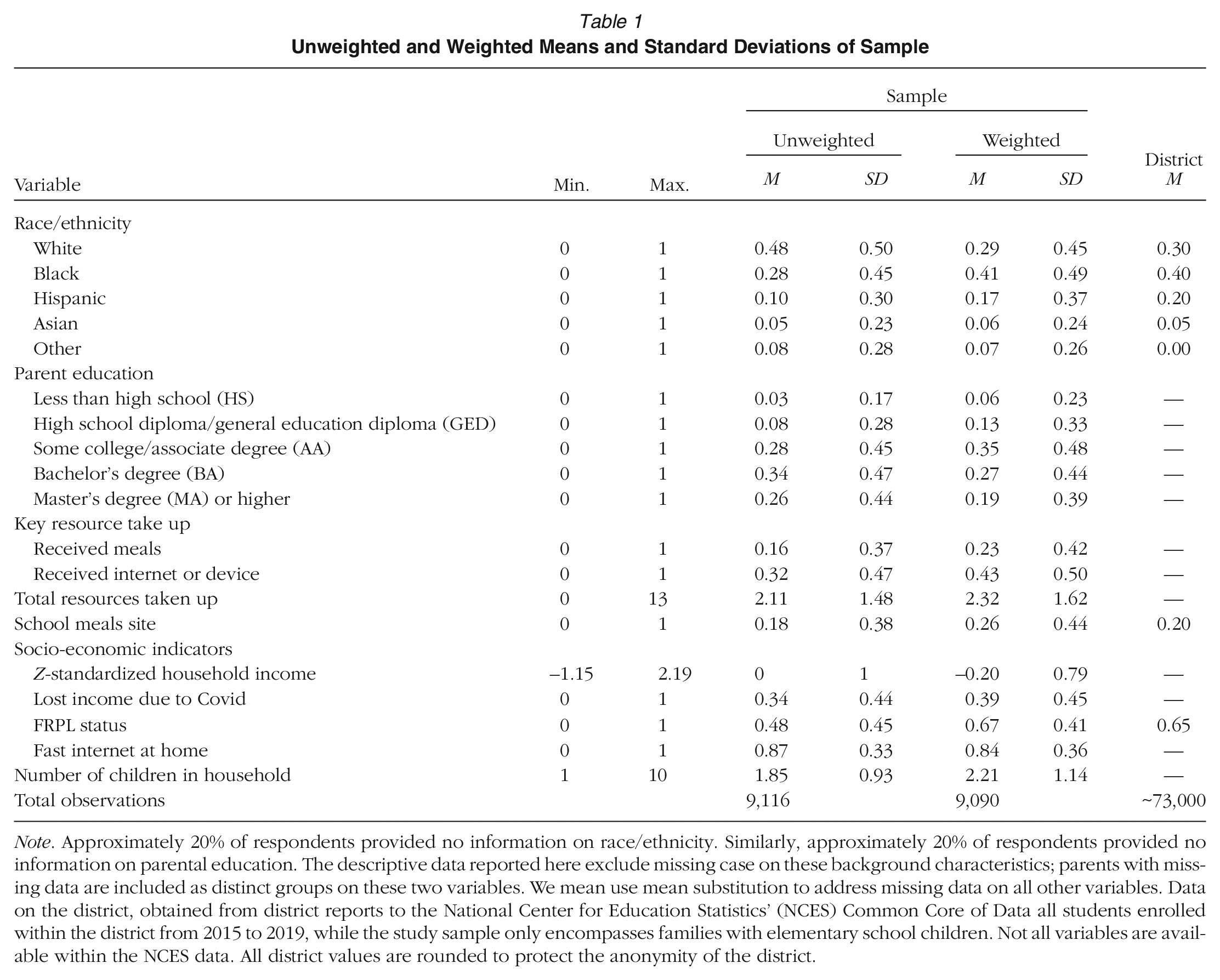
Note. Approximately 20% of respondents provided no information on race/ethnicity. Similarly, approximately 20% of respondents provided no information on parental education. The descriptive data reported here exclude missing case on these background characteristics; parents with missing data are included as distinct groups on these two variables. We mean use mean substitution to address missing data on all other variables. Data on the district, obtained from district reports to the National Center for Education Statistics’ (NCES) Common Core of Data all students enrolled within the district from 2015 to 2019, while the study sample only encompasses families with elementary school children. Not all variables are available within the NCES data. All district values are rounded to protect the anonymity of the district.
Dependent Variable
The key dependent variable is a count of the number of resources that elementary school parents reported receiving from their child’s school during the first few months of the pandemic-induced transition to remote learning. Our survey allows families to identify up to 14 different supplemental physical and academic resources received during the Spring 2020 semester, including (1) meals, (2) clothes, (3) housing support, (4) healthcare support, (5) transportation, (6) employment assistance, (7) school supplies, (8) cash payments, (9) devices such as computers and tablets, (10) internet access, (11) device assistance, (12) tutoring, (13) additional assignments, or (14) feedback on student work. As Figure 1 indicates, the modal respondent indicated that they took up two of these supplemental district-provided supports. However, family resource uptake varies considerably. Approximately 7% of respondents (6% of weighted respondents) report taking up no district-provided supplemental resources, while nearly 20% of respondents (25% of weighted respondents) reported taking up four resources or more. At the far-right-hand tail, a handful of families reported taking up as many as 13 school- or district-linked resources during the pandemic period.
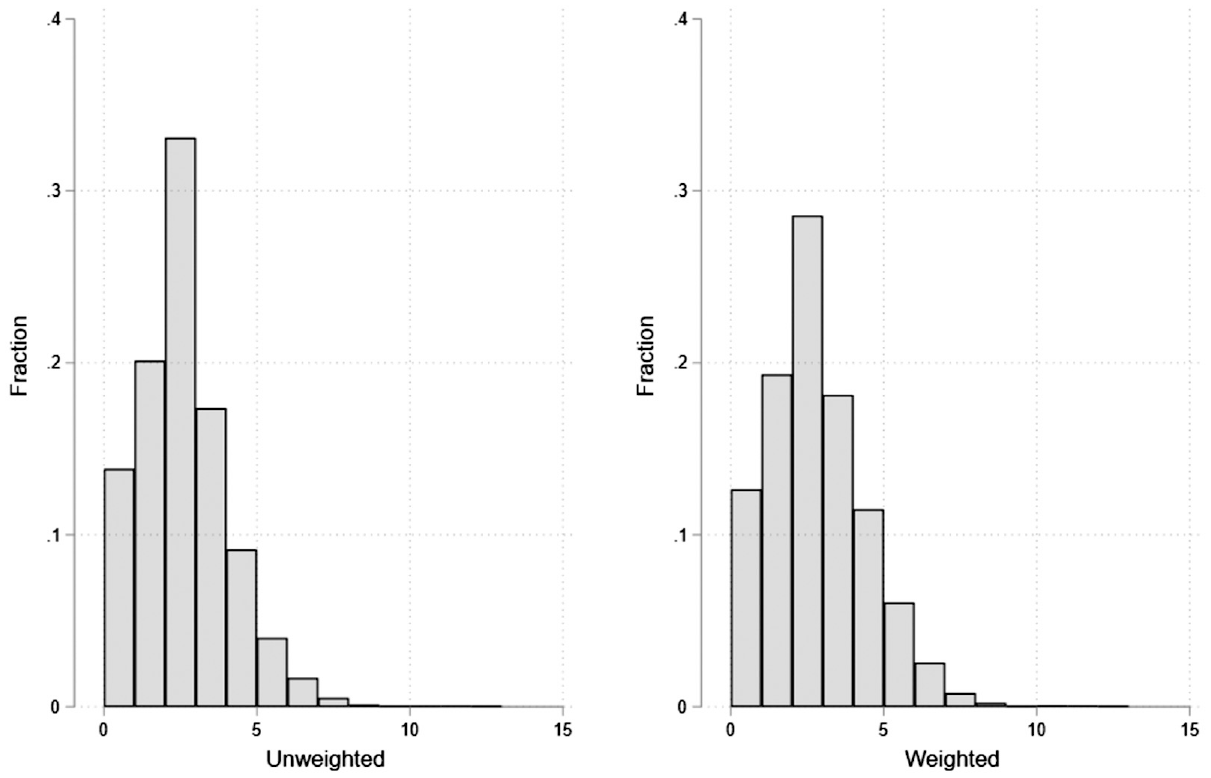
Distribution of resource uptake among survey respondents.
Survey responses indicate that meals and devices were the most commonly accessed supplemental resources during the Spring 2020 semester. Sixteen percent of respondents obtained meals, and 32% received internet or a device. (These figures are 23% and 43%, respectively, in the weighted data.) Survey responses indicate that families overwhelmingly received these resources from teachers, principals, or other professionals associated with their child’s school, although approximately 5% identified school-associated community organizations as a source of at least one resource received. A small number of parents report receiving resources from other families at their child’s school.
Focal Independent Variables
Our three key independent variables of interest based on our hypotheses include: need, school-based social connections, and school meal sites.
Need
We use self-reports from the parent survey to generate several need measures: standardized household income, an indicator variable for lost income during the early months of the pandemic; access to reliable fast internet at home; and pre-pandemic FRPL status. We use mean substitution to account for item nonresponse on these variables.
School-based social connections
Social connections are a theoretically and empirically important aspect to school community. Though social connections can occur at multiple levels and across various populations at a school, we focus on social connections among parents. The survey asked respondents to indicate the ways in which they communicated with parents of their child’s classmates. We then generate an indicator variable to represent a lack of school-based social connections where a respondent is coded as 1 if they do not report any communication with other parents.
School meal sites
As described above, a school meal site is one that is designated by the district to distribute meals. These data were collected from publicly available documentation of meal site locations in the district.
Analytic Methods
We investigate the relationship between need, social connectedness, and resource caravanning processes and families’ uptake of school-provided resources using both bivariate data visualizations and more formal multivariate analyses in which we regress predictors on a count of the number of distinct school-provided resources that families reported taking up during the pandemic’s early months. Since this analysis is a count variable with a distribution that is censored at the left-hand side, we use Poisson regression to investigate the number of total resources taken up by each family represented in the survey. 6 To ease interpretation, we report marginal effects for all multivariate models. As such, estimates from the Poisson regressions represent the change in the number of school- or district-provided resources families took up during the pandemic’s early months associated with a one-unit shift in the independent variable, conditional on other independent variables. Since supplementary analyses indicate that weights inform several of our multivariate estimates, 7 we employ weights in the multivariate analyses presented in the main article. Supplementary analyses, presented in the appendices in the online version of the journal, report unweighted results.
To test our first hypothesis, which suggests that higher levels of family need will be associated with higher levels of resource uptake, we estimate models of the following general form:

We estimate one version of this general model in which the dependent variable Y is the indicator variable flagging families that take up any school-provided resource and a second version in which the dependent variable Y is the count of the number of resources a family takes up. The key independent variables in this model are represented by the “Need” term. Our measures of chronic need include standardized household income, FRPL program participation, fast internet, and the number of children in the household. We additionally capture acute need with an indicator variable flagging families that reported lost income due to the Covid-19 pandemic. Since families with higher income levels and fast internet likely have lower need for school-provided resources, we interpret negative relationships between these predictors and resource uptake as consistent with our first hypothesis. Conversely, we consider lost income due to the pandemic, previous participation in the school lunch program, and a greater number of children in the household as indicators of family need; we interpret positive marginal coefficients for these predictors as consistent with our first hypothesis. Our model additionally controls for family race/ethnicity and parent education, both of which have been demonstrated to be associated with program participation in other contexts (e.g., Gray et al., 2022).
To test our second hypothesis, we elaborate the above model by adding an indicator variable flagging families who report no contact with parents of their children’s schoolmates during the first semester of pandemic-induced remote learning.

Since this hypothesis holds that socially disconnected families will tend to have lower rates of resource uptake than similarly situated families with more school-based social connections, our second hypothesis leads us to expect the marginal effects associated with this indicator,
To test our third hypothesis, we estimate models investigating the relationship between participation in our hypothesized key resources, meals and technology, and the total number of school-provided resources that families took up.

We test this hypothesis using Poisson regression models using the count of total resources as the dependent variable exclusively, since there can by definition be no variation in the indicator variable flagging families who took up any resource among those who took up one or more key resource. We test our third hypothesis in a series of three models. In the first, we include an indicator flagging families who report receiving school meals during the pandemic. In the second, we include an indicator flagging families who report receiving an internet-enabled device and/or high-speed internet access from their school or the district during the pandemic. And in the third, we include both measures of key resource uptake. If families who take up a key resource are no more likely to take up any other resource, the marginal coefficient for each key resource variable would equal 1. If taking up a key resource is associated with the uptake of other, nonkey resources, as our third hypothesis implies, the marginal coefficient for the key resource variables in these models will be significantly greater than 1.
While the analyses described above shed light on the ways need, social connectedness, and resource caravans are related to family uptake of district provided resources, they cannot speak to the ways the district reached out to families in need, creating, activating, and/or replacing families’ social networks and instigating resource caravans. In our final analysis, therefore, we examine how school meal sites, one of the district’s most prominent efforts to target resources to families in need, is correlated with resource uptake. Building on the finding that families whose children enroll in schools in which the district located meal distribution sites in Spring 2020 took up more resources than similar families who attend non-meal-site schools, we look more closely at the correlation between family social connectedness and resource caravanning for these families.
We test four additional models to investigate the process through which school-based meal sites boost resource uptake. The first of these models establishes the relationship between meal site attendance and total resource uptake:

The second estimates the extent to which social connectedness and key resource uptake act as mechanisms that explain the relationship between meal sites and total resource uptake:

Our final two models investigate the ways meal sites moderate the social connectedness and resource caravanning processes that we hypothesize drive resource uptake processes more generally. Of particular interest is the way meal sites moderate the link between social connectedness and total resource uptake. One could imagine meal sites activating existing social networks, making socially connected families at the meal site even more likely to take up district-provided resources. Alternatively, one could imagine meal sites undermining the link between social connectedness and resource uptake if they provide a mechanism to connect relatively unconnected families with resources. We test these possibilities by estimating the following model:

We further estimate a similar model to investigate how meal sites moderate resource caravanning processes.
Findings
Hypothesis 1: Needs Correlate With Resource Uptake
Figure 2 reports estimates from two multivariate models exploring the factors associated with uptake of school-provided resources. Model 1, the base model, reports a Poisson regression analysis that estimates the association between covariates and the number of total resources taken up. In addition to considering income loss during the early pandemic period as an indicator of family need, this model adds controls for family household income, FRPL enrollment in the pre-pandemic period, family size, and family access to high-speed internet. Model 2, which we discuss in detail below, adds an additional predictor measuring family social connectedness. Both models also control for student race/ethnicity and parental education. Only the coefficients of interest are reported in the figure. However, full models are reported in Appendix Table 1 in the online version of the journal.
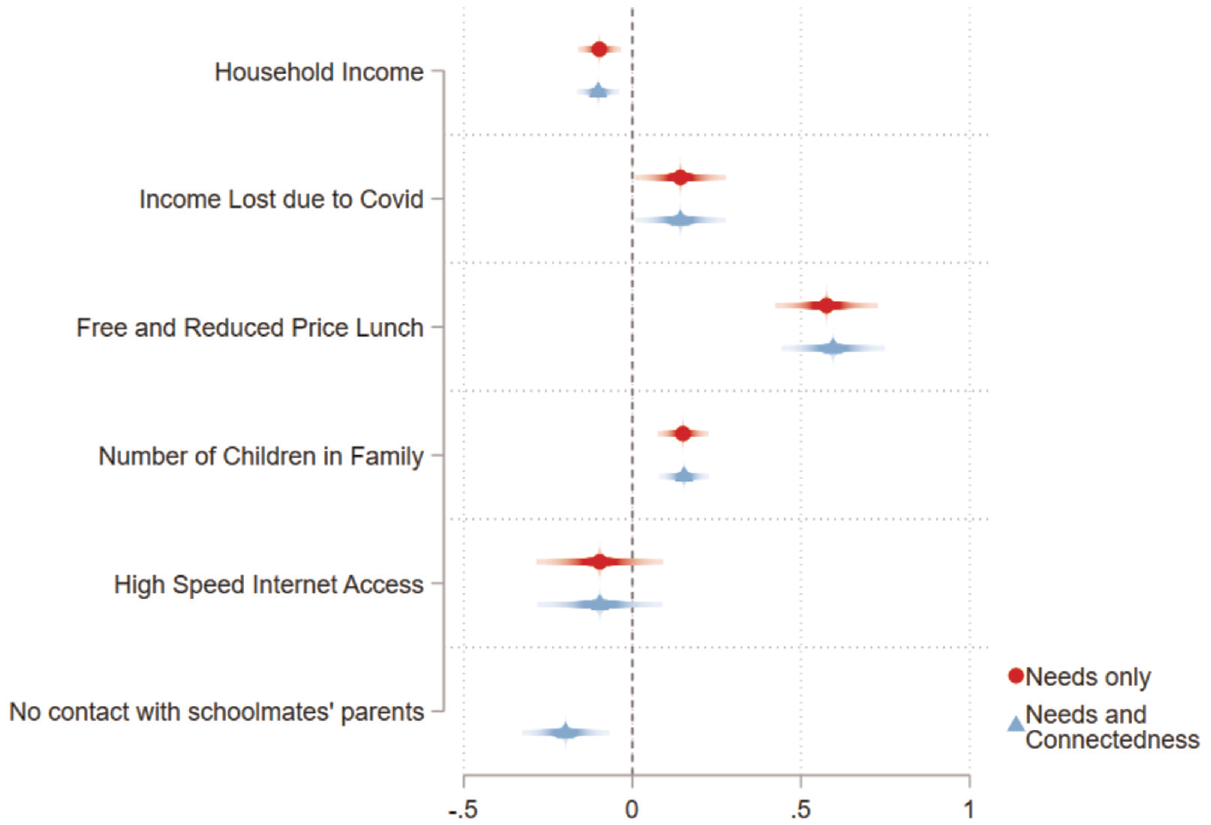
Poisson regression marginal effects, family socioeconomic need and social connectedness predicting total resource uptake.
Consistent with our first hypothesis, the base model indicates that families who report greater socioeconomic challenges were more likely to take up district and school-provided social services during the pandemic’s early months. Increased household income is associated with a decreased likelihood of obtaining any resource as well as a decreased likelihood of obtaining key resources such as meals or internet or device. Each standard deviation increase in household income is associated with a statistically significant 0.10 decrease in the count of total resources obtained, conditional on controls. This pattern is mirrored by the marginal effects on other socioeconomic covariates. Having lost income during Spring 2020 is conditionally associated with a predicted increase in total resource uptake of 0.14 resources. These models further illustrate that families with more children in the home and families who lacked access to reliable, fast internet were significantly more likely to take up resources and took up more resources, net of controls.
Notably, this model indicates that families whose children received FRPL prior to remote learning were more likely to take up any resource than economically and demographically similar families who did not receive FRPL; families who received FRPL before the pandemic received 0.58 more resources from their children’s school or the district during the early pandemic period. Our models include FRPL participation as an indicator of family need on the assumption that students whose families with higher levels of food insecurity were more likely to enroll in and take up FRPL when their schools operated in person. However, there is an alternative interpretation of the strong conditional association between pre-pandemic school lunch participation and pandemic-era resource participation. If receiving free or reduced-price meals during in-person instruction helps families see schools as reliable sources of essential social services, these meals may initiate resource caravanning processes that boost uptake of other school-linked services during the pandemic period. We will return to this possibility in our discussion of Hypothesis 3.
Hypothesis 2: Families With Limited School-Based Social Connections Are Less Likely to Take Up Resources
The Model 2 in Figure 2 tests our second hypothesis by adding an indicator flagging families who had no contact with the families of their children’s schoolmates when schools had transitioned to remote-only instruction. Results reported in Figure 2, Model 2 indicate that net of controls these families took up an average of 0.20 fewer resources than families who maintained contact with at least one other school-affiliated family. The addition of the measure for social isolation does little to offset the coefficients associated with previously discussed indicators for family need. We interpret this model’s results, therefore, as consistent with the COR-motivated hypothesis that social ties are correlated with resource uptake.
Hypothesis 3: Key Resource Uptake Is Associated With Resource Caravans
Figure 3 reports the series of Poisson regression models designed to test the resource caravan hypothesis, which holds that taking up one resource sets in motion a process that facilitates the uptake of other resources. As noted above, the conditional association between pre-pandemic participation in school FRPL programs and resource uptake, documented in Figure 2, provides an initial indication of support for this hypothesis. The results reported in Figure 3, which focus on the role that meals and internet-enabled device distribution played as key resources during the remote learning period, are similarly consistent with the idea of resource caravans.
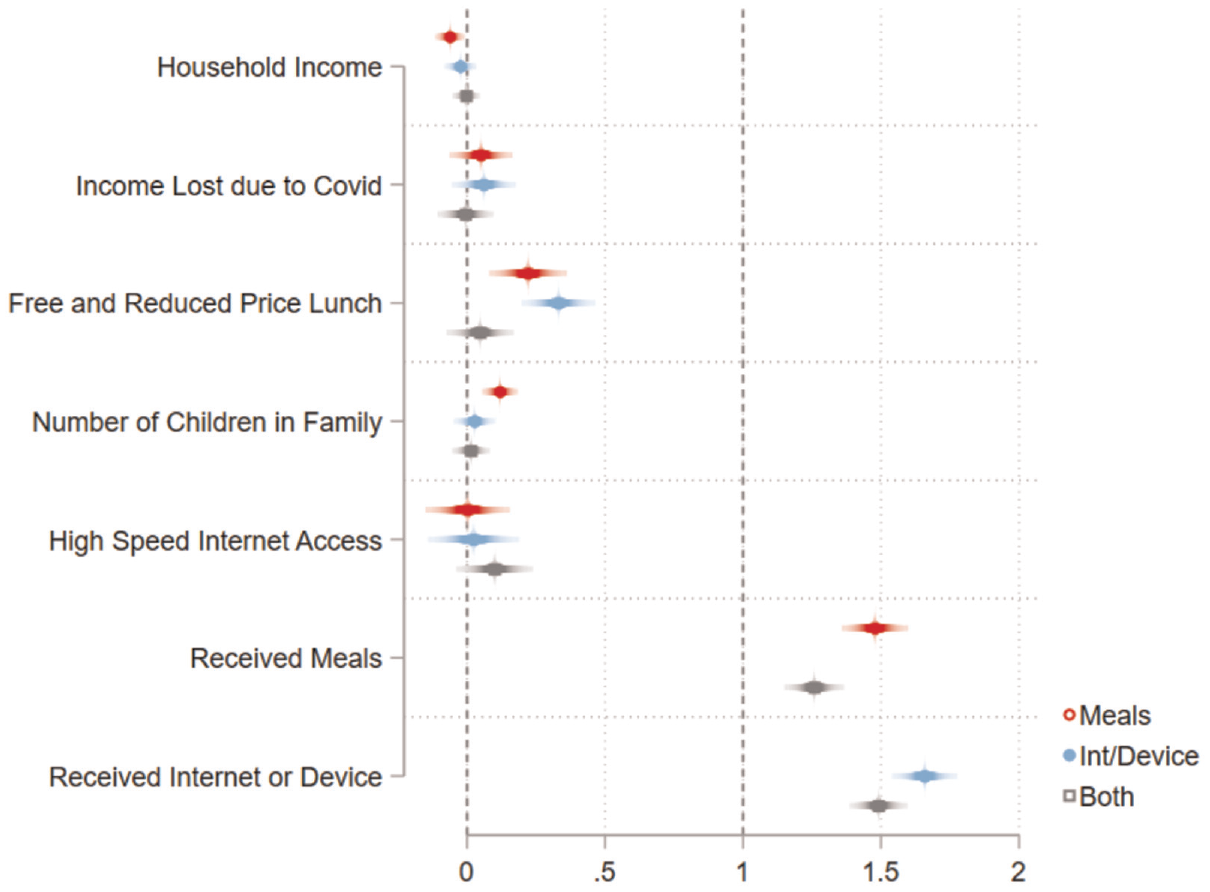
Poisson regression marginal effects, family socioeconomic need and key resource uptake predicting total resource uptake.
We run three separate models, adjusting the included covariates: Model 1 controls for the receipt of meals during the pandemic period, Model 2 controls for the receipt of internet or device, and Model 3 controls for the receipt of both key resources. Since these two key resources contribute to the count of total resources received, which is the dependent variable in this model, these two predictors are mechanically linked to the outcome. Put differently, when a family receives meals from their child’s school, this participation increases their count of total resources by one. As such, to test our third hypothesis, we determine if the coefficients for the key resources are statistically different from one. A coefficient significantly greater than one indicates that the independent variable is associated with the uptake of more resources. If taking up the identified key resources discouraged the uptake of additional resources, then this coefficient would be less than one. If the coefficient was exactly one, then the key resource would have no impact on additional resource uptake.
Compared to those that did not take up a meal, taking up a school meal during the remote learning period is associated with the uptake of 1.48 more resources (including meals) than those that did not receive meals. This finding is evidence of resource caravanning. If those that received meals were, on average, receiving the same number of nonmeal resources as those that did not receive meals, this value would not be significantly greater from one. A similar resource caravan pattern is observed with the receipt of internet or a device. Those receiving internet access or an internet-enabled device from the district received, on average, 1.66 more total resources, including this key resource. Furthermore, the analysis reported in Figure 3’s third model indicates that both key resources independently contribute to resource caravanning processes. This model indicates that the association between receipt of each key resource and total resource uptake remains significantly different from one even when both resources are included in the model. We interpret this to mean that both meals and internet or device acted as key resources during the pandemic’s early months and are associated with resource caravanning.
School Meal Sites as a Strategy to Improve Resource Uptake
As schools closed their doors and transitioned to remote-only schooling in Spring 2020, commentators and educators across the United States worried about the implications of school closure for youth nutrition. To help get meals to young people at risk of food insecurity during this precarious moment, our partner district set up dozens of meal distribution sites. The district situated many of these meal sites at high-poverty schools. Drawing upon COR theory, we hypothesize that children attending schools in which the district opened a meal distribution site will be more likely to take up district-provided meals and other resources. This hypothesis is grounded in the same mechanisms that our previous analyses indicate facilitated resource uptake more generally: (a) social networks among potential resource recipients and (b) resource caravans. In the analyses described in Table 2, we measure the link between attending a meal site school and resource uptake and investigate the mechanisms that account for that link.
Poisson Regression Marginal Effects, Relationship Between Attending a Meals Site School and Total Resource Uptake
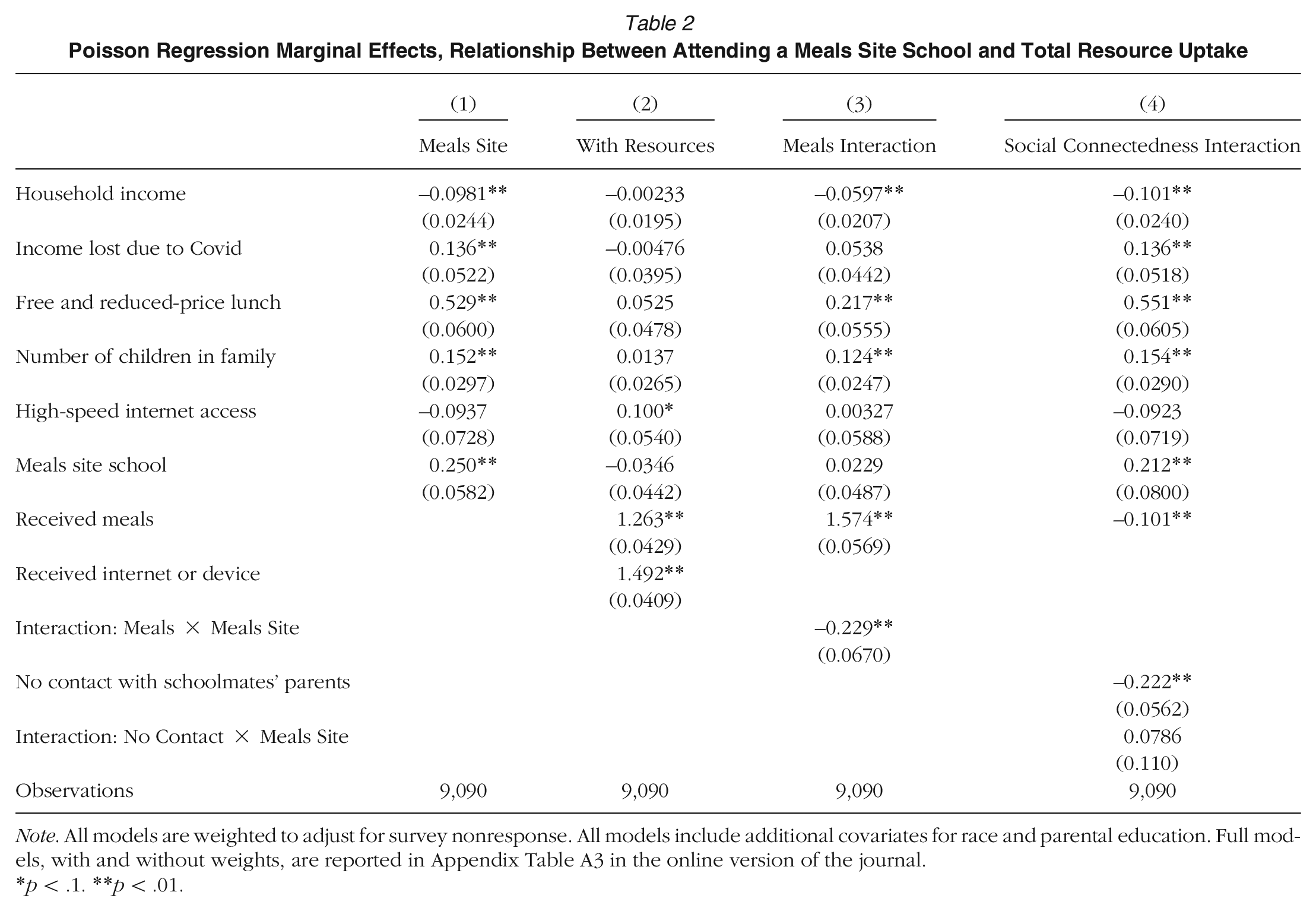
Note. All models are weighted to adjust for survey nonresponse. All models include additional covariates for race and parental education. Full models, with and without weights, are reported in Appendix Table A3 in the online version of the journal.
p < .1. **p < .01.
The multivariate model represented in Column 1 of Table 2 indicates that families whose children attended schools with meal sites took up approximately 0.25 more resources on average than families at non-meal-site schools, conditional on controls for family demographic background and need. This finding is striking since all families in the district had access to all of the resources made available at meal sites; and indeed, families who attended schools that did not operate meal sites typically had access to district-provided resource distribution points elsewhere in their neighborhoods. It indicates that simply by physically locating resource distribution efforts in their students’ elementary schools, the district helped families to access resources.
The remaining models in Table 2 investigate why school-based meal sites worked to boost resource uptake. The results reported in Column 2 indicate that attending meal site schools particularly boosted the likelihood that families took up the key resources. After controlling for family receipt of meals and internet or device, the marginal coefficient associated with meal site attendance is not statistically significantly different from zero, a finding that suggests these two resources drove the relationship between school meal sites and resource uptake.
Importantly, however, it is not clear that school-located meal sites facilitated the uptake of other nonkey resources. Column 3 of Table 2 reports the results of a model that includes an interaction term that investigates the extent to which resource caravanning associated with meal receipt differs for students attending meal sites schools compared to their peers who attended elementary schools that did not have an on-campus meal site. The negative and statistically significant coefficient in this model indicates that the families who took up resources at school meal sites seem to have been somewhat less susceptible to resource caravanning processes than families with similar levels of need elsewhere in the district.
This finding may be attributable to the limitations of the pandemic context. Because these meal sites were designed around the social distancing protocols in place in Spring 2020, they provided few opportunities for families to learn about other available resources and connect with one another. Indeed, in most cases, families received meals at these sites without leaving their cars. Consistent with this interpretation, the analyses reported in Column 4 of Table 2 indicate that the link between school meal sites and resource uptake is not substantially altered by controlling for an indicator for family social connectedness. Further, the interaction term between school meal sites and social connectedness in this model is not statistically significantly different from zero. Taken together, these findings suggest that school meal sites operated relatively independently of families’ social connections and did little to offset the negative link between social disconnectedness and resource uptake.
Discussion and Conclusions
By providing social and material resources to students and their families, school-linked service efforts have the potential to substantially improve student well-being (Maier et al., 2017). However, to reap these benefits, students and families must take up the resources and services their schools provide. Contemporary research provides little information about who obtains resources from schools, by which mechanisms, and the way community connectedness and distribution structures work together to encourage families to take up school-linked services. Our analyses indicate that family need is associated with resource uptake but that during the early months of the pandemic, many families facing acute needs did not take up the resources that the district and its schools provided. Our analyses point to two different mechanisms associated with resource uptake among families contending with acute needs. First, families who are socially connected are more likely to take up school-provided resources than families who have limited social ties with other parents in the school. Second, once families take up a first key resource, such as a meal or a device, resource caravanning processes often occur, leading to the uptake of additional resources.
We find it striking that social connectedness is so closely associated with resource uptake, even during the pandemic lockdown period, when public health measures created pronounced economic challenges for many families and made it difficult for them to maintain social connections. Families who did not have contact with other parents at their child’s school during the transition to remote instruction took up fewer district-provided resources during Spring 2020. This finding may reflect, in part, unmeasured challenges that families faced during the pandemic’s early months. Families facing severe economic challenges during the lockdown period—many of whom were grappling with health, housing and food security concerns, living paycheck to paycheck, juggling multiple jobs, and coping with unpredictable work schedules—likely also struggled to maintain school-based social connections. However, it is notable that even after accounting for a robust set of family socioeconomic measures, we find that families who maintain school-based social connections access more resources from the school and district. These findings are consistent with those documenting how organizationally brokered ties facilitate resource acquisition, particularly in school contexts (Lukasiewicz et al., 2019; Small, 2009; Small & Gose, 2020). By providing settings in which families can interact regularly, schools can build the social networks and trust that facilitates participation in school-provided services and resources.
Further, our findings indicate that connections to key resources, in this case, meals and internet-enabled technology, correlate with a positive gain cycle that connects families to other useful resources. This resource caravanning phenomenon is both theoretically and practically important, since it points both to the often-self-reinforcing nature of family distress and the potential for relatively small but well-chosen resources to exert disproportionately large consequences on family well-being. Even if individuals may be reluctant to pursue new resources due to the uncertainty of potential benefits (Hobfoll 2012), facilitating access to resources that fulfill essential needs will likely pave a path towards the acquisition of added resources.
We build our empirical models on information provided by the district about their distribution efforts in the early months of the pandemic. We note that there are limits to our ability to infer about the exact mechanisms that led to resource caravanning, since we are unable to track the path taken from the uptake of the first resource to subsequent ones. This study is not able to examine how resource provision efforts by the district changed over time—and the attendant rates of resource uptake—but instead capitalizes data early in the pandemic to capture patterns during an intense period of resource need and distribution. As schools increasingly find themselves on the front lines of crisis response, we believe our findings around resource caravanning provide useful insight to practitioners and policymakers seeking to develop crisis response plans and infrastructure.
Notably our analyses suggest that the design of school-based resource provision efforts can contribute to—or inhibit—the development of resource caravanning processes. During the early pandemic period, the district in which our survey was conducted set up an ambitious effort to distribute meals to families via meal sites located at 15 high-poverty schools. Meal sites provided an important mechanism for getting food to children and families facing high levels of economic need. However, resource caravanning processes among families who used meal sites located at their children’s elementary schools were less pronounced than resource caravanning among economically similar families whose children’s schools did not host a meal site. These findings likely speak to both the profound challenges facing schools and other service providers while families socially distanced, and the theoretical connections between social connectedness and resource caravanning. Since these meal sites provided few opportunities for families to interact with one another or with teachers, staff, and other service providers, they likely did little to supplement families’ social connectedness and facilitate the creation of resource caravans.
It is important to acknowledge that our data were collected in a single district during the highly atypical pandemic lockdown period. As such, we encourage readers to interpret and generalize findings from this case with caution. For example, we believe that it would be a mistake to interpret our findings as an indication of the limitations of school-based meal provision as a strategy for initiating resource caravanning processes. The pandemic context—and in particular the need to maintain social distancing in order to slow the virus’s spread—constrained the district’s implementation of the school-based meals program in a way that likely limited resource caravanning at school-based meal sites. But we should note that the meal sites were highly successful in providing daily nutrition to families. Moreover, due to both the pandemic context and the nature of our data, our analysis does not engage directly in the important role that families’ social connections with their children’s teachers and other educators play in influencing resource uptake. This is an important direction for future research.
That said, we believe that this district’s pandemic experience yields important insights for school-linked service provision in a broad range of other contexts. In an era of increasing civil unrest and climate catastrophe, profound educational disruptions and other crises are likely to be increasingly common. Schools often play a central role both in initial disaster response and in longer-term disaster recovery efforts (Galemore, 2012; Kennedy-Paine et al., 2013). In some instances, schools provide resources well beyond the disaster period by offering counseling support systems to address students’ socioemotional and mental health needs (Crumb et al., 2021). Our analyses indicate that schools can prepare for disasters by facilitating social connections among families, teachers, and community members. These social connections are likely to help educators design resource provision efforts that respond to family needs and increase resource uptake.
We suspect that this lesson also broadly applies to more commonplace school-based resource provision efforts. As we noted in the introduction, educational organizations increasingly offer knowledge-based and other material resources to families, including parent workshops, after-school tutoring (Nickow et al., 2020), health centers (Hodges et al., 2021), and other community programs (Osofsky et al., 2018; Valli et al., 2016). Most of the existing evidence about these service provision efforts comes from evaluations of relatively well-funded community schools models and similarly intensive efforts (Dryfoos & Maguire 2019). These programs are often highly intentional about collecting data on local needs and developing programs that respond directly to these needs. They also typically capitalize on formal school events and informal daily interactions to build dense social networks among educators and families and carry out distribution processes that contribute to the creation of resource caravans (Dryfoos & Maguire, 2019).
Most school and district-based service provision efforts lack the resources to conduct the planning and coordination that is typical in these gold standard programs. For example, effective full-service community schools employ a full-time coordinator to liaison between educators, community partners, and families (Dryfoos & Maguire 2019). The district from which we collected our data lacked this organizational capacity as it developed and implemented a broad set of new efforts to provide for student and family health, addressed issues associated with housing and food insecurity, broadened access to learning technologies, and responded to other needs.
In settings that have similar limitations to their organizational capacity, informal social connections among and between families, educators, and community members are likely to facilitate the development of programs that are genuinely responsive to family needs and that foster the sort of trust that contributes to resource caravanning (Ishimaru, 2020). Our analyses underscore that each of these three pillars—meeting needs, fostering social connections, and initiating resource caravans—plays an important role in getting school-provided resources and services to families.
Supplemental Material
sj-pdf-1-aer-10.3102_00028312231209231 – Supplemental material for Offer It and They Will Come? An Investigation of the Factors Associated With the Uptake of School-Sponsored Resources
Supplemental material, sj-pdf-1-aer-10.3102_00028312231209231 for Offer It and They Will Come? An Investigation of the Factors Associated With the Uptake of School-Sponsored Resources by Caitlin Kearney, Alma Nidia Garza, Lysandra Perez, Linda Renzulli and Thurston Domina in American Educational Research Journal
Footnotes

Notes
C
A
L
L
T
References
Supplementary Material
Please find the following supplemental material available below.
For Open Access articles published under a Creative Commons License, all supplemental material carries the same license as the article it is associated with.
For non-Open Access articles published, all supplemental material carries a non-exclusive license, and permission requests for re-use of supplemental material or any part of supplemental material shall be sent directly to the copyright owner as specified in the copyright notice associated with the article.
