




Abstract
The main aim of this exploratory study was to establish how Batswana teens (natives of Botswana), who predominantly spoke English in social interactions, negotiated communication transactions with non-speakers of English. The author presents her reflections in the manner of a think piece, However, she interviewed some young Batswana to help understand how they navigated communication with locals who did not speak English. The data was then analysed for themes, recurring patterns and variations. The findings of the study revealed that participants experienced satisfactory levels of social connectedness, due to the fact that they interacted primarily with ‘their own’ – that is, others who also spoke English at home and in their immediate social settings. However, they did experience unsatisfactory levels of social connectedness with non-speakers of English. In the analysis, the experiences were found to have elicited minimal negative effects, as they were viewed as transient and often sporadic. Beyond her conclusions, the author advances the implications of Botswana being at risk of losing its ‘cultural capital’, even as these young Batswana attain and enjoy linguistic capital. At risk is a loss of language identity. New ‘slang’ references, often derogatory in nature, have also emerged, with these young people being called ‘coconuts’ or ‘Oreos’.
Keywords
Over dinner, a 13-year-old nephew bemoans: My folks speak to me in English, my teachers speak to me in English, my friends speak to me in English, my dentist … the list goes on. Now my family in the village look at me queer because I can’t speak with them in Setswana, and my cousins refuse to play with me.
My argument derives from the notion that even though culture is considered dynamic, an unchanging social practice in Botswana is the extended family support structure. Regular contact with relatives is therefore inevitable, though this varies with different families. Locals residing in urban areas visit their home villages on the occasion of family weddings, funerals or other social events. Children often join in with these visits and activities. It could be argued that there is, consciously or at a deeper level, consistent socialisation for young people to cherish and sustain close kinship with their cousins and other relatives. My contention is that if these children are not taught the common language of communication in the village, they will find it difficult to integrate. The dominant language in typical Tswana villages is Setswana. It is spoken by the majority of the tribes of Botswana, such that tribes who have their own regional language can, and often do, speak Setswana.
Language is an inherent tool for social interaction – a system that human beings rely on to socialise and to strengthen social bonds with others. Language is an integral factor for a nation’s culture and provides for a nation’s ‘cultural capital’. Language also provides for an individual’s personal identity, language identity and linguistic capital (Bourdieu, in Meyer-Schwartzenberger, 2013 ). Consequently, teenagers, and indeed other age groups, work hard to gain linguistic capital. Meyer-Schwartzenberger (2013) describes linguistic capital as a form of cultural capital, where an individual in speech situations derives prestige based on their competence in the language.
Yeh and Inose (2003: 1) describe social connectedness as the relationships people have with others and the benefits these relationships can bring to the individual as well as to society. Social connectedness is clearly a necessary component for a well-functioning and socially sound member of any society. In their examination of social connectedness, Yeh and Inose (2003: 1) conclude that it is fostered when family relationships are positive and when people have the skills and opportunities to make friends and to interact constructively with others. Consequently, good health, employment, and feelings of safety and belonging are enhanced. Language reinforces social cohesion within societies.
For young people, language serves as a determining factor for social membership. Maynard and Perakyala (2003: 244) identify identity as one of the central themes in discursive psychology – that ‘in and through talk, speakers present themselves, those they talk to and those they talk about, as having particular identities’. Social connectedness is an important aspect of adolescents’ transition into young adulthood. In an analysis of adjustment difficulties, loneliness, social support and social connectedness, Duru (2008) explains that the transition from high school to higher education is a fundamental period in students’ social and academic lives in terms of adjustment. The formation of social relationships is crucial for students’ adjustment to college life. The importance of the English language in social interactions is further asserted by Telford (2014), who advances that numerous driving forces have pushed the English language beyond English-speaking countries. An example is the ever-growing connectedness of the global society, which has affected the way people speak and communicate.
It is evident that capacity for engagement in the social arena necessitates a common language – often English (for those from diverse language backgrounds) – as a means of communication and interaction. In the context of Botswana, Adeyemi (2012) argues that English is even more important for the young Motswana, as Recommendation 31 of the Revised national policy on education stipulates ‘English as a tool for effective communication study and work’ (p. 49). Adeyemi (2012: 49) advances that, in Botswana, English is an access language in technology and information services, and that it ‘facilitates the acquisition, creation and documentation of knowledge’. Competency in English, Adeyemi states, is fundamental in the educational system and in socio-economic terms in Botswana. Prophet’s study (cited in Adeyemi, 2012: 49) contends that competence in English is important for ensuring access to high-status jobs and upward social mobility. It may be that, in the context of Botswana, the attainment of linguistic capital for young people is also high because one of the requirements for entry into a tertiary institution is a pass in English. Because of this, it may be that parents encourage their children to attain mastery of the English language.
In light of the foregoing, I sought to explore how young Batswana who predominantly spoke English in their everyday social situations navigated communication with locals who could not or opted not to speak English. Purposive sampling was used as it was suitable for the study. The sample population comprised Batswana teenagers who predominantly used English as their language of communication in the social sphere. Their ages ranged from 13 to 18. There were six participants in total: three males and three females. For ethical purposes, permission for data collection was sought from their parents, and consent forms were signed by the parents and the participants. For confidentiality, the participants were given the following pseudonyms: Jane, Mike, Joey, Thato, Ben and Jennifer.
Participants' specifics are tabulated below.
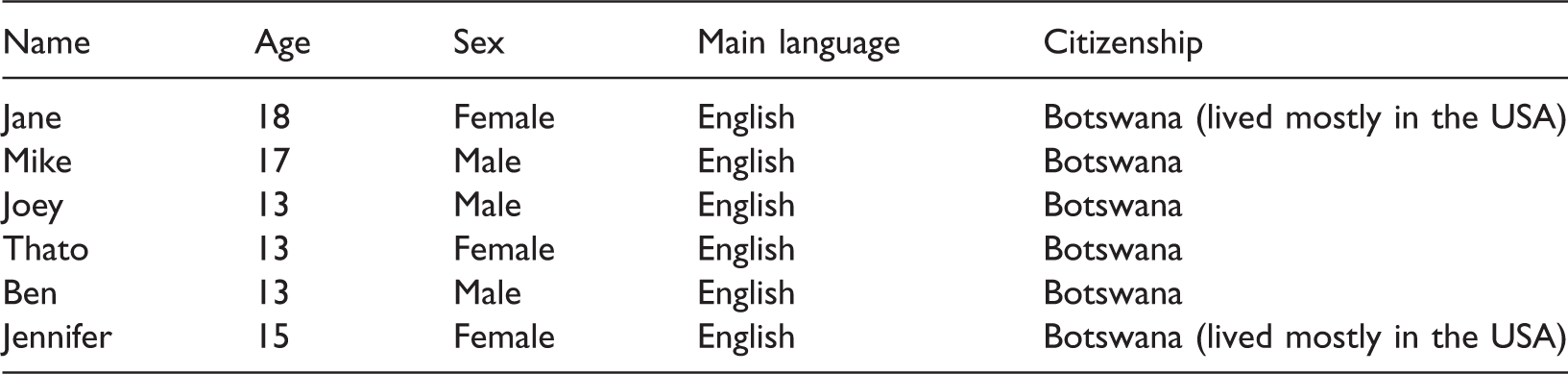
Two interviews were held with each participant on a one-to-one basis. One preliminary interview and one follow-up interview were conducted using open-ended questions. The follow-up questions were asked where clarification was necessary. The interviews were semi-structured, allowing for minimal follow-up questions, which were only for purposes of clarification. The interviews were held over six weekends, and the information obtained was noted and subsequently organised into common patterns and themes.
Findings and analysis
The participants generally stated that they grew up within a home culture that predominantly encouraged English when communicating with each other. As a result, there prevailed an inclination for all of the participants to speak English, even outside of the classroom. This is contrary to typical Tswana settings, where English is the official language and language for instruction in the classroom. This culture of English that the participants found characteristic of their immediate setting was what they attributed to their inclination to speak English over local languages spoken in Botswana, including their mother tongue.
The participants felt that they were generally proficient in English. In their descriptions of their competence in English, the participants used phrases like ‘very good’, ‘exceptionally good’ and ‘excellent’. For example, Jane stated that she was ‘excellent’, while Mike said: ‘I’m exceptionally good’. Joey gave a lengthier answer, saying that he was good at English and felt he had made progress over time, and ended by stating: ‘In fact, it is the only language I can speak well’. Thato and Jennifer said they were ‘very good’, while Ben said he was ‘pretty good’.
On the aspect of the effectiveness of communication transactions in social interactions with people who did not speak English, all of the participants mentioned that they had to employ some form of communication strategy to enhance communication. Only one participant used the word ‘difficult’, yet evidently they all found it necessary to improve and make communication effective in some way – for example, by using gestures, speaking slowly and using some Setswana vocabulary in a sentence.
Through the preliminary interviews, it was interpreted that the participants were not only confident in using English as their language of communication, but that this was their preferred language of use outside of school boundaries, where Batswana teens would characteristically revert to their mother tongue or Setswana.
Several themes emerged in the participants’ notation of an experience they were asked to recall. The purpose of the second round of interviews was to establish whether they felt socially connected in interactions with members of society who did not/could not speak English. The emerging themes were categorised as follows:
Difficulty and frustration when faced with people who either refused to or could not speak English. The use of non-verbal cues to aid communication with people who did not understand English. Annoyance and offence at people who made fun of the participants in the interaction. Feelings of limitation and lack of control in communication transactions with people who did not understand English or those who opted to use Setswana. A quest to learn other languages to enhance social interactions and communication with people who did not understand English.
Difficulty and frustration when faced with people who either refused to or could not speak English
The first theme identified in the social encounter was that the participants voiced frustration and found difficulty in navigating social conversations because of limitations when speaking to people who could not speak English. Although the participants did not blame either themselves or other communicators, Ben stated that he took offence when people presumed he only spoke English and was not conversant in Setswana – though, when prompted, he admitted that indeed he was not.
The use of non-verbal cues to aid communication with people who did not understand English
The participants utilised several strategies in order to enhance communication and meaning – for example, they would use body language, such as gestures, to get their messages across. Although the participants experienced frustration at having to deal with language barriers with fellow Batswana, they felt that the strategies employed aided communication transactions well. In this regard, they opted to continue to use communication techniques, in some way retaining their comfort zone. Thato and Mike especially reiterated this fact, explaining that it helped the conversation, as people then understood what they were saying.
Annoyance and offence at people who made fun of the participants in the interaction
Jane expressed that, at times, she was ‘annoyed’, while Ben said he ‘got offended’ when people made fun of him. For example, Jane, who had a distinct ‘foreign’ accent, did not like it when the people she interacted with mimicked her speech, while Ben felt that there was always a presumption that he did not know his own mother tongue – though admittedly he did not. These were the only two participants who seemed to feel a degree of irritation in the experience. The other four – Mike, Joey, Thato and Jennifer – often felt frustrated, but did not express it in terms of blaming the other party.
Feelings of limitation and lack of control in communication transactions with people who did not understand English or those who opted to use Setswana
The participants generally expressed that they did not have control when in communication with others, as they felt that people chose to speak local languages. Joey felt scared and confused, and, at times, lonely. He stated that he resorted to talking less, while Jane felt she could not ‘camouflage’ her speech, which made her feel out of place. Jennifer felt a degree of embarrassment when she made an effort to greet in Setswana, as she had a generalised American accent. Not all of the participants alluded to this. However, it was deduced that they all felt some degree of limitation in the encounter. Jane and Ben vented their frustration, which could stem from feelings of a lack of control in the situation.
A quest to learn other languages to enhance social interactions and communication with people who did not understand English
Thato, Mike and Joey said that they intended to learn other languages in order to enhance communication with non-speakers of English. It is striking that they all felt they had to learn more than one language and not just Setswana, which is the dominant language and caused their language handicap in the first place. For example, Thato stated that she intended to learn Mandarin, Spanish and Swahili, while Mike felt a need to learn Kalanga (his mother tongue) and to improve his Setswana. Joey felt that he needed to learn a ‘variety of languages in order to accommodate those who do not speak English’.
Conclusions
The quote at the beginning of this article provoked a need to explore the degree to which the language phenomenon has set in, and how the participants dealt with situations that called for a capacity for spoken Setswana. I further advance the implications of the decline of Setswana, in line with Meyer-Schwartzenberger’s (2013) take on cultural and linguistic capital, and the possible ramifications and/or benefits of attaining fluency. This is tallied with Adeyemi’s (2012) view on the importance of English for the Motswana teen – it is expected that students attain a pass in English for entry into tertiary institutions locally.
The study reveals that the participants experienced satisfactory levels of social connectedness, primarily because they interacted mostly with ‘their own’ – that is, those who also spoke English at home, at school and in the social arena. However, they did experience unsatisfactory levels of social connectedness in communication with non-speakers of English. This experience, however, seems to have elicited a minimal negative effect, as the participants deemed it transient and often sporadic – although the participants still had to negotiate meaning and enhance communication effectiveness through non-verbal cues and, at times, employ some Setswana vocabulary in order to be understood.
The reason why native teens continue to experience a degree of social connectedness in interactions is because English is the language that they use in their homes, with friends and at school – the language that pervades their world. They further evidenced their ability to navigate negative circumstances by using communication strategies that enhanced meaning and interpretation in communication. For example, Jane resorted to speaking slowly in order to be understood, while others used gestures to get their message across.
Even though the participants were not adversely affected in the experience, as they viewed it as transient and occurring seldom, there could be a bigger problem for the country as a whole – the risk of a loss of its cultural capital, even as individuals attain linguistic capital (Meyer-Schwartzenberger, 2013). In the long run, Botswana may experience a threatened and diminished cultural capital if the phenomenon gains momentum or goes unchecked, while individuals obtain and enjoy linguistic capital.
Another aspect of concern is whether the individual may not ultimately lose their personal and language identity as they gravitate towards English and away from their mother tongue. As understandable as it may be that parents view English as crucial for the academic achievement of their children – it is, indeed, one of the requisite subjects for acceptance at tertiary institutions locally – in the long run this could also lead to a new crop of Batswana with a language identity crisis. As contentious as this may seem, I propose the creation of a balance between the use of both languages, as was intended when Setswana was pronounced the national language and English the official language of Botswana. I feel that it is necessary to have this precarious issue on the agenda and to hopefully spark debate and discussion on it. Of late, derogatory terms such as ‘coconuts’ and ‘Oreos’ have mushroomed, reflecting how these young people are generally viewed by some members of society.