




Abstract
Purpose
—This paper aims at exploring politics of contemporary knowledge cultures and possible directions for responding to the postdigital challenge.
Design/Approach/Methods
—This paper researches history and present of several prominent strands and readings of the knowledge economy. Following Caruso's work (2016), it examines more closely the differences between the managerial paradigm and the cognitive capitalism paradigm. Recognizing the postdigital nature of contemporary knowledge cultures, it points towards a postdigital merger between the managerial paradigm and the cognitive capitalism paradigm.
Findings
—The paper identifies individual and social tensions between industrial and post-industrial modes of production and rapidly changing dynamic of social development. It examines the relationships between knowledge cultures and digital technologies. Based on recent insights by the father of the World Wide Web Tim Berners-Lee and his non-determinist views to digital technologies, it identifies knowledge cultures as sites of political struggle against various (material and non-material, technological and non-technological) closures over access to information and knowledge. Finally, it briefly outlines possible directions for responding to the postdigital challenge of knowledge cultures.
Originality/Value
—The paper provides an original contribution to theory of knowledge cultures and its relationships to the postdigital condition.
Introduction
Since the Second World War theorists from different perspectives and disciplines—sociology, economics, education, communication and media studies—have analyzed and described certain deep-seated and structurally transformative tendencies in Western capitalism and society, signalling a fundamental shift from the industrial to a postindustrial economy that focuses on the production and consumption of knowledge and symbolic goods as a higher-order economic activity. While scholars differ on its societal effects and impacts, most theorists agree on the epochal nature of this deep economic transformation and the way in which it represents an on-going automation of labor and technologization of processes of scientific communication, including the access, distribution and dissemination lying at the heart of knowledge creation and transfer.
Higher education and research have become major arms of knowledge economies. The knowledge, learning and creative economies manifest the changing significance of intellectual capital and the thickening connections between economic growth and knowledge. In particular, creativity, new knowledge discovery and its communication, as well as the formation and diffusion of Internet-based skills in higher education, have been emphasized by government policy and university leaders, as each university vies for the best international ranking. National higher education systems now encourage institutional mergers and funding patterns to create at least one mega-institution of world class. In this environment, economic and social activity is comprised of the “symbolic” or “weightless” economy with its iconic, immaterial and digital goods.
The “immaterial economy” includes new international labor markets that demand analytic skills, global competencies and an understanding of markets in tradeable knowledges. Developments in information and communication technologies (ICTs) not only define the globalization of scientific knowledge. They are changing the format, density and nature of the exchange and flows of knowledge, research and scholarship, leading to new forms of peer production and citizen science. Some scholars argue that becoming digital beings permanently changes our subjectivities and the nature of our institutions. Rapidly increasing world interconnectivity creates new global knowledge cultures based on collaboration and the ethic of sharing. Delivery modes in education are being reshaped. Global cultures are spreading in the form of knowledge, research and publication networks. Openness and networking, cross-border movement of students and academics, flows of capital, portal cities and littoral zones, and new and audacious systems with worldwide reach; all are changing the conditions of imagining, producing and the sharing of research in different spheres.
The economic aspect of digital creativity refers to the production of new ideas, aesthetic forms, scholarship, original works of art and cultural products, as well as scientific inventions and technological innovations. These developments embrace open source communication, the logic of big data, deep learning, artificial and collective intelligences, as well as setting up a set of tensions with commercialization and intellectual property. The knowledge economy undermines the three pillars of the economic exchange—excludability, rivalry and transparency—and the concept of scarcity giving way to an economy of abundance, demonstrating that knowledge, unlike other commodities, is not deplete but rather grows through application and sharing. The concept of “knowledge cultures” avoids the deep theoretical division between “knowledge economy” and “knowledge society” to recognize that the value, validity and significance of knowledge is fundamentally social and dependent on an evolving community of inquiry.
Higher education has been transformed in the past decade and will continue to change apace in the next decade. The development of the knowledge and learning economies emphasizes the changing significance of intellectual capital and tacit knowledge in the forms of human, social and intellectual capital for economic growth and development. The “symbolic” or “weightless” economy has highlighted the general importance of symbolic, immaterial and digital goods and services for economic and cultural development and resulted in new labor markets with a demand for higher analytic skills and new markets in tradable knowledges. Developments in communication and information technologies have contributed to various forms of globalization, changing the format, density and nature of the exchange and flows of knowledge. The digitization, speed and compression of communication have reshaped delivery modes in higher education, reinforced the notion of culture as a symbolic system and led to the spread of global cultures as knowledge and research networks. These developments have been noted for some time, and over the past fifty years many terms have been used to describe the development of the “knowledge economy” or to note aspects of its developing tendencies. The term itself first emerged and its use stabilized with the 1996 OECD report “The Knowledge-Based Economy” (OECD, 1996). It is possible to distinguish a number of different strands and readings of the knowledge economy and important to do so because it provides a history of a policy idea and charts its ideological interpretations.
The Age of Knowledge Economy
It is an important intellectual task not only to provide a chronological order for the set of readings that emerged concerning the emergence of the “knowledge economy” but also to recognize that different readings proceed from quite diverse premises and are based on political assumptions. Clearly, not all are based on neoliberal fundamentals. The inception of the idea actually predates neoliberalism and other interpretations operate more expansively to provide a critique of neoliberal conceptions of globalization. It is possible to distinguish a number of different theoretical strands and readings in economics, sociology and related disciplines that followed early attempts by Hayek (1937, 1945) to define the relations between economics and knowledge and thus lay the conceptual conditions for the concept and an emergent set of policies of knowledge economy. We take this list from “Introduction: Knowledge Goods, the Primacy of Ideas and the Economics of Abundance” (Peters, 2009, pp. 2–3).
In large measure, the two discourses of the economics and sociology of knowledge are parallel and separate (Peters & Besley, 2006), with the former focusing on the mode of production and the latter focusing on its distribution and stratification effects. The work of Daniel Bell and Alain Touraine and other sociologists cannot be described in neoliberal terms, nor can that of the economists Stiglitz, Romer, Lundvall, and Qyah, yet they address similar objects of study even if they understand them differently and describe the reality from different disciplinary perspectives using different methodological tools. While Machlup's conception bears the mark of the Austrian school—he completed his thesis under the guidance of Ludwig von Mises—Stiglitz is better considered “new Keynesian” and Romer has been described as “a post-scarcity prophet”. The first important point to note here is that the “knowledge economy” is not simply or solely an ideological policy construction; it points at some real phenomena that have to be described, analyzed and explained.
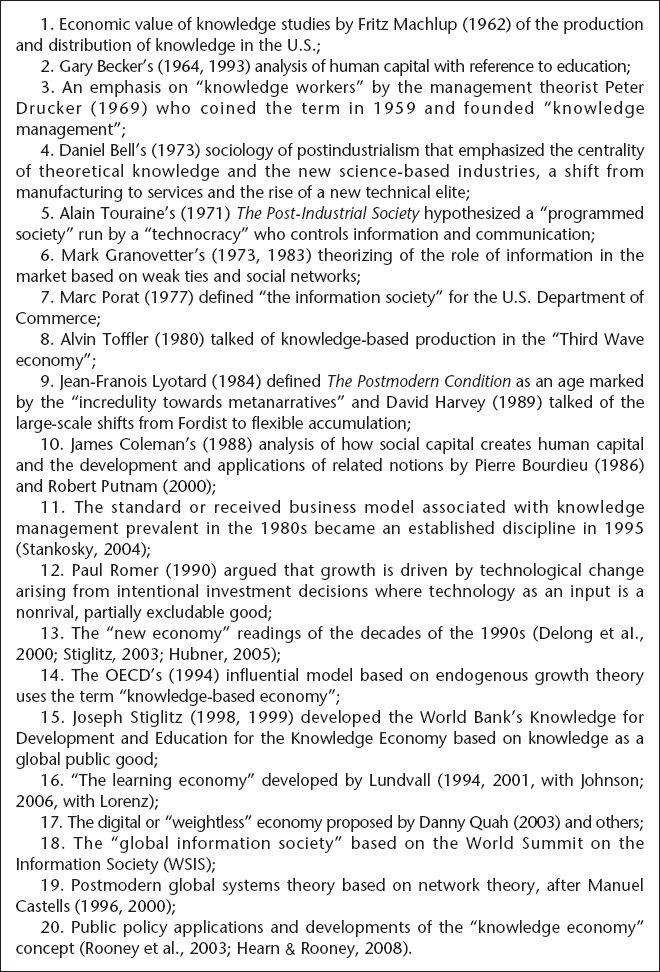
Interpretations and Genealogy of the Knowledge Economy (Peters, 2009, pp. 2–3).
J. Bradford De Long, Deputy Assistant Secretary for Economic Policy in the U.S. Department of the Treasury in the Clinton administration in 1993–1995, begins his Slouching Towards Utopia: The Economic History of the Twentieth Century (DeLong, 2015) with the assertion that the last hundred years is above all a history determined and driven by economics, and by the unrivalled events of the Depression and the end of the command economy of Soviet Russia that imploded and allowed neo-conservatives to herald the close fit between long-term economic modernization and democracy. As he writes: “For perhaps the first time, changes in the way we produce, distribute and consume the necessities and conveniences of daily life has been history's driving force” (DeLong, 2015). He characterizes the twentieth century in terms of an explosion of material wealth, huge expansion in the range of goods and services produced, and increasing gaps and global inequalities. 1 He summarizes his thesis in five propositions:
First, that the history of the twentieth century was overwhelmingly economic history.
Second, that the twentieth century saw the material wealth of humankind explode beyond all previous imagining.
Third, that because of advances technology, productivity, and organization and the feelings of social dislocation and disquiet that these advances generated the twentieth century's tyrannies were the most brutal and barbaric in history.
Fourth, that the twentieth century saw the relative economic gulf between different economies grow at a rapid pace.
Fifth and last, the economic policy the management of their economies by governments in the twentieth century was at best inept. Little was known or learned about how to manage a market or mixed economy. (Delong, 2000, pp. 3–4)
It seems that those basic features in terms of three pillars that since Adam Smith that have defined the way that property rights and exchange worked no longer apply. These features include:
Excludability: the ability of sellers to force consumers to become buyers, and thus to pay for whatever goods and services they use.
Rivalry: a structure of costs in which two cannot partake as cheaply as one, in which producing enough for two million people to use will cost at least twice as many of society's resources as producing enough for one million people to use.
Transparency: the ability of individuals to see clearly what they need and what is for sale, so that they truly know just what it is that they wish to buy.
None of these features apply to what he calls the “information-based sector” of the new economy. In other words, the new digital technologies undermine the assumptions of rivalry, excludability, and transparency. The knowledge economy is about a new source of economic growth which is less about accumulating more physical capital and more about creating intellectual capital (DeLong & Froomkin, 2000).
In Economics of Knowledge, Foray (2004) argues for a deep structural transformation:
Some, who had thought that the concepts of a new economy and a knowledge-based economy related to more or less the same phenomenon, logically concluded that the bursting of the speculative high-tech bubble sealed the fate of a short-lived knowledge-based economy. My conception is different. I think that the term “knowledge-based economy” is still valid insofar as it characterizes a possible scenario of structural transformations of our economies. This is, moreover, the conception of major international organizations such as the World Bank and the Organization for Economic Cooperation and Development (OECD) (our emphasis). (p. ix)
In this scenario “the rapid creation of new knowledge and the improvement of access to the knowledge bases thus constituted (…) are factors increasing economic efficiency, innovation, the quality of goods and services, and equity between individuals, social categories, and generations” (Ibid.). He goes on to emphasize “the expansion of knowledge-related investments and a unique technological revolution that radically changed the conditions of production and transmission of knowledge and information”. The forces of these two phenomena have created an economy characterized essentially by:
(i) the accelerating (and unprecedented) speed at which knowledge is created and accumulated and, in all likelihood, at which it depreciates in terms of economic relevance and value as well as (ii) a substantial decrease in the costs of codification, transmission, and acquisition of knowledge. This creates the potential for a massive growth of knowledge flows and externalities. Indeed, the strength of such externalities (and hence the importance of the problems they pose) is historically dependent on technological and organization. (Foray, 2004, p. x)
We consider, while still contentious and open to question, there is enough agreement among leading economists and world agencies to adopt Foray's structural transformation scenario as a working hypothesis. It is a productive hypothesis upon which to highlight differences between readings of the knowledge economy and to profile the importance of education at all levels—basic education that constitute the Millennium Goals of the United Nation's Education for All program and the role of higher education to such a structural transformation. It also raises the political question of whether the discourse of the knowledge economy is distinct from versions of neoliberalism, the neoliberal project of globalization, and the extent to which it is compatible with a more benign social democratic version of the knowledge economy.
The second important point is that theorists are divided on whether the knowledge economy represents a genuine transformation of class relations under capitalism. As Caruso (2016) puts it:
In the 1970s, the theory began to spread that the contemporary economy was no longer based on the production of material commodities, but rather on the quantity and quality of knowledge that capital and labor contain and produce (Toffler, 1970; Bell, 1974). According to theories of the knowledge-based economy (KBE), the recent technological and organizational transformations of capitalism are causing a general societal change. Toffler (1980) argued that the “knowledge age” is a “massive historical shift”, Stehr (1994) has claimed that it has put an end to the age of labor and property, Drucker (2001) maintains that work, labor, society and politics will take forms that humanity has never previously experienced, and Florida (2012) contends that the distinction between capitalists and the proletariat has become obsolete. On the opposite side, other interpretations, mainly Marxist (Garnham, 2004; Jessop, 2004; Thompson, 2005; Fuchs, 2012), deny that the knowledge economy represents a radical discontinuity in the social organization and consider the theories of KBE as ideologies. Garnham (2004) traces the ideological element of these theories to their denial of the continuation of class relations and labor exploitation. According to this view, KBE implies a transformation in production forces, but it does not substantially alter the capitalist production relationships. (p. 410)
Caruso (2016) distinguishes between the managerial paradigm that considers the knowledge economy “a historical transformation in the mechanisms of value creation and in the relationship between economy and society” (p. 411). As he states: “These authors argue that all work has become cognitive. In advanced capitalism there no longer exist jobs that do not require creativity or the use of mental faculties that are not functional to mere execution” (Ibid.). Business webs and crowdsourcing based on the open source movement provide the means for outsourcing, focused on including social groups in the production process and value chain. While crowdsourcing opens to forms of new social labor the network organization still remains hierarchical. What is more, as Caruso (2016) explains, both claims concerning “the democratization of the market and the socialization of strategic knowledge” (p. 416) are open to question.
By contrast, cognitive capitalism and post-workerism is the leftist account of contemporary knowledge techno-capitalism that depends on “participatory modes of innovation and to open models of intellectual property” often seen “as antithetical … to industrial capitalism”. Under this competing paradigm labor can no longer be measured by time as with traditional labor theory under Ricardo and Marx by rather must be measured by knowledge surplus and added symbolic value. As Caruso (2016) argues:
The theory of cognitive capitalism is significantly influenced by post-workerism, a strand of autonomist Marxism, whose major proponents are Negri, Hardt, Lazzarato, Fumagalli and Vercellone. In a post-workerist perspective, under cognitive capitalism, production directly invests social reproduction and territories, engendering a major contradiction between the Marxian general intellect—the social knowledge embedded in machinery systems and in work organization—and “living labor”, that is, workers’ creativity, abilities, skills, emotions and relations. Communication and linguistic interaction have become the core of production and value creation. Labor is thus defined as “immaterial” because the production factors and outputs are largely immaterial. Digital technologies cannot be likened to industrial fixed capital because their function is not to command merely routine activities, but to intercept the creativity of activities that must be kept free to create value. (p. 418)
Approaching the question of cognitive capitalism through Foucault's biopolitics, Caruso (2016) notes that these theorists maintain: “Cognitive capitalism does not produce only commodities, but together with them it also produces social relations and collective forms of life. It thus produces the subjectivity itself of those who come into contact with production processes” (p. 419). He suggests that the two theoretical approaches cannot deny the actuality of changes in the production process:
(1) at present, knowledge, information and informal social interactions are essential means for value creation; (2) there exists a tension between the improper commodity-knowledge and the private property regime, as also attested by the crisis of entire industrial sectors such as music and media (newspapers, television, cinema), mainly due to the fact that digital technologies make it possible to produce and socialize cultural and informational goods for free; and (3) in order to attract highly specialized knowledge, to reduce research, production and commercialization costs, and to actively involve consumers in highly competitive and filled markets, firms must at least partially adopt open and egalitarian organization models, as far as possible involving their external environment into the production-consumption cycle, including also non-mainstream (and, in a certain way, non-market) cultures, identities and practices. (Caruso, 2016, p. 420)
The Postdigital Merger between the Managerial Paradigm and the Cognitive Capitalism Paradigm
Cognitive capitalism is not just about juggling immaterial digital representations of knowledge; what we call knowledge economy is still deeply imbued in the material world. People need to produce computers, and eat while they use computers, and do numerous other things such as reproduce, build houses, and travel. In the age of rapid automatization of industrial production, producing consumer goods has become financially cheaper than ever (and capitalism is inherently blind to rising environmental costs of increased production). Today, worldwide production and consumption of material goods is at its historical peak and “we have not in any way left the smokestack era of factory production” (McLaren & Jandrić, 2014, p. 807). Therefore, cognitive capitalism has not changed the material base of human existence. However, it has deeply transformed ways of producing that material base—as more and more things are produced and shipped with less and less human effort (and at smaller and smaller price), an increasing proportion of humankind engages in production of immaterial goods. 2
As knowledge production takes primacy over industrial production, worldwide power relationships acquire well-known patterns from earlier historical periods of colonization and industrialization, which are best illustrated by the proverbial small print on the backside of our consumer products saying something along the following lines: “Designed in the U.S., produced in China”, or “Designed in Germany, produced in Malaysia”. However, it also introduces new power relationships which, as we write these lines, are rearranging the world as we know it. These days, China produces more consumer goods than the U.S.; technological automation destroys middle class and causes rising inequality between the super-rich and the poor (Peters, Jandrić, & Hayes, 2018); “old” occupations such as journalism are disappearing and “new” occupations such as data science are on the rise (Jandrić, 2017). In the age of cognitive capitalism, the importance of knowledge has indeed taken over the importance of material production. However, cognitive capitalism cannot be understood merely as a transition from production of (material) goods to production of (immaterial) knowledge written in digital bits and bytes. Instead, it is a complex phenomenon where production of material goods has acquired new relationships to production of knowledge. Therefore, we believe it is necessary to recognize both production of material goods and production of knowledge as equally important, foundational, and dialectically intertwined basis of our world. Cognitive capitalism has certainly shifted power relationships between production of material goods and production of knowledge in favor of the latter—yet both elements remain essential for functioning of human society.
The concept of knowledge cultures underlined by “a conception of collective intelligence that allows for the co-creation and co-production of knowledge, of digital goods in general, and of social democratic processes” (Peters & Jandrić, 2018a, p. 275) is primarily interested in immaterial production. In this conception, production of knowledge (e.g., collective intelligence, crowd wisdom, peer review …) cannot be divorced from dissemination of knowledge (e.g., political economy of academic publishing). The figure of homo economicus based on the concept of human capital gives way to the figure of homo collaborans based on the new (digital) forms of openness and col(labor)ation. The tension between these two figures and their underlying principles “reflects much deeper tensions in the society (capitalist economy vs. communalist economy), within knowledge production (individual production vs. peer production), and within our understanding of human nature” (Darwin's evolution vs. Kropotkin's mutual aid) (Peters & Jandrić, 2018a, p. 170). The concept of knowledge cultures is simultaneously individual and social; epistemic and practical; physical and non-physical; digital and analogue; technological and non-technological; material and non-material. Following our recent work (Jandrić et al., 2018), therefore, the concept of knowledge cultures is postdigital. According to Andersen, Cox, and Papadopoulos (2014),
Post-digital, once understood as a critical reflection of “digital” aesthetic immaterialism, now describes the messy and paradoxical condition of art and media after digital technology revolutions. “Post-digital” neither recognizes the distinction between “old” and “new” media, nor ideological affirmation of the one or the other. It merges “old” and “new”, often applying network cultural experimentation to analog technologies which it re-investigates and re-uses. It tends to focus on the experiential rather than the conceptual. It looks for DIY agency outside totalitarian innovation ideology, and for networking off big data capitalism. At the same time, it already has become commercialized.
Looking through the lens of the managerial paradigm, knowledge cultures describe new transformations in value production and dissemination. Yet, knowledge cultures cannot be described merely through an attachment to cognitive work because such work always takes place within a physical infrastructure. The cognitive capitalism paradigm, which sees knowledge cultures as an extension of capitalism into digital pastures, is supported by a simple truism—we still live in the capitalist society. Yet, knowledge cultures introduce fundamental changes in production and dissemination of knowledge such as the transformation from homo economicus to homo collaborans, the phenomenon of crowd wisdom, etc. Furthermore, today's global capitalist society is very different from capitalist nation-state societies of the 20th century which, gathered in the Western Bloc, occupied “only” half of the world's political spectrum—probably the best example of this transformation is present-day China with its unique blend between communism and capitalism.
In our recent study of the concept of the postdigital we show that “such messiness seems to be inherent to the contemporary human condition” (Jandrić et al., 2018, p. 895). Embracing this view, we can enhance our understanding of knowledge cultures by blending some aspects of the managerial paradigm and some aspects of the cognitive capitalism paradigm. At the level of epistemology, the postdigital view to knowledge cultures will certainly require further inquiry into the ancient philosophical problem of commensurability. At the level of theory, this will leave many of us with significant cognitive dissonance—working across grand narratives such as the managerial paradigm and the cognitive paradigm is a lot to swallow. At the level of practice, such dissonance inevitably causes some loss of clarity and guidance. To make things even more complicated, Cox (2014) shows that “the ruptures produced [by the postdigital] are neither absolute nor synchronous, but instead operate as asynchronous processes, occurring at different speeds and over different periods and are culturally diverse in each affected context”. Depending on context, therefore, (some aspects of) knowledge cultures may be described by the managerial paradigm, or by the cognitive paradigm, or by a multiplicity of paradigms in between and beyond them. Knowledge cultures in China will be different from knowledge cultures in Croatia and in New Zealand. As grobalization 3 and glocalization 4 compete in different places and speeds, the global knowledge culture will be some kind of mix between the multiplicity of world's knowledge cultures underlined by ever-changing power relationships.
The Politics of Knowledge Cultures
The concept of “knowledge cultures” reflects multiple individual and social tensions between industrial and post-industrial modes of production and rapidly changes the dynamic of social development. The primacy of production of knowledge over production of artefacts implies that social struggle slowly but surely shifts from fields and factories into universities, research institutes, and other (formal and informal) sites of knowledge production. Ownership over means of production has remained the key to social struggle. However, this ownership has become much more complex. In some fields, such as philosophy, ownership has become almost completely immaterial, as owning intellectual rights for academic articles has become more important than ownership over factories and servers which deliver these academic articles. In other fields, such as high particle physics and pharmaceutical research, ownership has transformed into a wide spectrum of combinations between material (laboratory) equipment and immaterial (intellectual rights) means of knowledge production. Capitalist oppression over Marx's proletariat was based on ownership of factories and land; capitalist oppression over today's cognitariat is based on ownership of some fields, and some factories, and a lot of information and knowledge.
Furthermore, today's knowledge cultures can be thought of only in relationship to today's digital technologies. It is through current affordances of the Internet, and the World Wide Web, that we are able to imagine the world of radical openness and col(labor)ation (Peters & Jandrić, 2018a). However, technological affordances change, and capital continuously seeks ways of appropriating technology for own purposes. In 1991 Berners-Lee set out to to resolve the problem of sharing scientific data at CERN and created the first webpage; less than three decades later, “five for-profit publishers (Elsevier, Springer, Wiley-Blackwell, Taylor & Francis, and Sage) own more than half of all existing databases of academic material” (Jandrić, 2017, p. 256). These days, even Harvard cannot afford access to academic material. This creates a paradoxical situation succinctly described by the past director of its library Robert Darnton: “We faculty do the research, write the papers, referee papers by other researchers, serve on editorial boards, all of it for free … and then we buy back the results of our labor at outrageous prices” (Ibid.). Obviously, this type of situation does not provide a fertile ground for development of knowledge cultures—instead, we are witnessing the latest (digital) attempt at approproation of means of production by the minority.
In his open letter written for the recent 29th anniversary of the Internet, the inventor of the World Wide Web Berners-Lee (2018) generalizes this problem:
The web that many connected to years ago is not what new users will find today. What was once a rich selection of blogs and websites has been compressed under the powerful weight of a few dominant platforms. This concentration of power creates a new set of gatekeepers, allowing a handful of platforms to control which ideas and opinions are seen and shared.
However, Berners-Lee (2018) does not despair—on the contrary, his position towards digital technologies is clearly non-determinist.
While the problems facing the web are complex and large, I think we should see them as bugs: problems with existing code and software systems that have been created by people—and can be fixed by people. Create a new set of incentives and changes in the code will follow. We can design a web that creates a constructive and supportive environment.
Knowledge economies, both in their industrial and post-industrial aspects, require knowledge cultures as the basis of development. Yet, both the managerial paradigm and the cognitive capitalism paradigm create conditions for capitalist social development which has failed to fulfill the optimistic predictions made by Toffler (1980) and other futurists that the age of knowledge will eradicate oppression and poverty. Instead, it seems that Marxist ideas that digital technologies have merely brought about a more advanced and more sophisticated form of capitalism seems to hold water. This brings the concept of knowledge cultures deeply into the field of politics and social struggle. On one side in this struggle, proper functioning of knowledge cultures requires open access to knowledge and information—and that implies that knowledge and education should be treated as public goods (Peters & Jandrić, 2018a, 2018b). On the other side of this struggle, intellectual property laws, the general trend of commodification of education, and even a large part of recent technology development, continuously maintain and expand various types of closures—from paywalls for academic articles, fees for university students, and the inability to modify source programming code. Knowledge cultures, and their promise of knowledge development, are based on various types of openness (Peters & Britez, 2008; Peters & Roberts, 2011; Peters et al., 2016). Once more, and unsurprisingly, epistemology is foundationally linked to research, to education, and to politics.
Conclusion
Knowledge economy and knowledge society are buzzwords which succinctly describe social transformations of the past few decades caused by an amalgam of causes including but not limited to digitization, globalization, and neoliberalization. Yet, like all buzzwords, they conceal a much more complex reality: our contemporary world is both industrial and postindistrial, and knowledge—while increasingly important—still has (and requires) solid material base in industrial production. We now live in the postdigital world where it is increasingly hard (and often straightforward impossible) to distinguish between digital and analogue aspects of human existence (Jandrić et al., 2018). This world brings about the promise of knowledge cultures—an approach to knowledge creation and dissemination based on openness and ethics of sharing enabled by digital technologies, which avoids the deep theoretical division between “knowledge economy” and “knowledge society” (Peters & Besley, 2006; Peters & Jandrić, 2018a).
The concept of knowledge cultures requires a wide transition from the figure of homo economicus based on the concept of human capital to the figure of homo collaborans based on the new (digital) forms of openness and col(labor)ation who can thrive only in an open environment which supports free access to knowledge and education (Peters & Jandrić, 2018a). Yet, current situation in academic publishing and higher education is far from that ideal, and knowledge cultures belong to a small number of privileged people who can bypass increasing prices of access to academic articles, increasing prices of education, and various forms of closure supported by digital technologies. Our previous research (Peters & Besley, 2006; Peters & Jandrić, 2018c) indicates that the concept of knowledge cultures first as glove to current affordances of digital technologies and offers tremendous potential for research, society, and economy. However, this promise will not arrive into being on its own. Therefore, our efforts to bring about knowledge cultures belong firmly into the political sphere.
There are two possible ways of responding to the challenge of knowledge cultures. First, we can try and (theoretically and practically) modify the concept of knowledge cultures to accommodate constraints imposed by political economy of knowledge. Within the Editors’ Collective 5 and other similar projects, authors of this paper are actively pursuing this line of action. Furthermore, we can also try and actively engage in changing political economy of education, educational publishing, software production, and other related fields towards more openness and sharing. This line of action, conducted by various mainstream and activist social actors, is already well under way (Peters et al., 2016; Jandrić, 2017). While we embark on one of these routes, or any combination thereof, it is important to remember that our society, economy, technology, and knowledge are in constant flux—our engagement in knowledge cultures, therefore, actively shapes their present and future.
Footnotes
1
Significantly, he goes on to say: “Some have argued for the importance of culture. But the presence or absence of a ‘culture of entrepreneurship’ is not usually a deciding factor” (DeLong, 2015). This is not an argument against the importance of culture so much as a reduction of “culture” to “entrepreneurship“ which does not exhaust arguments from culture.
2
This phenomenon is well-known since the earliest studies of the “information society” by Manuel Castells, Jan van Dijk, George Ritzer, and others.
3
The imperialistic tendency to use globalization for imposing own interests globally (Ritzer, 2004).
4
The tendency of localizing effects of globalization (Ritzer, 2004).

Notes on Contributors
Michael A. Peters is a professor at the Faculty of Education, Beijing Normal University, Beijing, China and emeritus professor in Educational Policy, Organization and Leadership at the University of Illinois at Urbana-Champaign. He is the executive editor of the journal Educational Philosophy and Theory, and founding editor of five international journals, Policy Futures in Education, E-Learning and Digital Media (SAGE), Knowledge Cultures (Addleton), The Video Journal of Education and Pedagogy (Springer), and Open Review of Education Research (T&F). His interests are in philosophy, education and social policy and he has written over 80 books, including most recently: Wittgenstein and Education: Pedagogical Investigations (2017) with Jeff Stickney; The Global Financial Crisis and the Restructuring of Education (2015), Paulo Freire: The Global Legacy (2015) both with Tina Besley; Education Philosophy and Politics: Selected Works (2011); Education, Cognitive Capitalism and Digital Labor (2011) with Ergin Bulut; and Neoliberalism and After? Education, Social Policy and the Crisis of Capitalism (2011). He has acted as an advisor to governments and UNESCO on these and related matters in the U.S.A., Scotland, NZ, South Africa and the EU. He was made an honorary fellow of the Royal Society of NZ in 2010 and awarded honorary doctorates by State University of New York (SUNY) in 2012 and University of Aalborg in 2015.
Tina Besley is a professor at the Faculty of Education, Beijing Normal University, Beijing, China. She previously held academic posts at the University of Glasgow, California State University San Bernardino and the University of Illinois at Urbana Champaign. She has been a high school teacher and counsellor in New Zealand. Tina's research interests are philosophy of education, policy, subjectivity, interculturalism and global knowledge economy. Tina is President of the Philosophy of Education Society of Australasia (PESA) and President of the Association for Visual Pedagogies (AVP).
Petar Jandrić is an educator and researcher. He published six books, several dozens of scholarly articles and chapters and numerous popular articles. Petar's works have been published in Croatian, English, German, Ukrainian, Spanish and Serbian. Petar's background is in physics, education and information science, and his research interests are situated at the post-disciplinary intersections between technologies, pedagogies and the society. Petar worked at Croatian Academic and Research Network, University of Edinburgh, Glasgow School of Art and University of East London. At present, he works as professor and director of BSc (Informatics) program at the Zagreb University of Applied Sciences and visiting associate professor at the University of Zagreb.