




Abstract
Purpose
—The purpose of this paper is to explain how the introduction of the Internet and digital tools renews and enriches John Dewey's experimentalist model for teaching and learning with particular attention to the place of and resources for higher order thinking.
Design/Approach/Methods
—The methods include a close exposition of Dewey's classical texts, and a thought experiment introducing ICT elements into Dewey's design diagrams for teaching and learning.
Findings
—Dewey's model has inherent difficulties, and that digital technologies helps resolve them.
Originality/Value
—With the Internet and new digital tools, teachers can design new virtual learning spaces and learning activities. Learners can use online information and communication tools to act more effectively using higher-order thinking skills.
John Dewey formulated his educational ideas more than 100 years ago, and they retain great historical and philosophical interest today. This paper focuses on thinking in Dewey's approach to education, and then considers how digital tools and the Internet can enhance it.
This undertaking will first require some delineation of Dewey's educational ideas. As Schwab (1959) noted, Dewey's experimentalist approach has often been misunderstood, misrepresented, and misapplied: “Most of what has been said by and for educators in the name of Dewey has consisted of distorted shadows and blurred images of the original doctrine” (p. 139). The situation has not improved since (Boostrom, 2016). So before turning to digital technology, an account of the main features of Dewey's experimentalist approach and the specific place of thinking are in order.
Thinking in Education
Conventional Classroom Education
Dewey developed his experimentalist education model as an alternative to the conventional education prevailing at the turn of the 20th century—and still prevailing today. In my presentations about Dewey I often show images of almost identical contemporary classrooms from Albania to Zimbabwe. Students differentiated mostly by skin tone in the distinct images sit facing forward, pencil poised, notebooks opened, listening to their teachers and taking notes, trying to understand and remember their lessons. Today's smart classrooms may have a screen and digital projector in place of the chalkboard, and laptops instead of notebooks, but the information still flows from the front of the room. Students may be invited to discuss the material or ask questions. They may be called upon or invited to the front for recitation. They may respond to prompts from teachers by pressing on digital “clickers”. But the lesson content is prescribed and pre-organized. Quizzes and high stakes examinations testing memory and understanding are administered to assure that lessons have been learned.
In The School and Society (1899) Dewey demonstrated his total rejection of this “old education”—the old education still prevailing 120 years after its publication.
If we put before the mind's eye the ordinary schoolroom, with its rows of ugly desks placed in geometrical order, crowded together so that there shall be as little moving room as possible, desks almost all of the same size, with just space enough to hold books, pencils and paper, and add a table, some chairs, the bare walls, and possibly a few pictures, we can reconstruct the only educational activity that can possibly go on in such a place. It is all made “for listening”—because simply studying lessons out of a book is only another kind of listening; it marks the dependency of one mind upon another. The attitude of listening means, comparatively speaking, passivity, absorption; that there are certain ready-made materials … which the child is to take in as much as possible in the least possible time. (MW1, p. 22) 1
Dewey notes that materials, tools and even space for constructive and creative activity are lacking. In classrooms with their set desks, “everything is arranged for handling as large numbers of children as possible, for dealing with children en masse, as an aggregate of units; involving, again, that they be treated passively” (MW1, p. 23). In such an arrangement, there is no room for thinking, which is inherently active. The bulk of instructional content in books and lectures “tends to swamp the native and active interests operative in intelligent behavior”. The content
remains unassimilated, unorganized, not really understood. It stands on a dead level, hostile to the selective arrangements characteristic of thinking; matter for memorizing, rather than for judgment; existing as verbal symbols to be mechanically manipulated, rather than as genuine realities, intelligently appreciated. (MW7, p. 269, my emphasis)
The Experimentalist Alternative
In Dewey alternative, experimentalist form of education, student thinking replaces rote memorization and shallow understanding at center stage; from the start, students are situated in activities that require them to experiment with ideas as they pursue ends that matter to them.
In The School and Society Dewey drew inspiration from developments in primary education in the closing years of the 19th century: art lessons, nature study, shops and gardens—situations where students act in complex, uncertain situations requiring judgment. In my talks on Dewey I often show images of students in active-learning situations: growing gardens, building sheds, experimenting with robots, conducting environmental research by testing water from local streams, making presentations. The contrast with the images of conventional classrooms is stark.
Action is End-Directed Behavior that Leads to Learning through Feedback
In Democracy and Education Dewey expanded his early insights about learning through activities into a comprehensive theory of education.
Dewey begins Democracy and Education by noting that education is living, and living is doing—taking action directed to the achievement of ends. He adds that when we act, we also undergo—we get feedback about what works and what fails that leads to reflection and changes in our action habits. Dewey states that “Life is a self-renewing process through action upon the environment … The energy it (the living creature) expends in thus turning the environment to account is more than compensated for by the return it gets: it grows” (MW9, p. 5, my emphasis).
By “more than compensated” Dewey points to a surplus from the energy expended in action. The creature is more than conserved. It secures more than it needs for immediate needs in sustaining life. It gets stronger and smarter. it gains power for subsequent action; it gets better at living. Thus it “grows”.
Thinking, in turn, is intelligence in action in the pursuit of ends under uncertainty. As Dewey states this, “Thinking is the equivalent to an explicit rendering of the intelligent element in our experience. It makes it possible to act with an end in view. It is the condition of our having aims” (MW9, p. 153). He adds, “The starting point of any process of thinking is something going on, something which just as it stands is incomplete or unfulfilled. Its point, its meaning lies literally in what it is going to be, in how it is going to turn out” (MW9, p. 154).
Consider this example. A schoolgirl is on the swim team. She is more than compensated for her effort. She gets exercise from swim practice that strengthens her muscles. She gets better at swimming by taking active steps to improve. She raises her status in the school community by joining a team, and gets better at relating with teammates, at controlling her emotions and being a “good loser”, etc. She learns to follow and to lead. She “grows as a person”.
Even in this simple example, we can isolate thinking as an essential component of growth. Perhaps the girl competes in the backstroke. She exerts energy in races and undergoes the results—e.g., her times, he place in the competition. She is attempting to achieve an end—e.g., gaining a place on the varsity squad or winning a medal. But the situation is complex and there are no guarantees. Her actions may fail. For example, she may have a poor time in a competition that costs her team a place in a regional championship. This forces her to recognize a need to improve. Thinking is her primary means for improvement.
Thinking does not take place in the schoolgirl's head; her thinking, her experimenting, is not something distinct from her doing but an essential component of it. She might, for example, make a plan to practice the backstroke with a teammate. To do so she has to design a practice schedule, requiring the teammates to analyze their school and family obligations. The teammates may create a video-camera setup to record her strokes, possibly applying ideas from a book or video. Then they have to test the setup to make sure it is working properly, and then gather data for evaluating performance.
In all these actions they are thinking about how to improve swimming. I italicize the thinking verbs here to connect them with familiar lists of cognitive action verbs in the six levels of Bloom's revised taxonomy of objectives—cognitive domain. The two lower levels in the cognitive domain are remembering and understanding. The four higher levels of thinking are: applying, analyzing, evaluating and creating (Clark, 2015a). Conventional schooling rarely goes far beyond the lower levels, while in Dewey's experimental model, the higher levels are constantly demanded and developed.
Learning from Communication
In addition to learning by doing, we also learn by communicating. As Dewey puts it, “All communication … is educative”. To listen, to receive a communication “is to have an enlarged and changed experience”. Meanwhile, the one who communicates in speech or writing has to get “outside of (a situation), seeing it as another would see it, considering what points of contact it has with the life of another so that it may be got into such form that he can appreciate its meaning” (MW9, p. 9).
Here again the essential role of thinking is clear. To listen and to speak to another, to get outside of an egocentric perspective on the situation and see it as another might, a communicator must think about points of contact with audiences. This involves trying and testing so as gradually to receive other's way of experiencing and being, and responding to contribute to a meaningful exchange. Seeking genuinely to make contact presupposes valuing others, acknowledging, respecting, appreciating them.
The action verbs italicized here are selected from the affective domain in the revised Bloom taxonomy, where the levels are identified as: receiving, responding, valuing and organizing, each associated with distinct groups of action verbs (Clark, 2015b). 2 For Dewey, however, even these affective verbs imply cognition—thinking. How, for example, are we to value others unless we understand and evaluate what they do and say?
In our example, the schoolgirl's relations with her swimming teammates may have become strained. By losing her race she may fear rejection by her teammates. She has to think how to test this fear and better secure her standing on the team. She may select a self-help book after evaluating several, then organize and apply its prescriptions. Or she may speak with a school counselor to seek an “enlarged and changed” experience of the situation. They may together make a plan to restore mutually supportive relations. She has to communicate with her teammates—to listen and to respond; she has to come to appreciate them as unique individuals. In extending beyond herself, in valuing others and seeking genuine contact she grows as a person.
To summarize: For Dewey learning by doing and communicating is the natural way to learn. Thinking is using intelligence in acting and communicating. Conventional schooling is not a natural way to learn; learning from formal school lessons, however necessary, is artificial and secondary.
Occupations in Education
Each individual in action is surrounded, Dewey notes, by hundreds of other people in their specific social roles acting in pursuit of their ends. Every action in every sphere takes place within and presupposes an interconnected dynamic world of social actors and institutions. The behaviors of all of these actors are governed by social norms related to ways of doing things. “Setting the table”, for example, is defined by rules about where dishes and tableware are placed. If a child places them differently, mother may say “that's not setting the table, dear”. We establish habits as we learn to act in accord with these norms.
Dewey refers to important life activities governed by normative ways of doing things as occupations. Occupations are not just jobs, but characteristic ways of occupying ourselves to some purpose. In School and Society he defines “occupation” in its educational sense as any “mode of activity on the part of the child which reproduces, or runs parallel to, some form of work carried on in social life” (MW1, p. 93). By engaging in occupations children learn to think in terms of concrete ends—to think like grown ups—and thus to grow. For Dewey, education in its broadest sense is the process of bringing young people along to full participation in occupations of adult social life.
By education through occupations Dewey does not mean education for occupations—preparing for particular jobs or careers. He rejects utilitarian goals, insisting that learning through occupations cultivates educational values—extracting the science and art in occupations, the habits of experimental thinking and persevering through obstacles to achieve goals. Students learn in their school years to navigate the ever-changing landscapes of adult life. They learn how to learn, how continually to acquire new knowledge for use in unpredicted future contexts. They learn to grow.
The Role of Teachers
Adults can bring young people along by establishing educational occupations, by “setting up conditions which stimulate certain visible and tangible ways of acting”, and then engaging the young in them, in pursuit of their inherent ends, as made more specific by the learners (MW9, p. 19).
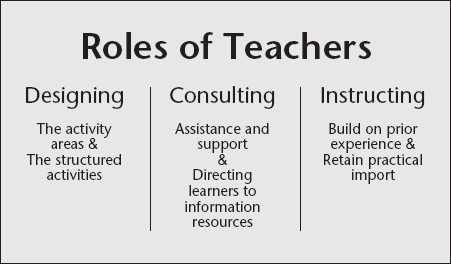
Teachers design the settings for learning and the learning activities. They consult with and coach the learners. They think with the learners about how ends may be achieved; through these consultations learners acquire thinking habits and skills for these areas of activity. For Dewey, “The sole direct path to enduring improvement in the methods of instruction and learning consists in centering upon the conditions which exact, promote, and test thinking. Thinking is the method of intelligent learning” (MW9, p. 160). By engaging in learning activities, students steadily come to think as gardeners, builders, athletes, and writers; through communication and feedback, their thinking improves.
For Dewey, teachers are at first instance designers of (i) occupation-based activity areas—gardens, shops, labs, studios—and (ii) the structured group activities in which young people take action and pursue ends. Learning how to set up learning spaces, and design and facilitate learning activities, is thus the primary task in teacher preparation.
Education as Preparation and Growth
Even after the young take on mature grown-up roles, new knowledge develops; technology advances. Change is a pervasive feature of experience. Old occupations fall away and new ones rise. Luckily even mature adults retain plasticity—“the ability to learn from experience, to modify actions on the basis of the results of prior actions”—throughout life (MW9, p. 50). New technologies can transform entire occupations—as the Internet has in our day thoroughly changed all occupations.
When we think of education as bringing a child along to full participation in occupations of adult social life, we may jump to the conclusion that education is preparation for the child's future—that is, training for already pre-selected occupations. This, says Dewey, is a big mistake. Occupations are always changing. We don't know what knowledge, information and expertise young people will require in the future. If we educate the young for the futures we imagine, we sacrifice the opportunities for experience in the present. When the future arrives the jobs we have trained learners for now require different knowledge and skill, or no longer even exist. But if we engage youngsters in present occupations as these change through their school years, they will be ready for the future when it arrives.
Design for Learning
In conventional education subject matters are predigested concepts and facts conveyed to learners to be “banked” for test performance; learners do not engage in challenging activities, pursue their own ends, and think through appropriate means. Instead, as we noted, for Dewey the whole setup is “hostile to the selective arrangements characteristic of thinking” (MW7, p. 269). In the experimentalist alternative, “subject matters” simply means materials—things to do something with, and thus to think about. While teachers need deep understanding of discipline-based subject matters, their job is not to “convey it”. Rather, it is to establish settings with many and varied materials for doing things together. Dewey sets out “typical stages” in subject matter learning:
(I) In its first estate, knowledge exists as the content of intelligent ability—power to do. This kind of subject matter, or known material, is expressed in familiarity or acquaintance with things. (ii) Then this material gradually is surcharged and deepened through communicated knowledge or information. (iii) Finally, it is enlarged and worked over into logically organized material—that of the one who, relatively speaking, is expert in the subject. (MW9, p. 193)
Teachers start with stage (i) learning by doing. They design information rich social settings for action, and structured activities with ends to accomplish that prompt thinking. All proven methods in education “give the pupils something to do, not something to learn; and the doing is of such a nature as to demand thinking” (MW9, p. 162). Students need first hand experiences with materials as the “initiating phase of thought”.
The first stage of contact with any new material, at whatever age of maturity, must inevitably be of the trial and error sort. An individual must actually try, in play or work, to do something with material … and then note the interaction of his energy and that of the material employed. (MW9, p. 161)
Learner action leads to undergoing—feedback in experience including difficulties and failures. These lead naturally to stage (ii) communication with peers and teachers that informs further actions. Teachers serve as consultants—offering aid to keep action moving or referring learners to pertinent information sources for self-directed study. But it is a big error to think that the difficulties learners undergo lead to “teachable moments” where the “real stuff” can be conveyed by teachers. Dewey insists that “no thought, no idea, can possibly be conveyed as an idea from one person to another”. Communication “may stimulate the other person to … think out a like idea, or it may smother his intellectual interest and suppress his dawning effort at thought”. But “only by wrestling with the conditions of the problem at first hand, seeking and finding his own way out, does (the learner) think” (MW9, pp. 167–168). Communication in education does not exist to convey “thoughts” but to redirect students back to learning activities with new resources for their own thinking.
At the end of a unit teachers build upon the stage (i) and (ii) experiences as they introduce the abstractions of stage (iii) systematic knowledge. The goal is for young people to leave school with the broad range of knowledge and competence needed in adult occupational life. During stage (ii) consulting, teachers introduce ad hoc knowledge in activities. For example, a learner's failure in the garden may raise questions about minerals in the soil, leading perhaps to mini-lessons about soil chemistry. These ad hoc knowledge inputs, however, can not offer the range or organization of chemical knowledge needed in many adult occupations. So teachers must, at stage (iii), organize chemical knowledge, introduce concepts of atomic weights and measures and the periodic table. But this systematic knowledge is not inert; it has to be presented in a manner that makes it available for subsequent action and thought not just in the future, but in the garden.
The chart (see Figure 1) below summarizes the roles of teachers in these stages of teaching.
Roles of Teachers.
The Organization of the School
In The School and Society Dewey illustrates the experimentalist approach to educational design and teaching with diagrams. The first (Chart II) (MW1, p. 46) (see Figure 2) shows the school in the larger society, surrounded by but walled off from (1) homes, (2) gardens, parks and country fields, (3) businesses, and (4) the university, with its technical and professional schools.
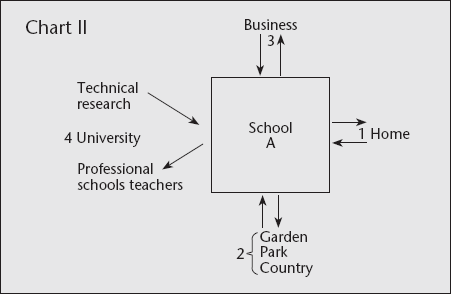
Chart II.
The second (Chart III) (MW1, p. 50) (see Figure 3)—Dewey's conceptual design for the elementary school—indicates relations between occupations in the local community and in the school activity areas.
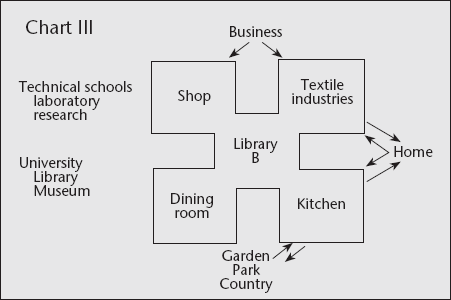
Chart III.
In Dewey's Chart III, at outer portions within the building, we find various activity areas: the (i) kitchen, (ii) dining room, (iii) shop, and (iv) textile area—others can easily be imagined. Teaching begins in stage (i) as teachers set out the learning areas and design the specific learning activities. The learning potential of each of these activity areas is not difficult to conceive. For example, in the kitchen, incidental to preparing food to be served in the dining area, students may learn about physical, biological, and chemical makeup of foods; the causes of food deterioration; and the concepts underlying food processing and preserving (Institute of Food Technologists, n.d.).
The boundaries between the school and its immediate periphery, and within the school, are porous, e.g., seeds and soil can be brought to the school garden from homes and nurseries, and foodstuffs from the garden can be brought into the kitchen to be prepared for the dining area. Everywhere, there are explicit parallels between the occupations in the larger society and school occupations in the activity areas.
Dewey's Chart IV (MW1, p. 53) (see Figure 4) represents the high school, with its laboratories and studios as activity areas, and its central information area in the library now augmented by a “museum” of artefacts.
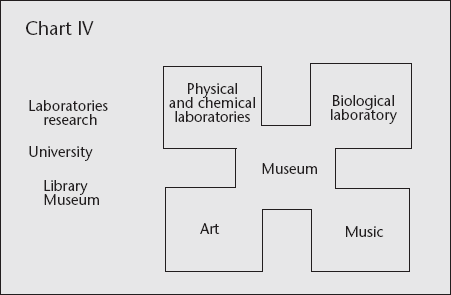
Chart IV.
The library and museum occupy the school center. Spaces exist between the activity areas and the center, where teachers in stage (ii) of learning consult with learners—providing direct coaching or sending them to the information center for the information they need. More systematic instruction (stage iii) is added later, to connect the information dots into organized knowledge. But note: there are no spaces designated as classrooms anywhere in Dewey's model school.
Learners in the school spend many years of acting in information and communication—rich settings, in occupations pursuing meaningful ends. They think collaboratively about means, and seek guidance and knowledge inputs from teachers and the library as necessary. In this way they acquire both occupationally oriented habits and skills and habits of cooperative living. When they come of age and take over as adults, society eo ipso becomes more intelligent and cooperative because the students, with their habits of free action and open communication, take over.
Experimental Education and Digital Technology
Dewey's model for education has not been widely implemented. In addition to opposition by economic and political elites and conventional educators, the approach also has inherent difficulties.
First, it has been hard to reproduce occupations in school settings. As Dewey complained, schools lack spaces for work. Few schools have e.g., fashion studios, dress shops, printing shops, book binderies, construction zones, or advertising agencies. The school garden has become a stock example of a Deweyan activity area because most schools can clear a small outdoor area for a garden. Few other activities have fit the conceptual constraints as well.
Second, experimentalist teaching requires ready-to-hand practical and theoretical knowledge few teachers possess: responding creatively in stage (ii) to unpredicted practical obstacles arising in school activities, by bringing almost unlimited systematic stage (iii) knowledge to bear.
Third, experimentalist learning requires students to possess a sense of personal agency. Teachers can place learners in activity areas, but if they don't feel capable they cannot act; they will remain over-reliant on teachers for direction.
A New Design for Learning
In the digital learning environment these difficulties can be addressed, and Dewey's vision can be more effectively realized. Consider what results when information and communications technologies (ICT)—the Internet and digital tools—are introduced into Dewey's Chart III and Chart IV. The most dramatic change is that the information center of school libraries and museums is now distributed throughout the school. 3 Teachers no longer send learners to the information centers during consultations—disturbing the rhythms of learning in the activity areas—because the activity areas already are information centers. And new activity areas can be created without much cost or effort, because the Internet already is the primary space for many real-world activities from drawing and painting to banking and marketing. A simple example: school students can now create and operate a global T-shirt company online, without manufacturing T-shirts, storing them in inventory, or distributing them. Design and marketing functions can be handled on any computer with web access. Other functions can be outsourced and managed online.
Information Centers as Architectures of Participation
On a deeper level, the web-based learning environment does not merely replicate or enrich the prior information centers of school libraries and museums, but transforms them into architectures of participation through social networks. This is especially important because the world of occupations today is itself an architecture of participation, with individuals working in globally distributed groups connected by information networks. Education through occupations today means education through information and communication networks.
Libraries and museums are adjusting to the social network context. The term “Library 2.0” was coined by Casey (2005) on his blog LibraryCrunch, for a new kind of information service using web 2.0 tools to deliver materials to library users and at the same time to harvest materials from them for the use of others. Library 2.0 relies on users for creating library content—and for creating the library user community itself. Services are designed and assessed based on the interests and capabilities of users, with participation as a central feature (Casey & Savastinuk, 2010).
Examples of Library 2.0 activities include librarian chat lines, online groups for discussion of specific books, online book clubs, user curated online book displays, user book review blogs made available on the library home page, author pages on the library website where users can “publish” their works for other users to read. A major aim of the movement is attracting and serving non-typical users, members of the community who are not users of physical libraries.
In Museum 2.0 the focus shifts from documents to artefacts. In the words of Nina Simon in The Participatory Museum and in her Museum 2.0 blog, 4 Simon (2006) initiated Museum 2.0 “to explore the ways that the philosophies of Web 2.0 can be applied in museums to make them more engaging, community-based, vital elements of society”. Simon conceives Museum 2.0 as an architecture of participation, where users generate, share, and curate the museum's content, where visitors become users, and museums become central to social interactions throughout the community.
Education 2.0: Information-Communication Technologies in the School
When ICT is distributed throughout the school it becomes an architecture of participation—a platform for thinking, doing, and sharing—Education 2.0 (Waks, 2014).
Information for acting and thinking
Four online resources—tip sheets, video tutorials, online research journals, and free online courses and programs—have particular and immediate application in experimentalist education, facilitating the tasks of both teachers and students.
Tip sheets
Tip sheets—simple lists of directions explaining how to do something by breaking complex tasks into small action steps—exist online for just about every action. A quick search for the phrase “how to …” called up tip sheets on myriad topics from how to hack a computer to survive a shark attack. Online tip sheets often include images and short video clips, becoming multimedia short courses on difficult or complex tasks.
Tip sheets also exist specifically on thinking: how to plan, select, organize, apply, evaluate and create. A quick search brings up guidance on planning and organizing homework schedules, school writing projects, school lockers, lunch boxes, work spaces, and art supplies.
Video tutorials
Free video tutorials can now be found for every conceivable activity from the sports field to the garden, kitchen, dining room, textile studio and shop. Learners can find dozens of free online video tutorials on our initial example—the backstroke—on video platforms like YouTube and Youku, some with almost a million views. 5 Many videos are aimed at beginners, including young children.
Online research journals
Prior to the year 2000 almost all academic research was behind paywalls. Teachers and students had no access to the current flow of knowledge. In the late 1990s free, open access online journals began to appear, providing access to research without financial, legal or technical barriers (Suber, 2004/2015). In January 2017 9,500 open access journals were listed in the Directory of Open Access Journals. Teachers and students today have broad access to current research—even opportunities for joining research teams and participating in research. Students can also share, repurpose, curate, and mashup research knowledge to create their own information products.
Free online courses and programs
Free online courses now exist on almost all academic subjects and practical fields. The number of courses and participants, continues to grow. There were 9,400 MOOCs announced in 2017, up from 6,850 in 2016. In 2017, Coursera, edX and Futurelearn, alone offered 5,200 courses. Seventy eight million learners participated in MOOCs worldwide in 2017 (Shah, 2017). Increasingly, these courses are available on demand. Learners can search for and take what lessons on whatever topic they wish, and mash up materials from several of these courses along with other materials to fashion their own personal learning programs (Waks, 2016).
Augmented Powers for Communicating
Learners and teachers in these participative environments have new powers of acting, thinking, learning, communicating, sharing, interests, collaborating, and acting collectively.
Expressive Acting
With new digital tools and platforms anyone make and share quality images or videos. Others can find, share, republish, emulate, alter, or mix them up to create something new, or collect, curate, and exhibit them.
Searching to Connect
In the networked situation everyone can do online searches for any topic and locate expert websites on page one. There are widely available online library help desks where learners can obtain assistance, new ideas and additional links on any topic. Tools like Twitter and Linkedin provide access to experts willing to share their knowledge and insights.
Group building
Shirky (2008) notes that social networks are a cross between “tools” and “communities”. Learners can use them to find and connect with others, engage in group projects, join in collective action. Sal Paquet (quoted in Shirky) calls this “ridiculously easy group formation”.
This power has allowed teachers to break out of their perpetual isolation. Teachers have been leaders in forming personal learning networks or “PLNs”. Crowley (2014) defines a PLN as “a vibrant, ever-changing group of connections to which teachers go to both share and learn”.
Collaborating
Web 2.0 tools now enable educators across school, district, regional, and national boundaries to collaborate on materials, lesson demonstrations, and even the delivery of actual lessons; students can contribute their own insights and dialogue with peers from diverse neighborhoods and even nations, and in so doing they can assist educators in understanding them as people and thus in better serving their needs.
Acting Collectively
Connections made through online communities, social networks, and blogs facilitate discussion and planning leading to collective action.
The Three Stages of Teaching and Learning in the Networked Environment
We can now consider the contribution of the ICT Internet and digital tools to experimentalist teaching, understood in terms of Dewey's three stage sequence.
Stage (i)—learning by doing
In stage (i) teachers design learning spaces and learning activities, and engage learners in the activities. Learners, in turn, act and undergo—run into difficulties and challenges. What new resources are available in the digital learning environment?
In stage (i) teachers can now use online platforms and apps to design new real-virtuality activity areas, such as the T-shirt business mentioned above. The Web has penetrated all occupations, and however they evolve, they will continue to be shaped by the Web; many now exist completely online, opening new possibilities for school occupations using computer workstations, digital cameras, drawing tablets, photo-editing software, spreadsheets, apps, and other tools.
The Internet and digital tools vastly augment learners’ stage (i) powers of acting. Even over-reliant learners can start in activities by applying suggestions from tip sheets and videos. They will still have to think through how to select, evaluate and apply these suggestions to their situations. For example, the school garden plot may not be as well equipped as those shown in a video. The gardeners may need to substitute tools on hand. These resources cannot do the necessary thinking for the students; they are like teachers, at best stimulants to further thinking.
Promoting the habit of using videos and tip sheets for suggestions is itself educative. Searching for, applying and modifying tip sheets instead of depending on others for getting started on and carrying through tasks can be an important step in becoming an independent thinker—one of the first rules of independent thinking being “don't reinvent the wheel” (Kleon, 2012).
Stage (ii)—learning by communicating
Dewey envisioned activity areas as social spaces—spaces for “conjoint activity” among learners of different ages, teachers, and other adults. When learners undergo difficulties they turn to others to gain an “enlarged and changed experience” of their situations. Teachers, however, work in crowded schools with limited resources. They don't have a lot of time for every learner, and they don't know everything.
The digital environment changes the stage (ii) communication situation. When called upon as consultants and coaches teachers no longer have to rely on their own stored knowledge. They can now call up—or direct student learners to—videos or tip sheets. Or they can initiate a video chat with a a local grad student or amateur enthusiast, or send a tweet to an expert. Or they can gather a group of learners for an ad hoc “let's find out together” session using online videos or clips from online courses. Working with their students, they can create web pages for their courses, containing lists of answers to frequently asked questions (FAQs) and collaborative activity wikis. If teachers need to augment their own knowledge, they can turn to open access journals or take online courses. Or they can rely on other teachers in their professional learning networks (PLNs); they are no longer dependent upon their own stored knowledge.
Today's students are broadly comfortable using the Internet and digital tools. They communicate with friends by email, text message and video chat, turn to Wikipedia for homework, find their way around with online maps. Many write blogs. Armed with these tools they are no longer dependent on teachers in stage (ii) situations. They should be expected to be more resourceful and self-reliant, finding others to assist in solving problems and answering questions, using online resources. In addition to tip sheets, videos, online courses, digital reference works, and academic research, they can now communicate with more knowledgeable peers and adult enthusiasts and experts through video chat, twitter and other social technologies.
Stage (iii)—Learning Organized Subject Matter
The knowledge that conventional discipline-based teaching presents is isolation from its uses. This creates a knowledge-action gap, as the students do not learn how to apply the knowledge they are acquiring in school—leading to the frequent complaint by employers and colleagues that graduates can't think and can't do anything. 6
Dewey confronted this problem in a radical fashion, by eliminating spaces for didactic instruction in schools. In his scheme, stage (iii) instruction takes place in or adjacent to the activity areas, and in close association with knowledge applications. Teachers draw on stage (i) and stage (ii) experiences in presenting stage (iii) knowledge, and then apply it back to practical applications. This is a lofty demand. To be effective, teachers have to possess broad, flexible knowledge they can call upon spontaneously for stage (ii) consulting. They then have to organize and systematize disciplinary knowledge in stage (iii), in the process incorporating the unique experiences their students had in stage (i) and stage (ii), and making the disciplinary knowledge useful for further applications in learning activities. This demand outstrips the resources of almost all school teachers—and everyone else.
Ready at hand academic research and online courses provide resources for handling instruction without falling back on conventional mass instruction in classrooms and lecture halls. In stage (ii) consulting, teachers can help learners locate appropriate online knowledge inputs on the spot, and then help them apply this knowledge in their activities. In stage (iii) they can draw more extensively on these resources—for example, by assigning an appropriate online course or MOOC, or by building a video review course from online course materials.
Summary
The Internet and digital tools provide powerful new means for acting and communicating—and even for forming distributed groups based on shared interests. They also enable a broader range of real world activities within the school setting. Online courses also provide materials for introducing systematic knowledge without turning away from activity areas to settings for didactic teaching.
While conventional education remains hostile to thinking and conducive to learner passivity, the experimentalist alternative builds habits of free action and open communication in complex, uncertain occupation-based situations. Armed with the Internet and new digital tools, teachers can design new learning spaces and activities. Young people can act and communicate more effectively and in new ways requiring higher-order thinking skills. Introducing ICT into the school helps resolve the inherent difficulties of experimentalist education. Young people bring the habits of thinking they build as they learn through occupations into the activities into adult life, rendering society itself progressively more intelligent and cooperative.
Footnotes
1
John Dewey. The School and Society. In The Collected Works of John Dewey (1882–1953). Jo Ann Boydston (Ed.). Carbondale and Edwardsville: Southern Illinois University Press, 1967–1991. The Collected Works have been published in three series as The Early Works (EW), The Middle Works (MW) and The Later Works (LW). These designations are followed by volume and page number. All subsequent references to the collected works will be cited in text, with further information provided in the bibliography.
2
I draw upon Bloom's taxonomy as a convenience, because it is widely known and used. It has also been widely critiqued, and I should not be taken as endorsing it. The assertion of a hierarchical relation between acts at these levels is problematic. Also, as noted below, I do not accept the sharp dichotomy between cognitive and affective domains.
3
By 2016, 83 percent of American schools had adequate wifi connectivity to support 1:1 learning environments—up from just 25% in 2013 and other countries are experiencing similar progress (Johnson, 2017).
4
Simon's The Participatory Museum can be read online at http://www.participatorymuseum.org/. Her blog is online at  .
.
5
See, for example, Speedo Swim Technique-Backstroke—Created by Speedo, Presented by ProSwimwear, https://www.youtube.com/watch?v=JghqyliWwb4; and How to Swim: How to Swim the Backstroke, ., each with 860,000 views as I write.
6
Dewey says, “There is all the difference in the world whether the acquisition of information is treated as an end in itself, or is made an integral portion of the training of thought. The assumption that information that has been accumulated apart from use in the recognition and solution of a problem may later on be, at will, freely employed by thought is quite false. The skill at the ready command of intelligence is the skill acquired with the aid of intelligence; the only information which, otherwise than by accident, can be put to logical use is that acquired in the course of thinking”. How We Think, revised edition (LW 8, p. 163).
Note on Contributor
Leonard J. Waks is a Professor Emeritus of Educational Leadership at Temple University. In addition to more than 100 scholarly journal articles and book chapters, Waks is the author, most recently, of Education 2.0 and The Evolution and Evaluation of Massive Online Courses. He is the editor of Listening to Teach: Beyond Didactic Pedagogy and co-editor of the Centennial Handbook on Dewey's Democracy and Education. Waks was the co-founder and program director of the U.S. National Technological Literacy Conferences, and the Conference Director of the National Conference on Democracy and Education, in celebration of the 100th anniversary of the publication of John Dewey's Democracy and Education. He is the founding editor of the journal Dewey Studies; he served as president of the John Dewey Society (2015–2017) and is a recipient of the John Dewey Society's Lifetime Achievement Award.