




Abstract
Purpose
—Forty years ago, China made a critical decision to reform and open up, achieving sustained economic growth. Simultaneously, China continued to center efforts on achieving its education modernization goals. It succeeded in the unconventional development of education, consolidating a population of nearly 1.4 billion into a powerful human-resource-centered nation and creating favorable interactive relationships with social and economic development. This paper aims to explore how these achievements were gained and how these relationships were made.
Design/Approach/Methods
—This paper is conceptual in nature.
Findings
—Based on the policy documents and development practice, this paper proposes a model of Dual Priority Agenda (DPA), whereby the government prioritized education development, and this development focused predominantly on promoting national development.
Originality/Value
—By elaborating the background, characteristics, rationales, and mechanisms of the DPA, this paper contributes to a new conceptualization of reciprocal relationship between the state and educational modernization.
A critical decision to reform and open up was made during the 3rd Plenary Session of the 11th Central Committee of the Communist Party of China (CPC) held in December 1978. Since the implementation of China's economic reform policy, the economy has sustained a 40-year growth, rising to 70th in global ranking for GDP per capita from 171st 1 and 2nd for gross GPD from 9th 2 . China's global contribution rose from 3.05% in 1978 to 31.53% in 2016 3 . This economic advancement was a miracle in the history of both China and the world.
China's education is a primary component of this miracle and a major driving force behind it. The pre-primary gross enrollment rate (GER) increased from 12.62% in 1981 to 77.4% in 2016, surpassing the average GER of moderate-to-high-income countries by 5%. The consolidation rate of nine-year compulsory education reached 93.4% in 2016, surpassing the average rate of high-income countries. High school GER rose from 39.56% in 1981 to 87.5% in 2016, surpassing the average GER of moderate-to-high-income countries by 5%. Tertiary education GER rose from 1.6% in 1981 to 42.7% in 2016, surpassing the average GER of moderate-to-high-income countries by 6%.
In the same period, China has performed quite well in the Program for International Student Assessment (PISA) and various rankings of global universities. China's significant development in education has transformed the human resource structure. The average years of education for Chinese people between the ages of 16 and 59 rose from below 5 years in 1981 to 10.35 years in 2016. In addition, the percentage of the population with a college degree or higher rose from 0.58% in 1982 to 12.44% in 2015 4 . The expected years of schooling in China was 8.8 years in 1990, ranked 119th in the world. By 2015, it rose to 13.5 years, elevating China to 8th 5 .
Scholars are interested in probing the reasons of such dramatic changes after the implementation of China's economic reform. John King Fairbank, a prominent American academic on the history of China, published The United States and China in 1948, which was the first publication from a Western author to compare the United States and China. Fairbank (1983) stated in his book that China was amidst a modernization movement; the most evident characteristic of this movement was China's decision to abandon all existing traditions and systems and then reference to the edifications and systems (including languages) of Western societies. Therefore, the modernization of China can be characterized as a process whereby China continually responded to the encroachment of the West (Fairbank, 1983). Over time, this impact-response model became recognized as the start of modernization in China among Western scholars. However, in China: A New History, Fairbank (1992) realized that the modernization of China may not be the result of Western impacts and China's responses. Instead, it might be the product of internal genetic change and intrinsic development impulse.
Ronald H. Coase (2012), a Nobel Prize winner in Economics in 1991, argued from his observation of China's reform that China's economic development cannot be explained using conventional Western economics theories, and the success of China's economic reform is the unintended consequence of human behavior.
Therefore, modernization neither follows a fixed development process nor does a set of “universal standards” exist. The success of China as a country and in modernizing education proves the multidimensionality of modernization and highlights the global significance of China's modernization success.
This paper aims to attribute the success of China in modernizing national education to the creative formulation of a model of Dual Priority Agenda (DPA) in education modernization (see Figure 1) by drawing on its strengths, promoting traditions, and learning from international experiences. The DPA is a model conceptualizing complementary and reciprocal relationships between the state and education development, in which simultaneously the state prioritizes education to promote national development.
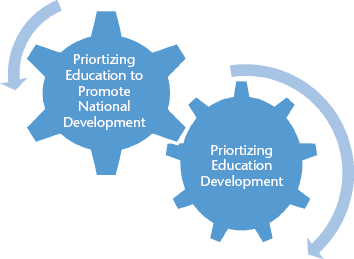
Model of Dual Priority Agenda (DPA) in China's education modernization.
Prioritizing the development of education over employment, social security, healthcare, hygiene, sports, and culture is the national policy and historical practice of China's education reform and development.
Education First
The Chinese leaderships believes that human capital and education are key to expediting economic development and catching up to developed countries. Only by prioritizing the development of education can modernization be quickly achieved.
Shortly after the return of Deng Xiaoping in 1977, he took the initiative in promoting education development, stating, “To catch up to advanced global standards, we must focus on science and education” (Deng, as cited in He, 1998, p. 1573). Deng (1993) firmly believed that science and technology are the foremost powers of productivity, stating, “to achieve modernization, we must improve our science and technology. To do this, promoting education is key” (Deng, as cited in He, 1991, p. 1573).
The 3rd Plenary Session of the 11th Central Committee of the CPC was held in December 1978. The ideology of “adopting class struggle as guidelines” was abolished during the meeting, and national operations were steered toward economic development. Thereafter, the status and effects of education modernization gained increased awareness, which coincided with the following statement of Deng (as cited in He, 1998), “The Four Modernizations are only empty words without science and education development” (p. 1577).
The Decision of the CPC Central Committee on Educational System Reform was published in 1985. It was one of the most crucial documents to be published during the reform and opening up of education in China, stating, “Human capital is the key to future success. To resolve the problem of human capital, education must improve significantly amidst economic development” (CPCCC as cited in He, 1998, p. 2285).
“The development of science, technology, and education must be prioritized, allowing technological advancement and increased labor quality to facilitate economic development”, was an idea first proposed in the 13th National Congress of the CPC held in 1987.
In response to the immense workload and financial limitations after implementing the economic reform policy, the ideology of “education must be set aside for the economy to grow” rose in popularity for a period in China. Supporters of this ideology believed that education was a consumption and advocated for the prioritization of funding for economic development. Unwavering, Deng Xiaoping (1993) stated, “At all costs, we must tolerate certain aspects and sacrifice some speed to resolve the education problem”. He criticized those that undervalued education as “those without foresight” (p. 121).
The Outline of Educational Reform and Development in China in 1993 regulated, “Various levels of government shall abide by the provisions in the Decision of the CPC Central Committee on Educational System Reform that stipulates ‘The increase in education appropriations by the central and local governments shall be higher than that of regular revenue, the average education expenditure per student enrolled shall increase steadily, and teachers’ salaries and average public expenditure per student shall increase annually”’ (as cited in He, 1998, p. 3473).
As the economy continued to develop, government officials began to understand the necessity of prioritizing education development. They came to realize that education is a basis and a driving force for economic development, and that it imposes fundamental, comprehensive, and pilot effects on the modernization of the entire country.
The strategy to prioritize education and adopt science education-centered national development policies as China's foremost national policies was first proposed in the 14th Congress of the CPC, held in October 1992. Jiang Zemin (2006) asserted when addressing the assembly, “We must prioritize education development and strive to enhance the ideological, moral, scientific, and cultural standards of our people, and this is the fundamental plan to modernize China”. He continued,
Scientific education-centered national development refers to adopting an ideology that science and technology are the foremost powers of productivity. We must adhere to an education-centered system and incorporate science, technology, and education into the key processes of economic and social development, thereby strengthening China's ability to convert science and technology into tangible productivity and improving people's science, technology, and cultural competency. Moreover, we must allow technological advancement and increased labor quality to facilitate economic development, expediting national prosperity. (Jiang, 1995)
In the 3rd National Education Working Conference held in 1999, Jiang proposed for the first time,
We shall adopt education as a key item of strategic development; incorporate education into the overall layout of modernized infrastructure; view education as a precursor and a global and fundamental task; and place education as a priority in our strategic development plan … “Party and government leaders at all levels must fulfil education objectives, ensure that education is ahead of development when formulating their economic and social development plans, ensure that the three aspects of growth concerning education funding are met when formulating financial budgets, increase the proportion of education spending in overall financial spending, and provide material guarantees for prioritizing education development. (Jiang, 1999)
As international competition exacerbated, the Chinese leadership further emphasized the aggressive implementation of strategies to strengthen China through human resource development and ensure national security and the future of the Chinese people.
During the National Talent Working Conference held on December 19, 2003, Hu Jintao asserted that national competition is basically human capital competition and proposed the Strategy of Reinvigorating China Through Talent Development. In the 34th Collective Learning Session held by the Central Politburo of the CPC in 2006, He asserted,
In today's world, knowledge is an increasingly crucial factor in enhancing overall national power and international competition, and human resources are an increasingly crucial strategic resource in promoting economic and social development … Human capital is at the root of the future development of China and reinvigoration of its people, and education is the basis for cultivating human capital. (Hu, 2006)
Hu Jintao (2007) further requested in a national educational meeting,
More effort and financial resources must be invested into education; education development must be prioritized in economic and social development plans; financial budgets must chiefly guarantee education investments; and public resources must chiefly meet the requirements for education and human resource development. (Hu, 2007)
During the One-Year Anniversary Event of the United Nations Global Education First Initiative held in September 2013, Xi Jinping (2013) reaffirmed, “China shall firmly implement the Strategy to Invigorate China Through Science and Education and always prioritize the development of education”. The report of the 19th Congress of the CPC held in October 2017 stated, “Strengthening education is fundamental to our pursuit of national rejuvenation. We must give priority to education”. 6 This is the latest statement and it fully reflects the policy continuity of the Chinese governmental agenda of prioritizing education.
“The Three Priorities”
Prioritizing education development in the modernization of China is a grand feat of social systems engineering. Based on national conditions, the Chinese government created “three priorities”, namely prioritizing education development in economic and social development plans, prioritizing government funding for education expenditure, and prioritizing public resources for education and human resource development. These three measures of “three priorities” have firmly ensured the implementation of “prioritizing education development”.
Prioritizing Education Development in Economic and Social Development Plans
Characterizing Education as a Key Item in National Economic and Social Development Plans
A key governance approach adopted by the Chinese government is the formulation of a development plan every 5 years. Deng Xiaoping (1978) asserted for the first time in 1978, “Education must coincide with the requirements of national economic development”, and “the State Education Commission, Ministry of Education, and other government departments must collectively center efforts to shape education into a vital component of the national economic plan”. Thereafter, education development became a key component in the formation of national economic and social development plans. The following part lists how education development has characterized in the national plan from 1986 to 2015.
The Seventh Five-Year Plan for National Economic and Social Development of the People's Republic of China issued in 1986 requested, “within five years, the national spending for education shall reach 116.6 billion CNY, for a 72% increase compared with the Sixth Five-Year Plan period, and the growth of education spending shall surpass that of regular revenues”.
The Outlines of the Ten-Year National Economic and Social Development Plan and the Eighth Five-Year Plan of the People's Republic of China issued in 1991 mentioned, “central and local governments at various levels shall gradually increase their education investments and center efforts in creating Chinese features and a socialist education system fit for the twenty-first century”.
The Outlines of the Ninth Five-Year Plan for National Economic and Social Development of the People's Republic of China and the 2010 Long-Term Goals issued in 1996 mentioned, “government departments at various levels shall govern education by law and increase education spending”.
The Outlines of the Tenth Five-Year Plan for National Economic and Social Development of the People's Republic of China issued in 2001 instructed, “adhere to appropriately exceeding the development of education and serving national economic and social development”.
The Outlines of the Eleventh Five-Year Plan for National Economic and Social Development of the People's Republic of China issued in 2006 contained a dedicated article that discussed the prioritization of education development.
The Outlines of the Twelfth Five-Year Plan for National Economic and Social Development of the People's Republic of China issued in 2011 stated, “accelerating education reform and development… guarantees that citizens exercise their right to education, and satisfies people's education needs”.
The CPC Central Committee Recommendations for the Thirteenth Five-Year Plan for Economic and Social Development issued in 2015 requested, “enhancing education quality, promoting the balanced development of compulsory education, promoting equal education, and enhancing teaching and innovation standards of high schools, enabling high schools and disciplines to reach or approximate world-class standards”.
Formulating Education-Centered Development Plans and Programmatic Policy Documents
Education development was not only characterized in the 5-year national economic and social plans, but also mentioned in several other crucial documents, such as the Decision of the CPC Central Committee on Educational System Reform issued in 1985, Outline of Educational Reform and Development in China issued in 1993, and the Outline of the National Medium and Long-Term Program for Education Reform and Development (2010-2020) issued in 2010. These documents stipulated concrete regulations for the prioritization of education, serving as critical guidelines for education development.
Allocating 4% of Government Funding to Education
During early stages of reform and opening up, China's economic and social development performance was relatively poor, and education severely lacked funding. In the first decade of reform and opening up, the education budget declined. Between 1980 and 1993, education spending dropped from 3.17% to 2.97% of the overall GDP, among which, the percentage of government-allocated funds for education dropped from 2.94% to 2.43% of the overall GDP. To ensure that education development was prioritized, the Chinese government proposed a goal in 1993 to increase educational investment to 4% of GDP by the end of 2000. Thereafter, the Chinese government centered its efforts on achieving this goal. It surpassed 4% of GDP for the first time in 2012 (4.28%) and maintained a percentage over 4% for 5 consecutive years.
Ratifying the “Three Growths” to Ensure the Continued Growth of Education Funds
To ensure the stable growth of education funds, the Decision of the CPC Central Committee on Educational System Reform issued in 1985 mentioned, “The increase in education appropriations by the central and local governments shall be higher than that of regular revenue, and the average education expenditure per student enrolled shall increase steadily”. The Outline of Educational Reform and Development in China issued in 1993 further asserted, “teachers’ salaries and average public expenditure per student shall increase annually”. These regulations completed the construction of the three growths model for government investment in education.
Table 1 shows the changes in public education investment in China from 1980 to 2016.
Changes in public education investment in China (1980–2016).
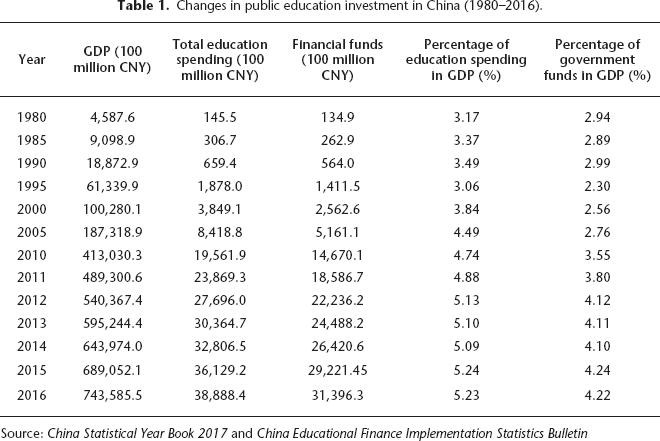
Changes in public education investment in China (1980–2016).
Source: China Statistical Year Book 2017 and China Educational Finance Implementation Statistics Bulletin
The growth of the government's education budget exceeded that of regular revenue
Over 35 years (1981–2015), the increase in fiscal appropriations for education was higher than or approximate to that of fiscal revenue in most years, which met the requirement that the growth of education appropriations by government departments at various levels shall exceed that of regular revenue (see Figure 2).
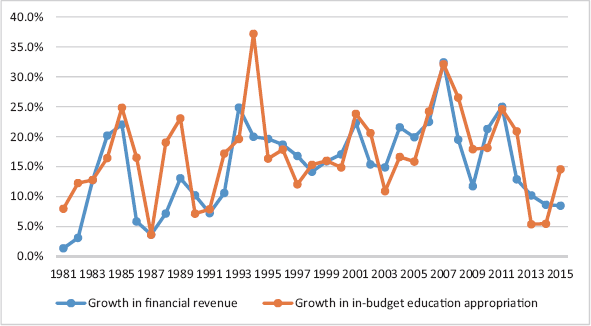
Changes in the growth of fiscal revenue and in-budget education appropriations in China between 1981 and 2015.
The average education expenditure per student enrolled gradually increased
Between 1993 and 2014, in addition to negative growth in the in-budget average education expenditure per student of secondary vocational education and general tertiary education, the in-budget average education expenditure per student at all other levels of education increased annually (see Figure 3). 7
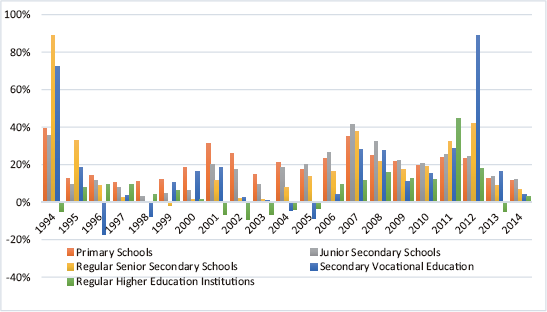
Changes in the growth of in-budget average education expenditure per student at various levels of education in China between 1994 and 2014.
Teacher salary and average public expenditure per student increased annually
Between 1993 and 2014, the growth of teacher salaries and average public expenditure per student at various levels of education in most years were higher than zero, suggesting positive annual growth (see Figures 4 and 5).
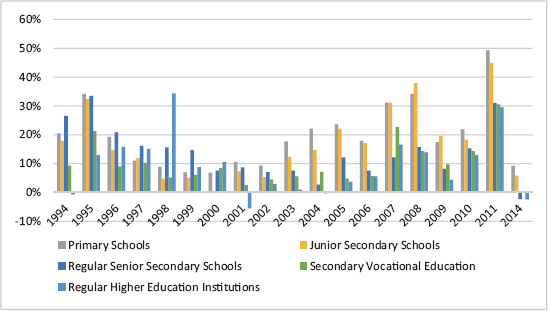
Changes in the growth of average public expenditure per student at various levels of education in China between 1994 and 2014.
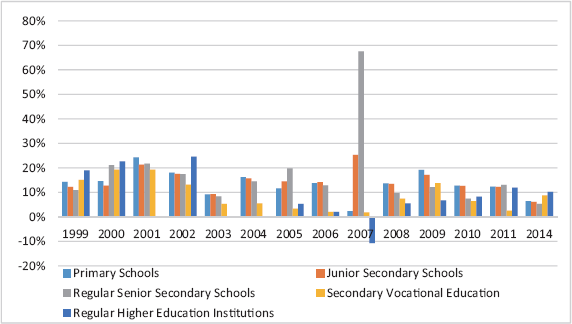
Changes in the growth of teacher salaries at various levels of education in China between 1999 and 2014.
Elucidating the Responsibilities of the Three Levels of Government concerning Financial Investment in Education
Prior to the reform and opening up, China's education budget was managed by a central authority. Over 40 years of education and school, management, and investment systems reform, China's funding system for compulsory education gradually shifted to an allocation model 8 wherein funds are provisioned by the central and local governments on project or pro rata bases (State Council of China, 2015).
According to the Outline of Educational Reform and Development in China issued in 1993 and the Decision on Education Reform and Development in Basic Education issued by the State Council in 2001, funds for higher education shall be budgeted by city governments or lower, whereas provincial governments shall be responsible for overall planning. The three-level schooling system that involves the central government, provincial governments (autonomous regions and municipalities), and major city governments is adopted for budgeting tertiary education, whereby the central government is primarily responsible for the provisioning of tertiary education funds to the various central ministries, and local governments are responsible for the provisioning of funds to local colleges and universities. This system provides a clear classification system for the appropriation of education funds at various levels of education and the responsibilities of various levels of government, facilitating long-term and stable growth in financial investment in education in China.
Reinforcing the Supervision of Education Appropriation
To ensure that local governments fulfil their education investment responsibilities, continue to increase education appropriations, and appropriately exceed the development of education in accordance with the education investment obligations of government at various levels, the central government constantly increased its efforts in supervision and inspection, thereby ensuring that the government at all levels strictly abided by relevant laws and regulations to expand their financial investment in education.
After 1986, the Standing Committee of the National People's Congress conducted six large-scale national enforcement inspections to determine the implementation conditions of the Compulsory Education Law of China and the Education Law of China. A key item of inspection was the appropriation of funds to compulsory education at various levels of governments. In addition, a budget and final account management system as well as an information transparency system were established to urge various levels of government to adopt education as a key domain for public expenditure and guarantee education expenditure by the government. These systems requested that local governments list budget items independently and submit the list to their local people's congress for approval and public announcement. Each year, an annual statistical report on the national and local education funding and expenditure conditions is compiled by a dedicated party and made available to the public, allowing people to supervise the growth and implementation of education funds. This process has provided an institutionalized supervision and management mechanism for ensuring the adherence of various levels of government to their education investment obligations and continually increasing financial appropriations.
Adequate financial investment is at the core of prioritizing education development. Nonetheless, relying solely on financial resources for prioritizing education development is insufficient. Only by reasonably combining human capital, financial resources, land, information, and other public resources to form a system that supports education reform and development can the prioritization of education development be truly fulfilled.
Valuing Teachers
Enhancing teacher employment standards
The quantity and quality of teachers are the foremost factors in education. Discussions on establishing a teacher qualification system began in China in the 1980s. In 1995, the Teachers Law of China and its implementation regulations were announced, providing a set of standards for the recognition and classification of teacher qualifications and the periodic review of teaching certificates. In addition, the Ministry of Education issued a number of policy documents requesting that teachers continually advance their educational level. The issuance of these documents prompted middle and elementary school teachers to meet national academic standards 9 . The Suggestions for Strengthening Teacher Training Programs announced in 2011 mentioned, “As of 2012, a clear progression of elementary school teachers’ education level toward college undergraduate level can be observed. A similar trend can be exhibited in middle school teachers toward university undergraduate level, and the proportion of high school teachers with a graduate degree or higher has increased significantly”. In 2015, the proportion of elementary school teachers in China with a college degree or higher reached 91.9%, the proportion of middle school teachers with an undergraduate degree or higher reached 80.2%, the proportion of general high school teachers with an undergraduate degree or higher reached 97.7%, and the proportion of general high school teachers with a graduate degree or higher reached 68.4%. These statistics suggest an exponential overall improvement in the standards of China's teaching resources.
Adjusting teacher staffing standards
Staffing standards govern the number of positions and teacher allocation. Staffing standards were proposed for the first time in 1984 with the release of Suggestions for the Staffing Standards of Teachers in Middle Normal Schools and Full-Day Middle and Elementary Schools. 10 The Suggestions for the Staffing Standards of Teachers in Middle Schools and Elementary Schools was re-issued in 2001 11 , changing staffing ratios from classroom-teacher ratios to student-teacher ratios, and modifying the standards for balancing urban and rural staffing standards to three-tiered staffing standards for cities, counties, and villages. The Notice on Unifying the Staffing Standards for Elementary and Middle School Teachers issued in 2014 formed a unified set of staffing standards for elementary and middle school teachers in urban and rural areas. The teacher-student ratios in high schools, middle schools, and elementary schools were 1:12.5, 1:13.5, and 1:19, respectively. Based on the teacher quota standards, national and regional staffing, human resource, and social security departments began coordinating and allocating teachers to their positions in elementary and middle schools, relieving the shortage of teachers and modifying teacher structures, and thereby optimizing staffing and ensuring that basic education schools continue to operate normally and that the basic requirements for education and learning are satisfied.
Improving teacher salaries and status
Respecting both teachers and education is a Chinese tradition. To promote respect for teachers and education nationwide, the Chinese government proclaimed September 10th to be the Teachers’ Day in 1985, reinforcing the legal status of public elementary and middle teachers as civil servants (State Council of China, 2018) as well as guaranteeing that teachers were paid an average salary of no more or less than the average salary of a public servant and that their salaries would gradually increase over time (Ministry of Education, 1993). According to the statistics released by the National Bureau of Statistics of China, the average salary of employees in urban education industry ranked 12th among the 19 major industries in 2007, rising to 8th in 2016 (see Table 2).
Average wage of employed persons comparison in urban units in various industries between 2007 and 2016 (Unit: CNY).
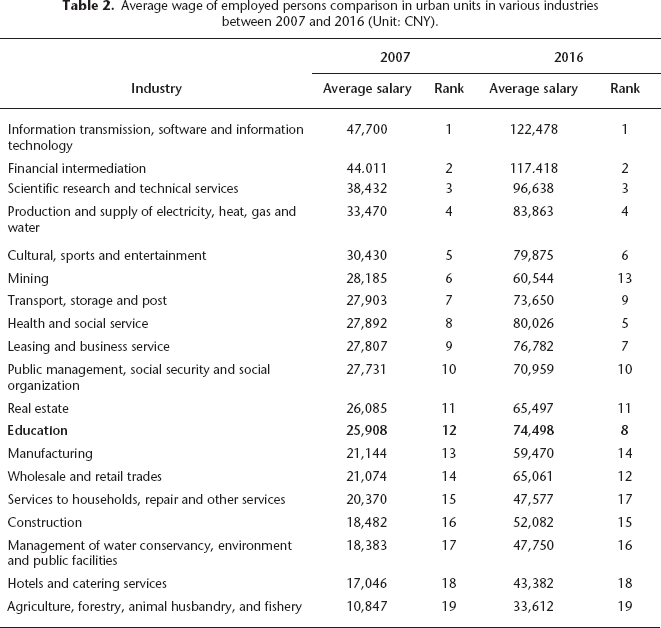
Average wage of employed persons comparison in urban units in various industries between 2007 and 2016 (Unit: CNY).
Implementing Preferential Policies to Meet the Educational Needs of Public Resources
To promote the national and local development of education industry, the government not only increases appropriations, but also levies education surcharges and prioritizes the revenue for improving education and teaching facilities. In addition, the government implements preferential policies for coordinating and allocating school land and schooling resources; implements prioritization and preferential policies for publishing and issuing textbooks and teaching materials as well as producing and supplying teaching instruments and equipment; and provides teacher and student discounts to libraries, museums, sports centers, cultural venues, and other public cultural and sports facilities, historical and cultural sites, and revolutionary memorial halls (sites), thereby enhancing access to educational content.
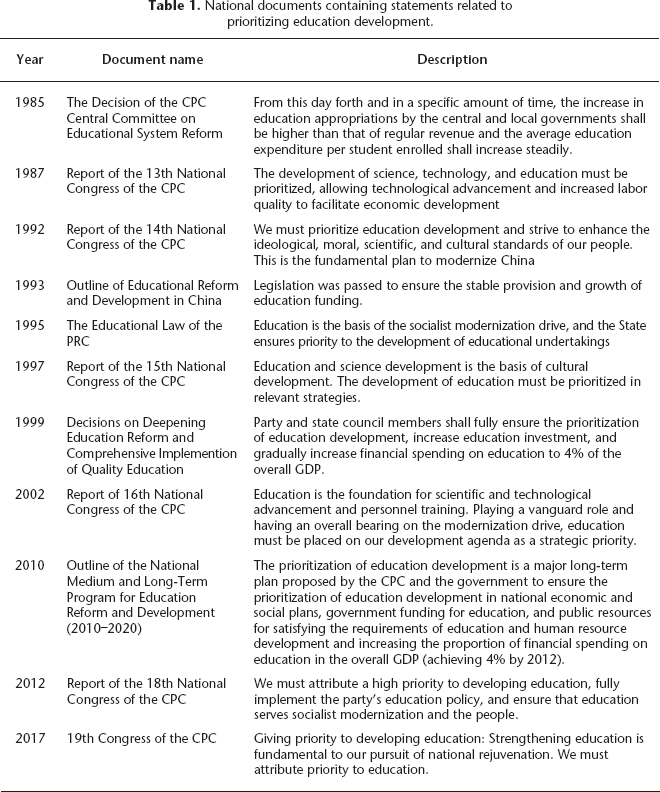
The promulgation of the Education Law of China in 1995 legally regulated the inclusion of school infrastructure into urban and rural construction plans as well as the responsibilities of local governments to plan and allocate land and resources to building this school infrastructure, in addition to the implementation of prioritization and preferential policies. The Notice of Education Tax Policies proposed by the Ministry of Finance and State Administration of Taxation in 2004 further clarified the scope and magnitude of tax exemptions for school land, guaranteeing the physical and mental fulfillment of prioritizing education development. Relevant key national documents regarding prioritizing education development are summarized in Appendix A.
Education is multifunctional. Prioritizing education to promote national development is the government's means to define China's education functions. This policy coincided with that of prioritizing education development, becoming an internal driving force for China's positive education development.
During the National Education Working Conference held in 1978, Deng Xiaoping (1990) stated, “Education must coincide with the requirements of national economic development” (p. 62). How well adapting to national economic development has always been an indicator of education development performance in China.
On a plaque given to a school in Beijing in 1983, Deng Xiaoping inscribed, “Education must advance toward modernization, the world, and the future”, which essentially reflected the government's expectations for education and confirmed the strategic goals and working principles for China's education development.
The Outline of Educational Reform and Development in China issued in 1993 summarized the main principles for creating a socialist education system with Chinese features, mentioning, “education is the basis for the modernized socialist development”, and “we must continue to invest in education to facilitate modernized socialist development, combine education with production and labor, consciously abide by and serve in this hub of economic development, and promote comprehensive social advancement”.
At the 3rd National Education Working Conference held in 1999, Jiang Zemin mentioned, “during the initial stages of China's socialist development, adopting education as a basis for economic, political, and cultural development provided the human capital and intellectuals required for modernization development. Human capital must be directly invested into various development projects, thereby encouraging contribution”.
In 2017, Suggestions on the Further Reform of Education Systems and Mechanisms issued by the State Council comprehensively and systematically presented the requirements for prioritizing education to promote national development, stating, “education should serve the people and the state administration of the CPC. It should serve the reinforcement and development of socialist systems with Chinese features, economic reform of China, and modernized socialism”.
“Strengthening education is fundamental to our pursuit of national rejuvenation” (Xi, 2017). This statement was made in the 19th Congress of the CPC, and it perfectly summarizes the concept of dual priority agenda.
Education must Serve Socialist Development, and Socialist Development must Rely on Education
The Decision of the CPC Central Committee on Educational System Reform issued in 1985 mentioned, “Education must serve socialist development, and socialist development must rely on education.” This sentence concisely illustrates the independent relationship between prioritizing development and prioritizing satisfaction. Prioritizing education to promote national development has both historical implications and realistic requirements in China.
Confucian Tradition
Since ancient times, China has developed a tradition of respecting mentors and teachers. One of the earliest book on education, Book of Rites: Xue Ji, mentioned, “Rulers that wish to govern their people effectively and form favorable customs must prioritize education.” This ideology became a major feature of the Confucian culture and was adopted by founders as a core value. “Governing people with benevolence” was already advocated during the Wenjin Period of the Han Dynasty, whereby people were taught democracy to maintain national security. Emperor Wu of Han adopted the recommendation of Dong Zhongshu to establish an imperial academy to educate the country. During the Nansong Period of the Song Dynasty, the leading figure in the School of Principle, Zhu Xi, mentioned, “Education is the foremost aspect of national prosperity and diplomacy.” He cited the Book of Rites: Xiangyin Jiuyi, “People must learn to respect and care for their elders before they are able to respect their parents and siblings at home. People that respect their parents and love their siblings at home and respect and help elders outside will form morality. Once morality is formed, the security of the country is ensured”, promoting “the formation of morality to ensure national security” to the extreme. During the Ming-Qing transition, the ideologies of “practical learning” and “practical application” were popularized in education. They centered on cultivating human capital that benefited the country. More recently, Sun Yat-Sen mentioned, “Scholars are a core component of a country. Without immediate amendment to existing laws and the promotion of education, how are we able to cultivate human capital and national resources?” This emphasized that education is the foundation of building a country. Tao Xingzhi firmly asserted, “When people receive adequate education, come to each other's aid, and take responsibility for their country, the foundation of the country would inevitably be strong” (Tao, 1991, p. 693). Tao began one of the largest movements for mass education in China's modern history, fully reproducing the historical tradition of embedding national development requirements into education.
Red Gene
Li Dazhao, one of the founders of the CPC, has long advocated that educators spread the seeds of light in society, stating, “Knowledge is a candle guiding people to the light and truth” (Chen, 1984, p. 8). Li believed that people wholly embracing education would “open up a new road for people's lives” (Chen, 1984, p. 176).
Mao Zedong passionately advocated that education should serve China's reform and the country. During the Chinese Soviet Republic era of 1934, Mao stated, “The Soviets must undergo cultural education reform, lift the constraints that the reactionary ruling class has imposed on the morale of farmers and laborers, and create a new Soviet culture centered on farmers and laborers” (Mao, 1934/1991, p. 282). Mao proposed a general principle for cultural education, stating, “Cultural education must serve reform and class conflict, facilitate the integration of education and labor, and allow the Chinese public to enjoy a happy and civilized society” (Mao, 1934/1991, p. 285). In 1942, Mao asserted that the economy and education were the two focal aspects during the crisis at the Shaan-Gan-Ning Border Region, stating, “Discussing education or learning without accounting for the economy is nothing more than empty worlds” (Mao, 1942/1986, p. 565). A popular work of Mao published in 1957, New Democracy, mentioned, “Our education policy should focus on the moral, intellectual, and physical development of learners, helping them grow into cultural laborers with a consciousness for socialism.” This statement became a consistent education ideology of the CPC.
International Competition Demands
In 1980, Deng Xiaoping provided a brief assessment of the international situation in the 1980s, stating, “the various tasks for building a powerful and modernized socialist nation are interrelated” (Deng, 1993) emphasizing that human capital and education are fundamental aspects. 12
Confronted with the changes in international conditions in the 1990s, national leaders realized,
Amidst changes in today's political climate, increasing intensity in international competition, and rapid technological advancement, global economic competition and overall national competition are essentially the competition of science, technology, and national quality … In this context, whoever controls education will have a strategic competitive advantage in the 21st century. Therefore, we must have foresight and plan for China's education early to meet the challenges of the 21st century. (He, 1998, p. 3467)
Entering the 21st century, Chinese leaders further emphasized human capital is the key to the development and reinvigoration of China, and education is the foundation for fostering human capital. Therefore, they requested the deepening of education reform, allowing education to more effectively meet national development and competitive advancement needs.
Three Stages to Meet National Development Requirements: Upscaling, Structural Adjustment, and Quality Enhancement
Upscaling Education and Resolving Insufficient Placement Problems
During early reform and opening up, the years of education received by the working population was fewer than 5 years. Nearly 10% of children attended preschool, 60% attended middle school, 20% attended high school, and 1% attended university. Chinese families hoped that their children could attend school, and the country hoped to “foster more and better professionals” (He, 1998, p. 2285). Upscaling education and increasing the GER at all three levels of education were the foremost education-related challenges faced by China during the early period of reform and opening up. In response, China first focused on establishing a 9-year compulsory education system while simultaneously developing secondary and tertiary education.
First, the 14th National Congress of the CPC held in October 1992 mentioned, “at the end of the last century, illiteracy among teenagers had been essentially eliminated, and implementation of 9-year compulsory education has been achieved in China”. Furthermore, the “double 85%” objective was achieved in 1994. At the end of the twentieth century, the 9-year compulsory education system was implemented in regions that accounted for 85% of the population, and the GER at the secondary education level achieved 85%.
Second, the Two Basic Action Plans on Education (2004–2007) centered on the Western regions of China were implemented in 2004. The plans were fulfilled at the end of 2007. The population coverage of the plan achieved 98% in 2007. In November 2011, all of the county administration departments and provincial administrative divisions in China conducted a full-scale survey to evaluate the universalization of the 9-year compulsory education system, and the elimination of illiteracy among teenagers and young adults, completing a historical strategic task.
Third, an announcement was made that, “all tuition and fees for compulsory education in urban public schools shall be exempted as of fall 2008”, achieving the objective of free education.
Increasing the Universalization of High School Education
Because of a large population and relatively poor education structure, the government was only able to promote a few high-priority high schools when universalizing the 9-year compulsory education system. Subsequently, the lag in general high school education became increasingly evident. In response, the Outline of Educational Reform and Development in China issued in 1993 mentioned, “actively universalizing high school education concurrently with the implementation of the 9-year compulsory education system in metropolitan and developed coastal regions” for the first time. Thereafter, enrollment and attendance at general high schools have increased annually. The advancement rate from middle to high school increased from 40.6% in 1990 to 51.2% in 2000, and graduation and advancement rate in high schools increased from 27.3% in 1990 to 73.2% in 2000.
Entering the twenty-first century, the development of high school education in China has shifted into the fast lane. The State Council of the PRC announced the Decision on Education Reform and Development in Basic Education in 2001, providing instructions to, “vigorously develop high school education, promote the coordinated development of high school education, and systematically universalize high school education in large and medium cities and economically developed regions”. In 2016, the high school GER rose to 87.5%, and in the same year, the Ministry of Education and three other government departments jointly proposed the Guideline for Popularizing High School Education (2017–2020), proclaiming an objective to achieve a high school advancement rate of 90% by 2020.
Achieving the Universalization of Tertiary Education
Between the 1980s and mid-1990s, the GER for tertiary education in China was roughly 5%. The Outline of Educational Reform and Development in China issued in 1994 mentioned that, “6.3 million students enrolled in general and adult universities and colleges in 2000. Among this number, 1.8 million were undergraduates, and 4.5 million were college students. The enrollment rate for students between ages 18 and 21 years rose by roughly 8%.” The outline accelerated the development of tertiary education; however, at the end of the 1990s, the pressure of employment and further education among tertiary-level students rose exponentially. In response to rapidly changing trends, the Chinese government implemented a plan in 1999 to expand the enrollment rate of colleges and universities, expanding the enrollment rate of general colleges and universities by roughly 50%, from 1.08 million in 1998 to 1.59 million in 1999 (see Figure 6). The enrollment rate continued to rise incrementally by another 45% over the next three years. With the sequential rise in the enrollment rate in the several years that followed, the scale of enrollment for general colleges and universities reached 3.20 million in 2002. The GER for tertiary education rapidly increased by over 15%, verifying the initial universalization of tertiary education 14 . The GER for tertiary education in China continued to rise into the twenty-first century, reaching 42.7% in 2016. However, a decline in population at the tertiary level occurred because of China's family planning policy. Nonetheless, by 2020, the GER for tertiary education is expected to surpass 50%.
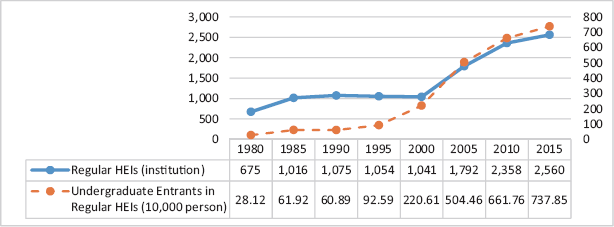
Number of regular higher education institutions and number of undergraduate entrants in regular higher education institutions between 1980 and 2015.
During the initial period of reform and opening up, China was a leading country in agriculture, and 70% of its population resided in farming villages. In the early 1980s, primary, secondary, and tertiary industries accounted for 30.1%, 48.5%, and 21.4% of China's overall GDP, respectively 15 . Amidst advancements in production quality and the progression of urbanization over 4 decades, China's urbanization rate surpassed 55% in 2016. This changed the proportions of primary, secondary, and tertiary industries in China's overall GDP to 8.6%, 39.8%, and 51.6%, respectively. The requirement for human resources in economic development changed concurrently with the adjustment of industrial structures. To meet these requirements, the education structure in China is constantly changing.
Adjusting General Vocational School Structures
In the early 1980s, the secondary education structure was fairly unitary. “Besides a few high school graduates advancing to university, millions of graduates entered the labor force without specialized knowledge or skills each year. Simultaneously, industries were in dire need of skilled professionals. However, newly employed workers had to undergo apprenticeship for 2 to 3 years, which hindered labor production” (He, 1998, p. 1855).
In 1980, the Ministry of Education and the Ministry of Human Resources and Social Security jointly announced the Report of the Reform and Development of Technical and Vocational Education, mentioning, “In order for high school education to conform with the requirements of socialist modernization development, general education and vocational/technical education must be promoted concurrently, fulltime schools and part-time/spare-time schools must be promoted concurrently, and national education and sales departments/factories and mining enterprises/community schooling must be promoted concurrently.” The education system reform of 1985 requested that the enrollment rate of high school-level vocational and technical schools match that of general high schools and that establishing reasonable structures and vocational education systems that communicate with general education be adopted as the primary objectives for adjusting general vocational structures. By the end of 1990, the number of secondary-level vocational schools increased from 4,773 in 1978 to 8,173, and enrollment rate between general high schools and secondary vocational schools increased from 3.7:1 in 1980 to 1.1:1 (see Figure 7).
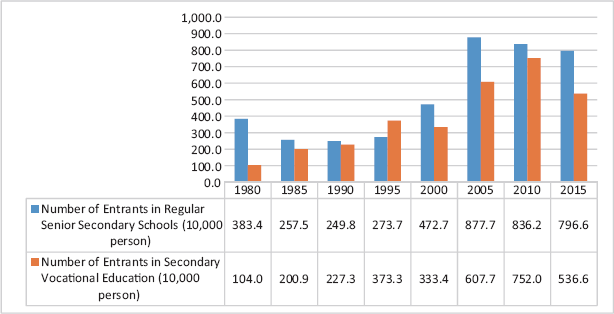
Number of students enrolled in regular senior secondary schools and secondary vocational education between 1980 and 2015.
In the same period, tertiary vocational education rapidly developed. By 2016, the number of vocational (technical) colleges reached 1,359, which was roughly 52.3% of all general colleges and universities, suggesting that vocational education accounted for half of all tertiary education in China.
Adjusting University Specialization Structures
Vital adjustments to specialization structures in tertiary education were conducted concurrently with the structural adjustment of secondary education. After the initial reform and opening up, China underwent four major adjustments to specialization structures at the tertiary education level.
The first adjustment of specialization structures occurred in 1984, focusing on “resolving the over-classification of professions and expanding the scope of specialization operations to reinforce scientific foundations, improve education quality, and strengthen talent adaptability” (He, 1998, p. 2202). After the adjustment, the number of professions in colleges and universities reduced from 1,039 in 1980 to 870 in 1988. In addition to an increase in the number of professions under the teaching, liberal arts, law, sports, and art specializations, the number of professions in the remaining six specializations decreased.
The second adjustment of specialization structures occurred in 1989, focusing on “valuing investment and social performance, correctly handling quantitative and qualitative relationships, forming reasonable specialization structures and networks, avoiding unnecessary repetitive settings, and ensuring stable development while guaranteeing quality and performance” (He, 1998, p. 2854). After the adjustment, a batch of specialization was adjusted and consolidated, and specialization content was enriched and expanded, forming a total of ten disciplines, 71 categories and 504 specializations. The number of specializations was 309 fewer than before the adjustment. Among them, 56 were interdisciplinary specializations urgently required in China, including those in information engineering, computer science, and computer software.
The third adjustment of specialization structures occurred in 1997, focusing on changing the over-emphasis of specialization-vocation matching to all-round development, which had a positive effect on expanding the specializations of colleges and universities, enhancing adaptability, strengthening professional development and management, and improving educational standards and talent development quality. 16 Compared with the previous directory, the specialization directory of 1998 adjusted the number of disciplines and specializations to 11 and 249, respectively, for a downward revision of 50.6%. A comparison between the old and new directories showed that the new directory not only added, adjusted, or removed professions to meet immediate national requirements but also added new high-tech specializations, which promoted the development of material science and construction, marine science, environmental engineering, electrical science and technology, and information and computer technology.
The fourth adjustment of specialization structures occurred in 2010. The 2010 specialization directory retained a batch of professions that were more mature, in stable demand, offered in more locations, and were more inheritable; adjusted a batch of specializations that were unclear, unstandardized, and less distinct; and added a batch of emerging specializations that were strategically beneficial to industrial development and the improvement of livelihood as well as being highly applicable and industry specific, such as logistics management and engineering, e-commerce, and rail transit signal and control.
From the initial adjustment and optimization of undergraduate specializations in 1987 to 2016, the number of specializations concerning primary industries reduced from 69 to 35, those concerning secondary industries reduced from 505 to 251, and those concerning tertiary industries increased from 276 to 309.
Rapid advancements in science and technology and the advent of the information era have constantly posed new challenges for people's qualities and demands. As the Chinese government channeled its efforts into increasing enrollment rates at various education levels, it also continually increased the quality and specifications of fostering human capital, changed the content of talent qualities, and prompted the transition of an extensive, labor-based economy into an intensive, knowledge-based economy.
Restoring Order to Education and Fulfilling the Two Basic Action Plans on Education
At the end of the 1970s and following the Cultural Revolution that lasted a decade, China's education system was left in complete ruin, and students lacked basic knowledge and training. China began rebuilding its education system in 1977, gradually restoring order to school education. In January 1978, the Ministry of Education announced the Full-Time Ten-Year Primary and Secondary School Teaching Plan, mentioning, “We must reinforce cultural education and teach students to diligently study for the revolution. Students should acquire a basic knowledge of advanced cultural science and its theoretical implications, gradually developing self-learning and self-analysis abilities” (He, 1998, p. 1593). In the same year, the Ministry of Education implemented a draft version of the Temporary Working Regulations for Full-Time Middle School Education and the Temporary Working Regulations for Full-Time Elementary Education. The objective for fostering full-time middle school students was to “allow students to expand the knowledge acquired in elementary school to continue fostering their basic language, mathematics, and foreign language knowledge and skills, gradually developing self-learning, self-analysis, and problem-solving abilities; gaining production knowledge; and forming the habit of enjoying, learning, and using science” (He, 1998, p. 1630); the objective of fostering full-time elementary school students was “to foster students’ preliminary reading, writing, and calculating abilities; general knowledge concerning nature and society; and positive learning habits” (He, 1998, pp. 1635–1636).
In addition, the working regulations stipulated that mathematics classes should aim to strengthen the teaching of basic mathematics and the training of fundamental skills. School works gradually improved, and a quality education system was established.
Overcoming the One-Sided Pursuit of Education and Achieving for All-Rounded Development
With the comprehensive restoration of order to fundamental education and learning as well as college and university entrance examination systems, an unprecedented rise in the pursuit of education by long-suppressed Chinese students occurred. Schools began “focusing on advancement rates rather than preparing students for employment, and on tests scores rather than ethical and physical education and the fostering of basic knowledge and skills” (He, 1998, p. 2148). In response, the Ministry of Education issued Suggestions on Further Improving the Quality of Education in General Middle Schools in 1983, requiring, “reforming and strengthening students’ ideological and political works” and “alleviating student burden, allowing them to actively learn and foster intelligence and capability; teaching content shall more suitably meet labor and further education needs”. The Decision of the CPC Central Committee on Educational System Reform issued in 1985 further indicated that the personnel required by the country must “exhibit ideals, morals, culture, and discipline; be passionate about the socialist motherland and socialist operations; be willing to sacrifice themselves for the prosperity of the country and its people; and demonstrate a scientific mindset for constantly pursuing new knowledge, seeking truth, thinking independently, and boldly creating”. The Outline of Educational Reform and Development in China issued in 1993 mentioned that schools at various levels must train participants of and successors to the socialist cause who develop morally, intellectually, and physically, emphasizing, “Middle and elementary schools shall steer the ‘examination-centered education’ toward enhancing quality and comprehensively fostering the ideological and moral, cultural and scientific, labor and skill, and physical and mental qualities of all students, thereby allowing students to develop actively and vividly”. These documents reflect the renewed requirements for quality and competence from economic and social development.
Emphasizing Key Competences
Decisions on Deepening Education Reform and the Comprehensive Implementation of Quality Education was issued by the State Council of China in 1999, which asserted,
In today's world, science and technology are rapidly advancing, knowledge economies are emerging, and national competition is intensifying. Education is a fundamental component in the formation of national power, and national power is becoming increasingly dependent on the quality of the workforce and the quality and quantity of human capital. These trends have created new and urgent demands for fostering and promoting new professionals in the twenty-first century. … With the emergence of new trends, our existing subjectivities and objectivities have caused our education ideologies, education systems, education structures, talent cultivation methods, education content, and education methods to lag behind those of other countries, hindering our youths from all-round development and our ability to meet national standards. (State Council of China, 1999)
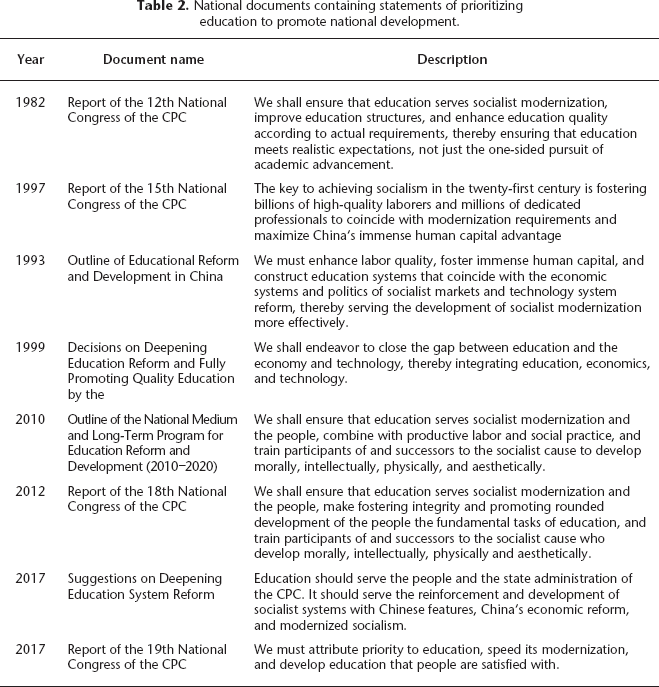
It proposed a key ideology of “implementing quality education”, which emphasized “the development of students’ creative spirit and practical abilities”. The Outline of the National Medium-and Long-Term Program for Education Reform and Development (2010–2020) issued in 2010 further emphasized that the key to implementing quality education was “the comprehensive development of all students, enhancing their sense of duty toward serving their country and its people, and cultivating their creative spirit for bold exploration and practical skills to solve problems”. The CPC Central Committee Recommendations for the Thirteenth Five-Year Plan for Economic and Social Development issued in 2015 provided instructions to, “deepen education reform and prioritize the enhancement of students’ sense of social responsibility, creative spirit, and practical abilities in national education”, which further emphasized fostering people's qualities. A list of key national documents on prioritizing education to promote national development is included in Appendix B.
Concluding Remarks
Since 1978, China has focused on achieving modernization of its education system. By being led by reform and opening up, rooting in the national context, and referencing the experiences of advanced countries, China formed an interactive and reciprocal model to prioritize both education development and education to promote national development, paving a path to pursue and surpass international standards.
Understanding and handling the relationships between national and social development are challenges shared by all leaders, and frequently discussed in academia. Fagerlind and Saha (1983) classified the relationships between education and national development into four types: developed capitalist countries, underdeveloped capitalist countries, developed socialist countries, and underdeveloped socialist countries. Moreover, they analyzed the associations between education and national development in two dimensions: economic levels and social systems. They believed that the most prominent differences in the relationships between education and national development in capitalist countries and socialist countries are that capitalist countries promote education for individual achievement, focusing on the intrinsic value of education, whereas socialist countries promote education for collective achievement, focusing on the instrumental value of education (Fagerlind & Saha, 1983, p. 208).
Associating socialism with planning economies and collective goals, as well as associating capitalism with market economies and individual goals, form a common ideological model in both Western and Eastern countries. However, this model cannot fully reflect modern situations. The goal to construct a socialist market economy system was clearly proposed for the first time in the 14th Congress of the CPC in 1994, proposing the merging of a fundamental socialist system with a market economy to establish a socialist market economy system. A socialist market economy is primarily a state-owned economy that prioritizes collective interests and protects private assets, respecting individual interests, encouraging market competition, and motivating individual activity. Since its reform and opening up, China has centered its efforts on minimizing the tension between individual development and collective objectives in education. Tsang (2000) clearly highlighted that after reform and opening up, the CPC centered party efforts on economic development; however, these efforts caused a conflict between social fairness and justice as well as political theory development, which constituted the broad social and historic environment for the development of the education system. The historical economic and political achievements of the CPC reflected its ability to adapt to social reform. In the future, it may further expand its control over the government and society, affecting the direction and pace of future social reform. Education remains the source of the science, technology, and human resources required for national development. Education policies should clearly highlight the “who, how and what” of education. Therefore, education has the potential to affect the agencies and departments involved in the formation of national development policies.
China has a historical tradition of respecting teachers and education. Regardless of prosperity or crisis, China has always valued personnel training and education development. After the reform and opening up, China proposed a model comprising “three priorities” and “three growths” to prioritize education development, to supply the country with the human resources required to achieve national modernization, and to convert immense population burden into social wealth. Similarly, China has always valued the social value of education, setting the satisfaction of social and national development as the foremost objective of education. Social development requirements are immediately reported to education authorities, which then propose work requirements and formulate relevant policies that coincide with the priority development policies.
The model of DPA was neither created on the first attempt nor simply developed linearly. Rather, it gradually materialized as China endured numerous major social changes. Furthermore, the complementary effects of the DPA were formed through incremental adaptation and development. During the past decade, the DPA and its complementary effects have become more apparent. The DPA can be anticipated to continue facilitating national development and accelerating the modernization of China's education system in the future.
Footnotes
1
Source: United Nations Statistics Division (UNSD;  ). Branch: GPD per capita (current USD). 187 countries were surveyed in 1978, and 212 countries were surveyed in 2016. The statistics presented in the article does not include three regions of China—Hong Kong, Macau, and Taiwan—unless otherwise specified.
2
3
4
Source: Statistics presented in the 1982 Census announced by the National Bureau of Statistics of China (http://www.stats.gov.cn/tjsj/tjgb/rkpcgb/qgrkpcgb/200204/t20020404_30318.html) and statistics presented in the 2015 1% National Population Sample Survey ().
5
6
The report is titled as “Secure a decisive victory in building a moderately prosperous society in all respects and strive for the great success of socialism with Chinese characteristics for a new era”, delivered by Xi Jinping at the 19th National Congress of the CPC, People's Daily, 18 October 2017.
7
To ensure data availability and statistical consistency, the in-budget average education expenditure per student statistics and average public expenditure per student statistics between 1993 and 2014 were used. The teacher salary statistics between 1998 and 2014 were used.
8
The funds required to meet average public expenditure per student shall be budgeted by the central and local government on a pro rata basis. The proportion of Western and Central China shall be based on the county (city, district) ratio of 8:2 ratified in the Policy of Grand Development in Western China, that for other central regions is 6:4 and for Eastern China is 5:5.
9
For example, the Outline of Educational Reform and Development in China issued by the State Council of the PRC in 1993 announced the achievement of a fundamental objective, “at the end of the last century, most middle school and elementary school teachers in China met national academic standards through supplementary and in-service training. The number of middle school and elementary school teachers with college or university undergraduate degrees is gradually increasing”.
10
According to the Suggestions for the Staffing Standards of Teachers in Middle Normal Schools and Full-Day Middle and Elementary Schools issued in 1984, the number of students per classroom in urban elementary schools was between 40 and 45, the number of teaching staff per classroom was 2.2, and the number of classroom teachers per classroom was 1.7. The number of students per classroom in rural elementary schools was between 30 and 35, the number of teaching staff per classroom was 1.4, and the number of classroom teachers per classroom was 1.3. The number of students per classroom in urban middle schools was between 45 and 50, the number of teaching staff per classroom was 3.7, and the number of classroom teachers per classroom was 2.5. The number of students per classroom in rural middle schools was between 40 and 45, the number of teaching staff per classroom was 3.5, and the number of classroom teachers per classroom was 2.5. The number of students per classroom in urban high schools was between 45 and 50, the number of teaching staff per classroom was 4.9, and the number of classroom teachers per classroom was 2.8. The number of students per classroom in rural high schools was between 45 and 50, the number of teaching staff per classroom was 4.0, and the number of classroom teachers per classroom was 2.8.
11
According to the Suggestions for the Staffing Standards of Teachers in Middle Schools and Elementary Schools issued in 2001, the teaching staff-to-student ratios in city, county, and village elementary schools were 1:13.5, 1:16, and 1:18, respectively. Those in city, county, and village middle schools were 1:13.5, 1:16, and 1:18, respectively. Those in city, county, and village high schools were 1:12.5, 1:13, and 1:13.5, respectively.
12
Deng Xiaoping emphasized “vigorously fostering science and technology talent” during the opening ceremony of the Science Conference of China held in 1978, stating, “education is the foundation for the fostering of science and technology talent”.
13
The document defined compulsory education as the guarantee of national education necessary for the development of modern production and social survival of school-age children and adolescents by the country, society, and family by law. Such education is a symbol of modern civilization.
14
Historically, the United States, South Korea, Japan, and Brazil respectively spent 30, 14, 23, and 26 years promoting their GER in tertiary education from 5% to 15%. China roughly spent a decade raising its GER in tertiary education from 3.4% (1990) to 15% (2002).
15
Source: China Statistical Year Book; ratio of the three education levels in corresponding year.
16
Note on contributor
Zhenguo Yuan is Professor and Dean of the Faculty of Education at East China Normal University (ECNU), and Vice-President of China's Society for Education Studies. Before returning to ECNU in 2014, he served as key policy planner at China's Ministry of Education for teacher education reform and director of China's Institute of Educational Sciences (2007–2013). He has published widely on education policy, comparative education, school leadership, and quality enhancement of education.
Appendix A
National documents containing statements related to prioritizing education development.
| Year | Document name | Description |
|---|---|---|
| 1985 | The Decision of the CPC Central Committee on Educational System Reform | From this day forth and in a specific amount of time, the increase in education appropriations by the central and local governments shall be higher than that of regular revenue and the average education expenditure per student enrolled shall increase steadily. |
| 1987 | Report of the 13th National Congress of the CPC | The development of science, technology, and education must be prioritized, allowing technological advancement and increased labor quality to facilitate economic development |
| 1992 | Report of the 14th National Congress of the CPC | We must prioritize education development and strive to enhance the ideological, moral, scientific, and cultural standards of our people. This is the fundamental plan to modernize China |
| 1993 | Outline of Educational Reform and Development in China | Legislation was passed to ensure the stable provision and growth of education funding. |
| 1995 | The Educational Law of the PRC | Education is the basis of the socialist modernization drive, and the State ensures priority to the development of educational undertakings |
| 1997 | Report of the 15th National Congress of the CPC | Education and science development is the basis of cultural development. The development of education must be prioritized in relevant strategies. |
| 1999 | Decisions on Deepening Education Reform and Comprehensive Implemention of Quality Education | Party and state council members shall fully ensure the prioritization of education development, increase education investment, and gradually increase financial spending on education to 4% of the overall GDP. |
| 2002 | Report of 16th National Congress of the CPC | Education is the foundation for scientific and technological advancement and personnel training. Playing a vanguard role and having an overall bearing on the modernization drive, education must be placed on our development agenda as a strategic priority. |
| 2010 | Outline of the National Medium and Long-Term Program for Education Reform and Development (2010–2020) | The prioritization of education development is a major long-term plan proposed by the CPC and the government to ensure the prioritization of education development in national economic and social plans, government funding for education, and public resources for satisfying the requirements of education and human resource development and increasing the proportion of financial spending on education in the overall GDP (achieving 4% by 2012). |
| 2012 | Report of the 18th National Congress of the CPC | We must attribute a high priority to developing education, fully implement the party's education policy, and ensure that education serves socialist modernization and the people. |
| 2017 | 19th Congress of the CPC | Giving priority to developing education: Strengthening education is fundamental to our pursuit of national rejuvenation. We must attribute priority to education. |
Appendix B
National documents containing statements of prioritizing education to promote national development.
| Year | Document name | Description |
|---|---|---|
| 1982 | Report of the 12th National Congress of the CPC | We shall ensure that education serves socialist modernization, improve education structures, and enhance education quality according to actual requirements, thereby ensuring that education meets realistic expectations, not just the one-sided pursuit of academic advancement. |
| 1997 | Report of the 15th National Congress of the CPC | The key to achieving socialism in the twenty-first century is fostering billions of high-quality laborers and millions of dedicated professionals to coincide with modernization requirements and maximize China's immense human capital advantage |
| 1993 | Outline of Educational Reform and Development in China | We must enhance labor quality, foster immense human capital, and construct education systems that coincide with the economic systems and politics of socialist markets and technology system reform, thereby serving the development of socialist modernization more effectively. |
| 1999 | Decisions on Deepening Education Reform and Fully Promoting Quality Education by the | We shall endeavor to close the gap between education and the economy and technology, thereby integrating education, economics, and technology. |
| 2010 | Outline of the National Medium and Long-Term Program for Education Reform and Development (2010–2020) | We shall ensure that education serves socialist modernization and the people, combine with productive labor and social practice, and train participants of and successors to the socialist cause to develop morally, intellectually, physically, and aesthetically. |
| 2012 | Report of the 18th National Congress of the CPC | We shall ensure that education serves socialist modernization and the people, make fostering integrity and promoting rounded development of the people the fundamental tasks of education, and train participants of and successors to the socialist cause who develop morally, intellectually, physically and aesthetically. |
| 2017 | Suggestions on Deepening Education System Reform | Education should serve the people and the state administration of the CPC. It should serve the reinforcement and development of socialist systems with Chinese features, China's economic reform, and modernized socialism. |
| 2017 | Report of the 19th National Congress of the CPC | We must attribute priority to education, speed its modernization, and develop education that people are satisfied with. |