




Abstract
Purpose
This paper focuses on the relationship between nature and education, which is crucial to educology and educational reform yet has not received much attention in educology or educational reform efforts or research in China.
Design/Approach/Methods
Through retrospection and analysis of the history, this study attempts to sort out the emergence of views of nature in China and changes in them over time as a preliminary to reconceptualizing the relationship between contemporary education and nature from a theoretical perspective and advancing the research on relevant themes in practice.
Findings
This paper is divided into three parts. Part 1 elaborates on the evolution of classical views of nature in ancient China, from the beginning of Chinese civilization. Part 2 examines how classical views of nature were changed or even lost in social upheavals. Part 3 explores the intricate process of “stepping out from the shadow” and “shaping the future” and discusses its characteristics.
Originality/Value
This work attempts to recover and reconstruct the long-lost dimension of nature in education and educology. Only if we retrieve the lost dimension of nature in society, educational systems and schools can we achieve a holistic change in Chinese education from modern to contemporary.
Part 1
The relationship between nature and education has not been seriously addressed in educology or educational reform in China. However, it is an important topic that must be explored. We came to realize its importance as we delved deeper into the studies on “New Basic Education” and “Life-Practice” educology and attempted to make sense of the findings of these two researches. This article begins with an overview of the process. The basic understanding I have developed thus far will be elaborated at length in this article's three parts.
Introduction and theoretical framework
Introduction
For the New Basic Education research program, 2012 was the first year, after a 3-year “ground-breaking” study. At that time, two batches of research base schools for “New Basic Education” (hereinafter referred to as the “base schools”) and the first batch of schools cooperating in “Life-Practice” educology research (from now on referred to as “collaboration schools”) had been established. Minhang District in Shanghai was the first district to construct five “New Basic Education” research-ecological areas with “collaboration schools” as the cores. Further, several cities and schools have been engaged, leading to a rapid increase in “New Basic Education” research teams and expanding geographic coverage in China. The establishment of the National Community for “New Basic Education” in response to this trend means that a new stage of the “New Basic Education” research, in terms of organization and scope, has begun.
Based on existing research results and the new organizational structure capable of launching national and regional initiatives, this research program could respond to the internal and external situations and the new requirement of balanced development of education at the macro level, as well as practical questions in school reform. The traditional strategy for the balanced development of education has been rotating principals and teachers. However, here, the “New Basic Education” research implies that rather than the above-mentioned approach, various interschool collaboration studies in research-ecological areas motivate schools to develop their capabilities while retaining their staff and building stable ties. This kind of interschool and interregional interaction can contribute to an overall improvement in educational quality.
However, the “New Basic Education” research should not be concerned with simply achieving macro-level balance and expanding in scope. It should achieve more than to merely apply research results to the daily operation of schools, leverage them widely in a particular area, and promote nationwide adoption, as at present. Otherwise, it risks being less relevant to the batch of pilot schools undertaking reforms or to the development of “Life-Practice” educology. Therefore, since 2012, we have concentrated our efforts on writing and publishing three series of books, including Life-Practice Educology: A Contemporary Chinese Theory of Education. Meanwhile, we have started to think about the future development of collaboration schools, make plans, and conduct exploratory experiments. One of the essential aspects of our work is to examine how students’ activities in school can be related to the natural world so that students’ school life can be holistically changed in terms of quality and organization. We have conducted exploratory studies in a few schools to address this topic.
In 2015, my essay “The Language of the Solar Terms,” published in the first issue of People's Education (Ye, 2015), was offered as a further reflection on Chinese school practices at this stage. In the essay, the introduction of the 24 solar terms was used as a lever to integrate the natural seasons with students’ school activities. And certain new requirements were proposed: (a) How can we change the status quo of having many “festivals” centered on subjects in schools, but in which each “festival” is held only once a year? (b) How can we develop a comprehensive approach to describing the four seasons of school life—“exploring spring,” “enjoying summer,” “experiencing autumn,” and “appreciating winter”—while reflecting the differences and continuities among the developmental needs of each age group of students? (c) How can we create a comprehensive language of seasons suited specifically for school life, including descriptions of the world and human nature, emotions, wisdom, interests, and educational beauty?
From the summer of 2015 to the present, with the new dimension of nature added to the research theme and its significance, the research program started its work for Stage Two, during which many schools conducted studies autonomously. These studies were motivated by school practices. Since the beginning of the spring semester of 2015, collaboration and base schools have experimented with approaches to school activities related to the four seasons. In addition to several new experiences, they have encountered many new problems. We have organized conferences within the region and in the national community; we drew the following general conclusions:
All schools have incorporated diverse content about the 24 solar terms, including the songs and calendars of solar terms, and related activities. Students described the activities and expressed their feelings through various artistic means. The plants and trees in the school were maintained by groups of students. Some were required to take observation notes. Comparatively, the “exploring spring” and “experiencing autumn” activities have become the focus of research because they occur during the semester. The new questions raised include how to organize and conduct winter and summer vacation activities, introduce them into the regular semesters, and make them viable educational resources and integral parts of activities for the four seasons. Owing to parents’ strong endorsement of “enjoying summer” and “appreciating winter” activities, students have more opportunities to be exposed to the natural world and make sense of nature and the society beyond their schools. Their participation in local volunteerism and environmental protection activities enhanced students' capacities for action. Further, the interactions with nature and society are beneficial to students. Many schools adopted the following practices: They organized existing festivals as usual (because they were already experienced and could handle them easily) and added four more “nature festivals” named after the seasons. However, the teachers who planned and organized these festivals commented that the addition increased their burden and questioned the necessity of having them. Other schools used the names of the four seasons as a simple framework—placing the activities conducted originally in different months into them and essentially recombining these activities without any other changes. It was unclear how the activities could be aligned with the developmental differences among grades and the meaning of the activities associated with each season. Many schools incorporated all these seasonal activities into the general framework of the curriculum. This approach is related to the new push for national curriculum reform, which emphasizes the individualization of the curriculum, promoting integrated learning instead of subject-specific courses. In practice, some schools replaced subject-specific teaching with activities organized around themes, proposing reforms that promote student-oriented and student-centered teaching. The basic standpoints of the “New Basic Education” research are as follows. First, basic education for various subject areas should be completed without any interference in the compulsory schooling stage. Second, subject-specific teaching is itself a product of human cultural development; with today's human scientific and technological development, integrated multidisciplinary studies for solving problems are based precisely on a solid disciplinary division and basic training in the disciplines. Third, for young students, acquiring knowledge already accumulated by humankind is a process through which they can socialize, create, and develop something new beyond current human achievements. In the compulsory schooling stage, based on subject-specific teaching and learning, integrated and interdisciplinary activities inside and outside schools can be conducted actively, including the activities for the four seasons that we advocated. They do not have to be included in the framework of the school curriculum. Instead, they can provide students and teachers with greater space for independent planning and exploration, where both students and teachers can use their creativity more flexibly. They are connection and extension to nature and the society for the schools and not the integrated courses in terms of curriculum. Encouragingly, some collaboration schools have already begun to reconfigure the overall semester schedule and key activities to avoid mechanical allocation of time. They considered the pace of students’ self-development and balance between their needs and stress state during the semester and the school's requirements. They did this to build a new rhythm of school life and create a new meaning for school festivals.
The nearly 3 years of exploration and practice in Stage Two in collaboration schools and some base schools have provided a wealth of data and ideas for the theoretical research into “Life-Practice” educology. Meanwhile, the exploration and practices also revealed the challenges for the research.
The above six conclusions including problems and creation can be further boiled down to the extent of awareness and understanding of the intrinsic relationship between nature and education. I realized suddenly contemporary Chinese people and education have left behind or forgotten nature for too long, to the extent that we are accustomed to a new normal of “being away from nature” without ever thinking about it. Educological studies, including my study of Life-Practice Educology, have not explored the relationship between education and nature as a field to understand its historical and theoretical implications. In my way of return and breakthrough, I only arrived at the origin of individual life and did not explore the roots of the national cultural traditions.
Therefore, once again, through retrospection and analysis of history, we need to understand the way of nature in the ancient Chinese nation, instead of just the “solar terms.” Building on this understanding, we must recover and reconstruct the long-lost dimension of nature in education and educology. These are emerging and essential tasks that should be addressed first and constitute a crucial area for follow-up study of “Life-Practice” educology. We need to reconceptualize the relationship between contemporary education and nature from a theoretical perspective and advance the research on relevant themes to Stage Three in practice. This article marks the beginning of this new stage in a certain sense.
Theoretical framework
What is the “way of nature?” Why do we research it? These are questions that must be answered to establish the research framework.
Typically, when we use the term “nature” to summarize the world around human beings, which precedes them and operates on its own without human will or power, we express our most basic views about humans and nature. Humans exist in nature, but nature exists prior to humans and can function on its own; compared to nature, humans are minuscule. In his essay “Nature,” Ralph Waldo Emerson, one of the leading figures of the literary American Renaissance in the 19th century, began by stating the following: Nature, in the common sense, refers to essences unchanged by man; space, the air, the river, the leaf. Art is applied to the mixture of his will with the same things … his operations taken together are so insignificant … that in an impression so grand as that of the world on the human mind, they do not vary the result. (Emerson, 2000, p. 2)
The above arguments provided us with an anchor point for thinking about the way of nature. When humans discuss “nature” in words, they view nature through their eyes. The quest for the way of nature is really the search for humans’ understanding of nature. Nature itself does not speak of nature. It only expresses itself in its existence. The Chinese word for “nature” refers to things themselves and as they are, while the English term “nature” can refer to innate qualities.
Humans have been searching for the way of nature since ancient times. In a certain sense, they take themselves as a frame of reference. Through interconnection and interaction, they deepen their understanding of the way of nature and accordingly form an understanding of the multiple relationships between humans and nature, establishing attitudes and behaviors toward nature. Thus, understanding the way of nature also reveals the way of human existence in nature.
From this perspective, this article attempts to frame the “way of nature” in three main dimensions. First is humans’ view of nature itself, referred to as the “ontological perspective.” The second is humans’ understanding of the characteristics of the relationship between nature and humans, referred to as the “relational perspective.” The third is humans’ view of the meaning of nature—their judgment of the value of nature to them—and their resulting attitude and behavior toward it, referred to as “perspective of values.” These are collectively referred to as the “three perspectives.”
By “tracing the origin” in the title of this paper, I mean to review the generation and transformation of the way of nature retrospectively in ancient Chinese culture. This process can be roughly divided into three periods: prehistoric period, early civilizations, and ancient classics. Based on an analytical framework formed by these “three periods” as the vertical axis and the “three perspectives” as the horizontal axis, the first part of this article will briefly discuss the “way of nature” in each period and its overall characteristics. Through this retrospective review, this part presents a preliminary evolution of the way of nature in Chinese culture. 1 It is expected that analyzing the reasons and examining the gains and losses will inform thought for the future.
The prehistoric indigenous period
To study the history of a human civilization, we must start from a prehistoric point in time, thousands or even millions of years away. This depth of time is so distant, deep, dim, and mysterious that we have to rely on our logical reasoning and imagination to reconstruct in words and mind the world of primitive people, their ways of life, joys and sorrows, and understanding of the surrounding nature. Scholars of geology, archaeology, anthropology, history, and folklore need to undertake thorough research to obtain physical evidence to aid reasoning and imagination. Perhaps, for this purpose, our own experiences and speculations are also necessary. In this sense, understanding an unreachable, primitive age of humans is not easier than comprehending the boundless space of the universe, because we can never go back nor get to the bottom of it.
Currently, a general academic consensus is that the following significant distinctions set humans apart from the rest of the animal kingdom, about seven to eight million years ago. Humans can walk upright, speak, use the natural objects around them as tools to obtain the things needed for survival, and live in groups because of these abilities. The advent of character, private property, and social hierarchy and privilege—the end of primitive equality—generally mark the beginning of human civilization.
When primitive humans choose to settle down in a particular place, a livable natural environment is paramount. “Chinese civilization was one of the first primitive civilizations of the Old and New Continents” (Wang, 1994, p. 426), and its uniqueness is directly related to its natural environment. The arena of Chinese civilization is located in the eastern part of Eurasia, bordering the Pacific Ocean along its west coast. Its vast territory is high in the west and low in the east, with crisscrossing mountain ranges and complex water systems. In terms of climate, the wide latitudinal range of the territory offers a continuous distribution from the tropics to the frigid zones. As China sits on an enormous landmass and borders the largest ocean, it has characteristics of a continental monsoon climate, including a considerable annual temperature difference in general, four distinct seasons in most areas, and rainfall concentrated in summer, abundant in the east but scarce in the west (Wang, 1994, pp. 426–428). “Such a diverse geographic environment explains the diversity of China's prehistoric cultures and classical civilizations as well as regional imbalance of cultural development” (Wang, 1994, p. 428). In the late 1970s, Chinese archaeologists successively discovered the remains of primitive human dwellings in several places. The Zhongyuan (Central Plains) civilization, by the Wei River in the Yellow River basin, was the first to be discovered. Zhongyuan has long been the political and cultural center of ancient Chinese dynasties and has played a decisive role in the cultural uniqueness of the Chinese nation. Therefore, Zhongyuan civilization is often referred to as representative of Chinese civilization.
Primitive humans’ knowledge of nature, first of all, relates to their geographical environment. Their land provides the materials needed to sustain survival and natural materials to make tools, with which people can obtain more materials more quickly and easily. These are not all parts of their bodies. Although it was impossible for them to use the “concept” of nature to summarize these things, including plants, animals, sun, moon, mountains, rivers, wind, rain, and thunder, they were amid nature. With their bodies, through various activities, they could physically feel that these things were not primitive humans themselves, nor of their kind, but different.
To distinguish humans from nature and recognize that nature is external to humankind is perhaps the original human understanding of nature.
It is from this standpoint that natural objects are classified as either beneficial or harmful. Whatever was beneficial was liked, acquired, used, and then honored and appreciated. However, harmful things were circumvented; in the case of a direct encounter, they had to fight it. Given the danger of losing their lives, they felt fear or apprehension; they could not find out the “why,” so they turned to their own experiences of “soul,” whose existence beyond the human body had been confirmed by dreams and hallucinations, to deduce that there was a deity behind everything. By magnifying their abilities, aided by imagination, they constructed images and powers of various gods. In front of the powerful and inscrutable nature, primitive humans could only pray to the gods for forgiveness and to obtain the psychological assurance of a natural shelter. In the collective representations by primitive humans, there existed a mysterious abstraction of mystic forces (Lévy-Bruhl, 1994, pp. 25–35, 56–61); anthropologists call this the stage of “natural pantheism.” Nature had a material significance for primitive humans and gave rise to primitive beliefs in gods and mystic forces. The “collective representations” formed by this primitive mentality were “often of a highly emotional nature” (Lévy-Bruhl, 1994, p. 376). “In their representations, the sensual and the other worlds are united as oneness. For them, what is invisible is inseparable from what is visible …, in fact, is always determined by mysterious forces” (Lévy-Bruhl, 1994, p. 376). “The secret forces, mysterious influences, interpenetration in all its forms are mixed into the data directly provided by perception, leading to the merging of the real world and the unseen one” (Lévy-Bruhl, 1994, p. 425).
When they attribute natural phenomena and all unexplainable external forces to the mystic, “most of the mysterious forces manifested in nature are diffused and personalized” (Lévy-Bruhl, 1994, p. 380). The coexistence of nature, gods, and humans in the consciousness constitutes a dual relationship between primitive humans and gods—one in which cognition and belief, utility and worship, and dependence and reverence coexist. Such a relationship is considered by historians the “initial harmony” between humans and nature.
Primitive humans’ belief in the mystic forces of nature that existed in their minds, was often represented in the form of group activities, such as prayers and rituals among the tribes. This led to two results. First, people chosen for their ability to communicate with mystic forces of nature on behalf of humans, also known as wizards, were relatively fixed in their tribes, marking the beginning of the division of cultural occupations and manual labor. The wizards, in turn, with their inscribed recordings of special divination symbols and symbols representing the forms of ritual procedures, offered later generations physical evidence about the earliest forms of character. In China, the most prominent evidence for this is the existence of oracle bone inscriptions. 2 Second, the programming of group rituals is reinforced by human participation in these activities. Moreover, these procedures are also recorded and transmitted by language and writing and, over generations, became relatively fixed folklore and traditions.
In sacrificial and prayer activities, the sacrifice is mainly offered to gods or ancestors and each tribe has its totem. In these activities, the need to narrate and display feats, divine powers, and images, on the one hand, leads to the conflation of the dedicatees of objects of worship from praying numerous gods to a single god. On the other hand, it leads to the gradual formation of what is called “ancient mythology,” with its exaggerated, imaginative, and human-related narratives. These myths have become a vital cultural resource for studying primitive societies. The creators of myths show that mystic forces related to daily living and production activities are no longer the subject of worship. They trace back to the origin and attempt to address more prominent and distant questions regarding creation, such as the following: How did everything in Heaven and Earth come into being? Who are the ancestors of humans? Who are the gods (or heroes) of humankind who deserve worship, thanksgiving, and remembrance? Their experiences and actions, in turn, express the ideal human–nature relationship of the creators of myths. The generation of myths represents an essential process of integration and promotion of humans’ understanding of nature and the human–nature relationship during the prehistoric indigenous period, marking the gradual accumulation of the cultural elements needed for the birth of a new civilization. This is also the process that shaped the cultural genes of different nations.
A cursory analysis led to a surprising finding. The emergence of the initial civilization in the spiritual sense of humankind was precisely the result of converging elements such as the creation of gods and myths, worship, collective rituals, and wizards, which are all deemed irrational forces today, formed by the belief in the super-individual, supernatural mystic forces. Why and how did this happen?
Perhaps it is a primitive expression of the intrinsic nature of the human mind: curiosity about and interest in the unknown; asking what and why when they encounter something new and unknown; when faced with a problem that cannot be solved directly, guessing, imagining, and pursuing answers to the questions of what, why, and where it came from, and where it will go. These creations, which scientists would regard today as ignorance or superstition, gave birth to civilization by means of their intrinsic primordial forces and are still deposited deep in the structure of each mind (the “collective unconscious,” as the psychologist Carl Jung put it). “It started when an individual just learned to speak and began their education for development that is still inseparable from their natural development” (Lévy-Bruhl, 1994, p. 101). Today, as scholars trace back to examine the collective representations and spiritual life of primitive humans and the role of nature therein, there is a better understanding of what is natural to humans in the first place. Educators may have a better understanding of the logic of children, in turn, advising adults against simply using our minds to “deprive them of what is essentially concrete, emotional, and vital things” (Lévy-Bruhl, 1994, p. 427).
Here, “may” indicates that while I agree with these opinions and ideas, there are many different or even opposite views. 3 In fact, the conclusion on primitive communities, if any, remains to be preliminary. In my opinion, a conclusion can be verified by the actual progress of human development as recorded by historical materials. Generally speaking, anything that lasts for a long time against the erosive effect of time is primitive and natural, with “natural” here used in the sense of “essence.”
The early civilizations period
In the classical traditions of the Chinese nation, a characteristic that is as important as genes, and very distinct in nature, is a deep and inseparable internal interaction, and can be considered an integration between culture and nature. This is first and foremost manifested in Chinese characters.
The character symbol system filled with natural flavor: Chinese characters
Characters are the watershed between pre-civilization and civilization, serving as both the primary symbol of civilization and a means for expressing human consciousness.
The uniqueness of Chinese characters is universally acknowledged. As far as the characters are concerned, their structural uniqueness results from the fact that these form-based characters is a combination of forms, pronunciation, and meaning. Chinese characters are called “pictographs” because they are based on forms. In terms of their history, Chinese characters, as the carrier of the Chinese civilization, “are a unique and original character symbol system in the world with sustained and stable development over a long period of time” (Huang, 2017, p. 10). Since its formation, this system has developed from and coexisted with the original Chinese civilization. Owing to their “originality,” the Chinese culture and characters have drawn a strong and unique flavor from nature and their agricultural society.
It can be argued that the structure of Chinese characters offers a starting point to examine their relationship with the Chinese civilization, and subsequently help them conceptualize nature.
The Chinese characters took thousands of years to form. Archaeological findings suggest that as early as 7,500 years ago in the Neolithic Age, there were many symbols carved on tortoise shells, bone vessels, stone tools, and pottery. Philologists believe that these findings can be regarded as substantial evidence of the initial creation of characters in the land of China (Huang, 2017, pp. 27–41). The Xia dynasty is considered the era when Chinese characters were created to form a system. The discovery of many oracle bone inscriptions in Yinxu (the ruins of the last Shang capital in today's Anyang, Henan Province), proves that Chinese characters were used for divination and memorization as early as around 1,500 BC. Approximately 5,000 Shang and Zhou bronzeware with inscriptions were found in Anyang, of which 2,000 characters correspond to today's Chinese characters, indicating that by the Shang Bronze Age, Chinese characters had become largely stable in form and structure. In the national sense, “the unification of writing” began around 200 BC, after Qin Shi Huang, the emperor of Qin dynasty, ordered it. Since then, “Chinese characters” as a unified, universal character symbol system of the Chinese nation have taken hold and been widely used. Before long, the emergence of Lishu (literally, clerical script) simplified Chinese writing. During the late Han dynasty, Kaishu (literally, regular script) was introduced, marking the completion of writing standardization and providing a writing system which is still used today. From the oracle bone inscriptions to the clerical script, Chinese character form once dominant in history have been retained as calligraphy and carving art, passed down from one generation to another.
The above brief outline of the history of the creation of Chinese characters shows that their maturity is forged by history and has withstood the test of time. It has come from the distant past and is still familiar and friendly to us, talks to us, takes us back to the past, and inspires us to plan and think about the future.
The structure of Chinese characters, 4 being pictographic, is considerably different from the phonemic writing used in Western countries in its basic principles of word-formation. The creation of Chinese characters breaks down pictographs into strokes that represent fundamental forms. According to structural rules, they are combined to convert the world existing in nature into corresponding and relatively fixed expressions of character symbols. Subsequently, these pictographic characters are connected to the pronunciation of what they indicate. Therefore, Chinese characters are “logographic” with combination of forms, pronunciation, and meaning, as each character represents at least one phoneme and morpheme. The amount of information contained in each Chinese character is a compound of three-dimensional heterogeneity and internal correlation, corresponding to the things denoted by the phoneme. Thus, Chinese characters have taken a unique way, and the combination of abstract thinking and the physical world is reflected in the Chinese nation's creation of character.
This characteristic is evident first in the creation of single-component characters, such as those representing the sun, the moon, mountains, water, fields, wood, and other natural objects, as well as human and the concepts of 大 (big) and 小 (small) embodied in people's gestures (where the horizontal or diagonal lines represent the arms showing a big or small space). They became the first elements in the world of Chinese characters. Building on them, subsequent creative endeavor in writing expanded and increased the expressive ability of Chinese characters. The points below present some of the main approaches adopted by the ancient Chinese to create more characters:
Adding strokes, such as adding a horizontal stroke (一) to 日 (sun) to get 旦 (dawn) which means the time when the sun rises from the horizon. The new character created by adding “一” implies the shift from representing only physical objects to representing abstract time. Moreover, adding a horizontal (一) above 大 (big) to get 天 (Heaven) transforms how people stand, a physical spatial form, to the celestial space. Combining two or more single-component characters into a new character using any of several structural patterns, such as upper-middle-lower and left-middle-right, denotes the character's phoneme, form, and morpheme together, intuitively and comprehensively. For example, 日 (sun) and 月 (moon) are combined to form 明 (bright); the word 明天 (tomorrow) is formed by combining 明 and 天 because another day will begin after one rotation of the sun and the moon, thus referring to the sequence in time. This way of combination is highly flexible and is also considerably expressive. For example, it can be used to indicate an action: The character 解 (to butcher), which comprises three single-component characters of 角 (horn), 刀 (knife), and 牛 (ox), vividly expresses a series of moves for grasping horns and dissecting an ox carcass with a knife. Alternatively, it can be employed to express abstract meaning: The character 昰 (a variant of 是 [be]) has an upper-lower structure and is a compound of 日 (sun) and 正 (upright). It can be intuitively understood that it means the sun is directly overhead, and the shade overlaps with your footprint. With this kind of natural, observable, and experiential facts, the linking verb是 (to be) was created, as the upper and lower parts of the character, considered together, can mean equal. The wisdom that transforms a real phenomenon to an abstract concept is remarkable and fascinating. Chinese characters show that the Chinese nation has the creativity to shift freely from concreteness to abstraction. They make sense of the perceived natural events and things around them and generate abstract concepts, which can still evoke specific images, scenarios, and experiences in the minds of readers. Some single-component characters are transformed or specially created to denote categories of things and meanings, which are then combined with other components to form the largest group of new characters. They are called 偏旁部首 (pian pang bu shou, radicals). These radicals are conventionally named, such as the following: 口字旁 (kou zi pang, mouth radical by the side), 心字底 (xin zi di, heart radical at the bottom), and 宀 (bao gai tou, roof radical on the top). Xinhua Dictionary has collected 201 radicals and classified tens of thousands of Chinese characters into the categories they entail. They facilitate consultation of dictionaries as well as embody the classification and clustering thinking in Chinese character symbol system. Most Chinese characters’ radicals indicate morphemes, while the rest represent phonemes. There are four tones of pronunciation in Chinese characters. One character can have multiple pronunciations, and one pronunciation can be used for several characters. This flexibility reduced the total number of Chinese characters without compromising their ability to express meanings and eased the burden of memorizing and mastering them.
The above approach, which involves creating complex characters based on single-component characters,
5
reveals to us the following: First, nature is the root and soul of Chinese characters, which “were acquired from as close as humans bodies and things far away.” Second, form is the foundation of Chinese characters, and it “expresses meaning” and “complements pictographs with sound.” Third, the relation between soul and body, diversity of approaches, conventional rules, and flexible derivation explain and reflect the extraordinary vitality of Chinese characters. Chinese characters can also evoke vivid representations and feelings of nature in readers’ minds. Thus, they have the unique function of activating and linking two hemispheres of a reader's brain. They are a special endowment for Chinese people, helping them hone their thinking abilities, develop a characteristic national mindset and cultural genes. Various synthesis and systematic generation approaches are fundamental to the self-expansion of Chinese characters. Additionally, during the formation of the Chinese character system, a set of writing rules was gradually refined. From the stroke order and structure of individual characters to the vertical writing in columns of text going from right to left, a series of designs were used to integrate otherwise individual, isolated, logographic units composed of dots and lines into a complex, rich, and orderly set of text writing rules. The way of forming such a formal system also fully demonstrates the wisdom of the Chinese people. It is a treasure that is silent yet ubiquitous and limitless, nourishing the development of the Chinese mentality from one generation to another.
Chinese characters are treasures that the Chinese world has nurtured.
Chinese creation myths: simultaneous birth of Heaven, Earth, and humans
Myths are created generally by primitive humans and mostly passed down orally, from one generation to another. Almost all countries and different ethnic groups within countries have myths, most of which are bizarre and imaginative descriptions and explanations of mystic forces afoot in nature and the world. Among them, creation myths are a common and vital part of different mythologies and reflect the collective national imaginary on nature and the origin of all things. In their monograph Chinese Creation Myths, Chinese scholars Tao Yang and Zhong Xiu defined “myths that are mainly about the creation of Heaven and Earth, the origin of humans, the birth of nations, the beginning of culture, and the commencement of all things in the universe” as “creation myths” (1989, pp. 2–3). 6 In addition to the myths retrieved and compiled, they provided detailed comments, offering an essential resource for the analysis below.
It is common in cultural anthropology research to regard myths as created by primitive humans and a source of national culture. When viewed from the perspective of dissemination, I could argue that myths already existed as oral creations at a time when there were no written records. They were disseminated horizontally in space at a shared moment in time and vertically through generations over time in spoken language by chanted or poetic narrative. But every dissemination is only possible with the participation of humans, whose differences in living environment, culture and historical period, and individual thoughts, understandings, feelings, and expressions alter the original myths during dissemination. To this day, among some ethnic groups that remain in a relatively primitive societal state, myths continue to be spread orally, undergoing transformations in the process. After the emergence of writing, recording, and compiling myths in written forms inevitably incorporates generally accepted ideas in later times into the primitive myths. A case in point is the existence of textual materials broadly similar in content but differing in description and intent from one compiler to another. In such cases, two speculations can be made when we see that certain ideas conveyed in the myths are consistent with those of the later generations. First is that myths, being the earliest oral creations, have developed ideas that have had a profound and lasting impact on later generations. Second is that it was a long process, from the initial appearance of myths to their relative stability. The myths that are still known to us and can still be read now have incorporated the concepts and understandings of the later civilized societies. Regardless of whichever is more convincing, it can be concluded that myths reflect the most valued and accepted cultural spirit in the collective memory of a nation and are a spiritual treasure worthy of being passed down from one generation to another. That is why a nation's myths are still celebrated and remembered.
Based on the above understanding, in my opinion, mythology can’t merely be defined as created by primitive humans. Instead, mythology is a unique, collective expression of a nation, as shown by the accumulation of its people's cultural spirit over time. Positioning mythology within the context of the early civilizations period, immediately following the prehistoric indigenous period, underscores the deep linkage of mythology with the antecedent era.
China has a rich heritage of creation myths, including several that present a specific view of nature. To illustrate the distinctive intertwining of culture and nature represented in mythology, several widely circulated, seminal examples are selected here for further analysis.
Cosmogonic myths
The legend of how Pangu opened up Heaven and Earth is the most representative and influential myth in this category. Heaven and Earth were in chaos like a chicken egg, and in the middle, Pangu was born. Eighteen thousand years passed before Heaven and Earth were split open. The clear whites that were Yang became Heaven, and the turbid yolk that was Yin became the Earth. Pangu lived within them and went through nine transformations in one day, becoming more divine than Heaven and sager than Earth. Each day as Heaven rose one zhang higher and Earth grew one zhang thicker, Pangu grew one zhang taller. And so it was that in eighteen thousand years, Heaven reached its utmost height, Earth reached its utmost width, and Pangu reached his utmost size. Then came the Three Emperors.
7
First, Heaven and Earth began as a unified form that contained life in a state of oneness described as “chaos like a chicken egg.” The use of “chicken egg” as a metaphor for such oneness is an analogy to life. This description illustrates that in the cultural notions of the Chinese nation, Heaven, Earth, and humans were all living beings that existed as a singular whole at the beginning of time, with no distinction between the animate and inanimate. This concept of “life” laid the foundation for subsequent changes. However, Heaven, Earth, and humans (Pangu) were three parts of a unified whole, with people existing in the middle of Heaven and Earth. This arrangement affirms the spatial relation between humans and Heaven and Earth. Both of these notions are of paramount significance and are clearly shown in the myth's first sentence.
Second, Heaven, Earth, and humans transformed together in a tedious process that spanned eighteen thousand years. The key takeaway here is Pangu “went through nine transformations in one day.” In other words, the growth and strength of humans brought the significant cause of opening Heaven and Earth to fruition. Pangu “grew one zhang taller” each day, pushing Heaven and Earth to grow one zhang each in opposite directions (Heaven grew higher, and Earth grew thicker) each day. Having reached their utmost height and width while Pangu grew to his utmost size, Heaven and Earth eventually opened up and separated from the unified whole. This saying is in stark contrast to the idea in Christian mythology that God existed in Heaven before creating all things (including humans) in the universe. Pangu, however, worked hard with his strength and growth. 8 This cosmogonic myth of the Chinese nation distinguishes itself by stressing the unyielding might of humankind in its relentless pursuit of growth and self-exertion. The fighting spirit of Pangu as he grows is the most primitive mythological expression of the Chinese notion that “a virtuous man should constantly strive for self-perfection.”
Third, the myth makes a Yin–Yang distinction between Heaven and Earth. This quotation also deserves our attention. The excerpt above shows Heaven has been associated with Yang and Earth with Yin, offering a clue to the potential connection between this myth and the Yin–Yang doctrine. This association shows us the intrinsic value of the Yin–Yang philosophy in explaining the world. All things are inherently divided into Yin and Yang by nature or gender, as in the Chinese sayings that “from the union of Heaven and Earth came all things” and “men are Yang, and women are Yin.” The duality of Yin and Yang came from a singular whole; the union of Yin and Yang then produced a trinity, which eventually led to the creation of all (other) things. The Yin–Yang philosophy is the cornerstone of the Chinese notion of natural creation, reflecting faith in the undying vitality and endless cycle of nature as well as the worship of the generative power of life in traditional Chinese culture.
Finally, human history is traced back to a starting point in the distant past—but only after Heaven and Earth were split apart and settled. The legend concludes with “Then came the Three Emperors,” indicating that the beginning of human history was possible only after the natural way of Heaven and Earth had been established first. This primitive “nature–human” spatiotemporal sequence in which nature precedes humans is remarkable because it was recognized as early as the nascent period of Chinese civilization.
The cursory analysis above reveals that myths mean more than just the expression of primitive speculation and imagination; the essences encapsulated in myths may be of continued meaning to people, up to the present time. This argument is supported by the fact that Chinese people often refer to events of considerable historical significance as “opening up Heaven and Earth” and view those who accomplish such achievements as Pangu-type heroes. Pangu is a human god, an archetypal embodiment of the greatness of humans.
Myths about human origins
The most well-known Chinese mythology around human origins is Nüwa's creation of human figures. According to Xu Shen's Shuowen Jiezi (literally, “Discussing Graphs and Explaining Characters”), “Wa” was “the ancient goddess who transformed all things” and who could be deemed the oldest “goddess” in China. In addition to creating people out of clay, another extraordinary achievement of Nüwa was to melt down five-colored stones to mend Heaven. In Chinese mythology, Pangu, representing males, and Nüwa, embodying females, are the two greatest and most inspirational gods. In the myth of Pangu's “Splitting of Heaven and Earth,” Pangu coexisted with Heaven and Earth; conversely, Nüwa existed independently and created human beings. The difference indicates that during the period associated with Nüwa's myths, people established the distinction between human and “Heaven and Earth” and became well aware of the human realm, developing a framework to describe the relationships among Heaven, Earth, and human domains.
Besides creating human beings, Nüwa was the one who safeguarded their survival. The myth of “Mending Heaven” reveals that nature can be as merciful as it is destructive to humankind. In ancient times, the four pillars of Heaven collapsed, and the Earth underneath it, which used to accommodate the nine states, split open. Heaven could not cover the entire Earth, nor could the Earth carry everything that was on it. A huge fire blazed beyond control; a great flood inundated the land and could not be checked. Savage beasts devoured innocent people; vicious birds preyed on the weak and old (Huainanzi·Lanmingxun). Nüwa refined the five-colored stones to mend Heaven, supported the four pillars with the legs she had cut off of a giant turtle, killed the black dragon to save the people of Jizhou, and blocked the flood with accumulated reed ash. Thus, Heaven was mended, its four pillars erected, the flood tamed, Jizhou pacified, the atrocious birds and beasts killed, and the innocent people salvaged (Huainanzi·Lanmingxun).
Myths about connection and disconnection of “three realms” 9
“Many creation myths tell the close proximity of Heaven and Earth in the Honghuang [literally, chaos and ignorance] Age and the ‘ladder to heaven’ as a means of communication between the gods of Heaven and the people of Earth” (Tao & Zhong, 2006, p. 165). Mountains such as the Kunlun Mountain and the giant tree called Jianmu can be used as a “ladder to heaven,” through which people can go up to Heaven and gods can land on Earth, thus making the interaction between Heaven and humans easier. Gong Zizhen had a concise but comprehensive overview of how Heaven and Humans usually communicate: “At the beginning of human history, Heaven communicates downward while Humans communicate upward. They can go to Heaven in the morning and land on Earth in the evening. Humans maintain communication with Heaven all over the day” (Tao & Zhong, 2006, p. 166). In a certain sense, this myth reflects a perception among people at that time, who regarded the heavenly gods as their “family members” and wished to “exchange information” and “interact in a friendly way” with them. This sense of equality between gods and humans seems to be rare in Western mythology. It can be speculated that this is a product of the time when clan society was still classless, and hierarchy was not conclusively established. Some scholars also believe that this reflects the “primitive humans’ ‘theory of canopy-heavens’ about the structure of the celestial bodies, and the cosmology of the three realms of Heaven (gods), Yang (humans), and Yin (ghosts)” (Tao & Zhong, 2006, p. 166, pp. 177–184).
However, the “good times” described above did not last long and were replaced by a more pervasive situation of “disconnected Heaven and Earth.” In ancient times, the people and the gods are not mixed, … and to the decline of Shao Hao, Jiuli was in chaos, and the people and the gods were mingled to the extent that no distinction could be made. … When Zhuanxu received the land, he ordered Nan Zheng Zhong to govern Heaven as the residence of gods and Huo Zheng Li to supervise Earth as the place of people. The restoration of lost normalcy by insulating gods from humans was referred to as disconnection of Heaven and Earth. (Guoyu·Chuyu, Cited in Tao & Zhong, 2006, p. 166)
In my opinion, the more profound impact of the “disconnection of Heaven and Earth” on traditional culture is that it provides a mindset for defining and justifying the relationship between Heaven and humans. Heaven is above and gods, while Earth is below and people. The way of heaven, order, and indications (or celestial phenomena) are the basis and specifications for explaining the way of human, order, and phenomena. In other words, in traditional culture, the “alignment of Heaven and humans” is dominated by heavenly principles. On the one hand, this mindset reflects the importance of nature that humans in an agrarian society attach to as the way of heaven, which is beyond their control but critical for survival. On the other hand, it reflects the decisive significance of “nature” and “the way of Heaven” for “the way of human,” the principles that apply to the human world, resulting in respect for Heaven. Before being used to explain the way of human, heavenly indications must be assigned cultural meanings in the human world, leading to deep entanglement of nature and humanity in terms of mentality. This entanglement has continuously and extensively influenced the development of Chinese civilization for thousands of years.
The creation myths of the Chinese nation also include various myths about the origin of celestial phenomena, clans and nations, and culture. A general conclusion can be drawn from reading these myths that intense hero worship developed in the early period of civilized society. By attributing the origin, creation, or change of the above aspects to the merits of heroic gods, ancestors, or masters, these myths established ancestors, or idols for all levels and quarters of the society to worship and, in turn, laid the foundation for the systematic creation of a social etiquette. Further discussion of the spirit and mentality reflected in these myths is unnecessary, as they are basically the same as those presented in the above three myths.
The perspective of nature presented in the above myths is the early Chinese perspective. Nature and its relationship with humans began from a “oneness” that was chaotic and alive but was later divided into three due to the growth and power of human. The greatness of nature has a dual effect on humans. It nurtures humans, but it can also harm them or even bring disasters. Gods, who represent humans’ survival needs, pour out their divine powers and wisdom of “refining” and “employing” to change nature and overcome difficulties so that humans can live in peace and prosperity across generations. People worshiped and celebrated these gods, with their own ancestors and sages, as heroes, forming the first worship of and faith in Heaven, gods, and ancestors. Shortly after the three-part division, the gods of Heaven and people of the Earth engaged in natural, convenient, and equal interaction. However, the violation of boundaries and the resulting lack of virtue and disorder eventually transformed the relationship between Heaven and humans into a hierarchical one with clear boundaries. Acting according to Heaven became the norm. The value of nature to humans can be discussed in three dimensions: Heaven as norms, Heaven as resources for nurturing and materials for making tools for life and production, and Heaven as an object of external observation, study, and knowledge.
A multidimensional framework of division and distinction, interrelationship, and value within and among humans and nature hence takes an initial shape. Although it is expressed only in primitive mythology, the deep entanglement of culture and nature has become identifiable in multiple dimensions. The uniqueness of this characteristically Chinese perspective of nature has taken an initial structural shape including concrete interpretations and ways of thinking.
Agricultural calendar as an integrated lunar–solar calendar
The Chinese people developed an agrarian society and maintained it for thousands of years. Owing to the need for survival and production, they were most interested in the natural world, which was beyond the grasp of humans and had its own laws. The experience, knowledge, and cultivation skills created and accumulated in agricultural production from one generation to another, and the use and production of tools played an essential role in sustaining life and creating wealth and material civilization through farmers’ daily toil.
Agricultural production not only treats nature as an object of labor practice, but also creates and forms the agricultural calendar, which requires observing and recording nature as an object of perception through one's own experience and then drawing regulations from those recordings to determine the cyclical changes of nature. The agricultural calendar is the crystallization of the wisdom of the Chinese people, who have studied the observable celestial movements and perceivable climatic changes comprehensively for a long time. It is the earliest way of naming and sequencing time and knowledge about celestial phenomena, climate, and phenology. It is an outstanding achievement in the understanding of nature from the early days of Chinese civilization, representing one of its most valuable contributions to human civilization.
Building a calendar for time
The Chinese character 历 (calendar) is often associated with recording events and processes. For example, direct personal participation in something is called 经历 (experience), and the account of external and past events is called 历史 (history). People are less likely to think of the history of 历 as recording time that accommodates these events and processes. Although they frequently use 日历 (daily calendar) and 月历 (monthly calendar), they mainly care about specific time and dates, and few think about the underlying meaning of 历.
In retrospect, we Chinese people should be proud that our ancestors formed a “calendar” for time. As early as in the Xia dynasty (about the 21st century BC to the 16th century BC), the earliest calendar was already in place. Although the Chinese calendar has been adjusted and changed several times, it is still often referred to as the “Xia Calendar.”
The calendar is a system that records the time and date and stipulates the standard for calculating time. The agricultural calendar was created by the Chinese civilization and is one of the various calendars that have existed throughout history. Although the Gregorian calendar, which is widely used globally, was introduced to China later, the agricultural calendar is still parallelly used in China. 10
The formation of the standard for calculating time comes from the understanding of the spatial–temporal relationship and its operational law by our ancestors. It also implies the view of space and time held by the ancient Chinese. This is the highest level of abstraction in understanding nature, and our ancestors delivered answers with their wisdom.
How to make time visible, memorable, and identifiable when it is invisible, silent, and insensible? Here occurs a crucial transition in the way of thinking. Instead of thinking hard about what “time” is and how it looks, these ancestors looked for a spatial reference that exists simultaneously with time but is moving. It is evident that things on the ground cannot serve this purpose—one cannot see the movement of mountains or fields. Conversely, crops grow and animals move, but this is according to their needs, not synchronized with regular time changes. Only the sun, the moon, and the stars in the sky are potential candidates for calendrical movement. The arcs of these radiant celestial objects in space are visible, observable, and recordable. Crucially, they have a cyclical pattern. The 天 (space of sky) thus became the main reference for the Chinese ancestors to understand time. Does this conceptualization of 天空 (sky), consequently, assign a philosophical meaning to space? The changes that occur in the space of the sky became an important object of knowledge and the earliest reference for defining a system to measure time. Thus the perception space and time are interrelated was born.
Measurement of day, month, season, and year
Day
The changes of day and night are the easiest to feel; the alternate rising and setting of the sun and the moon constitute an entire day. The work and life of people are synchronized with it. “Working at sunrise and resting at sunset” became the most natural daily rhythm in the life of the ancestors. Perhaps, this direct experience is precisely what made people aware of the “alignment of Heaven and humans.” The Chinese character 日 (sun) was used to denote a day because the sun offers a reference system.
Month
The sun is too dazzling for people to look at directly, and it lacks variation in shape to determine how many days make up the cycle of change. Conversely, the soft light of the moon and its cyclical phases of waxing and waning helped create the concept of a unit of time known as a month, named after月 (moon).
Season
The creation of the concept of 季 (season) as a unit of time is more complex. In addition to referring to the sun and the moon in the sky, it covers spatial changes in the constellations. Throughout the year, the climate varies between hot and cold with fluctuating rainfall and weather warm or cool felt by people. And the phenology on the ground is as follows: Plants emerge in spring, grow in summer, ripen in autumn, and wither in winter; migratory birds move in autumn and return in spring. Together, these account synthetically for the evidence of the length of time constituting a season.
In turn, the concept of “season” enhanced the understanding of celestial phenomena, meteorological phenomena, phonology, and the human perception of changes in them, leading to a breakthrough in the richness and comprehensiveness of humans’ knowledge about the relationship between natural changes and time.
Year
Building on the concept of “season,” it is possible to create a still more extended period with the concept of 年 (year) which contain 12 months in a cycle of four seasons. 11 What can be directly observed here is still the sky. Draco was the most important constellation to the earliest Chinese ancestors, “because, in ancient times, for a long period of history, the cycle and orientation of the Draco were in line with the agricultural cycle of the year” (Liu, 2010, p. 177). Draco moves from east to west and takes a year of seasonal rotation between the first and subsequent rises.
The fundamental basis for the day, month, season, and year is the regular movements of the sun, the moon, and the stars. “The people have no way of knowing Heaven directly. They can only get the sense of it through seasonal changes of weather and the movements of the sun, the moon, and the stars” ( Lüshi Chunqiu ·Bugou Lun·Dangshang). The above-quoted passage summarizes how the ancestors linked the spatial and temporal concepts together. 12
According to historians, the Tai Chu Calendar of the Western Han dynasty (about 104 BC) 13 established the rough framework for the Chinese agricultural calendar as an integrated lunar–solar calendar 14 and was used until the end of the Qing dynasty.
The 24 solar terms 15
As denoted by the oracle bone inscription in the brackets, 年 (year) ( ) originally meant that the grain was ripe and people were harvesting. This implies the existence of a mature farming society before the creation of this character. According to historical records, the 24 solar terms can be dated back to the Xia dynasty. For example, “The two solstices and equinoxes were already identified in Shangshu·Yaodian. They are identical to today's Chunfen (spring equinox), Qiufen (fall equinox), Xiazhi (summer solstice), and Dongzhi (winter solstice). The 24 solar terms were named later in the Warring States, Qin, and Han dynasties.” “Huainanzi·Tianwen was the first document that began to use all the 24 solar terms” (Zhu, 2011, p. 99).
16
They comprise 12 major and 12 minor terms with roughly even distribution across the 12 months of the Gregorian calendar. Each month has one major followed by one minor term; hence, each season has three major and three minor terms. As part of the traditional Chinese calendar, the solar terms make the otherwise dull passage of time exciting and meaningful over the year. At these festivals, time takes on a special meaning and iconicity. The solar terms are associated with significant changes in weather and phenology, and also with important events in agricultural production, the size of the year's harvest, with political stability, national wealth, and individual well-being. Therefore, even before the Spring and Autumn Period and the Warring States Periods, there were officials specializing in astronomy, administering monthly mandates. On important solar-term days, officials also led the people to hold grand ceremonies to worship Heaven and ancestors, pray for a year of good weather and bumper harvest, and prepare thanksgiving celebrations after an abundant harvest.
17
) originally meant that the grain was ripe and people were harvesting. This implies the existence of a mature farming society before the creation of this character. According to historical records, the 24 solar terms can be dated back to the Xia dynasty. For example, “The two solstices and equinoxes were already identified in Shangshu·Yaodian. They are identical to today's Chunfen (spring equinox), Qiufen (fall equinox), Xiazhi (summer solstice), and Dongzhi (winter solstice). The 24 solar terms were named later in the Warring States, Qin, and Han dynasties.” “Huainanzi·Tianwen was the first document that began to use all the 24 solar terms” (Zhu, 2011, p. 99).
16
They comprise 12 major and 12 minor terms with roughly even distribution across the 12 months of the Gregorian calendar. Each month has one major followed by one minor term; hence, each season has three major and three minor terms. As part of the traditional Chinese calendar, the solar terms make the otherwise dull passage of time exciting and meaningful over the year. At these festivals, time takes on a special meaning and iconicity. The solar terms are associated with significant changes in weather and phenology, and also with important events in agricultural production, the size of the year's harvest, with political stability, national wealth, and individual well-being. Therefore, even before the Spring and Autumn Period and the Warring States Periods, there were officials specializing in astronomy, administering monthly mandates. On important solar-term days, officials also led the people to hold grand ceremonies to worship Heaven and ancestors, pray for a year of good weather and bumper harvest, and prepare thanksgiving celebrations after an abundant harvest.
17
The ancient Chinese book Liji·Yueling includes sections on the activities for the solar terms in 12 months and sets a formal structure for writing monthly mandates. It begins by specifying the positions of the sun and constellations, and attributing the months to one of the five phases accordingly (e.g., the first month belongs to wood). Presiding gods, animals, sounds and notes, numbers, tastes, smells, gods of the sacrifice, and offerings with the same properties are also listed, showing the broad application of the Wuxing (five-element theory) at the time. After that, it describes phenology representative of the prevailing weather. For example, the description for the first month of spring is “the east wind thaws, stinging insects begin to vibrate, the fish are on the ice, the otter sacrifices fish, and the swan geese come.” Subsequently, it elucidates how the residence, costume, carriage, and artifacts used by the Son of Heaven in each month match the properties of that month. For example, in the first month of spring, the color of the wood is green and cyan, so the objects used by the Son of Heaven are green too. This work also gives a detailed account of activities the Son of Heaven and ministers participated in on solar-term days in the first month of spring. For example, the Son of Heaven personally led the three councilors, the nine ministers, the vassals, and the great officials to welcome spring in the eastern suburbs. When he returned, he rewarded the councilors, ministers, vassals, and officials in the court. He ordered the prime minister to give mandates for virtue and harmony and execute certain policies that benefit the general public. the Son of Heaven ordered them to offer sacrifices to the mountains, forests, rivers, and ponds, but female animals should not be used as offerings and felling of timber was forbidden. Also, no nests were to be overturned, no young insects, fetuses, or birds were to be killed, and no fawns and eggs were to be captured. Do not change the Tao of Heaven, do not destroy the principles of Earth, and do not disrupt the disciplines of humans. In the first month of spring, implementing the summer mandates will lead to irregular rains, fading grass and trees, and frequent emergencies in the country. Implementing the autumn mandates will lead to epidemics, frequent wind and rainstorms, and rampant weeds. Implementing the winter mandates will lead to floods, frost, and snow, making it impossible to seed in the first place.
18
For another example, the concluding remarks for the first month of summer, except for the first three prohibitions, also discuss the consequences of going against the season mandates: In the first month of summer, implementing the autumn mandates will lead to continuous rains, poorly nourished grains, and people living in border areas rushing to safety. Implementing the winter mandates will lead to withered grass and trees, followed by great floods defeating their cities and countries. Implementing the spring mandates will lead to locust plague, storms, and flowering without germination (Wang, 2001, p. 209).
The purpose of analyzing the stylistic structure of Liji·Yueling with Chapter Mengchun (the first month of spring) as an example is to present a relatively concrete and rich impression of records and think about seasonal activities more than two thousand years ago. The solar-term days are remarkable for their close relationship with everything in nature, farming, honoring gods and ancestors, and praying for peace and harmony. Readers can understand how ancient Chinese people perceived time from different perspectives when reading these passages. Moreover, Liji·Yueling also indicates the ancient people's accurate understanding of patterns of natural growth and changes and how they cherished and protected all kinds of life. The monthly mandates include many dos and also don’ts for specific periods in a year and are explicit about the unintended consequences for acting in an untimely manner. In short, the Tao of Heaven should not be changed, the principles of Earth should not be destroyed, and the disciplines of humans should not be disrupted. Sima Qian stated the following: “Therefore, germination in spring, growth in summer, harvest in autumn, and storage in winter are the framework of Heavenly Tao. The whole world would lose its guidelines without the framework, which, thus, could not be violated” (Epilogue to the Records of the Grand Historian) (Sima, 2001). More importantly, the monthly mandates suggest that in addition to distinguishing Heaven, Earth, and humans, people already believe that they can obtain resources for their survival through labor as long as they comply with the perceived way of nature instead of pushing against it. Their respect for Heaven is no longer a primitive kneeling and begging ritual engaged in due to fear, uneasiness, and powerlessness; instead, it is a ritual of faith and gratitude, a seeking of blessings for the future. Superstition about gods has been gradually replaced by exploring the Tao of Heaven and principles of Earth, which provide the basis for establishing behavioral norms for humans. People decided to build a new, harmonious relationship informed by a better understanding of the relationship between Heaven, Earth, and humans and the accumulation of the lessons learned. They adopted a new way of self-adaption to realize this goal, and over time, this new relationship and way became well-established and came to play an essential role in people's survival and the society's development.
In addition to appreciating the ancestors’ view of time and their festive activities as represented in the ancient literature, we can also see the importance ancient Chinese people attached to the solar terms from many ballads and agricultural proverbs that circulated among the people. For example, “the rain falls in Lichun will continue until Qingming,” “the rain falls in Chunfen suggests fewer patients,” “the south wind in Qingming leads to a great harvest,” and “the rain falls in Mangzhong in April forecasts a wet May and dry June” (Xie, 2003, p. 19). Most of these proverbs summarize farmers’ experience over many years, predicting future weather, harvests, and people's health according to the weather at the festival. On the one hand, they demonstrate the significance of solar terms in the shift of weather conditions, as a day's weather could affect the weather several days later. On the other hand, the success or not of these predictions is, to some extent, measure to detect patterns. The ballads contain a spark of scientific thinking in weather study and are extremely valuable. They also reflect the importance and relevance of the solar terms to practical life.
I would also like to point out that the names of the 24 solar terms are vivid and elegant, and express their characteristics clearly. They are both factual and artistic, leaving wondering how the Chinese could have created such a distinctive time culture. Each of the four seasons is begun by a solar term, with Lichun (the Beginning of Spring), Lixia (the Beginning of Summer), Liqiu (the Beginning of Autumn), and Lidong (the Beginning of Winter) for the spring, summer, autumn, and winter, respectively. The “Li” in these names means arrival, full of expectations and wishes. We could expect a gentle breeze, warming sun, and sprouting grass and trees in Lichun. Lixia means everything grows rapidly, and blue waves ripple smoothly. We hope for a garden full of fruits and abundant grains in Liqiu, heavy snow, and a promising New Year in Lidong. The middle of each season is determined by the duration of day and night. The two days of the year with equal day and night are called Chunfen (the Spring Equinox) and Qiufen (the Autumn Equinox), while the days with the longest day and longest night are named Xiazhi (Summer Solstice) and Dongzhi (Winter Solstice), respectively. The phrases 两分 (two equinoxes, referring to Chunfen and Qiufen) and 两至 (two solstices, referring to Xiazhi and Dongzhi) reflect the tendency in Chinese philosophy toward “dividing one into three parts,” corresponding to its two extremes and the middle point. For the solar terms of Xiaoshu (Minor Heat), Dashu (Major Heat), Xiaoxue (Minor Snow), Daxue (Major Snow), Xiaohan (Minor Cold), and Dahan (Major Cold), Xiao (minor) and Da (major) are used to signify how cold or hot it is. The shift from “Xiao” to “Da” reminds people to prepare for the most bitter heat or cold and other extreme weather conditions. Given considerable meteorological and phenological changes in spring and autumn, some vivid, dynamic words are used to name the solar terms. For example, Yushui (Rain Water), Jingzhe (Awakening of Insects), Qingming (Pure Brightness), and Guyu (Grain Rain) depict “warming-up” weather in spring, while Bailu (White Dew), Hanlu (Cold Dew), and Shuangjiang (Frost's Descent) show “cooling down” in autumn. Moreover, another group of the terms reflects the weather and phenology, and brings relief to people. For example, Xiaoman (Grain Buds) and Mangzhong (Grain in Ear) in summer make people feel that a good harvest is in sight, while Chushu (End of Heat) in autumn makes people relaxed as the heat of summer is finally coming to an end. If we recite the solar terms by seasonal group, we can feel the charm of spring, the heat of summer, the coolness of autumn, and the silence of winter. How can such an evocative and fanciful naming not trigger infinite poetic feelings? The names of solar terms are cultural essences that can be incorporated into poems, compositions, dances, and paintings, once again revealing the strong expressive power of Chinese characters and words, and their charm to touch people's hearts.
In the agricultural calendar, some important traditional Chinese festivals are also related to the formation of the solar terms 19 such as the Spring Festival, Dragon Boat Festival, Qi Xi (the seventh evening of the seventh moon, i.e., Chinese Valentine's Day), and Mid-Autumn Festival. They are also all closely related to the rhythms of celestial phenomena, climate, cycles of the sun and the moon, agricultural affairs, ancestor worship, and family reunions, expressing Chinese time culture in unique ways. Together with the 24 solar terms, these festivals start from the timing of natural phenomena and form a social time mechanism for specific social and collective rhythms of life, constituting a calendrical festival system for the Chinese nation. They are like the colorful beads that dress up our time, passing down from one generation to another and shining brightly.
Thus, the agricultural calendar has had and continues to have a profound impact on Chinese people's lives for generations. As a product of the deep entanglement of nature and humanity in the dimensions of time and space, it defines and measures the rhythm, value, and significance of our lives and activities. It provides new paths and rich and unique experiences to help humans understand time and space. On November 30, 2016, the 24 solar terms were inscribed on the UNESCO List of the Intangible Cultural Heritage of Humanity, further establishing the landmark status of this historical living heritage in the history of human civilization. 20
Unique traditional Chinese medicine
In this section, traditional Chinese medicine (TCM) is taken as an example of the view of nature in Chinese civilization for the following three reasons. First, TCM regards the human body as a small universe, which combines the essence of Heaven and Earth and is connected with all things therein. At the same time, it also sees human beings as unique nature, observed and studied in the form of objects. Second, it takes human life and health as the purpose of medicine, helping people to nourish their body, prevent, and cure diseases. Third, it uses various natural objects, such as flowers, trees, birds, beasts, and even non-living things such as ores and soil, as medicinal materials. By depending on external nature to nourish and cure the inner nature of the human body, it essentially presents a unique form of the human–nature relationship.
Discipline of life both ancient and young
TCM could be the earliest knowledge of human life in China. Its classic work, Huangdi Neijing (literally, The Yellow Emperor's Classic of Medicine, hereinafter referred to as the Neijing) was completed at an unknown date but possibly at the beginning of the Western Han dynasty; some scholars call it “an encyclopedia of life sciences. It explores the mysteries of life and explains the nature of life by leveraging pre-Han traditional philosophical ideas, mentality, knowledge in astronomy, calendars, meteorology, phenology, geography, and even sociology, psychology, and mathematics” (Zhang & Sun, 2008, p. 1). The Neijing covers almost all the knowledge related to humans that was known in China at that time, giving another example of a Chinese cultural mentality characterized by comprehensive, holistic, dynamic, and dialectical thinking. As a classic, it has influenced the development of Chinese medicine for generations and is a must-read and must-study work for Chinese medical education. To distinguish it from a scientistic approach to Chinese medicine, Li has defined ancient Chinese medicine as follows: “Ancient Chinese medicine is an ethnic medicine rooted in traditional Chinese culture, guided by traditional Chinese medical theories, addressing the physical and mental health needs of the people and carrying out activities such as health maintenance, disease treatment, and rehabilitation” (Li, 2018).
However, the literature of ancient Chinese medicine encompasses far more than just the classics such as the Neijing. The rich experience and texts accumulated over thousands of years of healing and saving people through the succession of generations of physicians’ family members and their apprentices, including countless graphics and text of the operation of meridians, acupuncture and moxibustion therapy, the names and medicinal uses of various herbs, and prescriptions for the treatment of multiple diseases, are also part of this body of knowledge. Together with the long-established system of traditional medical discourse, it has given TCM a mysterious veneer, making it extremely difficult to teach and learn. Peer Western disciplines find it challenging to replace or integrate into the profession. Therefore, TCM is the “most Chinese” science in a certain sense.
Chinese medicine is also a science full of life, which not only refers to its object and content, but also to the virtues, wisdom, talents, and skills of individual practitioners as the living carriers of TCM. Their successful medical interventions and constant exploration and discovery in diagnosis are the driving force for the thriving of Chinese medicine. The historically famous doctors Bian Que and Hua Tuo are nearly household names in China. The well-known Li Shizhen's Compendium of Materia Medica and Zhang Zhongjing's Shanghan Lun (Treatise on Febrile Diseases) have become classics. Their lifelong dedication to practice and research has made them sages of the medical profession and “gods” that people admire and appreciate. Today, those who excel in the Chinese medical community are always highly respected in the countryside and urban areas. The relationship between TCM doctors and their patients is often more trusting and warmer than in Western medicine. TCM has a unique way of communication for treatment, starting from looking at the complexion, hearing the sound, feeling the pulse, and asking questions. In the meanwhile, it often provides some self-care advices. Its treatment does not seek quick and immediate results but instead focuses on conditioning the entire body. The warmth felt by patients is a characteristic part of Chinese culture.
Although TCM is considered mysterious, it has been a true blessing to the Chinese people's lives and health, guarding against diseases for thousands of years before Western medicine was introduced into China. People also love Chinese medicine because it focuses on maintaining health before getting sick and prefers natural food and herbs. Such aspects make it easy to popularize in a certain sense. Even today, in Chinese villages that lack access to health services, people rest their faith and hope in TCM. City people, who can spend their time and money more freely, are also fond of TCM's approaches to health and wellness. For many researchers in the humanities and natural sciences, the Chinese philosophical and cultural ethos of TCM is a key factor that attracts their interest. As an ancient discipline of knowledge, TCM has been frequently challenged and even banned by the government of the Republic of China. Its space of survival as a mainstream medical practice has been continuously squeezed. To this day, many people accuse it of being non-scientific and are skeptical and unsupportive of it. Nevertheless, for the reasons discussed above, TCM demonstrates remarkable resilience and promising development potential. In this sense, it can be called as a “young subject” in science.
Elaboration on the details of TCM here is unnecessary for this article. Instead, taking the Neijing as a representative example, I attempt to outline the Chinese ancestors’ view of the human body as presented in the TCM through a cursory analysis. Subsequently, by discussing concepts for nourishing the living body and curing diseases based on the view of TCM on the human body, I want to present the way of nature and the Chinese cultural spirit as reflected in the ancestors’ understanding of the human body. 21
Traditional Chinese medical view of the human body
The core of Chinese culture as embodied in the traditional Chinese medical view of the human body is as follows: (a) application of the understanding of the correspondence between Heaven and Earth and the rhythm of their movement to the overall understanding and elaboration of the human life form; (b) discussion of the human body as a focal point for a harmonious relationship between Heaven, Earth, and humans, thus establishing the philosophical rationale of human life and overarching guidelines for living; (c) recognition that, in this way, the abstract view of the operation of the universe in time and space is embodied in the human body—a living body owned by everyone—so that everyone can feel, know, and understand this view. This kind of wisdom of interpretation, aggregation, and embodiment is rare among the ancient human nations and is still valuable enlightenment today. In addition to the view of time described above, two other vital components enable this integration and embodiment: the dichotomy of Yin and Yang and the five-phase system.
Dichotomy of Yin and Yang
The dichotomy of Yin and Yang originally came from the need of humans to locate the ground space. Wherever a person stands in any position, they can always differ in orientation toward or away from the sun: The sunward side is called Yang, and the backside is called Yin. The former corresponds to the sun, and the latter corresponds to the moon. The sun and the moon are the two brightest celestial objects observable on earth. They bring day and night to humans and are the “way of Heaven” that define the division of Yin and Yang. In terms of time, the day is Yang, and the night is Yin. The sunny side is Yang in space, and the backside is Yin. The place where the sun rises is designated east, the place where it sets is defined as west, and when people stand facing east, the right side is defined as south and the left side as north. As a person stands still, the sun's position above the head is defined as the middle. This is the earliest system of the five spatial concepts, composed of “four directions” and a “middle,” where the concepts of Yin and Yang as related to directions and celestial objects can be identified. Structurally, the characters 阴 (Yin) and 阳 (Yang) may have something to do with the 日 (sun) and月 (moon) but may have been created after designing the characters for the sun and the moon. Their special relevance to humans originated from their abilities to signify directions; later, through abstraction, they were used to refer to any two categories of things with opposite properties. Subsequently, all living things can be divided into two categories of Yin and Yang as the concepts are applied across various fields. Setting Yang as rigid and Yin as soft made it possible to apply them to non-living things, such as mountains as Yang and water as Yin. Even Heaven and Earth could be distinguished between Yin and Yang. Thus, Yin and Yang became the first criterion for the ancients to distinguish the properties of various tangible and intangible things, and were widely used in our ancient culture. When the conclusion of “one Yin and one Yang make up the Tao” was proposed in the I Ching, Yin and Yang had risen to the level of the Tao, the most abstract concept in Chinese philosophy.
The importance of the Tao of Yin and Yang lies in its vitality as a “way of life”: “Tao gives birth to one, one to two, two to three, and three to everything. They carry Yin and embrace Yang, and the interaction between Yin and Yang leads to harmony.” 22 This famous saying elucidates the general principles that Yin and Yang interact and combine; this interaction is the first Tao of Heaven, Earth, and humans in a certain sense.
The Tao of Yin and Yang underlies the theory of the human body in Chinese medicine. It is reflected by the primary gender distinction between men and women and, more importantly, the assumption that Yin and Yang qi (vital energy), present in every human body, must reach equilibrium to ensure health. Any qi that is too strong or weak will compromise health and lead to disease if not regulated. Any disease can be traced from its symptoms to strengthen Yang or Yin qi as its cause. Regulating Yin and Yang is the first key to health, as stated in the opening chapter of the Neijing: The sages in ancient time who knew the Tao (the tenets for cultivating health) followed (the rules of) Yin and Yang and adjusted Shushu (the ways to cultivate health). (They were) moderate in eating and drinking, regular in working and resting, avoiding any overstrain. That is why (they could maintain a desirable) harmony between the Shen (mind or spirit) and the body, enjoying good health and a long life (Zhang & Sun, 2008, pp. 1–2).
A caveat about the Yin and Yang of the human body: From day to day and across the four seasons of the year, the amount of Yin and Yang is not necessarily the same. “Yin in the Yang and Yang in the Yin” means that while Yin and Yang may vary within the human body, such variation should be aligned with the varying strength of Yin and Yang in Heaven. Moreover, “Yin in the Yang, Yang in the Yin, Yang in the Yang, and Yin in the Yin” means that the two may interact in multiple ways. Although Yin and Yang are qi of opposite nature, their relationship in the human body is never simply dichotomous. There are actually various interactions.
Furthermore, while the Neijing's discussion on Yin and Yang focuses on qi, some other implications should also be noted. Every part of the human body and its structures and organs can be distinguished between Yin and Yang. The external skin and hair are Yang, while the internal muscles, bones, and internal organs are Yin. For the body trunk, the back is Yang, and the abdomen is Yin. The solid internal organs are Yin, and the hollow organs are Yang. Moreover, the distinction between Yin and Yang in the physical human body has a certain relativity. All the internal organs in relation to external hair and skin are Yin, but internal organs themselves can be distinguished between Yin and Yang. This narrative of the human body surprisingly conforms to the hierarchical structure in modern systems theory.
Similarly, the blood vessels and meridians running through the body can also be categorized into Yin and Yang. In short, the doctrine of Yin and Yang is the foundation of TCM. It covers the whole body and explains transformations through complex interactions and integration. Within the human body as an organism, Yin and Yang are the driving forces of life activities. The health of the human body can mainly be judged by the relationship between Yin and Yang.
Five-phase systematic view
The five-phase theory was born around the Western Zhou dynasty (1046–771 BC), established during the Spring and Autumn and Warring States periods (770–221 BC). It became increasingly prevalent in the Qin and Han dynasties (221 BC to 220 AD), especially after Dong Zhongshu's theory of Heaven–human interaction was put forward in the Western Han dynasty (202 BC to 8 AD). It has an important place in the history of ancient Chinese thought. Owing to its value in guiding people's daily behavior and its direct application in fate divination, the doctrine is also influential among ordinary people; almost all Chinese adults know something of it.
In relation to the theory of Yin and Yang, the five-phase doctrine was initially composed of “four directions” and a “middle.” Later on, it was extended to encompass five major substances, which could be arranged in various ways. The substances correspond to five directions: wood (corresponding to the east), fire (to the south), metal (to the west), water (to the north), and earth (to the middle). The most classical arrangement is “water, fire, wood, metal, and earth” according to Shang Shu·Hong Fan, while in everyday language, it is “metal, wood, water, fire, and earth” (Pang, 2008, pp. 52–58). 24 However, regardless of the order of arrangement, notably, it is not linear but circular (as shown in Figure 1).
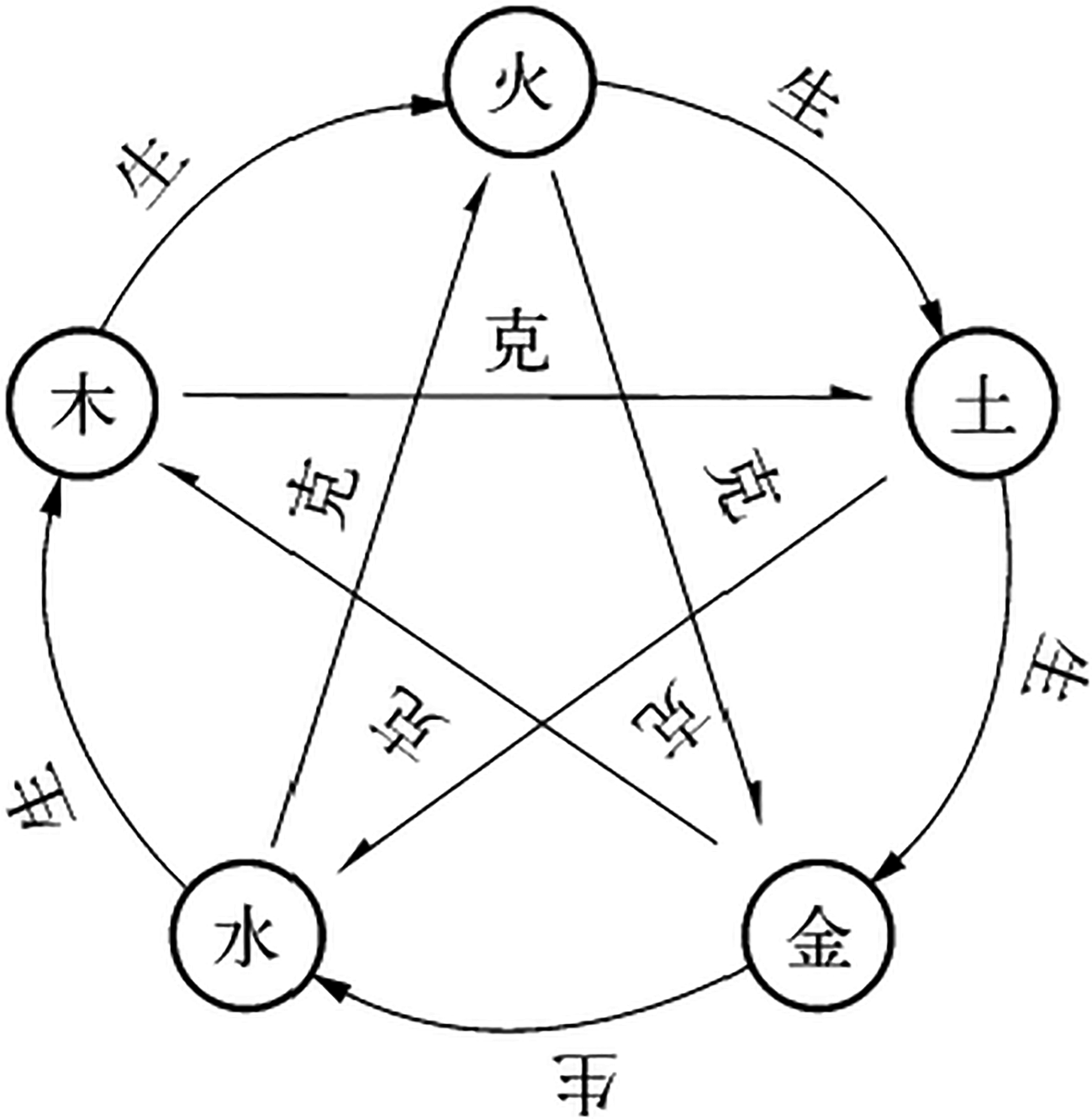
The cycles of generating and overcoming among five phases. Note. Translation of embedded Chinese characters are as follows: (a) generating, (b) fire, (c) overcoming, (d) earth, (e) metal, (f) water, (g) wood.
This diagram is simple but helps us grasp the essential content and core ideas of the five-phase system.
First, the five phases here refer to five specific substances, which, except for metal, are the most familiar and essential substances for humans living on earth: water in all its forms, the earth we stand on, wood that is planted in and grows on earth, wood that is initially drilled to start a fire and later burned to obtain the fire. Metal in ancient times generally refers to iron and a few other metals obtained from ore that is calcined and refined. As reflected in its status as one of the five phases, it is also effectively taken from nature. Moreover, by the Bronze Age, when people could use iron tools for farming and working and metal vessels for holding things, metal had become indispensable for human survival and living. The point is that the substances of the five phases are not selected casually, but comes from the ancient people's emphasis on the value of things that exist in nature. They are natural things deemed essential and crucial by ancient people.
Later, knowledge about the five phases came to extend into two directions. One was to assign meaningful interpretations to various substances. That is, the substances’ properties as defined by the five-phase doctrine are matched with the five categories using the other senses, such as five colors, five tastes, and five virtues reflecting the humanistic and moral senses, thus transforming the material nature of the five phases into the abstract principle of “nature,” and at the same time, giving the number “Five” a unique importance that transcends numerical symbols. Second, the five-phase system provides a framework for qualifying and relational research. Historically, from the perspective of epistemology, the system guides ancient scholars’ efforts to attribute a fundamental quality to various fields; this fundamental quality differs from the chaotic “oneness” of ancient philosophy and also from a quality distilled from only one substance. It starts with a set of correlated substances. Ancient Greek philosophy believes that some elements are fundamental to all substances; conversely, the five-phase system uses “categories” to understand the universe and everything within it, implying the need to examine relationships and interactions.
Second, the interrelationship between the elements in the five-phase circular movement can be described as a continuous cycle of life, involving interactions and conversions through 生 (generating) and 克 (overcoming). Every organic individual must go through a course from birth to death; in other words, “everything that has a beginning has an end.” This interrelationship also exists among various substances in nature. Indeed, there underlies a fundamental law in modern ecology—the dynamic ecological equilibrium does not depend on the reproduction and death of individuals. In ancient China, the relationship between the five phases is described as “generating the subsequent while overcoming the next subsequent” (Pang, 2008, p. 59). Therefore, each phase has a dual function. Clockwise, it generates the subsequent phase and overcomes the next subsequent phase. Without the regulation of “overcoming,” the function of “generating” would “lead to the collapse of the whole system due to ‘oscillation’ in terms of the systems theory (Pang, 2008, p. 59)”. As Pang Pu further suggested, “The five phases operate under a mechanism of self-restraint and self-control. It enables the whole system to maintain equilibrium and keep stable development without oscillation. This is an essential systems theory idea” (Pang, 2008, p. 59). The Pang Pu's analysis on recognizing the relationship between the five-phases and systems theories has been enlightening and shocking to us. We become suddenly aware that the five-phase doctrine is similar in effect to the systems thinking—the Western philosophical view of science that has been gradually taking shape since the 1960s. Interestingly, the two views, more than two thousand years apart in time and thousands of miles apart in space, are superficially different but essentially alike.
In this sense, the five-phase doctrine is considerably robust. While it is relatively primary, it adopts a holistic approach to understanding the relationship of all things in the world. Indeed, it has taken humans a long period of scientific analysis to regain a comprehensive and holistic, as distinct from atomistic, view of nature's intrinsic relationships, echoing the thought of the five-phase doctrine.
Third, the five-phase framework contains the order that regulates internally balanced positive and negative two-way movements and applies to the operation of the whole natural universe. With the derivation of the five-phase doctrine, this grand order has become a significant instrument for the Chinese to understand and explain the functioning of and changes in human society, human life, and all other things. Its significance also lies in the formation of a positive belief in life. In the face of adversity, people are less likely to be knocked down entirely by misfortune as long as they still have the faith to be reborn and change their destiny. This idea warns people to remain cautious and humble when they have achieved success and fame, to avoid the possibility of loss due to fullness or the force of destruction taking advantage of their complacence. The resultant virtue of sharing and helping the weak, so that “fullness” does not reach “overflow,” has engendered the wisdom of returning to zero and reopening new fields.
As a general remark on the basic ideas of the five-phase doctrine, I can borrow from the “Preface” to Ervin Laszlo's Introduction to Systems Philosophy by L. V. Bertalanffy, who is widely known as the “founder of general systems theory”: “The specialist's presupposition is a “pluralistic” universe whose parts are isolable enough to permit independent exploration in the conventional disciplines; but this needs as a complement the generalist's vision of systemic order and interdependence” (Laszlo, 1972, foreward). Again, the similarities in humans’ mentality toward understanding natural systems across considerable expanses of time and space are significant and exciting. Here, I would like to express my most profound respect for the wisdom of the Chinese cultural tradition.
Application in TCM
The five-phase doctrine has had an unprecedented influence in Chinese history in the specialized fields of thought and daily life practice. Pang Pu called it “the basic framework of Chinese culture” (Pang, 2008, p. 2), and I do not think that is an overstatement. Chinese medicine is the study of human life and health and the treatment of diseases. Its practices of thousands of years in applying the five-phase doctrine lend full support to Pang's argument. The extensive use of the five-phase doctrine is evident in Neijing, one of the earliest classics of Chinese medicine. The first stage of its application is mapping in a physical sense. The Neijing refers to the solid organs in the human body as the five solid organs and maps them to the five phases and then to the five directions, five times, five colors, and five sensory organs. “The east direction is green-colored, compatible with liver and manifesting on eyes. It stores its essence in the liver”; “The south direction is red-colored, compatible with heart and manifesting on ears. It stores its essence in the heart”; “The middle is yellow-colored, compatible with spleen and manifesting on the mouth. It stores its essence in the spleen”; “The west direction is white-colored, compatible with lung and manifesting on the nose. It stores its essence in the lung”; “The north direction is black-colored, compatible with kidney and manifesting on anus and urethra. It stores its essence in the kidney” (Zhang & Sun, 2008, pp. 22–24). Based on the above assertions about the fundamental relationships, the prevalence of different diseases by season and causes are further analyzed and specified. The Neijing allocates medical terms and connotations to the five phases.
Second, the relationships among the five phases, five directions, and Yin and Yang are synthesized and applied to the elucidation of the interrelationship of the organs, presenting an understanding of the intrinsic interrelationship of the body's major systems.
In addition to the five solid organs, the Neijing also presents the “twelve-organ theory,” referring to the five solid organs (spleen, heart, lung, liver, and kidney), the six hollow organs (gallbladder, stomach, large intestine, small intestine, bladder, and triple energizer), and the danzhong (pericardium) (Zhang & Sun, 2008, p. 50). The Neijing defines the functions of each of the 12 organs and emphasizes the mutual relation of detoxicity among them. The definitions aim to distinguish between nobility and inferiority or primary and secondary functions. The mutual detoxicity concept specifies the inner correlation, involving the “lord” and “minister,” “decisive function” and “regulatory function,” and “receiving” and “dredging.” They embody mutual generation and restriction and are opposite and supplementary to each other within the body system in the five-phase doctrine (Zhang & Sun, 2008, pp. 50–53).
The Neijing also discusses in detail the activation and deactivation of each organ by time and place, stating that seeking peace while avoiding bias is the general way to health (Zhang & Sun, 2008, pp. 63–110). With knowledge of such interrelationships and their changes, the “phenomena” manifested externally to determine the “hidden” condition of the internal organs can be observed. 25 Nevertheless, the Neijing highlights the complexity involved in examining the human body and how to address this complexity: “Even if we understand the general relationship, its manifestations could be limitless”; “a meticulous approach is warranted to gauge and discern the variations.” With the accumulation of the variations, we can then extract the patterns and make judgments, developing a systematic understanding over time: “multiplication could make something larger while induction leads to underlying rules” (Zhang & Sun, 2008, p. 52). Moreover, gauging and discernment are necessary for medicine; a minimal error or deviation may result in wide divergence. This is true for both diagnosis and prescription.
The uniqueness of the five-phase doctrine in terms of this “order” has already been illustrated in the above two points on TCM, especially in relation to the natural seasons and the changes of the three qi of Heaven, Earth, and humans (Zhang & Sun, 2008, pp. 87–91).
Notably, in addition to using the Yin and Yang five-phase doctrine to describe the physiological systems of the human body, TCM pays special attention to whether the spirit, mental state, and body are internally coherent. According to the TCM, the essence of the human dwells in the upper, middle, and lower parts of the body—the “three fields.” The brain is the “field” of the human spirit. The Neijing clearly distinguishes the three: “The five organs determine the strength of the body. The head, housing the essence, may signal the deprival of spirit if it droops with depressed eyes” (Zhang & Sun, 2008, p. 95). 26 However, the mind and body are inseparable, which is especially notable in terms of traditional Chinese medical diagnoses and treatment method decisions. The Neijing repeats several times that during diagnosis and treatment, doctors should observe the patient's urine, stool, and pulse and “examine the mental state while administering treatment” (Zhang & Sun, 2008, p. 71). While inquiring about the mental state, “Doctors should patiently and meticulously inquire about the patient's condition, ensuring that the patient has no worries and confides freely, in order to learn the truth and observe the patient's expression. Those with good spirit have a good prognosis; those without spirit have a poor prognosis.” While enquiring about the patient's condition, the doctor should delve into the encounters and any other misfortunes (Zhang & Sun, 2008, p. 550). 27 This is imperative if the doctor wants to identify the source and root of the disease and prescribe the right medicine.
In summary, the ancient Chinese medical “view of the human body” has been discussed in considerable depth and specificity in the Neijing. The human body is a part of nature, and there is a complex and ever-changing correspondence between the health of the human body and its own spiritual state and all things in Heaven and Earth. This fully reflects the traditional Chinese thinking that focuses on the ways of growth, change and strategies of adaptation, requiring doctors to understand basic principles to make a diagnosis and treatment appropriate to each specific patient's state.
The Neijing clearly expresses this general principle for medicine, as follows: “The most general theory must be verifiable against the tiniest details,” “Those eloquent about Heaven must check their theories against humans,” “Those eloquent about the past must check their stories against the present,” “Those eloquent about qi must check their descriptions against physical manifestations,” “Those eloquent about adaption must respond to Heaven and Earth evolutions,” and “Those eloquent about evolutions and changes must communicate with the gods” (Zhang & Sun, 2008, pp. 391–392). Accordingly, doctors and those who inherit the medical Tao and teach others are required to “know astronomy above, geography below, and human affairs in the middle” (Zhang & Sun, 2008, p. 543), raising specific requirements for teaching. Well aware of the general belief that educology has many similarities with medicine, I still struggle to describe my surprise when I found that the first half of my Chinese-style definition of education—teaching knowledge of nature and society, cultivating self-consciousness of life—was already expressed in a word-to-word manner in the Neijing. 28
I suddenly realized that TCM is indeed a key to opening the treasury of the Chinese civilization. We need to rediscover TCM in the contemporary social context—not only in the sense of the respective advantages and disadvantages of the Chinese and Western medicine but also in terms of the complex relationship between the traditional Chinese and contemporary civilizations of the world, and the intrinsic relationship between humans and nature. Its mysteriousness and sometimes, obscure terminology should not discourage us from redeveloping this treasure trove “hidden in the deep mountains.”
Period of ancient classics
The period of ancient classics extends from about 800 BC to 200 BC. Ancient Chinese civilization developed from the genetic root to a giant tree during this period. Some historians call it the axial period of the Chinese civilization.
Since this first formation of the classical tradition of the Chinese nation, it has endured despite a series of historical changes. Why is it so resilient? First, the original creation of our culture was rooted in an agricultural civilization. It was difficult for external economy and culture to enter the system because of the long-standing political system based on “grand unification” and the relatively closed geographical environment. However, this tradition's longevity is also closely related to the relative maturity and richness of the classics of the ancient civilization and the relatively established historical mechanism of following and inheriting traditions.
The view of nature in the classical period went through a long, multidisciplinary process of creation and formation, presenting rich diversity in forms, united by some commonalities. These commonalities evolved into philosophical forms during the Spring and Autumn and the Warring States Periods, forming a relatively stable system represented by several schools of philosophy that can be called classical today. They survived over time and became the mainstay of Chinese philosophy. These ideas are called the “ancient classical view of nature.”
This view is “classical” because it has gathered previously existing views of nature and deepened them to the philosophical level. Further, it has strong vitality and has been continuously regenerated during the long history of the development of the Chinese nation since then, expanding to all areas of culture and life and becoming an important spiritual symbol of the Chinese culture.
Among various schools of philosophy, there is a plurality of views, seemingly very different and even opposite in terms of their positions (including philosophical and political) and methods of thought; this difference becomes even more apparent when they refute and argue with each other. However, if we can identify the levels and perspectives inherent in what they say and then explore their fundamental views, we may see the richness, profundity, and enlightenment of the ancient traditional views of nature and realize the necessity and importance of research on them. Therefore, in this article, instead of dividing up the discussion of views of nature by school, we will take the essence of each school according to the horizontal axis of the “three views” proposed earlier and make a re-integrated synthesis.
What is nature?
The structure of nature
In the most general sense, traditional Chinese philosophies are consistent in their views of nature. Nature refers to the universal Heaven and Earth, comprising all things naturally generated, outside of humans, in the world. It is a large organism that undergoes regular movement and change and has a complete life of its own. Nature is the existence that is visible and perceptible to humans, and the survival of humans is closely related to it, but it does not depend on the will of humans.
Joseph Needham compared ancient Chinese philosophies with those of ancient Greece and India. He concluded as follows: “While the Greeks and Indians considered formal logic carefully very early, the Chinese have been devoted to developing dialectical logic. Meanwhile, by the time the Greeks and Indians developed mechanical atomism, the Chinese had already formulated their philosophy of an organic universe” (Needham, 1978, p. 337). This distinctive character of the ancient Chinese philosophical view of the universe has been impressive to foreign scholars and corroborates from another side the generality of this view of nature in ancient China.
However, the ancient Chinese philosophical thinking about nature was not satisfied with this. What was also constantly being pursued was answers to the following questions: (a) What constitutes nature? (b) Can all things be classified? (c) How can they be classified? (d) How can we name these classifications? (e) What is the relationship between different classifications? (These are structural questions about natural systems.) (f) How does nature operate and change? (g) Is there a pattern to its process? (These are process questions about dynamic changes in natural systems.) (h) Where does nature really come from? (i) Are there any abstract rules above and beyond reality that play an essential role in reality? (These are “meta” [about origins and rules] or “transcendent” questions about natural systems.)
We have already dealt with the theory proposing that all things are formed by the interaction of Yin and Yang, essentially a primitive framing of the nature of all things leveraging the concepts of time and space. The five-phase doctrine is a clustering analysis of matter. Building on the five primary groups of elements and distinguishing them between their Yin and Yang, a macro ecosystem subject to an internal balancing mechanism was formed by ordering the groups according to interpromotional and interregulatory principles.
Here, another framework is needed to complete the discussion. It comprises 64 hexagrams generated by combinations of any two of the eight basic trigrams (Bagua). It is more extensive and profound, with the ability to encompass the above two frameworks because of its higher level of abstraction for the expression of content or structure. However, intellectuals previously despised it due to its use mainly in fortune-telling. Much more research is needed for an in-depth understanding of the framework.
Bagua arose from the human observation of all things. According to Zhou Yi·Xi Ci II: Anciently, when Paoxi (Fuxi) had come to the rule of all under Heaven, looking up, he contemplated the brilliant forms exhibited in the sky, and looking down, he surveyed the patterns shown on the Earth. He contemplated the ornamental appearances of birds and beasts and the (different) suitabilities of the soil. Near at hand, in his own person, he found things for consideration, and the same at a distance, in things in general. On this, he devised the eight trigrams to show fully the attributes of the spirit-like and intelligent (operations working secretly) and classify the qualities of the myriads of things. (Zhou Yi·Xi Ci II)
The basic symbols of the trigrams are two types of lines. The solid line “—” represents Yang and rigid things; these are called Yang lines. The broken line “- -” represents Yin and soft things; these are known as Yin lines. This is the Chinese invention that Leibniz later described as “binary” when he read it. More interestingly, everything in the world can be represented by a hexagram composed of lines. The three lines are arranged to denote eight groups, symbolizing each of the eight types of nature (the eight trigrams):  Qian (Heaven),
  Kun (Earth),
  Zhen (thunder),
  Xun (wind),
  Kan (water),
  Li (fire),
  Gen (mountain),
  Dui (lake).
In my opinion, Bagua is another important creation of the Chinese abstract symbolic system, in addition to Chinese characters. It fully reflects ancient Chinese philosophical thinking based on natural systems. Each of the eight trigrams is accompanied by a 象 (phenomenon), composed of a digital combination and special 字 (character). Therefore, it can be called a “symbol system of character and double digits.” Among them, the abstraction of the figure is particularly unique, with the numbers nine and six representing odd and even numbers. This may be related to the ancient times when wizards used yarrow for divination, leading to the emergence of “binary”. Each trigram is named with a character of special meaning and represents a natural phenomenon that exists in reality. To understand each of the eight trigrams, it is necessary to first understand the triple transformation: from the actual image to the trigram symbols (combination of digits and symbols) and then to the trigram name. Moreover, the interpretation of each trigram is related to the trigram symbols and the nature of the actual image and involves explaining the process meaning presented by the internal structure of the trigram. 29 With a unique system of discourse, it is too comprehensive and complex for modern readers to understand without commentary. On the one hand, this shows the specialization of this system of symbols; additionally, it reveals how truly astonishing the wisdom of the ancient Chinese was in creating symbols and using them to explain the world thousands of years ago.
Compared with the five-phase doctrine, Bagua is not simply an expanded version of the 5-phase doctrine adding three physical phenomena. In fact, while water and fire are retained, metal, wood, and earth are excluded. The other six objects are Heaven, Earth, thunder, wind, mountain, and lake. In this sense, as a whole, the Bagua covers a wider range of nature than the five-phase doctrine. Besides Heaven and Earth, mountain and lake are added to describe landforms, and thunder and wind are included to depict weather. From another perspective, however, Bagua seems more primitive. In the eight trigrams, there is neither wood to represent plants, nor metal, which appeared only after the Bronze Age. They present a picture of the Honghuang (literally, chaos and ignorance) Age, after Heaven and Earth were just split open, when there were no living creatures yet. Perhaps the trigram maker intended to reflect the foundational meaning of the eight trigrams through the most primitive means: Heaven and Earth, weather, water and fire, mountains and lake, all existed before life; therefore, they constitute more fundamental categories to represent the world. The combination of the eight trigrams leads to 64 hexagrams, commonly known as Chonggua (combined diagram) or Biegua (transformed diagram), showing the generative power of the trigrams.
Another difference between the eight trigrams and five phases is that the relationship between the eight trigrams is not interpromoting or interregulating, as is the case of the five phases, where each generates the subsequent phase while overcoming the next-subsequent phase. First, the basic trigrams have four pairs of Yin and Yang–opposite trigrams: Heaven and Earth, thunder and wind, water and fire, mountains and lake. Subsequently, these basic trigrams are combined to form the 64 hexagrams. In terms of intention, there is also a harmony between Yin and Yang between hexagrams, such as rigid and soft, uneducated and enlightened, demand and wait, dangerous and confident, and so on.
Sixty-four hexagrams cover all possible combinations of hexagrams, from extreme Yang to extreme Yin. The changes result from the internal structure of Biegua (transformed diagram) rather than the relationship of interpromotion and interregulation. This is a significant improvement over the five-phase doctrine in terms of ability to express the complex internal structure of each type of thing with symbols. The eight trigrams represent the natural beginning of things. However, each hexagram could also represent everything, far beyond natural objects. Their richness and depth are beyond those of the five-phase doctrine.
Whether it is the symbolic composition of the trigrams or formation of their meanings, we can see that this symbolic system stemming from the observation and study of nature presents a strong internal and external structure and reflects a philosophical thinking ability that enables evolution from simple to complex through “generating everything by three.” For more than 2,000 years, in China and worldwide, there has been no second set of philosophical symbol to compare with it.
Dynamic change of natural processes
In addition to the theory of intergeneration of two opposite things through mutual dependence and change based on Yin and Yang doctrine, as well as the relatively concise and brief judgments of Taoism on the interrelationship of fortune and misfortune, the I Ching, which is composed of hexagram symbols and explanatory hexagram symbols, is the best among ancient texts on change processes. Its interpretation of the 64 hexagrams is rich and clear.
“Yi” in I Ching (Zhou Yi), as summarized by Zheng Xuan, has three meanings. One is simplicity, referring to the simplicity of divination by means of yarrow. The second is change, suggesting that it is a book on changes. The third is eternal, conveying that universal principles, such as “settlement can be reached between Heaven and Earth by specifying Heaven as supervisor and Earth as subordinate,” are eternal. The core is the meaning of “change.” Sima Qian's comment is both general and precise: “I Ching addresses Heaven and Earth, Yin and Yang, four seasons, and five phrases, thus focusing on changes” (Epilogue to the Records of the Grand Historian) (Sima, 2001).
The I Ching pays special attention to the study of changes because it is a book of signs and omens. Each hexagram is composed of symbol, hexagram description, and line description (textual parts). The hexagram description includes the name and an overview, while the line description explains the meaning of each line (Feng, 1994, p. 76), 30 covering signs of future possibilities and uncertainties. The hexagram description includes at least three parts: (i) the symbol, indicating the signs and an interpretation of each line; (ii) the relationship between the different signs; (iii) the conditions needed for realization or change of the signs. The signs direct people's attention to areas that require it. For example, what should be done to turn misfortune into fortune or how to realize good signs. All these are reflected in the divination words.
As each hexagram is composed of six lines, the interpretation of each line successively constitutes a continuous or transitive description of the change process. As signs are descriptions of possible and non-deterministic processes of change in the future, the time consciousness presented in “Yi” is particularly concerned with the “opportunity” of timing or the key points where things change. This reminds us of the attention paid to the 24 solar terms in the agricultural calendar. Timing awareness is a dynamic expression of nodal awareness, which suggests paying special attention to nodal points of transition when facing uncertainty and then making strategic choices in response. This is the wisdom of riding the wave of a dynamic process. If you cannot read a sense of timing in the I Ching, you probably have not understood it. Such a study of uncertainty may be described in currently fashionable terms as postmodern. In my view, however, this approach is more powerful than a postmodern approach. The basic attitude in the face of uncertainty is one of responsiveness, not helplessness. This is the power generated by the spirit of self-improvement that runs deep in the essences of traditional Chinese culture. Here again, we see the encounter between contemporary philosophy and ancient Chinese classics, and perceive the wisdom hidden in the “Yi,” which has long been regarded as a superstition.
The meta-question about natural systems
This article has explained in the Chinese Creation Myths section how the universe, Heaven, the Earth, and humans are all embedded in chaos, which is their common origin. By the pre-Qin period, philosophers’ thinking had departed from mythology. For Confucians, Heaven was the highest form of natural existence, and they no longer pursued any more fundamental existence or rules behind it. Instead, it was Lao Tzu who persistently explored this question and put forward a series of arguments, concentrated in his only surviving Taoist classic, the Tao Te Ching, presenting his theories about the Tao. 31
The Tao is a considerably important concept in Lao Tzu's philosophy, and the first sentence of the Tao Te Ching, whcih is “the Tao that can be explained is not the unchanging Tao,” shows that this “Tao” is not the “Tao” of the path or reason we usually talk about, but instead, “the beginning of all things” or “the Mother of all things” (Tao Te Ching, Chapter 1); “There was a mixture of things that came into being before Heaven and Earth … . I did not know its name and decided to call it the Tao” (Tao Te Ching, Chapter 25); “Is called the root from which grew Heaven and Earth” (Tao Te Ching, Chapter 6). Further explanation is more philosophical. Lao Tzu proposed that “everything is born from something, and something is born from nothing” (Tao Te Ching, Chapter 41). Here, the relationship between “existence and non-existence” as “existence can spring from non-existence” can be defined. The next paragraph reads as follows: “The Tao produced One; One produced Two; Two produced Three; Three produced All things” (Tao Te Ching, Chapter 42). Therefore, “Tao” is something non-existent, the origin from which born things are “existing” as a chaotic energy that contains everything, not divided yet. From this “One” are born the Yin and Yang as “Two.” The interaction of Yin and Yang or Heaven and Earth to make “Three” produces everything else. All of this is thus born from something “non-existent.” This distinction between the “non-existent” and “existent” makes this Tao different from everything else in Heaven and Earth in terms of its nature and level. This vision is unique for its originality. Here, the Tao is extremely different from the Western “God.” Lao Tzu's “Tao” is “non-existent” but contains all things and therefore can give birth to them, while “God” is the absolute One who exists as a creative force or intelligence. Additionally, God itself remains unchanging, while the Tao is changing: “The opposite is generated by the movement of Tao” (Tao Te Ching, Chapter 40)—it undergoes constant movements of interchange of Yin and Yang, in the forms of “independence without change, circumambulation without danger” (Tao Te Ching, Chapter 25).
As the origin of the universe, “Tao” is the Mother of all things before Heaven and Earth and has an independent status that is not influenced by any other beings. What is the relationship between such a unique “Tao” and all things, apart from the assumption that it gives birth to all things?
First, the “Tao” is the law of all things in Heaven, Earth, and the human world. In the words of Lao Tzu, it means the following: “Therefore, the Tao, Heaven, Earth, and people are all great. Among the four that are great, the King is one of them” (Tao Te Ching, Chapter 25). Considering the status of the King as only one of the four that are great, indicates Lao Tzu's position of not treating the King as the only great one(s). Immediately afterward, he replaced “the king” with “people” to further clarify the relationship between the four great ones, which is a famous saying: “People follow the laws of the Earth, the Earth follows the laws of the Heaven, the Heaven follows the laws of the Tao, and the Tao follows the laws of nature” (Tao Te Ching, Chapter 25). Here, humans are at the end of a series of “laws” and should be subject to the Earth, Heaven, and the Tao. This is reasonable given the origin of the universe, where humans were shown as insignificant in relation to the Earth, Heaven, and the Tao. However, surprisingly, above the Tao, which is regarded as the origin and beginning of all things, there is also a “nature” in the sense that “The law of the Tao is it being what it is.” What is this “nature?”
Obviously, this “nature” does not refer to the general term for things outside of humans, which includes all physical things in Heaven and Earth. Reading through the entire Tao Te Ching reveals that “nature” here refers to a kind of law that applies to the development of everything and can be called “natural.”
The “Tao” is non-existent, and its relationship with all things is to give birth to all things, but it does not possess and dominate all things. “(The Tao) produces and raises all things; it produces them but does not own them, does not seek rewards for its actions, including the control of what it raised” (Tao Te Ching, Chapter 10). This is the unique law of the operation of the Tao, and Lao Tzu called it “the mysterious virtue.” This “virtue” only helps things to “accomplish what they strived to accomplish” (Tao Te Ching, Chapter 17), to be what they are. Therefore, Lao Tzu's Tao has no desire, name, and wish but only follows the “natural” nature of all things so that it can help “all things … be transformed by themselves” (Tao Te Ching, Chapter 37); “Thus it helps the natural development of all things” (Tao Te Ching, Chapter 64) rather than go against the nature of all things, and “comments about other people, family, neighborhood, state, and kingdom can only be made by that of the same capacity” (Tao Te Ching, Chapter 54). Therefore, influencing others of varying capacities is impossible. Lao Tzu also called the Quality of the Tao, which is based on other things and benefits other things, the “highest excellence.” He used water as a metaphor to illustrate the rule of “naturalness”: “Water is the perfect example to show what is the highest excellence. The water borders on the highest excellence because it benefits all things without conflicts and goes anyways no one wants to go” (Tao Te Ching, Chapter 8). Water is shapeless, taking the shape of its vessel. Therefore, it can be both square and round. It maintains good obedience to heavenly time, and does not compete with all things, so there are neither complaints nor blame. This is the reason that water is used as a metaphor for the Tao.
I believe that the key to unlocking the mystery of the term “Tao” as used by Lao Tzu lies in the understanding of “nature” in the sense of “the law of the Tao is it being what it is” beyond the real category. It is only possible to get the key by entering the level of the law—“Tao” itself is “non-existent” but is a fundamental law that all things operate under: conforming to what it is then to be what it is or conforming to nature then to be nature. Here, Lao Tzu suggests how to deal with existing nature and other people, uniting humans and nature into what he considers to be the fundamental law of nature. “Being what it is” is the highest level of argument in Lao Tzu's Tao Te Ching: One has to follow the great law of nature or conform to nature to be nature. I am not sure I agree with scholars or religious believers who see Lao Tzu's philosophy as a religious faith. Conversely, Lao Tzu saw the chaos of his time and its origin in selfishness and desire and proposed a way of removing “selfishness,” “desire,” “wisdom,” and “governance” to follow nature. He was the philosopher who most emphasized on the way of nature. He had no beliefs in common with Taoism, which later became a religion in his name.
In this sense, it can also be concluded that Lao Tzu posed and answered the meta-question of nature. Nature is the carrier that presents the laws of its own operations or the concrete, rich, and diverse variety of self-existing things presenting the laws in a metaphysical way. This philosophical understanding was not only unique at the time but remains so today, and still has an inspiring value.
In short, in the above-mentioned philosophical expressions of the classical views of nature and “what nature is,” we see the extraordinary creativity of ancient philosophers. They no longer just described nature or talked about nature, but asked questions on a metaphysical level and created symbolic systems to express the structure of things. They used the regular reorganization and operation of symbols to reveal the process of change in all things. They gave metaphysical meaning to the concept of “Tao” and achieved understanding of the basic laws of nature. Simultaneously, they could pay close attention to the questions of physical objects and people. This will be discussed further below.
Relationship between nature and humans
By the Western Zhou dynasty, China had basically completed the transition from the worship of ghosts and gods to the respect of the Heaven and worship of ancestors. Chinese people termed the supreme ruler the “Son of Heaven,” while the people were called “His People.” Social civilization and institutions were also well established by that time, including the establishment of a set of “Heaven-based” rituals to consolidate social institutions and order, regulate human moral behaviors, organize the main production activities in the social systems, and supervise public activities within clans and families. The correspondence between the ritual system of Heaven and humans outlines the basic “unity” between humans and nature.
Double meaning of heaven
Heaven on which the ritual system is based has a double meaning. The first is the “natural Heaven,” which has its own laws of operation, and in relation to which humans can only act in obedience and follow the example of what it does to obtain blessings. Second, it is the supreme will of Heaven that dominates the human world, in what is called the “humanistic Heaven” for the time being—the heavenly will and command—which are unconditional and irrational. This will is not expressed in the form of words but only foretold or warned by means of heavenly signs, which can only be interpreted by extraordinary people such as diviners who can understand them. It cannot be resisted or disobeyed; if it is, disaster will follow. The rulers paid special attention to this “humanistic Heaven,” which was related to the legitimacy and consolidation of their ruling position. They set up different official posts in the government, such as those of celestial officials, diviners, and priests, who specialized in observing and recording celestial signs, creating a special Heaven–human relationship in which humans need to interpret the will of Heaven. It is this duality of the concept of Heaven and the existence of the “rituals according to Heaven” and the “interpretation of the will of Heaven by humans” that marked the existence of the “unity of Heaven and humans.” This scheme was proposed for the survival and development of society and the maintenance of the ruler's power while acknowledging the separation of Heaven and humans. It became established as the dominant ideology, presenting the inseparable relationship between nature and humanity in ancient China in a conceptual sense. Despite the social turmoil and chaos during the Spring and Autumn and the Warring States Period, a hundred schools of thought did not shake the principle of “the unity of Heaven and humans.” The philosophers of each school only expressed this view through their own understanding of Heaven. Their differences are precisely rooted in their different views and attitudes toward institutions, governance, morality, and their formation rather than Heaven itself.
Different expressions of the Heaven–human relationship
The Heaven–human relationship is most succinctly stated by Confucius, who of course represents Confucianism, and his attitude toward Heaven is relatively clear and concise. It is recorded in the Analects that “His discourses about man's nature, and the way of Heaven, cannot be heard” (The Analects of Confucius: KUNG-YE CH'ANG, Chapter X) (Confucius, 1960). He is also silent about other mysteries, forces, chaos, and gods, stating, “While you are not able to serve men, how can you serve their spirits?” “While you do not know life, how can you know about death?” (The Analects of Confucius: HSIEN TSIN, Chapter XI) (Confucius, 1960). This is a frank statement of the Confucian ethical stance, which takes the present life and state of humans on earth as the main backbone of learning.
In Confucius's eyes, the natural Heaven does not say anything: “Does Heaven speak? The four seasons pursue their courses, and all things are continually being produced, but does Heaven say anything?” (The Analects of Confucius: YANG HO, Chapter XIX) (Confucius, 1960). However, this does not mean that Confucius did not care about the “humanistic Heaven.” He said that he engaged in his study as “a transmitter and not a maker, believing in and loving the ancients” (The Analects of Confucius: SHU R, Chapter I) (Confucius, 1960). Here, “ancients” refers to the “Rites of the Zhou.” In Confucius’ eyes, these rites were perfect, the “order of man” that embodied the “order of Heaven,” the system of the unity of Heaven and humans, and had become a routine in politics and life practice, the practical embodiment of Heaven on Earth. Confucius directly said, “I follow Zhou” (The Analects of Confucius: PA YIH, Chapter XIV) (Confucius, 1960), and defended, elaborated, and practiced the Zhou rites to manifest his adherence to the “humanistic Heaven.” Although Confucius's greatest concern was the ideal benevolence, conservation of rites, government of clarity, and morality, almost the entirety of the Analects is devoted to rites. The way of life and death should follow rites: “That parents, when alive, be served according to propriety; that, when dead, they should be buried according to propriety” (The Analects of Confucius: WEI CHANG, Chapter V) (Confucius, 1960). Human behavior is governed by rites: “Look not at what is contrary to propriety; listen not to what is contrary to propriety; speak not what is contrary to propriety; make no movement which is contrary to propriety” (The Analects of Confucius: YEN YUAN, Chapter I) (Confucius, 1960). Regarding governance, “When rulers love to observe the rules of propriety, the people respond readily to the calls on them for service” (The Analects of Confucius: HSIEN WAN, Chapter XLIV) (Confucius, 1960). In Confucius’ mind, rites are basically stable and do not change much. Therefore, “Some other may follow the Chau, but though it should be at the distance of a hundred ages, its affairs may be known” (The Analects of Confucius: WEI CHANG, Chapter XXXIII) (Confucius, 1960). The importance Confucius attached to the “Zhou rites” could be said to be so significant that “he attributed everything under them.” Notably, Confucius makes an important transition: The “principles of the Tao of Heaven” that are generally accepted by people have actually come down to earth and become “humane rites” applicable to political institutions, social morality, and personal cultivation. The transition of the “heavenly principles” to “humane rites” is the unification of the Heaven–human relationship at its root. This provided a means for later rulers to maintain their rule by transforming what was really the “human will” into the requirements of the “heavenly rites” and using them (or it) to strengthen the authority and rationality of what they said and did and what they obtained. The effect of this reverse “unity” must have been unanticipated by Confucius.
Additionally, Confucius also spoke directly about the ordinances of Heaven and believed that a virtuous man must have “three awes”: “He stands in awe of the ordinances of Heaven. He stands in awe of great men. He stands in awe of the words of sages” (The Analects of Confucius: KE SHE, Chapter VIII) (Confucius, 1960). He emphasized that people should not “offend against Heaven” (The Analects of Confucius: PA YIH, Chapter XIII) (Confucius, 1960). “Knowing the decrees of Heaven” is an important stage in his personal life after “bent to learning,” and only afterward does he reach the state in which “my ear was an obedient organ for the reception of truth” and “I could follow what my heart desired, without transgressing what was right” (The Analects of Confucius: WEI CHANG, Chapter IV) (Confucius, 1960).
In short, although Confucius did not speak of Heaven, he was extremely clear about the power of the decrees of Heaven and recognized it as the highest “rule” so that he tried to know it and sincerely respects it.
However, Confucius also loves nature as it is. He wanted his students to read the Poems to help them to be proficient in expressing themselves and also know more about the names of birds, beasts, plants, and trees. He used the character of the pine tree as an inspiration: “When the year becomes cold, then we know how the pine and the cypress are the last to lose their leaves” (The Analects of Confucius: TSZE HAN, Chapter XXVII) (Confucius, 1960). Faced with the rolling eastward river, he sighed at the passing of time, the relentlessness of history, and the shortness of life: “It passes on just like this, not ceasing day or night!” (The Analects of Confucius: TSZE HAN, Chapter XVI) (Confucius, 1960). Confucius’ lack of opportunities to fulfill his potential also made him yearn for nature, hoping that the world would remain stable and that in the last month of spring, he would wash in the River Yi, enjoy the breeze among the rain altars, and return home singing (The Analects of Confucius: TSZE HAN, Chapter XXV) (Confucius, 1960). The difficult process of defending the Tao made him think that if “My doctrines make no way. I will get upon a raft, and float about on the sea” (The Analects of Confucius: KUNG-YE CH'ANG, Chapter IV) (Confucius, 1960). These words and actions of Confucius show us a long tradition of ancient Chinese scholars using nature as a place of peace and tranquility for themselves, in which to withdraw from social and political strife. This is a unique relationship between ancient scholars and nature that establishes a spiritual connection between Heaven and humans. Zhuangzi, however, is an irreplaceable figure of the period who pushed to the extreme way of avoiding the world, returning to nature, removing all human desires, and realizing a set of philosophies of life and worldly affairs from nature.
Among the Confucians, Xunzi was the one who had the soberest understanding of the way of nature as different from the way of the human world. His most famous assertions are concentrated in the Discourse on Heaven, which begins with the words, “Nature is the true law.” Therefore, the problems on earth, “cannot blame the sky, its way as it is”; “those who understand the difference between Heaven and humans can be said to be the most excellent.” At that time, Xunzi must have been considerably sober and brave to say these words against the general belief in “Heaven and man corresponding to each other” and the “alignment of Heaven and humans.” Indeed, he can be recognized as a sage who “understood the difference between Heaven and man.” He advocated that people should know the Heaven so that they can make progress in a timely manner, such as “prosperity and growth in spring and summer, and accumulation and collection in autumn and winter,” and discussed what must be done if agricultural and pastoral production is to be successful. If we encounter some abnormal natural phenomena, “it is understandable to be surprised, [but] to be afraid of it is not.” In turn, Xunzi concluded that humans’ attitude toward Heaven should be “to follow the mandates of Heaven and implement them.” If humans do not know, and treat Heaven in the wrong way or act in the wrong way, then they “attribute human errors to Heaven, risking losing control over all things.” Notably, Xunzi's exhortation “to follow the mandates of Heaven and implement them” is different from the modern belief that humans can transform and overcome nature. He prefers to conform to the changes of nature itself, and leverage the changes so that the energy of nature contributes to the success of “all things.” This is a rational relationship between humans and “natural Heaven,” not a submissive relationship out of fear of natural forces. What Xunzi emphasizes is that humans should recognize and actively respond to the unchangeable “natural Heaven.”
Additionally, Xunzi is committed to breaking the irrational entanglement between the way of Heaven and that of humans. In his mind, “water and fire have qi but no life, grass and trees have life but no knowledge, beasts have knowledge but no righteousness. Humans have qi, life, knowledge, and righteousness, so they are the most valuable in the world” (Xunzi·Wang Zhi) (Xunzi, 1997). Based on such judgments, Xunzi, unlike Confucius, proposed three distinctions of ritual: “Rites have three bases: those of Heaven and Earth are the base of life; those of ancestors are the base of humans; those of masters are the base of governance. … So the rites should be served to Heaven and Earth, ancestors, and masters. They are the three bases of rites” (Xunzi·Lilun) (Xunzi, 1997). This is the distinction between Heaven and Earth and human affairs; each has its own role to play rather than blindly respecting and fearing.
These shocking statements of Xunzi are not tolerated in Confucianism; therefore, later, Confucians often did not include him as part of their tradition. However, this study believes that he was a sober Confucian scholar: courageous, meticulous, well-educated, good at thinking, and daring to criticize the common sense. Moreover, he proposed a series of constructive ways of governing the state and cultivating the body that were different from the way of natural Heaven. This independent personality and critical thinking are fully reflected in Xunzi's doctrine; it is a pity that it has not been taken seriously and fully developed since then, and has not loomed larger in the academic consciousness. Instead, it was a lightning-and-thunderbolt in the historical sky, cutting through without reverberating in the history of Confucianism and its impact on reality.
Lao Tzu's view of nature made him advocate a thorough distinction between the humanistic and natural Tao that Confucianism adhered to at that time, during the pre-Qin period. However, he still insisted that humans should ultimately follow nature, the natural “Tao” of creation. Fundamentally, there is no major difference between Confucianism and Taoism in terms of the principle of “alignment of Heaven and humans”; nevertheless, there is a complete difference in the prescription of the heavenly Tao. This leads to opposite propositions in the governance of the state, such as the proposition of rule by effortless action and teaching through not teaching. The important difference between Confucianism and Taoism in terms of philosophy, social governance, human nature, and education lies precisely in the understanding of nature. This shows once again that to truly understand the roots of ancient classical Chinese philosophies, one must delve deeper into their views of nature. However, although Confucianism and Taoism do not disagree on the Tao of the “alignment of Heaven and humans,” the natural law of creation that Lao Tzu agreed to could not be fully applied to human society, especially the chaotic reality of the world at that time. Therefore, Lao Tzu's philosophy has become one of escaping from society or seclusion and is often used by later generations of intellectuals to comfort their souls when they cannot change social reality.
Different views on the heavenly nature of humans
The question of humans’ heavenly nature is not concerned with the physical sense. Instead, the naturalness nature of humans that people are born with, the so-called human nature, had already been addressed within Confucianism. Confucius's own views on human nature are mainly epistemological: the well-known “only the most superior and the most inferior in knowledge does not change” (Analects·Yang Huo, Chapter 17) (Confucius, 1960). He considered himself one who “learns to know” and thought that for most people, it is possible to perfect human nature through “learning (new knowledge),” “reflecting (on existing knowledge),” and “teaching” to conform to the rites of benevolence and morality. The distinction between the “virtuous man” and the “villain” that Confucius often refers to is not a distinction made by birth but one between two kinds of personalities that are developed and exist in reality. For those who do not devote themselves to learning or are lazy or interested in learning something other than the way of benevolence and righteousness, Confucius used the metaphor that “rotten wood cannot be carved.” Mencius, however, clearly proposed that human nature is inherently good and that people are born with “the origin (sprout) of good” and “the spirit of greatness.” As long as they develop these, they can become virtuous. Xunzi's view is the opposite of Mencius's: Human nature is inherently evil—all humans are born with various desires to satisfy their physical needs. These desires can never be fully satisfied; moreover, good qualities can only be acquired by learning and external constraints. It is not the subject of this article to discuss these views. They are mentioned for illustration. By the pre-Qin period, philosophers’ understanding of the naturalness of humans already included both mind and body—they had embarked upon a conscious exploration of the naturalness of humans in a holistic sense. 32 They view newborns as natural beings from the perspectives of physical, cognitive, and human nature, achieving a rich and developed understanding of human nature.
The Heaven–human relationship embodied in the I Ching, which is served as a classic of process philosophy, is seamlessly expressed in the annotation and interpretation of the trigrams, owing to their ability to change as needed. This is in the sense of the process to endorse the view that the heavenly Tao, human affairs, and individual morality all follow the same process logic, aimed at the “alignment of Heaven and humans.”
These aspects help us assert that the “alignment of Heaven and humans” as a principle of the relationship between humans and nature was already an important component of the classical view of nature at the philosophical level during the pre-Qin period rather than just being embodied in specific fields such as mythology, agriculture, or medicine.
Taking heaven as the rule
Ancient Chinese views of nature shifted from the influence of the Tao of Gods and Ghosts to that of the Tao of Creation. Subsequently, they rose to the Tao of Heaven in the composite sense of nature and humanity, elevating Heaven to an absolute height. Whether in natural matters, human production and life, and even the life and death or the misfortune and fortune of individuals, the Tao of Heaven should be obeyed. The will of Heaven and rules of Heaven become the highest and most decisive command, which even the Son of Heaven—the ruler of the Earth—cannot disobey. People can achieve their own expectations only per the heavenly Tao. Thus, it is often said that one should “listen to the fate decided by Heaven.”
The more you do what is right and good, the more you will be supported by the will of Heaven. When one makes a mistake, if one knows it, confesses it, and asks for forgiveness, one also has a chance of regaining good fortune. Conversely, if one persists in one's mistakes or becomes increasingly reckless, one will be punished by Heaven. Heaven is the final resort to seek justice when it is lacking on Earth. As the saying goes, “Heaven will reward the good with good and the evil with evil. It is just a matter of time for that to happen. When the time comes, justice will be served.” This has become a belief of ordinary people in China.
The more active role of Heaven is that of a revelator of wisdom and model of morality. Observing and knowing the way of nature can inspire and promote high morality. Such a transformation is often achieved through analogy. There are many such analogies in the discourse of philosophers in pre-Qin period.
In addition to its relevance to the material existence and life of humans, Heaven, as nature, often serves as an inexhaustible source for people to express their emotions and create various artistic and spiritual treasures and becomes an integral part of their spiritual life. The oldest collection of Chinese poems, the Book of Poetry, contains a detailed description of the natural world and the emotions and aspirations that people have expressed in and through it. Since its origins, Chinese poetry has developed a unique tradition of expressing emotions through objects, blending scenes, and connecting people with objects. Afterwards, descriptions of nature and human activities in nature gradually developed, and any artistic form has excellent performance in this regard.
Conclusions
Chinese civilization expresses the concept of the symbiosis of humans, Heaven, and the Earth and the chaos of the universe in prehistoric legends. Humans are an intrinsic component of nature. They also achieve the significant work of opening up Heaven and Earth through their own struggle and obtain a free, broad space for survival. Primitive Chinese mythology is an expression of the national soul. Nevertheless, it presents the spiritual beliefs of the Chinese people, their determination for self-improvement, and their optimism in the face of nature. Subsequent Chinese societies have inherited this essence and continued, enriched, and enhanced it. Ancient Chinese civilization is based on agricultural production and naturally maintains a close interdependence with nature in survival, production, and life. The depth and continuity of the ancient ancestors’ observations of, thinking on, and understanding of nature reach a level and uniqueness that stand out in the world's ancient history and are still relevant today, particularly for the mentality stressing holistic integrity, process interaction, interconnectedness, and circular life cycles. Ancient Chinese civilization as a whole presents a strong sense of nature as its root. The deep entanglement between humanity and nature is manifested extensively and diversely, and particularly in the continuous upgrading of epistemological levels—for example, starting from Chinese characters, the basic symbol of civilization, and moving to the materiality of Yin and Yang and the five basic elements, and then to the abstraction of “meta” concepts in various fields. The use of “one,” “two,” and “three” expresses the circular relationship between all living things, while the relationship pattern among the five phases in interpromoting and interregulating reflects the order among elements and the balancing mechanism and operation pattern within the systems. It gives a natural and humanistic color and meaning to these counting and numerical symbols. This entanglement of humanity and nature also manifests at the primary conceptual level, such as the complexity of nature and humanity embedded in Heaven itself. Nature denotes the dual meaning of the general term of creation and the natural law that all things must follow to grow. Finally, the classical concepts of nature, multiple relationships between nature and humans, and value of nature are embedded in the culture of time represented by the agricultural calendar and culture of Chinese medicine in human body represented by the Neijing. They are also elevated to the philosophical level by pre-Qin philosophers, presenting a unique mentality and cultural fundamentals. I Ching, however, stands out as the earliest process philosophy, boasting the capability to predict changes in all things. The ancient Chinese civilization's views of nature had reached a mature stage by the Qin and Han dynasties. They formed a unique symbolic series or system of expression in Chinese civilization comprising different levels and aspects. This can be called the classical Chinese views of nature, which is unique among the world's ancient civilizations. The classical views of nature in ancient China has been passed down from one generation to another for the following reasons. On the one hand, China early on formed various official communication and activity systems based on writing, schools, and institutions. Conversely, because of the long existence of the folk system based on farming culture, even most of the agricultural population could not read or write and thus never left the land and continued to live with nature, but through customs and traditions, and oral culture and drama, classical views of nature have been widely spread at the household level and survived the test of time. Although the size of the urban population is growing with the development of cities, the still strong tradition of respecting ancestors implies that urban residents originally hailing from rural areas still have a strong relationship with the countryside. Even for the urban population, who have been detached from rural nature for a long time, their deep spiritual roots are not yet completely separated from nature. It is thus evident that the concept of alignment of Heaven and humans in ancient Chinese civilization is not only an ideological and cultural symbolic existence but also a practical and living form of existence—embodied in public institutions and activities such as government and society, and indispensably and inextricably affecting everyone's way of life and spirituality. It is thus extremely resilient; indeed, it has been passed on for thousands of years without losing its essence. Nowadays, if we want to fully and deeply understand classical views of nature in ancient Chinese civilization, we must reject the stereotypes. It would be difficult to achieve our ambition if we stick to only the theoretical discourse of a school of thought or biased history. To grasp such diverse, extensive, comprehensive, dynamic, complex, and systematic classical views of nature, we need to expand our vision, change our ways of thinking, and re-read historical books and classical works. Thus, we may make a breakthrough in mending the original crude and biased framework of understanding as we are galvanized by the essence of multiple philosophies to which we used to turn a blind eye. This process of tracing the origin itself also involves our own reconceptualization of nature and views of nature in ancient Chinese culture. For me, this is a personal return to the roots of Chinese civilization, a process of nourishing spiritual life through rediscovery. Without these changes, it is difficult for us to understand and appreciate traditions and efficiently leverage their educational value, let alone to truly revitalize, carry forward, and creatively transform views of nature in Chinese tradition today.
This is a long journey, but fortunately, we have already set our feet upon it.
Part 2
At the end of 2017, I finished the writing of Part 1 of this article, which aimed to reconstruct the relationship between education and nature in educological theory in the Chinese context. Part 1 focused on the evolution of views of nature in the traditional culture of ancient China. Covering three periods of the evolution process—prehistoric indigenous, early civilizations, and ancient classics—it presented a rather holistic but structured review and discussion. It reached the following five conclusions about the ancient views of nature (the root of Chinese traditional culture).
Assuming the symbiosis of humans and Heaven and Earth in a chaotic universe, the primitive views of nature of the ancient Chinese people implied a consistent, coherent Tao of Heaven and Tao of humans, defining a universe full of energy and the intrinsic and fundamental human–nature relationship. Ancient Chinese civilization was based on agricultural production and thus was positioned to appreciate nature's holistic integrity, process interaction, interconnectedness, and circular life cycles. This mentality formed over time as the Chinese nation approached the world from its particular perspective, reflecting a distinct uniqueness of the Chinese culture. Ancient Chinese civilization as a whole presents a strong sense of nature as its root. The deep entanglement between human and nature is manifested in ancient classics and secular life. The word “nature” in Chinese denotes the dual meaning of the nature as the creator and the natural law that all things must follow to grow. The ancient Chinese classical views of nature were passed down over generations through two channels. The first comprises formal culture, institutions, and education. The second is more important; it is the pervasive way of life and secular culture that made these views an integral component of everyone's life. Despite many vicissitudes over multiple generations, the fundamentals of these views have been kept intact for thousands of years. Today, after dramatic changes played out in a time frame of more than one-and-a-half centuries, we are well separated from ancient China. Its traditional views of nature have faded out, been replaced or overshadowed by a range of new ideas and subjects of interest, both in schools and society at large. To revive traditional views of nature in this new era, we need to “step out from the shadow” and reconceptualize them. Otherwise, efforts at “tracing the origin” will be spent in vain, let alone at “creating the future” to “find the lost dimension of nature in modern education.”
The second and third parts
33
of this article result from the author's work nearly 2 years after Part 1 was published. While Part 2 examines how the views of nature were “lost” in the “renewal” process, Part 3 explores the complex process of “stepping out from the shadow” and “creating the future” and discusses its characteristics.
Recent social upheavals and conversion of views of nature
It has been nearly two hundred years since Chinese society left feudalism behind and moved toward modernity, which is a target we have not reached yet. The transformative period can be roughly divided into three stages by dominant social system: the Late Qing dynasty (1840–1911), the Republic of China (1912–1949), and the People's Republic of China (1949–). This period, spanning two centuries, is characterized by radical changes. However, compared with many political and economic changes, there was a more steadfast, consistent, and continuous transition from the gradual destabilization of traditional Chinese views of nature to the following: the emergence of the modern view of nature; its growing popularity; supplantation of the classical views. The “contemporary view of nature” oriented to the future did not appear until the end of the 20th century. Over the three stages, the factors that drove the transition, issues that emerged, nature of the changes, “platform” that staged the changes, and priorities and speed of these changes were nevertheless notably different. This will be further elaborated on in the following sections.
The late Qing dynasty (1840–1911)
Drastic changes in the nature of society
This was a period of considerable changes in Chinese society, the likes of which had not been seen for thousands of years—a period that “shrunk centuries into a single moment” (Chen, 2017, p. 248). The landmark starting point of the changes was the First Opium War, initiated by the British government in 1840. The British used the power of their gunnery to blast open the closed-door Qing dynasty. Subsequently, Western powers leveraged their military might to coerce the Qing into signing hundreds of unequal treaties, including opening ports to foreign merchants, ceding land and paying reparations, establishing concessions, and surrendering control of economic lifelines. The Opium Wars were ostensibly fought over the prohibition of opium in China, but the underlying cause was the expansionist nature of the capitalist commodity economy. “The need of a constantly expanding market for its products chases the bourgeoisie over the entire surface of the globe. It must nestle everywhere, settle everywhere, establish connexions everywhere” (Marx & Engels, 1995, p. 276). In Capital, Marx soberly stated that world capitalism in the 16th–18th centuries took early colonialism as “one of the main methods of primitive accumulation of capital.” “On their heels treads the commercial war of the European nations, with the globe for a theatre. It begins with the revolt of the Netherlands from Spain, … and is still going on in the opium wars against China” (Marx & Engels, 1972, p. 819). The Opium Wars were “commercial wars.” It has to be emphasized here that the world in which the Qing dynasty lived at that time was being “globalized” by capitalist domination. China was awakened by guns and panicked by the military might of the “barbarian countries” that it had long scorned. China, under the reign of the Qing dynasty, experiencing bloodshed and the shame of losing sovereignty, was dragged into “globalization” as a huge piece of meat that the Western imperialists were eager to devour and a market to be dominated. The Opium Wars also marked the beginning of Chinese society's emergence from feudalism and its embarkation on the road to modernization with the burden of a semi-colonial and semi-feudal society on its back. This path was distinctly different from the West's path of capitalist modernization through industrialization. China opened its commercial markets under conditions of strong foreign military coercion, dumping of foreign goods, and plundering or unfairly low-priced acquisition of raw materials, thus compromising agricultural production and curbing traditional handicraft industries. China's economic policy of “emphasizing agriculture and suppressing commerce,” which had been the foundation of the country's economy for thousands of years, had to be revised. Commercial port cities developed rapidly. For example, Shanghai was officially opened for international trade in 1843. The first foreign concession was established on November 29, 1845, when the Shanghai Land Regulations were issued. By the beginning of the 20th century, the total area of concessions in Shanghai was approximately 45,000 mu (30 km2), occupying massive previously cultivable land. Shanghai became the most influential commercial city in the country, and the first batch of foreign factories, followed by national capital enterprises, was established there (Jin, 1999). The rural areas near cities inched away from the small-scale peasant economy that had been self-sufficient and dependent on natural conditions for thousands of years. Urban machine production required extensive labor; in the rural areas south of the Yangtze River, women—auxiliaries in agricultural production—were first recruited to work as laborers in the nearby urban silk reeling and textile factories. Despite the long laboring hours and low wages, they had changed status from peasants to urban workers. It turned out that one first mover in a township could lead to the migration of many others from rural areas to the city. 34 In addition to factories, a large number of businesses and services in cities required a cheap labor force. In short, the former agricultural population became a cheap source of all kinds of labor in the city, where a new class of toiling masses, mainly industrial workers, was formed.
The rapid growth of the new cities changed the economic structure of the country and the demographic structure of urban and rural areas and also caused the economic decline of the rural areas. The peasants—whose livelihood depended on nature and who had been most closely related to nature for thousands of years—were considered representatives of backwardness, poverty, and conservatism. The urban population had its sources of revenue, ways of survival, and discourse (even their accent changed). The rural birthplace and nature were no longer such intimate and supreme things in their minds as previously. What was remaining was only the nostalgia for childhood, which was also diminishing after a few generations, if not disappeared altogether. It was said that the newborn urban population did not even know that rice and oil were produced from plants grown in the field; for them, these products were only something they bought from the store with money.
As the brief review above makes clear, changes in the nature and structure of society, unsustainable state policies that maintained agriculture as the only pillar of the national economy, the concentration of wealth and labor force in cities constituted the political factors and economic basis that gradually obscured the classical views of nature.
Westernization movement and emergence of modern schools
Western invasions directly kicked off China's modernization process. They ignited unprecedentedly fierce debates within and outside the imperial court in multiple fields, covering a wide range of topics involving China and the West, the past and present, and the “New–Old Battle.” How to empower the country, defend it from foreign invasions, preserve the imperial regime, and conserve the Chinese nation were considered urgent core questions to be addressed. Members of the “Westernization Group” that emerged within the imperial court strongly advocated the idea of “Chinese Learning as Substance, Western Learning for Application.” This highlighted the importance of preserving the essence of traditional Chinese culture while learning from the West how to empower China. They argued that the top priorities of the time were to learn Western languages and train translators; along with the purchase of Western-style weapons, military academies were to be established to train soldiers and teach them to operate the new weapons. All these efforts and personnel training were for “application,” not for thoroughgoing reform. The Westernization Group was represented by ministers like Zhang Zhidong, Li Hongzhang, and Zuo Zongtang. Upon the emperor's approval of their petitions, they implemented the initiatives despite the fierce attacks of the conservative forces, leading to the establishment of the first batch of “Westernization schools” in Chinese history.
However, this group was regarded as conservative by later scholar-reformists in modern history and classified as royalists by the revolutionary party of the 1911 Xinhai Revolution. They were criticized as disgraceful losers in history textbooks until long after the founding of the People's Republic of China. It was not until the 1980s that the academic community was prompted to reflect and that a new assessment emerged among historians.
35
As scholars reexamined memorials to the throne, school constitutions, and course materials written by the representatives of the Westernization Group, we could make sense of their wishes for self-strengthening and national salvation that inspired the policy of “Chinese Learning as Substance, Western Learning for Application” in the design of new educational institutions. Three examples are given below for simple illustration.
At the beginning of the Westernization Movement, the first batch of institutions was set up to train diplomatic translators. These included the School of Combined Learning in Beijing and the one in Shanghai; the latter was established because of Li Hongzhang. In his 1863 Memorial Requesting for the Establishment of Foreign Languages and Writing School, he put forward several reasons for establishing these schools. “In exchanging with foreigners, Chinese must first understand their thought and intentions. Otherwise, it is impossible to evaluate their statements or representations comprehensively, let alone consider specific cases effectively” (Chen, 1986, pp. 51–53). At the time, business transactions between the Chinese and foreigners were monopolized by tongshi (interpreters), who understood foreign languages but colluded with foreigners, thereby causing considerable harm. Therefore, Li advocated the establishment of a Shanghai foreign languages and writing school in addition to the School of Combined Learning in Beijing. In terms of the admission of students, he recommended that eligible students should not be limited to the sons of the Qing Eight Banners. Instead, “the scope of admission channels and geographic coverage should be expanded to increase the number of language learners; great talents could only come from a large base of students (Chen, 1986, pp. 51–53)”. He believed that “our Chinese wisdom and cleverness are not inferior to those of the West (Chen, 1986, pp. 51–53)”. As long as the students were proficient in foreign languages, they could learn and then transfer Western technology and knowledge to the fellow Chinese over time. “Therefore, it [the establishment of the foreign languages school] seems to be helpful for China's self-strengthening efforts” (Chen, 1986, pp. 51–53). According to the Constitution of the School of Combined Learning in Shanghai, the courses offered included Western languages and scriptures, history, arithmetic, and poetry. The study of Western languages also included mathematics, chemistry, physics, foreign history, and other subjects (Chen, 1986, pp. 54 and 58). In 1866, Zuo Zongtang mentioned in his Memorial on Detailed Proposal for Establishing Shipping Bureau Constitution, Procurement, and Faculty Recruitment that it was appropriate to ask the French to help with the process, for the following arguments: the French merchant marine “has less desire to grab wealth than the British;” France “is not contented to be inferior to the British for a long time;” “France and Britain do not practice the same religion.” Therefore, it was more suitable for China to depend on the French side for self-strengthening (Chen, 1986, pp. 69–70). This is just one case of his thoughtfulness for self-strengthening efforts. Regarding teaching in the shipbuilding school, Zuo Zongtang advocated that “except for specialized subjects,
36
the Chinese language is equally important, additional readings include the Filial Piety Scriptures and the Sacred Edict and Maxims, and policy essay writing course should also be provided” (Chen, 1986, p. 77). With such a curriculum, he embodied the idea of “Chinese Learning as Substance, Western Learning for Application.” Zhang Zhidong began the Memorial on Establishing the Army and Navy School (1887) by stating that “talents can only be developed through learning. Learning is a matter of both lecture and experience.” He stressed that the joint operation of the two schools of the army and navy was beneficial to the training of military talents. In addition to foreign languages, the curriculum of Western learning was generally designed based on the strengths of various countries without acquiring bad habits. In other words, the focus is on practical armaments rather than ideological grounds. For classroom activities, reading the Four Books and Five Classics for a few quarters every morning is mandatory to rectify the foundation of cultivating talents. On the day when the foreign instructors are off, lectures on classical books will be arranged with policy essay tests to inform students about Chinese history and military affairs, providing necessary context for applying their capabilities (Chen, 1986, pp. 89–90).
This memorial reveals that after nearly 20 years of experience in running schools under the Westernization Movement, extensive details and considerations had been incorporated in implementing the mandates and planning for feasibility, with attention paid to the effectiveness of schooling.
During the Westernization Movement, a dozen similar well-known modern schools were established nationwide, specializing in a wide range of subjects from armaments to engineering, agriculture, industry, transportation, and medical services. These schools were rather influential and widespread.
The curriculum for the above modern schools signifies at least three changes in teaching content.
First, as part of Western learning, foreign languages, basic subjects such as mathematics, physics, and chemistry in the natural sciences, and Western applied knowledge and technical subjects for military and civil purposes were formally included in the school curriculum. Western learning was no longer a vague concept. It referred to two major parts: foreign languages as tools and the foundation and application of natural science. While applied technology constituted most teaching content on the ground, in terms of curriculum design, science and technology included separate basic and applied subjects. The actual teaching activities also exposed students to the Western natural sciences. Under the influence of the Westernization schools, some non-Westernization-oriented academies followed suit and introduced several natural science courses.
Second, the curriculum still retained the classics of Chinese learning and deemed them fundamental. Poetry and policy essays were also kept as part of efforts to cater to aspirational students and those who still wanted to take the imperial examination. The “mixture of Chinese and Western learning” is characteristic of the early transition period after the introduction of Western learning, which lasted until the abolition of the imperial examination system in the early 20th century.
Third, these schools essentially offered secondary education. In the traditional Chinese school education system, there were no specific schools or institutions for secondary education. Instead, only elementary and higher education were offered. The former comprised early childhood education (mainly for learning to read) and private tutoring (which focused on memorizing and reciting ancient classics, poetry, and prose). Higher education was provided by universities (including public universities and private academies founded by scholars or scholarly schools).
Most ancient traditional schools for early childhood education and private tutoring were located in rural areas, where children lived and learned in nature. They could feel nature at all times and everywhere as they lived with adults and observed their production processes. The classical view of nature was subconsciously instilled in the minds of young people through various seasonal festivals, holidays, rituals, proverbs, and folklore. Although academies were not located in villages, they were always seated in the beautiful, quiet natural environment of the mountains, relatively far from the city centers. As the students were already well-educated in Chinese literature, with peer students, they could improvise poems inspired by nature, maintaining a close connection with nature in life, culture, and emotion. Some students who failed in the imperial examinations would go back to the countryside to become private schoolteachers. Even those who passed and were granted official titles sometimes resigned from government positions and returned to the mountains and forest suburbs. In short, at that time, educated people were not completely detached from nature, and the natural world was an intrinsic part of their culture and spiritual world.
The first batch of Westernization schools were occupational secondary schools. They were established by transforming academies or as schools attached to shipyards (such as the shipbuilding school requested and founded by Zuo Zongtang). The armament schools were more closely related to the armed forces. The teaching content of these schools was already considerably different from that offered by traditional schools. The curriculum did not include subjects related to “nature” but to natural science. Moreover, students’ internship was spent dealing with machines, weapons, foreign guns and cannons, and foreign-style training. These new students were equipped with some special knowledge and skills related to industry and machinery, and their relationship with nature was far different from that of traditional scholars and outstanding students in the past, marking the beginning of the transition from traditional “scholars” to “intellectuals” as social elites. This transformation was also the starting point of the gradual “rivalry” between ancient learning and natural sciences, as traditional views of nature started to lose their grip on the intellectual class.
I do not intend to attribute the fading or diminishing of traditional views to the Westernization Movement, which was a necessary and inevitable step in the development of China. However, not only can we see the impact of the Westernization Movement on the withdrawal of the traditional Chinese views of nature from the school curriculum system, but also be aware of the subsequent problems in the development of modern Chinese history, which are still deeply affected by the loss of traditional views of nature from the educational content.
For a balanced discussion about the Westernization Movement from the 1860s to the late 1890s, two more aspects should also be addressed. One is the compilation and translation bureaus that were established at all levels in the country. For example, the School of Combined Learning in Beijing, established in 1862, formerly the Russian Translation House, had a translation office attached to it. “In 30 years, it translated nearly 200 Western books, especially in the categories of diplomacy, history, geography, politics, and law” (Chen, 2017, p. 103). Another example is the translation house added by the Jiangnan Manufacturing Bureau in 1868. “In 40 years, it translated up to 199 books, mostly on natural sciences and practical sciences” (Chen, 2017, p. 103). The scale and effectiveness of the translation of books by these two houses alone show the breadth and commitment of the promotion of Western learning. Moreover, emerging folk printing houses, newspapers, and magazines often spared no effort to introduce Western culture, concepts, and customs and published many up-to-date translated works. “The scientific careers of famous modern scientists Xu Shou, Xu Jianyin, Li Shanlan, and Hua Hengfang were inextricably linked to the translation of books” (Chen, 2017, p. 107). These scientists were among the first important forces that kicked off Chinese science education and scientific development. Second, in 1871, Zeng Guofan, together with Li Hongzhang, submitted a request to send young children to study in the United States. In 1872, the first batch of 30 students departed for the United States at public expense (before that, there were already many members of missionaries, children of wealthy merchants, and various types of laborers going abroad, but they were all non-officially sent). According to the original plan, 120 students would be sent in four batches. After the return to China, many of these students became the backbone members of the emerging industries or professions at that time. Zhan Tianyou (who had studied in the United States) and Yan Fu (who had studied in England) were prominent representatives of this group. As they had lived in Western countries for many years, they could understand Western culture, economy, and professions more profoundly and directly than those who studied only at home, and they played an active role in promoting Western learning in China (Chen, 1986, pp. 112–161). Public and self-financed study-abroad and work-study-abroad programs became established channels to cultivate talents, with the coverage later expanded to many European countries. Following the Chinese defeat in the First Sino-Japanese War, there was another wave of studying abroad, this time in Japan.
The Westernization Movement began with Chinese learning about armaments and military arts from the West to enhance the military power of the country but failed because of the tragic defeat in the Sino-Japanese naval war in 1895. This was a bitterly ironic ending, but these efforts were not fruitless. Their legacy is the beginning of the introduction of Western natural sciences and various Western subjects into the unique cultural closure formerly enforced by the study of traditional scripture and history. Moreover, this period initiated the transformation of education and produced a group of intellectuals different from the traditional “scholars.” These intellectuals were pioneers in the promotion of new Western ideas in different fields, leaving a lasting impact on history.
The hundred days of reform and development of modern schools
The cross-correlation and continuity between the Hundred Days of Reform (June 11, 1898–September 21, 1898) and the Westernization Movement were mainly reflected in education and schooling, leveraging Western learning for application to empower China. However, the reform involved the upgrading of tools and amending of laws. Thus, the scope of learning had expanded from Western natural sciences and applied technologies to social systems, political sciences, and humanities. In the words of Chen Xulu, the movement built the new without getting rid of the old, while the Hundred Days of Reform added the new while removing the old. Those who envisioned, initiated, and led the reform were scholars instead of senior ministers. Nevertheless, similarities can be drawn between the two movements. Neither of them aimed to overthrow the imperial administration; instead, they asked it to support reform, endorse their proposals, and put them into practice. Among the reformists, Kang Youwei and Liang Qichao made more urgent demands for political reform and stronger and more specific requests for constitutional amendments. Their decision to ally with the Guangxu Emperor led to a more violent backlash from conservatives within the court, especially after the conservatives received explicit support from Empress Dowager Ci Xi. The political implementation of the reform lasted only a hundred days, and it was terminated after the leading figures’ bloodshed (the Six Gentlemen) and exile abroad (Kang Youwei and Liang Qichao).
However, the Hundred Days of Reform was more powerful and effective than the Westernization Movement in establishing modern schools, proposing new ideas, informing the general public, and promoting the comprehensive spread of Western learning. There were three major developments in the establishment of modern schools during this period, as follows.
Transforming academies
Examples of this group include the Shaanxi Weijing Academy, the Shanxi Lingde Academy, and the Jiangxi Youjiao Academy. They all added Western learning, arithmetic, or current affairs to their curricula. The significance of these reforms lie in empowering China and improving students’ knowledge and skills, changing what they learned and their mindset for learning, and setting ambitious goals. In 1895, Liu Guangfen, the dean of the Shaanxi Weijing Academy, stated in the Constitution of the Current Affairs House that the house was established to reverse the trend of “Chinese people reading the books of Duke of Zhou and Confucius every day, caring less about the material world and more about lofty arguments” (Chen, 1986, p. 256). In its curriculum, all kinds of Chinese classics (on Taoism, history, economics, etc.) needed to be supplemented by books on “foreign religion and customs,” “the history of foreign countries,” and “foreign politics (Elements of International Law).” The Book of Poetry must be read in conjunction with “foreign languages and literature and calendar and arithmetic.” In short, the requirement was “integrating Chinese and the West” (Chen, 1986, p. 258). Compared with the Westernization Movement, which involved only the “addition of subjects,” Liu Guangfen, in his guidelines, highlighted the importance of “integrating Chinese and the West” in education. Meanwhile, he also emphasized that each student should specialize in learning the arts that were available in the West but not in the Chinese tradition. He was convinced that “all the arts result from the self-revealing of Heaven and Earth. The West has got them and bestows them to China. We could benefit from receiving them and be harmed by rejecting them. Why should we not study them carefully to understand the underlying mechanisms?” (Chen, 1986, p. 258) Notably, he recognized that all arts of the Western natural science originate from “the self-revealing of Heaven and Earth,” tracing the origin of that knowledge back to nature. Essentially, his argument implies that while the Chinese and Western learnings are different, nature is their shared origin. This was a rare insight in that time when few people could delve deep into their differences to find common ground.
In terms of learning methods, Liu specified that “while people used to learn by returning to physical and mental thinking, today's arguments must be in line with our physical experience (Chen, 1986, p. 259)”. He also required teachers to read newspapers regularly to familiarize themselves with the latest developments, “and those who do not read newspapers are not allowed to enter the House to deliver lectures” (Chen, 1986, p. 259). In his Learning Regulations in Current Affairs House, Liu stressed the importance of determination and moral self-discipline. Being well aware of the domestic crisis after the defeat in the First Sino-Japanese War, he suggested that this crisis could only be addressed by students who are determined to dedicate [themselves] to learning. … I hereby reach the following agreements with all the students: We should be self-motivated, try to get out of bad habits, and strive to be a true talent. With the fear of falling into the hands of an alien nation and the vigilance in their minds, students could learn at a faster pace and will all become useful talents. (Chen, 1986, p. 260)
In 1896, Hu Pinzhi and Qian Junxiang of the Shanxi Lingde Academy, in their Request for Amendment of the Academy's Constitution, explained their rationale for transforming the Academy: “… [T]hose who slandered the new learning do not know its possible applications, while those who had blind faith in the western learning despise the ancients and refuse to surrender their positions. The only way to avoid the biases is to amend the constitutions of the Academy” (Chen, 1986, p. 266).
Establishment of various types of schools at all levels
Compared with the Westernization Movement period, the difference lies in the fact that schools did not focus on cultivating talents needed by specialized fields since the beginning of the Hundred Days of Reform. Instead, general elementary and middle schools, and higher educational institutions were established. A few places also pioneered women's education, such as Shanghai with the Chinese Girls’ School (officially opened in 1898). From 1895 onward, the elementary and Chinese and Western schools, and universities were established in Beijing, Tianjin, Shanghai, Anhui, and Shaoxing (in the Zhejiang Province). The most well-known universities were the Imperial University of Peking and Nanyang College. Notably, they both had “teacher training” classes (delivered at teacher training houses or institutes) and elementary schools for preservice teachers to practice in; these were among the first classes to be opened. The Nanyang College also had a “special class” that focused on studying the Japanese. Cai Yuanpei was the chief instructor, offering a curriculum that covered all aspects of Western learning. The Tianjin Chinese and Western School had a first-grade (university-level) school and a second-grade (secondary) school, the latter with English, mathematics, history of various countries, geography, the Four Books, scriptures, and Chinese history as the main courses of studying over 4 years. Students had to complete these studies before entering the first-grade school, with its specialized courses and foreign teachers. It was officially opened in 1895 (Chen, 1986, pp. 291–295). The Shanghai Elementary School can be taken as an example of elementary schools whose general constitution began with the following statement: “The public schools are divided into the Mengguan and the Jingguan, which are equivalent to elementary schools in foreign countries (Chen, 1986, pp. 297–298)”. Based on the classification into first- and second-grade schools in Nanyang and Beiyang, “the Jingguan can be called the third-grade school while the Mengguan [is] the fourth-grade school” (Chen, 1986, pp. 297–298). The Mengguan, which came first, was mainly for literacy but also for writing, including making sentences and writing small essays, after which the writing methods of ancient essays were taught. The study period was 3 years. The subsequent study period in the Jingguan was also 3 years; the main focus was on reciting the scriptures while learning English and reading Western books. Students had to learn each lesson by heart before the next lesson. “Every evening after school, students are required to exercise with gymnastics, walk in the garden for hundreds of steps, or play games such as dribbling a ball. It is also advisable to teach students to sing various simple songs to lift their spirits and to relax” (Chen, 1986, p. 301).
The above examples illustrate material changes in schooling in the Hundred Days of Reform period as compared with the Westernization Movement period. As schooling transformed systematically by learning from the educational systems of the West and Japan, private tutoring and academies were integrated into the new systems. After the failure of the Westernization Movement, China turned to Japan to learn its country-strengthening strategies during the Meiji Restoration. Reflecting on the failure, the imperial administration concluded that schools established in the Westernization period “focused on practical applications. Further, because of the need to interact with foreign countries, foreign languages and naval and military forces were the main focus of education in this period, [and] no complete education system had been established” (Chen, 1986, p. 227). However, implementation was fraught with difficulties. Accordingly, it was advocated to establish general primary and secondary schools at all levels. After the defeat of the Hundred Days of Reform, the imperial administration decreed that the establishment of primary and secondary schools in each province, state, and county must stop, and the education system reverted to the old ways. However, the changes during the Reform period served as a prelude to the abolition of the imperial examinations and the establishment of schools and reform of the education system in the early 20th century.
Schools established by the scholar-reformists
Among the schools that aimed to promote reformist ideas and cultivate talents with the ambition to change the Constitution, the most famous were the Wan Mu Cao Tang, founded by Kang Youwei in 1891, and the Hunan Academy of Current Affairs, presided over by Liang Qichao in 1897.
The Wan Mu Cao Tang was founded by Kang after his petition for reform was not heeded. After he returned to his hometown, Guangzhou, he decided to start with the provision of education and the cultivation of talents because he thought that it was difficult for him to make a statement alone and that he needed a mass base. He took Confucianism and other scriptures as the essence and history and Western learning as applied knowledge, like the previous reformers. “Whenever he discussed a subject or topic, he would offer historical context to examine changes over time and cite examples from Europe and the United States for comparative analysis” (Chen, 1986, p. 358). While his approach can be classified as another variant of “Chinese Learning as Substance, Western Learning for Application,” evoking the restoration of the ancient ways and Confucianism in the Hundred Days of Reform, he was considerably different from those traditional scholars who only knew the ancient and not the modern. Studying in Wan Mu Cao Tang, students also need to learn rituals and music, even the “Wencheng Dance” choreographed by Kang (Chen, 1986, p. 360). The school had considerable social influence in Guangzhou at that time.
Liang Qichao, in the Ten Chapters of Regulations of the Hunan Academy of Current Affairs, in addition to emphasizing determination, resolution, and integrity, required that “studying” must be well-rounded, cross-referencing the Western theories. He said that students should be able to understand the arguments underlying the Chinese and Western statements from the ancient past to modern times “so that students become sensitive to their surroundings and can see something big from trivial things. Over time, they will be adept at innovating new methods, making novel tools, and performing seminal studies. This is how exceptional talents are cultivated” (Chen, 1986, p. 397). In education, it is especially evident that Liang attached importance to the mastery of basic theories. At that time, Liang Qichao, following Kang Youwei, advocated that students should master Confucianism and “take patriarchal Confucius as the doctrine. That is, Confucius’ teaching applies to one country and the entire world. In the future, when all students have completed their studies, they should still share the ambition to spread Confucius’ teaching of peace and commonwealth to all nations as it is the ultimate goal of learning” (Chen, 1986, p. 398). Today, some scholars believe that “Confucianism as religion” was first proposed by Kang Youwei and Liang Qichao.
However, Kang and Liang introduced “Confucianism” with the intention of changing the system along the line of the ancient classics. Their version of “Chinese Learning as Substance, Western Learning for Application” is unique—Chinese learning was used mainly to justify the legitimacy and necessity of reform. The complete failure of the Hundred Days of Reform was a lost political fight and, more importantly, a failure of the reform initiative to promote new learning through Confucius and the classics of the past and present, and a satire of the illusory dream of achieving the commonwealth of all nations through the teachings of Confucius. The successive failures of the Westernization Movement and Hundred Days of Reform had shown that under the formidable pressure and control of foreign capitalism at that time, and as the Qing dynasty edged perilously closer to its end, relying only on improvement and education could not save the country. It was this failure of “improvement” that pushed China to the path of revolution.
A more extensive account of the intricate relationships between East and West, old and new, in the gradual change in education in these two periods of the late Qing dynasty, leads me to realize the full complexity of this historical process. In particular, although the reformists all emphasized “Chinese learning as substance,” this “Chinese learning” generally referred to the scriptures and history, the sociopolitical significance of Confucianism, integrity, and resolution to apply. Pedagogically, the focus was on the memorization of content. “Chinese learning” had been downgraded to a tool for political fights. The spirit of traditional Chinese culture and the fundamental Tao of nature—with the alignment of Heaven, nature, and humans—had faded, diminished, or even been forgotten. Therefore, the fading-out of traditional views of nature in education cannot be entirely attributed to the introduction of “Western learning” and its gradual replacement of “Chinese learning.” However, the importation of Western learning—the introduction of Western economic and cultural elements on an increasingly large scale—nevertheless remains one important reason for the loss of the traditional Chinese views of nature.
In this period, Yan Fu was the first figure who spread Western learning and had an important and lasting influence. The next section treats him in detail.
Yan Fu and the formation of China's “modern view of nature”
Why Yan Fu?
During the Hundred Days of Reform period, Yan Fu was most interested in studying the relationship between the power of the West and theoretical contributions of its great thinkers. According to Benjamin Schwartz, a leading sinologist, “He was the first Chinese scholar who seriously, closely, and persistently associated himself with Western thought”; “It seems to me that Yan Fu was concerned with matters of great significance … the issues he raised, both for China and for the West, were critical”; “His writings have indeed had a considerable impact on the youth of his contemporaries and on prominent figures in Chinese intellectual and political circles who are now in their 70s and 80s. Liang Qichao was deeply influenced by him, and various others, such as Hu Shi, Cai Yuanpei, Lu Xun, and Mao Zedong, were also inspired by him when they were young” (Schwartz, 1995, p. 3, pp. 22–30).
While Schwartz's assessment is appropriate in the sense of the exchange between the East and West, I think that Yan Fu was much more than a researcher and preacher of “Western thinkers” in terms of his life, thought, and his words and actions. In response to the problems in Chinese society, he was the one who, in the late 19th century, did the most to produce a holistic integration of the ancient, modern, Chinese, and Western, leveraging his own experience in the West and his in-depth observations of society. He was one of the greatest thinkers of his time and a scholar worthy of our in-depth study. Unlike his contemporary Kang Youwei, Yan Fu was not directly involved in political movements; however, contrary to the industrialist Zhang Jian, he confronted reality with ideological criticism. While his translations were indeed an important component of his writings, his earlier and sharper commentaries on current events, published in the press in a very critical style from 1895, were also notable. Yan Fu's discourses on education and expositions of his basic ideas were also numerous, constituting a fundamental component of his ambition to combat poverty and national weakness in China. The failure of the Westernization Movement, disgrace of the First Sino-Japanese War, and the short-lived Hundred Days of Reform characterized the world in which Yan Fu lived. In this historical context, the factors that made him such an outstanding figure include his endowment, life experiences, and strong determination.
Yan Fu came from a family of scholars and lived in privileged conditions at an early age. He learned in private schools during his childhood and maintained a life-long interest in reading and studying classical Chinese scriptures and history. After his father's early death, however, Yan Fu had to suspend private tutoring. He entered the Fujian Shipbuilding School in 1866 to learn ship operation and then interned at sea many times after 1871. Whether studying or practicing, Yan Fu's performance was excellent and highly appreciated by his instructors. His experience in the Westernization school was also foundational to his life. During this period, he mastered English and came into direct contact with basic knowledge in Western natural sciences and the pedagogical methods of Western teaching. This familiarity helped him while studying in England from 1877 to 1879 to focus on understanding Western learning in the philosophical and sociological sense. After his return to China in 1879, Yan Fu's life was divided into two parallel lines. One was in social service and the other was in pursuit of a government position. After his return to China, he served successively as an instructor at the Fuzhou Shipbuilding School and an instructor and chief administrator at the Beiyang Naval Academy. He took the imperial examination three times from 1885 to 1895 but failed each time, making his later advocacy of abolishing the imperial examination extremely personal. Subsequently, he served as the general manager of the translation bureau attached to the Imperial University of Peking. Second, he did extensive continuous reading and research on the fundamental works of Western scholars at that time. His “heavenly doctrine” based on Western doctrines presents what can be called a modern view of nature. Yan Fu used it as an ideological weapon to criticize current affairs and help recover the nation's consciousness and will for self-strengthening.
From 1895 onward, Yan Fu devoted himself to current events commentary and the preparation of translations. He translated eight major works between 1898 and 1909, including Huxley's Evolution and Ethics, Smith's Inquiry into the Nature and Causes of the Wealth of Nations, Spencer's Study of Sociology, and Mill's On Liberty and A System Of Logic, Ratiocinative And Inductive. Yan Fu's unique and well-known translation style involved translating Western masterpieces into ancient Chinese texts, in which he intervened with his own views and comparative commentary on the past and present and the East and West. The purpose of such a translation style, which is unthinkable to today's readers, is to translate Western masterpieces as a means to realize his academic pursuit of “bridging” the past and present and the East and West. He employed the translated works to justify his long-term and fundamental strategy for governing and strengthening the country. This shows the difference between Yan Fu and the Westernization Group on the issue of past/present and East/West. While Yan Fu strived to achieve the unity of “substance” and “application” by bridging the past and present and the East and West, the work done by the Westernization Movement tended to add the two together based on differentiation.
In short, Yan Fu's ideological approach to the integration of Chinese and Western views can be characterized by the following: (a) the unity of substance and application; (b) realizing the unity of Chinese and Western learning ontology in the sense of the philosophical concept of the “heavenly Tao”; (c) arguments about “application” in the sense of “axioms” to achieve consistency between the Chinese and the West (“Chinese learning” as used by Yan Fu refers to the Hundred Schools of pre-Qin dynasty thought, as he believed that “Chinese learning” after the Qin dynasty had deviated from and distorted the pre-Qin classics. Accordingly, he denied the veracity of post-Qin Chinese learning and its comparability to Western learning. (d) While emphasizing the commonality of general principles and axioms between the past and present, as well as the East and West, he highlighted that specific Western learning was developed by applying general tenets and scientific methods for acquiring knowledge. These methods, which were urgently needed in China then, included observation and argumentation, induction and deduction, and theory and verification in various natural and social sciences disciplines. 37
While it is not the purpose of this article to study Yan Fu comprehensively, the abovementioned basic points cover the major issues of concern to patriotic scholars of that era. For the following discussion of the “modern view of nature” and educational reform ideas proposed by Yan Fu through his translations of Western works, they offer necessary information about Yan Fu's thoughts and basic epistemological framework. 38
Similarities and differences between the “modern view of nature” and the “classical views of nature”
In the translated Chinese version of Huxley's Evolution and Ethics, Yan Fu gave a systematic account of the “modern view of nature” that was the result of Yan's study of and research into Western philosophical thought, especially Darwin's theory of evolution and the ideas in Evolution and Ethics, whose author was a pugnacious defender of evolution. Moreover, the Study of Sociology by Spencer also had a profound influence on Yan Fu's worldview, values, and social perspective. 39
Similarities
First, the general commonality between the two views of nature lies in the fact that they both affirm that the “Tao of nature” does not alter at the will of humans. Everything is born from one, nature is a circular cycle of life, and humans are no exception; they coexist with nature. This Tao of “nature as it is” is the greatest Tao or the “heavenly Tao.” The publication of Yan Fu's translation of Evolution and Ethics brought the Chinese scholars and students at the end of the 19th century out of their sense of helplessness after the failure of the Westernization Movement and Hundred Days of Reform and back to their earlier interest in nature and the heavenly Tao, the root of the world of human understanding, science, and technology. It opened up a new perspective to observe the world, the national situation, and human development, injecting the vitality of nature into all of them. This vitality was restored by applying the heavenly Tao to analyze the “present” along with the “ancient.” It is encouraging to see the brief return to the original in modern Chinese thought after “nature” had generally faded out, as discussed above. In Yan Fu's writings, the confirmation of the primacy of “the heavenly Tao of nature” is consistent and reflected in all fields, including human development.
Without negating this general commonality, as shown in further exposition below, the present and old views of nature may still contrast each other to varying extents.
Differences
Present and old views of nature all agree on the idea of “change.” In his translation of Evolution and Ethics, Yan Fu often relates to the ideas of “changes” and “alternation from the circular cycle of life”—the original expressions of the constant changes in the heavenly Tao. Yan agrees that “the changes produced by heavenly Tao are by nature unpredictable” (Yan, 2014a, p. 265). The form of these changes “may be progressive and not obvious, leading to the belief that the Heaven and Earth do not change” (Yan, 2014a, p. 265); numerous facts about long-term changes in nature are needed to shake such a belief. Notably, the “Heaven” here refers to the natural world. “Therefore, the word unchanging can never be used to describe the Heavenly movement. Something that comes into being must be the result of constant changes … In a long time frame, we do not know what the ultimate effect will be after the changes” (Yan, 2014a, p. 266). Evolutionary gradualism is a fundamental point of Darwinian evolution. It is impossible to reach this conclusion without observing from a long horizon of the history of biological change, collecting and classifying a wide range of organisms from different geographical areas and of different kinds, and conducting a comparative study to reveal the gradual changes systematically. China's ancient I Ching uses different combinations of Yin and Yang lines in the form of “64 hexagrams” to express gradual changes, but they cannot convey the idea of “evolution.” Instead, the ancient concept of natural evolution is considered to refer to the infinite cycle of the four seasons and seasonal changes. Thus, there is a significant difference between the nature of “change” as judged in the present and old “views of nature.” The difference in the judgment of the character of “changes” in nature has led to significant differences in the understanding of the path of human society and history between the East and West: “Chinese regard the alternation between peace and violence and prosperity and recession as natural or a reflection of Heavenly movement. Conversely, the West is engaging in a relentless pursuit of academic and political development for prosperity without a recession and peace without violence” (Yan, 2014b, p. 11). Yan Fu deemed it trivial to argue with those he thought as stubborn believers in the unchanging nature of the heavenly Tao.
How then does “change” arise, and what is its role? “The Heavenly evolution is fundamental, and it plays two roles: one is mutual competition, and the other is Heavenly selection” (Yan, 2014a, p. 266). This is the famous theory of “mutual competition and Heavenly selection,” embodying the relationship between the substance and application of heavenly evolution. Further explanation is as follows: “Mutual competition is for survival. With a thing to compete with other things, it will survive or die. Its effect is attributed to Heavenly selection. That selected by Heaven could survive. Its existence must have reasons.” “Heaven selects that by nature, or the selection itself is not a selection in substance.” In the words of Spencer, “That selected by Heaven is always the fittest.” In conclusion, “While things compete for survival, Heaven selects the one after the competition. This is how a change is played out” (Yan, 2014a, p. 266). “The survival of the fittest” theory emerged in China.
“Natural selection and survival of the fittest” is Yan Fu's most concise summary of the core ideas of Darwin's theory of evolution and is now regarded as common sense in Chinese intellectual circles. However, its implications were shocking at the time. The greatest difference from the old view, which emphasized that all things are interdependent, complementary, hierarchical, and harmonious, lies in the emphasis on competition between things in a state of limited resources. Mutual competition comes first, and only those that have their unique talents and grow them in a suitable environment, plus the process of growth to the best of their abilities, can become strong. “Things compete for existence, and suitable ones stand on their own. Therefore, those who stand are strong, and the strong are prosperous. Those who do not stand are weak, and weakness leads to destruction” (Yan, 2014a, p. 276). Obviously, such a view of nature is consistent with the capitalist social logic of “free” competition for survival. It reflects that the evolutionary mechanisms of species competition and natural elimination exist in nature and puts forward the principle of survival that only the fit, strong, competent, and, in short, victorious can exist. This starkly contrasts with the Chinese agrarian society's longstanding assumption that changes in and vicissitudes of nature are natural, uninvolved with mechanisms of “competition” and “selection” or “fitness” and “unfitness” between physical body or bodies in an environment. According to this view of nature, for the Chinese society at that time, its weakness and oppression by powerful countries would be expected results of “heavenly selection.” The first thing to blame was oneself: Why was Chinese society so weak, and why was it still unable to overcome the enemy after more than 30 years of the “Westernization Movement?” This was precisely the strong ideological impact brought by the translated version of Evolution and Ethics. The implication was that China must engage in thorough introspection. Only by rising to the occasion and choosing the road to survival and development could China have a promising future. Yan Fu was a believer in Spencerian social Darwinism, and his translation of Evolution and Ethics was intended to awaken Chinese people with this “heavenly Tao”: “The Heavenly evolution is not only embodied in animals and plants. In fact, all the things of the people, … none of them is not the result of Heavenly evolution.” “Good observers will get a sense of it … and its application is also infinite” (Yan, 2014a, p. 268). The difference, selection, and competition are “the three laws that should be considered holistically”; otherwise, “the world would not be the one we are living in today” (Yan, 2014a, pp. 270–271).
Human efforts are omnipresent in the real world and, in Yan's usage, refer to humans achieving with their endowed mentality, intelligence, and physical strength. “They can be called achievements or works and collectively as human things that nature does not inherently bestow upon humans.” From ancient farming tools to the trolley and iron ship seen in Yan's time, all are human things, “so the human things can expand the limit of Heavenly works” (Yan, 2014a, p. 273). However, these things from “human efforts” can only be preserved by human continuity. These are inferior to the greatness of nature, and humans themselves are the result of Heavenly evolution. “Both human management and Heavenly movement are part of Heavenly evolution” (Yan, 2014a, p. 274). 40 “With one origin, the ends could be multiple” (Yan, 2014a, p. 275). If people are to succeed and achieve their set goals, they need knowledge and understanding, as you only accomplish things after you get the know-how. Human things, the selection made by humans, are different from or even oppositional to Heavenly selection. “Humans select what to work on, but the success depends on whether the potential of things is brought to full play” (Yan, 2014a, p. 277). One cannot think that one can prevail over Heaven and practice reckless ways. This warning in the translated version of Evolution and Ethics is relevant even today.
Social implications of “heavenly Tao and human management”
Yan Fu believed that the principles revealed in the translated version of Evolution and Ethics were also applicable to the state and nation. Some people, who want to use human management to level mutual competition, are bound to fail. “As competition is everywhere, production can only come from competition.” “Competition underlies the operation of human affairs and the physical world. Eloquent arguments against this hard fact could only serve the purpose of self-deception” (Yan, 2014a, p. 281). However, if we compete, we will fight, and if we fight, someone has to be defeated and die, so how can a country be built only based on “competition?” Thus far, Yan Fu has introduced two new pairs of concepts in his translated version of Evolution and Ethics: the private individual and the group, individual freedom and cooperation within the group. He first takes the animal world—bee swarms and ant colonies—as examples and points out that these collectivities are “not their [own] design but the embodiment of Heavenly nature” (Yan, 2014a, p. 284). Although human groups form in the same way that animals swarms do, there are three major differences between human groups and swarms of animals.
One is the division of labor. In the animal herd, “they are born to serve fixed functions [throughout] their whole life.” For humans, conversely, even with different endowments, “no such division is fixed to prevent them from pursuing other possibilities” (Yan, 2014a, p. 285).
Second, although both humans and animals have a nature that competes for survival—giving rise to the assertion that human nature is selfish—human grouping “begins in the family, and its beginning is only the union of husband and wife, father and son,” which also emerges out of human nature. “Together for a long time and the ties are more solid … then its mutual birth and maintenance” gradually become patriarchal: “so that the group, together to prepare for its external competition, against people or non-people, will be fearless. … First it needs to get rid of internal competition to be strong, thus win external competition” (Yan, 2014a, pp. 284–285). If people only care about their private affairs without being concerned about group interests, “if they act as a principal, the Tao of group will be invalid, leading to the destruction of the human race” (Yan, 2014a, p. 286). The power to “control selfishness” lies first of all in the mutual love of children and parents, which starts from “selfishness,” but “from selfishness comes compassion, from compassion comes benevolence, and from benevolence overcomes selfishness” (Yan, 2014a, p. 286). The motivation of living in groups shaped by the above mechanism distinguishes human beings from animals. Yan Fu emphasized the value of patriarchy in the human “group,” offering another example of his skill in unifying the East and West.
Third, people can imitate others, and more importantly, they can relate to each other. “The relating mechanism underlies the Tao of a group” (Yan, 2014a, p. 287). Therefore, what people do reflects their merits and others’ disapproval or approval. Thus, people acquire the difference between right and wrong, likes and dislikes. Over time, the master of the heart will emerge—people call it tianliang (conscience). “It is the Lord of protection of the group, so the selfishness can be controlled without undermining the whole group” (Yan, 2014a, p. 287). Thus, the ethical concept of “conscience” is placed at the natural foundation of human nature. Thus, in the translated version of Evolution and Ethics, nature is the root and has supremacy; however, it does not confuse humans with animals, instead making a distinction between them in the area of social group interaction.
The third difference between humans and animals related to the group is actually directly connected to the fact that humans can learn because they can imitate and be taught because they can relate, providing a natural basis for education and making it possible. We can now move on to Yan Fu's discussion of education.
In the final chapter of his translated version of Evolution and Ethics, Yan Fu outlined the new “heavenly Tao” based on evolution: “The Tao is to know the nature of things and, in turn, know how to turn harm into a benefit” (Yan, 2014a, p. 333). “All people can be related. The more degree they are related, the more progress can be made, and the more humans can prosper” (Yan, 2014a, p. 333). “It is easier to teach people than training a dog. Suppose that from now on, we can leverage their intelligence, motivate them, and work steadily toward aligned goals, [then] we can realize great prosperity in the foreseeable future” (Yan, 2014a, p. 334).
“I would like to share this ambition with all those who want to have a better world!” (Yan, 2014a, p. 334). This was the cry Yan Fu made at the end of the 19th century through his translated version of Evolution and Ethics. His sentiment, intention, and will were sufficient to shake the hearts of people who were worried about the country and its people, and this cry still echoes and vibrates in this ancient land of China.
Educational thought based on the modern view of nature
There is no chapter dedicated to education in the translated version of Evolution and Ethics. However, it addressed the human nature, the distinctions between humans and animals in the relationship of social groups and selfishness. Yan Fu also insisted on some fundamental ideas in certain chapters. These included equal human rights for all in state governance, the contentedness of people in wealthy countries, the idea that education is only possible when people are at peace, and the possibilities of teaching and learning based on human nature. Yan Fu's monographs and speeches on education in 1895 and afterward also echo these ideas. Arguably, the natural heavenly Tao, as discussed in the translated version of Evolution and Ethics, is the solid philosophical foundation of Yan Fu's educational thought. He expressed clearly and firmly that “[a]ll that is natural is called nature, and all that which is born with is called nature” (Yan, 2014a, p. 325). The same is true for humans. Although there are differences in their natural endowments, “with this nature is how humans obtain supremacy and how governance and education [can] be possible” (Yan, 2014a, p. 326). Yan Fu's thought is indeed unique compared to well-known scholars at that time!
Yan Fu's educational thought is both critical and constructive. The criticism is directed at the reality problems and popular wisdom, while the construction involves making judgments and suggestions based on reason. Leveraging his erudition and good thinking, with the publication of the translated version of Evolution and Ethics and the study of classical Chinese philosophy, he shifted public interest to the significant process of constant change and evolution without resorting to radical ideas. His way of thinking, which sought balance in dynamics and aimed at the middle ground, had led him to combine the urgency of salvation in the short term with the depth of long-term change in his educational thinking. His ability to alter priorities as the situation and problems change is admirable, which reflects a flexible and practical approach to thinking.
In addition to translating books, running newspapers, and writing various articles, Yan Fu also spent considerable time on education. He had held several senior positions in the institutions that were mostly like universities in the Qing period. After the success of the 1911 Revolution, Cai Yuanpei asked him to be the president of the Peking University. He also served as the president of the Fudan Public School during the Republic of China period. These experiences made him keenly aware of the state of education at that time, and he was most concerned about popular education, emphasizing the importance of universal education. The following brief discussion in three levels illustrates his remarkable insights about teaching.
Level 1: National education
Yan Fu proposed “enlightening civil wisdom,” “enhancing (boosting) civil strength,” and “exemplifying (transforming) civil morality” (Yan, 2014b, pp. 23 and 32).” 41
This proposal is essentially a political proposition, a product of comparing the differences between the governance of the “people” in China and the West at that time and criticizing the reform approach of the Westernization Movement, which sought only to treat the symptoms but not the root cause of China's decline. The essence of education, in Yan Fu's view, is the combination of civil wisdom, strength, and morality. The sadness of China's situation at that time did not lie in its war defeats but in the fact that “the civil wisdom had diminished, the civil morality had declined, and civil morale had been trapped” (Yan, 2014b, p. 18). The root could be the obscurantism traced back to the First Emperor of the Qin dynasty, while in the Western democratic societies, everyone was given freedom: “people born with their endowments could be fully empowered with freedom” (Yan, 2014b, p. 12). “Therefore, the current top priorities must be related to the following three goals: boosting civil strength, enlightening civil wisdom, and transforming civil morality” (Yan, 2014b, p. 32). In particular, Yan Fu emphasized that civil strength mostly “relates to physical strength of the people's hands and feet.” While appreciating that “local schools did not forget martial affairs,” he denounced men smoking opium and women being foot-bound and asked for changes to boost civil strength. Yan Fu believed that “the civil strength” was the basis of wealth and strength. He argued from the contrast between the East and West. The Western approach to learning, after the Renaissance, was considerably different from the Chinese, with its emphasis on physics and application. Their teaching methods required students to observe for themselves, “(they need to) develop their own minds, acquire knowledge by themselves instead of relying on the others, and think critically about existing theories and arguments” (Yan, 2014b, p. 34). He said, based on the idea of Huxley: “Reading only gives you secondary knowledge, and primary knowledge only comes from exploring the world and relating the results to the physical world again” (Yan, 2014b, p. 34). The approach in China at the time was to seek to learn by memorizing ancient teachings, words and chapters, exegeses, notes, and worse, the eight-legged essay: “terrible enough to destroy the talents, how could you expect enlightenment?” (Yan, 2014b, p. 34). The damage is particularly severe for children of 6 or 7 years of age, who are “not yet firm in their brains.” “Therefore, if we want to enlighten civil wisdom, we must teach Western learning. For promoting true learning, we must reform social mobility regime and adopt alternative approach for recruiting government officials, particularly including the abolition of eight-legged essays, testing ode, and policy essays in the Imperial Examinations” (Yan, 2014b, p. 35). On “transforming civil morality,” Yan Fu suggested that to clarify the meaning of equality, China should learn from Western religion, which regards everyone “as born by Heaven,” “so its people know self-respect and can thus be encouraged to behave morally.” 42 Since the beginning of the Qin dynasty, the government, “although there are differences in leniency and harshness, mostly treat our people as slaves …, then the people also treat themselves as slaves,” making them equate “morality” with behaving like a slave (Yan, 2014b, p. 35). Each contends with all the others; thus, people harm each other, making the degradation of morality inevitable. In this regard, Yan Fu, in his essay Pihan (Arguing Against Han Yu), criticized Han Yu's assertion in Yuandao (Original Tao): “The ruler, the one who gives orders; the minister, the one who carries out the ruler's orders and affects people; the people are the ones who give corn, rice, linen, silk, utensils, and circulate goods and money to serve their superiors” (Yan, 2014b, p. 37). He viewed such a ruler as “stealing the state” from the people. In ancient China, Mencius had had the view that “people are more important than rulers.” Yan Fu also quoted the Western words to define ruler: “The country, the public property of the people; the king and the generals, the public servant of the country” (Yan, 2014b, p. 39). Later, as a famous Chinese writer, Lu Xun's critique of “the national nature” echoed this political article by Yan Fu.
Yan Fu's detailed discussion on the “three civils” proposal suggests that these political issues essentially function together as a broad national education issue, which is considered the principle of “Original Strength” and the basis for treating the root cause, addressing what he believed was the path to a strong and revitalized China. In other words, a good education is imperative for the ambition of building a strong country. While the proposal laid out Yan Fu's requirements for people's morality, intelligence, and physical strength to achieve a well-off China, he regarded enlightenment as the top priority and “transforming civil morality” the most challenging task. The proposal reflects the aims of democracy, freedom, and equality in the governance of the country and the need to promote Western scientific education. We can see it as the closest precursor to the strong demand for “democracy” and “science” made by the May Fourth Movement, taking place on May 4, 1919. Based on his analysis of China's history and national conditions, Yan Fu said in his Letter to the Emperor in 1898 that the reasons for China's weakness at that time could not be found in external problems alone and that “while three out of ten are external problems, seven out of ten relate to internal governance” (Yan, 2014b, p. 64). It was rare for anyone to be daring enough to make such a judgment at that time. Thus, it is not an overstatement to call Yan Fu the intellectual pioneer of the enlightenment at the beginning of modern China.
Level 2: School education
First, Yan Fu pointed out that the “malfunction of school” at that time was so horrible that “teachers had nothing to teach, and students had nothing to learn, while the state had schools in vain and could no longer expect the effect of school” (Yan, 2014b, p. 85). Although some people tried to address this situation with the construction of the academies, these were still ultimately aimed at the eight-legged essay for the imperial examinations. Yan Fu satirized this situation as planting new wood on rotten soil, where it would have no hope of becoming usable timber. He regarded the knowledge of Confucian scholars at that time as inferior to that of merchants and peddlers, fanning ridiculous arguments detached from reality. He strongly advocated the abolition of the imperial examination and separation of learning from the selection of government officials, under the rationale that different people are “different in strength and flexibility, and no one can be good at learning and governing at the same time” (Yan, 2014b, p. 86). In today's world, “the more enlightened the country, the finer the division of labor. For learning and politics, given their complexity, it is impossible to master both” (Yan, 2014b, p. 86). The abolition of the imperial examination did not leave the scholars without a way out. He said: If, “nowadays, people who are specialized in learning can choose a career freely in agriculture, industry, and commerce, and the state is excellent in its system and careful in its protection, then the specialized talents would have their pursuits, signifying the existence of civil rights in China” (Yan, 2014b, p. 86). For a clear division between learning and politics and proper function of schools, such specialization necessitated the abolition of the eight-legged essay—a common understanding of Yan Fu and many other intellectuals at the time. However, Yan Fu's arguments are the most convincing, as he addressed the issue in terms of the difference in individual intellectual endowments, division of labor in contemporary society, and proven significance of modern schooling for national development and implementation of civil rights.
Second, he said that education should become an independent system. In response to the common problem that primary and secondary schools had no funding and lacked teaching staff, higher academies did not achieve concrete results, and the courses in the subjects of science, chemistry, and arithmetic only took a few months to complete the speed-up program, Yan Fu proposed that measures should be taken to first expand school coverage. Schools should not be large but cheap, and teaching difficulty should be low so that “a township can set up a school, with readily available ancestral shrines. All the children over ten years old are forced to attend school. For a period of three years, several easy books could be taught” (Yan, 2014b, p. 181). For language, the requirements could include writing vernacular family letters and recording what they had seen and heard. Using an abacus, they should be able to add, subtract, multiply, and divide. A book of dozens of pages is also needed “containing the great forces of Heaven and Earth,” the axioms that apply to everyone. According to this plan, the issues of funding and teacher shortages in promoting education accessibility can be solved, and “although the countryside is impoverished, it is still feasible.” After several years, the trend of illiteracy everywhere in the country would be curbed; simultaneously, “for the higher teacher training colleges and universities, quality rather than quantity is paramount … Teacher candidates should be fully trained, … five years in the future, they will be qualified teachers” (Yan, 2014b, p. 181).
Yan Fu also advocated industrial education, but he emphasized that it should follow general education—the basis for understanding the world including industrial education. Yan also argued for the necessity of following this order of education in terms of the natural maturation process of humans. When a person is young, they should not be required to be overly attentive; the strength of mind and brain, the muscles and bones, and the blood must rest and recuperate at that time. The success or failure of life will be seen after 30 or 40 years (Yan, 2014b, pp. 250–251). “Every time I see people who have achieved great things … the fruit of this is not the result of less sleep, but in relaxed childhood, which is not a suitable period for overly stretching their mind” (Yan, 2014b, p. 251). Conversely, for those who cannot achieve remarkable things, the reasons are often “they worked too hard in their childhood, leaving little energy for their future work” (Yan, 2014b, p. 251). These words are worth reading for those hardcore believers in the axiom “do not let your children lose at the starting line” today. For industrial education, one of Yan Fu's insights was that “the key to it is not in the school but in the experience of doing things after leaving the school. What is taught in the school is only the fundamentals of learning to broaden knowledge and serve as a ladder for future undertakings.” To become a true industrialist, “one must still practice in the realm of industry” (Yan, 2014b, pp. 251–252). Industrialists must also be happy with their work, maintain integrity, and have the willingness to serve the country and the people: “industrial affairs … rely on people's power as a source of capital with necessary work skills … so that everyone is fed and warm. So, even if we exaggeratedly compare the benefits brought by industry to the benefits of Dayu's (the third of the three legendary emperors who created the Chinese state) founding of the state, is it not wrong?” (Yan, 2014b, p. 253).
Level 3: Purposes of education
Yan Fu believed that the value of school education lay in supporting and empowering people “to help people become self-sustainable or knowledgeable according to their desires” (Yan, 2014b, p. 291). The primary purposes of education are to understand right and wrong, discern truth and falsehood, and distinguish beauty and evil (Yan, 2014b, pp. 292–293), containing the cultivation of virtue, wisdom, and beauty. In response to the social issues prevalent at that time, he stressed that moral education “must be supplemented by intellectual enlightenment.” The integration of knowledge and behavior implies that learning is more than reading books, and students are also required “to observe their surroundings as learning from nature is especially important.” Even in disciplines such as history and ethics, “only those who have gained experience through observation can grasp the axioms and commonalities” (Yan, 2014b, p. 292). Nevertheless, reading books is also crucial, “especially the books of one's own country” but also books from other countries. Students should neither confine their field of vision nor get interested in only a few kinds of science and a little foreign history. “Those who know nothing about our country's rich history and knowledge base … such individuals are not the pillars of our country's future” (Yan, 2014b, p. 293). Yan Fu seems to be inconsistent on the issue of “reading the scriptures.” In the late 19th century, when he advocated abolishing the imperial examination, he proposed to abolish reading the ancient Chinese scriptures simultaneously. However, in the 20th century, especially at the beginning of the Republic of China, when some other people strongly advocated abolishing reading the scriptures, he clearly asserted in his speech at the Central Education Association in 1913 that “scripture reading should be actively promoted” (Yan, 2014b, p. 462). In fact, he explained that China's special national character had not been extinguished for more than two thousand years because “the teachings of Confucius helped us.” “As Chinese people, we must not desert the scriptures and scorn the ancient times.” “The science of today, … if our country wants to make progress, certainly should not be abandoned.” Whether for questions related to individuals, the country, or the world, he said that the Chinese people can always find suitable solutions from the scriptures (Yan, 2014b, p. 463). Yan Fu further discusses the relationship between scriptures and the Tao. “The scriptures are the most legitimate text in our country” and “the books that are fundamental to Chinese life.” If we require our people not to read the scriptures, “they will have no personality and turn to others, diminishing our national character. No personality is called non-human, no national character is called non-Chinese, so the scriptures must be read” (Yan, 2014b, p. 464). Comparative analysis of Yan Fu's words in these two periods indicates that although he raised contradictory arguments about the need to read the scriptures, his position did not really change. He had always been a vigorous defender of pre-Qin classics, doctrines and the I Ching, regarding them as the stem of “Chinese learning.” He always insisted on the need to save and strengthen the country and its culture, not embrace wholesale Westernization. He took the classics of the pre-Qin as the stem of “Chinese learning” and believed that the ancient Chinese and Western philosophies were implicitly compatible (Not as some people say, “All Western learning comes from Chinese learning”). He explicitly stated that “Western learning,” the natural sciences as they are today, is the product of the deepening and classification of the philosophical knowledge of the West and the application of new methods of study. It does not contradict the “Chinese learning” of the various disciplines to which he referred. This is Yan Fu's unique proposition about the past and present and the East and West. He believed that even with these differences, people still could and should find a way to integrate them. It is clear that Yan was not a stickler for the past. He firmly believed in the inevitability of the gradual evolution of the “heavenly Tao” but did not simply deny everything in the past. He respected Western natural sciences but did not demand the abandonment of the wisdom of the past. This fundamental position, as reflected in his varied opinions about scripture reading in education, highlighted the importance of being adaptive and echoed the natural principle of “survival of the fittest” proposed in his translated version of Evolution and Ethics. In this sense, it appears that Yan Fu at that time had already integrated the past and present and the East and West. This “unbiased” stance is also consistent in his commentary on education in the Republic of China period.
When talking about the relationship between moral, intellectual, and physical education for everyone, Yan Fu advocated physical strength as the basis, including the need to start with women's health: “the mother's health is relevant for a child's robustness,” he said, possibly reflecting his knowledge of genetics. In intellectual education, one should not be in a hurry to achieve fame and fortune; quick success will lead to superficial learning. Intellectual education must be supplemented by students’ self-learning, self-reflection, self-organization, and self-dependence. Moral education cultivates team spirit and patriotism. It is impossible for everyone to be selfless, but the ideal governance is “to consolidate the selfishness of the world for the public” (Yan, 2014b, pp. 32–36). All these lessons need to be emphasized from early childhood and are important matters of education. In conclusion, moral, intellectual, and physical education are all important components of Yan Fu's educational thought, but the relationship among the three and their order of priority vary according to the specific context and over time. Nevertheless, it is an essential requirement that education in all the three dimensions should be pursued simultaneously in a balanced manner.
It is true that Yan Fu was not a practitioner who led change or fomented revolution, but he was indeed the intellectual giant of his time in China. He developed a theory of the past and present and the East and West, enabling communication between them while retaining their differences. His “modern view of nature” was based on the assumption of “natural selection and survival of the fittest” allowing him to balance nature and human efforts as well as the heavenly Tao and human management, to enrich the country and people. This view of nature summarizes his profound thought and important theoretical contributions.
Yan Fu remained ambitious throughout his life and summed up his life in a will to inform his descendants, hoping that they could follow his legacy and continue to go forward. The sincerity of his intention and perseverance of his heart are truly impressive.
In his honor, I would like to conclude my commentary with Yan Fu's dying words: If China is not to be destroyed, the old laws can be revised but must not be rebelled against. To live happily, health is the top priority. Be diligent in what you do, knowing that time and opportunities will never come again. Think hard and be organized. You must learn to ask questions to increase your knowledge and ability while appropriate self-evaluation keeps you modest. When it comes to conflict of interest, you must remember to put the group's interests ahead of your interests and do not commit sins. If you can do so, you can live a peaceful life. Even if you are not rich, you should not be poor (Yan, 2014b, 520).
43
Part 3
The Republic of China period (1912–1949)
The 1911 Revolution, led by Sun Yat-sen, overthrew the Qing dynasty by armed struggle and established the Republic of China. It put an end to the feudal imperial rule that had lasted for more than 2,000 years in Chinese society since the Qin dynasty, opening up China's first democratic-republican political system and state. The period from the establishment of the Republic of China to the founding of the People's Republic of China coincided with China's transition out of the early modern period and into the modern period. In terms of historical facts, despite the “Three Peoples of Principles” (National independence and democratic republic) formulated by Sun Yat-sen immediately after the founding of the Republic of China, no substantial political progress regarding nationalism or democracy was made during the period, as China still could not escape from the infighting of various political factions and almost continuous wars. Progress was the most obvious in the livelihood of the people, for which Sun Yat-sen had made a huge amount of effort. Economically, China started to build its industries by following the development path of Europe and the United States. Culturally, with the new knowledge organized into Western-style academic disciplines and highlighting the importance of rationality and science came a new culture that largely supplanted the traditional culture. In terms of education, policies introduced to establish modern schools and abolish the imperial examination system during the Hundred Days of Reform (June 11, 1898–September 21, 1898) in the late Qing dynasty were upgraded. A new system of schools similar to that in the West and different from that of the late Qing dynasty began to take shape. In this education system centered on modern schools, particularly for elementary education, the traditional private tutoring classes were largely abandoned.
The transitions in the economy, culture, and education, while only capturing a small part of the changes undergone in the Republic of China, explain the continued evolution of the traditional view of nature after Yan Fu, change the relationship between schooling and nature.
Modern industry and changed nature of Heaven–human relationship
Sun Yat-sen, the leader of the democratic revolution and founder of the Republic of China, was a great man who was learned, thoughtful, and knowledgeable. He made critical decisions on how to build the country for its revitalization while giving careful consideration to specific national conditions. The Plan for National Reconstruction, written by him from 1917 to 1919, summarized his relevant theories, ideas, and decisions. The work is relevant to the topics of this article mostly in two aspects, described in the following two sections. A detailed discussion of them is warranted, given their considerable impact on social development during and after the Republic of China period.
Distinguishing humans and other creatures in terms of natural selection
Yan Fu's translated version of Evolution and Ethics, advancing the theory of “mutual competition and natural selection” or “survival of the fittest,” was widely disseminated in the late Qing dynasty and early Republic of China period. Some famous scholars, political activists, and revolutionaries were rather critical of this theory and offered their own perspectives. For example, Zhang Taiyan noted that heavenly nature was different from an individual's destiny, as the latter varied depending on individual experiences. Therefore, Heaven did not have the power to dominate humans. Everything had the ability to be “self-generated,” “self-powered,” and “self-made.” More importantly, he distinguished between humans and animals: Humans had consciousness and will, which were often in opposition to nature, and heavenly Tao was different from human Tao. He also cited experimental science to verify his view that “the change of Heaven is not formidable” (Zhang, 1996, p. 18). He argued: “humans are born independently, not for any others … not subject to any precedent natural laws” (Zhang, 1985, pp. 444–445). Humans were “self-reliant and not dependent on others,” and they had the ability of “moral self-reliance.” Zhang Taiyan disrupted the classical view that “Heaven and humans are aligned.”
Liang Qichao, conversely, emphasized on the struggle between might, manpower, and nature, believing that with might, there can be freedom, and only by valuing military power can there be might. The fundamental characteristic of human capabilities was to confront the “heavenly operations”; “human rule essentially means fighting with the heavenly operations through constant competition … regarding a person's entire life, it is like sailing against the current for decades, allowing no day of rest” (Liang, 1936). This was also true for nations and even the whole world. “The rise and fall of a nation are determined by its people rather than heavenly orders” (Ge, 1984, p. 224). His view is known as “artificial evolutionism.”
It is evident that Friedrich Nietzsche's concept of the superman influenced both Zhang Taiyan and Liang Qichao, as they highlighted the importance of humans’ wit, virtues, and strength as they highlighted the humans' wit, virtues, and strength, separating Heaven from humans and humans from other things.
Sun Yat-sen highly praised Darwin's book The Origin of Species. He suggested that the theory of “natural selection” had made evolutionary science “very influential and changed schools of thoughts around the world, and all kinds of academic studies can be boiled down to evolution since then.” Nevertheless, “the evolution is just the Tao of nature” (Sun, 2011, p. 162). Sun explicitly argued that, although matter, animals, and humans are all evolving in time, the evolution of humans and animals are based on different principles. “Animals evolve based on the principle of competition, while humans evolve based on the principle of mutual aid. A society or state is a body built on mutual aid. Morality, benevolence, and righteousness are just embodiments of mutual aid. Humankind will prosper if it follows the principle; if not, it will perish” (Sun, 2011, p. 163). With this understanding, Sun Yat-sen justifies his political ideal—for humans, “the whole world would become one community if the Supreme Tao prevails.” He suggested that heavenly Tao applied only to animals and boiled down human Tao to human ethics. He noted critically that “scholars mostly think that benevolence, righteousness, and morality are all useless, while competition for survival is useful. While it is tempting to apply the principle of animals to human evolution, in fact … human evolution today has gone beyond the principle of animals” (Sun, 2011, p. 164). While Sun Yat-sen distinguished himself from most other scholars with his in-depth understanding of evolution, he also took the first step in deviating from the classical Chinese views of nature in the sense of “Tao”—from the “alignment of Heaven and humans” to the “separation of Heaven and humans.” He wanted to promote this understanding to change the situation of human society and inter-state relationships caught up in bitter rivalry. However, the domestic and international realities of the time made such a change virtually impossible. In China, the warlord war was in a white-hot state, leading Sun Yat-sen to name it a “war disaster.” In this sense, he was an idealist.
Strengthening industries for people's livelihood requires control of nature
After establishing the principle that the “heavenly Tao” and “human Tao” should be distinguished, Sun rejected Marx's theory of the “material” driving force of social development, which he considered unsuitable for China's reality. He put forward his own views: “The focus of history is the people's livelihood, not material things.” “We should ascribe the political, social, and economic centers of history to the people's livelihood, and take the people's livelihood as the center of social history” (Sun, 2011, p. 856). This correction of the center was as important as Copernicus’ changing a geocentric understanding of the universe, as Sun said.
The solution to people's livelihood must be to feed the people so that they can meet their basic needs for survival and then live a comfortable life, and ultimately so that “four hundred million people are well clothed and fed” (Sun, 2011, p. 897). A viable way to achieve such a goal was to learn from Europe and the United States. Sun admired the United Kingdom and the United States at the time, believing that they were “the most civilized countries in the world … They are rich and powerful, and their people's life is far more pleasant than that of people in China” (Sun, 2011, p. 918). China's benchmark for becoming rich and strong was to be “on a par with the United Kingdom and the United States” (Sun, 2011, p. 936). Specifically, it was about developing the real economy, changing outdated production methods in agriculture, industry, transportation, and other economic fields to achieve a modern industrial transformation.
In both the Plan for National Reconstruction and the Three Peoples of Principles, Sun focused on exploring paths for improving people's livelihood. For industrial development, he advocated the use of machines to replace the handicraft production of daily necessities, as well as the opening of mines, construction of roads, and building of ports to create a modern transportation system. The great power of the machine should be leveraged to delve deep into the earth and obtain new energy. Hydroelectric energy could be obtained by changing the natural flow of rivers, such as by building dams. Several fundamental and new approaches were proposed to increase agricultural production as soon as possible. The first was to replace manual labor with machines for wasteland reclamation. The second was to improve soil fertility with chemical fertilizers. The third was crop rotation to allow the soil to rest and increase yields. The fourth was pesticide application to treat pests and diseases. The fifth was updating the methods of processing agricultural products to achieve long-term preservation by canning. The sixth was changing the means of transporting agricultural products by human power and waterways to instead use modern means of transport, such as trains. The seventh was to combat natural disasters, such as floods and drought. Massive tree planting throughout the country was a permanent solution to these, while the construction of dams, dredging of rivers, and pumping of water by machines were temporary solutions. The above seven measures are feasible and nearly perfect in terms of means and impact; however, they can only be achieved by the power of (manufactured) machines and industrial products. From the more fundamental perspective of the “Heaven–human relationship,” Sun Yat-sen's strategies are essentially fighting against Heaven and Earth and battling with nature or changing nature with human power. In contrast to his opposition to the concept of “fighting with each other,” Sun Yat-sen advocated that humans should rein and control nature. On the Heaven–human relationship, he made a pronounced shift from the “distinction between Heaven and humans” to the “rivalry between humans and Heaven.” In a certain sense, he completed a fundamental transformation of the ancient views of nature (“alignment of Heaven and humans”) in the early modern period.
Because of political corruption and frequent wars, the progress of Sun's efforts to improve people's livelihood and foster industrial development was very limited. The problem of feeding and clothing the masses of workers and peasants was far from solved. The new industrialization-based “heavenly concept” and “Heaven–human relationship” indeed replaced the ancient classical “alignment of Heaven and humans” views of nature and took the central position, generating profound historical implications.
Sun Yat-sen's epistemology is known for its argument that “to understand is difficult; to act is easy.” History tells us: It is difficult to have insights into the “intrinsic logic” of things, know for certain the interrelationship among them, and predict and track their dynamic changes. Everyone who lives in a certain era, without any exception, must benefit from human achievements and the spirit of the times while also being constrained by them. This is true even for someone as talented, ambitious, and thoughtful as Sun Yat-sen. As Lao Tzu put it: “Misery!—happiness is to be found by its side! Happiness!—misery lurks beneath it!” This is a caveat that applies not only to individuals but also to the development of society as a whole. It is only when extreme contentment is reached that long-simmering discontentment explodes suddenly and noticeably. This misery should not be attributed to any individual, nor can any individual assume it. At any period of time, while creating evolution and contributing experience, humans are gradually accumulating the negative effects of development and forming lessons.
Academic transformation and the New Culture Movement
Academic transformation
The transformation of traditional Chinese culture was a long process that began in the late Qing and lasted until the Republic of China. The academic transformation, as part of the broader transformation, refers to the shift in the knowledge system of Chinese intellectuals from the four “Chinese academia” categories of Confucian classics, history, philosophy, and literature to the “seven disciplines of academia”: literature, science, law, commerce, medicine, agriculture, and engineering. The “seven disciplines of academia” were a new system of knowledge constructed according to the Western concepts and knowledge systems. The dismantling of the four categories and their integration into the seven disciplines marked the beginning of the integration of traditional Chinese learning into Western disciplines, and thus from generality and erudition to a framework of academic specialisms (Zuo, 2004, pp. 198–199). Zuo's evaluative conclusion was based on an in-depth study of the historical process of the transformation; his monograph illustrated the long process of transformation, presenting in great detail the debates over the relationship between Chinese and Western learning and the emergence of various classification schemes. It focused on the period from the end of the Qing dynasty, when Zhang Zhidong proposed the division of learning at the Imperial University of Peking, to the establishment of the Republic of China in 1912, when Cai Yuanpei became the chief of education and issued the Decree on Universities, confirming that the reform of the academic system in 1912 notched up an initial success of the transformation (Zuo, 2004, pp. 152–200). This conclusion has now become a basic consensus in the study of early modern cultural history and education history in China (Li, 1997, pp. 74–124; Liu, 1996, pp. 48–50; Zuo, 2004, pp. 1–9).
Liu suggested that the first person to realize the need to reclassify learning in a modern way in China was Wang Guowei, who pointed out the basis of the social changes necessary for disciplinary classification: “Today's world necessitates the division of profession. All studies and professions require special skills and education. Life-long dedication is needed for a chosen profession” (Liu, 1996, p. 45). He also proposed a more general disciplinary classification for modern knowledge: science, history, and literature, with literature and history including philosophy and art. “All studies that recount things for exploring their causes and determining theories and laws belong to science” (Liu, 1996, p. 46). Science here includes both natural and social sciences, equivalent to what we now call a broad concept of science. However, subsequent developments up to the present day have formed the criterion of scientificity in terms of the knowledge characteristics and research methods of the natural sciences. Therefore, social disciplines must meet this criterion to qualify as science. The process of establishing this criterion was accompanied by the increasingly prominent role of natural science—the first discipline introduced to China in the country's early modern history of specialist-disciplinary development, and collectively called the studies for obtaining knowledge by investigating things (Gezhi studies). From a social development perspective, natural science is important because it is the basis for the development of industries and applied technologies.
In addition to the replacement of the old generalist system of knowledge classification with a new system, the academic transformation also included further disciplinary subclassification under each category. Besides, the third-level transformation was embodied in the establishment of the knowledge system and research method system for each specific discipline. In the case of specific disciplines included in natural science, the transformation was made by direct translation and introduction of Western works or teaching materials. For social disciplines, in addition to translation and introduction, the Chinese parts of some disciplines, such as literature and history, were retained, mainly based on pre-existing knowledge but increasingly Westernized in terms of terminology, analytical framework, and research methods. The “New Culture Movement” (1915–1923) made these phenomena the mainstream of academia.
Here, it is particularly important to note that the emergence of broad categories of science and their increasingly subdivided specific disciplines have an additional effect: the classical ancient Chinese views of nature as a whole and the relational view of Heaven–human are removed from the scope of science, becoming at most a part of Chinese philosophical studies. Moreover, because the focus of Chinese philosophical studies is on ethics rather than natural sciences, traditional views are essentially marginalized with the scientific emphasis. Furthermore, what philosophy addresses is abstract questions, not the organic and holistic study of nature. Even the Western botany and zoology introduced through translation in the early 20th century are analytical studies based on the Western taxonomy of animals and plants. In short, the “living” nature is “dismembered” and divided into different categories from a rational perspective, constituting subjects of natural science and forming abstract disciplines such as mathematics, physics, chemistry, and other basic disciplines of natural science, and specific disciplines such as botany, zoology, and geography, which are dominated by analytical thinking and their own bodies of theory and practice. Thus, we once again see the weakening and dismantling of the classical Chinese view of nature by the new “natural science” of the early modern Western period.
New Culture Movement
It is generally believed that the New Culture Movement began when Chen Duxiu founded the magazine The Youth in Shanghai in 1915 (renamed New Youth a year later) 44 , and its heyday was in the 1920s and 1930s, after the May Fourth Movement of 1919. During this period, the new culture became mainstream in cultural and educational fields, and a class of new intellectuals was formed. The New Culture Movement, with democracy and science as its ideological symbols, launched a strong critique of traditional culture, such as “respect for Confucianism and reading the scriptures” and similar “classical Chinese” expressions, striving for a full cultural transformation from early modern to modern. The New Culture Movement was mainly pushed by well-educated youth, and the May Fourth Movement saw a new wave of patriotic anti-imperialist activity by young intellectuals supported by urban workers and citizens. In the same period, Marxism began to spread in China, and the Communist Party of China was founded, bringing some new features to the movement, including concern for public literacy and education and changing the routines, such as the usual way of life and customs. With its diversity and resilience, the New Culture Movement is an integral part of the cultural history of the Republic of China.
Empowering youth and changed view of time
In the 20th century, with the decline of the Qing dynasty, the Chinese society put its hope for development in the youth. In 1900, Liang Qichao issued the first such argument: “A wise youth generation makes a wise state, a rich youth generation makes a rich state, and a strong youth generation makes a strong state.” This idea has reverberated for a century and up to the present. Following the path of the past, China may be “doomed to go extinct. Therefore, the responsibility of today lies not with others, but with our youth generation” (Liang, 2011a, pp. 36–37). Liang expressed fervent hope for a rising youth generation and their potential contributions to a rich and strong China in the future. In 1903, in the article “On Hope,” Liang Qichao elucidated more clearly how hope provided the internal motivation for human evolution and discussed the relationship between the past, present, and future with a unique expression: “The realm of the present is narrow and limited, while the realm of the future is wide and infinite.” The present did not exist for the present, but for the future. The two were often incompatible in terms of interests, but hope lies in the future, so it was justifiable “to sacrifice the present for the benefit of the future” (Liang, 2011a, p. 103). By viewing time from the perspective of evolution, he emphasized the importance of future progress for China in the context of the traditional Chinese culture, which viewed time naturally as a succession of “constant four seasons” and “repetitive cycles.” Regarding the view of time from the perspective of the life cycle, his view deviated from the traditional concept of “father governs son,” or social order based on seniority. Instead, by empowering the younger generation and viewing them as the hope of the society, he brought modern social significance to the time in the traditional view of nature.
Chen Duxiu's article “To the Youth,” published in the first issue of The Youth, was considered a precursor of the May Fourth Movement. In contrast to Liang Qichao's On the Young China, published 15 years earlier, Chen's article echoed the praise and fervent hope for the youth as a stage in life. “Youth is like the early spring, like the sunrise, like the budding of hundreds of flowers … It is the most precious period of life. Youth is to society as new and lively cells are to the human body” (Chen, 1987, p. 3). He also sounded warnings about youth's improper understandings of life and society, pointing out that youth should have the self-awareness to break the old spirit and rationales, both physically and spiritually, and work toward creating a new society. He took sides on six major aspects of the debate: “autonomous rather than enslaved,” “progressive rather than conservative,” “aggressive rather than apathetic,” “globalized rather than locked-in,” “practical rather than ideological,” and “scientific rather than imaginative.” This was a great advance compared with Liang's article. Furthermore, he clearly presented the relationship between China and the rest of the world in terms of a spatial view. The quest for democracy, progress, human rights, science, motivation, and personal independence was the core mission of the New Culture Movement, which inspired and influenced the development of a generation of young aspirants and rendered this hope palpable in reality. At that time, Chen Duxiu was not yet a Marxist. However, from his first published essay, it is evident that he was influenced by various Western philosophical threads, including the “pragmatism” of Nietzsche, Bergson, and Mill and the “experimental philosophy” of Comte (Chen, 1987, pp. 7‒8). These philosophies are powerful weapons in his criticism of traditional Chinese culture and social ills.
In 1916, The Youth was renamed New Youth. Li Dazhao, who was the first to study and introduce Marxism in China, was shot and killed by a warlord and later called the “God of Youth” by Sun Yat-sen, had published an essay titled “Youth” in Vol. 2, No. 1 of New Youth. The essay not only glorified youth but also emphasized that youth is a symbol of all-powerful change: “Everything has youth, and everything can be rejuvenated.” “Rejuvenation” is a magic word here that adds the power of “youth” to all those who want to change, making “youth” a symbol of vitality that can change the world, and exceptionally inspirational.
The 20th century is known as the “century of children” in the West, and I think, it can be called the “century of youth” in China. The views of time and space in relation to both social and individual development began to transform from early modern to modern, constituting the basis of the transformation of the classical views of nature.
The cult of science
One of the features that reflected notable changes in the general structure of knowledge from early modern to modern stages was the promotion of science. The introduction of science had started during the Westernization Movement, during which many foreign books were translated and science-related courses were developed over time. After the establishment of the Republic of China, especially during the New Culture Movement (particularly during the period before and after the May Fourth Movement), “science” not only was a general term for the specific natural discipline introduced from the West but was also highlighted as a weapon to criticize and negate traditional scriptures and enhance human wisdom and ability, and was promoted as a cultural belief. The words of some socially influential people of the time offer some good examples of such criticism and exaltation.
In 1915, Chen Duxiu pointed out in “To the Youth” that “science” differs from “imagination” for its objectivity, rationality, and empirical evidence. The development and superiority of early modern Europe over other nations could be largely attributed to “the rise of science, which is equally important to human rights. They constitute two wheels of a cart.” As long as rationality and science were observed, superstition and ignorance could be removed. Therefore, “if the people of our country want to break away from the age of ignorance and improve education, they should urgently catch up while giving equal importance to science and human rights” (Chen, 1987, pp. 8‒9). In fact, he had already raised the two banners of the new culture of “science” and “human rights” (later supplanted by the key term “democracy”). The objects of criticism in his article were “superstition” and “illusion,” and only science could cure the disease of ignorance prevailing in the society at that time.
In 1917, Chen Duxiu published “On the Issue of Confucianism Again,” in which he stated: “In the future, the true faith, understanding, and practice of humankind will be guided by science, and all religions will be abandoned.” Moreover, “there are two types of laws in the universe: One is the laws of nature and the other is the laws of humans. Natural laws are universal, permanent, and definite. For example, science is part of the natural laws.” Meanwhile, human laws were partial, temporal, and indefinite. “Religion, morality, and legislation are all human laws.” In terms of the future evolution of humankind, humans should correct all human laws as per science, which was just beginning to develop in China at the time, amending them for alignment with nature, so that they would have the same effect as natural law. Then, in his words, “the universe and life will truly be in harmony.” In short, the only thing that could truly liberate people was science. “Therefore, I advocate replacing religion with science to develop our true faith” (Chen, 1987, p. 91). Chen Duxiu formally proposed “replacing religion with science” because science represents universal and permanent natural laws. As the founder of the New Culture Movement, he issued a call for “science” as faith, targeting his criticism toward religion.
In 1918, Chen Duxiu emphasized “academic independence,” arguing that the greatest cause of China's academic underdevelopment was scholars’ own ignorance of the sanctity of academic independence. “If scholars do not respect what they have learned, how can the learning be developed?” By shifting the blame from academic knowledge to scholars, he highlighted the importance of the human factor.
Liang Qichao believed that across the history of Chinese learning, “historical evidence about scientific achievements was extremely scarce. Among them, only arithmetic and calendars are notable” (Liang, 2011b, p. 171). They were quite developed in the Qing dynasty, but can only be considered to stem from an early stage “the dawn of science.” To develop science in China, it was necessary to introduce science from the West, and thus science was an important component of “Western Technology” as advocated by Liang Qichao. In his view, “Western learning is a repository of both scientific and technological knowledge and knowledge of the principles of the organization of nature” (Zhang, 1995, p. 66). Unlike Chen Duxiu, Liang Qichao limited the study of science, which was “the study of reason,” to the understanding of the uniqueness of nature, not to ethics.
Liang Qichao made it his creed to progress in life by “challenging what I was in the past by what I am today.” On his trip to Europe after World War I, he saw the enormous damage to human society and life caused by the application of science to war, and thus no longer regarded science as harmless. He even put forward the theory that “science is bankrupt.” However, in his speech “The Spirit of Science and East-West Culture,” given at the 1922 Annual Meeting of the Science Society of China, he remained positive about the contribution of “science” to humankind. He defined the spirit of science as the quest for true wisdom and knowledge, systematic true wisdom and knowledge, and wisdom and knowledge that can be taught to people. He criticized Chinese people for taking science as too low, too dull, and too narrow, without serious learning and investigation. “If these two attitudes of the Chinese toward science remain unchanged, the Chinese will never have any independence of learning in the world, and the Chinese will soon become the eliminated nationals of modern times” (Wang, 2011, p. 237). This was Liang Qichao's strong appeal to the public for popular science education.
In 1923, in his article “Life View and Science,” Liang Qichao made the judgment that “‘science’ is the study to analyze and synthesize the facts from experience to find out a near-true theory to deduce similar things” (Wang, 2011, p. 324). Liang believed that most of the “problems of life” could be solved by the scientific method, because life is always related to “the conditions of life in the physical world” and “some or all of the nature of interest should be governed by the ‘laws of things.’” Therefore, scientific methods should be applied to these questions. However, he also disagreed with the idea of “the omnipotence of science.” Science could not unify the view of life, and the latter did not have to be fixed. “It is time for science to function with limits … While rationality is indispensable for human life, it cannot be said that rationality includes the whole content of human life.” Another extremely important part of human life was “emotion”; the “empire of science” could not override the role of emotions, even if its territory and authority were expanded. Emotion could even be “deemed as the driving force of life” (Wang, 2011, pp. 326–327). It is evident that Liang Qichao has pulled back from an extreme understanding of the science cult and belief in its omnipotence. Nevertheless, he still deems it necessary to employ human and scientific power to transform nature. In his words, “the universe is incomplete and is in the process of creation. It is to be worked on by human beings … Apart from human activities, there is no such thing as the universe. The present universe is still far from seeing the light” (Liang, 2011a, p. 321).
Hu Shi had a lot in common with Liang Qichao. He was influenced by Angel's “new pacifism” during his stay in the United States. He agreed with Angel's idea that instead of humans fighting each other, it was better to “struggle together against nature for human life and people's livelihood” (Tang, 1992, p. 62); he believed that these were the most valuable purposes of human power. As a thoroughgoing scientist, Hu Shi further advocated the unity of material and spiritual civilization: “All civilization is the work of the human mind and intellect using the masses and forces of nature. No civilization is solely spiritual, nor is any civilization entirely material” (Hu, 2013, p. 252). This unity actually represents the unity of nature and humans. Going one level deeper, Hu Shi emphasized that human ethics and morality could be justified only if they were based on natural human instincts and desires. This was an important theoretical basis for his criticism of feudal ethics for suppressing and distorting human nature and his advocacy of women's liberation and free love.
Hu Shi appreciated ancient Chinese philosophy for its earliest discovery of natural cosmology and considered it a great contribution to the emancipation of the mind. However, he also believed that the naturalistic philosophy of the past 2,500 years has failed to produce natural science only because it worships nature too much with blind faith in ‘Tao.’ The blindness prevented the Chinese from understanding Heaven and humans. The delusion about effortless action provided them with an excuse to accept nature as it is and reject knowledge. As they dared not fight against nature, they finally do not know what nature is. (Jiang, 1991, p. 376)
Hu Shi took the last step in the transformation from classical to modern views of nature in the history of Chinese culture. Although he used Xunzi's ancient philosophy as the “basis” for his “creat[ing] heavenly orders for application,” his attitude toward nature was far more ruthless and arrogant than that of Xunzi. Of course, Hu Shi was not a natural scientist. He only used this exaggerated language to express his philosophical belief in the victory of humans over nature. This belief aligned with that of Western scientism and rationalism, which had become mainstream, constituent parts of modernity from the West to the East, and had changed the relationship between humans and nature worldwide. Science, technology, and industrial production became the most important means of change.
Humans were increasingly unafraid and assertive in front of nature, thinking themselves to be immensely powerful until they came to be aware of the harms inflicted on themselves.
The vernacular language movement and Chinese character reform
The New Culture Movement was basically a movement launched by political thinkers and cultural figures with the intention of renewing traditional culture. Advocates of vernacular writing, unification of language and writing, and reform of Chinese characters had far-reaching and profound (both positive and negative) impacts on Chinese culture, shaking the cultural roots of views of nature. In this movement, there was a struggle not only between the so-called conservatives and revolutionaries but also between the left, central, and right views within the revolutionaries.
As early as 1902, in his “arguments on progress” in Theory of the New Citizen, Liang Qichao raised the question of why China had been “slow to progress” for thousands of years, using evolution as a principle and the West as a reference. He cited the lack of reform of Chinese characters as one of the many reasons for this slow progress, pointing out that the greatest advantage of the Western alphabetic writing system was that the spoken and written languages were consistent. In contrast, the Chinese characters created a gap between the vivid and dynamic everyday spoken language and the conservative written language. There were several consequences. The first was that “with spoken language expanding daily, the stagnant written language could not interpret new words satisfactorily if interpretation was possible.” Therefore, the written language could not reflect new knowledge with new forms. Second, learners “could not learn effectively without reading a sufficient number of ancient books to understand ancient meanings. Therefore, in recent centuries, scholars often devote their lives to the study of exegesis with no room to engage in practical learning.” Third, because Chinese characters are logographic, learners need to learn almost word-by-word before being able to read and write. In contrast, for the alphabetic writing system, learners only need to know the pronunciation; that is, they could read and write to express themselves in principle as long as they could speak. Given the longer time required to learn Chinese characters, in contrast, it was difficult to improve public literacy. These shortcomings “exacerbate the gap that prevents Chinese from accessing new things and knowledge of the contemporary world. It explains dampened spirit and delayed dissemination of ideas” (Liang, 2016, pp. 123–125). The only way to eliminate these shortcomings was to “unify written and spoken languages.” The most desirable direction of change was to learn from Westerners by adopting an alphabetic writing system.
Those in favor of this kind of suggestion could be represented by the leftist Qian Xuantong in the Republic of China period. In a letter to Chen Duxiu on March 13, 1918, he argued strongly for the abolition not only of Chinese characters but also of the Chinese language, with the biggest reason being: “If we want to keep China from dying, if we want to make the Chinese nation a civilized nation in the twentieth century, the fundamental solution is to abolish Confucianism and Taoism. The abolition of the Chinese language, which records the doctrines of Confucianism and Taoist fallacy, is even more fundamental” (Chen, 1987, p. 743). 45 He also emphasized that it would be impractical to “adopt the alphabetic writing system given the discrepancies between spoken and written languages and inconsistent pronunciation” (Chen, 1987, p. 742). The best alternative was to adopt Esperanto, possibly for new terms on a trial basis. Chen Duxiu's answer showed that he favored abolishing classical written Chinese, and thought the Chinese language should be kept for the moment. Hu Shi's wish was to replace the classical written Chinese with a simplified writing system and then turn the vernacular characters into alphabetic writing. The reason was that “everything must be dealt with progressively” (cited in Chen, 1987, p. 745). Fortunately, the suggestion was only hotly debated, and never acted on; otherwise, traditional Chinese culture would really have been uprooted. Still, we can see in the novels of the 1920s and 1930s that there are expressions interspersed with the use of new terms and special scientific terms spread directly in English (French) or through Japanese translation from English, showing the new intellectual and linguistic trends.
The one who really had a substantial impact on Chinese character reform was Zhao Yuanren, who was studying in the United States at the time. He had always been interested in the study of Chinese characters. In 1915, he presented “Whether Chinese Characters Could Adopt the Alphabetic System and How to Do It” at the annual meeting of the Literary and Scientific Research Department of the Chinese Students’ Association in the Eastern Part of the United States. Later, in collaboration with other musicologists, he developed a set of Chinese phonetic symbols, which were in common use during the Republic of China period. I learned these symbols when I was in elementary school in the 1940s. “No one can deny the benefit of the Mandarin phonetic symbols to schoolchildren” (Tang, 1992, p. 139).
Hu Shi's most outstanding contribution to the New Culture Movement was advocating that vernacular language should be used instead of classical Chinese. In January 1917, Hu Shi's “Ruminations on the Improvement of Literature” was published in New Youth, Vol. 2, No. 5, expressing his “view of literary evolution” and putting forward eight proposals that became an instant sensation and had long-lasting influence. He believed that the vernacular language was important and must replace classical Chinese because it was “living” and popular, being able to better express new ideas and be read and accepted by the public. To implement vernacular language instead of classical Chinese in all fields of literature, Hu Shi advocated writing vernacular poetry, and proved its feasibility through doing so himself. Although this article triggered heated debates, it was greatly appreciated by Chen Duxiu. In the same year, Chen Duxiu published in Vol. 2, No. 6 of New Youth an article titled “On Literary Revolution,” which was more violent and pointed than Hu Shi's. The article asserted that “the history of early modern European civilization can be called the history of revolution. Therefore, the solemn and splendid Europe of today is the gift of revolution” (Chen, 1987, p. 95; Tang, 1992, pp. 149–150). He rejected all the representative works in the history of Chinese culture from the Book of Poetry to the Qing dynasty, rebuking them one by one. Chen Duxiu called Hu Shi the vanguard of the righteous banner of the “Cultural Revolutionary Army,” and said he “would like to drag the cannon with a forty-two centimeter caliber to be the vanguard of it” (Chen, 1987, p. 98). In his own memoirs, Hu Shi also claimed that he had proposed two major revolutions in Chinese culture: the scientific and literary; he was “dedicated to the Chinese literary revolution and no less than to the conquest of nature” (Tang, 1992, p. 141). In this state, it was only logical that he further proposed “total Westernization.” Hu Shi cast his own vote decisively in the more than 70-year-old dispute between “the past and present and the East and West” that had officially begun in the Westernization Movement period. Regarding the direction of Chinese cultural development, he completed the modern transformation from “Chinese Learning as Substance, Western Learning for Application” to the “new cultural style,” which was the result of total Westernization. On these issues, Lu Xun's position was consistent with those of Hu Shi and Chen Duxiu. There was indeed no lack of great leading champions in the camp of the new culture.
As long as it does not involve politics and political power, the Republican government was also supportive of promoting science, learning from the West, and rolling out the new culture. Just two examples will be sufficient to show the government's determination to sweep away old customs and learning derived from the so-called feudal culture. One was that the Republican government had ordered the cancellation of the annual celebration of the Chinese New Year under the traditional agricultural calendar, celebrating instead New Year's Day on January 1 as in the Gregorian calendar. However, the order had not been effectively implemented because of the tenacity of the traditional custom. Chinese people still regard the Spring Festival and Chinese New Year's Eve reunion as the biggest family event of the year. The month and day of the agricultural calendar were still printed on the Gregorian calendar, but smaller, to indicate the “subordinate” position. Second, in 1929, the first Central Health Committee of the Nanjing Nationalist Government, established in 1927, adopted the Abolition of Chinese Medicine bill proposed by Yu Yan, a member of the Committee, for the following reasons: TCM “is all codified out of thin air and is not factual,” and “the promotion of connection between Heaven and Earth is an obstacle to scientificity.” In particular, Neijing was castigated as a “secret book and a powerful tool” to confuse and kill people. Six measures for the demise of Chinese medicine were also included in the bill. The decree aroused strong resistance from the TCM community. They sent representatives to Nanjing to petition with the slogan “Promote TCM to prevent cultural aggression and promote Chinese herbal medicine to prevent economic aggression” (Zhang, 2009). As a result, the decree was never implemented. Some scholars consider the petition to have been the beginning of the “history of modern Chinese medicine” (Pi, 2019, p. 2).
Today, looking back at the fierce words and actions of the leading champions of the New Culture Movement, we can easily identify the elements of radicalism. At the same time, we can appreciate their eagerness to change a poor and less-developed China and their determination to make a complete break with feudal culture. However, the inherent reasonableness of the traditions and their wide acceptance in folklife, together with the existence and struggle of some scholars who were derogated as “metaphysical ghosts,” “nationalists,” “conservatives,” and “eclectics” at the time, prevented the implementation of the most radical revolutionary ideas, such as completely abandoning traditional culture and abolishing Chinese characters. In effect, these ideas promoted the opening-up of the Chinese culture to the world and breaking down of obstacles that were not conducive to the development of national culture. 46 Therefore, students who entered primary and secondary schools before the 1950s could still recognize traditional characters, which were ultimately retained, and resonate with the wisdom of the creators of Chinese characters in embodying mechanisms underlying Heaven and Earth and humans in character. It is a great fortune for them to be able to read publications in traditional Chinese characters. For these reasons, we need to pay tribute to Liang Shuming, Qian Mu, and the Xueheng school for their fierce defense of the traditional culture, which carries the soul of the nation.
New education system and new schools
Education is an indispensable tool for communicating with the public and cultivating talents. How education is provided can represent most of the political, economic, and cultural facts of a society at a given time. The early modern period in China, from the Westernization Movement to the Republic of China, provides an excellent example to illustrate this point. When society changes dramatically, education, which largely goes unnoticed, comes to the forefront, as evidenced by the inception of early modern education during the Westernization Movement period. When the social system undergoes drastic changes, the education system must be on the agenda, as exemplified by the abolition of the imperial examination system in 1905 and emergence of the first early modern education system in Chinese society during the Hundred Days of Reform of the late Qing dynasty. When a society experiences sharp conflict between old and new cultures, the purpose and content of education will swing in a tug-of-war manner. All these changes were embodied once again as education completed its transition from early modern to modern during the period of the Republic of China period. Associated with the construction of a new disciplinary system for the education system and introduction of new disciplines from the West, educology as a discipline first appeared in China in the early 20th century. The Republic of China period thus also saw the emergence of the first group of modern educators and educologists, 47 who established several professional associations.
Given the subject matter of this article, a brief description of education will be provided from the following two aspects.
New education systems
1912–1913 education system (癸丑学制)
In September 1912, the first School System Order of the Republic of China was published, establishing the “1912 Education System (“壬子学制”).” After a year of successive revisions, it was updated in 1913 and implemented until 1922. Therefore, it was called the “1912 and 1913 Education System (“壬子癸丑学制”).” The similarities and differences between this education system and the earlier one, issued in 1902 in the late Qing dynasty as the first national official education system but never fully implemented, or the “1902 Education System (“壬寅学制”)” (see Zhu, 1987, p. 99; 1990, p. 26), can be summarized as follows:
Under both the 1902 and 1913 education systems, education was divided into three major stages—primary, secondary, and higher—corresponding to the age groups of students. However, under the latter education system, children could begin primary education 3 years earlier, at only 6 years old, reflecting a deeper understanding of the match between natural age and the stages of education. Under both education systems, the primary stage was divided into lower and upper grades. But the former is called “the rooms of learning” (学堂), while the latter is called “school” (学校). Both systems provided initial education in the upper grade of primary school in parallel with industries and businesses. The latter education system also added specialized courses, alternative courses, industrial tutorial schools, and primary industrial schools. The addition of these schools suggested that the early Republic of China responded to increased demand for primary-school-educated elementary labor with industrial development as well as the family economic conditions and the learning ability of primary school students in upper grades. It also indirectly reflected the country's increased urbanization. The secondary school stage differed greatly between the systems, except for the fact it involved 4 years of education under both. Under the former system, teacher training schools and secondary industrial schools were established in parallel to secondary schools, which also offered “industrial courses” from the second year of secondary education. Under the latter system, in addition to the 4-year secondary schools, there were 2-year “specialized courses,” 3-year “tutorial courses” and “alternative courses,” primary school teacher tutoring courses, a 4-year preparatory course for type A industrial schools, and 1-year preparatory course and 4-year “second-level” teacher training education systems (the last year was deemed a part of higher education). The variety of these schools was thus dazzling. For the stage of higher education, there were more differences than similarities. The former system was divided into three levels. There were three major parallel categories in the first level: higher-education colleges and university preparatory schools, higher industrial colleges, teacher training colleges, and public servant learning colleges. The second level was called university and was vertically connected with the first level. The third level had no limit on age or years and was called academies.
48
The latter was also divided into four categories each of three consecutive or non-consecutive levels. For 1-year preparatory courses divided by a solid line, there were two main categories: undergraduate higher teacher training schools and specialized undergraduate schools. Higher education schools also included 3-year preparatory courses without division into disciplines and undergraduate courses divided into seven disciplines completed in 3 to 4 years. In addition, the second level also offered 2- to 3-year specialized and advanced courses, while the third level offered graduate courses and included academies. The graduate courses were connected to undergraduate higher teacher training schools and specialized undergraduate schools. Academies were only connected to undergraduate universities. The biggest difference between the two education systems was the obvious strengthening of the preparatory courses and the addition of different types of graduate courses, equivalent to the level of today's graduate programs. Undergraduate courses for teacher training and specialized schools were added. This addition reflects increased quality requirements in training talents for real sector development and the progress of education.
The first education system of the Republic of China, in general, was characterized by a clear distinction between the “stem” and “branches.” Basic education, especially the lower grades of primary education, was the foundation of all students’ development. Specialized branches were available only in the upper grades. Secondary and higher education, in general, maintained this distinction between the stem and branches; the difference was that the stem became increasingly slender, and higher education had many majors. The branches became even more diversified further up the education level. The pattern reflects that the education system was very responsive to the societal need for professionals of a wide range of types and levels. The second characteristic was the singling out of teacher training into a multi-level system of its own. From a positive point of view, this highlighted the importance of teacher training; however, in general, the lower-bound requirements for teacher education were low, especially for the training of primary school teachers. Those teachers only needed higher grade primary school education to be qualified. Furthermore, as most of the teacher candidates were from poor families and were women, given the social and cultural context of the time, teacher training schools were deemed inferior. At present, it is generally believed that the standard of teacher training universities is lower than that of comprehensive universities that train human resources in various disciplines (under the education system then, they were called “universities with seven disciplines”). The root of this inferiority can be traced back to the education system of the period, or even the earlier “1904 Education System” enacted at the beginning of the 20th century by the government. The low social status of teachers was institutionally reflected in the two education systems, representing a stark decline in comparison with teachers’ social status in ancient tradition, which placed teachers on the same level as “Heaven, Earth, king, and parents.”
The root of the above problem also lies in the transplantation of the Western modern culture to China. This culture was the product of the Western industrial society and analytical, rational thinking, which put knowledge and science in the highest position and split the development of a natural person as a whole into cultivating their ethics and knowledge. The social status of teachers’ profession was evaluated based on the depth and level of knowledge they had learned. This is a sign that society was still at a preliminary stage in caring about and appreciating the intrinsic value of the teaching profession. While we can forgive people then for the denigration of teachers, it is still necessary to find the root of the problem, as this view is still prevalent today. Nature, as one holistic subject, was divided into numerous disciplines in science, while a human, as one holistic part, was divided into knowledge and ethics. In modern society, not only has the classical Chinese view of nature as “the alignment of Heaven and humans” been transformed into “the struggle between Heaven and humans” but also the understanding of Heaven-nature and the human-self has undergone transformative changes.
Cai Yuanpei, the first education chief of the Republic of China, published Opinions on Education Policy on the eve of the promulgation of the “1912 Education System.” He proposed that Chinese education still needed to have “military and national education” to serve and strengthen the nation; “pragmatic education” with people's livelihood as the backbone of general education; the “education of civic morality” that would cultivate freedom, equality, and love; and an “education of worldview” and “education of aesthetics” that transcended politics. These views of Cai's were expressed in the decree on the purposes of education issued by the Ministry of Education of the Peking Government in September 1912, “to emphasize moral education, supplemented by pragmatic education and military and national education, and to strengthen morality with aesthetic education,” giving a clear definition of the interrelationship among various aspects of education. In the same article, Cai Yuanpei also analyzed the consistency of the “New Five Education” with ancient traditional education and Western education. They could also be matched with the physical education (military and national education), intellectual education (pragmatic education), and moral education (education for civic morality and aesthetic education) advocated by the educational circle, while the worldview education “unifies the three as one.” Cai also used the interactions of the various organ systems of the human body as a metaphor for the relationship between the Five Education, emphasizing that “the five cannot do one thing and neglect another.” From the discussion of these relationships, we can see that Cai Yuanpei's educational thought is characterized by “inclusiveness” and an approach that emphasizes the organic connection of each aspect of education, reflecting elements of “naturalism.”
Regarding the distribution of the Five Education among various disciplines, Cai believed that “depending on the nature of each discipline, the percentage allocated to each discipline will also vary.” However, it was never the case that one or a group of disciplines would be responsible for the implementation of a certain aspect. For example, “arithmetic is pragmatic education, while the number is purely abstract. The Greek philosopher Pythagoras took number as the origin of all things, reflecting one of the aspects of worldview. Geometry, with its various lines, can be used for aesthetic education” (Chen, 2001, p. 329). 49 Cai Yuanpei listed a large variety of disciplinary courses, especially natural history (including its pragmatic elements, aesthetic elements observed, morality strengthened through the study of evolution, and worldview guided by appreciating the omnipotence of creation), drawing, singing, crafts, games, military gymnastics, and general gymnastics. Recognizing the educational value of disciplinary courses, he included a comprehensive set of such courses with wide coverage and great novelty. The natural history and art courses added to primary and middle schools offered a channel for direct and imaginative communication between humans and nature in school education, considered especially important in childhood. Cai's educational proposition to exalt children's nature and develop their individuality was even more remarkable (Li, 1997, pp. 243–245), and was unlike any reform introduced in the Qing dynasty. The design of these disciplinary courses was also reflected in documents such as the primary and secondary school orders of the early Republic of China and the Ministry of Education's Provisional Curriculum Standards for General Education (1912) (Chen, 2007, pp. 25–26). 50
Cai Yuanpei was a knowledgeable educator with his own philosophical ideas and educational ideals and passions. However, his requirements regarding the Five Education and each discipline, including those on curriculum, are difficult to be fulfilled fully and truly even today, not to mention under the conditions of society and education in the Republic of China. Nevertheless, the presentation of such concepts and ideals in itself means that a page was opened for the transformation of Chinese education from the early modern period to the modern period. Even though these concepts and ideals were short-lived, they were worth remembering and thinking about.
The education system continued to be implemented until 1922, withstanding many debates and undergoing adjustments to the structure of its requirements and specifications. In the cultural sense, it was affected by the struggle between the “feudal restoration” and “anti-restoration” campaigns in China.
Around the 1920s, the Republic of China basically won the political struggle against the feudal restoration forces, and the anti-imperialist, patriotic May Fourth Movement in 1919 and its subsequent influence showed the rise of a new generation of young people and the support of progressive forces from all walks of life. Then, under the impetus of the New Culture Movement, there was a boom in the study of knowledge from the West. As early as 1917, Chen Duxiu publicly called for “China's education learning from the West” (Chen, 1987, p. 107), arguing that “Western civilization is far ahead of Chinese.” Furthermore, this kind of learning should be “automatic rather than passive,” “secular rather than sacred,” and “whole body rather than the brain alone” (Chen, 1987, pp. 108–109).
During this period, Western educational theories, methods, systems, and models were introduced in large numbers. Many translations, compilations, and introductions of Western educational masterpieces and teacher training and educology textbooks appeared in China. International students who had studied in the West in the early days also returned to China one after another and participated in various cultural, educational, scientific research, and industrial construction undertakings, prompting a shift in the orientation of China's educational reform from Japan and Germany to the United States and Europe. By then, the practice and experience of the new education approach of the Republic of China and the successes and shortcomings of the “1912–1913 Education System” introduced at the beginning of the Republic of China period had gradually become clear. The reform of the education system began to be conceived in 1915, with related investigations and discussions (Li, 1997, pp. 133–135). The close attention of the Association of the National Education Committee and the support of specific studies, as well as the partial experiments of the education system reform together contributed to the birth of the new “1922 Education System.”
The improvements and changes of the 1922 Education System are summarized mainly in the following aspects.
Primary school, lower and upper secondary school, and university lasted for 6, 3, 3, and 4 years, respectively. The total number of years (excluding post-graduate education) was 16; compared with the “1912 and 1913 Education System,” it was reduced by 1 year. The system was the same as the education system in the United States at the time in terms of sections and years of study. It included the standards for the development of disciplines, with the following explicit statements: Education should be adaptive to the needs of social evolution and consistent with national economic development. Education should cater to the public at large, to make it easily accessible. Education should seek the development of individuality and secure freedom of choice. These statements related to the expectations of education among three major groups: society, the general public, and individuals. The system itself was flexible, as the standards allowed local deviation and mentioned that the admission age and the upper limit of age could be set based on the actual situation of students. Teacher education began in secondary schools and ran parallel to general secondary education and vocational-technical schools. On the education system chart, teacher training universities were listed separately and explained in detail in the notes. Preparatory courses for universities were abolished. From the secondary school level to higher education, the distinction between general education as the stem and vocational education and teacher training education as branches was clear cut.
After that, the “Education System of the Republic of China” was formulated in 1928, and the Teacher Training School Law was promulgated in the 1930s, followed by a motion to abolish it. Then, the Regulations of Teacher Training Colleges and its amendments were promulgated, stating clearly that higher teacher training colleges should be established separately or as independent colleges in universities. They were administered until 1942 when the Revised Regulations of Teacher Training Colleges was promulgated (Li, 1997, pp. 161‒163). It can be said that provisions about teacher education were the part with the most frequent changes and alterations in the education system. Teacher education had increased adaptability and flexibility in terms of levels and training institutions.
In a word, the 1922 Education System was effectively implemented in the middle and late Republic of China period and was an influential system. Notably, education circles engaged in intensive debates on the education system. Especially, and first of all, Tao Xingzhi's opinions warrant further discussion.
Tao Xingzhi proposed the need for an “original education system” that is “appropriate to national conditions, individuality, and the academic needs of the profession.” To this end, China should be open-minded in discussing, researching, and experimenting with practical reform while learning from the experience of foreign education systems. China “should have the ability to identify and choose better options, and should never follow others’ example or absorb others’ knowledge without a thorough investigation of its own characteristics.” He wanted to reverse the trend of blind copying of the West in the past. Meanwhile, “the advantages of the old system should not be discarded.” “In making a choice, what is important is suitability, rather than old or new.” Educational development was “an endless undertaking,” and the reform of the education system was only “the first step in a long journey” (Li, 1997, p. 142; Tao, 1922). Such an understanding, in my opinion, has transcended the disputes over China and the West, the old and new, and the substance and application, implying that the overarching goal should be an “original education system.” On the basis of the research, an “original education system” would be formed by absorbing good elements from past and present systems as well as from Chinese and foreign approaches, as long as they were needed and feasible.
Tao Xingzhi not only made such propositions, but more importantly, spent his life conducting extensive related research in China. He worked with students to establish the Nanjing Xiaozhuang Normal School, with minimal external support. He introduced “civilian education” and “village education.” Later on, he proposed “life education,” established a natural learning garden and mountain and sea working and learning group for children, and established the National Tragedy Education Society during the Second Sino-Japanese War. Moreover, he set up the Yucai School in Sichuan for children displaced by the war, with a special nature group in the school. In 1945, after China's victory in the war, Tao Xingzhi established the Social University in Chongqing, practicing the philosophy of “unity of action and knowledge,” advocating the “unity of teaching, learning, and doing” in education, and emphasizing that students should use their hands and brains simultaneously. Under the conditions of teacher scarcity, he introduced flexible methods such as the “student as teacher system” and “fast learners teaching slow learners” (Zhou et al., 1998). 51 Although Tao Xingzhi's educational practices were too broad to be fully discussed here and were not widely implemented in society at that time, his dedication to education in China was complete. He cared about the children of the common people and worked hard for their education, even creating a “new education” with them. He set a glorious example of “a people's educator,” deserving of respect. Tao Xingzhi's educational practices focused heavily on the countryside, realizing a combination of productive labor and educational life. By bringing children and students back to nature, he wrote a unique and unforgettable page in the history of education in the Republic of China.
The characteristics of the Outline of Primary School Curriculum Standards under the “1922 Education System” can be summarized as follows. First, it provided more details, such as that Mandarin learning was divided into four parts (language, reading, composition, and writing) from the fourth grade onward, with reading and composition always taking up the largest proportion of class time. The social studies course was also divided into four parts: health, civics, history, and geography. On January 12, 1920, the Ministry of Education issued an order to all provinces, starting with the national schools, to “change the official language into an oral language, with a view to achieving consistency between spoken and written languages” (Ministry of Education, 1920). The order gave support and endorsement to the vernacular language advocated by Hu Shi in terms of education. All textbooks would adopt the vernacular language gradually, with Mandarin being the first course to do so. Second, some courses were abolished, such as the cultivation of the body. Natural history was changed to “nature,” which was taught in both primary and middle schools and was divided into nature and gardening in primary schools. Painting and handicrafts were changed to industrial arts and figurative arts, respectively. Third, the following requirements were added in the note: Foreign languages should be taught from the third and fourth grades of primary school. Fourth, the content of each course and its expression, including how to teach it, emphasized the children's standpoint, and a new round of textbook writing began in line with the new curriculum.
The general framework did not change after that in the ROC period, although there were several other education system reforms. The primary school curriculum was mainly changed in terms of the content of political education. The 1936 primary school curriculum standards combined social studies and nature courses into general knowledge, clearly lowering the status of “nature” education in primary school education and the number of lessons. At the same time, the courses of industrial and figurative arts were abolished and renamed “manual work and art.” This state of opening and closing continued until 1949.
By comparison, it is clear that the position of “natural” education in basic education is volatile, with a general trend of gradual weakening. Among schools, teachers, students, and their parents, the general perception is that Mandarin (or language) and math are the main courses, while other courses, including nature and society, music, physical education, art, and work skills, are secondary. They are of little importance, can be taught less or more, can be taught or not, and can be learned seriously or not, based on interest. The weakening of natural education is a long-lasting legacy and hidden problem left by the Republic of China's education system for basic education.
What is also worth mentioning in the education system of the Republic of China is the attention paid to common people's education and industrial education. Education was not only necessary for the labor force but also a means to support ordinary working people, to improve their literacy and help them make a living. Prominent among those who advocated industrial education was Huang Yanpei, and there were also the experiments of Liang Shuming and Yan Yangchu in the transformation of the countryside. This education was different from the formal education mainly provided for the children of the nobles, rich, and well-to-do families. It was more related to life, production, and nature. Tao Menghe emphasized that “remedial education should be at least as important as vocational education” (Li, 1997, p. 146), and that “if the … education that a person received ten years ago cannot be applied now, remedial courses should be given. So remedial education can be said to be lifelong” (Li, 1997, pp. 145–146). It is a surprise that the idea of “lifelong education” was put forward as early as the 1920s.
New schools gradually replacing the dominant role of private tutoring
After the Qing emperor decreed the abolishment of the imperial examination system in 1905, private tutoring began to recede, because it was essentially a preparation for imperial examinations. At the beginning of the Republic of China, the Ministry of Education made primary school compulsory (Chen, 1987, pp. 178–187). Beginning in the 1930s, a series of regulations related to primary education was introduced to speed up the implementation of this compulsory education, including allowing grade 1 primary schools to be set up separately. Although the compulsoriness of education was rarely effective in its implementation, formal new schools increasingly posed a threat to private tutoring.
This is certainly laudable progress if we only look at the development and improvement of education and its transition to modernity. However, in the eyes of sociologists of the time, there is another line of commentary that is equally worthy of our consideration.
In Fei Xiaotong's famous book Peasant Life in China: A Field Study of County Life in the Yangtze Valley, we can see the state of peasant life in a relatively affluent small village south of the Yangtze River in the 1930s in the Republic of China. What is interesting is the coexistence of multiple cultures. Timing systems adopted were those that could satisfy the needs of agricultural production activities. “The knowledge about seasonal cycles of the organic world is of great relevance to the people” (Fei, 2001, p. 131). Therefore, the traditional calendar they used was the lunar calendar. They were sensitive to and concerned with the twenty-four solar terms, “which were used to record weather changes” and to organize production activities. The calendar book for daily life was “a red booklet bought from the town.” Although “the government banned the traditional calendar and the publication of these booklets was illegal,” every family had this booklet, and “it was often the only [book] in the house.” In addition, there was the matter of timing based on the solar calendar. For timing alone, there were three methods in total (Fei, 2001, pp. 131–139). 52 Science and technological tools coexisted with the fact that wizards were invited when disasters beyond human control were encountered. Industries related to local agriculture gradually entered the village, while at the same time, strong kinship ties weakened. The transformation of society took place slowly over time, with the new and old coexisting together naturally.
The case of education was somewhat different. According to Fei: “The children were educated in their own families,” with boys joining their fathers in the workforce from the age of 14 and becoming full-time laborers by the age of 20. Girls learned silk techniques, sewing, and domestic work from their mothers. Public schools require school attendance from the age of 6, and for 6 years, students were required to be dedicated to learning. The development of a side business in sheep farming, for instance, in the village conflicted with school learning. “Learning does not show that it helps with community life.” Also, because parents were illiterate, they did not take schooling seriously. There were more than 100 students enrolled in the local school, but “the number of students who actually attended the classes” “rarely exceeded 20.” The literacy level of the students, as far as the essay tests were concerned, was alarmingly low. The village chief, who was also a primary school principal, suggested that school hours were not coordinated with the farming seasons, and the education method of the school was “collective,” and absentees lost interest in learning when they could not follow the classes. In addition, “the current female teachers have no prestige in the village,” so “this new education system cannot work in the village.” Fei believed that this situation was not limited to this village but was a common phenomenon in China (Fei, 2001, pp. 50–60).
Another prominent sociologist, Pan Guangdan, asserted that one of the major mistakes of the so-called new-style education in the past 30 years lay in forgetting the origin and not serving the nation and inherent environment. “[They] forgot the continuity and interconnection of the nation and the inherent environment,” thinking that the old could be kicked away and the new can be achieved overnight (Pan, 1999, p. 431). In his article “On Localized Education,” he pointedly suggested that “In China, where localism has always been strong,” localized education “has gone almost unnoticed.” Since the textbooks for primary and secondary schools had become national and the standard topics standardized throughout the country, there was no longer any localized education, leading to an imbalance between urban and rural areas. Students were limited to reading dead books, reading deadly in school, and dead with reading. They could not survey the field or pay attention to their hometowns. “In recent years, one of the biggest problems of the national economy and people's livelihood is the distress of remote areas and the decline of the countryside, caused, directly, by talent issues and, indirectly, by education.” “If the more ambitious people in the countryside keep running to the cities, and those from other counties run to the provincial capitals … How could remote areas avoid distress and the countryside prevent decline?” (Pan, 1999, p. 377). Pan clearly stated in a previous article: “China's education should have been centered on the countryside. All facilities should have been aimed at the well-being of the peasants, that accounted for more than 85 percent of the population.” However, the achievements of universal education over the previous few decades “seem[s] to have the sole purpose of teaching them to leave the countryside and join urban life. What this education has given them is: Knowing more words and improving their economic demands and spending power … Now that the new education has uprooted them, how could the population and the countryside avoid distress and extinction?” (Pan, 1999, p. 432). Pan had become so anxious and angry that he had to cry out.
The aforementioned criticisms of the two sociologists are fact-based and insightful and still have something to ponder about, even today. However, looking at the big picture and from a long-time frame, the demise of the traditional private tutoring and its replacement by new schools is a long but inevitable process of basic education moving toward modernity.
Private tutoring (mengxue) developed greatly during the Tang (618–907) and Song (960–1279) dynasties. By the Ming (1368–1644) and Qing (1632–1912) dynasties, it had become so developed that various types of tutoring halls were established in towns and villages. Over this long period of history, private tutoring was responsible for providing elementary education to children of all kinds of families who needed and could afford it, developing the basic skills of reading, writing, and arithmetic for further learning and making a fundamental contribution to the preservation and transmission of cultural traditions. Private tutoring, especially in rural areas, enabled children to learn without leaving the environment of the countryside. It maintained a direct connection with nature during childhood. The scenes of nature were often a vivid component of the nostalgia for the countryside that these children could not forget even after they grew up and grew old, often far from home. Tutors that provided private tutoring were often “big intellectuals” in the countryside. In many cases, they were learners who failed the imperial examinations. They would help the uneducated villagers by writing letters and taking over the “writing tasks” for important events such as weddings and funerals. If they won the public trust for their good character and capabilities, they often became mediators and agents in mediating and handling disputes, conflicts, and “public affairs.” In short, they were inextricably linked to local villagers and their affairs and were often considered the “key person” in a village. Private tutoring education, especially free private tutoring available to all village children, was often provided in a temple or ancestral hall; these housed the first new schools temporarily in many cases. The abolition of private tutoring and tutors, given their long history and role in countryside culture, was understandably more complicated than the abolition of the imperial examination system by the emperor. The above strengths of private tutoring were precisely the weaknesses of new schools established under government orders. This is an intrinsic reason why this transition took a long time to complete. 53 The decree issued in 1912 for “consolidating private tutoring” suggested that “private tutoring will be eliminated after primary schools are well-established” (Jiang, 2007, p. 215). However, until the founding of the People's Republic of China, private tutoring still existed, especially in the remote countryside.
From 1928 onward, the Republic of China improved the implementation of “compulsory education.” By the mid-1930s, primary schools became relatively mature and developed. On June 14, 1935, the Ministry of Education promulgated the Rules for the Implementation of the Provisional Measures for Compulsory Education. On June 1, 1937, it promulgated the Measures for the Improvement of Private Tutoring, which stipulated that training classes or seminars for tutors would be held during winter and summer vacations to discuss the curriculum and teaching methods of the new schools. Moreover, it aimed to introduce further reading materials to the tutors, arrange for them to visit good primary schools, require them to assume the role of friend-like teachers in nearby primary schools, and ask them to participate in local primary school study groups (Xiong, 1998, pp. 180–181). At the same time, the government adopted several standardization measures, such as examining the qualifications of private tutors and registering them. In addition, the curriculum of private tutoring was meant to be equivalent to that of lower primary schools (or simplified primary schools, or at least short-term primary schools). In terms of student enrollment, the above “rules” reinforced the degree of compulsion to promote compulsory education, aiming to change the dire situation in which only 23% of school-aged children were in school at that time (Xiong, 1998, p. 198). At the same time, private tutoring was required to divide students and disciples into classes. Tutors were required to adopt the new teaching method, which was more student oriented, in the spirit of the new culture. That is, tutors were meant to try to stimulate children's interest, progress step by step, and avoid methods focused on memorization (Jiang, 2007, pp. 220–222). These changes essentially shattered the core of traditional private tutoring, and in terms of quantity, primary schools became absolutely dominant over private tutoring (Jiang, 2007, p. 249). These developments reflected that new education had been established at the basic education stage. The generation born from the late 1930s to the 1940s was basically cut off from the academic connection with traditional culture at the primary school level. Most of them were also unfamiliar with the Four Books (The Great Learning, Daxue; The Doctrine of the Mean, Zhongyong; The Confucian Analects, Lunyu; and The Works of Mencius, Mengzi) and Five Classics (The Book of Songs, Shijing; The Book of History, Shangshu; The Book of Changes, Zhou Yi; The Book of Rites, Liji; and The Spring and Autumn annals, Chunqiu). They had little exposure to even children's books such as the Three-Character Classic and the Thousand-Character Classic, especially for children born in ordinary families in the cities. Moreover, they barely had the chance to read the Shijing, Tang poems, or Song lyrics. The children in the new education system grew up in a spiritual world that lacked interaction with nature, influence of traditional arts such as Chinese poetry, calligraphy, and painting, and poetic imagination. In this sense, basic education in the Republic of China completed a transition from the traditional to modern views of nature, cutting off the roots of traditional culture in the hearts of children born after the 1940s.
Continued from Part 2, this part discussed changes in the relationship between China and the rest of the world, collision of the Chinese and Western cultures, changes in socio-political and economic patterns, cultural trends in China, transformation of the academic system, and upgrading of education systems and organizational structure. It has covered the period from 1840 to 1949, when the Chinese society underwent two major transformations due to the invasion of Western forces and ideas. As China cut its ties with feudal society and began to learn from the West, it initiated a complex process of modernization, developing its industries, sciences, and technologies. While Chinese society made significant developments and changes as a whole, the inheritance and development of cultural traditions were greatly hindered. Traditions were all treated by the new mainstream intellectuals as the legacy of feudal society, and even the ancient writings were deemed part of the tradition to be swept into the garbage heap of history. The views of nature, which were the foundation of traditional Chinese culture, were also transformed into an attitude that regarded Heaven and Earth or nature as much less formidable. In the pursuit of progress and socio-economic development, the intellectuals advocated fighting with Heaven and Earth. They treated nature as an object of scientific research, believing that science could conquer nature for the benefit of humankind. Education, inevitably under the circumstances, had gradually taken the path of becoming increasingly distant from the “nature” or the traditional classical view of nature and eventually losing a sense of nature.
The rise of new Chinese cities has led to a general decline of the countryside and an increasing wealth gap between urban and rural areas, and eastern and western China. Coupled with wars of various natures, large and small, which almost never really stopped, natural disasters almost year after year, and the growth of the population, this complex and tortuous path of social transformation up to the end of the Republic of China in 1949 led to the deterioration of the ecological environment. From the beginning of the Republic of China to 1938 alone, there were 77 major natural disasters, of which 49.4% were floods and droughts. Desertification and salinization of land, siltation of lakes, and reduction and even extinction of biological species were the main manifestations of ecological environment deterioration in the Republic of China. Deforestation, excessive grazing, over-exploitation of mineral deposits, accelerated industrial processes, misuse of chemicals, and various kinds of pollution brought about by urban development were all human-made factors causing ecological damage (Zhang, 2019, pp. 26–31).
Blind superstition toward science invited its punishment of human beings, excessive harm to nature led to the “fury” of nature, indulgence in greed caused “calamity” for humans themselves, and contempt for comprehensive thinking brought about mechanical stupidity in thinking and dealing with things. Perhaps these are deep insights we can gain by reflecting on this long century-old history.
The People’s Republic of China period (1949 up to present)
The founding of the People's Republic of China in 1949 was a rebirth of China and the Chinese nation, starting a gradual reawakening of the classical views of nature, a process that witnessed their re-establishment, increased vitality, and taking of a new form. The spirit and wisdom of the classical views of nature demonstrate new potential in contemporary times. Given the long history of the classical views of nature, they are saturated with the essence crystallized from the development history of the Chinese nation. After absorbing contemporary realities, they have undergone an overall transformation toward the “new view of nature” in this ancient land, connecting with the future development of humankind.
The social background behind the formation of “new view of nature”
The People's Republic of China, as a “new China,” had 70 years of history by 2019. For an individual, this is old age; however, in terms of human history and even the century and a half of China's early modern and modern history, the new China has at most come out of its “childhood” and entered its “adolescence,” with great vigor. This 70-year journey has been different from that of years of the revolutionary war but has still been, and remains, complex and difficult. Not only did China have to overcome the challenge of internal and external confrontation politically, but it also had to take Marxism as its guide, the Communist Party of China as the leader, and the socialist system as the premise. By doing so, its hundreds of millions of poor workers and peasants were empowered to modernize an economy still dominated by traditional agriculture and a territory torn by wars for nearly a century. Making the Chinese nation stand again on par with other nations in the world and achieving this great rejuvenation needed courage, wisdom, perseverance, and strength. The Communist Party of China has led generations of Chinese to achieve that. During its 70-year journey, because China had to take new paths and create new businesses, it gained different new experiences and achievements as well as made mistakes and encountered setbacks. It is the power of reflection and self-renewal of the Communist Party of China that has time and again set the right direction and continued to move forward, finally bringing today's achievements. Now, China is the only strong socialist power in the world, an independent power with modern industry, agriculture, science, and technologies.
The 70-year journey toward modernization has also involved a tortuous process in the transformation of views of nature. For about half a century, to alleviate poverty and promote development, thus catching up with the developed countries, China still basically followed a scientific and rational (and sometimes fanatical) approach. It treated nature as an object of study and a resource to be exploited, focusing on taking from nature, without reverence or love. Indiscriminate cutting of trees to meet immediate needs caused severe soil erosion. Although water conservation facilities were built to control flooding, the loss was greater due to the bias in the overall approach. Nature finally got “angry.” In the summer of 1998, the Yangtze, Nengjiang, and Songhua River basins were hit by a huge flood. Afforestation and reforestation became the focus of forestry work. Large-scale exploitation of mineral resources resulted in decreasing non-renewable natural resources. The accelerated development of chemical enterprises and sudden growth of local enterprises has caused serious water pollution due to the lack of capacity to deal with pollution. Desertification in the northwest has caused severe sandstorms during winter and spring, alarming people with the “roar” of the earth. In its own way, nature woke up people who used to “fight against Heaven and Earth.” They began to rethink nature, reflect on their attitude toward it, and rebuild the relationship between humans and nature.
More importantly, with its now well-developed economy, China is gradually shifting to sustainable social development, comprehensive human development, and the well-being and health of the people. 54 The shift coincided with the transformation of human society from an industrial society to an information one. In the late 1970s, the Central Committee of the Communist Party of China established the state policy of “reform and opening-up” and accelerated institutional reform for the development of a socialist market economy. As waves of informationization, globalization, and marketization have swept across the world, China has embraced these three processes and worked to accelerate their progress. With this, the country is entering a new phase of transformation, moving from an industrial society towards an information society.
In the second decade of the 21st century, China's social development entered a new period. The “great rejuvenation of the Chinese nation” was proposed by the new leadership of the Central Committee of the Communist Party of China in the form of the “Chinese Dream,” which has rich content. It no longer involves just catching up with the world's advanced level but innovating independently. Moreover, it requires perfecting and systematizing the achievements of reform and opening-up, charting a path for Chinese socialist modernization, and building a relevant theoretical framework. China must walk with other nations while carrying forward the Chinese spirit and uniting Chinese power. 55 The traditional culture, which has been dismissed many times since the early modern period and has long been considered feudal and backward, has regained its importance. China needs to rediscover this spirit and revive it in contemporary times, making it a fundamental component of the Chinese nation's reconstruction of “cultural self-confidence.”
The Central Committee of the Communist Party of China has put “green development” on the agenda while adjusting the industrial structure of society and even while accelerating urbanization to develop new cities. On October 19, 2015, Xi Jinping, at the second meeting of the Fifth Plenary Session of the 18th Central Committee of the Communist Party of China, elaborated on the “new vision on development.” He emphasized that “adhering to innovative development, coordinated development, green development, open development, and shared development is a profound change that is relevant to China's overall development” (Central Institute of Party History and Literature, 2019). On January 5, 2016, Xi pointed out in his speech at a symposium on promoting the development of the Yangtze River Economic Belt that this is “a major regional development of national significance that should adhere to the principle of ecology first and green development, joining forces for effective protection while avoiding excessive development” (Central Institute of Party History and Literature, 2019).
With the advent of the 21st century, the building of a harmonious society based on new development has become the main theme of China's government's development efforts. The significant shift in the “view of culture” and “view of ecology” as reflected in the decisions of the Communist Party of China and the Chinese government, as well as the ensuing increasingly deep and extensive study of traditional cultural and social practice in various fields, has created the necessary conditions for the birth of a new view of nature.
Characteristics of the new view of nature 56
Contemporary revitalization of the classical views of nature
If the Chinese society does not begin to understand and appreciate the cultural traditions that have been formed by the nation over more than 5,000 years, and if it does not reflect deeply on the childish and coarse understanding and behavior that were caused by the introduction of and immersion in Western culture in the early modern period and the total negation of tradition due to the revolutionary search for newness, there can be no contemporary renewal with the classical views of nature in traditional Chinese culture as the root.
The “root” here refers to respect and gratitude for nature inherent in the classical views, the understanding of nature as continuous cycles of life with innate interconnectedness, mutual generativeness, and mutual restraint of all things, harmonious unity between humans and nature, the tenacity to survive in the face of natural disasters and difficult living conditions, the ability to resist and overcome the damage caused by such disasters, and the agency that motivates the employment of human wisdom and strength, to improve the conditions of survival.
The influence of the classical views of nature on culture in China began with Chinese characters and later extended to calligraphy and Chinese landscape and flower-and-bird paintings, as well as the unique national architecture, gardens, and folk music. From the Book of Poetry to popular poems and lyrics of the Tang and Song dynasties, these art forms and their related aesthetic ideas were, for a time, regarded as “relics” of a backward culture and were marginalized and reduced to pleasures for a few cultural figures, not relevant to the education of ordinary people and youth. With the revival of traditional culture and views of nature, the cultural content of Chinese characters regained attention and in-depth study. The unique Chinese art and views of art have gradually found a new cultural identity, showing contemporary potential and vitality of inner development with the gradual renewal of new content and forms.
The renewed awareness of and research on Chinese medicine is a concrete indicator that the “alignment of Heaven and humans” philosophy, the root of the classical view of nature, has returned in terms of views of human health and the treatment of diseases. Writings on Chinese medicine and the comparison of philosophical ideas from Chinese and Western medicine have shown unprecedented attention to the classical view of nature. In recent years, certain changes are notable. For instance, solar terms and traditional timing methods, which express the traditional Chinese view of time, have regained popularity. The establishment of a national holiday system that incorporates many traditional festivals has reinforced the sense of “reunion after a long time.” Popular culture has taken on a “nostalgic shift”; even Hanfu (traditional Chinese garment) and Tang Suit (Tang dynasty costumes) may be part of the fashion. Chinese people living in the contemporary information society feel closer than before to the ancients and to their own culture. The success of the application for the “24 solar terms” to be included in the United Nations Intangible Cultural Heritage, the inclusion of Chinese medicine in the international pharmacopeia, and the growing popularity of Chinese fitness methods such as taijiquan (tai chi) abroad show that the unique expression of the traditional Chinese views of nature has attracted more recognition and attention in the international arenas.
The contemporary revitalization of traditional views of nature is manifested in the following three main aspects.
Significant changes in the understanding of “nature”
With the development of science, humankind's understanding of nature is no longer a hazy holistic view, but a scientific understanding supported by a rich multi-layered knowledge system consisting of both holistic cosmology and earth science and natural sciences by discipline. The development of new technologies, such as the launch of artificial satellites and success of the moon landing program, has changed our relationship to ancient stories and our understanding of the formerly invisible and untouchable trajectory of the stars, now concretized and expressed by accurate data, according to which humankind can visit the cosmic space. At the same time that the ethereal presence of celestial bodies is reduced, humankind finally realizes the limitations of their cognitive abilities and absurdity of their arrogance. Now, they understand that there is still more, boundless, (dark) matter in the universe alongside the measurable and accessible substances; the universe is endless, and so is human cognition. The ancient cosmology in which “existence can spring from non-existence” has a new interpretation in contemporary times. This is the contemporary fruit of understanding borne by scientific and technological knowledge shared by human civilizations, enriching and rebuilding humans’ understanding of nature.
Profound changes in the views of space and time
A closer space and smaller Earth are the main aspects of change in the contemporary people's views of space. The freedom and speed of human movement in space have increased to an extent unimaginable in ancient times. To the two major spaces, celestial and terrestrial, cyberspace has been added. Its information storage capacity and transmission speed are incomparably better than those of physical space. “Distance cannot keep you two apart” is no longer just a poetic description. The “Heavenly network” actually offers a networking capability for all kinds of earthly communication. In this sense, the spatial coexistence of the “Heavenly network” and “human network” has added new content to the “alignment of Heaven and humans.”
The change in views of time is first reflected in the development of people's understanding of time, which is no longer simply a repetitive cycle. The ancient solar terms or periods are also subject to atmospheric changes for a variety of reasons today. In contemporary times, they become a reference point for judging natural transition periods rather than a precise turning point. Second, the decrease of necessary human labor time and increase of leisure time are directly related to the widespread penetration of information technology into social production and the increasing ability of information processing to reduce simple labor. Time is filled with diversified activities, and humans feel that it is accelerating. People can accomplish in a limited amount of time what used to take many times longer to do. Finally, humans’ desire and planning for a better life in the future and society's need for innovation have led to a greater focus on future possibilities regarding the value of time. In contrast, ancient societies placed great importance on the accumulated experience of the past.
Methodological transcendence in understanding nature
The contemporary method for understanding nature has avoided two extremes, in ancient times and in the modern period. Ancient people acquired their understanding of nature by thinking and processing their overall intuitive observations and experiences. In the early modern period, scientific rationality left little space for the humanities. The analysis of nature implies that nature needs to be dismantled to precisely reveal partial reality. In contrast, the contemporary method adopts holistic, complex, dynamic thinking to examine different organization and communication channels and ways, inside and outside the natural system. With the existence and interaction of multiple possibilities, such as one cause and many effects, many causes and one effect, and many causes and many effects, the butterfly effect has become a typical expression of the effect of the interaction among elements of nature and between nature and humans in terms of propagation and continuous involvement of multiple causes. The deep research into quantum mechanics provides a new way of thinking about the world, such as quantum motion and quantum entanglement, which are completely different from the way of interaction of everything revealed by Newtonian classical mechanics. In a word, the methodology for human understanding of nature has also emerged from a single extreme. It has identified the suitability of each method to the object of understanding and its limitations, strengths, and weaknesses, focusing on the complementarity of disciplinary knowledge and methods and the structure of an interdisciplinary and multi-layered system in the methodological sense. The renewal of methodology is decisive for the continuous expansion of the possibilities in understanding nature and the increase of the degree of conformity and accuracy with the objective existence of nature.
Offering a rationale for regarding nature as a life and ecological system
It is an important characteristic of the contemporary view of nature to consider nature as a whole, as a living being rather than a non-living being of a different category from humans. The important property of being a living being is that it is a living body, which is internally composed of homogeous organizations and components of various functions deployed in a coordinated way. It undergoes an exchange of matter, energy, and information with the outside. Although it uses symbols and modalities different from those used by humans, humans may also need to constantly increase their deciphering power in the various languages of nature to better coordinate with nature by changing humans themselves and the human world to take preventive measures against the onset of natural disasters. For example, the most familiar of such decipherments are weather forecasts and typhoon warnings. This shows that the contemporary interpretation of the “alignment of Heaven and humans” has shifted from prescribing human Tao with heavenly Tao to interpreting nature as a living being. That is, humans can take the initiative to reach consistency with nature and avoid harm without destroying the intrinsic life mechanism of nature. The logic of the inner mechanism of all living beings is “metabolism.” In this sense, “nature” also encompasses “life” and “death,” undergoing various growth processes and stages, similar to any other living being. It is only that the unit of time for calculating natural life is different from that of humans, just like the difference between the speed of a common object and the speed of light or even beyond it, so that humans cannot feel the breathing and metabolism of the life of nature. Nature is not, as it has been for thousands of years, a totally different living being from our human life, because of the richness of the Earth and vastness of the universe, and limitations of human cognitive ability and means to understand and predict its whole and evolution. Realizing this, contemporary humans, initially in the medium of science fiction, then resorted to science to understand the “death” of earth and universe and began a journey to find out whether there are other Earth-like planets among the celestial bodies that are suitable for human existence.
Understanding the rationale for regarding nature as life is the prerequisite for regarding it as an ecological system and is also the product of a change in the methodology for understanding nature. Ecological relations exist only for living beings, from which ecological problems and even crises arise. The only way to decipher complex ecological problems is to think in a holistic and complex way. Natural interrelationships follow an ecological logic that includes both internal and external aspects. Internally, there is the interrelationship among stars, the interrelationship between the earth's soil and climate, mountains, rivers, oceans and plants and animals, and the interrelationships within and among scientific branches and sub-branches and even microsystems. Externally, it is mainly the relationship between natural activities and human activities. A good and ideal ecological relationship is a harmonious one of coexistence with mutual benefit and complementarity. Ecological problems are caused by “broken chains,” “anomalies,” and “disruptions” of this harmony.
Understanding and respecting the rationale of regarding nature as life and an ecological system does not mean restricting humans’ role and motivations. Instead, humans should regard nature from an ethical perspective. The development and application of science and technologies should be based on the premise that the earth and humans are parts of a community of life, implying that value should be defined based on the harmonious coexistence of humans and nature.
Highlighting the importance of whole-process, holistic, and harmonious development of humans as unique living beings
Contemporary society, in a certain sense, can also be regarded as being in a period of accelerated development, as humans reflect on and rebuild their self-understanding, and the image of a person as a unique living entity has taken shape.
With the improvement of material and overall living conditions, contemporary Chinese people's natural length of life, has exceeded 70 years. In developed cities like Shanghai, it has exceeded 80 years. The natural life of humans has unfolded more fully than ever before in the individual and in the general sense, enabling us to deepen our understanding of the full process of natural life. People value more than before the existence of life, health care of the body, and treatment of diseases. The ability to live healthily is fundamental to life's well-being and is at the foundation of social and individual self-awareness.
The renewal of the understanding of the whole life is also expressed in the formation of the concept of the uniqueness and relevance of each stage of life.
The “discovery of youth” in the Republic of China has evolved into the “discovery of children” in contemporary times, especially since the prevalence of small families with one child in towns and cities. As China enters the 21st century, families and society have come to realize the fundamental role of childhood in life. Children are not small-sized adults. Instead, they have their own potential, personality, and interest that need to be respected and discovered. Although there are still many deficiencies in their understanding and behaviors, these arguments on children have become mainstream. Children have been called “the flower of the motherland” and “the hope of the future” since the founding of the People's Republic of China. Later on, they become the “little sun” of the single-child families, where six people from two generations of a family are arranged around one child, and even the title of “child's slave” has appeared, reflecting the reality of children's status and importance in the whole process of life from a negative perspective.
The importance of young and middle-aged people for society and family has always been recognized, and they have been called “the pillar” of society and family. In the contemporary outlook of individual life, the uniqueness of young and middle-aged people in life lies in several aspects. First, while assuming various responsibilities, they must continue to enrich and improve their social adaptation, creativity, self-esteem, and self-confidence for continuous learning and growth during their career. This is far different from the outdated notion that there is no possibility of significant development of human intelligence and personality after the age of 18. Young and middle-aged people need to weather the storms in their lives and see the world, moving forward along their river of life with twists and turns while expanding the arena of their lives. The process is directly related to whether they can have a high quality of life in old age.
Old age, in the past, implied only debilitation and was associated with the ultimate endpoint of life, death. The increase in the average lifespan of the Chinese has shifted the starting point of old age backward, especially the individual's sense of old age in general. In the early days of reform and opening-up, retired elderly people still wanted to find jobs. This was called “using their residual heat to the fullest.” However, with the advent of the information age, the resultant shortening of the necessary labor time, and transformation of the technological base of humankind as a whole, “using their residual heat” became a less important motivation for society and the aging population. Nowadays, people generally believe that old age should be spent in a sedate and enriching way. Enriching means that one could make up for life's regrets: for example, enjoying hobbies one was unable to pursue due to a busy life in the past. Second, older people could diversify their daily routines. Particularly in terms of health, they could engage in suitable sports to improve their quality of life and enhance the experience of the beauty of life. Moreover, they could participate in some cultural and other recreational activities, so that both physical and mental needs are satisfied. Third, they could learn new knowledge and skills to avoid feeling discarded in the information age. Older people will have more autonomy and freedom in their lives if they can use these new knowledge and skills freely. Fourth, they have time to review and summarize their lives. In addition to reflecting a more complete self, they can also distill some useful experiences for the next generation to learn from. Sedation means to face with ease the new state and changes in the course of the life of their offspring and in the relationship between the two generations that emerge, such as children and grandchildren. Facing one's own aging and illness, embracing death, and saying final farewells to friends and family, these individuals need to give themselves a better life. Therefore, life in old age is still an unfolding experience, and it is still important to support the completion of the last stage of life with lifelong learning.
The wholeness of life means that each individual life is a complete entity and that all aspects of life are closely and intrinsically related, including body and mind, sensuality and rationality, virtue and wisdom, thought and behavior, and personality and sociality, all of which are important and necessary to achieve inner balance and present the unique wholeness of the individual. Only individuals who are fully developed in multiple facets can constitute a social community rich in inner growth potential and creativity, offering the possibility of optimizing humans and their society for harmonious development, with multiple interactions and fantasies.
Only culture and education based on the above contemporary “new views of nature” can be called a new contemporary culture and education.
Contemporary education reform based on the “new view of nature”
Facing the needs and problems of the new social transformation
Since the establishment of the People's Republic of China, important changes have taken place in the field of education. If the decade of the Cultural Revolution is taken as a dividing line that distinguishes two main phases in the past 70 years, the pre-Cultural Revolution period mainly changed the nature of education, which became the right of workers, peasants, and their children. In the early 1950s, all schools were converted to public schools, adhering to the policy of opening doors to worker and peasant families. The government made great efforts to eliminate the backwardness of education in China: The Republic of China government had left 80% of the population illiterate, and there were only a very small number of higher education schools in the newly founded People's Republic of China, prompting the development of education at an unprecedented speed. In 1958, the educational policy required that “education must serve the politics of the proletariat and must be combined with production and labor to cultivate workers with socialist consciousness and a certain level of literacy.” Given the requirement to participate in production and labor while attending schools, even urban adolescents still had the opportunity to get in touch with nature every year, even though for just a short period of time. Nature classes, or general knowledge classes, were also a part of the curriculum for primary schools. Urbanization was a slow process then. The connection between urban and rural areas, including blood ties between families from these two areas, offered urban adolescents opportunities to contact rural areas and nature during holidays. After the Cultural Revolution, the greatest achievement in education was the effective implementation of nationwide universal 9-year compulsory education by the end of the 20th century, reaching the goal of eradicating illiteracy. The achievement provided a solid foundation for the improvement of the overall level of the populace's cultivation and subsequent development of secondary and higher education in the 21st century. Since the turn of the 21st century, high school education has also shown substantial development, with the accelerated growth of general high schools and secondary vocational and technical education. In the 2020s, a proposal was made to raise compulsory education to the high school level, given the developments. In the first decade of the 21st century, higher education measured against international standards can be said to have been universal, with postgraduate education growing accordingly. Since the reform and opening-up, the education system has made great achievements in the scale and universality of education for the population. To respond to changing needs, education reforms have been introduced since 1985 in the form in decisions, opinions, and documents of the Central Committee of the Communist Party of China, ranging from institutional reforms to national curriculum reforms to general education. In 2018, Xi Jinping made several references to cultivating new talents. On September 10 of that year, in a speech at the National Education Conference, he stated: “Education is critical to the country and the party. With reforms and innovation, and working for the goals of uniting people, improving their personalities, developing human resources, cultivating talents, and benefiting the people, we could cultivate socialist builders and successors who are well-developed in terms of morality, intellectuality, physical strength, aesthetics, and labor skills. The measures that could be taken include speeding up the modernization of education, building a strong country in education, and running a good education to the satisfaction of the people” (Central Institute of Party History and Literature, 2019). This is a clear request on behalf of the Party and the government to continue the educational reform launched after China adopted the reform and opening-up policy.
However, in terms of the actual progress and state of educational reform in the past 40 years, there is still a long way to go before meeting this requirement, and there are even many problems arising from the violation of fundamental tenets of education. The most attacked and criticized ones are: adolescents are overwhelmed by schoolwork; educational competition is becoming increasingly intense and market-oriented; adolescents are overindulging in fashion, consumption, and cyberspace. They can bring harm to the physical, mental, and personality integrity of the new generation, directly affecting the quality of life of a generation.
Rebuilding education based on the “new view of nature”
The current educational reform in China needs to be based on the above “new view of nature.” Fundamental changes are needed to ensure individuals can meet requirements imposed by contemporary social development and maintain health in their lives.
At present, China needs to gradually complete the systematic transformation of education from the modern era of industrialization to the contemporary information era. This will take a considerable amount of time, the process of which has already begun.
The following is a brief description of the reconstruction of education based on the “new view of nature” at three levels: society, education system, and school.
Society
Education on the contemporary view of nature should become an important component of social education and a basic requirement for public education. In all areas of society, everyone should become aware of the importance of the harmonious coexistence of nature and humans, thus cherishing the gifts of nature to humans and refraining from wasting, indiscriminate exploitation, and blind and excessive consumption. People need to lead a green and environmental daily life to create a good ecological environment. Regarding urban construction, in addition to the green landscape for surrounding streets, neighborhoods, and street gardens, the building materials used and formation of the ecological chain of the inner system should make it possible for people working in buildings to interact with nature. Creating a green environment by transforming the roof and internal and external walls can make the “buildings breathe,” as they have the inner ecological circulation and balance forces for metabolic functions,
57
thus changing the cities currently being called “concrete forests.” Urban growth should minimize encroachment on rural land, maintain the cleaning and purifying functions of the urban water system, reduce greenhouse gas emissions, and improve the living environment for humans. These are not only achievements for government officials but also basic requirements for respecting each person's life and enhancing their quality of life. The construction of the beautiful countryside has given a new look to China today. While it is an extremely important decision of a global nature to raise the civilization of the countryside to a contemporary level, the “new view of nature” could guide the education of villagers and practical implementation of the decision. The decision does not intend to turn the countryside into a city-like place; instead, the aim is to modernize agricultural production and enrich the cultural life of villagers without causing pollution. It is also necessary to mention that the rotation and rest in farming, grazing, and fishing, as well as the development of the traditions and national experience in ecological protection, are, in essence, ways of growing natural organisms naturally by following their life rhythms and natural changes in the external environment, so that each product has its unique temporal structure throughout the year. For example, there is an annual fishing season and a closed season for fishing. The unique practice in Zhoushan, Zhejiang Province, and other coastal areas is to name the beginning of the “closed season” the “Thanking Ocean Day,” holding grand ceremonies and folk performances to thank the ocean for its generosity throughout the year and celebrate the bountiful harvest of labor. The change in the name of the festival reflects the harmony between humans and nature, expressing humans’ reverence and gratitude to Heaven and nature and instantly arousing a warm feeling. I once heard from a friend of the She people that in the She tradition, farmers without land depend on the “mountain rotating system” as their main way of survival. They would rent a barren mountain from the neighboring area, cultivate it, and return it after 3 years without paying the rental fee, just planting trees before returning it. Then, they move on to another barren mountain. Therefore, it is called “mountain rotating.” When I was investigating the Wuyi area of Zhejiang, I found that the mountains were richly wooded, and there were many ancient trees. I learned that the family tradition here had set rules to protect the mountains and forests by prohibiting excessive felling of trees, which ultimately become a village rule. Each household has a clear-cut responsibility to protect a certain part of the mountains and forests with rewards and punishments. A family rule and a village rule played the role of the effective protection of mountains and forests and of the overall environment. Thousands of years of agricultural society have left not only a countryside with backward productivity but also a pearl of unique agricultural wisdom, a good tradition of harmony between nature and humans, full of philosophical and warm-hearted insights. The use of science and technologies and reform of the business system will bring productivity improvement and liberation, but overuse of science and technologies will bring unseasonal products resulting from unnatural growth. People will hardly know the natural taste of these food items. If the reform of the system cuts off the connection between agricultural producers and nature, it will bring about a break in the emotional and spiritual connection between humans and nature in production. I think it is inappropriate to exclude “education” from China's current poverty reduction targets. The construction of a beautiful countryside should undoubtedly attach great importance to the construction of rural schools and spiritual culture, as well as cultural projects with local characteristics, including the comprehensive development of tourism and other businesses. However, it is equally important to avoid fake culture, fabricated stories, and similar elements. Otherwise, these new development projects may result in new pollution. Today, we need to create a new type of agricultural civilization based on tradition in the information era and under the socialist system. The structural change in the task force is also the key to the construction of a beautiful countryside. In the early days of the reform and opening-up policy, to develop township enterprises, rural cadres took the initiative to invite retired or working engineers and technicians back to the township for guidance. Since the turn of the 21st century, the monolithic rural economy has shifted to integrated development. To varying degrees, people from different industries have entered rural areas. They may have increased their links with the countryside. Since the beginning of the second decade of the 21st century, there have been some intellectual youths and university graduates who quit their urban jobs to go back to their hometowns and take the path of rural entrepreneurship. What they bring to their hometowns is not only knowledge, skills, and wealth but also the vigor of youth, the courage to think and change the status quo, and the contemporary and civilized way of life. There is such a group of 80s to post-90s youth in Shangyu, Shaoxing, Zhejiang Province.
58
They engage in the processing and development of traditional products, which are sold in neat packages through e-commerce. They also try to market the products from temporary marketplaces in the towns and sell them through exhibitions in Shanghai. They offer an example on how urban and rural areas could be complementary. Moreover, by engaging in agricultural, industrial, and commercial activities, they have expanded their arena and spiritual world. Society as a whole needs to gradually foster a social culture that is more friendly to people and nature, especially to children, the elderly, and the natural environment around them, especially in the information technology society. This awareness is particularly important in the service sector, the total output value of which in China now accounts for more than 50% of the total output value of the national economy. Society also needs to create a favorable social environment conducive to the physical and mental health of adolescents and the development of their education, offering social support for school education at all levels in multiple ways. For example, at present, museums, libraries, art galleries, and other various public cultural and entertainment venues should be open to the public. Moreover, such institutions could consider hosting various events that enable people to interact with nature and enrich their spiritual lives. Society should provide bases for students to come into contact with society and nature, thus achieving coordinated progress in school education and other social activities. The role of education in contemporary society in creating a new life for society and humankind and in training a new generation can be wholly fulfilled only if it is recognized by society as a whole and seen as a cause that an entire society must work together on.
The above four points seem to be about social construction beyond education. However, their real realization depends on the development and pooling of “social educational power.” 59 How to raise awareness of and practical compliance with the intrinsic prescriptions of nature is a necessary topic for the education of the wider society.
Education systems
At present, lifelong education in China covers almost every stage of life, but there is a lack of coherence between the stages, especially in terms of human growth and development. First, improvement of the practices requires the coordination of different educational powers to achieve synergy. Second, just as learning can take place “at all times, everywhere, and for all,” it is also important to note that “everything” can offer learning opportunities. Only by enhancing the awareness that education and learning relate to “everything” in practice can lifelong education be unbound from external institutions, venues, and special education and learning activities. Embedding education into people's daily life can unlock the learning and education potential of individuals’ life practice, thus increasing the cascading effect. Only when everyone is aware of learning in their life practice can learning be transformed into the need and motivation for human life development.
The construction of a socialist education system with contemporary Chinese characteristics, including the construction of a healthy ecology of education, has become an urgent issue to be put on the agenda in the PRC. The education system in China has not been formally revised for nearly 70 years, except for the Education System Chart of the People's Republic of China, officially published in 1951 (Government Administration Council of the Central People's Government, 1951). The times, educational concepts, and the reality of the education system have changed dramatically. Not only does the education system need to be formally revised, but the overall structure of the contemporary education system should also be clarified.
School education
Schools of basic education are ultimately the implementers of education that conforms to the “new view of nature” and the core organization responsible for the training of adolescents in contemporary times. With hundreds of millions of students and tens of millions of teachers involved in school education in China, there is no doubt that the implementation of the “new view of nature” in education is first and foremost conducted in schools, which must assume the responsibility, as contemporary school education reform is deepened, to ensure that education is “based on nature.” The “new view of nature” education in school education reform aims to root school education in the space and time of nature, let students develop a love for nature, get close to nature, improve their ability to appreciate and express its beauty, enjoy their bodies and minds in nature, and develop the kindness and ability to protect their own lives and the ecology of nature; in this way, this approach cultivates “children of nature.” 60
For the temporal design of school reform in the new era, it should be possible to use a long period of time, celebrating germination in spring, growth in summer, harvest in autumn, and storage in winter. By planning the semesters and holidays holistically, the “24 solar terms” can be incorporated. In the festivals connecting with nature, assignable to specific natural periods, and derived from consolidating various subject festivals, various activities appropriate for the growth and development of adolescents can be designed and employed. For example, the first-grade entrance education of Juqianjie Primary School in Changzhou and the autumn “Harvest Vehicle Festival” school parade held by Minhang District Experimental Primary School in Shanghai in 2020 were important steps in design that changed the overall view of school time.
In transforming the spatial environment, many schools focus on beautifying it, to have flowers and greenery in all seasons. They grow plants inside and outside each classroom, which students are responsible for taking care of, in small groups. Introducing flowers and trees into the school has thereby become part of the plan for improving the school environment. For example, Gumei School, in Minhang District, Shanghai, which was the first school to implement four-season education, has transformed a school that was nearly closed 20 years ago into one that is beautiful and vibrant, with the participation of teachers and students. It was exquisitely designed to reflect the “beauty” of the “ancient” lotus culture. Students can now play under the trees and read in the pavilion. Other schools have created “kaleidoscope gardens” to form boulevards and build rooftop gardens on the teaching buildings, and combine modern technology with traditional culture and folklore. Hua Cao Middle School, in Minhang District, can be regarded as a typical example, and has undergone a comprehensive, deepening transformation of its spatial environment. While students spend a lot of time during their school years on subject learning, we advocate designing integrated practical activities that are not restricted by the curriculum and making sufficient time for children to organize outdoor activities and go into nature in stages, so that the school's learning space can be extended to nature.
The change in the spatial and temporal design of the school toward nature also amounts to an initiation of an overall change that brings nature into the daily life of the school.
The content of the current compulsory education curriculum is defined by the Ministry of Education. Substantial progress has been made in modernizing its content and reflecting new developments in science and technology, as well as in emphasizing the connection between the content of the curriculum and real life. Although the curriculum program requires that all localities and schools have local curricula and teaching materials to supplement the main curriculum, various factors such as examinations and evaluations have made this aspect insufficiently recognized and implemented. As a result, students often have 9 years of compulsory education but still cannot express or understand basic facts about their hometown, for instance. Another shortcoming of school education is the lack of teaching about nature as a whole (and not just specific subjects based on scientific classifications). For the first grade of primary school, “nature,” as the subject that provides children with an initial understanding of the natural environment in China and around the world, has been renamed “science” in recent years. This removal of “nature” as a subject is worthy of research attention and discussion.
A more difficult reform is that of the teaching process in schools. Most commonly and routinely, school teaching focuses on the transmission of knowledge and development of basic skills, neglecting the intrinsic education value of each subject and its teaching process. The teaching process is a special way of life for teachers and students in schools, and has its own unique internal logical regulations, which require continuous two-way interaction between teachers and students in a purposeful and effective way to actively promote its organic development. However, the vast majority of classroom practices and discussions about teaching and learning processes still oscillate between the dichotomous questions posed by linear thinking, such as teacher- or student-centered, teaching first or learning first. Behind this phenomenon is not only a chaos of teaching ideas but also the difficulty of changing teachers’ traditional views on teaching, their basic skills, or their habits. But no matter how difficult it is, until this transformation is completed, teaching will not really reach its intrinsically prescribed “natural” state.
A wide range of student activities is the most important component of school life. It reflects and fosters students’ autonomy, develops their unique abilities, and promotes their individuality. It is in these activities that the vitality of the school often fully blossoms. 61 Currently, most Chinese schools are haunted by the following problems: activities biased toward subject-related aspects and lacking direct contact with nature; insufficient openness in the way the activities are carried out, with too much planning and excessive teacher intervention; lack of time for activities, especially before exams, toward which major subject review and remedial classes often divert time that might be devoted to these activities; activity resources insufficiently connected to the surrounding world. Hongqiao Middle School in Shanghai has engaged in long-term cooperation with the nearby Shanghai Zoo by using “nature notes” to cultivate a group of nature observation and research enthusiasts and create a valuable experience.
As far as my limited experiences have been able to illustrate, rural schools, given the basic conditions, are educational places where much can be done. They are well-positioned to root education in nature, display ethnic and folk culture, and transform them into resources for nurturing people. Only when rural schools have developed their uniqueness will they have true vitality.
The majority of schools in China are located in rural areas, and it is significant and crucial to preserve the unique charm of these schools while reforming them. This is key to promoting reciprocal enhancement between urban and rural areas in education and advancing the national transformation of education from modern to contemporary.
The ultimate goal in deepening education reform, consistent with the “new view of nature,” is to act in accordance with “what education is” and achieve a state of “naturalness.” For almost 150 years, the natural world has been absent from our schools in China. However, in the new era, we are starting to conceptualize and prototype a contemporary approach to reconnect education with nature, based on our traditional values and beliefs. The road ahead is long. The search for solutions to the ongoing endeavor of cultivating individuals will undoubtedly continue. Only by insisting on theoretical creation and practical investigation can we chart a new path of hope full of the light of nature by “tracing the origin and creating the future!”
Footnotes
Author's note
This article is a translated and adapted version integrating four articles published by the author in the two Chinese journals of Research in Education Development and Education Science in China in 2018 and 2020, with the theme of “The Relationship Between Education and Nature.” This article integrates four articles into a coherent one based on the three historical stages of traditional Chinese society, the late Qing Dynasty and early Republic of China era, and the period from the Republic of China era to the establishment of the People's Republic of China. The translation has been authorized by Research in Educational Development and Education Science in China and acknowledged by ECNU Review of Education.
Declaration of conflicting interests
The author declared no potential conflicts of interest with respect to the research, authorship, and/or publication of this article.
Funding
The author disclosed receipt of the following financial support for the research, authorship, and/or publication of this article: Lan Ye acknowledges the support of China's Major National Social Science Fund Education Project entitled “Research on the Reconstruction of Organizational Forms and Institutions in Future Schools Theoretically and Practically” (grant number VFA210006).