




Abstract
As the United States and Russia continue to consolidate their nuclear arsenals, the number of sites in the world that host nuclear weapons also has decreased.
As of the end of
By far the largest concentrations of nuclear weapons reside in Russia and the United States, which possess 96 percent of the total global inventory (91 percent if you count only operational nuclear weapons). (See “Estimated Global Nuclear Weapon Inventories, 2009,” p. 87) In addition to the seven other countries with nuclear weapon stockpiles (Britain, China, France, India, Israel, North Korea, and Pakistan), five non-nuclear NATO allies (Belgium, Germany, Italy, the Netherlands, and Turkey) host about 200 U.S. nuclear bombs at six air bases. (For a listing of all the sites worldwide, see “Estimated Worldwide Locations of Nuclear Weapons, 2009,” p. 90; it includes sites where there is reason to believe that nuclear weapons are deployed or stored. 1 )
ESTIMATED GLOBAL NUCLEAR WEAPONS INVENTORIES, 2009
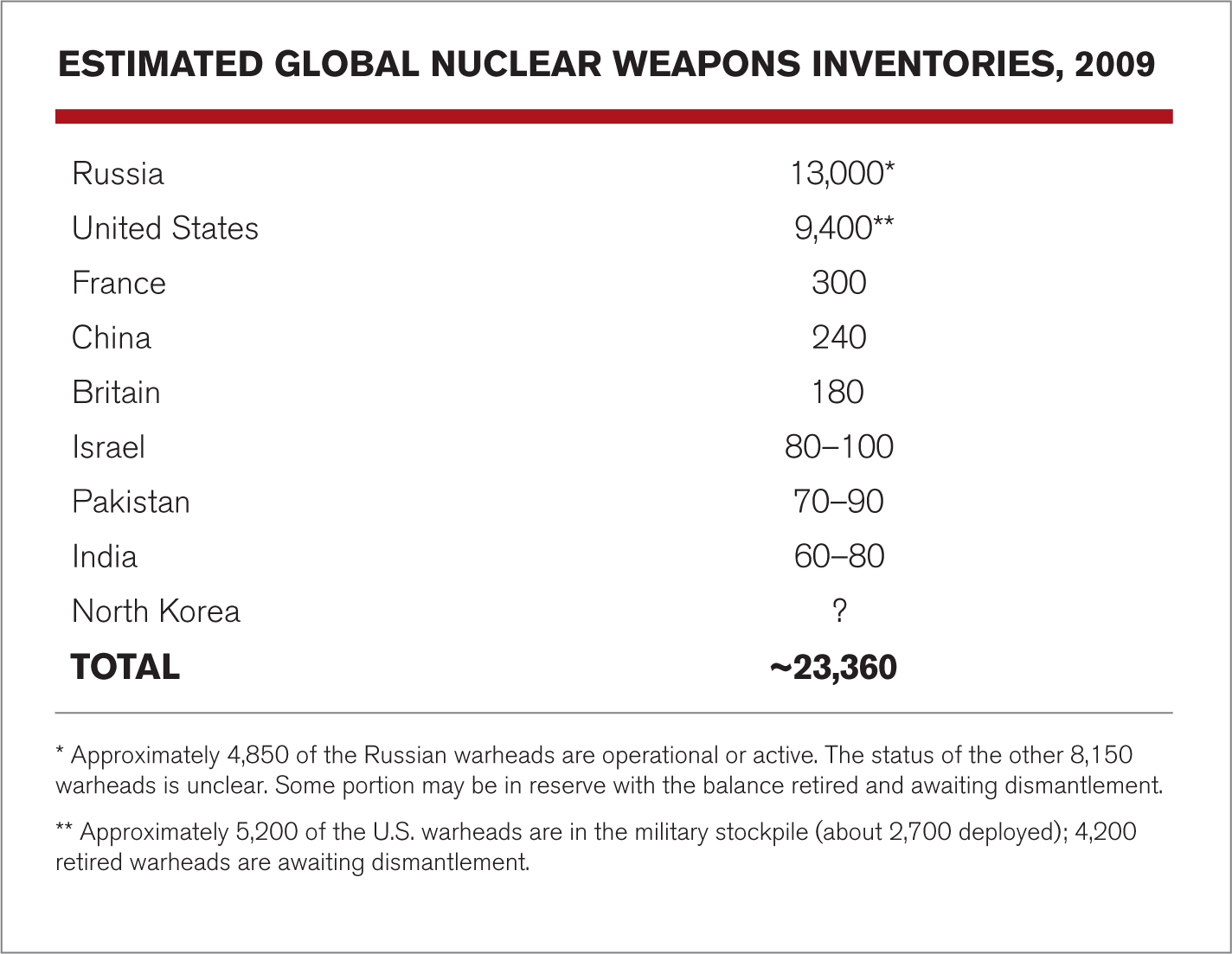
Approximately 4,850 of the Russian warheads are operational or active. The status of the other 8,150 warheads is unclear. Some portion may be in reserve with the balance retired and awaiting dismantlement.
Approximately 5,200 of the U.S. warheads are in the military stockpile (about 2,700 deployed); 4,200 retired warheads are awaiting dismantlement.
Many sites that once stored weapons are still maintained because a nearby base–such as bases for Tu-22M Backfire and Su-24 Fencer bombers or Il-38 anti-submarine aircraft–continues to have a nuclear strike mission. The Russian Black Sea Fleet based in Ukraine also has a nuclear capability, but the weapons probably have been withdrawn to central storage in Russia. If the fleet relocates to Novorossiysk when the lease of the Sevastopol area expires in 2017, a nuclear weapons storage facility might be built there as well.
Russian permanent nuclear weapon storage locations fall into three main categories: operational warheads at Strategic Rocket Force, air force, and navy bases; reserve/retired warheads at national-level storage sites; and warheads at assembly/disassembly factories. 5
One uncertainty when counting Russian nuclear weapons storage sites is whether the number includes overall sites or individual storage facilities co-located within a site. For example, the Defense Department's Threat Reduction Program statement in 2000 indicated that Russia had 123 nuclear weapons storage locations where it has requested security assistance, apparently counting separately fenced areas within large national storage facilities. As a result, a large storage site with eight separately fenced areas would have been counted as eight sites instead of one. 6 Using similar counting methods, the National Nuclear Security Administration recently listed 73 Russian warhead sites, including 39 navy sites, 25 Strategic Rocket Force sites (on 11 bases), and nine 12th Main Directorate sites. 7 Our best estimate is 48 permanent nuclear weapons storage sites, many of which include several individually fenced storage bunkers.
None of China's nuclear warheads are thought to be mated with their delivery vehicles. Instead, it is believed that they are kept in storage facilities controlled by the Central Military Commission. For reasons related to survivability and readiness, we assume regional storage sites exist near each of the six major base units that operate nuclear missile brigades and that additional warheads are in central storage. Whether storage sites exist at the two missile submarine bases is unknown, but we assume they might, for a total of 8-14 storage sites. (It is probably closer to the lower number, which would include six regional sites, one central site, and two industry sites; some storage for submarine and bomber weapons seems plausible, although co-location might occur.)
In the case of Pakistan and India, we have found no credible information that identifies where nuclear weapons are produced or stored. Neither country's nuclear weapons are believed to be fully operational under normal circumstances. It is thought that they are stored in central storage locations rather than on bases with operational forces. We estimate that each country has about half a dozen storage sites.
We are not aware of credible information on how North Korea has weaponized its nuclear weapons capability, much less where those weapons are stored. We also take note that a recent U.S. Air Force intelligence report did not list any of North Korea's ballistic missiles as nuclear-capable. 8
ESTIMATED WORLDWIDE LOCATIONS OF NUCLEAR WEAPONS, 2009
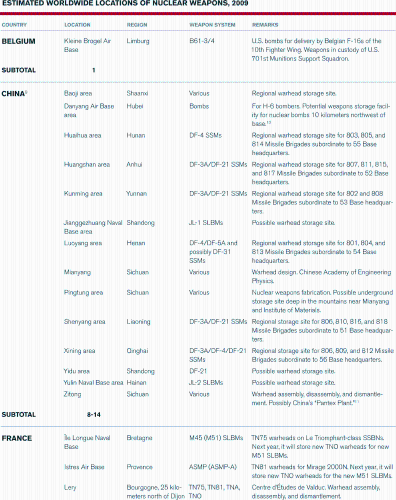
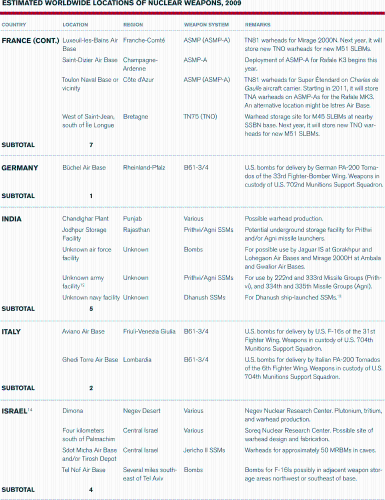
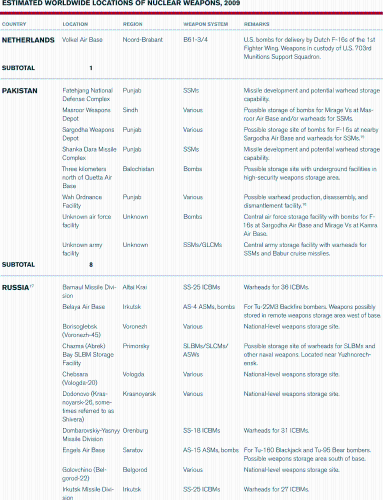
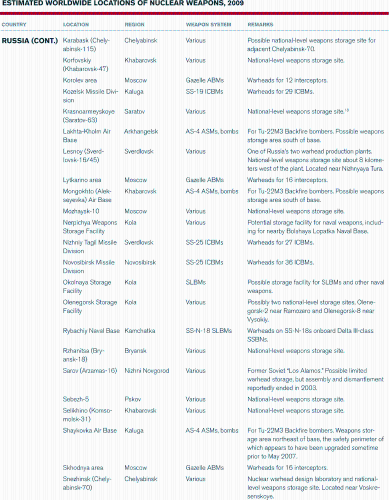
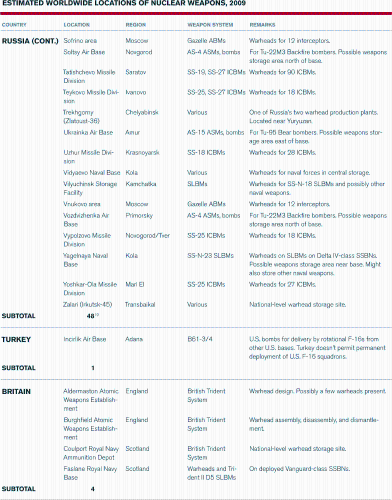
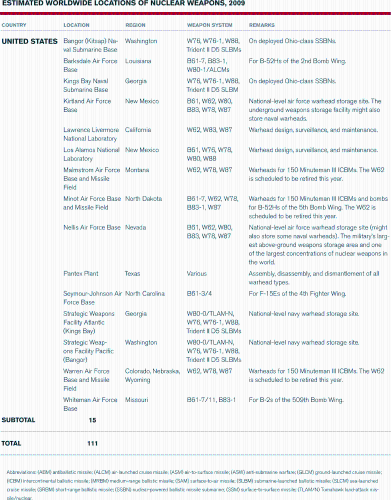
Abbreviations: (ABM) antiballistic missile; (ALCM) air-launched cruise missile; (ASM) air-to-surface missile; (ASW) anti-submarine warfare; (GLCM) ground-launched cruise missile (ICBM) intercontinental ballistic missile; (MRBM) medium-range ballistic missile; (SAM) surface-to-air missile; (SLBM) submarine-launched ballistic missile; (SLCM) sea-launched cruise missile; (SRBM) short-range ballistic missile; (SSBN) nuclear-powered ballistic missile submarine; (SSM) surface-to-surface missile; (TLAM/N) Tomahawk land-attack missile/nuclear.
Footnotes
1.
Valuable open-source reference material for estimated deployments of nuclear
weapons include: William M. Arkin and Richard Fieldhouse, Nuclear
Battlefields: Global Links in the Arms Race (Harper Collins, 1985);
William M. Arkin et al., Taking Stock: Worldwide Nuclear Deployments
1998 (Natural Resources Defense Council, 1998); Thomas B. Cochran
et al., The U.S. Nuclear War Plan: A Time for Change (Natural
Resources Defense Council, 2001); Joseph Cirincione et al., Deadly
Arsenals: Nuclear, Biological, and Chemical Threats (Carnegie
Endowment for International Peace, 2005); SIPRI Yearbook,
various issues; and the Monterey Institute for International Studies open-source
research database on the Nuclear Threat Initiative website available at
 .
.
2.
For the period of 1951-1977, see Robert S. Norris, William M. Arkin, and William Burr, “Where They Were,” Bulletin of the Atomic Scientists, November/December 1999, pp. 26-35, 66-67, and “How Much Did Japan Know?” Bulletin of the Atomic Scientists, January/February 2000, pp. 11-13, 78–79.
3.
Defense Department, “Proliferation: Threat and Response,” November 1997 (sheet 54 of web version); Taking Stock: Worldwide Nuclear Deployments 1998, pp. 33, 81-87. According to Securing the Bomb 2008 by Matthew Bunn (Project on Managing the Atom, November 2008), “The total number of warhead sites in Russia is not publicly known, but appears to be in the range of 110-130, including both permanent and temporary sites, but not counting the front-line tactical sites that may no longer have warheads day-to-day.” In Charles L. Thornton's December 2003 presentation, “U.S. Efforts to Secure Russia's Nuclear Warheads: Background and Issues,” before the Russian-American Nuclear Security Advisory Council, he estimated a total of 150-210 sites of which 110-150 were permanent storage sites.
4.
In 2002, the Russian government announced, “All nonstrategic nuclear munitions have been transferred to the central storage facilities of the Ministry of Defense.” See Ministry of Foreign Affairs of the Russian Federation, “Statement of the delegation of the Russian Federation at the First Session of the Preparatory Committee for the 2005 NPT Review Conference under Article VI of the Treaty,” April 24, 2002.
5.
Weapons are also occasionally present at an unknown number of temporary storage sites when in transit between bases and production facilities.
6.
We're indebted to Bunn for this insight. For reference to the 123 sites, see Senate Armed Services Committee Subcommittee on Emerging Threats and Capabilities, “Statement of Dr. Susan Koch, U.S. Deputy Assistant Secretary of Defense For Threat Reduction Policy,” March 6, 2000, p. 2.
7.
National Nuclear Security Administration, “NNSA: Working to Prevent Nuclear Terrorism,” September 2009, p. 1; National Nuclear Security Administration, “FY 2010 Congressional Budget Request,” May 2009, p. 390. Note that the press release lists 25 Strategic Rocket Force “sites” out of 73 upgraded Russian nuclear warheads “sites,” while the budget request explains that the 25 Strategic Rocket Force “sites” are at 11 bases. In other words, individual base locations can contain multiple sites.
8.
9.
Estimated locations listed here for Chinese land-based missile forces are mainly based on Thomas C. Reed and Danny B. Stillman, The Nuclear Express: A Political History of the Bomb and Its Proliferation (Zenith Press, 2009), pp. 84-113, 220-234, 354-363; Bates Gill et al., “The Chinese Second Artillery Corps: Transition to Credible Deterrence,” in James C. Mulvenon and Andrew N. D. Yang, eds., The People's Liberation Army as Organization: Reference Volume v. 1.0 (RAND, 2002); Mark A. Stokes, China's Military Modernization: Implications for the United States (U.S. Army War College, September 1999); Taking Stock: Worldwide Nuclear Deployments 1998, pp. 45-48, 89; Robert S. Norris et al., Nuclear Weapons Databook Volume V: British, French, and Chinese Nuclear Weapons (Westview Press, 1994).
10.
China also deploys about 120 H-6 bombers at Anqing Air Base, Leiyang Air Base, Nanjing Air Base, Qili Air Base, and Xian Air Base. Any of these bases could potentially have a secondary nuclear mission, but Danyang is the only air base with an external igloo-type storage facility nearby. Anqing and Leiyang Air Bases both have underground facilities that potentially could store nuclear bombs, and several of the bases are undergoing modernizations that might be associated with adding a cruise missile capability to some of the H-6 bombers.
11.
This might be the nuclear weapon production and storage facility reported in The Nuclear Express on p. 358 as located two-and-a-half hours north of Mianyang near the city of Pingtung.
12.
Locations of nuclear Prithvi/Agni garrisons are not known. Potential Prithvi host candidates include Bhatinda and Jullundur in Punjab. A potential new, but unconfirmed, Prithvi and/ or Agni underground storage facility might be located near Daijar, north of Jodhpur, in Rajasthan. The facility includes a dozen tunnels with what appear to be roll-out-and-launch pads and missile-handling buildings.
13.
The Indian Navy also is developing a submarine-launched nuclear capability in the form of a ballistic missile and possibly a cruise missile; warhead design for these systems probably is underway.
14.
Claims of a nuclear capability for Israeli Harpoon or Popeye cruise missiles on Dolphin-class submarines remain ambiguous.
15.
In response to reports about terrorist attacks on suspected nuclear facilities, including Sargodha Depot, Pakistani military spokesman Maj. Gen. Athar Abbas stated, “These are nowhere close to any nuclear facility.” Ishtiaq Mahsud, “Pakistani Officials: Militant Clashes Kill about 70,” Associated Press, August 12, 2009.
16.
Ibid.
17.
Locations listed here are based on “U.S. Efforts to Secure Russia's Nuclear Warheads: Background and Issues”; Oleg Bukharin et al., New Perspectives in Russia's Ten Secret Cities (Natural Resources Defense Council, October 1999); Joshua Handler, Russian Nuclear Warhead Dismantlement Rates and Storage Site Capacity: Implications for the Implementation of START II and De-alerting Initiatives (Princeton University, February 1999); Taking Stock: Worldwide Nuclear Deployments 1998, pp. 26-38, 81-87; Thomas B. Cochran et al., Nuclear Weapons Databook Volume IV: Soviet Nuclear Weapons (Harper & Row, 1989). Other valuable resources include Defense Department, “Cooperative Threat Reduction Program Annual Report to Congress Fiscal Year 2009” (and previous years); Securing the Bomb 2008, pp. 47-49, 93-95; Gunnar Arbman and Charles Thornton, Russia's Tactical Nuclear Weapons Part II: Technical Issues and Policy Recommendations (Swedish Defence Research Agency, February 2005); Pavel Podvig, ed., Russian Nuclear Forces (MIT Press, 2001).
18.
Gen. Eugene Habiger, the former commander of STRATCOM, visited Saratov, the Russian national storage site, in 1998 and later described being shown strategic and tactical nuclear weapons: “We went to Saratov, a national nuclear weapons storage site, where I saw not only strategic weapons, but tactical weapons. … And they took me into the side of a mountain, a hill, where we went behind two doors that were each several thousands of tons in weight. And you had to open up one door at a time, these sliding, massive doors, in order to get into the inner sanctum. In the inner sanctum, there were five nuclear weapon storage bays. They took me into one of those bays, and we had an interesting discussion.” Defense Department news briefing, June 16, 1998.
19.
In addition to these permanent storage locations, a significant number of temporary storage sites include railhead and transfer stations. Nuclear-capable bases where weapons have been moved to central storage include air bases with Su-24 Fencer bombers (Chernyakhovsk, Dzhida, Eysk, Khurba, Lebyazhye, Morozovsk, Pereyaslavka, Siverskiy, Smuravyevo, Voronezh, and Vishnevka), naval bases with Tu-22M Backfire bombers and Il-28 anti-submarine warfare aircraft, and air bases with nuclear-capable SA-10 Grumble surface-to-air missiles. U.S. government lists tend to have a higher number for Russian nuclear weapon storage locations, apparently because they include many temporary sites, particularly navy sites, and sometimes also count individual fenced sites within larger facilities. For a recent example of this, see the fact sheet “NNSA: Working to Prevent Nuclear Terrorism,” p. 1; and “FY 2010 Congressional Budget Request,” pp. 390–391.