




Abstract
The United States and the Soviet Union spent hundreds of billions of dollars trying to out duel each other during the cold War. Today, nuclear arms races would cost considerably less.
In two research articles, scholars Keir Lieber and Daryl Press suggested in Spring 2006 that the United States had achieved nuclear primacy over Russia and China.1 The United States could conduct a nuclear first strike on either country and remain virtually unscathed in the aftermath, argued Lieber, an associate professor of political science at the University of Notre Dame, and Press, an associate professor of government at Dartmouth College. Their analysis met a great deal of skepticism within the international security community. U.S. and Soviet/Russian strategic calculations had indeed changed since the end of the Cold War, as had calculations between the United States and China, but most, if not all, observers believed both nations had sufficient nuclear forces to deter the United States.
Despite this initial skepticism, the idea that the United States had gained a dominant strategic position over Russia and China lingered, raising the tantalizing question: What if Lieber and Press were right? How easily might Russia and China expand their nuclear arsenals and challenge U.S. superiority? And how should U.S. thinking on arms control and nonproliferation change as a consequence to avoid further destabilizing arms races?
These concerns are vital. Since its post-Cold War decline, Russia has been making a bid to regain its global power and standing, and its recent military buildup includes new nuclear forces. Further to the east, China continues its rise to superpower status. While Chinese actions have remained relatively pacific in recent years, its economy financed yearly double-digit percent increases in its defense spending during the past decade.2 And new nuclear arms races may not be limited to just the United States, China, and Russia. With the prospect of an Iranian nuclear capability looming on the horizon, a number of countries including Egypt, Saudi Arabia, and Turkey may also develop nuclear weapons.
The following analysis demonstrates that cost would not be a barrier to nuclear weapons states, including Russia and China, looking to increase their deployment of nuclear weapons. Indeed, cost also would not be a barrier for many states that currently don't deploy nuclear weapons but have or are contemplating developing the infrastructure to support nuclear energy generation. These findings make it easy to contemplate renewed arms races.
The greatest obstacles for states looking to build nuclear weapons remain the challenges of obtaining fissile materials and maintaining the political will to do so. Efforts to limit both vertical and horizontal proliferation should thus continue to focus on restricting access to fissile materials and reducing the incentives for nations to build nuclear weapons.
An average cost of $74 billion a year would be daunting to many states seeking to build a nuclear arsenal. However, this average includes the development costs for the entirety of U.S. strategic forces, including research, development, the mass production of nuclear arms, and everything from building hardened ICBM silos to maintaining a fleet of nuclear-armed bombers. We refer to these as “deployed weapons” expenses to reflect the costs of the weapons, the delivery systems, etc. The cost of building only the warheads will be referred to as “warhead only” expenses.
This distinction is worth making, because not all nuclear weapons states have a full array of nuclear delivery systems, yet their nuclear forces are sufficient to maintain deterrence. Britain eliminated its land-based platforms in 1963, retired its nuclear-bomber fleet in 1994, and currently relies solely on its submarine fleet to provide a nuclear deterrent. France eliminated its land-based program, reduced its fleet of nuclear bombers, and continues to maintain its nuclear-armed navy. Other states such as India, Pakistan, and Israel have adapted current aircraft systems to deliver nuclear weapons rather than develop single-purpose bombers.3
COSTS Of U.S. NUCLEAr wEApONS AND STrATEGIC fOrCES, 1951–1965
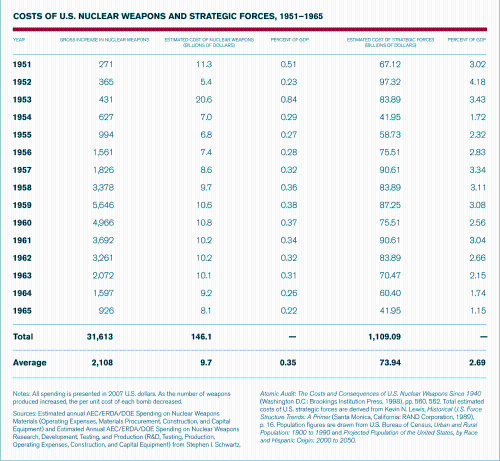
Notes: All spending is presented in 2007 U.S. dollars. As the number of weapons produced increased, the per unit cost of each bomb decreased.
Sources: Estimated annual aEc/ErDa/DOE Spending on nuclear Weapons Materials (Operating Expenses, Materials Procurement, Construction, and Capital Equipment) and Estimated annual aEc/ErDa/DOE Spending on nuclear Weapons Research, Development, Testing, and Production (R&D, Testing, Production, Operating Expenses, Construction, and Capital Equipment) from Stephen I. Schwartz, Atomic Audit: The Costs and Consequences of U.S. Nuclear Weapons Since 1940 (Washington D.C.: Brookings Institution Press, 1998), pp. 560, 562. Total estimated costs of U.S. strategic forces are derived from Kevin N. Lewis, Historical U.S. Force Structure Trends: A Primer (Santa Monica, California: RAND Corporation, 1989), p. 16. Population figures are drawn from U.S. Bureau of Census, Urban and Rural Population: 1900 to 1990 and Projected Population of the United States, by Race and Hispanic Origin: 2000 to 2050.
To provide a low-end estimate for states looking to build nuclear weapons, we also looked at what the United States spent to produce each warhead during the same period. “Costs of U.S. Nuclear Weapons and Strategic Forces, 1951–1965” summarizes these expenses, which include costs for warheads deployed on tactical nuclear weapons. These calculations suggest that with an average annual expenditure of $9.74 billion, states with access to nuclear materials could produce massive numbers of nuclear weapons. It should be noted that these figures do not include the research and development costs of the Manhattan Project and immediate post-war follow-on work. However, much of this research and investment is no longer necessary for states looking to build nuclear weapons, due to the diffusion of technology and knowledge. The key barrier for states today is obtaining highly enriched uranium and plutonium, the fissile materials that fuel nuclear weapons. The United States and Soviet Union developed the infrastructure to produce these materials, but many other states have not.
While we would prefer to offer comparable cost figures for the early days of the Soviet nuclear program, providing reliable estimates is exceedingly difficult, as “the political and the heavily militarized economic system that the Soviets followed provided no way to accurately measure these costs.”4 Despite these difficulties, scholars Noel Firth and James Noren place annual Soviet spending on strategic offensive and defense weapon systems at $28.53 billion a year from 1951 to 1959.5 Estimates of Chinese nuclear spending on just warheads place the costs at $3.56 billion a year in the 10 years prior to Beijing's 1964 nuclear test.6 Observers estimate that the initial 10 years of the Indian nuclear weapons program cost between $820 million and $2 billion a year, a period that saw the Indians produce roughly 150 war-heads.7 Although the totals in the latter two cases are relatively small, these costs make up 39 percent, 5 percent, and between 8 and 21 percent, respectively, of U.S. spending on similar programs.8
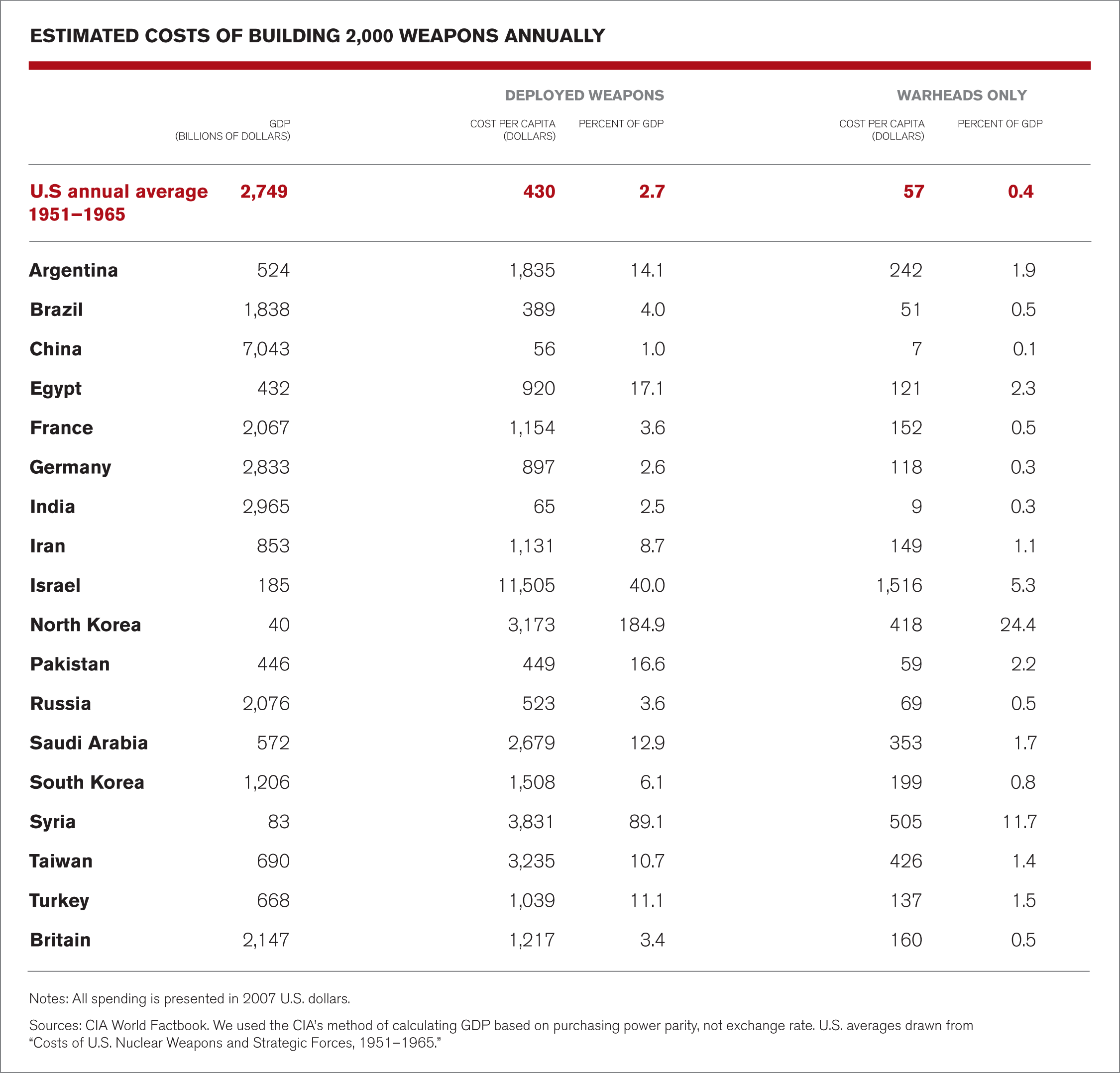
This U.S. buildup between 1951 and 1965 cost an average of 2.7 percent of U.S. GDP, whereas today, China, Germany, and India could build a huge arsenal of strategic forces by spending less than 3 percent of their national GDP (see “Estimated Costs of Building 2,000 Weapons Annually”). Four more states–Brazil, France, Russia, and Britain–could do so for between 3 and 4 percent of their GDP. Keep in mind, the $74 billion average yearly U.S. price tag used to draw these comparisons represents a very high-end cost baseline for building and maintaining a full-fledged nuclear triad.
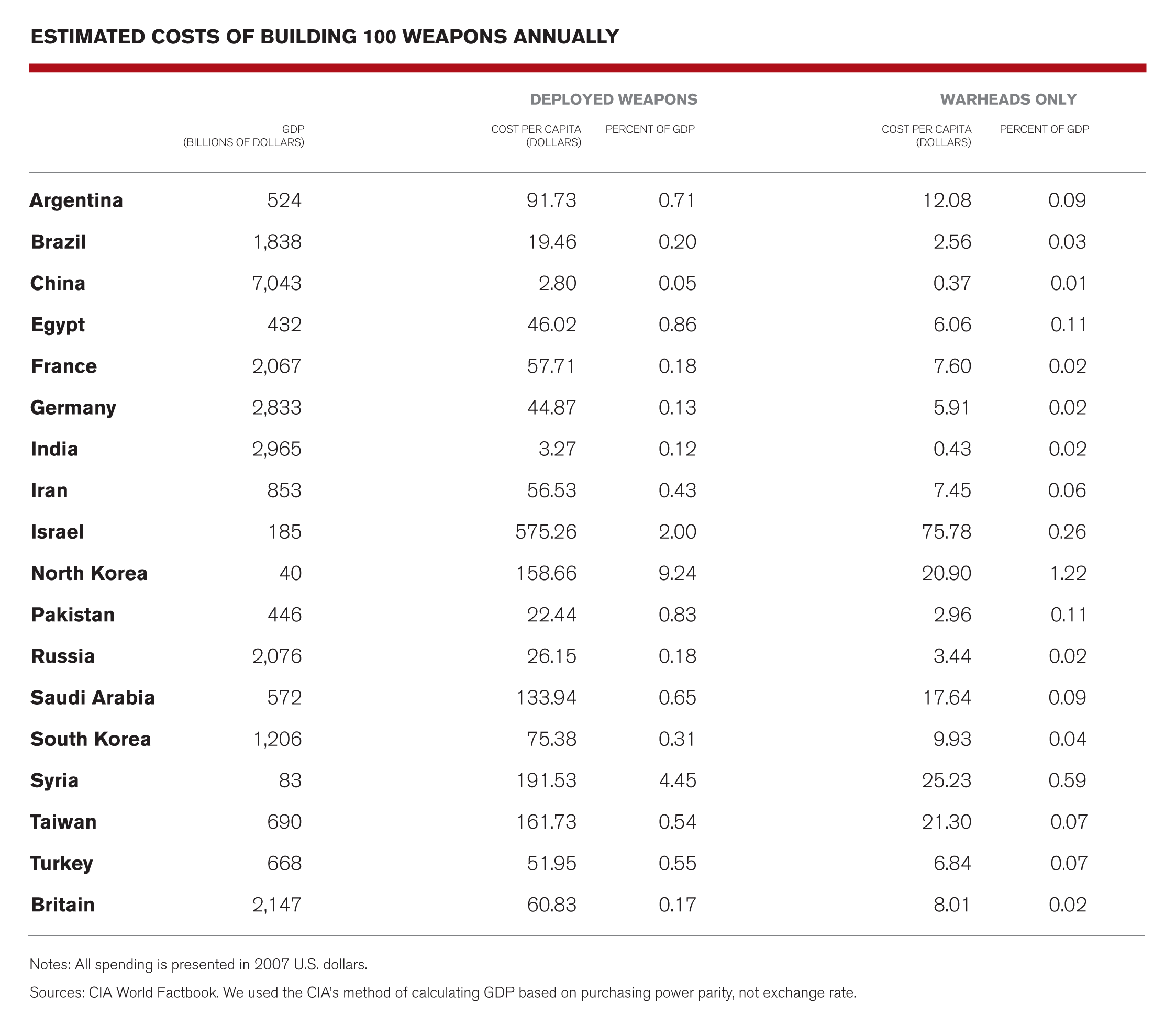
When looking at just the cost of building warheads, more than half the states we examined could afford to build approximately 2,000 warheads per year by spending just 1.5 percent or less of their GDP, matching the annual U.S. warhead development rates of the early Cold War. Using our metrics, this rate of warhead development would cost each Russian citizen $68.89 per year. The annual per capita costs for China and India would be $7.37 and $8.62, respectively. It is unlikely, however, that any state would want or need to build thousands of nuclear warheads a year, even if they wanted to establish a state of mutually assured destruction with the United States. The costs of a slower buildup, say 100 weapons per year, would be even more doable for states, and building at this rate would, for example, give both India and Pakistan parity with China in three years.
ESTIMATED COSTS Of BUILDING 2,000 WEAPONS ANNUALLY
Notes: All spending is presented in 2007 U.S. dollars.
Sources: CIA World Factbook. We used the CIA's method of calculating GDP based on purchasing power parity, not exchange rate. U.S. averages drawn from “Costs of U.S. Nuclear Weapons and Strategic Forces, 1951–1965.”
ESTIMATED COSTS OF BUILDING 100 WEAPONS ANNUALLY
Notes: All spending is presented in 2007 U.S. dollars.
Sources: CIA World Factbook. We used the CIA's method of calculating GDP based on purchasing power parity, not exchange rate.
By taking 5 percent of the U.S. cost estimate for a 2,000-per-year buildup of weapons and warheads, we can estimate the cost of building 100 weapons and warheads (see “Estimated Costs of Building 100 Weapons Annually”). We recognize that this may underestimate costs, as costs per unit do not scale down linearly. Yet, the diffusion of knowledge and technology since the 1950s, as well as the relatively high degree to which U.S. officials valued safety and manufacturing standards during the weapons production process, suggests that other states could build nuclear weapons with lower unit costs. In any case, these are rough illustrative estimates. Considering the great uncertainty about cost estimates for the Russian, Chinese, and Indian programs, any cost baseline for manufacturing facilities and technology development is imprecise, as would be cost estimates for scaling up. We simply suggest that cost is not a significant barrier for many states if they should choose to build nuclear weapons.
We would do well to remember the fear of nuclear annihilation that enshrouded the Cold War. Our analysis suggests that at least as far as costs are concerned, those fears could easily return, and not just for the United States but also for many regions of the world. The prospect of new and renewed arms races should make national leaders more cautious about adopting bellicose or inflammatory policies. Why start a nuclear arms race unless we really have to?
Footnotes
1.
Keir A. Lieber and Daryl G. Press “The Rise of U.S. Nuclear Primacy,” Foreign Affairs, vol. 85, no. 2; and Keir A. Lieber and Daryl G. Press, “The End of MAD?” International Security, vol. 30, no. 4.
2.
China's official defense budget for 2008 is $59 billion; for 2007 it was roughly $45 billion. U.S. estimates of China's 2007 defense expenditures ranged from $95 billion to $140 billion.
3.
P. K. Ghosh, “Economic Dimension of the Strategic Nuclear Triad,” Strategic Analysis, vol. 26, no. 2. While Russia continues to maintain its nuclear triad, its scale has been significantly drawn down since the fall of the Soviet Union. China relies predominantly on its land-based missiles while maintaining an antiquated submarine fleet. For a more detailed account on the current status of the Russian and Chinese nuclear forces see previously cited articles by Lieber and Press.
4.
Ibid.
5.
Noel E. Firth and James H. Noren, Soviet Defense Spending: A History of CIA Estimates 1950–1990 (College Station: Texas A&M University Press, 1998), p. 111.
6.
George Perkovich, India's Nuclear Bomb: The Impact on Global Proliferation (Berkeley: University of California Press, 1999), p. 80.
7.
Ibid., p. 283. Figures converted by the authors to 2007 U.S. dollars. Note that India Today reported an arsenal of 150 weapons, about three times most current estimates of the Indian arsenal.
8.
We used the full U.S. program costs to calculate these percentages for the Soviet Union and China, and the U.S. warhead-only costs when comparing to India.