




Abstract
Recent research exposes the fallacies that helped to drive missile stockpiles to astronomical levels, making Russia's persistently slow reduction of deployed missiles all the more inexcusable.
Of the many components of the U.S.-Soviet arms race, the ballistic missile played a prominent role. The Soviet launch of Sputnik on October 4, 1957, forced the ballistic missile to the top of the Eisenhower administration's agenda. If Moscow could launch a satellite into space eventually they could target a nuclear warhead to any place on Earth. To compound the near panic in the United States, the Soviets announced three days later that they had successfully tested a new thermonuclear warhead that presumably could be affixed to a ballistic missile.
During the ensuing decades, both sides put enormous resources into their intercontinental ballistic missile (ICBM) programs and into efforts to find out what the other side was doing. In general, early ICBMs were large and inaccurate, carried a single high-yield warhead, and were deployed aboveground, leaving them highly vulnerable. Later generations were deployed underground in hardened silos, were increasingly accurate, and some carried multiple warheads. Estimates of actual and future missile capabilities were the combustible fuel that stoked claims by advocates on both sides for new and better systems. In the United States, “missile gaps” loomed, and “windows of vulnerability” threatened national security, as the numbers and types of ICBMs became highly politicized in presidential and congressional races. In the Soviet Union, a similar irrational sense of fear arose.
While the history and details of U.S. ICBMs are fairly well documented, similar information about the Soviet/Russian ICBM programs has only recently come to light. Research published by Stanford University scholar Pavel Podvig, who is also a member of the Bulletin's Science and Security Board, in the Summer 2008 International Security, added substantially to public understanding of this topic.1 (We borrow liberally from Podvig's research in the accompanying tables.)
In his article, Podvig introduces new evidence that suggests Soviet ICBMs were less capable than Washington feared. U.S. concerns about a “window of vulnerability” emerged in the mid-1970s and lasted through the early 1980s. Some U.S. officials claimed that the vast number of Soviet ICBM warheads and their supposed accuracy put U.S. ICBMs at risk from a preemptive attack and that Moscow sought missile superiority for the purpose of coercion or, if deterrence failed, to fight and win a nuclear war. This perceived vulnerability prompted U.S. officials to search for a basing scheme for the new MX Peacekeeper ICBMs that would allow them to survive a preemptive attack. After exploring approximately 25 different ways to base the missile (some of which were bizarre concepts that deployed missiles in space or onto floating launch pads in the oceans), the U.S. Air Force deployed the MXs in the same silos that earlier were said to be vulnerable.2 As for intentions, Podvig's research makes clear that the Soviet ICBM program was driven by the inertia of the military-industrial complex rather than by efforts to gain political advantage or to win a nuclear war.
While U.S. fears of a surprise attack derived from the Japanese attack on Pearl Harbor, Soviet fears of a surprise attack derived from the Nazi invasion of June 1941. These interlocking fears led both sides to prepare for all eventualities: preemption, launch-on-warning, and retaliation.
From 1989 to 1994, a team of U.S.-Soviet specialists interviewed 22 senior military officers who served on the Soviet General Staff and the Strategic Rocket Force.3 The researchers found that by the early 1970s, the Soviet military leadership had dismissed the possibility that they could win a nuclear war. Therefore, Soviet officials set out to prevent nuclear war by adopting the principle of deterrence, backed by robust forces in the field.
In a mirror image of U.S. fears, the Soviets believed that the United States was preparing for a first strike, for example, by fielding highly accurate missiles such as the MX and Pershing II and by issuing Presidential Directive-59, which introduced a “countervailing” strategy of more selective attacks short of massive retaliation. While U.S. fears of a surprise attack derived from the Japanese attack on Pearl Harbor, Soviet fears of a surprise attack derived from the Nazi invasion of June 1941. These interlocking fears led both sides to prepare for all eventualities: preemption, launch-on-warning, and retaliation.
U.S. ICBMs, 1959–2008
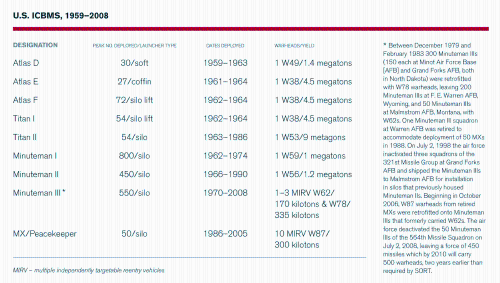
MIRV – multiple independently targetable reentry vehicles
Between December 1979 and February 1983 300 Minuteman IIIs (150 each at Minot Air Force Base [AFB] and Grand Forks AFB, both in North Dakota) were retrofitted with W78 warheads, leaving 200 Minuteman IIIs at F. E. Warren AFB, Wyoming, and 50 Minuteman IIIs at Malmstrom AFB, Montana, with W62s. One Minuteman III squadron at Warren AFB was retired to accommodate deployment of 50 MXs in 1988. On July 2, 1998 the air force inactivated three squadrons of the 321st Missile Group at Grand Forks AFB and shipped the Minuteman IIIs to Malmstrom AFB for installation in silos that previously housed Minuteman IIs. Beginning in October 2006, W87 warheads from retired MXs were retrofitted onto Minuteman IIIs that formerly carried W62s. The air force deactivated the 50 Minuteman IIIs of the 564th Missile Squadron on July 2, 2008, leaving a force of 450 missiles which by 2010 will carry 500 warheads, two years earlier than required by SORT.
Between 1960 and 1967, contractors managed by the Army Corps of Engineers excavated and built 1,180 underground missile silos, 57 aboveground launch sites for the Atlas D and E missiles, and more than 100 Minuteman launch control centers. The work for the six silo missile variants (Atlas F, Titan I and II and Minuteman I, II, and III) was carried out on, or near, 22 air bases in 19 states. North Dakota had the most ICBMs with 300 missiles, while Vermont had the least with 2.
In the mid-1970s, the cumulative megatonnage of Soviet ICBMs peaked at almost 450,000 Hiroshima-sized bombs. As accuracy improved and reductions took hold, the total yield decreased. But old habits are hard to break: As of 2008, Russia has twice as many ICBM warheads as the United States.
Each of the approximately 450 Minuteman missiles active today is maintained on alert in an unmanned, hardened underground launch facility approximately 80 feet deep, 12 feet in diameter, and covered by a 100-ton blast door that is removed just before the missile is launched. (MX missiles, which were retired in 2005, were maintained under similar circumstances.) A launcher support building buried near the launch tube contains environmental-control equipment and standby power sources. An electronic surveillance system is deployed at each launch facility to detect intruders. The missiles are deployed in circular “flights” of 10 missiles, and each flight is controlled by a single, centrally located launch control center manned by a missile combat crew. The control center contains the equipment needed to control and monitor the missiles and launch facilities. The control centers are separated by a minimum of 14 miles and are buried at a depth of between 40 and 100 feet below grade. An aboveground missile-alert facility is paired with each launch control center and contains living quarters and support equipment for the facility, cook, and security personnel. Each missile squadron contains five missile flights and five launch control centers, which are all redundantly connected by a buried, hardened cable network. Each center continually monitors the operational status and security of the 10 missiles and facilities in its own flight and has the capability to control, monitor, and launch all 50 missiles in its squadron. The launch of any of a squadron's missiles, if directed, must be commanded by at least two different control centers in the squadron or by the airborne launch control center aboard a modified EC-135 or E-6B, though exceptions to this rule do exist.
The United States evenly divides its arsenal of Minuteman IIIs among Malmstrom Air Force Base (AFB) in Montana, Minot AFB in North Dakota, and Warren AFB in Wyoming. A total of 838 Minuteman IIIs (including 44 for research and development) were produced between 1966 and 1978. Instead of building new ICBMs, the U.S. Air Force has refurbished the remaining Minuteman IIIs with new motors, propellant, and guidance system, extending the service life through 2030.
In their extensive treatment of Soviet/Russian strategic nuclear forces, Podvig and his colleagues split the ICBM history into five stages.6 During the first stage (1959–1965), the Soviets deployed large ICBMs aboveground in clustered groups, leaving them highly vulnerable. These missiles were not very accurate and compensated by carrying multi-megaton warheads. The missiles took hours to fuel, leading to extensive launch readiness times.
SOVIET/RUSSIAN ICBMS, 1960–2008
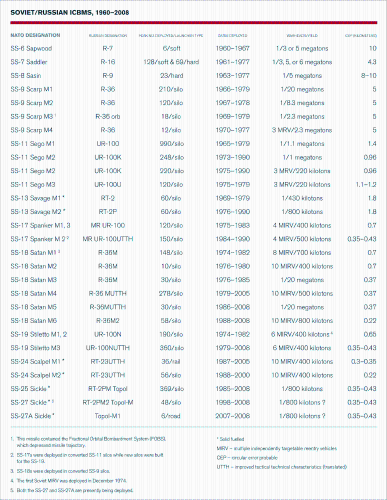
This missile contained the Fractional Orbital Bombardment System (FOBS), which depressed missile trajectory.
SS-17s were deployed in converted SS-11 silos while new silos were built for the SS-19.
SS-18s were deployed in converted SS-9 silos.
The first Soviet MIRV was deployed in December 1974.
Both the SS-27 and SS-27A are presently being deployed.
Solid fuelled
MIRV – multiple independently targetable reentry vehicles
CEP – circular error probable
UTTH – improved tactical technical characteristics (translated)
The second stage (1965–1973) was characterized by the extensive deployment of SS-9, SS-11, and SS-13 ICBMs in underground silos. Unlike the first-generation missiles, these ICBMs were stored fully fueled in their silos. (The SS-13 was the first solid-fuel Soviet ICBM.) Arms control negotiations, which began in 1969 and culminated in SALT I three years later, froze the number of ICBM and SLBM missile launchers at existing levels. With regard to ICBMs, the term “launcher” refers to the silo, not the missile.
During the third stage of ICBM development (1973–1985), the Soviets dramatically increased the number of warheads carried on each missile by deploying multiple independently targetable reentry vehicles (MIRVs), improved the accuracy of its missiles, and enhanced the missiles' survivability by super-hardening their silos. In June 1979, SALT II was signed. The treaty never entered into force because the United States never ratified it, yet its provisions nonetheless guided the force structure of both sides.
The fourth stage (1985–1991) saw the introduction of new silo-based and mobile ICBMs meant to enhance ICBM survivability against increasingly accurate U.S. missiles that theoretically could have destroyed even super-hardened silos.
During the fifth stage (1991-present), Russia began substantially reducing its strategic nuclear forces and slowly modernizing those that remained. Upon signing START I in July 1991, Russia had 1,398 ICBMs, which carried more than 6,600 warheads. In mid-2008, Russia had 415 ICBMs with 1,422 warheads. The implementation of START I and the guidance provided by START II and the SORT agreement (otherwise known as the Moscow Treaty) largely determined the size and shape of these arsenals. Production of the SS-27 continues but at a slower rate than anticipated. Production of the silo-based version will end in 2010, as production shifts to a MIRVed version known as RS-24.
New revelations about two current Russian ICBMs make them of particular interest. The road-based SS-25s each carry an 800-kiloton warhead, significantly more powerful than the 550-kiloton warhead of earlier estimates, and it is possible that the silo- and road-based SS-27s also carry 800-kiloton warheads. Likewise, that 30 SS-18s each carry a single 20-megaton warhead suggests that this weapon serves as Russia's bunker-buster.
Footnotes
1.
Pavel Podvig, “The Window of Vulnerability That Wasn't: Soviet Military Buildup in the 1970s,” International Security, vol. 33, no.1, pp. 118–138.
2.
“MX: The Weapon Nobody Wants,” The Defense Monitor, Volume X, No. 6, Center for Defense Information, 1981, pp. 5–12.
3.
John A. Battilega, “Soviet Views of Nuclear Warfare: The Post-War Interviews,” in Henry D. Sokolski, ed., Getting MAD: Nuclear Mutual Assured Destruction, Its Origins and Practice (Carlisle, Pennsylvania: Strategic Studies Institute, U.S. Army War College, 2004), pp. 151–174.
4.
Stephen I. Schwartz, ed., Atomic Audit: The Costs and Consequences of U.S. Nuclear Weapons Since 1940 (Washington: Brookings Institution Press, 1998), pp. 130–135.
5.
The missiles listed in “Soviet/Russian ICBMs, 1960-2008” do not include spares, research and development models tested prior to deployment, and a group of missiles held for continued test launches during the service life of the missile.
6.
Pavel Podvig, ed., Russian Strategic Nuclear Forces (Cambridge, Massachusetts: MIT Press, 2001), pp. 117–234.