




Abstract
Civilian and military stockpiles of materials that can be used to make nuclear weapons continue to pose global risks.
Fissile materials are those that can sustain an explosive fission chain reaction. They are essential in all nuclear explosives, from first-generation fission weapons to advanced thermonuclear weapons. The most common fissile materials in use are highly enriched uranium (HEU) and plutonium. The production of kilogram quantities of these materials was the key challenge for the U.S. effort more than 60 years ago to build the world's first nuclear weapons and remains the major obstacle for any state seeking nuclear weapons today. Control of these materials is crucial to nuclear disarmament, to halting the proliferation of nuclear weapons, and to ensuring that terrorists do not acquire nuclear weapons.
The International Panel on Fissile Materials produces an annual Global Fissile Material Report, which includes a review of worldwide stocks, production, and disposition of HEU and plutonium. What follows is adapted from the 2008 assessment.1
Plutonium is produced as a by-product in a nuclear reactor, usually as a mixture of several plutonium isotopes (determined by how long the uranium fuel fissions in the reactor), and needs to be separated from the spent nuclear fuel to be usable in a weapon. According to the U.S. Energy Department, “Virtually any combination of plutonium isotopes … can be used to make a nuclear weapon.” The Nagasaki bomb was made from plutonium.
The IAEA defines a “significant quantity” of fissile material to be the amount required to make a first-generation implosion bomb, including production losses. The significant quantities are respectively 25 kilograms of uranium 235 contained in HEU and 8 kilograms of plutonium. Modern two-stage thermonuclear weapons typically contain both HEU and plutonium, with an estimated average of 4 kilograms of plutonium in the fission primary stage and 25 kilograms of HEU in the thermonuclear secondary stage.
The nine nuclear weapon states are, in historical order, the United States and Russia with roughly 10,000 nuclear warheads a piece (5,000 U.S. warheads are awaiting dismantlement, the number to be dismantled in Russia is highly uncertain); Britain with 185; France with fewer than 300; China with about 240; Israel with between 100 and 200; India with 60-70; Pakistan with about 60; and North Korea with fewer than 5. Estimates of their current nuclear weapon stockpiles are based on the Nuclear Notebooks published in the Bulletin of the Atomic Scientists. The U.S. and Russian stockpiles peaked at approximately 30,000 warheads for the United States (around 1965) and 40,000 for Russia (around 1985).
The United States, Russia, Britain, France, and China have each declared (China informally) that they have ended or suspended production of fissile materials for weapons. North Korea has also declared an end to production of plutonium for weapons and opened its facilities to international inspection. Only India, Pakistan, and possibly Israel continue to produce fissile materials for nuclear weapons use.
The global HEU stock is decreasing due to the ongoing down-blend activities in Russia and the United States, in which HEU that has been declared excess to military needs is diluted to produce low-enriched uranium (LEU), typically 3-5 percent enriched, for use as power reactor fuel. Together, the two countries have been eliminating about 40 tons of HEU a year. As of June 2008, Russia had eliminated 337 tons of weapon-grade HEU, out of a total of 500 tons that it had agreed to downblend as part of its 1993 deal with the United States. The deal is to be completed in 2013. As of mid-2008, the United States had downblended about 96 tons of HEU, but little if any of this material was weapon-grade.
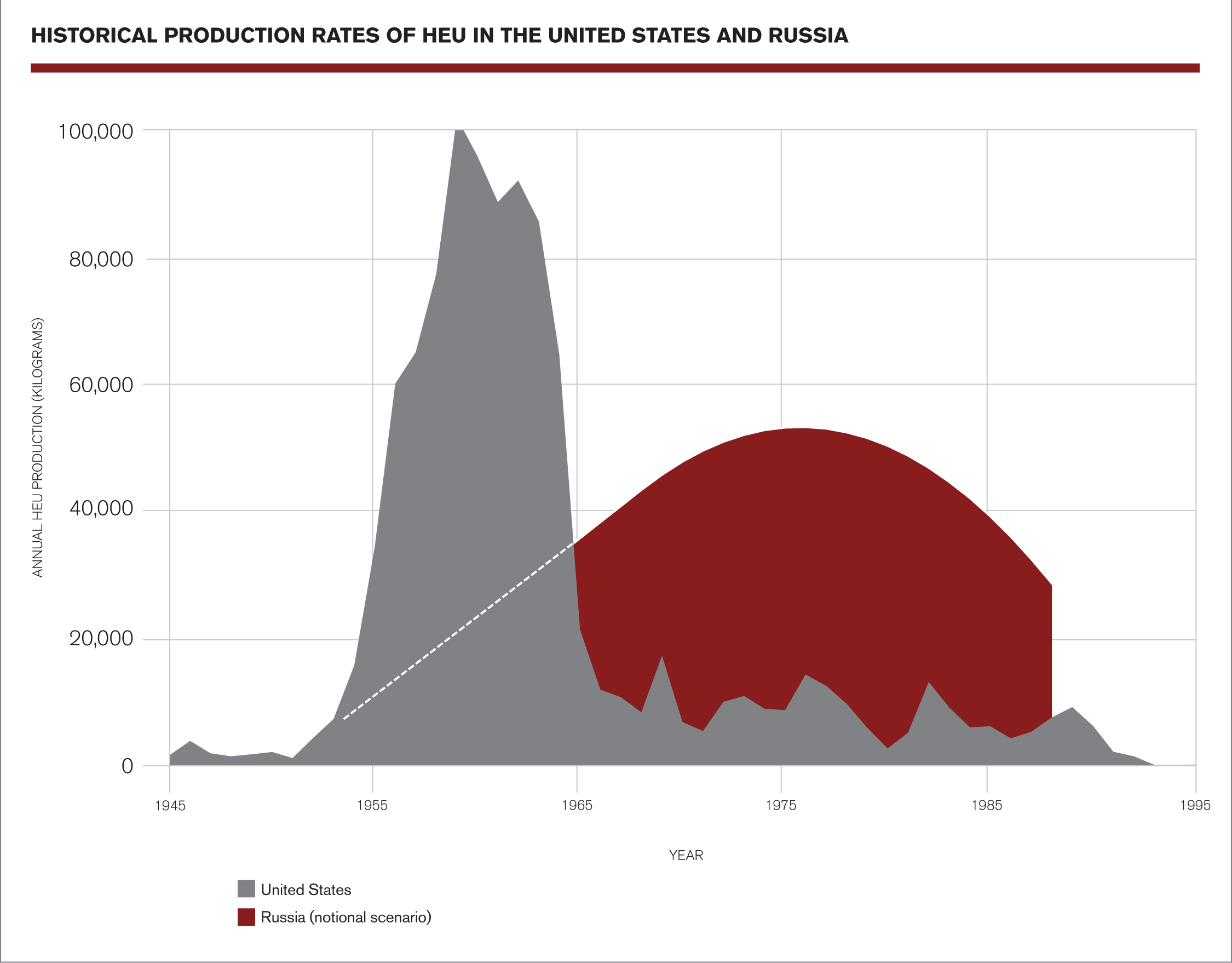
Over the long term, Pakistan's annual HEU production capacity will be constrained by the need to also fuel its plutonium production program from its limited domestic production of natural uranium (currently about 40 tons per year). Pakistan's Khushab plutonium production reactor requires about 13 tons of natural uranium as fuel per year. Two new production reactors are now under construction at Khushab. When all three reactors are online, they will require virtually all of the natural uranium that Pakistan currently produces.
Israel is often assumed not to have produced HEU for nuclear weapons.2 Recently, however, two former U.S. government officials highlighted that Israel may have covertly acquired about 100 kilograms of weapon-grade HEU from the United States. In October 2007, former congressional staffer Henry Myers wrote, “Senior officials in the U.S. government concluded in the late-1960s that weapon-size quantities of HEU had probably been diverted from [the Nuclear Materials and Equipment Corporation] to Israel.”3 Victor Gilinsky, a former U.S. Nuclear Regulatory Commissioner, has revealed that “the CIA believed that the nuclear explosives in Israel's first several bombs, about 100 kilograms of bomb-grade uranium in all, came from material that was missing at a U.S. naval nuclear fuel plant.”4 There have been several classified investigations into this case.
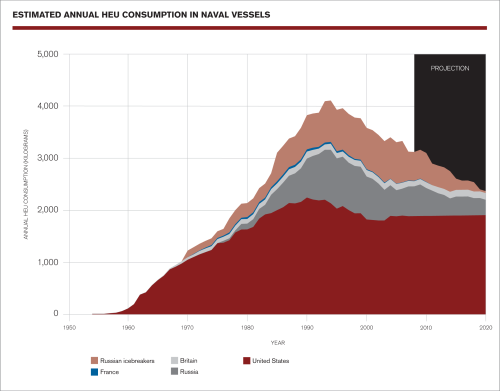
The United States is the world's largest user of HEU as naval fuel. Toward the end of the Cold War, the Soviet Union and the United States each used about 2 tons of HEU annually for this purpose (see chart, “Estimated annual HEU consumption in naval vessels,” above).5 Today, the United States still consumes 2 tons of weapon-grade HEU per year as naval fuel. Russia uses about 1 ton (not all weapon-grade) a year, with its nuclear-powered icebreaker fleet accounting for a significant fraction of this HEU consumption.
The United States appears to be committed to maintaining its reliance on nuclear propulsion for its aircraft carriers and submarines, and possibly expanding it to include nuclear-powered cruisers. We estimate that the 128 tons of HEU (sufficient for more than 5,000 nuclear weapons) that the United States has reserved for its nuclear navy could fuel its surface ships and submarines for 40-60 years. In 2008, the U.S. Senate instructed the navy to study the possibility of moving to LEU fuel for future ships.
India is not included in our naval-HEU consumption projections, but it has been producing HEU to fuel its planned nuclear-powered ballistic missile submarine, the Advanced Technology Vessel. Construction on the vessel is reported to be near completion, with plans to begin sea trials in early-2009. Reports suggest India intends to deploy three nuclear submarines, each with 12 nuclear-armed ballistic missiles, by 2015.
By the end of 2007, India would have needed to produce an estimated 400 kilograms of HEU (enriched perhaps to 45 percent uranium 235) to supply fuel for the land-based prototype naval reactor and the first submarine core. To have fuel ready in time for the additional planned submarines, India will require another 400 kilograms of HEU over the next 5-6 years. To reach this production rate, India will need to increase its uranium enrichment capacity.
Since 1978, an international Reduced Enrichment for Research and Test Reactor (RERTR) program has sought to convert HEU-fueled civilian research reactors to low-enriched fuel. Almost all new reactors designed since that time use LEU fuel. By the end of 2007, the RERTR program had converted or partially converted 56 reactors.
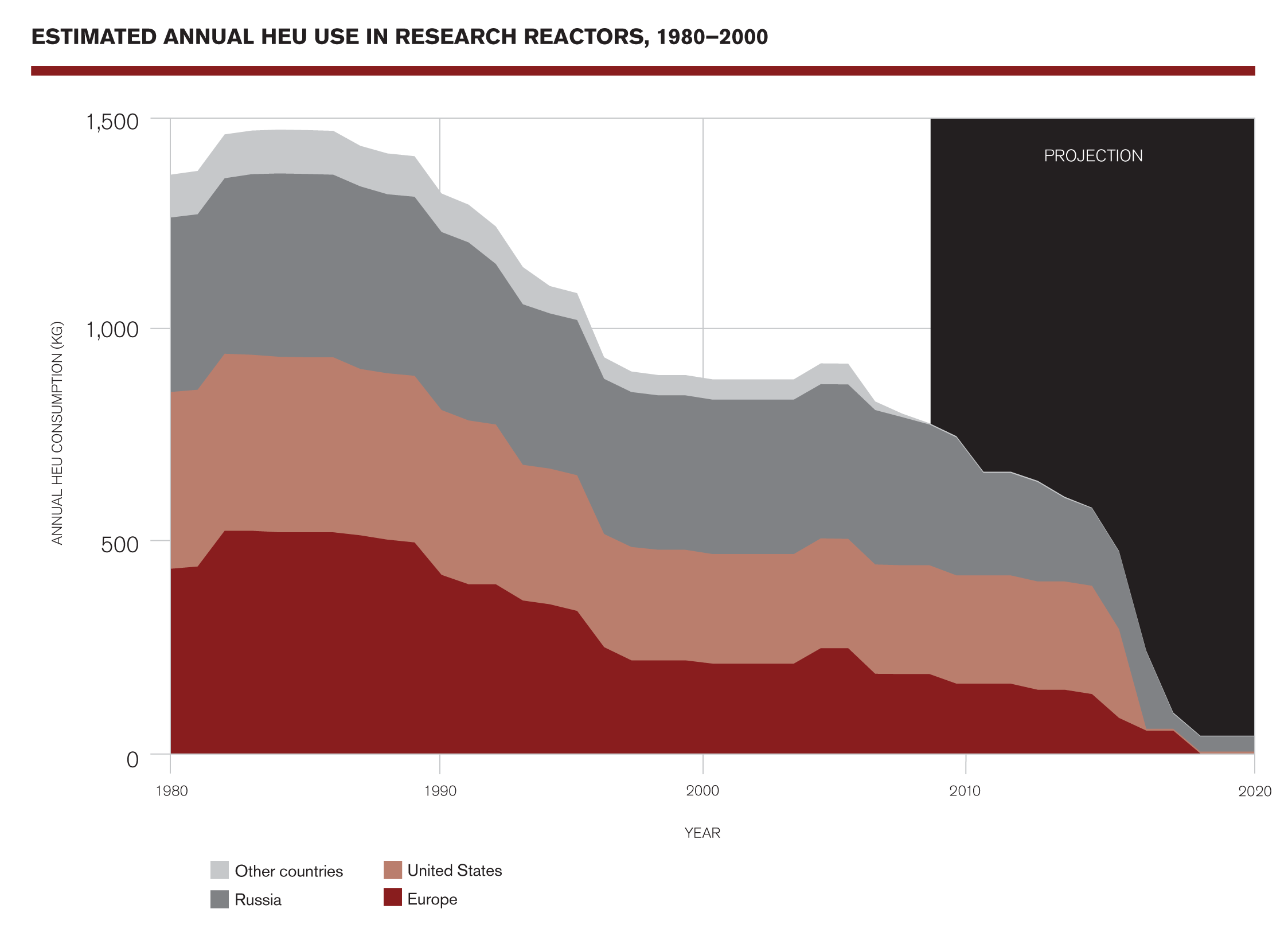
The world's research reactors now consume about 800 kilograms of HEU per year–a significant reduction from the more than 1,400 kilograms that were needed annually in the early 1980s (see chart, “Estimated annual HEU use in research reactors, 1980-2000,” p. 7).6
In 2004, the United States merged its reactor-conversion and spent HEU-fuel take back efforts into the Global Threat Reduction Initiative. If this program achieves its ambitious objectives, annual HEU demand could drop to very low levels by 2020. Critical assemblies and pulsed reactors with lifetime cores do not require regular refueling (and are therefore not shown in the respective chart)–but they can contain ton-level quantities of barely irradiated uranium and are not yet formally being targeted by any of these conversion and consolidation efforts.
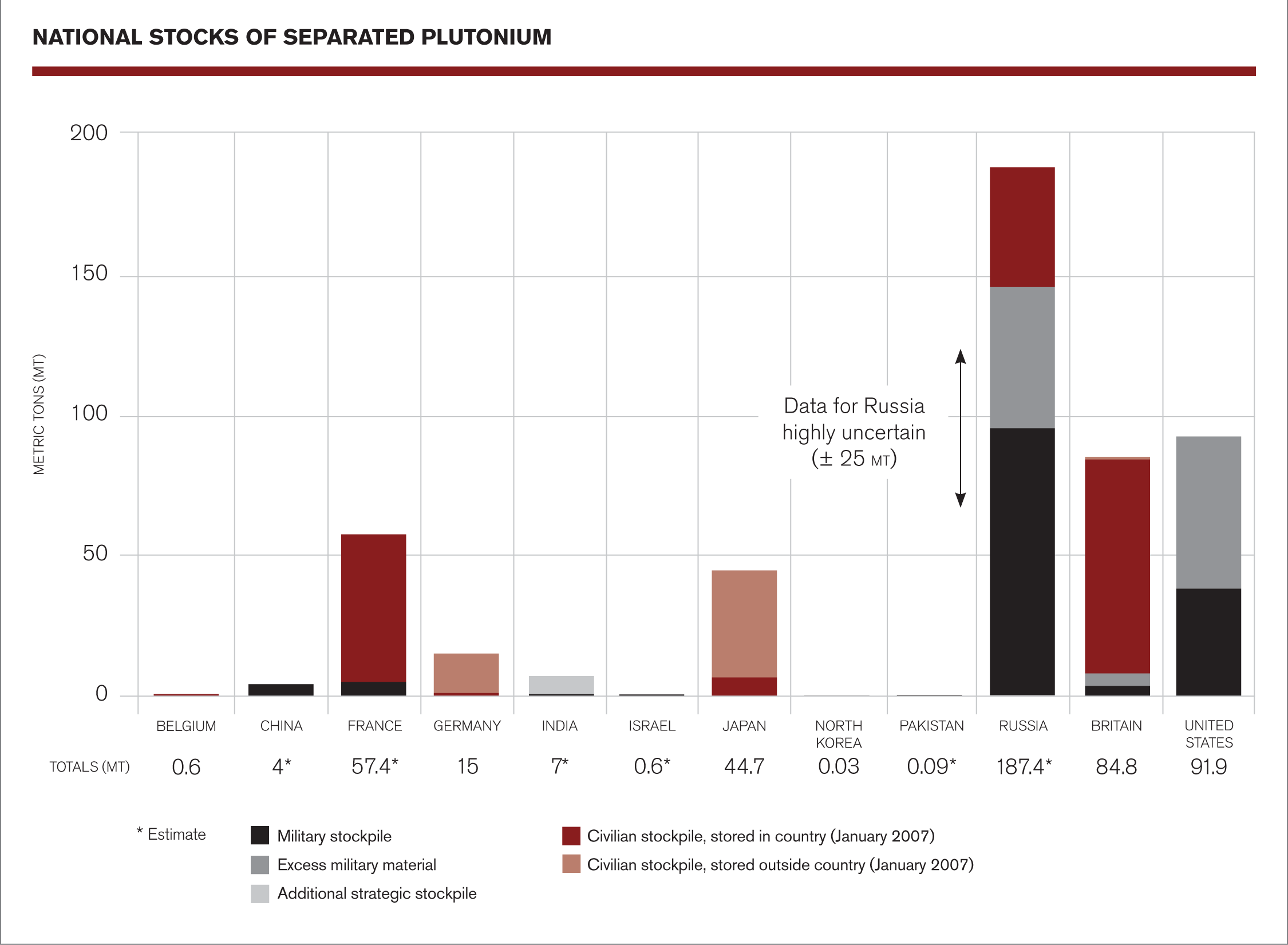
Russia and the United States possess by far the largest stocks of military plutonium, 120-170 tons and 92 tons, respectively. Russia has declared 34 tons, and potentially up to 50 tons, of its weapon-grade plutonium excess for weapon purposes. The United States has declared as excess 54 tons of separated government-owned plutonium. Despite the U.S.-Russian Plutonium Management and Disposition Agreement of 2000, which committed each country to the transparent and monitored disposition of 34 metric tons of weapon-grade plutonium, virtually none has so far been disposed of.
India's annual domestic uranium production has been falling short of the combined demand from its growing number of nuclear power, naval-propulsion, and plutonium-production reactors. In September 2008, under U.S. pressure, the 45-nation Nuclear Suppliers Group, which manages international nuclear trade, exempted India from the normal requirement of full-scope IAEA safeguards as a condition of access to the international market for uranium and nuclear technology. This will allow India to import uranium to make up the shortfall in supply and expand its nuclear energy program by purchasing reactors, while expanding its production of fissile material for nuclear weapons.7
The plutonium from foreign spent fuel, or equivalent British plutonium, will be returned to foreign clients as mixed oxide (MOX) fuel. Britain has not yet determined a strategy for disposition of the approximately 100 tons of plutonium that it will have separated from its domestic spent fuel.
Almost all of the foreign spent fuel under contract has been reprocessed, and only minor new contracts have been signed. The economic burden of reprocessing is increasingly of concern to Électricité de France, the national electric utility. As in Britain, reprocessing has left a large environmental and cleanup legacy.
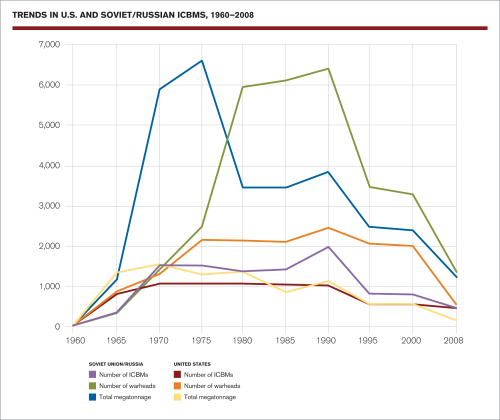
The United States and Russia have declared a fraction of their stocks as excess to their weapons requirements, but they still hold the bulk of the world's stock of both HEU and plutonium. Even with arsenals of 5,000 weapons each, the two countries could declare even more material excess. If they were to reduce their total warheads to 1,000 on either side, their fissile material stocks would be reduced about tenfold from current levels.
Large stocks of fissile materials, sufficient for many thousands of nuclear weapons, are currently designated for civilian or naval reactor use, and kept outside international safeguards. These stocks too may hamper prospects for deeper cuts, to levels of a few hundred warheads each, in U.S. and Russian arsenals, and be an obstacle to bringing states with smaller nuclear arsenals into the disarmament process.
The reduction and elimination of current fissile material stocks will also need an accompanying verifiable worldwide ban on the production of fissile materials for weapons.12 Many military fissile material production facilities have been shut down and some have been dismantled, others have been converted to civilian use. But new civilian uranium enrichment and plutonium separation facilities are being built in several states. The enrichment of uranium and the separation and use of plutonium, even under safeguarded civilian nuclear energy programs, provide states with a virtual nuclear weapons capacity and pose a major challenge for efforts to control fissile materials and for nuclear disarmament.
Footnotes
1.
International Panel on Fissile Material (IPFM), “Global Fissile
Material Report 2008,” September 2008,  . Some of the stockpile estimates
have been derived from previous estimates published in: David Albright, Frans
Berkhout, and William Walker, “Plutonium and Highly Enriched Uranium
1996,” Stockholm International Peace Research Institute, Oxford
University Press, 1997.
. Some of the stockpile estimates
have been derived from previous estimates published in: David Albright, Frans
Berkhout, and William Walker, “Plutonium and Highly Enriched Uranium
1996,” Stockholm International Peace Research Institute, Oxford
University Press, 1997.
2.
According to Mordecai Vanunu, Israel may have produced enriched uranium in limited quantities starting in 1979-1980, but information on this program is very limited. Frank Barnaby, The Invisible Bomb: The Nuclear Arms Race in the Middle East, (London: I. B. Tauris, 1989), p. 40.
3.
Henry Myers, “The Real Source of Israel's First Fissile Material,” Arms Control Today, October 2007, p. 56. Myers was on the staff of the House of Representatives Interior Committee that had the responsibility for overseeing the Nuclear Regulatory Commission when it investigated the Nuclear Materials and Equipment Corporation (NUMEC) matter in the late-1970s.
4.
Victor Gilinsky, “Israel's Bomb,” New York Review of Books, vol. 51, no. 8, May 13, 2004. From the same author, see also “Time For More NUMEC Information,” Arms Control Today, June 2008.
5.
Ole Reistad and Styrkaar Hustveit, “HEU Fuel Cycle Inventories and Progress on Global Minimization,” Nonproliferation Review, vol. 15, no. 2, July 2008.
6.
Ibid.
7.
8.
9.
10.
Data from INFCIRC/549 declarations to the International Atomic Energy Agency.
Projection for Germany from: M. Weis et al., atw, vol. 51, no.
12, 2006, pp. 793-796. Projection for Japan from: Tadahiro Katsuta and Tatsujiro
Suzuki, “Japan's Spent Fuel and Plutonium Management
Challenges,” IPFM Research Report No. 2, September 2006, .
11.
12.
In the Global Fissile Material Report 2008, the IPFM has proposed key elements for a verifiable Fissile Material Cutoff Treaty and provided technical arguments for how such a treaty could be verified by the IAEA. A companion volume, “Banning the Production of Fissile Materials for Nuclear Weapons: Country Perspectives on the Challenges to a Fissile Material (Cutoff) Treaty,” provides a country-by-country analysis of the concerns of key states to different aspects of a prospective Fissile Material Cutoff Treaty and proposes specific policy initiatives and compromises that states could make to break the logjam preventing negotiation on a treaty.