




Abstract

What may be one of the most important debates of the 21st century has been taking place just below the threshold of public perception. This debate concerns how much longer it will be before world oil production starts to fall, forcing a transition to other sources of energy and probably a simpler lifestyle.
From time to time, a spike in gasoline prices or an election forces aspects of this debate to the public's attention, and various solutions–more drilling, more wind turbines, more biofuels–are proposed. Most of these solutions fail to grapple with the real issue–that world oil production, according to the International Energy Agency (IEA), has been essentially flat for several years and will soon steadily and irreversibly decline. Few want to hear this message for it will mean the rapid and dramatic decline in the world's standard of living. In many of the underdeveloped megacities in Africa and Asia supplies of kerosene and propane for cooking already are in short supply or are becoming unaffordable. Sputtering hydroelectric stations affected by droughts and unaffordable $100-per-barrel oil are resulting in electricity shortages and failing water and sanitation systems. For many, the peaking of the world's oil supply will raise issues not just of living standards but of survival.
For the last 40 years, the United States, which has been largely insulated from the early tremors of oil depletion, has imported all the oil its population has needed with large trade deficits and the sale of U.S. Treasury bills to foreign countries. Real trouble, however, is not far away, according to peak oil theory. Sales of U.S.made automobiles are in free fall due to $4-per-gallon gasoline, and the U.S. airline industry is contracting rapidly.
The declining availability of oil products will mean steadily increasing prices for nearly everything else. As prices rise, the use of gasoline-powered automobiles, boats, all-terrain vehicles, and RVs will wane. Gradually, more and more people could be priced out of using their personal vehicles as freely as they do now.
Before we get too far ahead of ourselves, let's go back in history to understand where the idea of such a potentially dire future arose.
If you don't believe in the theory of evolution, then you are likely to believe that oil is abiotic and is constantly being formed and pushed up for our use from somewhere deep in the earth. For the rest of us, however, fossil fuels are understood to be composed of organic matter from organisms that lived hundreds of millions of years ago, which was buried and pushed deep underground by geological forces. Over the eons, that material was converted into oil, coal, and natural gas by high temperature and pressure. Peak oil starts with not only the question of how much fossil fuels were formed but also how much can realistically be extracted from beneath Earth's surface.
Hydrocarbons within the earth come in many forms, ranging from the desirable light, low-sulfur crude oils to heavy oils, tar sands, kerogen (sort of a “pre-oil” substance found in prodigious quantities inside shale), and finally natural gas and coal. Fossil fuels are also found in a wide variety of locations. Some are found on land, some deep beneath the sea, and some below polar ice. Much of the debate over the future of world oil production stems from a failure to appreciate that all oil is not created equal. Unfortunately, most of the high-quality, cheap, and easy-to-extract oil has already been consumed.
From the very beginning of the oil age, some 150 years ago, experts have predicted that it was about to run out. Until 50 years ago, such predictions were idle speculation, as most of the world had not been fully prospected and no one had a clear idea about how much oil existed. The first real insight was gained in 1956, when Shell Oil geologist M. King Hubbert calculated that U.S. oil production in the lower 48 states would peak in 1970. Hubbert, of course, had the benefit of studying a region that, by that time, had been fully explored so that major new oil finds were unlikely.
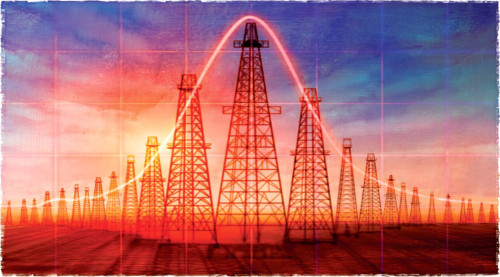
The heart of Hubbert's theory is the observation that the rate of oil production from a well or a field generally follows a bell-shaped curve and reaches peak production after about half of the oil has been extracted.
When U.S. oil production actually did peak when Hubbert predicted and the country's demand for oil continued to rise, the United States could no longer control world oil prices as it had done for many previous years. Power shifted to OPEC, the Mideast oil cartel, which had substantial oil, little domestic consumption, and the ability to control production and thereby prices.
In 1973, the world learned a new lesson about oil, which haunts us to this day, when OPEC exercised its power over the global oil market to enforce an embargo on Israel's supporters in the Yom Kippur War. U.S. imports of Arab oil dropped within two weeks from 1.2 million barrels per day to 19,000. The United States experienced nationwide gasoline shortages and the quadrupling of gasoline prices. Shortages also developed during the early days of the Iran-Iraq War, when supplies of oil were reduced.
Later, however, in the 1980s and 1990s oil experienced its golden years. New discoveries in Alaska, the North Sea, Mexico, and off the coasts of Africa and Brazil led to a surfeit of oil. Crude prices stayed around $20 a barrel and supplies were plentiful. World oil consumption grew rapidly from 58 million barrels per day in 1980 to 76 million in 2000. While the Soviet Union may have been done in by cheap oil in the late 1980s (oil was selling so cheaply that it was below the Soviets' cost of production), in the United States, plans for oil conservation and efficiency that were formulated during the oil shocks of the 1970s went by the wayside, and the country went on an oil binge that lasted for the next 25 years. Consumption increased and reliance on imported oil (and the countries that exert control over supply and thus price) increased as well. Today, nearly 70 percent of oil consumed daily in the United States is imported.
Warning bells began to sound again when an article by two respected European geologists, Colin Campbell and Jean Laherrère, appeared in the March 1998 issue of Scientific American indicating that the world was rapidly consuming its known oil reserves. Crude oil was being pumped out of the ground much faster than new oil was being discovered. The authors predicted oil peaking globally within 10 years.
The article's publication marks the beginning of the peak oil debates that continue to this day. Most criticism of peak oil has centered on the idea that increasing oil prices would bring forth new supplies from unconventional sources, such as the Alberta tar sands, long considered too expensive to extract and process into usable oil. Many have pointed to developing technologies such as horizontal drilling, 3-D seismology, and oil field flooding, which peak oil critics believe will bring so much new oil to market that prices will fall, providing plentiful supply for at least another 30-40 years. The U.S. National Geodetic Survey contributed to this belief by releasing a report that estimated another trillion barrels of conventional oil were waiting to be discovered and produced.
But an important part of this debate, often left out by such projections, is that oil these days is not always the black stuff that comes up from a well. Although traditional petroleum constitutes the bulk of what is called oil, there are also liquids that are extracted from natural gas, heavy oil that is extracted from tar sands, and biofuels that are produced by distilling sugars from plants and processing plant oils. While conventional crude oil and the liquids that condense out of the natural gas that comes out of the ground with the crude currently amount to about 74 million barrels per day, total oil production, which is also known as “all liquids,” amounts to 86 million.
For six years after Campbell and Laherrère's article not much happened. Oil production (of all liquids) climbed to about 80 million barrels per day in 2000 and then slipped back a couple of million barrels due to an economic downturn. Some thought they were witnessing the peak of world oil production in 2000, but this was not the case. After 2003, when oil production surged, peak oil doubters ridiculed those who had called the peak in 2000.
READING LIST
FOR MORE INFORMATION ON THE IDEAS AND ISSUES DISCUSSED IN THIS ESSAY, THE BULLETIN RECOMMENDS READING:
With the end of the recession in 2003, world oil production and prices began to climb rapidly. The inflation-adjusted price of oil had been steady at $20-$25 per barrel since the mid-1980s and had reached a low of $15 per barrel in 1998. From 2002, when oil was $26 per barrel, oil began a steady upward surge in both production and price. Crude went from an average of $30 per barrel in 2002 to a high of $147 in July 2007. World oil production (all liquids) climbed from 76 million barrels per day in 2002 to about 86 million in 2008.
By 2004, surging prices and consumption brought the issue of peak oil to wider attention. Blogs and websites on the subject began to proliferate (many blogs focusing on peak oil date from that year). New books foretold a very bleak future for the world without oil. Some were so apocalyptic in their pronouncements that their authors and peak oil adherents were labeled “doomers.”
This development moved the peak oil debate in a slightly different direction as the so-called doomers argued with the “techno-fixers,” those who believe that there are many alternate sources of energy, including nuclear, solar, wind, wave, and biofuel. For the doubters, peak oil is simply another item to be added to the list of possible, but improbable, dangers–cataclysmic comet strikes, thermonuclear war, and a super virus–that people should worry about, but not too much. Somewhere in all this uproar, which mostly took place online, the real issue of peak oil got lost. The question asked by peak oil is simply whether the world can produce enough new oil each year to keep up with falling production at older fields.
Peak oil is the last thing anyone really wants to hear or think about because it illustrates how humanity has blown through the planet's fossil fuel stores in a couple of centuries and that without these resources, life on Earth will become much rougher. Consider what happened to President Jimmy Carter some 30 years ago, when he told Americans to put on sweaters to deal with high fuel prices and was ridiculed for it. Few officials anywhere in the world will publicly say that worldwide oil production is nearing a peak, if that is truly the case, and that preparations should be made for this eventuality. Instead, U.S. politicians talk in circumlocutions, decrying the country's “addiction to oil” or touting a need for “energy independence.” The press is also culpable, for as yet few stories connect all the dots in the peak oil story. Most reporters and editors content themselves with focusing on high gasoline prices. Few in the Western media have noticed that many places in the underdeveloped world are already suffering power and cooking fuel shortages due to unaffordable oil.
So what is likely to happen? Has oil really peaked? Production of crude oil has basically been flat since 2005, according to the U.S. Energy Department and the IEA, which both track worldwide oil production. Occasionally a single month will set a slightly higher production record, but annual production figures are no longer climbing. Although the “other liquids” number is climbing a bit as the world increases its production of natural gas-derived liquids and biofuels, it is important to realize that many of these alternate sources of liquid fuel contain substantially less energy than conventional oil does, so adding other liquids to world crude oil production overstates the amount of energy available.
In the last year, high prices have led to reduced consumption in parts of the world. U.S. oil consumption is down nearly 5 percent according to Energy, and in the rest of the Organization for Economic Co-operation and Development (OECD) countries consumption is flat. Chinese and Indian consumption, however, continues to grow rapidly.
What started out many years ago as a geological theory has become a much simpler issue that is readily observable–can new oil production keep up with the depletion of existing reserves? In recent years, “megaprojects analysis,” a new way of approaching this issue, has attempted to answer this question.
Megaprojects analysis starts with an assessment of just how fast existing world oil fields are running dry. Ascertaining this information should be easy, but in many oil-producing countries depletion rates are a closely guarded state secret. Although there are many variables that determine the rate of oil depletion, such as oil field management and the use of water or gas flooding to force oil to the surface, the conservative consensus among oil watchers is that the rate is about 5 percent annually. This means that if no new projects begin producing oil in a given year, by the end of that year about 4 million fewer barrels per day will be produced. In short, the world's oil industry has to find 4 million barrels of new production each day, each year just to stay even, much less keep up with growing demand.
Yet most new production comes from giant, expensive projects that when fully operational produce no more than 50,000 barrels per day. Today such projects cost billions and take six to seven years to complete, hence the term “megaprojects.”
Megaprojects are too big and expensive for a country to hide, so periodic updates on their progress are available from public announcements and in the trade press. Even with all this information, predicting how much new oil production will come online per year is still more art than science. Multibillion-dollar project deadlines have a tendency to slip, sometimes by many years, both as to when they will start production and when they will reach their peak production goal. Due to such variables, just how much new oil production will come online in the next few years is open to debate.
Despite all the unknowns, a consensus seems to be emerging among those tracking megaprojects, most notably Chris Skrebowski, editor of the London-based Petroleum Review, and a mega-projects team connected to the peak oil blog The Oil Drum, that at sometime between 2010 and 2012, new oil production will not be sufficient to keep up with depletion and that world oil production will begin dropping.
The reduction in oil production will stretch over decades or more likely centuries. Once major conventional oil fields go into decline, it is unlikely that new fossil fuel extraction technologies will come along to reverse that trend. Trillions of barrels of hydrocarbons certainly are deposited in Alberta's tar sands, in Colorado's shale, in Venezuela's Orinoco heavy oil fields, and under the polar ice caps. While such “oil” can be exploited, the cost, time, and energy required to extract it will not keep up with the coming decline in conventional sources.
A decline in world oil production may also come from a lack of demand. The price of oil has been dropping for the last two months because the markets collectively believe that a major worldwide recession is coming. If the current economic difficulties are serious and long-lasting enough, the reduction in demand could mask the geological peaking of oil for many years. With the recent rapid growth of China and India, it is also possible that future Asian demand will be high enough to offset any drop in demand from OECD and underdeveloped countries.
A last important factor in the peak oil equation is that the major oil exporters are using more and more of their own oil domestically, so there is less available to sell. This is particularly true of the Middle East and Russia. Statistics from the IEA indicate that total world oil exports are beginning to decline; in 2007 they were down by 2.3 percent, or 1 million barrels per day. Mexico's exports are dropping rapidly due to a very high depletion rate at its largest oil field, so fast that Mexico may become a net oil importer within three or four years.
This year has, without a doubt, been an eventful one in the U.S. economy. Crude prices soared from below $100 per barrel to $147 in July and then fell back to below $100 a barrel in September. The ongoing U.S. mortgage crisis has turned into an economy-wide liquidity crisis and now a worldwide economic crisis. In September, a pair of hurricanes slowed U.S. oil production and refining, which resulted in gasoline shortages across the southeastern part of the country.
U.S. voter concern about high gasoline prices has transformed this year's presidential election into a search for painless energy solutions with proposals to increase drilling and the production of biofuels, increase taxes on oil companies, punish speculators, and build more nuclear plants.
Yet no one is seriously talking about the world's flattening oil production, the likelihood of declining oil imports, the near certainty of much higher gasoline prices, or how we adjust to a world without cheap, abundant oil.
Alternative, renewable energy sources–solar, wind, tides, and biofuels–as yet provide only a tiny fraction of our energy needs. As the peaking of world oil production becomes more and more evident, our society will have to get by with considerably less energy, particularly from oil, in the next few decades, until new energy technologies can be brought into production and energy efficient forms of existing technologies become more widely adopted.