




Abstract
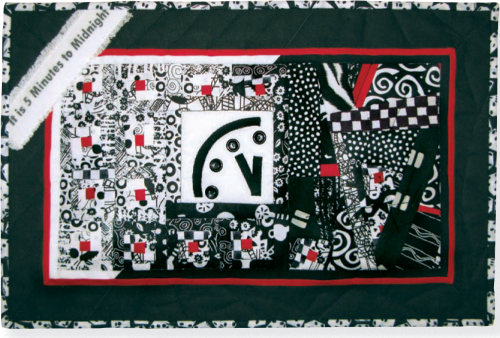
The Doomsday Clock has been many things to many people, but never the centerpiece of a quilt. Until now. Pam Collings, a member of the Sinnissippi Quilters Guild in Rockford, Illinois, featured the Clock as part of a project to interpret a public symbol using only black, white, and one other color.
It turns out that the Clock, with its ability to synthesize the complex global security picture, was an ideal subject for the quilt. “If you know anything about quilting you would recognize before midnight as being nice neat little log cabin blocks with the hearth [red center] clearly defined,” she explains. The area to the right of the Clock, her portrayal of after midnight, is a combination of black and white patterns combined in a more chaotic manner.
Collings loaned her creation to the Bulletin for display in a public meeting area that includes magazine covers from all 18 Clock changes since 1949 and original art from Clock designer Martyl.
Doomsday Clock inspires quilt design
PEOPLE
The Bulletin is pleased to welcome
Bierut is a partner at the international design firm Pentagram, where he works to create identity design, environmental graphic design, and editorial design solutions. Bierut has won hundreds of design awards, including the AIGA Medal.
Finkel is founder and president of Chicago-based Prism Capital, a venture capital firm. Finkel currently serves on the Boards of Artromick, Inc. and SterilMed, Inc. and is a founder and former chair of the Illinois Venture Capital Association.
Schnieder is a professor in the Department of Biological Sciences at Stanford University and a senior fellow at the school's Center for Environmental Science and Policy. Schneider has contributed in various capacities to the Intergovernmental Panel on Climate Change. His research interests include climate change and the impact of climate on food production.
Hansen, the director of NASA's Goddard Institute for Space Studies, is regarded as among the most influential voices on climate science worldwide. A physicist, Hansen first testified before Congress on the warming effect of accumulating greenhouse gases in Earth's atmosphere in 1988.
PROGRAMS
The Bulletin is pleased to announce the establishment of the
The Scorpio Rising Fund, a Chicago-based, donor-advised fund, has agreed to a $100,000 challenge pledge to help the Bulletin raise a total of $250,000 to fully fund the Simpson Collection. By late July the boards and staff had raised nearly $62,000 in matching gifts and pledges, many of which have come from Simpson's former students and colleagues. For additional information about contributing to the founding of the Simpson Collection, please contact Director of Development Kendal Gladish at 312.364.9710, ext. 17, or
On October 13 at Lincoln Center, the
Bulletin Publisher
Bulletin Governing Board Member
For further information about these events, please contact Development Associate Anji Harris at 312.364.9710, ext. 10, or
In short, no. Although many in the United States think so–despite technical evidence to the contrary.
Instead of lamenting record-high prices at the pump, the United States should impose taxes to keep them at such levels in hopes of breaking its reliance on gasoline and diesel
Although its populace has a severe, Chernobyl-induced nuclear allergy, the Belarusian government views nuclear power as the key to ending its energy woes.
The global plan for containing laboratory samples of poliovirus could hold the keys to securing a range of dangerous bacteria and viruses.
The program that turns Russian highly enriched uranium into U.S. electricity isn't as significant a boon to nonproliferation as advertised.
India may not be responsible for the high greenhouse gas emissions causing climate change, but that's no reason for New Delhi to cling to poor energy policies.
French president Nicolas Sarkozy is promising to sell nuclear power technology to any country that wants it–but how plausible is his offer?
Still coping with the residue from Soviet-era bioweapons programs, Central Asian scientists are using foreign assistance to improve their region's disease surveillance capabilities.
First, four U.S. policy elites surprisingly suggested that a nuclear-weapon-free world is attainable. Now, a foursome of prominent British policy makers have made a similar call.