




Abstract
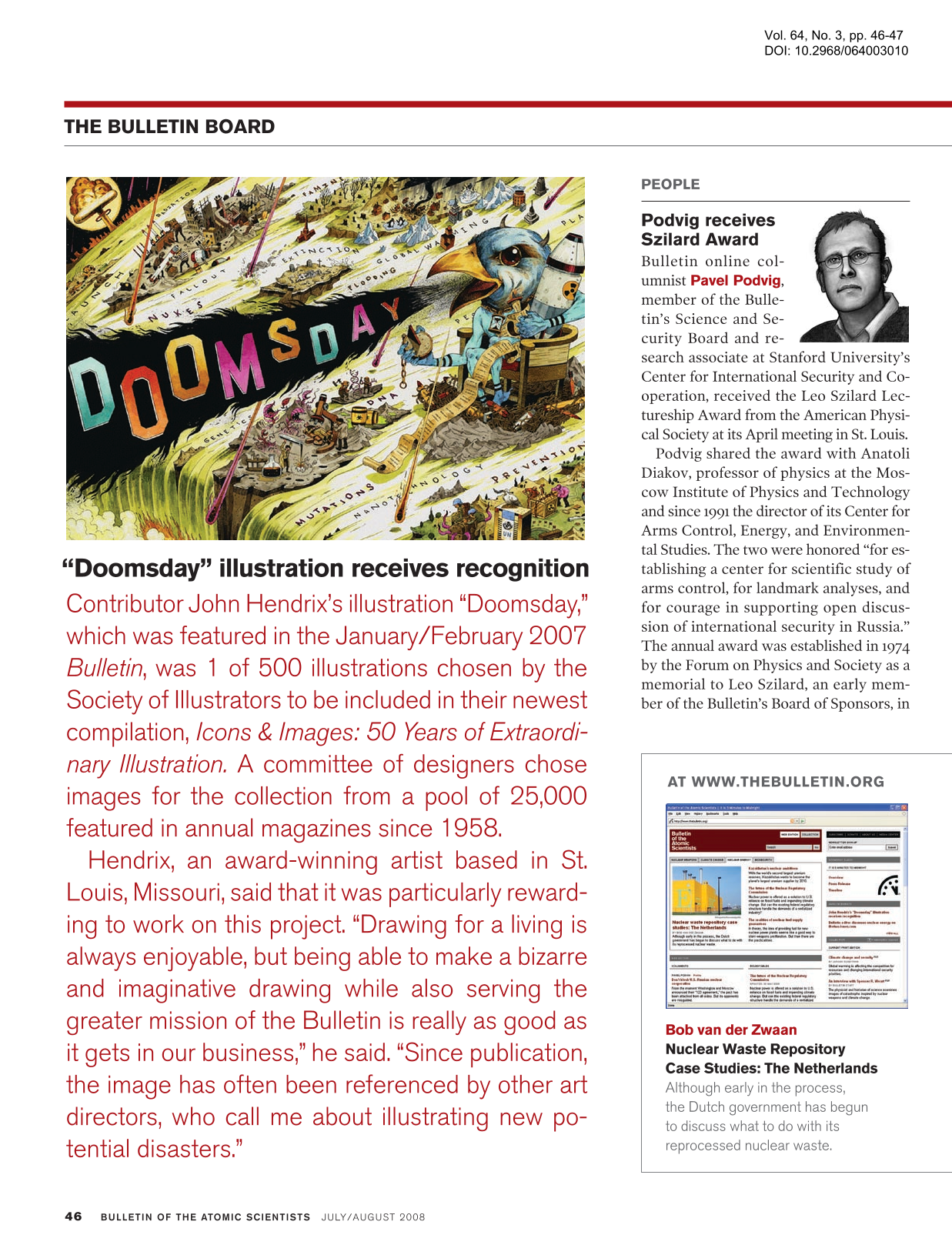
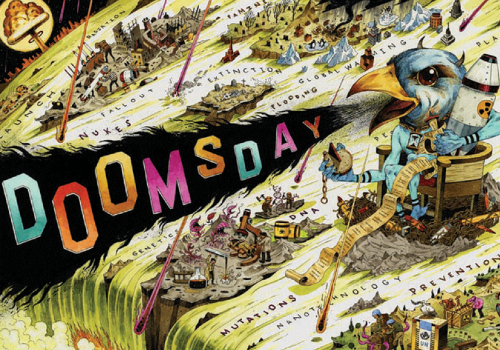
Contributor John Hendrix's illustration “Doomsday,” which was featured in the January/February 2007 Bulletin, was 1 of 500 illustrations chosen by the Society of Illustrators to be included in their newest compilation, Icons and Images: 50 Years of Extraordinary Illustration. A committee of designers chose images for the collection from a pool of 25,000 featured in annual magazines since 1958.
Hendrix, an award-winning artist based in St. Louis, Missouri, said that it was particularly rewarding to work on this project. “Drawing for a living is always enjoyable, but being able to make a bizarre and imaginative drawing while also serving the greater mission of the Bulletin is really as good as it gets in our business,” he said. “Since publication, the image has often been referenced by other art directors, who call me about illustrating new potential disasters.”
PEOPLE

Bulletin online columnist
AT WWW.THEBULLETIN.ORG
Although early in the process, the Dutch government has begun to discuss what to do with its reprocessed nuclear waste.
From the moment Washington and Moscow announced their “123 agreement,” the pact has been attacked from all sides. But its opponents are misguided.
States had the chance to combat the potential of novel, “nonlethal” chemical weapons, but tragically decided to wait until next time.
The renewed call for a nuclearweapon—free world is coming from an unlikely source—former policy elites.
Fearing wholesale regional insecurity, Iran's neighbors don't want to see Tehran develop nuclear weapons any more than the West.
Building synthetic pathogens may be the easiest way to spread certain diseases, but it wouldn't be easy.
Growing crops resistant to drought and disease sounds like a good idea, but the companies promoting them need to ensure that they're safe.
With the world's second largest uranium reserves, Kazakhstan wants to become the planet's largest uranium supplier by 2010.
For many in the GOP, the true test of their commitment to former President Ronald Reagan is how strongly they support national missile defense.
The Bulletin is pleased to welcome
McGarvie is the founder and president of Leadership for International Finance LLC, which provides global perspectives to U.S. and multinational companies in the consumer goods, financial services, and knowledge-based industries.
Socolow is a professor of mechanical and aerospace engineering at Princeton University and the codirector of the school's Carbon Mitigation Initiative. His current research focuses on global carbon management and the hydrogen economy.
Ramana is a senior fellow at the Centre for Interdisciplinary Studies in Environment and Development based in Bangalore, India, and works on issues relating to nuclear disarmament and the environmental impact of nuclear energy in India.
Glaser, a physicist, is a researcher at the Program on Science and Global Security at Princeton University and for the International Panel on Fissile Materials. His research interests include the nuclear fuel cycle and nuclear forensics.
Bulletin Publisher and Executive Director
In a January speech at the University of London, Benedict argued that citizens must have a say in nuclear weapons policy: “With more democracies in the world than ever before, with access to information about the most technical subjects available at our fingertips, and with no overwhelming military threats from other countries, citizens in the U.S. and Russia have no excuse for inaction.”
Greene, a professor of physics at Columbia University, observed in a June 1 New York Times essay, “When we look at the wealth of opportunities hovering on the horizon–stem cells, genomic sequencing, personalized medicine, longevity research, nanoscience, brain-machine interface, quantum computers, space technology–we realize how crucial it is to cultivate a general public that can engage with scientific issues.”
PROGRAMS
The submissions deadline for the third Ruth Adams Award is approaching. The award recognizes journalists–writers, web editors, and documentary producers–who translate complex issues of peace and security into everyday language and images. The award provides $7,000-$10,000 to one person for a specific project. Further details about the award and an online application are available at www.thebulletin.org.
This year's Adams Award winner,