




Abstract

The proliferation of cruise missiles equipped with nuclear, biological, or chemical warheads has become one of the central themes in U.S. threat projections and defense planning (not to mention in other nations' projections and plans). The proliferation of designs and technology for ballistic and cruise missiles “has raised the threat to the [United States] from WMD delivery systems to a critical threshold,” former Director of Central Intelligence George Tenet told the Senate Armed Services Committee in March 2002. By 2010, he predicted, land-attack cruise missiles (LACMs) “could pose a serious threat to not only our deployed forces, but possibly even the U.S. mainland.” 1 And the National Air and Space Intelligence Center predicted in 2006 that “at least nine foreign countries will be involved in LACM production during the next decade, and several of the LACM producers will make their missiles available for export.” 2
These sorts of statements are normal fare from intelligence agencies. Cruise missiles are in fact spreading to more countries–largely through sales or outright donations from allies–but whether they are being outfitted with WMD is a different question. (There is no universally accepted definition of a cruise missile, but they are typically powered by an air-breathing or rocket engine, generally guided for their entire flight, weaponized, and optimized for oneway missions.) 3 In the case of nuclear cruise missiles, it is hard to conclude that a “critical threshold” has arrived–nuclear cruise missiles are not proliferating beyond the known nuclear weapon states. In fact, over the past two decades, only China and Pakistan (and perhaps Israel) have made steps toward adding nuclear-capable cruise missiles to their arsenals.
Russia has seven (possibly nine) types of nuclear cruise missiles for delivery by aircraft, submarines, and surface ships–down from 15 types in the late 1980s–and it is developing a new air-delivered nuclear cruise missile, the KH-102.
The United States has three types of nuclear cruise missiles, with another on the drawing board, but reductions and retirements are on the way. The advanced cruise missile (ACM) will be retired in 2008, and the air-launched cruise missile (ALCM) inventory will be cut in half by 2012. The life-extension program for the W80-1 warheads aboard these missiles has been deferred, which could signal that the weapon systems may be retired within the next decade. The sea-launched cruise missile (SLCM) narrowly escaped retirement in 2003, but there have been no test flights in four years, and a missile that is stored ashore and not deployed on submarines is a candidate for retirement. The United States withdrew and eliminated its ground-launched cruise missiles as a result of the 1987 Intermediate-Range Nuclear Forces (INF) Treaty. The only new plans for U.S. cruise missiles involve the “Enhanced Cruise Missile,” for which new warhead concept studies are under way, though no decision has been announced to proceed.
The French cruise missile, the airsol moyenne portée (ASMP), was first deployed in 1986 and is carried by air force Mirage and navy Super Étendard aircraft. France, unlike the United States, Britain, and Russia, continues to deploy nuclear weapons on its aircraft carriers. An advanced ASMP-A is scheduled for deployment at the end of 2007 or in 2008, after which the ASMP will be retired.
China has at least one nuclear-capable cruise missile in development, designated the DH-10. The Pentagon stated in 2001 that China “produces several types of land-, sea-, and air-launched cruise missiles, which are potential means of delivery for NBC [nuclear, biological, and chemical] weapons.” 4 In 2005 the Defense Department described Chinese first- and second-generation LACMs under development as “conventionally armed” but added that there are “no technical bars to placing on these systems a nuclear payload, once developed.” 5 Air Force intelligence reported in March 2006 that a new Chinese cruise missile will be “conventional or nuclear.” 6 And in May 2007, Defense added that “new air- and ground-launched cruise missiles that could perform nuclear missions” will “improve the survivability and flexibility of China's nuclear forces.” First- and second-generation LACMs may be deployed in the near future, Defense said, for “stand-off, precision strike capability against hard targets.” 7
Pakistan has nearly completed development of what appears to be a reverse-engineered U.S. SLCM. Pakistani officials have stated that the missile, known as the Babur, can carry various kinds of warheads, including nuclear ones. U.S. Air Force intelligence credits the missile as “conventional or nuclear.” 8
Israel is widely rumored to have equipped one of its cruise missiles with a nuclear capability for deployment on new Dolphin-class diesel submarines. Speculation has focused on a naval version of the Popeye missile or the U.S.-supplied Harpoon, but Israeli officials strongly deny the rumors.
Nuclear cruise missile systems, then and now
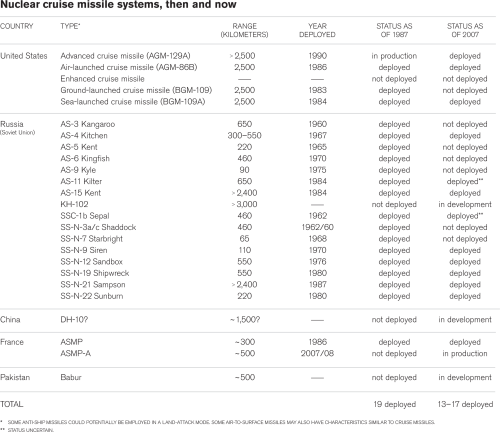
SOME ANTI-SHIP MISSILES COULD POTENTIALLY BE EMPLOYED IN A LAND-ATTACK MODE. SOME AIR-TO-SURFACE MISSILES MAY ALSO HAVE CHARACTERISTICS SIMILAR TO CRUISE MISSILES.
STATUS UNCERTAIN.
India is also rumored to be working on a nuclear SLCM, but its Sagarika, long thought to be an SLCM, is actually a ballistic missile.
The fact is that very few countries have tried to develop nuclear cruise missiles–and with mixed success. It is a significant technical challenge to develop a missile with sufficiently long range and accuracy to threaten another country, and another to miniaturize a nuclear warhead to fit inside the small diameter of a cruise missile.
Undaunted, there are those who argue for a cruise missile defense system by citing worst-case scenarios of a nuclear attack. One Pentagon concept study claims that defenses against cruise missiles “are likely to be a critical element of U.S. military capabilities in the future as adversaries obtain the capability to strike with increased precision, lethality (WMD), and long-range systems.” The report outlines a scenario that “starts with detection of a terrorist conversation (Adversary X) discussing plans to rapidly procure a portfolio of capabilities (computer network attack, WMD, ballistic and cruise missiles) aimed at inflicting mass casualties and economic disruption within U.S. borders.” 9 The acquisition of complex nuclear cruise missile technology by a terrorist cell, however, seems quite unlikely given the facts.
Supplementary Material
Ballistic and Cruise Missile Threat
Footnotes
1.

2.
3.
Christopher Bolkcom and Sharon Squassoni, “Cruise Missile Proliferation,” Congressional Research Service, July 3,2002, p. CRS-1, footnote 1. U.S. intelligence defines an LACM as “an unmanned, armed aerial vehicle designed to attack a fixed or mobile target. It spends the majority of its mission in leveled flight, as it flies a preprogrammed path toward its predetermined target.” NASIC, “Ballistic and Cruise Missile Threat,” p. 25.
4.
Defense Department, Office of the Secretary of Defense, “Proliferation: Threat and Response,” January 2001, p. 17.
5.
Defense Department, Office of the Secretary of Defense, “The Military Power of the People's Republic of China, 2005,” July 20,2005, p. 29.
6.
NASIC, “Ballistic and Cruise Missile Threat,” p. 26.
7.
Defense Department, Office of the Secretary of Defense, “The Military Power of the People's Republic of China, 2007,” May 25,2007, pp. 17,19.
8.
NASIC, “Ballistic and Cruise Missile Threat,” p. 26.
9.
Defense Department, “Deterrence Operations Joint Operating Concept,” Version 2.0, December 2006, pp. 37,62. Emphasis added.