




Abstract
Climate change challenges us to move beyond a culture that has reduced nature to yet another consumable.
Let me describe an experiment I performed once–not a very scientific experiment, but an extremely laborious one. I found what in 1990 was the largest cable television system on Earth, in Fairfax, Virginia. It had 100 channels, and I found 100 volunteers to tape for me everything that came across each of those channels for a 24-hour period. They shipped me a cardboard box with 2,400 hours of VHS tape, a day in the life of the information age, pre-internet. So, I went to Sears, bought a recliner, and settled in and watched, about eight hours a day for a year.
The results of that experiment became a book, The Age of Missing Information. It was filled with my sense of how the world would look to individuals if the TV were the main window through which they apprehended it (which, for a great many people, it is; we're the first generations to live a mostly mediated life, our experience predominantly prechewed). I wrote about how it affects our sense of time, sufficiency, history, and war. But if you had to boil down everything that came through that coaxial cable into a single idea, it would be this: You are at the center of everything, you sitting there on the couch with the remote control in your hand. You're the heaviest object in the known universe, and everything should orbit around you. Advertisers pander and cajole; entertainers truckle and flatter. Certainly, there is much mention on television of human shortcomings–but always with a product that can cure the problem. Basically, this Bud's for you.
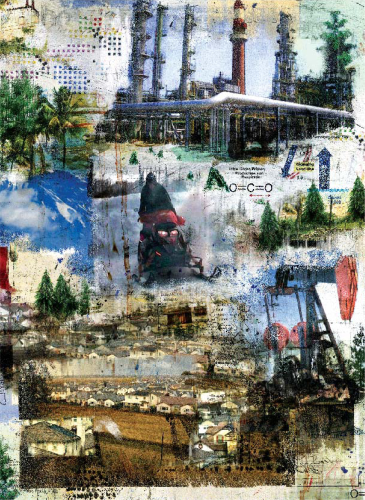
It's the same message that comes from every organ of our consumer culture. The suburb, for instance, the institution to which we've devoted the largest share of our economy for half a century, speaks by its very design to our isolation. In recent years, more and more upper-end houses come with a new design feature: dual master bedrooms. The husband snores, the wife steals the covers, and our solution is 900 square feet more house–and one final layer of hyperindividualism. We've gotten so used to the idea that our own individual selves should be the center of our lives that we've taken to calling it “human nature.”
Hence, it is easy to fear that we simply will not be able to rise to the challenge presented by our environmental dilemmas, which, after all, require us to think past ourselves. If we were serious about controlling carbon dioxide in the atmosphere, for instance, the first thing we would do is make carbon more expensive, either by directly taxing fossil fuel or by implementing some form of cap-and-trade system that would impose a less obvious tax. But that would require foregoing some consumption right now–we'd have less money to spend on ourselves. In some way, we'd be sending that cash into the future, making the investment that would allow the future to prosper at the slight expense of the present. That kind of sacrifice, some maintain, simply goes against the “human nature” I've described. As the late philosopher Norman Care once put it, “Certain familiar sorts of motivation are not available to support policies demanding serious sacrifice for the sake of future generations, and we may well be discouraged by the further apparent fact that the cultivation of a form of motivation directly supportive of such policies might require something close to an overhaul of main elements in the makeup of our society which influence the moral psychology of citizens.” In other words, we're stuck in the realm of what's in it for me?, and getting out of that realm would require some kind of soul transplant. I'm not an optimist by temperament. (I wrote the first book for a general audience on global warming, and called it, cheerfully, The End of Nature.) But on this question of human nature, it seems to me quite possible that we've mistaken our particular culture for the whole of humanity and, in so doing, have limited our sense of the possibilities for real change.
Anthropological evidence indicates that for almost all of human civilization, most people in most cultures have had something other than their own selves close to the center of their identity. That is, they understood themselves much more strongly in relation to something else than we do: their tribe or community, their God, the natural world around them. (A Native American tenet concerning the stewardship of land was, “In our every deliberation, we should consider the impact of our decisions on the next seven generations.”) And this sense of identity was useful in that it let them more easily place limits on their behavior; that is, if you really understand yourself to be a part of a community, then there are things you won't do because they harm that community. We've spent 500 years doing away with those limits in the “Western world–that's been the central theme of our ongoing project of “liberation,” and much of it has been good and useful. We've developed a strong sense of personhood, mobility, and freedom of thought and action; no one expects us to live in the same spot as our parents or follow the same career.
But in the United States in recent decades, we've gone further: As the most fully realized consumer society in history, we've defined ourselves almost entirely as individuals, without any limits on what we should want. Any call to group action is dismissed as interfering with economic growth, with our personal quest for more. Even in emergencies, we're urged to keep thinking of ourselves as atomized individuals. In the wake of 9/11, for instance, there was a bit of flag-waving and fellow-feeling, but President George W Bush's only real request was that we resume normal life, which he defined as returning to shopping.
But was that because a particular (powerful and largely nonpartisan) ideology has gained great sway in our society, or was it because of human nature? That's a key question, so perform this thought experiment. Say that President Bush, on September 12, 2001, had spoken to us from the Oval Office and said: “Job No. 1 is to catch Osama bin Laden. But job No. 2 is to make sure we're never in this situation again–that no future generation of Americans ever again is involved in the tortuous politics of places we don't understand simply because we need the oil beneath their sand. Beginning tomorrow, there will be a $1 tax on every gallon of gasoline pumped in the United States, and that money will be used to make sure every American is driving a plug-in hybrid car by the time I leave office.” Or say he'd taken the occasion of the horror that we felt in the wake of Hurricane Katrina to say: “Job No. 1 is to succor the victims of this tragedy. But job No. 2 is to try to lower the odds that these superstorms will become commonplace for our descendants. From now on, every ton of coal burned to power our lives will come with enough of a tax to make sure that when I leave office, there will be 10 million solar panels on the roofs of our houses.”
My guess is that there remains in us enough of the other facets of human nature–those predilections for community, for moral responsibility–that we would have responded. Not all of us: Peabody Coal and General Motors would have raised holy hell because their identities truly are only about the quarter ahead. But actual people are more complex than the model of homo economicus driven by utility-maximizing single-mindedness that economists have proffered in recent decades.
Where's my evidence? This is not an area subject to easy empirical proofs, but take this anecdote as one small sign: Earlier this year, a few of us decided that there wasn't enough political protest about climate change–that though polls showed that most Americans knew about the problem, little action was being taken in Washington because politicians perceived scant pressure. So we–and in this case “we” means me and six kids who had just graduated from Middle-bury College–launched a website on January 10, 2007. We asked people to organize rallies in their communities for April 14, rallies demanding that Congress pledge to cut carbon emissions 80 percent by 2050. That is, we were demanding that our leaders spend our money and our attention as a nation in the next half century trying to accomplish the energy transformation that science now tells us is our only hope for preventing completely catastrophic changes in Earth's condition. (James Hansen of NASA, our foremost climatologist, says his computer modeling gives us less than a decade to reverse the flow of carbon dioxide into the atmosphere before we're committed to the melting of the Greenland and West Antarctic ice sheets and, in his words, “a completely different planet.”)
We began this effort, which we called Stepitup07.org, with neither any money nor any organization–we didn't even have a mailing list. As a result, our expectations were low; we hoped we might organize 100 demonstrations, but that sounded grandiose, so we didn't tell anyone. Instead, twelve weeks later, on April 14, there were 1,400 demonstrations in all 50 states, one of the biggest days of grassroots environmental protest since the first Earth Day in 1970. It wasn't because of any organizational genius on our part–it was because all over the United States, people were in despair about climate change and looking for some kind of signal about what to do with that despair. Given a lead, they ran with it: Scuba divers organized underwater demonstrations off the endangered coral reefs of Key West, and skiers put together mass descents of the glaciated western slopes that won't be glaciated in a few decades' time. In Lower Manhattan, thousands of people in blue shirts formed a “sea of people” around the Battery showing where the new tide line would fall; in Jacksonville, Florida, they winched a yacht 20 feet into the air to show where the sea level was headed. On beaches and mountaintops, on church steps and in public parks, people came together and made enough noise that, in combination with new scientific reports and new Supreme Court rulings, started to put real pressure on the system. Within weeks, the leading Democratic presidential contenders had all endorsed carbon emission cuts of 80 percent by 2050, and legislation to that end was suddenly on a fast track in the House and Senate.
As the most fully realized consumer society in history we've defined ourselves almost entirely as individuals, without any limits on what we should want. Any call to group action is dismissed as interfering with economic growth, with our personal quest for more.
Large numbers of Americans, in other words, were clearly willing to put their own lives on hold for weeks to organize rallies and to advocate policies that would cost them in the short run; their actions were impressive enough that seasoned politicians were willing to start endorsing similar ideas, albeit less vigorously. Put differently, it is possible to envision a real effort for the future, even here in the United States. Much of the rest of the world has already taken similar steps: Europe has taxed energy highly for years, and as a result, they already use half as much per capita as we do. Yet they've adopted strong national plans to trim that usage further still even though they're starting to cut into muscle instead of fat. Even in China, where the stark and immediate pressures of poverty make it harder to think very far into the future, officials are adopting innovative policies: Their automobile mileage standards, for instance, are higher than ours.
There's no question that reducing carbon emissions will be a difficult task, in both engineering and political terms. The vested interests tied to the status quo in this country are enormous, and the momentum of economic development in much of the rest of the world is daunting. But to dismiss the possibility out of hand because human nature doesn't allow it is as useless as it is wrong. We will see what human nature is made of in the next couple of decades–we'll see, in some sense, whether higher intelligence and consciousness turn out to be adaptive or destructive. It's very clear that foresight is not our collective strength, and so we've waited until the last possible moment to act. But the question of whether we will act has not yet been decided–not by our genes, not by our evolutionary heritage. It's still an open and fascinating problem.
Supplementary Material
How Can We Avert Dangerous Climate Change?