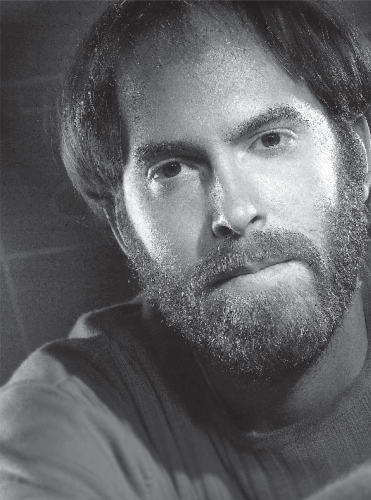
Life is full of risks. Buf one scienfisf confends fhaf life fueled by more
nuclear power is filled wifh fhe sorf of risks fhaf are insurmounfable and
unnecessary.
Born in Denver, Colorado, not far from the Rocky Flats nuclear facility, Brice Smith
graduated from Washington University in St. Louis and started concentrating on nuclear
issues while studying physics at MIT. “I became active in a student group
that wanted to find ways to make use of the advantages that we had been given with the
access to this education and to apply that scientific training to trying to address some
of the big issues that we saw facing the world. Energy was a big part of that and, as a
physicist, a kind of natural fit with what my training had been.”
After graduate school he joined the Institute for Energy and Environmental Research
(IEER). “That's where my real education in all of this
began,” he says. “I owe a great debt to Arjun Makhijani who runs
the institute and who was a tremendous teacher and mentor for me. He helped me develop
how I think about these issues.” Smith spent three years at the institute,
leaving after publishing Insurmountable Risks: The Dangers of Using Nuclear
Power to Combat Global Climate Change (Rdr Books, 2006). He is currently an
assistant professor of physics at the State University of New York at Cortland and a
senior consultant to IEER. He has appeared on “The Climate Code with Dr.
Heidi Cullen” which airs on the Weather Channel and has been invited to speak
about risk assessment and nuclear power at events across the United States and in
Europe. Managing Editor John Rezek spoke with Smith for the Bulletin.
BAS: What is the most persuasive argument against nuclear power?
SMITH: The risks associated with nuclear power are rivaled only by climate
change in the complexity and the difficulties that we have in dealing with them. There
are three classic risks of nuclear power: the link between the fuel cycle and nuclear
weapons proliferation, the issue of reactor accidents (which are unique in the energy
system because they are low probability but potentially extremely catastrophic), and the
disposal of nuclear waste (which is problematic because we don't have a good
way of understanding what it means to have a waste product whose peak risks occur
thousands, tens of thousands, or hundreds of thousands of years in the future).
“When you put those together along with the expense of nuclear power, it
makes a very risky technology overall.
BAS: Is nuclear energy a subject about which the public is singularly
unschooled?
SMITH: I wouldn't say that. The issues with nuclear power today
are not that dissimilar from those in the 1970s and 1980s. The main risks are very well
understood. The issues with Iran and the potential for the fuel cycle to lead to
proliferation are discussed quite a lot, as are some of the advantages of nuclear power.
But the issues take a long time to grasp in the necessary detail. And the risks of
nuclear power are difficult for anyone to understand. And that reflects itself in the
public debate.
BAS: Why is nuclear power enjoying such a renaissance and can it be boiled
down to the exigencies of climate change?
SMITH: I would question whether it is going through such a renaissance. A
nuclear facility is a large centralized power station that can make a lot of electricity
in one place–which is what the current grids are designed for–and
it has low CO2 emissions. Those two things together have led a lot of people
to consider what role it could play in mitigating climate change. But there's
a lot of hesitation to actually put the money on the table. The banks and the executives
from some of the nuclear industries are hesitant to go forward with the investment
without government guarantees. There have been demands for 100 percent loan guarantees
and regulatory insurance in case there are delays with the licensing procedure.
There's a lot of paper being generated but not a potential for a lot of
electricity yet.
BAS: Are there scientific reasons why a nuclear renaissance will not go
forward or do you think its future is entirely economic?
SMITH: It's not entirely economic, but it's also not
entirely technical either. There are a lot of political issues in this as well. At its
heart, nuclear weapons proliferation is a political issue as much as it is a scientific
issue. The technical facts are clear: Fuel cycle facilities–uranium
enrichment or reprocessing facilities–can be used both for nuclear power and
for nuclear weapons. And you'd need a fairly significant expansion of the
fuel cycle to fill even the future expectations for nuclear power. Can you make that
expansion tenable politically and geo-politically?
Nuclear power is going to run into several problems when you look at the nuts and bolts
of what it will take to expand nuclear power to 1,000 reactors by mid-century. How many
reprocessing facilities will you need? What do you do with the spent
fuel–which is a technical, economic, and political issue? We've
been working on the waste issue since its generation. The notion of mine repositories
goes back to 1957–yet no one's been able to implement this idea in
the real world. It's a very complex technical issue with lots of political
and economic components. The costs for the proposed site at Yucca Mountain, for
instance, have accelerated greatly so it's not clear what they will be when
and if a repository like that is ever constructed.
BAS: Let's assume we have enough nuclear engineers and highly
trained construction personnel to construct, by mid-century, the estimated 1,000 nuclear
power plants worldwide that would be needed to make a significant reduction in
CO2 emissions. Is that a realistic plan?
SMITH: One of the problems with nuclear power in terms of its role in
climate change is the speed with which these reductions need to be made. The reductions
that are made sooner have a proportionally bigger impact on stabilizing the climate.
Nuclear power plants take a very long time to build because of their complexity and the
parts that are required. It's been 25 years since we've had an
order for a power plant placed in this country that was actually filled and more than a
decade since the last plant came on line. A lot of the manufacturing infrastructure no
longer exists, or not at the level that might be necessary You'd have to ramp
that up or import it from overseas. How rapidly nuclear power could realistically ramp
up limits its ability to contribute.
BAS: Could you describe the alternatives to nuclear power in terms of their
efficacy and the speed with which they could be implemented?
SMITH: I'm really glad that you asked because it's the
most important question that is asked the least in a lot of these discussions.
We're not short of low CO2 alternatives. “What
we're short of is time and money. So, it's good to focus on where
best to put it. Arjun Makhijani has recently published an important study entitled
“Carbon-Free and Nuclear-Free: A Roadmap for U.S. Energy Policy”
that's a guide to a zero CO2 economy that does not include nuclear
power. It will be released as a book this fall.
Efficiency is the largest single thing that we can do and needs to be done regardless of
what supplies of energy we use. Massive improvements in efficiency can be made
residentially, commercially, and industrially. Not only in electricity production, which
is the main focus when we are talking about nuclear power, but in terms of heating and
transportation. “When you put these things together it can make a huge impact
on our carbon emissions. On the supply side there are numerous alternatives that are
ready or nearly ready for deployment that can be used in combination, such as
utility-scale wind farms, solar power at several different scales, pumped hydro and some
natural gas for stabilization and backup, and some types of sustainable biomass. The
list could go on.
BAS: If efficiency is such an immediate and no risk answer, why
hasn't it garnered more attention? Is there a program of efficiencies that is
scientifically agreed upon that can make a significant difference? If so,
what's stopping its implementation?
SMITH: There are a lot of efficiency technologies that are ready to go.
There are some others that are close, but not quite there. The focus on the supply
side–the idea that somehow we will build our way out of the problem by
building the supply rather than building ways to reduce the
demand–isn't helping. The demand reductions and efficiency
measures involve inherently more decentralized structures that will require having to
change the way homes are built, heated, cooled, and lit. That requires a different focus
than simply building another large centralized generation plant. Efficiency is best
appreciated from a systems point of view. The energy system is highly interconnected and
when you focus on nuclear power, you're carving off the electricity sector
and viewing it as an independent entity. There are a lot of places where the different
sectors of our energy system connect, and it is at those connections where efficiency
can have its most important effects. Consider how we heat our homes: Employing electric
earth-source heat pumps or direct solar thermal would displace natural gas, which could
then be used for generating electricity or for transportation. Plug-in hybrid cars are
very efficient, particularly for the kinds of commuting travel that represent a large
portion of car travel. Here you'd be increasing electricity consumption to
decrease oil consumption. And you do so in a very efficient way. But focusing just on
the electricity sector, you would view that as an increase in demand when
it's actually an efficiency improvement. We compartmentalize things, and
sometimes that can limit our ability to see the efficacy of some of these efficiency
measures.
BAS: Scientists disagree about the relevant risks of nuclear power as you
outlined them. Is the science that debatable?
SMITH: There are gaps in our scientific understanding, particularly about
reactor accidents and nuclear waste disposal. They're very complex
engineering and scientific questions that have to be addressed, and there are gaps in
our understanding that have to be filled as best we can. The uncertainties associated
with these calculations–particularly with reactor accident
risk–make them very difficult to deal with. It's what's
been called the zero-infinity problem. You have very low probabilities multiplied by
very high consequences, and therefore your result, which is typically referred to as the
risk, becomes dependent upon the specific assumptions you put in and how much faith you
have that your assumptions are correct. These probabilistic risk assessments, in spite
of their complexity, give you just a couple of numbers to work with.
But basically reactor safety boils down to three things. One is the issue of design
defects; your model is only as good as your ability to guess failure modes. Two, you
have to maintain aging parts which may not behave in the way you expect. And third is
the inherent unpredictability of humans–especially in an accident scenario
with lots of pressure. The seriousness of the accidents at Three Mile Island and
Chernobyl was exacerbated by decisions made by the human operators. If they had behaved
differently, those accidents could have evolved very differently.
BAS: Describe the risks that accompany nuclear waste storage at Yucca
Mountain.
SMITH: They're dependant on our ability to understand how the
waste will migrate through the geology. And we are relying very heavily on
human-engineered systems rather than natural geology. But even if you completely
understood the geology, after you carve a big hole to make your repository, how will
that engineered damage zone change the way things will migrate? The big uncertainty is
time. The Energy Department's projections for Yucca Mountain predict peak
radiation doses will occur hundreds of thousands of years in the future. But trying to
forecast what human population distributions will be like, what human behaviors and
exposure pathways will be like, and predicting how radionuclides will actually move over
timescales that are truly evolutionary in scale, introduced very significant
uncertainties in these calculations. From a strictly technical point of view,
it's very hard to have a great deal of confidence in some of these
assessments because of these uncertainties.
BAS: Do you think that there are scientists who believe science can solve
problems and scientists who believe that science is just a tool to investigate the
problems? There are certain scientists who talk about the possibility of nuclear energy
who seem extremely confident about the issues that you question, and there may be a
different orientation for how to use the science that is available.
SMITH: I'm not sure if I would characterize it that way. There is
perhaps a tendency in some to have a faith that any problem can be overcome by a
suitable effort and application in technology. Any problem we create, we can find a way
to get around it. As a scientist, I take as objective a look as I can and recognize
where I can't reach a conclusion, where the uncertainties could lead to a
very grave outcome. And then I ask myself: is this a necessary risk for us to take?
It's entirely possible that some of these issues are not going to be
significant and that everything will be better than projected. But if it's
not, what are the consequences? If it were necessary that nuclear power were absolutely
required to address climate change, I would have a much harder time and a much different
calculus to balance the risks of nuclear power against climate change. But given that it
will be difficult but possible to address climate change without relying on nuclear
power, trading the sort of large, hard-to-predict, potentially catastrophic consequences
of climate change for other large, hard-to-predict, potentially catastrophic
consequences of a large expansion of nuclear power, just doesn't make a lot
of sense to me.
BAS: Could we come to a moment where time runs out, where the risks become
less insurmountable, or where they simply must be accepted?
SMITH: Many alternative technologies will be ready within the next 10 years
for full-scale commercialization. So the less time we have the more attractive fast
options will become. Also the risks associated with a large expansion of nuclear
power–primarily nuclear weapons proliferation–are so severe and so
global in their implications. Iraq, North Korea, and Iran are good harbingers of things
to come. It would be hard to see the impacts of nuclear weapons proliferation as
acceptable compared to these viable alternatives.
BAS: There are many prominent anti-nuclear activists, Helen Caldicott for
one. What arguments for their cause are they not using?
SMITH: I have had the honor of working with a number of activists from
national and grass roots groups that oppose the development of nuclear power, such as
Caldicott's Nuclear Policy Research Institute, Public Citizen, the Southern
Alliance for Clean Energy, and others. Their arguments generally hit all the important
points mentioned above and many others I have not focused on.
One case where I would be in disagreement with some is over the issue of the
CO2 emissions from nuclear power. With current projections for the amount of
reasonable-grade uranium ore needed, the CO2 emissions from the type of
nuclear expansion that I'm talking about will be much lower than coal or
natural gas. So that's not really an issue. Others have argued that the
emissions will be significant, but on technical grounds, I do not believe this is a
strong argument for opposing new nuclear construction.
It's important to keep in mind that the public intervention process with
nuclear power has been very important for a number of reasons. It's actually
made some significant improvements to the safety of nuclear power plants.
It's not simply an adversarial point of view, the public intervention process
can be very important to catching things that may otherwise have gotten through. The
best example for that, of course, is when the Union of Concerned Scientists identified
problems with the emergency core cooling system for our nuclear reactors. That was an
important issue, given a public airing because of the public intervention process.
BAS: There are sensible advocates for nuclear energy. Are there some with
whom you can have a rewarding conversation?
SMITH: I can have a rewarding conversation with anyone who approaches these
issues with an open mind and wants to have a serious technical discussion. So far I
haven't run into many with whom I haven't been able to have that
kind of conversation.
BAS: When you have these open-minded conversations, do you find that you can
persuade people to think in a new way? Do you take away helpful things from these
conversations as well?
SMITH: Yes. Any time you have a discussion with different viewpoints you can
refine your arguments and take away things that they've seen that you maybe
have not seen. I've done a number of panel discussions on nuclear power where
a wide spectrum of opinions have been discussed, and I always take away quite a lot from
them. That kind of exchange occurs on both sides.
BAS: Do you recall a specific insight that made you hone or recast a thought
you might have had?
SMITH: Probably the most important example of that would be the issue of how
to talk about the differences between the three big risks of nuclear power (nuclear
weapons, nuclear waste, and nuclear accidents) and how those risks differ not just
quantitatively but also qualitatively from other parts of the energy system. Risks from
nuclear power don't fit very well into the quantitative risk assessment that
insurance companies, chief financial officers, and investors like to rely on, because
you have these low probability, high consequence events or these incredibly long
timescales with nuclear waste. It's more effective for me to talk about how
these risks don't fit well into our current structures of risk assessments,
being that they're different from the risks of driving a car or other daily
risks that are more amenable to quantitative analysis. How I speak about that has
definitely changed from my interchanges with people on the other side.
BAS: What insights have you brought to their understanding of the issues?
SMITH: I think I point out the political difficulties associated with having
to deal with the massive expansion of uranium enrichment that would be required to fuel
nuclear power growth. Also, for people who are used to thinking about risk assessments
strictly in terms of the numbers, I have been effective in encouraging them to think
more qualitatively about the character of the risks.
BAS: If you were in a debate pitted against a fervent nuclear advocate,
which compelling points would you try to make early on?
SMITH: The nuclear weapons issue is on the top of my list, because
it's a very large, very multi-faceted problem that is not likely to be
solved, certainly not in the current international or technical climate. Coming second
would be the fact that there are viable low-carbon alternatives to nuclear power, and
thus accepting the many risks of nuclear technology is not necessary to addressing the
risks of climate change.
BAS: Does the current nonproliferation regime effectively hinder the
expansion of nuclear power and the possibilities for proliferation among rogue or
non-state actors?
SMITH: It's not the current nonproliferation regime so much as
the existing nuclear weapon states' insistence to continue indefinitely
maintaining their nuclear weapons. The deadlock we have seen in the non-proliferation
treaty, in its review conferences and its preparatory conferences, has been this tension
between the nuclear weapon states, which want to maintain their weapons, and the
non-nuclear weapon states who say that they have the right to have access to these
fuel-cycle technologies for civilian use. The nuclear weapon states have the obligation
under the treaty to achieve nuclear disarmament, and if they're not living up
to their end, how can they dictate and take away non-nuclear states' access
to this technology?
That's the question being asked. It's that tension that makes the
problems insurmountable in the current climate. The only sustainable solution to that
problem would be if the nuclear weapon states began serious steps toward complete
nuclear disarmament. That would create a very different global climate, and it would
create very different situations for the risks associated with those technologies and
create a very different openness for dialogues. Barring dramatic steps such as those,
I'm not sure there are other reasonable possibilities for achieving any kind
of breakthrough.
BAS: Why do you suppose the subject of nuclear power is so polarizing? It
has become almost a political litmus test that evokes comparable reactions as
affirmative action and abortion do.
SMITH: There are probably many reasons, but one of them is the fact that
nuclear power and nuclear weapons are linked. For a long time the Atomic Energy
Commission oversaw both the development of weapons and the development of civilian
nuclear power, and the Energy Department still oversees the U.S. nuclear weapons
infrastructure and promotes and funds research on the nuclear power side. That
connection has made it a particularly emotional issue. Then there are the accidents at
Three Mile Island and Chernobyl, the latter of course being much more serious. The
consequences of the Chernobyl accident, as in many large-scale disasters, evoke a great
deal of emotion because they carry a very high cost both physically and psychologically.
BAS: Have you found that ideology often eclipses facts on both sides of the
debate about nuclear power?
SMITH: Not in the circles in which I have moved. Generally the people that I
have interacted with have been seriously interested in trying to do what they think is
best. They've generally been open to the facts. However, we might disagree on
what those facts are.
BAS: Is there an argument for nuclear power which is particularly arrogant
or irritating?
SMITH: Not to me. I personally don't find arguments irritating.
If it's a good argument, I'll want to study it and try to see
whether I need to change some of my opinions, and if it's not, I
don't pay it much heed.
BAS: Is it a reasonable assumption that the nuclear power industry has our
best interests at heart?
SMITH: The nuclear industry is not any more monolithic than any other
industry, but the nuclear utilities and the nuclear reactor manufacturers all have
different interests. Then you have the national labs which have different interests from
the other two. Businesses are about making money and making profits, and so their
interests lie naturally in that direction. Utilities are also service-oriented
institutions. I think it's too broad and heterogeneous a community to be able
to ascribe any single set of motives or emotions to them.
BAS: As a person with an informed scientific perspective, what advice would
you offer to others who wish to express their opposition to nuclear power? What are
current anti-nuclear advocates doing right and doing wrong?
SMITH: It's important to expand beyond the idea of just nuclear
power. Energy as a whole is a central issue, and there are a lot of people who have
options to reduce their own draw on the system not only by conservation but also through
their own supply. For example, many people can now afford residential solar or wind
systems with the aid of local and state incentives. It helps to bring energy visibly
into our communities and into the way we think about our daily interaction, and not
regard it as just something that comes out of the plug. I think a lot of people are
making those connections and recognizing that you have to address all these issues of
energy and the environment together, not just the nuclear piece. Given what we know
about climate change and equally what we don't know, what the uncertainties
are, it's very important to keep our eye on all of the balls.