




Abstract
Der Physiker der Mullahs (The Mullahs' Physicist), a film by Egmont R. Koch, broadcast on German PublicTelevision (WDR) on February 22, 2007.
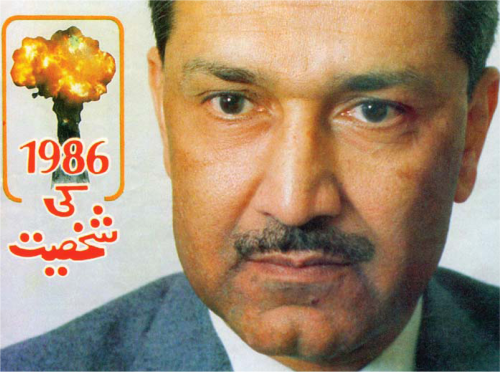
Open for business: A. Q. Kahn in a still from the documentary The Mullahs' Physicist.
Masud naraghi owns a small company specializing in vacuum technology in Orange County, New York. In his previous career, the 73-year-old physicist was in charge of acquiring equipment for Iran's uranium enrichment program. His dealings with the Abdul Qa-deer Khan network and his defection to the United States is the subject of a German Public Television (WDR) film documentary, The Mullahs' Physicist, by Egmont R. Koch, a veteran investigative journalist who has been interested in Pakistan's nuclear weapons program since the mid-1980s.
The Mullahs' Physicist examines the early stages of Iran's nuclear program, from 1985 to 1992. In the mid-1980s, Iran's leadership decided to acquire the technology for uranium enrichment. By that time, neighboring Pakistan had already mastered the process, and despite the unstable relationship between the two countries, officials from the two states held clandestine talks on nuclear cooperation. Pakistani scientist Abdul Qadeer Khan had paved the way to the Bomb for his country by secretly acquiring blueprints for gas ultra-centrifuges from his employer, the European uranium enrichment consortium Urenco. With these plans, and a small network of trusted friends in Europe helping him purchase equipment from various companies and exporting it to his country, Khan was able to open an enrichment facility in Kahuta, a small town near Islamabad. By 1984 at the latest, this facility had produced enough highly enriched uranium for a nuclear weapon.
In his film, Koch reports that, in parallel to the official talks between Iran and Pakistan, members of the Khan network started their own business with Iran. From 1985, Heinz Mebus, a German engineer and former colleague of Khan at Urenco, negotiated (appar-endy on Khan's behalf) with Iranian officials. Khan and his partners had realized that the material they had in their possession–blueprints of machines and facilities, and the industry contacts necessary for acquiring functioning equipment–constituted a valuable package, and they were willing to sell it.
Koch's film identifies the Iranian individual in charge of these negotiations: Masud Naraghi. A U.S.-trained PhD in laser physics, Naraghi had returned home in the 1970s. By 1985, he was a high-ranking official in Iran's nuclear program. Olli Heinonen, deputy director general of the International Atomic Energy Agency (IAEA) and responsible for the agency's investigation into Khan's activities, confirms Naraghi's role in an interview for the film. Heinonen describes him as the “project leader” for Iran's enrichment program. Koch reports about Naraghi's trips to Europe in the mid-1980s, during which he met key figures of Khan's network. Among the companies Naraghi visited was Cologne-based Leybold-Heraeus (LH), a leading manufacturer of vacuum technology that had been prominently involved in equipping Pakistan's nuclear program from 1977 onward. There, he came in contact with Got-thard Lerch, an engineer and manager with LH who was involved in the company's Pakistan business. Lerch was to become one of the central actors in Khan's proliferation network, allegedly playing a leading role in its later dealings with Libya. By the end of 1985, Lerch left LH and founded his own company in Switzerland. Thereafter, the negotiations between Iran and the Khan network occurred in Switzerland.
The deal between the two sides was closed in 1987 at a hotel suite in Dubai, in the presence of both Mebus and Naraghi, as Koch reports. In the film, Heinonen explains that the Iranians got reliable “specifications and drawings, and manufacturing instructions for the equipment” from the network. They also received a list of companies that could manufacture the parts. According to Koch, the Iranians paid $8 million for the package, with the largest single share of the money going to Gotthard Lerch.
Koch presents a “master plan” for a uranium enrichment facility that was later found in Lerch's office in Switzerland. This outline, says Koch, is an original Urenco plan with modifications indicating a setup for high enrichment, i.e. weapon grade, instead of low enrichment, for reactor fuel. Koch suggests that this blueprint may have been part of the package sold in Dubai.
However, even with the material the Khan network provided, the Iranians made little progress with their enrichment program. According to Koch, Naraghi led the Iranian project to an impasse and lost his responsibilities in 1992. Later that year, he walked into the U.S. Embassy in Bern, Switzerland, and was flown to the United States with his family.
On February 1, 1993, the U.S. Joint Atomic Energy Intelligence Committee (JAEIC) issued the secret report “Iran's Nuclear Program: Building a Weapons Capability,” which, Koch conjectures, was based on Naraghi's debriefing by the CIA. So, did U.S. intelligence know that Iran's nascent nuclear program was intended to produce a weapons capability? If yes, why didn't the U.S. government act more decisively at that point? And why was the information not shared with the IAEA? Koch's main charge in this film is voiced through David Albright, the president of the Institute for Science and International Security: “If the IAEA had this information back in 1992, 1993, 1994, they could have moved aggressively against Iran and in a sense open up the program as they finally did in 2002, 2003. But the information that the inspectors got was largely useless or bad. So, information was held back from the IAEA, and that put them in a position that they couldn't uncover the Iranian program.”
Did U.S. intelligence know that Iran's nascent nuclear program was intended to produce a weapons capability? If yes, why didn't the U.S. government act more decisively at that point? And why was the information not shared with the IAEA?
Instead, the United States focused its efforts at the time on convincing the Russians and Chinese to cease their nuclear cooperation with Iran. Reports of exchanges of nuclear engineers between Russia and Iran culminated in 1995, when the two countries signed an agreement under which the Russians were to finish construction of the Bushehr nuclear reactor. In addition, Russia was to build a complete enrichment plant in Iran. The latter deal was prevented due to U.S. diplomatic efforts, which involved providing Russia with a detailed intelligence report on Iran's efforts to acquire equipment for a nuclear weapons program.
China, on the other hand, had secretly sold uranium ore to Iran in 1991, began constructing a conversion plant in Isfahan, and planned to deliver a reactor to Iran. Here, too, U.S. pressure finally led China to discontinue support for Iran's nuclear activities.
In the context of the Clinton administration's efforts toward Russia and China, it appears indeed remarkable that the United States was not able to provide the IAEA with the kind of actionable intelligence that was needed to “open up Iran's program,” as Albright puts it. It so happened that the Iranians went back to the Khan network in 1993 to begin procuring components for about 500 centrifuges of the older P-l type, as well as designs for the more advanced model P-2 centrifuge. These shipments then gave a boost to Iran's clandestine enrichment program.
Koch's conclusion that the lack of U.S. cooperation with the IAEA in 1993 was key to Iran's ultimate successes relies largely on the content of the JAEIC report, which is classified as secret to this day. The issue requires further study. However, if Naraghi's debriefing did give the CIA specific knowledge about Iran's dealings with the Khan network, then one cannot but deplore that lost opportunity. An early and credibly supported revelation of Iran's nuclear intentions could have prevented the situation we are in now. At the same time, it could have dealt a major blow to the Khan network in its nascent period, when it was transforming itself into an “export network” rather than supplying just Pakistan with nuclear equipment. Recall that most of the damage inflicted by Khan and his companions was done after 1992.
Koch's film leaves the viewer with the question of why the CIA withheld the results of Naraghi's debriefing from the IAEA. Was it because the incoming Clinton administration did not have enough trust in the IAEA's role and effectiveness? And why did the United States not maintain a higher level of alertness with respect to Khan's activities upon learning of the Pakistani-Iranian cooperation? That at least some of the details were known was recently confirmed by Robert Einhorn, then a senior State Department official, in the book Shopping for Bombs by Gordon Corera. According to Einhorn, however, this connection was assumed “not to be a significant factor.”
Egmont R. Koch's film is well-written and, with the important questions he raises, a valuable journalistic contribution. It benefits from Koch's long familiarity with the subject, which is also well-documented in his recent book Deadly Plans: How the Atomic Bomb Got into the Wrong Hands.