




Abstract
“Arms Control and Nonproliferation: A Catalog of Treaties and Agreements,” Congressional Research Service, January 29, 2007.
Nonproliferation has become a tool of antiterrorism policy, which, in some ways, may diminish its role as a tool of international security policy.” Such assertive, critical statements are rarely found in Congressional Research Service (CRS) reports, nonpartisan assessments produced by the Library of Congress. But the recently published report “Arms Control and Nonproliferation: A Catalog of Treaties and Agreements” lands a few punches with its frank, although at times uneven, overview of President George W. Bush's non-proliferation record.
As the title of the report suggests, it is first and foremost a concise history and overview of the various treaties, agreements, and other measures–unilateral, bilateral, and multilateral–that comprise the global nonproliferation regime. The report spans from the creation of the International Atomic Energy Agency in 1957 to such present-day innovations as the Proliferation Security Initiative (PSI). Experts and neophytes alike will find it a useful one-stop shop for facts, figures, and dates.
The report also serves as an early postmortem of the Bush administration's arms control record, which is controversial and still developing (especially given that the crises in Iran and North Korea remain unresolved). However, it is possible after nearly eight years to draw some initial conclusions about the White House's approaches toward arms control–many of which, as the CRS report points out, break with past precedents.
The report correctly identifies two widely agreed tenets of the Bush administration's nonproliferation strategy. The first is that the White House prefers “a far less formal approach [to nonproliferation policy], with voluntary guidelines and voluntary participation replacing treaties and multilateral conventions.” One example is President Bush's February 2004 proposal that the Nuclear Suppliers Group (NSG)–an informal consortium of nuclear-technology exporters who cooperate on national export controls–deny a country access to reprocessing or enrichment technology unless it already possesses it. The idea was a clumsy proposal that struck many countries as an effort by the nuclear “haves” to exclude the nuclear “have-nots.”
The second observation is that the Bush administration has shifted the focal point of nonproliferation policy from weapons to actors “that the United States believes can threaten U.S. or international security.” In other words, nukes don't kill people; people kill people. Thus, the United States vigorously opposes Iran's effort to develop uranium enrichment and plutonium reprocessing capabilities but pours political capital into advancing U.S.-Indian civilian nuclear cooperation.
These observations are true but incomplete. Few would dispute the Bush administration's preference for informal modes of cooperation, and the report strongly hints that this preference is misguided; it is better to have collective agreement on a set of rules than a patchwork of agreements. But it is not always possible to achieve universality on robust rules. This is why, for instance, a faction of parties to the Nuclear Non-Proliferation Treaty (NPT) banded together to create the NSG following India's 1974 test of a “peaceful” nuclear explosive it had built using diverted civilian technology.
Taken together, the report suggests that these trends have subsumed non-proliferation into the broader strategy of the administration's global war on terrorism. In this regard, the report goes too far. There is nothing inherent in most of the administration's nonproliferation measures that makes them solely, or even primarily, tools of anti-terrorism policy. Consider, for instance, the PSI, an informal consortium of nations that authorizes sea-borne interdiction of ships suspected of transporting unconventional weapons and materials. Under PSI, the 2003 interdiction of the ship BBC China found centrifuge parts bound for Libya and helped break the A. Q. Khan nuclear smuggling network. Meanwhile, measures that focus on non-state-sponsored terrorism–such as U.N. Security Council Resolution 1540, which obliges nations to take “appropriate effective” actions to restrict the spread of dangerous technologies and materials–will also erect barriers to state actors bent on acquiring unconventional weapons.
The more accurate description of the Bush strategy–particularly during the first term–is that nonproliferation policy and antiterrorism policy are both tools of a broader, more ambitious strategy of regime change. The Bush administration continually invoked the specter of Saddam Hussein transferring nuclear weapons to terrorists to justify the invasion of Iraq, even though the Iraqi leader had no connection to Al Qaeda and no viable nuclear weapons program.
This strategy, however, has failed–proliferation problems have worsened nearly across the board. This failure can be attributed to willful ignorance of a key historical lesson: the critical importance of security in a state's decision about whether to go nuclear. As veteran nonproliferation expert Lewis Dunn recently observed, nonproliferation policy during the Cold War often free-rode on U.S. Cold War alliance policy. Most of the major nonproliferation victories of the Cold War–namely, the prevention of proliferation outbreaks in Europe and East Asia–were achieved in significant part by extending the U.S. nuclear umbrella to jittery allies.
The NPT helped consolidate these victories. For most U.S. allies, however, the new nonproliferation norm had to be underwritten by enduring U.S. military and political commitments. Indeed, in some historical cases, such as South Korea and Taiwan, the United States even threatened to withdraw its security commitment unless the ally abandoned its nuclear plans. In essence, as part of a comprehensive strategy to develop a norm against proliferation, the United States used security guarantees as both a carrot and a stick to prevent its allies from going nuclear.
“We call this one ‘The Regime Changer.’”

By contrast, most cases of horizontal proliferation among other nations have happened largely outside the confines of the U.S.-led Cold War alliance structure. China's nuclear weapons program prompted India to seek the bomb; India's efforts inspired Pakistan's. Brazil influenced Argentina's nuclear ambitions and vice versa. South Africa developed nuclear weapons because it feared that the West would abandon it to its hostile neighborhood. Israel sought nuclear weapons in response to regional threats. In these and other instances, U.S. security carrots and sticks were either unavailable or not credible to the target states.
The Bush administration came into office determined to press a harder line against foreign adversaries, specifically Iraq, Iran, and North Korea. Carrots and sticks were deemed the old way of doing business. White House officials believed that these countries were fragile and could be threatened or squeezed into capitulation or outright collapse; granting them concessionary incentives for disarmament, in their view, amounted to appeasement. In the aftermath of 9/11, that determination morphed into the doctrine of preventive war, culminating in the spring 2003 invasion of Iraq.
Insofar as this strategy was intended to scare Iran and North Korea, it appears to have worked. The Iraq War, combined with the Bush administration's bellicose rhetoric, gave these countries every reason to value their nuclear programs even more. And during the last few years, those programs have advanced considerably.
The Bush administration, meanwhile, has struggled to identify countervailing incentives and disincentives. Regime change is no longer credible, given the worsening situation in Iraq. And while the United States can squeeze regimes, it cannot snuff them out without the help of partners, such as China and Russia. These countries, however, reject the regime-change strategy.
The United States must develop a more nuanced strategy for managing and countering the demand side of nuclear weaponry among adversaries and allies, as well as the supply side. Fortunately, there appears to be a demand-side renaissance among nonproliferation specialists. Creative experts and scholars are revisiting historical cases of countries that have eliminated or constrained their nuclear programs to gain a higher-resolution understanding of what drives proliferation, with an eye toward developing new strategies to counteract these drivers. The February 13, 2007 deal cut in Beijing with North Korea is a hopeful sign that the Bush administration has come to grips with this historical insight.
The CRS report is an informative, useful piece of work for both experts and nonexperts, even if its analytic conclusions are uneven. Reviewing the long record of accomplishments that the report documents, one cannot help but feel impressed by the many successes of the global nonproliferation regime.
Yet those very same successes compel one to contemplate the lost opportunities of the last few years. The “White House's failure to let diplomatic initiatives run their course helped lead to a disastrous war in Iraq. The breakthrough deal with North Korea could have been achieved years earlier had the administration not consistently refused meaningful negotiations with Pyongyang. And any interest that Iran may have in negotiating away its nuclear fuel programs has greatly diminished during the last three years. The twin threats of nuclear proliferation and terrorism could have compelled the White House to strengthen existing norms, such as pushing for ratification of the Comprehensive Test Ban Treaty. Unfortunately, we will never know if a more competent administration could have used that moment of global unity after 9/11 to inspire a renewed international commitment to preventing the spread of nuclear weapons, materials, and technology.
JOURNAL ROUND-UP
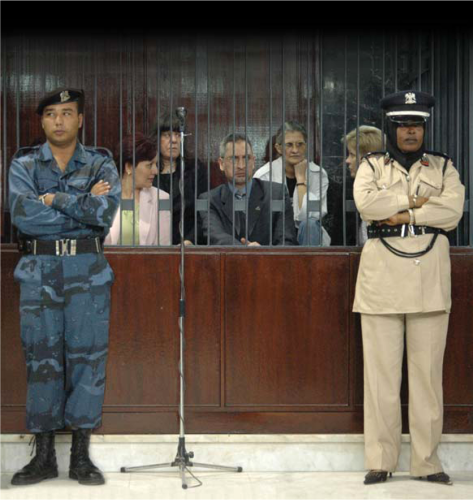
Undue process: Guards flank accused medical workers at a Libyan court in Tripoli.
Prosecution complex
Eight years ago, Libyan authorities imprisoned one Palestinian and six Bulgarian medical workers on the charge of deliberately infecting more than 400 children with the HIV/AIDS virus at a pediatric hospital. Despite expert testimony that, in fact, poor hygiene and ineffective sterilization procedures were responsible for the tragedy, six of the defendants were sentenced to death at a 2004 trial; and again at a 2006 retrial. The verdict prompted protests from governments, human rights organizations, and public health agencies.
Writing in
The strategy is low-risk, Ronen concludes, since massive foreign investment into Libya has tempered the outrage of the international community. Meanwhile, as the fate of the medical workers remains unresolved, Qaddafi has once again “emerged phoenix-like from a potential domestic and international crisis.”

Supplementary Material
Arms Control and Nonproliferation: A Catalog of Treaties and Agreements