




Abstract
The Nuclear Borderlands: The Manhattan Project in Post-Cold War New Mexico, by Joseph Masco, Princeton University Press, 438 pages, 2006, $24.95.
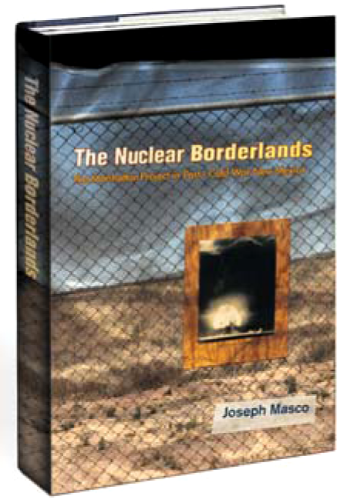
To call Joseph Masco's The Nuclear Borderlands daunting would be an understatement. Scholars of literature, intellectual history, and cultural studies will recognize the multiple theoretical frameworks that Masco calls upon: post-Freudian analysis (“the uncanny”); post-structuralist ethnography via Foucault (“regimes of knowledge”); post-Marxist theoretics (“cultural economies”); and, perhaps most importantly, post-Frankfurt School reconstitutions of Walter Benjamin's never-completed Arcades Project–his vast collection of writings on nineteenth-century cultural life in Paris. Each of these has its own language, grammar, shorthand, vernacular, even slang. Masco's quickness to move among these makes his work difficult even for a member of the post-structuralist humanities to understand.
Masco's earnestness, sincerity, and commitment to these theoretics is not quixotic, opportunistic, or shallow. Rather, they reflect the urgency he feels about the very nature of his subject. Masco is one of a handful of thinkers and writers who takes seriously the notion that the advent of atomic weapons utterly changed the world–not simply in its physical makeup but in the way it is seen, the way it infects and transforms political and ideological strategy, but everyday life as well, bringing a sort of mutation that renders the otherwise significant pale or inconsequential, while investing other events or circumstances with an inappropriate ominousness, even doom. Why is the post-Hiroshima world so bound up in doomsday thinking, and concomitantly so obdurate in denying, forgetting, or explaining away the immediate and long-term consequences of the atomic-weapons project?
Historians of the atomic age, most notably Paul Boyer and Spencer “Weart, (but also William Chaloupka, Allen M. Winkler, and Janet Bailey), have delineated this process with greater precision and clarity than does Masco. However, Masco proposes that oblique, interrupted, and discontinuous strategies of analysis are more appropriate to the underlying issues–that lining things up in rational order erases the particular logic of this atomic culture, thus requiring ethnographic strategies for its investigation.
Let's start with what the book is not. It is not a history, because it refuses the seamless narrative that characterizes the historical enterprise. The book moves back and forth among noteworthy events, ethnic and racial heritages, local, national, and global histories. Comparing it to the ease, momentum, and even suspense found in Richard Rhodes' standard popular history of atomic weapons, The Making of the Atomic Bomb, one may find Masco's method frustrating. But those who know Rhodes' work well know that his research was shallow, his moral sensibility thin, and his narrative hyperbolic, even histrionic, fitting for a television documentary. The popularity of his work only supports Masco's proposal that we grasp for tools to render the terrifyingly apocalyptic disarmingly logical and familiar.
By contrast, the work that Masco does, and demands that his readers do, seems more fitting to the significance of the subject. Masco's writing has combined the research strategies of multiple disciplines. Historical archives are not his mining-grounds, but the many research reports and publications of various government agencies are fully represented. In addition, the ethnographer's tools of participant-observer research are evident in the photographs he's used, in the interviews he's done, in the meetings, rallies, parades, and “information sessions” he has frequented.
Yet this is not an ethnographic work as, say, an anthropologist like Clifford Geertz would know it. Masco's strategy is often to cite a passage from a report, a segment of an interview, an impassioned speech, a doleful recollection or a passionate self-justification; then he mines it, with the tools of literary and anthropological analysis, psychoanalytic work, and deconstructive theory. Often he repeats a telling phrase from the passage in question, then disassembles its meanings. Sometimes this is frustrating, for he rarely completes the process by giving a satisfying summation; rather he seems almost to meander off the path, tread a thicket, and emerge on an entirely different route.
This isn't uncontrolled wandering. Early on, Masco proposes that the true subject of his study, and the true core of the atomic and nuclear culture, is to be found by studying an essay by Freud on the unheim-lich, commonly translated as “the uncanny.” One of Freud's excursions into literary criticism, this essay has found currency in contemporary literary theory, and so at first it seems a little too stylish for Masco's project. But Masco is able to use the concept to unpack his central thesis: that the atomic culture devolving from Al-amogordo to the present is characterized by an often-bizarre intertwining of horror and normalcy, in which the solution to the very “unthinkability” of atomic holocaust is to transform it into “thinkability”–introducing and sustaining a belief in the inevitability and permanence of a nuclear culture. In Masco's eyes, everyone engaged in the nuclear enterprise, whether triumphalist scientists such as Edward Teller or embittered protesters like the Puebloans from the lands surrounding Los Alamos, eventually find themselves existing in a consciousness that depends on the fear and promise of nuclear weapons, nuclear research, nuclear waste, nuclear employment, nuclear cleanup, and, naturally, nuclear dollars. Everyone born into, living in, or inheriting the atomic age is engaged in a necessary process of “normalization.”
This is where Freud is both useful and incomplete. As Masco points out, the very fundamental of “the uncanny” lies in the alienness of the thing itself–its quality of unheimlich or, as literally translated, “unhomeliness,” exile beyond the expected boundaries of everyday life. This, he declares, is the universal experience of those living on this globe after 1945: We are all continually confronted by the displaced terror experienced when the unheimlich coexists with the safe and everyday. Our response is to repress, to deny, to transform, this uncanny into something we know–we make our excursions out into its realms and find them not as threatening as we thought, or we invite it into our routines, and find it possible to live with the result.
Masco moves in two directions from this proposal. One direction is local: He explores the principal communities in and around Los Alamos: scientists; Puebloans; Hispanos (he calls them Nuevomexicanos), that is, descendents of the land-grant Spanish-Mexican residents who predated the Anglo incursions; protest groups and nongovernmental organizations; and even the flora and fauna of the region. The other direction is national and global: He proposes that the United States has come to define itself as a nation, a superpower, a global force, through atomic weapons, until it can no longer imagine an identity without that weaponry. This is what he ungracefully calls “a technonational fetish,” “the one true sign of ‘superpower’ status and the ultimate arbiter of ‘national security.’”
WHAT I'M READING
A veteran of 22 years at NASA Mission Control in Houston, Oberg is an author and news media consultant who regularly visits space sites and events in Russia.
Detailing the smaller and more intimate incursions on tribes, protest organizations, subcultures, and economic interests, Masco is better than this passage would imply. He has little sense of an audience for his writing except, perhaps, the generation of recent doctoral scholars overtrained in cultural theory and overburdened by post-structuralist jargon. The result is a book on a difficult subject that is more difficult than it should be, or needs to be. One may anticipate that most readers who should be taking the book's often-telling insights to heart, and mind, will have tossed it aside in frustration long before Masco has made his points.
If I am right, then this is a real pity, for Masco's work is significant, even compelling. He has proposed a rationale for the often-bizarre illogic of the atomic age: Scientists who must know better than to turn from evidence and tailor their results to their desires, doing just that; politicians whose pronouncements amplify fear and panic rather than quelling or directing it; ordinary people who find themselves unable to give voice to their understanding of their mortal peril, or who respond by stridently arguing for the beneficence of the agent of their injury and danger. Masco ends with a telling statement: “The Manhattan Project put in motion a revolution in American society, creating the concept of the nuclear superpower, making technoscience one of the key U.S. national projects of the twentieth century, installing a new system of secrecy within American democracy, and beginning a new kind of nation-building built on nuclear fear. Consequently, the Manhattan Project is now best thought of as a multigenerational social mutation, one that has not only transformed the earth's surface into a biosocial experiment, but that has also provided the core structures for organizing both American society and the international order.”
Masco's counterweapon is simultaneously naive in its promise of a mental-cultural revolution brought about by culture-wide insight, and tellingly fatalistic in its picture of a cultural task of Herculean proportion. Masco seeks “an alternative way of living in the nuclear borderlands” that span the globe; he doesn't offer an easy route to that alternative.