




Abstract
The RRW Program will not close the growing generation gap among weapons designers.
For most of us, the Energy Department's reliable replacement warhead (RRW) is just a thing. Some see it as a good thing–a way of assuring that the United States cuts its nuclear stockpile and avoids nuclear testing–while others see it as a bad thing–a sign that the United States is reinvesting in nuclear weapons. I see it in more human terms. That is because as an anthropologist who studies Lawrence Liver-more National Laboratory, I know the people who designed it.
Professor of cultural studies at George Mason University and author of People of the Bomb and Nuclear Rites. He studies the political culture of nuclear weapons scientists and antinuclear activists in the United States and the former Soviet Union.
The RRW design that Energy picked in March is a variant on a Livermore device, tested in the 1980s but never deployed. The lead designer for that device was Seymour Sack, a mythically brilliant and gruff designer, now retired, who spent his days at work chain-smoking and drinking the strongest coffee the human constitution can withstand. His impatience for fools and refusal to negotiate his technical judgments was a source of legendary vexation to the administrators who tried to manage him. The female scientist who took the lead in reworking Sack's primary design for the RRW–that is, the fission component–was mentored by a Sack student, a designer I knew in the 1980s for his love of medieval European cathedrals.
The group leader is another Sack student whom I met soon after I arrived in Livermore in 1987. I was a graduate student in my late twenties trying to find thesis material in conversations with weapons designers; she was a young physics PhD, fresh out of MIT, beginning to learn her craft as a weapons designer. We became friends of sorts. I think of her not as a Strange-love, but as a person who had a large and boisterous golden retriever, a woman who gave her free time to help local schoolgirls go into science careers, a Japanese-American struggling to live amid the historical fallout from World War II.
Weapons designers learn their craft through apprenticeship, and they often have very close relationships with their mentors. I sometimes hear weapons scientists refer to Livermore's RRW design as having a good “pedigree.” By this they mean it stays close to a well-tested and understood design. But I think “pedigree” also refers to a line of exceptional weapons designers whose expertise stands behind the design as a guarantee. So as well as being a thing, a bomb is embedded in a genealogical matrix of expertise–and the RRW is a younger designer's homage to a mentor's mentor, supplementing his accumulated wisdom and technique with her own.
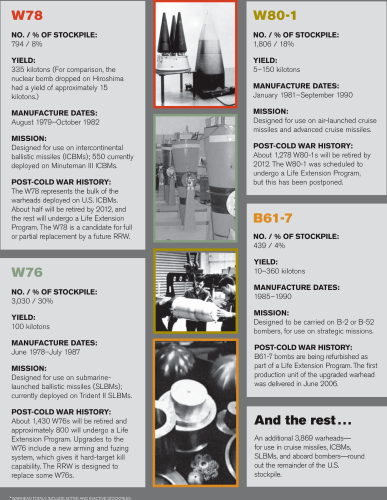
RRW will likely affect the composition of the current U.S. nuclear stockpile (detailed below), as the programs that maintain and upgrade existing weapons will compete with RRW for resources.
W78
794/8%
335 kilotons (For comparison, the nuclear bomb dropped on Hiroshima had a yield of approximately 15 kilotons.)
August 1979-October 1982
Designed for use on intercontinental ballistic missiles (ICBMs); 550 currently deployed on Minuteman III ICBMs.
The W78 represents the bulk of the warheads deployed on U.S. ICBMs. About half will be retired by 2012, and the rest will undergo a Life Extension Program. The W78 is a candidate for full or partial replacement by a future RRW.
W76
3,030/30%
100 kilotons
June 1978-July 1987
Designed for use on submarine-launched ballistic missiles (SLBMs); currently deployed on Trident II SLBMs.
About 1,430 W76s will be retired and approximately 800 will undergo a Life Extension Program. Upgrades to the W76 include a new arming and fuzing system, which gives it hard-target kill capability. The RRW is designed to replace some W76s.
W80-1
1,806/18%
5-150 kilotons
January 1981-September 1990
Designed for use on air-launched cruise missiles and advanced cruise missiles.
About 1,278 W80-1s will be retired by 2012. The W80-1 was scheduled to undergo a Life Extension Program, but this has been postponed.
B61-7
439/4%
10-360 kilotons
1985-1990
Designed to be carried on B-2 or B-52 bombers, for use on strategic missions.
B61-7 bombs are being refurbished as part of a Life Extension Program. The first production unit of the upgraded warhead was delivered in June 2006.
And the rest…
An additional 3,869 warheads–for use in cruise missiles, ICBMs, SLBMs, and aboard bombers–round out the remainder of the U.S. stockpile.
In anthropology, we sometimes talk about the “social life of things”–the alliances, reciprocities, and conflicts that accrete around the production, trading, and inheritance of things such as Persian rugs or African artwork. Nuclear weapons also have a social life, helping to form a tapestry of human relationships at the weapons laboratories. In the high days of nuclear testing during the Cold War, particular approaches to a design signaled filiation, and the preparation for a test would generate massive interdisciplinary teams of scientists and technicians working together over months. If successful tests built careers, failures could destroy them. Nuclear tests played the same role that publications do for academics, enabling the people behind them to build reputations and earn promotions. New designers would be delegated responsibility for parts of tests, the ambitious among them looking forward to the mid-career break of being lead designer on a test that would catapult them into the tiny designers' elite within the laboratory.

If the end of U.S. nuclear testing in 1992 capped the arms race, it also froze and distorted the cyclical processes of mentoring, knowledge accumulation, and career building within the weapons laboratories. In place of the gradient of knowledge and experience connecting the senior and junior weapons designers, it introduced an aporia between those with testing experience and those who would never acquire it. For two generations of weapons designers the normal avenues of growth and promotion have been foreclosed. These were the designers hired after 1992, who have no testing experience (the assistant professors, if you like), and the slightly older designers who were just beginning to hit their stride when the politicians ended the game (the associate professors, so to speak). A good example of this generation is John Pedicini, the lead designer for the defeated RRW design put forward by Los Alamos National Laboratory. Pedicini wrote in March on the Los Alamos blog: “At age 49, I am the youngest of the seriously experienced [Nevada Test Site]-tested designers, and the last chance for generational transfer of knowledge and art form.”
From 1992 until now, the Stock-1 pile Stewardship Program allowed, even in the absence of nuclear testing, for simulations and experiments that would enable scientists to accumulate knowledge and build reputations in attenuated ways that did not involve building and testing new warheads. The RRW exercise facilitates a deeper approximation to the old social processes, since it involves more fundamental design work and production oversight of a kind that would enable, albeit less so than nuclear testing, the building of design reputations and the extended engagement of design teams in the creation of an actual warhead. This can only be good news for the mid-career designers who hit the test-ban wall in the 1990s.
It should not be altogether surprising, then, that some of the commentary leaked into the public domain since the March announcement of Livermore's victory in the RRW design competition has suggested a generational difference of perspective among the designers. While the mid-career designers seem to have embraced the RRW design exercise with enthusiasm, their mentors seem more skeptical. For example, the press has quoted Sack as saying that while he is confident the design is a good one, he is not necessarily convinced of the need for an RRW.
At stake in this difference of perspective are a number of issues: the fact that the RRW and other RRWs to come would replace the stockpile that is the older designers' legacy to the nation; the older designers' preference for the literalism of nuclear testing versus the younger designers' greater comfort with simulations; the understandable yearning of the younger designers to implement the clever ideas that follow years of apprenticeship in their arcane craft; and the greater restlessness we always find in colonels than in generals, especially retired generals.
As the nation decides whether to go ahead with RRW, we are deciding not just whether to build this thing, but also what will happen in the social dramas that surround it.
Throughout the Cold War, the United States spent on average $98 billion per year on developing and maintaining its nuclear arsenal. With new nuclear warheads on the drawing board, what is the financial forecast for Complex 2030? Experts are struggling to crunch the numbers because the need for how many and what types of warheads remains uncertain.
Rearmament
Analysts widely acknowledge that the Reliable Replacement Warhead (RRW) Program would increase costs in the near term, while costs savings, if any, would not materialize for decades. Though no detailed estimates yet exist, a July 2005 Secretary of Energy Advisory Board task force estimated that the RRW Program could cost on the order of $155 billion over the next 30 years, a figure that was generated using computer models from the national labs. The figure was criticized in a subsequent April 2006 Government Accountability Office report, which cited the model's high degree of uncertainty, but remains a point of reference. Stephen I. Schwartz, editor of the authoritative 1998 report Atomic Audit, believes that the RRW Program will realistically cost even more: “If you look at Energy's track record with regard to major capital projects, time and time again those projects went wildly over budget, or were never completed on schedule, or both. I have a hard time believing that the same bureaucracy would be any more efficient now.”
Disarmament
While no studies have estimated what could be saved through complete nuclear disarmament, some have looked at what deep cuts in the arsenal would save. Relatively modest savings would result from simply lowering stockpile numbers, but when carried out over time, the lion's share of the budget for nuclear activities is insensitive to the number of warheads, according to budget analysts. In his January 2001 study, “The Hunt for Small Potatoes,” Rand Corporation analyst David Mosher theorized that the high fixed-costs of staying in the nuclear business–manufacturing, securing, and deploying the Bomb–essentially limit the cost savings that could be gained by making deeper and deeper cuts in the arsenal, as the United States did during the Clinton years. From 1990 to 2000, the annual budget for all nuclear-related activities fell from $58 billion to $35 billion, but from that point, Mosher demonstrated the diminishing marginal returns: Another 60 percent reduction in forces would not push annual costs below $30 billion. “There are plenty of good reasons to consider deep cuts in nuclear weapons, but big savings is no longer one of them,” Mosher concluded.