




Abstract
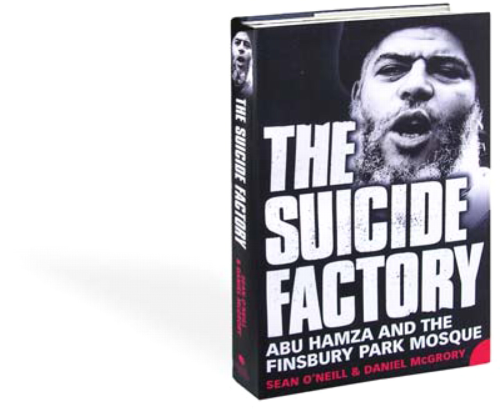
The Suicide Factory: Abu Hamza and the Finsbury Park Mosque, by Sean O'Neill and Daniel McGrory, HarperPerennial, 320 pages, 2006, £7.99
Last November, three months after the arrest of 23 British citizens who planned to crash a string of airliners over the Atlantic, Dame Eliza Manningham-Buller, the head of the British internal security agency MI5, delivered a rare public briefing. Her speech received little attention in the United States, which was absorbed with that week's thunderous election results. But in Britain it was big news. Manningham-Buller announced that her colleagues were “working to contend with some 200 groupings or networks, totaling over 1,600 identified individuals (and there will be many we don't know) who are actively engaged in plotting, or facilitating, terrorist acts here and overseas.” The British security chief went on to point out that, “If the opinion polls conducted in the UK since July 2005 are only broadly accurate, over 100,000 of our citizens consider that the July 2005 attacks in London were justified.”
The terrorist groups are all Muslim and the 100,000 justifying militant activity approach a tenth of the Muslim population in the country. Were the figures broken down, we would find that most of those are children of immigrants, largely from Pakistan and Bangladesh. Many have rejected the traditional Islam of their parents as irrelevant for coping with modern, secular Britain. Yet at the same time many of these post-migrant Muslims do not feel that they are British, even though Britain is Europe's most tolerant, pluralist, and multicultural country.
Why does Britain stand out among European countries for its militant Islamist threat, even though Muslims do not comprise as large a relative cohort as in other European countries? Back in the early 1990s, scholars such as Phillip Lewis were already documenting the growing linguistic and cultural gap between British children and their immigrant parents. Elders were helpless to understand their children's rejection of their parents' tongue, religion, and cultural norms. In some ways this was the same “revolt of the second generation” that played out between Eastern European immigrants and their increasingly assimilated offspring at the beginning of twentieth-century America.
But there is a difference–a double difference. Britain, like the rest of Europe, was not a “country of immigration,” built by foreign settlers who implanted what sociologist Rogers Brubaker calls a “cultural idiom of immigration.” Europe's nations were ethnic countries, unlike “civic” America, where what economist Gunnar Myrdal termed “the American creed” is the passport to integration. Secondly, and more importantly, Britain's rejected Muslims were offered a glorious alternative to their parents' mosques by the kind of outsiders who ran the notorious London Finsbury Park Mosque, whose story is told in an excellent book by two London Times reporters, Sean O'Neill and Daniel McGrory, titled The Suicide Factory (available in Britain).
As Abu Hamza “sat cross-legged in one corner of the mosque, surrounded by a circle of young men listening to his views on the Koran and world affairs, his henchmen would be teaching more base skills and conducting other business in darker corners and different rooms.”
The Suicide Factory was the five-story Finsbury Park Mosque (FPM), presided over by Abu Hamza who, one-eyed, hook-handed, and sweet-voiced, became London's most charismatic, telegenic, and articulate jihadist imam. Soon after taking over FPM in 1997, he began conducting wedding ceremonies against the wishes of the spouses' “old-fashioned” parents and the mosque's “greybeard” trustees. Attendance quadrupled at Friday prayers.
WHAT I'M READING
The Fairfax M. Cone Distinguished Service Professor Emeritus at the University of Chicago, Marty taught in the Divinity School for 35 years. The Martin Marty Center has since been founded there to promote “public religion” endeavors.
Abu Hamza's aspiration was not to become a teenage idol but to form a cadre of young Islamist militants. Assembled at FPM at one time or another during the imam's seven-year tenure was a veritable all-star team of terrorists. Those most familiar to Americans included Richard Reid, the hapless “shoe bomber”; Zacarias Moussaoui, the so-called twentieth hijacker who is serving a life term in a U.S. maximum-security prison; Ahmed Ressam, who attempted to bomb the Los Angeles airport; and Ahmed Omar Saeed Sheikh, who allegedly murdered Wall Street Journal reporter Daniel Pearl. Among the less familiar but more lethal were Abu Doha, whom the head of French surveillance called Al Qaeda's “main recruiter in Europe”; Nizar Trabelsi, a Tunisian footballer in Germany who was arrested days before he was to blow himself up at a NATO base in Belgium; and Abu Dahdah, convicted in Spain for masterminding the March 11, 2004, Madrid bombing.
But it is not this imposing gathering of terrorists that constitutes FPM's danger and historical importance. Rather, it is the ties forged there among alienated, post-migrant Muslim youth.
Mohammed Siddique Kahn first went to FPM two and a half years before his July 2005 bombing in London. He was known to spend nights in the mosque basement. But Kahn and his protege Shehzad Tan-weer did not initially go to FPM–it came to them. Abu Hamza took his show on the road, delivering sermons at provincial mosques in places like Kahn's Beeston section of Leeds. Recruits from Muslim immigrant backgrounds–alienated teenagers at odds with their parents–were directed to Islamic bookstores sprouting in all major cities and youth clubs in the grips of militants who, according to O'Neill and McGrory, “steered them to academies like Finsbury Park.” Waiting inside were “talent spotters, men trained in Afghanistan or other war zones, whose job now was to weed out the poseurs and exhibitionists from the boys who might be of some use…. For hundreds of them the long march to the Al Qaeda training camps would begin from there.”
These teenagers watched videos of Muslim victims and mujahideen vengeance and were told that they could be on the front lines. Meanwhile, as Abu Hamza “sat cross-legged in one corner of the mosque, surrounded by a circle of young men listening to his views on the Koran and world affairs, his henchmen would be teaching more base skills and conducting other business in darker corners and different rooms.” FPM needed forgers, computer programmers, accountants, shoplifters, orators, confidence tricksters, smugglers, film editors, clerks, and drivers, as well as frontline fighters. Much of the cash from fraud, stolen goods, and credit-card and passport forgeries went to mujahideen groups.
In Al Qaeda safe houses in Afghanistan, the CIA found dossiers of those accepted for field training. FPM was listed as a reference in numbers that “shocked” the agents. Nominees were given plane tickets, spending money, and a letter of introduction from Abu Hamza. His recommendation guaranteed entrance into the Al Qaeda-run training camp at Khalden, Afghanistan.
Of all the bizarre chapters in this exotic tale, the attitude of British authorities is the most peculiar. Muslim trustees of the mosque went to police seven times to complain about Abu Hamza, but nothing was done despite Prime Minister Tony Blair's frequent pleas that Muslims do more to expose radicals in their midst. Abu Hamza was briefly detained in 1999, but upon his release, his taped exhortations to kill “apostate” Muslims were returned to his home, along with bin Laden's encyclopedia of jihad with instructions on bombs, ambushes, land mines, and target selection, including Big Ben.
For years, both British and foreign intelligence services knew of ongoing terrorist recruitment at FPM. In particular, the French fumed at the license given to Algerian terrorists of the GIA (Armed Islamic Group) who had attacked the French transit system; FPM printed and distributed the GIA newspaper. Paris wanted it outlawed, but Whitehall refused. British authorities “were reluctant to intrude into a place of worship” and thought the French were “wildly overreacting to the Islamist threat.”
Defenders will point to the British absorption with the very real danger from the Irish Republican Army and its offshoots. They might note that MI5 was spending “20 times more money on tracking drug barons than on watching Al Qaeda terrorists operating in London,” according to the authors. But French intelligence gave credence to “a Faustian pact” between British authorities and the militant Islamists. Jihadists such as Abu Hamza and Abu Qatada, Al Qaeda's reputed “ambassador to Europe,” firmly believed the idea of a “covenant of security”–the government tolerating Islamist activities as long as there were no attacks in Britain. O'Neill and Mc-Grory report that Abu Hamza was “in close and regular contact with British police and intelligence for a number of years.” His was a “sham show of cooperation” in which he told tales about rivals. Certainly Manningham-Buller's MI5 has plenty to answer for.
The authors conclude that “what discussion there was of Islamic dissidents living in Britain was largely self-congratulatory. Britons were proud of the fact that their country continued to give safe haven and a platform to political refugees who, in all likelihood, would be arrested and tortured if sent back to their native lands.” It reveals an interesting convergence between the British assumption that evil resided exclusively in the authoritarian regimes in the Muslim world and the standpoint of U.S. neocons, who saw the democratization of the Middle East as the cornerstone of their strategy against terrorism. By the same token, the tolerance of the High Court and the stifling of the police and the security services reflected the true distance in multicultural England between the culture of the Muslim street and that of the British establishment. The authors write that the British debate remains “desperately ill-informed,” especially because sub judice laws bar the public from being made fully aware of the reality that counterterrorism forces deal with daily. In this, Britain is no exception in Europe. But only in Britain could it be said that, “In the land of the blind, the one-eyed man was king.”