



Abstract
Once deemed a humanitarian problem, failed states are now recognized as threats to global security. Today, 52 countries are mired in poverty and lack effective governance. Yet no one is certain how to help them.
Once deemed a humanitarian problem, failed states are now recognized as threats to global security. Today, 52 countries are mired in poverty and lack effective governance. Yet no one is certain how to help them. By Missy Ryan

Most days, Fadil Mohamed Sayf pushes a battered wheelbarrow laden with tools around the streets of Yemen's capital, Sanaa, hoping to find work welding metal gates or repairing water tanks. The 45-year-old, wearing a threadbare shirt and dusty plastic sandals, earns up to $20 on a good day, barely enough to sustain his wife and seven children. Other days, he goes home empty-handed.
Sayf is one of the roughly 10 million poor in Yemen, where a third of the workforce is unemployed, half the population cannot read, and per capita gross domestic product is estimated to be between $650 and $800.
This page: At the market in the village of Thulla.

But Yemen, one of the Middle East's least-developed nations, struggles not only with rampant poverty. Nestled at the end of the Saudi peninsula, close to the volatile Horn of Africa, Yemen is also trying to buck a reputation for security problems.
Those problems have included sporadic tribal violence, lawlessness in the outlying areas, unsecured borders, a bustling weapons trade, and terrorist operations conducted by Al Qaeda, including a suicide attack in 2000 against the U.S. warship Cole while it was refueling off the port city of Aden, which killed 17 U.S. sailors. A similar attack against the French tanker Limberg two years later killed a Bulgarian crew member and wounded 12 others.
In the 1980s, scores of young Yemenis joined the mujahideen to fight in Afghanistan against the Soviets. Some who returned in the 1990s fought alongside Osama bin Laden. Since the September 11, 2001, attacks on New York and Washington, D.C., Yemenis have comprised about one-fifth of suspects imprisoned at Guantanamo Bay.
Despite its myriad problems, Yemen is not a “failed state” that has collapsed into complete anarchy–at least, not yet. Rather, Yemen is one of dozens of so-called weak or fragile states: borderline countries where weak governance and poverty make them attractive hubs for terrorist groups and criminal syndicates. “Unfortunately, crisis has become a growing business,” explains Flavia Pansieri, who directs U.N. development activities in Yemen. “It has forced us to rethink what is our approach to development… and the impact of failed development in producing lack of security.”
The United States and the global community have responded to these concerns by boosting foreign assistance. Overall levels of aid from donor nations have increased, and the world's rich countries now spend about 0.25 percent of their total national incomes on foreign aid, according to the U.N. Development Programme. Last November, for instance, an international donor conference convened in London pledged $4.7 billion to be disbursed to Yemen over four years–a sum that represents more than 85 percent of the government's external financing needs. 1
Yet, underlying such largesse, questions persist over the effectiveness of financial aid as a means to support fragile nations–and, more broadly, to address the security problems they represent. Some analysts openly worry that the policy prescriptions for these states are themselves a failure.
Less than a decade ago, Washington deemed failed states a peripheral, humanitarian issue. A 2000 report of the bipartisan U.S. Commission on National Security for the Twenty-First Century suggested that concerns over domestic stability should be limited to countries of “major importance to U.S. interests,” such as Mexico, Colombia, Russia, and Saudi Arabia. The commission labeled failed states a “lesser priority” best handled by peacekeeping operations and U.N. conservatorships. 2
Moreover, humanitarian intervention and nation building developed bad reputations in Washington due to U.S. experiences in Somalia and the Balkans. During the 2000 presidential campaign, candidate George W Bush and his foreign-policy team openly derided such efforts as a drain on military resources and a distraction from more pressing security matters. As Condoleezza Rice famously put it, “We don't need the 82nd Airborne escorting kids to kindergarten.” 3
The mood in Washington abruptly changed on September 11, 2001, when a “peripheral” failed state, Afghanistan, emerged as the staging ground for the most devastating terrorist attack in U.S. history. After years of struggle against Soviet dominance, the 1990s had brought ruinous internecine violence to Afghanistan. This climate of near anarchy allowed the Taliban, which imposed order with their strict interpretation of Islamic law, to thrive; they in turn gave haven to Osama bin Laden and his fighters. What's more, throughout the decade, Al Qaeda used three other failed states–Somalia, Sudan, and Yemen–to build a global network by establishing businesses, training camps, and regional bases of operations.
Thus, in just two years, the conventional wisdom among policy makers completely reversed, as the White House's 2002 “National Security Strategy” concluded: “America is now threatened less by conquering states than by failing ones.” Across the political aisle, Democratic Sen. Joseph Biden of Delaware declared, “Weak states are cracks in the foundation of our international system. Left untended, they can threaten the entire edifice of political and economic stability.” 4 Foreign policy “realists,” such as Harvard University's Stephen Walt, acknowledged, “The attacks on September 11 demonstrate that failed states are more than a humanitarian tragedy; they can also be a major national security problem.” 5 By 2005, Francis Fukuyama, a professor of international political economy at Johns Hopkins University's Paul H. Nitze School of Advanced International Studies, had quipped that a “new failed state industry” had emerged in Washington. 6
By all accounts, business is booming. Broadly defined, weak and failing states are nations that are disproportionately poor and lack effective governance and the ability to ensure their citizens' physical security, and provide basic services like water, sanitation, and education. They are also frequently besieged with internal conflicts. According to a methodology developed by scholars at the Brookings Institution and the Center for Global Development (CGD) in Washington, D.C., the “current universe of weak and failing states” constitutes 52 countries that, taken together, account for more than 1.1 billion inhabitants, or approximately 17 percent of the world population. Nearly two-thirds of these countries are located in Africa, although other regions are represented through nations such as Yemen, Pakistan, Uzbekistan, Nepal, Haiti, and North Korea.” 7 (See map on p. 54.)
Poor governance and rampant poverty are among the key characteristics that attract terrorist groups and criminal syndicates to failing states. Writing in the Washington Quarterly, Ray Takeyh, currently a senior fellow at the Council on Foreign Relations, and Nikolas Gvosdev, editor of the National Interest, liken the appeal to an overseas business decision: “While the multinational corporation seeks out states that offer political stability and a liberal business climate with low taxes and few regulations, failing or failed states draw terrorists, where the breakdown of authority gives them the ability to conduct their operations without risk of significant interference.” 8
Indeed, as Takeyh and Gvosdev point out, the benefits are numerous for an ambitious terrorist organization. Because resource-starved, weak governments often don't have the manpower or clout to police their own countries effectively, terrorist groups can take over wide swaths of territories to build training camps or even develop business interests to finance their operations. (In Yemen, for instance, the climate of lawlessness has allowed terrorist groups to entrench themselves in outlying areas, such as the eastern province of Al Hadramut, the ancestral home of Al Qaeda leader Osama bin Laden.) 9 That same atmosphere of lawlessness also enables weapons smuggling. (In Yemen, there are an estimated 60 million firearms among a population of fewer than 20 million.) Rampant poverty may allow terrorist groups to hire new recruits. These groups may also build loyalties by providing the basic services–such as schools and physical security–that the governments themselves are unable to provide. And, lastly, failing states remain sovereign nations, which may complicate cross-border efforts to eliminate terrorist networks. Unfortunately, though failing states might enjoy the legal trappings of sovereignty, they may also lack the capabilities to secure their own borders. In the 1990s, Yemen's largely unpatrolled 1,400-kilometer (870-mile) boundary with Saudi Arabia made it a popular refuge for Islamist militants. 10
In addition to offering refuge to terrorist groups, failing states may also engender the “spillover effect.” According to Susan Rice, a senior fellow at the Brookings Institution who was assistant secretary of state for African affairs under President Bill Clinton, failed states “often spawn wider regional conflicts, which can substantially weaken security and retard development in their sub-regions. The conflicts in Sierra Leone, Congo, and Sudan, each largely internal in nature, have also directly involved several other states.” 11 Beyond the humanitarian dimensions of such conflicts, she notes, the impact is felt abroad through the outward flow of refugees, increasing levels of narcotics trafficking and conventional weapons proliferation, billions of dollars spent on aid and peacekeeping efforts, and the opportunity costs of lost trade and investment.
Yet the connection between failing states and international security is not always immediately clear. A country that is so poor or so chaotic that it lacks reliable financial, transport, and communications infrastructure could even dissuade a militant group from roosting. In other cases, says Stewart Patrick, who directs CGD's project on weak states and U.S. national security, more prosperous nations that aren't typically considered failing states–such as Russia, Ukraine, or Colombia–also suffer serious weaknesses, such as corruption, lack of territorial control, weapons proliferation, or narcotics smuggling. “It's important to recognize that there are aspects of fragility in a broader cohort of states than just the poorest in the world,” Patrick explains. Because these countries have more robust trade, more ties to the globalized economy, and a more mobile population, they can pose even greater threats than the poorest countries.

ON THE BRINK
Today's weak and failing states as determined by a methodology developed by the Brookings Institution and the Center for Global Development.
“It's precisely those countries that have decent connections to the international system and to the networks and channels,” he explains, “that tend to be the soft underbelly of globalization.”
The United States has undertaken several initiatives to confront the issue of failing states. In 2004, the State Department created a coordinator for reconstruction and stabilization (CRS) to oversee interagency policies for nations in danger of civil war or those emerging from conflict. The office, which has so far led government response to crises in Sudan and Haiti, liaises with partners like the U.N. Peacekeeping Commission and distributes to policy makers a watch list of countries at major risk for conflict or collapse, which is compiled twice a year by the National Intelligence Council.
In 2006, Secretary of State Con-doleezza Rice declared “transformational diplomacy” to be a top priority and pledged to make establishing democracies and transforming weak, ineffective, or authoritarian governments the centerpiece of foreign assistance.
But the cross-governmental response to countries on the brink of collapse is still in its infancy, and the State Department's CRS office to date has only 11 officials on its active response roster who can be deployed to a crisis. (The office also has a “standby response corps” roster of more than 300 current and retired State Department officials.) “It is still evolving, but we've come a long way,” says Melanie Anderton, a spokeswoman for the unit.
The United States is not alone in bureaucratic responses to perceived threats. In 2001, the United Nations created a Bureau of Conflict Prevention and Recovery. The United Nation's Pansieri sees “a very strong linkage between a failure of development” and the security threats that “hopelessness can create.” She says, “If you think about the Palestinians, if you think about the youths in a country like Yemen, where job opportunities are extremely limited, or Somalia or Sudan, the lack of a sense of progress that often can be conveyed … influences life decisions or life or death decisions.”
Underlying Pansieri's comments is a premise that is as common as it is contentious–that there is a direct link between alleviating poverty and undermining terrorism. President Bush himself echoed Pansieri's remarks in 2002, when he announced a $5-billion plan to assist developing nations: “Poverty doesn't cause terrorism. Being poor doesn't make you a murderer…. Yet persistent poverty and oppression can lead to hopelessness and despair. And when governments fail to meet the most basic needs of their people, these failed states can become havens for terror.” 12
In a weak, poor state, a young man without job prospects, with inadequate education, may be a more likely recruit for a militant group, Pansieri agrees. “As we see only too often in the region, the lack of perception of a future causes especially young people to be very easily influenced by messages that encourage hopeless actions with a perspective that a positive future is possible only after death,” she explains. “It becomes therefore a contributing factor to the influence that radical and terrorist messages can have.”
But others are skeptical. “If poverty was the driving force in extremism and violence, you'd have a lot more terrorism coming out of sub-Saharan Africa,” observes Barbara Bodine, a longtime Mideast diplomat who was Washington's ambassador to Yemen at the time of the Cole bombing. Look at the world's 20 poorest countries, and you won't necessarily see nations that have hosted terrorist groups or bred militant activity, adds Bodine, who is now a fellow at the Massachusetts Institute of Technology's Center for International Studies.
It's been widely noted that the masterminds behind the 9/11 attacks were educated men, from middle- or upper-class families in more affluent countries; most of them from Saudi Arabia.
Leaders of militant groups in the Middle East and elsewhere have tended to be the same–like Al Qaeda principal Ayman al-Zawahiri, or, in Peru, the Shining Path's Abimael Guzman. Similarly, many stable democracies have bred militant activity, like the Irish Republican Army or the Basque separatist movement in Spain. And as Bodine points out, foreign-led militancy in poor countries, such as the Cole attack in Yemen or the 1998 bombings of U.S. embassies in East Africa, has not reflected broad support for militants' goals in those countries. Still, countries such as Yemen and Algeria have supplied foot soldiers, she acknowledges, the low-level facilitators and fixers. “Not having jobs, not having industry, not having anything else, they were very susceptible to recruitment,” she notes.
In her view, however, economic, social, or even cultural marginalization could be more instrumental–as typified by the young men who carried out the 2005 bombings in London. “What seems to be a real trigger for terrorism and extremism is when there is a sense of alienation and marginalization.” It's a view shared by Stewart Patrick, who has argued, “The ‘safe havens’ of global terrorists are as likely to be the banlieues [suburbs] of Paris as the wastes of Sahara or the slums of Karachi.” 13
According to Robert Rotberg, who heads the Program on Intrastate Conflict and Conflict Resolution at Harvard's Kennedy School of Government, quality of governance may be as important a factor in driving security threats as poverty.
That's why he believes that the United States and other donors need to focus aid on strengthening government institutions in poor countries by making courts more efficient, balancing power among the executive and legislative branches, and fighting corruption.
“We should be bolstering incipient good leadership and strengthening all aspects of governance,” he says, including basic initiatives that keep young girls in school, provide clean water and sanitation, and promote family planning. More broadly, he adds, “Our role should be supporting positive elements in local civil society.”
The connection between failing states and international security is not always immediately clear. A country that is so poor or so chaotic that it lacks reliable financial, transport, and communications infrastructure could even dissuade a militant group from roosting.
For his part, Stewart Patrick at worries that the current U.S. strategy toward fragile states suffers from a one-size-fits-all approach that fails to take into account each country's unique pathologies and challenges. There is a need to distinguish between fragile states based on their genuine “commitment to reform” and their “capacities to meet their responsibilities to their own citizens and the international community.” 14 Patrick advocates a more coordinated approach that unites the “three Ds” of U.S. foreign policy–defense, development, and diplomacy. “The precise country strategy will vary according to the perceived root causes of weakness,” he wrote in a recent article. “Where capacity is lacking, the United States should enable states to fill the gaps. Where will is lacking, the United States should deploy incentives to persuade or compel a stronger commitment. When both are absent, the United States must try to change the attitudes of the country's leadership while working with civil society to build basic capacities and empower agents of reform.” 15
The success of such measures is predicated, in part, on the level of commitment from the United States itself. Patrick and his CGD colleague Kaysie Brown conducted an assessment of the Bush administration's fiscal 2007 budget and found a yawning gap between the White House's rhetoric and the resources it allocates to strengthen fragile states. They calculated that the bilateral foreign assistance earmarked for fragile states was around $5.2 billion, or 40 percent of the $13.2 billion total requested for U.S. bilateral aid. However, if you strip away the money pledged to Iraq, Afghanistan, and Pakistan–three countries deemed to be on the front line of the war on terrorism–the bilateral assistance to the remaining 49 fragile states identified by CGD plummets to roughly $2.6 billion, or an average of less than $3 per citizen of those nations. That translates into $0.03 for the Central African Republic, $0.30 for Niger, and $0.34 for Bangladesh. Yemen gets a slightly better deal: $1.30 per citizen. 16
“This is our major security threat and we're spending so little,” bemoans Patrick. “We're pretty good at fighting wars but we're not particularly good at the [prevention] side of things.”
On one day in Yemen's Marib governorate, the midday heat reached more than 105 degrees. A group of women, almost entirely invisible under black abayas, gathered outside a roadside restaurant, waiting for diners to leave so they could scrape remains into plastic bags.
The intense poverty in Marib, where tribal law reigns and foreign aid workers don't travel without armed guards, highlights the difficult task of development in places like Yemen.
Marib, along with four other gov-ernorates that have traditionally been ruled by tribal sheikhs, is one of the areas that the U.S. government is targeting with its development assistance. U.S. funds have built schools, health clinics, and latrines; the program also works with women's organizations.
“What USAID is doing here is trying to focus on programs which would change the conditions on the ground,” says Mike Sarhan, USAID's mission director in Yemen. “We're kind of like the hearts and minds part of our fight against terrorism,” he adds.
But donor spending still doesn't amount to much. The United Nations spends a total of around $40 million a year here; the United States spends less than $50 million on development and security aid; Britain's development budget is about $80 million. One U.S. official on the ground in Sanaa criticized what he saw as shortsightedness in “Washington. “We are not nearly matching the importance of Yemen becoming the next Somalia or the next Afghanistan,” he says.
Many Western officials are confident that the government of Ali Abdullah al-Saleh, with the help of the Americans, has broken the back of Al Qaeda activity. After the Cole attack and 9/11, the U.S. government beefed up security assistance in hopes that Yemen would crack down on Al Qaeda. The U.S. government has helped establish a counterterrorism unit and create a coast guard.
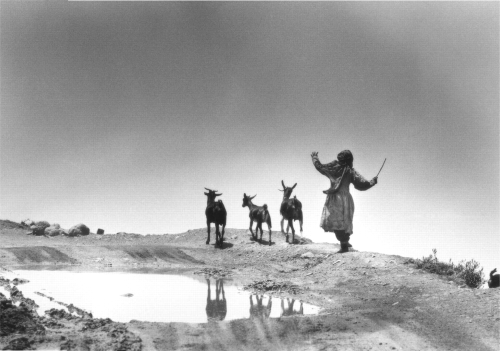
A girl from the region of the Jabal Sabir Mountains walking with three of her familys goats. More than half of Yemeni women marry before the age of 18.
But Sheila Carapico, a University of Richmond professor and Yemen observer, warns that the United States must be careful that its own security goals are not co-opted by fragile governments; doing so could undermine the goodwill produced by U.S. development efforts. After the Cole bombing, she explains, the United States “wanted the Yemeni government to arrest enemies of America. The Yemeni government wanted to arrest its own enemies.” In a recent book published by CGD, she noted, “Outside of widespread opposition to American policies regarding Israel and Iraq, Yemen is by no means a hotbed of anti-American and anti-Western sentiment…. Such sentiments may be stoked if Washington and the West are seen as conspiring with an extractive national security state responding to external powers.” 17
In the meantime, the hurdles for this country, and for other fragile states around the world, are considerable. In Yemen, water is already in short supply, and there are few dynamic industries. More than half of Yemeni women marry before the age of 18, and the average Yemeni woman has about seven children. The population may double by 2030, overloading already stressed resources.
The biggest challenges may lie ahead. In January 2007, a Congressional Research Service report bluntly noted that some observers believe Yemen is “at risk for becoming a failed state in the next few decades.” 18 And it remains to be seen whether even the promised inflow of foreign aid will measurably change the status quo. Carapico has written that previous aid efforts “have always been statist by definition, greatly expanding the power, wealth, and bureaucracy of the central executive and, in many sectors, contributing to unwieldy, ineffective public agencies and corporations.” 19
Even the senior U.S. political figure in the country is uncertain about the future, offering an assessment that seems applicable to fragile states everywhere: “Right now,” says U.S. Ambassador Thomas Krajeski, “it's kind of a toss-up where Yemen is going to go. Will Yemen become another Somalia, or will Yemen be another Jordan?”
Supplementary Material
Yemen: Current Conditions and U.S. Relations
Footnotes
1.
Alfred B. Prados and Jeremy M. Sharp, “Yemen: Current Conditions and U.S. Relations,” Congressional Research Service report, January 4, 2007.
2.
“Seeking a National Strategy: A Concert for Preserving Security and Promoting Freedom,” U.S. Commission on National Security for the Twenty-First Century, April 15, 2000.
3.
James O. Goldsborough, “Will America Return to Isolation?” San Diego Union-Tribune, October 30, 2000, p. B9.
4.
Quoted in “State Building and Global Development,” Center for Global Development, June 2006.
5.
Stephen M. Walt, “Beyond Bin Laden: Reshaping U.S. Foreign Policy,” International Security, Winter 2001/2002.
6.
“The Failed State Industry,” Global Strategy Institute, Center for Strategic and International Studies, June 2005.
7.
Stewart Patrick and Kaysie Brown, “Fragile States and U.S. Foreign Assistance: Show Me the Money,” Center for Global Development, Working Paper Number 96, August 2006.
8.
Ray Takeyh and Nikolas Gvosdev, “Do Terrorist Networks Need a Home?” Washington Quarterly, Summer 2002.
9.
Prados and Sharp, “Yemen: Current Conditions and U.S. Relations,” January 4,2007.
10.
Sheila Carapico, “No Quick Fix: Foreign Aid and State Performance in Yemen,” in Nancy Birdsall, Milan Vaishnav, and Robert L. Ayres, eds., Short of the Goal: U.S. Policy and Poorly Performing States (Washington: Center for Global Development, 2006).
11.
Susan E. Rice, “The New National Strategy: Focus on Failed States,” Policy Brief 116, The Brookings Institution, February 2003.
12.
“President Proposes $5 Billion Plan to Help Developing Nations,” White House Press Release, March 14, 2002.
13.
Stewart Patrick, “Weak States and Global Threats: Fact or Fiction?” Washington Quarterly, Spring 2006.
14.
Patrick and Brown, “Fragile States and U.S. Foreign Assistance: Show Me the Money,” August 2006.
15.
Patrick, “Weak States and Global Threats: Fact or Fiction?” Spring 2006.
16.
Patrick and Brown, “Fragile States and U.S. Foreign Assistance: Show Me the Money,” August 2006.
17.
Carapico, “No Quick Fix: Foreign Aid and State Performance in Yemen,” 2006.
18.
Prados and Sharp, “Yemen: Current Conditions and U.S. Relations,” January 4,2007.
19.
Carapico, “No Quick Fix: Foreign Aid and State Performance in Yemen,” 2006.