Abstract
For all the buildings and artifacts that we preserve, thousands are lost forever. In this special Bulletin essay, Pulitzer Prize-winner Richard Rhodes examines the value of protecting the physical legacy of the U.S. nuclear enterprise and what its loss would tell us about ourselves.
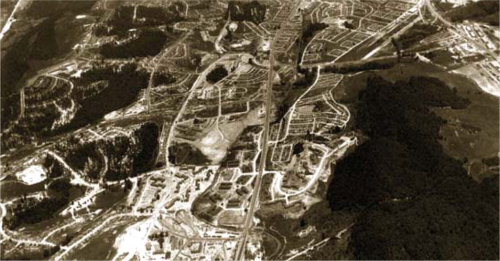
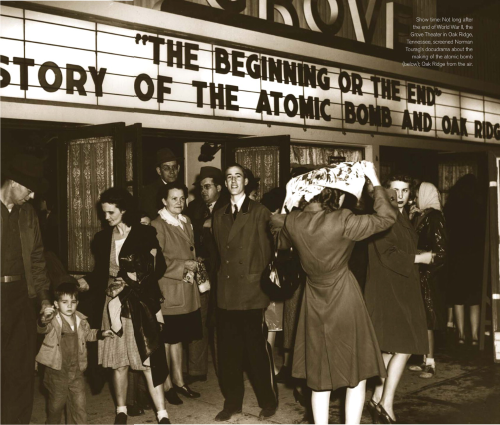
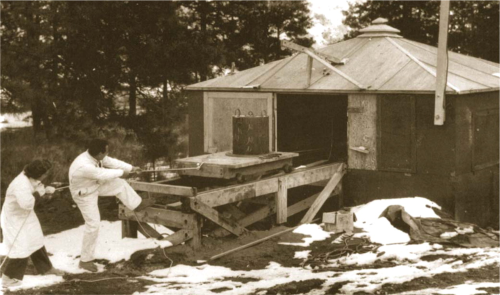
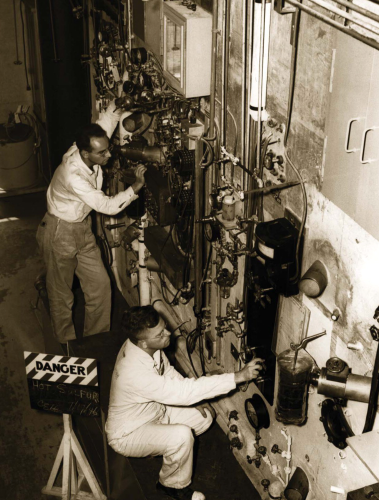
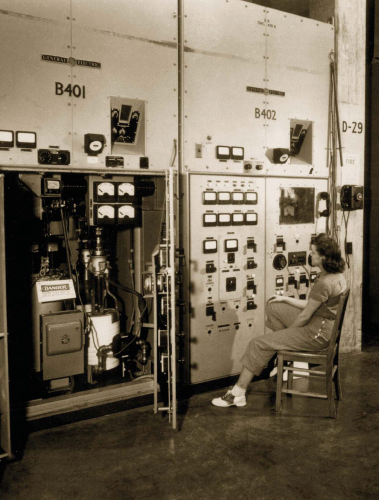
Hot stuff: Lab workers remove a radioactive source from a Los Alamos, New Mexico building for use in an experiment (above); Oak Ridge's X-10 graphite reactor (opposite) supplied the Los Alamos lab with its first significant amount of plutonium
Why should the structures of the Manhattan Project–the buildings, artifacts, and machinery, such as the K-25 gaseous diffusion plant at Oak Ridge–be preserved? Should Americans be proud of the Manhattan Project's work? Should we be ashamed? Should we look the other way, or should we remember? Or are such questions inappropriate to the physical preservation of our common past? These are issues worth examining, both specifically in terms of the Manhattan Project and generally where historic preservation is concerned.
We preserve the Declaration of Independence and the U.S. Constitution in elaborately sealed cases that are lowered at night into expensive bombproof vaults when there are perfectly readable copies around. We preserve Williams-burg, Bandelier National Monument, and Ellis Island. But why? There are reasonably good scaled-down reconstructions at Disney World and in Las Vegas of everything from the Eiffel Tower to the Taj Mahal. And certainly many people go to such places to view recreations without having to incur the trouble and expense of traveling to see the originals. I still remember, on my one and only visit to Disney World, hearing a mother threatening her misbehaving child while they walked among the scenic areas that represented different countries. “If you don't straighten up,” she said, “I won't take you to Canada.” With good reconstructions around, what's so special about the originals?
The answer to that question isn't necessarily mystical, but it is philosophical. The philosopher John Searle has examined the enigma of what he calls “social reality.” The factories and bombs that Manhattan Project scientists, engineers, and workers built were physical objects that depended for their operation on physics, chemistry, metallurgy, and other natural sciences, but their social reality–their meaning, if you will–was human, social, political. The same is true of Williamsburg and Bandelier and the Declaration of Independence. “There are portions of the real world,” Searle writes, “objective facts about the world, that are only facts by human agreement. In a sense,” he goes on, “there are things that exist only because we believe them to exist. I am thinking of things like money, property, governments, and marriages.”
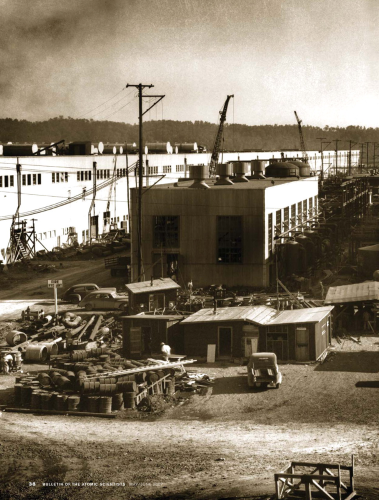
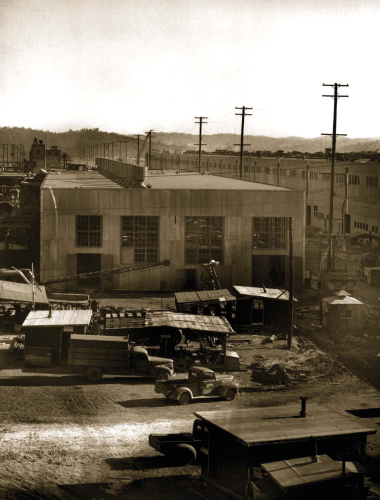
Sleeping behemoth: Measuring a half mile by 1,000 feet, Oak Ridge's K-25 plant employed 12,000 workers and housed the gaseous diffusion machines that enriched uranium for the Hiroshima weapon. The hulking structure still stands today, a vivid reminder of the enormous industrial capacity built during the war, and preservation efforts to maintain it are underway.
Searle distinguishes between what he calls “institutional facts”–facts that require human institutions for their existence–and “brute facts.” Paper money, citizenship, property, the meaning of words, and the high value of diamonds are institutional facts. Brute facts are the facts of the sciences and of the physical world–that the continents drift, that DNA preserves genetic codes, that a hydrogen atom has one electron. Brute facts are facts of physical reality. Institutional facts are facts of social reality, which is every bit as real to us and as complexly structured as physical reality, but weightless and invisible.
I'm sure you see where this is going. We preserve what we value of the physical past because it specifically embodies our social past. However weightless and invisible social reality might be–all the vast interconnections and communications we share together and with our forebears, all our records, experiences, photographs, poems, paintings, highways, inventions, celebrations, styles of everything from clothing to romantic love–that social reality is anchored to physical objects, starting with our own living bodies but extending far and deep into the physical world of landscapes, buildings, documents, machines, and artifacts. Finding meaning in the preservation and contemplation of those physical objects isn't merely sentimental, because the meaning isn't merely an extra, an add-on. To the contrary, physical facts and social facts can and do occupy the same space at the same time.
Or to say it more simply: When we lose parts of our physical past, we lose parts of our common social past as well. Anyone who has ever misplaced a wedding ring, or had an album of family photographs destroyed in a fire, or, worse yet, lost a loved one, knows exactly what I mean. Within recent memory, a horrific example was the Taliban's decision to destroy the great Buddhas carved into the mountainside at Bamiyan Valley in Afghanistan. The Taliban's reason for destroying the Buddhas concerned its interpretation of Islamic prohibitions against worshipping graven images, but even Islamic leaders in other countries were outraged at what the world rightly perceived to be a barbaric despoliation of the common human past. Reproductions can give a sense of the past, but because they lack authentic social facticity they can never wholly substitute for the original, any more than copies of a painting can substitute for the original. That's what informs the purpose and justifies the expense of historic preservation.
But of course we don't preserve all the past. We pick and choose. Every building where human beings have lived or worked is embedded densely with memories. Most of those memories are private, however; not many structures or artifacts embody historic transformations. There were log cabins everywhere in rural and frontier America, but only a few witnessed the births of poets or presidents. Shops and laboratories and factories have fared even less well than birthplaces, perhaps because the historic events they witnessed were less universal as human experiences go and therefore less emotionally resonant. They were venues for invention and discovery rather than birth and marriage and death. Nor do we often preserve places where we did things we're ashamed of, except to educate future generations and to memorialize the victims.
“Where does the Manhattan Project fit in this spectrum of values? Was it a great achievement? Or was it, as some have accused, a monument to man's inhumanity to man? I think these questions beg the question whether or not the Manhattan Project was a historically significant enterprise. If it was, then some recognizable part of it ought to be preserved. We have not destroyed, for example, the antebellum plantation houses of the American South even though they were built by slaves and rewarded slave owners. We have preserved Gettysburg even though far too many young Americans died there.
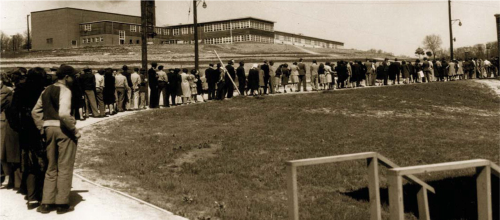
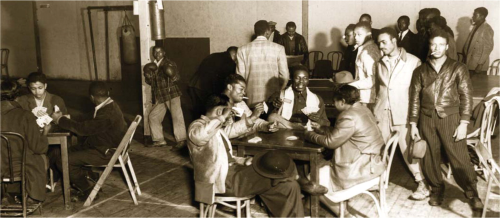
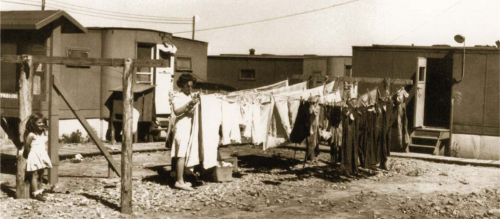
Daily grind: (Opposite, from top to bottom) Oak Ridge residents line up to buy cigarettes in Jackson Square; Oak Ridge workers take a break from the routine; in a Los Alamos trailer park, laundry is hung up to dry.
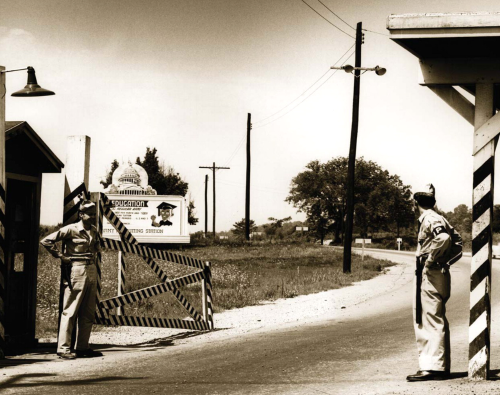
On duty: Military police guard the entrance to Oak Ridge (above).
Robert Oppenheimer, who led the work of building the first atomic bombs at Los Alamos, hoped that in the long run, the discovery of the brute fact of how to release nuclear energy and its application to make a terrible new mechanism of war might force nations to avoid at least large-scale war, and there is reason to believe he was right. From the eighteenth century forward, the number of human-made deaths from war, military and civilian, increased exponentially until 1945, when deaths dropped precipitously and stayed low thereafter as one nation after another discovered that its nuclear weapons or alliances compromised its pursuit of total war by inviting nuclear retaliation. Whether an arms race with all its dangers had to accompany that discovery is another question for another time–the short answer is no–but the new knowledge of nuclear energy has undoubtedly limited national sovereignty and scaled down the destructiveness of war. If that's not a good enough reason to work for and contribute to the Manhattan Project's historic preservation, what would be? It's certainly good enough for me.