Helicopters fitted with radiation sensors mapped New York City in the summer of 2005. After more than 100 flight hours, at a cost of $800,000, the helicopters had gathered background radiation measurements for the entire city. The survey allowed officials to identify previously unknown radiation hot spots and prepared first responders for future crises.
No other city has performed a similar survey, and many cities may not be aware of the potential benefits, according to “Combating Nuclear Terrorism,” a report put out late last year by the Government Accountability Office (GAO). If neither the Energy Department nor the Department of Homeland Security actively promote and provide this capability, “U.S. cities will miss an important opportunity to be better prepared for a terrorist attack,” the report concludes. JONAS SIEGEL
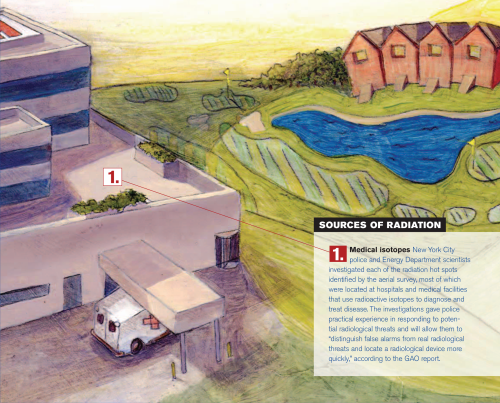
SOURCES OF RADIATION
1. Medical isotopes New York City police and Energy Department scientists investigated each of the radiation hot spots identified by the aerial survey, most of which were located at hospitals and medical facilities that use radioactive isotopes to diagnose and treat disease. The investigations gave police practical experience in responding to potential radiological threats and will allow them to “distinguish false alarms from real radiological threats and locate a radiological device more quickly,” according to the GAO report.
2. Fertilizer The survey also familiarized city officials with often-overlooked sources of low-dose radiation, such as the fertilizer typically used in large quantities on golf courses and other grassy areas. New city development and changes in fertilizer use necessitate the regular updating of radiation baseline levels throughout the city, according to Energy officials cited by GAO, which would allow officials to consistently revise response protocol.
3. Industrial waste During the course of their survey, New York City officials uncovered one piece of city land flush with radium. A former industrial plant, the site had been converted into a local park. By uncovering the contamination in the soil, city officials will be better able to protect public health in the event of a nearby brush fire that would require park land to be excavated and would release radiation into the air.
4. Rocks and minerals Granite and other minerals dug up from earth continue to emit small doses of radiation once they are used as building or decorative materials–for example, as the base of a statue or a headstone. Identifying baseline radiation levels of city buildings and parks will allow for targeted cleanup efforts after a radiation release or a dirty bomb attack, according to the GAO report–a valuable tool, considering estimates for dirty bomb cleanup costs stretch into the billions.