




Abstract
Broken Genius: The Rise and Fall of William Shockley, Creator of the Electronic Age, by Joel N. Shurkin. Macmillan, 378 pages, 2006, $27.95.
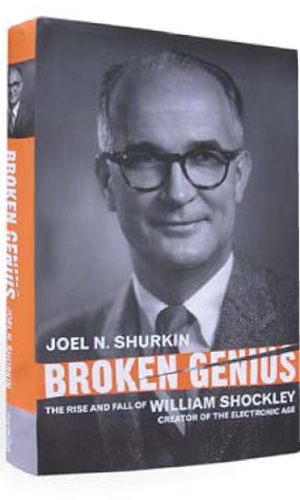
William shockley was a resourceful, imaginative, and practical-minded physicist whose accomplishments included the coinvention of the transistor, for which he shared the Nobel Prize in physics with Walter Brattain and John Bardeen, in 1956. The year before he had moved from Bell Telephone Laboratories, the site of the transistor work, to Palo Alto, California, where he had spent much of his youth. There he played a key role in the creation of Silicon Valley, became a professor at Stanford University, and savored his considerable success. But in the early 1960s, he ventured into the hazardous arena of genetics, race, and intelligence, publicly claiming that the United States was being swamped by the over-reproduction of genetically inferior people, that blacks as a group were genetically inferior to whites, and that perhaps a neo-eugenic program of sterilization was needed to set American society back on a genetically sound course. Persisting in these claims, Shockley besmirched his public standing and became a scientific pariah.
Broken Genius is Joel N. Shurkin's attempt to understand Shockley's life and career, particularly why he went off the rails, inviting condemnation as a racist and biological ignoramus. (“Some of the main concepts of genetics have escaped Professor Shockley,” Luigi Cavalli-Sforza, the Stanford population geneticist, observed.) An accomplished journalist and science writer, as well as the author of several popular books about science, Shurkin has probed the vast body of archival materials that Shockley and his pack-rat family accumulated, including letters, notebooks, and diaries, and he acknowledges a debt to the extensive account of the invention of the transistor in Michael Riordan and Lillian Hoddeson's
Crystal Fire: The Birth of the Information Age (1997). However, he appears to have neglected Shockley's scientific papers and a number of histories and biographies that bear on his story. The result is a book of uneven quality, marred, especially in the discussion of Shockley's neo-eugenics, by errors of fact, unsourced quotations, questionable judgments, and historical misunderstandings. Broken Genius is nevertheless a captivating read that is particularly valuable, if used with caution, for the light it throws on Shockley's personal life and how he saw the major events of his scientific career.
The book is Shurkin's attempt to understand Shockley's life and career, particularly why he went off the rails, inviting condemnation as a racist and biological ignoramus.
Shockley was encouraged to study science by his father, an MIT graduate and mining speculator, who together with his wife homeschooled their son as long as possible. After a year at UCLA, Shockley completed his undergraduate work at Caltech, earned a doctorate at MIT in 1936, and was quickly hired at Bell Labs. He soon established an informal discussion group devoted to exploring the implications of quantum mechanics for the physics of semiconductors. In December 1939, he recorded in his laboratory notebook the idea that semiconductors might be used for switching and amplification in telephone networks. In the spring of 1942, he was recruited as part of the scientific mobilization for World War II into operations research, devoting his talents first to antisubmarine warfare, then to strategic bombing.
After the war, Shockley returned to Bell Labs and put together the group that, in 1947, invented the point-contact transistor. Shockley had endowed the group with the idea that led to the achievement–the hypothesis that an external electric field could regulate the flow of current in a semiconductor–but he had not been directly engaged in the work. For legal reasons, Bell Labs omitted Shockley's name from the pointcontact transistor patent. Having initiated the field-effect approach, he felt deprived of just credit. Perhaps fueled by resentment, Shurkin suggests, Shockley soon went Brattain and Bardeen one better, devising the superior junction transistor, for which Bell Labs filed a patent in June 1948.
Electronics pioneers: John Bardeen (left to right), William Shockley, and Walter Brattain in 1947.
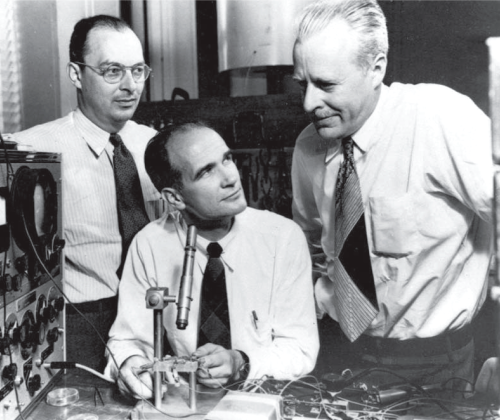
Eager to appease Shockley, Bell Labs promulgated the myth, using publicity photographs and press releases, that the invention of the pointcontact transistor was the product of the three men operating in a well-managed team. Shockley was in fact a poor manager. Shurkin notes that having long been schooled at home, he lacked formative “experiences with other people,” adding, “He was never burdened with self-awareness.” He was high-handed in managing the transistor group–for example denying Bardeen the freedom to work on superconductivity. Bardeen eventually left for the University of Illinois, where his work on the subject earned him a second Nobel Prize.
Shurkin judges that Shockley's contributions to the invention of the transistor were “hardly minor, in his mind or in truth” and warranted a share in the 1956 Nobel. But his arguments dwell on the invention of the point-contact transistor and ignore the Nobel presentation, which cited Shockley for exploiting the point-contact arrangement “in a series of ingeniously conceived experiments” to disclose the properties of current flow in the semiconducting material–a program of research that was related to his pursuit of the junction transistor.
On his return to Palo Alto, Shockley founded Shockley Semiconductors, obtaining backing from Arnold Beckman, a fellow Caltech graduate who had made a huge success in the instruments industry. His contribution to the establishment of Silicon Valley was to recruit a dazzling group of young scientists and engineers that included Gordon Moore and Robert Noyce, later the founders of Intel, and to focus the new firm on silicon. “Shockley put the silicon in Silicon Valley,” Moore later remarked.
At his semiconductor company, as at Bell Labs, Shockley was excessively controlling, giving his senior research staff the impression that they were obligated primarily to pursue the technical ideas he gave them. He insisted, Shurkin puts it, that they cooperate in “a kind of trickle-down creativity.” In 1957, after about 18 months, Moore, Noyce, and six others, organized themselves into Fairchild Semiconductor, where Noyce and collaborators devised the integrated circuit. Shurkin points out that since Noyce, Moore, and most of the others went on to create new successful companies, Shockley's role in spawning Silicon Valley deserves more credit than it has received.
Married in 1933, Shockley was often callous to his wife, with whom he had three children and whom he left after 20 years, when she was recovering from uterine cancer. Divorced in 1955, he soon remarried, gaining considerable happiness and contentment. But no better at relating to his children than in managing a research group, he grew increasingly alienated from them, and they from him. In an interview in 1980, he said that in intelligence they all represented a regression to the mean of the population.
WHAT I'M READING HUGH GUSTERSON

It has been a good year or two for Oppenheimer aficionados.
Tom Vanderbilt's
Vexed by the U.S. misadventure in Iraq and teaching two classes on war this semester, I have tried to understand how war as an institution is changing. The shift toward ethnic cleansing and asymmetric warfare is best explained by the British peace activist Mary Kaldor in
Finally, I've been rereading sociologist James William Gibson's exploration of U.S. “technowar” in Vietnam–
I'm planning to finish my semester by reading the imposingly thick history of the Pentagon,
In his neo-eugenics, Shockley was a throwback to the earlier movement that said of immigrants from Eastern and Southern Europe what he claimed about African Americans and that warned similarly that the high birth rates among groups alleged to be genetically inferior would lead to national degeneration. Science and social experience had eventually discredited those claims. Why did Shockley revive them? Perhaps out of a propensity for self-destructiveness or the kind of pigheaded arrogance that makes a little knowledge a dangerous thing. Shurkin's biography, while at times insightful and revealing about Shockley the man, leaves the question of his neo-eugenic turn unresolved.