




Abstract

If people in the United States recognize Somalia at all, they know the East African country mainly from the “Black Hawk Down” incident in 1993 (or, more precisely, from its movie version). That may not remain the case, as war-ravaged Somalia slides into the clutches of a radical Islamist movement and becomes yet another base-camp for the global jihadi network.
In June 2006, the Supreme Islamic Courts Council defeated the warlords of Mogadishu, Somalia's decimated capital. Since then, the council's Islamist militia has dislodged other warlords from almost all of the country's south-central heartland. Somalia is divided into three distinct political and geographical units: the south-central region including Mogadishu, and the two autonomous regions of Somaliland and Puntland, which do not share the radical agenda of the council and are run by separate administrations. One of the more immediate sources of concern is the Islamist militia's advance into these regions in pursuit of its agenda of unifying Somalia under the banner of Islam. Somaliland, a region largely untouched by the civil war, is particularly vulnerable, and Puntland is already getting tense and may become violent.
New order: Sharif Sheikh Ahmed and the Islamic Courts Council swept into Mogadishu in June 2006.
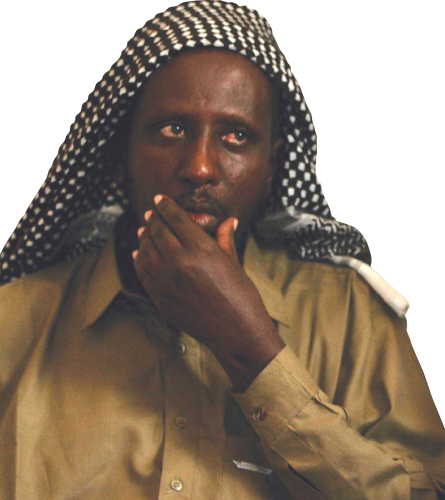
It is a narrative that bears an uncanny resemblance to the rise of the Taliban in Afghanistan, as they swept aside opposing forces and marched into Kabul more than 10 years ago. And the similarity goes beyond the manner and context of the two victories. In the process of consolidating power and in their adherence to a jihadi worldview, the Somali Islamist militia has been equally repressive.
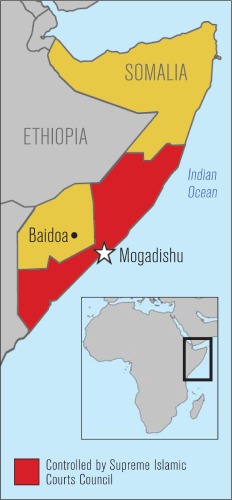
The United States hasn't had a direct presence in Somalia since the disastrous military intervention in the early 1990s. The civil war that ensued after the fall of Gen. Said Barre's military government in 1991 continued relentlessly for the next 15 years. In that war, Washington consistently opposed the Islamist movements that were only one of the conflict's many factions. Following 9/11, the United States stepped up its support for the opponents of Islamist militias and met again with spectacular failure. The warlords who were defeated by the council's forces in Mogadishu were openly financed and backed by the CIA. Yet, mainly because of the lack of public support, they have proved no match for the more disciplined and motivated Islamist militia.
U.S. attempts to covertly and overtly influence the outcome of the civil war have worsened its already tarnished image in the country. The council skillfully played this card to rally public support. “I think it is the American government that is against the Somali people,” Sharif Sheikh Ahmed, head of the council's executive committee, told the U.N. news agency IRIN after taking over Mogadishu. “It is they who attacked the Somali people. It is the U.S. government that gave a lot of money to fund the faction leaders…. It is the Americans who are against the Somali people. We are not against them.”
For its part, the Bush administration accuses the council, especially its firebrand spiritual leader Hassan Dahir Aweys, of supporting Al Qaeda and giving refuge to terrorists responsible for the 2002 bombings of U.S. embassies in Nairobi and Dares Salaam. Alongside Aweys, Hassan Turki is another militia commander who is on the State Department's list of terror suspects. An Osama bin Laden audiotape lauding the victory of the Somali Islamist forces has only further augmented U.S. fears.
Public punishment: A Somali man gestures (left) before his June 2006 execution, sanctioned by an Islamic court. The convicted murderer was executed by his victims brother.
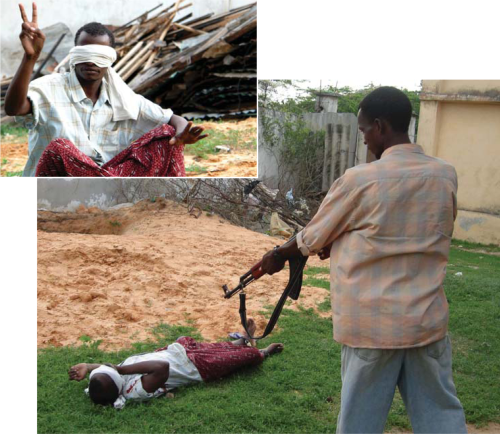
The rise of the Islamic Courts Council has created an illusion of peace and order. However, its social policies and mode of implementing criminal law mirror that of the Taliban regime.
Somalia's anti-U.S. sentiment engenders a general hostility toward Westerners. Soon after the Mogadishu takeover, and in the heat of reaction to blasphemous cartoons in a Danish newspaper, a Swedish cameraman was shot dead during a rally sponsored by the council. His killers remain unknown. In September, after the Pope's remarks on Islam, an Italian nun and her bodyguard were killed while crossing a road in the capital. Facing threats from Al Shabab, an obscure extremist group, U.N. staff relocated from all the areas under the council's jurisdiction. The Islamist extremists regard U.N. agencies and foreigners working for them as spies of the United States.
Much like Afghanistan, warlords have carved up Somalia. It has been without central rule since 1991. No fewer than 14 attempts to restore statehood through internationally brokered national governments have failed to bring order or stem the violence. The rise of the Islamic Courts Council has created an illusion of peace and order. However, its social policies and mode of implementing criminal law mirror that of the Taliban regime.
Public executions of murderers and floggings for minor criminals are becoming a common method of dispensing justice. Cinemas and photo shops in Mogadishu and other cities have been closed. Traditional singing performances by folk musicians, radio broadcasts containing music and “un-Islamic” material, and other modes of entertainment are officially banned in the council's domain. Women must follow a strict code of modesty, and their participation in public affairs is restricted and actively discouraged. The council leadership also tries to enforce similar rules for women working for international aid and relief agencies.
A number of regional countries have a stake in Somalia's internal conflict–yet another complication it shares with Afghanistan. The Islamist-minded government in Sudan backs the council, as does Eritrea. Although in Eritrea's case, the support is not so much born out of any religious or ideological affinity, but rather a desire to counter the influence of Ethiopia, which backs the internationally recognized, but fragile, transitional government in Baidoa.
Trouble for the West? After backing the secular, opposition warlords, the United States now worries that Somalia could become a safe haven for terrorist organizations.
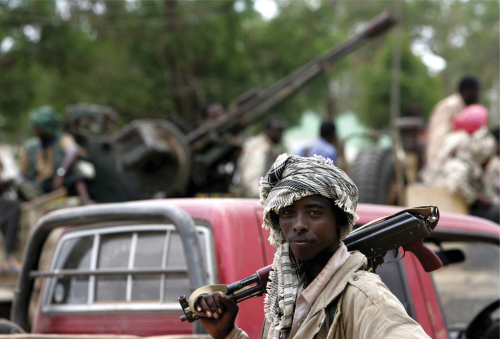
The emergent power and popularity of the council has evoked a hostile response from other neighbors, many of whom have sizeable Muslim minorities. Ethiopia, a long-standing supporter of Abdullahi Yusuf Ahmed, a warlord now leading Somalia's shaky transitional government, is especially wary of the Islamist administration in Mogadishu. Ethiopian worries are related to its troubled “Fifth Zone,” a Somali-dominated Muslim region whose separatist movement has old ties with Somali Islamist movements. Ethiopian forces have conducted exercises on and, at times, inside the Somali border. Any further advance of the council is likely to elicit a stern response from Addis Ababa under the pretext of saving the transitional government it helped to form. The council, meanwhile, vows to wage jihad if Ethiopia or any other foreign country intervenes.
Kenya, too, has cause for concern. Already burdened by more than 50,000 refugees, it fears that more bloodshed and violence–a likely outcome of the council's ascendancy–will increase the flow of people across the border. The strong suspicion that Al Qaeda fugitives implicated in the 2002 U.S. Embassy bombing are in Somalia reinforces the perception of threat. Kenya was also a key actor in setting up the transitional government undermined by the council.
Some still consider the country a pillar of moderate Islam. For instance, in his July 11, 2006, testimony before the Senate Foreign Relations Committee, David Shinn, former U.S. ambassador to Ethiopia, asserted that the rise of Islamist militias “does not mean, however, that Somalia is likely to become a major Al Qaeda base or that it is headed toward a Taliban form of government. The vast majority of Somalis follow a moderate form of Islam, and they are highly suspicious of foreign influence.”
But in the wake of protracted internecine violence–exacerbated by the political maneuverings of regional powers and the United States–the forces seeking to radicalize Somali society appear to have the upper hand. However tolerant Somalia might have been in the past, a new theater of violent confrontation has opened up in the Horn of Africa, the impact of which will be felt far beyond the region.