



Abstract

The new nuclear threat

Before reading William Arkin's provocative “The Continuing Misuses of Fear” (September/October 2006 Bulletin), I counted myself, as a coauthor of The Four Faces of Nuclear Terrorism, among the experts Arkin singles out as confirming and accepting the threat of nuclear terrorism. But Arkin shook me out of my complacency by making a compelling case that representatives across the political spectrum have overhyped this threat.
However, he still rightly underscores that “much more has to be done to rid the world of the WMD menace” post-9/11. Graham Allison, the author of the companion piece (“The Ongoing Failure of Imagination”), would surely agree. Allison feels that the Bush administration's failure to stem the North Korean and Iranian nuclear programs and its refusal to devote more resources toward securing nuclear material has increased the threat of nuclear terrorism.
His “Doctrine of Three Nos” (“no loose nukes,” “no new nascent nukes,” and “no new nuclear weapon states”) helps but does not go far enough. His plan stops existing and future nukes from falling into terrorist hands, but it does not reduce the number of weapons in the world's nuclear arsenal. Instead, Allison should advocate for “no nukes,” as only a world free of nuclear weapons and weapons-usable material can prevent a nuclear 9/11.
Fellow for science and technology
Council on Foreign Relations
Washington, D.C.
In certain respects, Graham Allison, like those he criticizes, also suffers from a failure of imagination. He fails to imagine how a world without nuclear weapons can check nuclear terrorism. Unfortunately, his view doesn't differ much from many others in the U.S. nuclear policy community, all of whom seem committed to trying to prevent nuclear terrorism while maintaining the two-tier structure of nuclear weapon “haves” and “have-nots.” To wit, he makes no mention of the failure of “the haves” to fulfill their Nuclear Non-Proliferation Treaty (NPT) obligation to pursue nuclear disarmament.
By relying on nuclear weapons for security–and occasionally threatening to use them–the nuclear weapon states continually demonstrate the utility of these weapons to the rest of the world. Further, the more nuclear weapons in the world, the likelier such weapons will end up in terrorist hands. Therefore, the five NPT nuclear weapon states must grow serious about their obligations under this treaty, commence good faith negotiations to achieve nuclear disarmament, and, along with non-NPT states, bring remaining stocks of weapons, weapon-grade material, and nuclear technology under strict international control.
The greatest failure of imagination still belongs to the leaders of the nuclear weapon states who believe they can continue to brandish their nuclear weapons without it leading to nuclear-armed terrorists. To truly eliminate the specter of nuclear terrorism, these leaders must urgently pursue measures leading to the elimination of their nuclear arsenals. Anything short of that constitutes a partial measure, leaving the door open to future nuclear terrorism.
President
Nuclear Age Peace Foundation
Santa Barbara, California
William Arkin correctly notes that global efforts to stem the spread of nuclear weapons have yielded far more success than most people realize and that some politicians inappropriately exploit nuclear fears. That said, he wrongly concludes that this means we should not worry about nuclear terrorism or that concern about this threat is based on “unthinking” presumptions.
UPDATE: A job well done?
John Bolton.
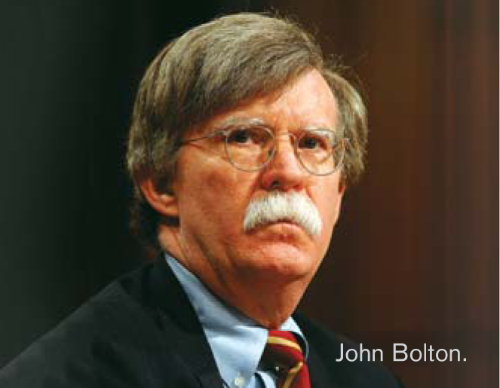
Protest and indignation followed President George W. Bush's nomination of John Bolton as the U.S. ambassador to the United Nations in March 2005. The clamor continued even after Bush made Bolton a recess appointment. In early December, Bolton submitted his resignation, which Bush grudgingly accepted.
In “The World According to Bolton” (July/August 2005 Bulletin), David Bosco, an expert in international law, attempted to separate Bolton's abrasive personality from the worldview that would ultimately guide him at the United Nations. Bosco wrote that despite Bolton's disdain for formal treaties, his work on nonproliferation “has shown the capacity–if not always the will–to work effectively with foreign governments.”
At the end of the day, did Bolton, in Bush's words, prove his critics “flat wrong”? “Given the jeremiads against Bolton during his confirmation hearing,” says Bosco, “diplomats at the United Nations must have been relieved when he didn't assault them. Critics conjured a snarling, dogmatic creature who bullied subordinates and twisted intelligence. It was a caricature, even if it contained important elements of truth.
“Bolton's counterparts at the United Nations, it appears, encountered a hardworking, sharply intelligent man who doggedly pursued his nation's policies. Contrary to what they heard, he seemed to follow State Department instructions; no hotline to the neoconservative cabal was in evidence. Bolton's bombast did not disappear, but for the most part it was subsumed by the job at hand.”
Setting off a nuclear bomb remains one of the most difficult missions a terrorist organization could conduct. In several reports, we have detailed the significant progress domestic and international authorities have made in strengthening security for many facilities housing nuclear weapons and weapons-usable material. But as we have also documented, serious risks of nuclear theft and terrorism still exist. Repeated examinations by nuclear weapons experts have concluded that a capable, well-trained terrorist group could construct and deliver a nuclear weapon if it got the nuclear material. Such an attack would be an unparalleled catastrophe. A prudent defense against nuclear terrorism must do more than rely on the attack's level of difficulty.
Governments should work urgently for a world in which every nuclear weapon and every kilogram of potential nuclear bomb material is secured to standards adequate to defeat the threats terrorists and thieves have proven they can pose. Meeting this requirement will demand sustained global cooperation in the face of a common threat, not unending war, as Arkin supposes.
In confronting the threat of nuclear terrorism, fearmongering is not justified. But neither is complacency.
Project on Managing the Atom
Harvard University
Cambridge, Massachusetts
William Arkin admits he's “out on a limb” when he writes that the threat of nuclear terrorism has been overblown and that terrorists can no longer obtain nuclear materials or nuclear weapons. After reading Graham Allison's accompanying piece, there's plenty of reason to think Arkin will fall from his limb, with catastrophic consequences for both himself and the rest of us.
Arkin believes that fear of nuclear terrorism will inevitably build support for preemptive war, “confirming the wisdom and necessity of the administration's fight.” We should not dismiss this claim. The Bush administration manipulated nuclear fears to build public support for the Iraq War, and the danger exists that it will use these same concerns to launch an equally disastrous attack on Iran.
But in opposing these wars, we should not argue that the danger of nuclear terrorism no longer exists. The danger is great, and we cannot wish it away. Instead, we need to make the case that invading Iraq increased the terrorist threat in precisely the ways that the partially released National Intelligence Estimate illustrates.
Attacking Iran will only replicate the Iraq mistake in spades. And if we use nuclear weapons to do so, the world will regard us as the greatest warmongers of the twenty-first century, finding us guilty for a crime that our grandchildren will apologize for generations from now.
Cofounder, Physicians for Social Responsibility
Northampton, Massachusetts
I was puzzled that both “Nuclear 9/11?” essays neglected to discuss radiological terrorism. True, we should not confuse radiological dispersal devices (RDD) and the sabotage of nuclear power infrastructure with an attack that uses a nuclear weapon or improvised nuclear device (IND). But radiological terrorism represents a weapon of choice for terrorists because it exposes civilian populaces to radiation, adding a high level of anxiety, stress, and panic disproportionate to the modest damage and casualties it would inflict.
Dirty bombers can strike at a much larger segment of a population by exploiting this psychological ripple effect, as radiological weapons resemble–and are easily confused with–nuclear weapons. A radiological device confers prestige and provides impressive results without requiring users to obtain or build nuclear weapons. And it requires only rudimentary technical expertise to assemble a RDD compared to a nuclear explosive device. Similarly, low-level radioactive substances–the building blocks of dirty bombs–are readily available. It's weaponry that offers terrorist organizations a low-tech, powerful equalizer as they battle advanced states.
A July 2006 survey of more than 100 foreign policy experts in U.S. News and World Report rated the probability of a dirty bomb attack at 20 percent, followed by an attack on a chemical or nuclear plant (11 percent), a chemical weapon attack (10 percent), a biological weapon attack (9 percent), and a nuclear weapon attack (6 percent). Recognizing this, the 2006 U.S. Russian Global Initiative to Combat Nuclear Terrorism vows to “prevent the acquisition, transport, or use by terrorists of nuclear materials and radioactive substances or improvised explosive devices using such materials, as well as hostile actions against nuclear facilities.”
Any meaningful debate regarding nuclear terrorism clearly must go beyond nuclear weapons and INDs to include RDDs.
Associate director, Center for International Trade and Security
University of Georgia
Graham Allison's “The Ongoing Failure of Imagination” serves as a sobering reminder of the threat of a nuclear terrorist attack. However, on the theory of how terrorists could smuggle a nuclear device into the country, the use of drug smuggling routes seems more plausible than the “follow the golf clubs” theory.
I'm not sure how Allison formulated that golf clubs traveling by ship from Tokyo to the United States stand less than a 3 percent chance of being inspected. U.S. Customs and Border Protection (CBP) claim they physically inspect 6 percent of all incoming containers. The Rand Corporation, quoted in the article, pegs the likely number at 5-6 percent. While still a low percentage, CBP follows a multilayered risk assessment when deciding which shipment gets chosen for closer scrutiny. This starts before the container is loaded on the vessel and includes security measures and programs implemented post-9/11. One of the numerous parties to such a transaction (the origin trucker, receiving personnel, carrier, destination terminal, delivery trucker, etc.) could also report something suspicious about the shipment.
None of this means that Allison's scenario couldn't happen. But the chances of a personal shipment of golf clubs making it to the United States without any scrutiny or inspection are much lower than Allison leads us to believe.
Alameda, California
I appreciate the recent essays on the threat of nuclear terrorism, but neither articulated an indispensable feature of hope for escaping such an ultimate calamity–a change in U.S. foreign policy away from preventive war, unilateralism, and a militaristic stance that makes weapons of mass destruction the backbone of national defense.
While we're putting more locks on the doors and policing the world for nuclear contraband, we also need to commit to ceasing our belligerent ways. We should start by recalling our military presence from the Middle East and by initiating an international conference to fulfill the mandate of Article VI of the Nuclear Non-Proliferation Treaty, which explicitly requires its signatories to pursue nuclear abolition with international enforcement.
Webster, New Hampshire
Erika Falk is probably correct that shifts in the political agenda affect Americans' willingness to vote for a female president (“Gender: Political Glass Ceiling,” July/August 2006 Bulletin). Gallup Poll time-series data show that popular support for a “qualified” woman declined during the Vietnam War and after 9/11. However, support for a woman president rebounded in the 1970s, and a June 2006 Gallup Poll found that enthusiasm for a female candidate currently stands at pre-9/11 levels.
Yet I question whether increased salience of foreign policy and military issues is necessarily detrimental to female candidates. Using American National Election Studies data, I found that even during the Iraq War the character trait that best predicted the 2004 presidential vote was the perception that a candidate “cares about people like you”–not strong leadership, honesty, or morality. “Strong leadership” actually better predicted the vote before 9/11 during the 2000 presidential election, while an emphasis on compassion could boost a female candidate's appeal.
An anti-war protester shows his support for a Hillary Clinton presidential run.

Further, recent surveys indicate that a substantial majority of voters now feel that the Iraq War is going poorly and wasn't worth the human or financial sacrifice. These conditions could challenge traditional stereotypes that men are somehow better suited to handle foreign policy or military engagement. If the “war on terror” is perceived as failing to provide either peace or security, female candidates with a different agenda might have an electoral advantage.
Professor of political science
University of Pittsburgh
“Nuclear Power: Russia's Sea Change” (July/August 2006 Bulletin) cast welcome scrutiny on a worrisome Russian project to build floating nuclear power plants, but it needs clarification. Construction of a small demonstration plant, using two KLT-40S reactors, began at Sevmash Shipyard in Severodvinsk in early August 2006. The project could be completed as early as 2008, though the schedule may stretch into 2014. Russia may employ the VBER-300 reactors pictured in the article's schematic in larger versions.
The KLT-40S reactor (sometimes transliterated as the KLT-40C) probably constitutes a modified version of the KLT-40 reactor used in the Russian icebreaker fleet. While the icebreaker model uses highly enriched uranium (HEU), the KLT-40S will use proliferation-resistant low-enriched uranium. Although the article implies otherwise, switching fuels does not require a completely new reactor type. In fact, the reactor design may need only relatively minor changes. Generally, Russia might find itself tempted to switch to HEU fuel because it means fewer trips for refueling and waste disposal.
Russia's concept is not new either. The U.S. Army operated a nuclear reactor onboard the U.S.S. Sturgis in Panama from 1967 to 1976. Later, the International Atomic Energy Agency, among others, promoted floating nuclear plants for desalination in developing regions, a use likely to resurface in this context. In addition, Russia has friends in the endeavor. China initially provided loan guarantees for the plant, and some reports claim it offered to help with the construction, an offer that Russia, citing technology transfer concerns, declined. Kazakhstan, however, will build part of the plant, though the Central Asian nation's exact role remains unclear.
Science fellow
Center for Defense Information
Washington, D.C.
I strongly agree with the positions Jennifer Ouellette outlined in her July/August 2006 Bulletin interview. Today, every person must remain informed about science in order to make good decisions–especially in the voting booth. As such, we need to stress the importance of scientific literacy no later than junior high school. As a teacher, I try to relate the scientific method back to every subject I instruct. When students see how science affects their daily life, it helps build an informed generation that will continue the search for scientific knowledge.
Richton Park, Illinois
PUT IT IN WRITING
Send your letter to Bulletin of the Atomic Scientists, 6042 South Kimbark Avenue, Chicago, IL 60637, by fax to 773/702-0725, or via e-mail to