




Abstract
Field Notes from a Catastrophe: Man, Nature, and Climate Change, by Elizabeth Kolbert. Bloomsbury, 192 pages, 2006, $22.95.
Events in the Arctic exert a powerful influence on our thinking about the perils of climate change. The compelling anthropomorphic images of marooned polar bears and abandoned baby walruses resonate throughout the developed world, engendering emotional appeals that something must be done. But does this approach present a comprehensive and politically persuasive view of the issues?
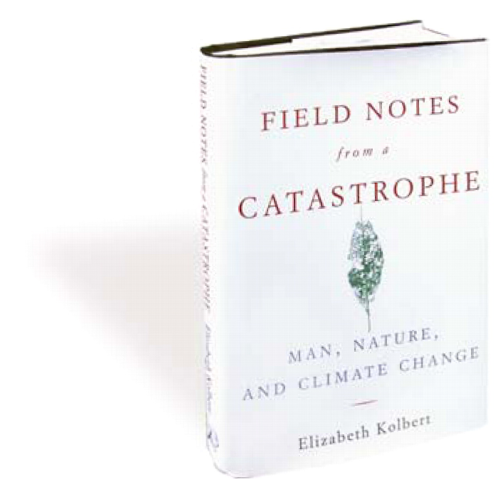
Elizabeth Kolbert, a staff writer with the New Yorker, has produced a powerful and elegantly crafted polemic on the threat of climate change. Drawing on an extended set of her feature articles, she focuses on the Arctic, graphically describing the catastrophic impact of rising temperatures on both Inuit communities and the permafrost (frozen soil). She extends this analysis to the receding glaciers in Iceland and the even more alarming shrinking of sea ice across the Arctic Ocean.
Kolbert's narrative is further enhanced by her discussion of past climate changes, wherein she skillfully compresses millennia of meteorological history into a few pithy dramatic examples. She vividly describes the chaotic world during the last Ice Age that ended 10,000 years ago, citing evidence that has emerged from ice cores taken from the ice caps of Greenland and Antarctica. And she explores the history of the Middle East around 4,000 years ago to illustrate the fragility of human endeavors in the face of even relatively small perturbations in climate. During that period, she recounts, a major drought led to the sudden collapse of the Akkadian Empire in Mesopotamia and the Old Kingdom in Egypt.
Armed with analysis and emboldened by the ratification of the Kyoto Protocol by 163 countries, Kolbert argues that action across the board can–and must–start now.
This evidence of past instability is set against the emerging understanding of contemporary climate change. Here Kolbert presents the view, which is espoused by the great majority of climate scientists, that the principal cause of the sharp rise in global temperature in recent decades is human activities–the most significant being the emission of greenhouse gases, of which carbon dioxide formed by the combustion of fossil fuels is the dominant contributor. This analysis predicts that the greatest temperature rise will occur in the Arctic, dramatically reducing the extent of polar sea ice and accelerating the melting of the Greenland ice sheet. The latter will add appreciably to rising sea levels around the world.
This scenario inevitably begs the intractable question of what can be done to prevent the coming catastrophe. This task might be achieved if humanity could address the challenge of limiting emissions of carbon dioxide so that atmospheric levels do not exceed 500 parts per million (roughly twice the pre-industrial level). To that end, Kolbert draws upon the work of Stephen Pacala and Robert Socolow, both at Princeton University's Carbon Mitigation Initiative, who argue that we already possesses the fundamental scientific, technical, and industrial know-how to solve the carbon and climate problem for the next half-century. A portfolio of technologies now exists to meet the world's energy needs over the next 50 years and limit atmospheric CO2 to a trajectory that avoids a doubling of the pre-industrial concentration.
Armed with this analysis and emboldened by the ratification of the Kyoto Protocol by 163 countries, Kolbert argues that action across the board can–and must–start now. Yet, amid this urgency she skims over the considerable obstacles to implementing these solutions. Certainly, some will be an easier sell than others. For instance, renewable sources of energy are likely to enjoy greater acceptance than ever before, thanks to rising oil prices, dependence on foreign oil imports, and residual fears of nuclear power.
When it comes to energy prices, politicians are tiptoeing through an electoral minefield–particularly when it comes to transportation. Socolow and Pacala propose that every car in the world must be driven half as much as today and become twice as fuel efficient in order for automobiles to make a proportionate contribution to stabilizing carbon emissions. That first objective will almost certainly require such measures as higher gas taxes (to reduce demand), road pricing, and limited access to cities. The second goal is more achievable, providing that motorists would be willing to give up their obsession for gas-guzzlers and SUVs, and drive smaller vehicles. Nevertheless, the chance of developed nations (particularly the United States) adopting fiscal measures to curb energy demand is, to say the least, unlikely to happen in the short term.
So, how are politicians going to justify their continued prevarication? As always, they will find solace in “what if” questions. The first of these: What if the recent warming is not principally due to anthropogenic effects? There is a vocal minority of climatologists, not all of whom are in the pay of the oil companies, who contend that some vitally important issues are being overlooked in the desire to achieve consensus. This view holds that observed change, to a considerable extent, may be due to natural implicit variability of the climate or external influences, such as fluctuations of solar radiation.
And if that line of argument fails, there's always the second question: What if other human activities are equally significant? Again the majority of the climatology community cites human emissions of greenhouse gases as the principal culprit. There are, however, questions as to whether other activities have been adequately considered. One such question is the impact of changes in land use. Another is how the production of aerosols and particulates alters the properties of clouds: a powerful, but unquantified influence on climate change.
Although these doubts reflect the minority view among climate change researchers, they are attractive to a general public conditioned by the personal conviction that we cannot predict the weather, or by a deep-seated skepticism of doomsaying “experts.” So, when push comes to shove, politicians are unlikely to incur the wrath of voters by curbing personal freedoms or introducing higher taxes. Even the British government, which has been a committed supporter of the Kyoto targets, twice backed off a long-term commitment to raise the tax on gasoline in line with inflation when opposition reached uncomfortably high levels.
None of this will damage the prospects of Kolbert's book, which is likely to be widely quoted alongside former Vice President Al Gore's documentary An Inconvenient Truth as providing cogent reasons for immediate action on carbon emissions. Whether politicians continue to prevaricate about taking painful decisions will, however, be defined by future climatic events. Unfortunately, as the institutional weaknesses exposed with the flooding of New Orleans by Hurricane Katrina have revealed, by then a damascene conversion will be too late.