




Abstract
Poorly secured nuclear materials at sites across the United States present a grave risk. So why hasn't the Energy Department taken its own advice and consolidated operations?
The classified post-incident report read like the script of a bad action film. In the dead of night, a team of terrorists infiltrated Los Alamos National Laboratory's sensitive Technical Area-18 (TA-18), shot their way past guards, and entered Kiva-3, one of three on-site assembly buildings where nuclear fission experiments are conducted. Once inside, the terrorists found what they had come for: two large plates of highly enriched uranium (HEU).
Site of the “attack”: Los Alamos' Technical Area-18 in 2002, prior to the removal of its highly enriched uranium and plutonium.
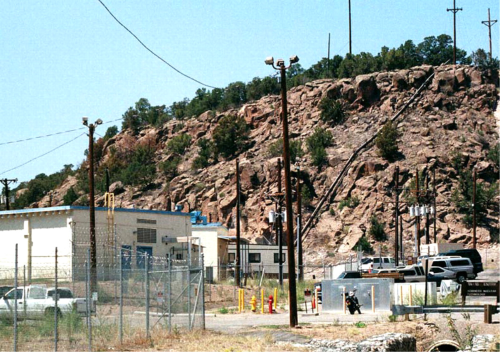
They unbolted the heavy plates, placed one on the floor, and held the other 6 feet above it. Months of planning came to fruition as they dropped the plate, initiating a chain reaction. In the blink of an eye, a nuclear “flash” nearly the size of the Hiroshima blast lit up the black desert sky for miles around.
Or so the story went.
The 2000 report, published by the Energy Department's independent oversight office, merely detailed the results of a force-on-force security test at Los Alamos in New Mexico, in which faux attackers used conventional means to devastate TA-18's underprepared security force. The fake scenario led to real change; the possibility of terrorists creating an improvised nuclear device (IND) at a U.S. facility helped drive the typically recalcitrant Energy Department to de-inventory TA-18 of all its HEU and plutonium at the end of 2005.
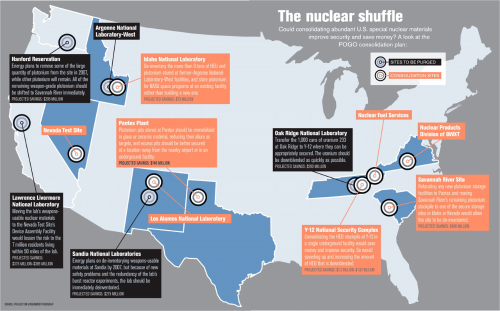
At nearly a dozen other sites in the continental United States, such “special nuclear materials” (SNM) remain attractive targets for terrorists. Up to a ton of plutonium, for example, remains at Lawrence Livermore National Laboratory in California; 9 tons of HEU and plutonium are stored at Idaho National Laboratory; and about 80 tons of plutonium are stored at the Savannah River Site in South Carolina.
Perhaps the most dangerous collections of special nuclear materials exist at two Energy facilities in Tennessee: Oak Ridge National Laboratory and the Y-12 National Security Complex. At Oak Ridge, Energy stores 1,000 cans of uranium 233 (a fissile isotope produced by irradiating the slightly radioactive material thorium) in a hard-to-secure building, where the uranium awaits down-blending into a less dangerous form. Though an isotope derived from uranium 233 holds great promise as a cancer treatment, uranium 233 also poses a serious threat, because like HEU, which has a high concentration of fissile uranium 235, it can be used to create an IND.
At Y-12, an 811-acre compound where Energy manufactures HEU components, the department maintains the world's largest repository–400 metric tons–of metallic HEU, the easiest material with which to make an IND. 1 Public officials have complained that the plant has too many structures and too small a buffer zone to secure it properly, and timeline tests conducted by both on-site and Energy security teams have shown that during an attack, intruders could get from the plant's outside fence to inside one of the six HEU storage buildings in the time it takes to microwave a cup of coffee.
Linton Brooks, the head of the National Nuclear Security Administration (NNSA), the semiautonomous branch within Energy that manages the U.S. nuclear weapons complex, acknowledged in April 2004 that Y-12 has “some of the most difficult security problems” in the complex. “[Its] facilities were built in the early days of the Cold War with no thought of the kind of threat we have now,” Brooks told Connecticut Republican Cong. Christopher Shays during a April 27, 2004 Government Reform subcommittee hearing.
There is widespread agreement among intelligence analysts, security experts, and the scientific community that one of the best ways to increase the security of special nuclear materials is to consolidate them into fewer, better-defended sites. Yet while the U.S. government continues to spend considerable effort and money reducing the vulnerability of poorly protected nuclear material in the former Soviet Union and other countries, Energy and Congress are failing to adequately address the risks posed by material on their own shores.
DIY nukes
Security gaps at U.S. nuclear weapons labs have been an ongoing source of concern. In a 2003 interview, Richard Levernier, who led war games on behalf of the U.S. government, recalled: “In more than 50 percent of our tests at the Los Alamos facility, we got in, captured the plutonium, got out again, and in some cases didn't fire a shot because we didn't encounter any guards.” 2 During a 1997 exercise at TA-18, U.S. Army Special Forces managed to haul away 136 kilograms (300 pounds) of HEU in a garden cart purchased at a nearby Home Depot.
The September 11, 2001 attacks added a new variable to the calculus of security at weapons labs, since they revealed that large terrorist organizations were willing and able to coordinate complex suicide operations with the goal of inflicting mass casualties. Suddenly, the nightmare scenario confronting Energy was not merely theft of nuclear materials, but the possibility that terrorists might barricade themselves within a facility and use available nuclear materials to quickly construct a crude weapon. Several facilities with special nuclear materials sit in such close proximity to large cities that even a “partially successful” terrorist attack could cause collateral damage to the surrounding civilian population, according to a 2005 Secretary of Energy Advisory Board task force report known as the “Overskei Report.” 3 In the case of Lawrence Livermore, exurban sprawl from the San Francisco Bay Area has ballooned to the point that homes stand literally across the street from the lab's fence line, and 7 million people live within 50 miles of the lab.
Terrorists might use conventional explosives to create a radiological dispersion device (RDD)–a so-called dirty bomb–that would spread radioactive material over a wide area. A worst-case analysis conducted by Energy at one of its sites revealed that an RDD could result in a dispersal of plutonium that would contaminate several hundred square miles and ultimately cause thousands of cancer deaths. 4
Alternatively, it is not inconceivable that terrorists might construct an IND. Estimates as to how much HEU terrorists would need to create such a weapon vary from 40 to 90 kilograms (88-198 pounds), although the precise means by which an IND might be detonated remain classified. Physicist Luis Alvarez, a senior weapons designer at Los Alamos during the Manhattan Project, once suggested, “If separated HEU is at hand, it's a trivial job to set off a nuclear explosion.” Physicist Frank von Hippel, a professor at Princeton University's Program on Science and Global Security, has confirmed at least one crude method: Dropping a 100-pound mass of weapon-grade uranium on a second 100-pound mass, from a height of about 6 feet, could produce a chain reaction yielding a blast of 5-10 kilotons. Finding pieces of uranium that size is unlikely, he noted. 5 But the potential level of destruction renders this a scenario that cannot be readily dismissed. A 10-kiloton IND could kill hundreds of thousands of people, and “approximately 8,000 square kilometers (3,000 square miles) of land will have to undergo varying degrees of decontamination,” according to Department of Homeland Security national planning scenarios.
Indeed, Energy has long acknowledged this threat. A 1994 security manual directed sites to institute a “denial strategy” to prevent “an unauthorized opportunity to initiate or credibly threaten to initiate a nuclear dispersal or detonation, or to use available nuclear materials for on-site assembly of an improvised nuclear device.” 6 Although Energy took some immediate steps to further improve physical security following 9/11, it wasn't until 2003 that it completed a comprehensive reassessment of its security at sites with IND concerns. As the Government Accountability Office (GAO) noted in 2004, “During this extended period, Energy's sites were only being defended against what was widely recognized as an obsolete terrorist threat level.” 7
The September 11,2001 attacks added a new variable to security at weapons labs.
Suddenly, the nightmare scenario confronting the Energy Department was not
merely theft of nuclear materials, but the possibility that
What's more, the GAO gave failing grades to the supposedly new and improved security measures. Energy was preparing for a large-scale terrorist attack exclusively at sites that handle nuclear weapons. But the sites containing special nuclear materials were prepared to deal with only a small terrorist force, effectively ignoring recommendations for a more robust defense that were made by the U.S. intelligence community.
So, in September 2004, it was back to the drawing board. Energy issued new directives that security forces be required to repel more than three times the number of attackers that they were required to protect against prior to 9/11. Furthermore, security forces will act under the assumption that adversaries will be using far more lethal weapons and much larger truck bombs than previously considered. These enhanced standards, however, will not be fully implemented until 2008.
In the meantime, the price tag of these new security measures is creating a significant burden on Energy's budget. The cost of Energy's security programs rose to $1.5 billion in 2007 alone. The NNSA estimates that for its seven sites, the improvements in security will cost $500 million a year in manpower. This figure doesn't even include further technological upgrades such as more secure storage facilities, activated barriers, high-tech sensors, cameras, and other infrastructural improvements. (For instance, a line of two fences with sensors and cameras between them would cost each site, on average, $14,000 per linear foot.) As such, Energy Secretary Samuel Bodman has noted that the growing cost of security “tends to call for consolidation” within the complex.
All together now
The concept of consolidation is hardly heretical. NNSA spokesman Anson Franklin succinctly summarized the argument last year: “By putting more of the materials in fewer places, you simply reduce security risks and therefore reduce the costs of securing materials.” 8 But consolidating the nuclear complex has always proven to be more difficult than it appears.
Since the late 1990s, and indeed even earlier, report after report made the case for consolidation. The classified January 21, 1999, “Internal Report to the Secretary: Special Security Review” (otherwise known as the “Hagengruber Report”) recommended consolidation and building underground storage facilities at Y-12 and the Savannah River Site. A May 2005 independent review of NNSA security led by retired Adm. Richard W. Mies found that Energy and NNSA lacked “an enterprise-wide plan for consolidation of special nuclear material” and recommended that they “seek to make greater use of underground storage.” 9 The Project on Government Oversight (POGO), a nonprofit government watchdog organization for which the authors work, also released a report in 2005 that recommended the consolidation and downblending of special nuclear materials to improve security and save an estimated $2.7 billion over three years (see “The Nuclear Shuffle,” at right). And the Overskei Report made the radical recommendation of “consolidating all Category I and II SNM” (high- and medium-risk nuclear materials) and nuclear weapon “primary and secondary components” to one facility, a proposed Consolidated Nuclear Production Center, to “reduce the security costs… and the overall threat to the complex.”
Despite consolidation's security and fiscal common sense, Energy has moved slowly to implement many prescribed changes. “The Department of Energy is a dysfunctional bureaucracy that has proven itself incapable of reforming itself,” the President's Foreign Intelligence Advisory Board bluntly concluded in 1999. Little has changed since to alter that assessment. 10 A 2005 GAO report on Energy's plutonium consolidation program criticized the department for failing to develop a coherent complex-wide plan and for relying on “individual sites to independently develop plans” that proved to be incompatible with one another. 11
Entities within Energy can't even agree on who is responsible for paying for disposal of certain excess nuclear materials. The Office of Energy, Science, and Environment (ESE) claims the uranium 233 at Oak Ridge is NNSA's problem, even though Oak Ridge is an ESE site. Similarly, ESE has no plans to deal with the remaining plutonium at the Hanford Site in Washington State, as it is left over from NNSA experiments at Los Alamos.
Parochial interests also have thwarted consolidation initiatives. The weapons labs provide tens of thousands of jobs in communities across the country, and the politics at play are akin to the struggle to close military bases. The labs–trying to prove their post-Cold War relevance and already under siege owing to egregious cases of mismanagement–view consolidation as the latest threat to their livelihoods. It's small wonder that the Overskei Report got a cool reception from New Mexico Republican Sen. Pete Domenici, whose state is home to both Los Alamos and Sandia. “I do not think we should rush into quick fixes,” Domenici said. He saw to it that Congress would allocate a paltry $5 million to study consolidation in the fiscal 2006 budget. Meanwhile, Los Alamos just began construction of a $1 billion plutonium research center, which won't be completed until 2017–just seven years before Energy supposedly plans to completely remove plutonium from the facility.
Similar dynamics are apparent at Lawrence Livermore, where the lab's prized project is the National Ignition Facility (NIF). As originally conceived, the NIF will use 192 high-powered laser beams to mimic the thermonuclear detonation of a hydrogen bomb within a sealed chamber. But technical obstacles and cost overruns–the price tag for construction has grown from less than $1.2 billion to an estimated $4.6 billion–have incurred the wrath of Capitol Hill. Nowadays, “the anxiety du jour [at Livermore] has to do with losing plutonium facilities,” says anthropologist Hugh Gusterson, who has studied the culture of nuclear weapons labs. 12 As Phil Coyle, former deputy director at Livermore, once explained, “If they have to reduce materials at Livermore to the point where they can't do their work, then people will ask why everything just can't be done at Los Alamos.” 13
As such, Livermore and its supporters were alarmed when, in May 2004, then-Energy Secretary Spencer Abraham expressed his desire to remove plutonium from the site. California Democratic Cong. Ellen Tauscher, whose district includes Livermore (and around 8,700 lab employees), acknowledged that “there is excess nuclear material at Lawrence Livermore National Laboratory that can be removed if another location is found to store it,” but added that “some special nuclear material must remain at the laboratory if it is to perform its essential national security mission.” 14
Yet the only Livermore studies that currently require special nuclear materials, concerning aging plutonium and cracked plutonium pits for nuclear warheads, could also be completed at the Nevada Test Site's easier-to-defend, belowground Device Assembly Facility. As the Mies Report notes–implicitly fingering Livermore–the rationale for maintaining the status quo in storing Category I and II quantities of plutonium and HEU is weak: “It appears that some SNM [are] being stored at some Energy/NNSA sites more for convenience than necessity…. Moving this material to more secure and remote sites, and bringing the scientists and mission to the material, would decrease the number of storage locations and consolidate SNM in more secure, unpopulated areas.” 15
In April 2006, Energy finally decided to de-inventory Livermore of Category I and II quantities of special nuclear materials. But critics note that the decision isn't legally binding and that the de-inventorying deadline isn't until 2014, four years after the House Armed Services Committee, which authorizes funding for the labs, wants “national security laboratories” free of nuclear bomb materials. 16
Energy's current consolidation plans call for at least a two-stage move of Livermore's plutonium operations, first to a new facility at Los Alamos and then to another new facility at the Nevada Test Site in the early 2020s. In its 2007 report on energy and water development appropriations, the House Appropriations Committee criticized this plan as “irrational” and honed in on Energy's bureaucratic inertia: “It appears designed to maximize future budgets and the number of new facilities required, rather than provide an efficient balancing of required capabilities, limited resources, and programmatic risk.”
Adding to the confusion: Despite Energy's claims that it intends to de-inventory Livermore, last December NNSA announced it would double the amount of plutonium allowed at the facility from 700 kilograms (1,540 pounds) to 1,400 kilograms (3,080 pounds). The San Francisco Chronicle reported that this change “will allow plutonium from other nuclear sites, including Los Alamos National Laboratory in New Mexico, to be shipped to Livermore for the lab's program of studying longterm decay of nuclear bomb parts and finding ways to maintain the bombs.” 17 Meanwhile, Livermore has beefed up security, installing powerful Gatling guns to deter potential attackers–suggesting that the plutonium is not leaving the Bay Area anytime soon.
Design flaw
As part of its overarching plan for the complex, Energy announced earlier this year that it plans to downblend the entire uranium 233 stockpile at Oak Ridge. While this is welcome news, until the operation is complete–no deadlines have been set yet–the material continues to present a serious risk thanks in part to out-of-date security measures.
Absent from Oak Ridge's security system are some fundamental protections: a double fence line with sensors and cameras between them, an adequate number of guards, and a Special Response Team (SRT)–an on-site security team with SWAT capabilities. Those guards that are at Oak Ridge are not even as effective as they need to be. In June 2005, Energy Inspector General Gregory Friedman reported that Oak Ridge security officers, on average, trained 40 percent less on combat readiness than dictated by the federal requirements. 18 This training deficit was made glaringly apparent a year earlier, when lab security officers failed a self-assessment force-on-force test in which Y-12 SRT members acted as attackers, successfully breaching security at the lab and “killing” the entire Oak Ridge protective force in 90 seconds, according to Energy security officials.
Energy has promised to improve security at the site, and in March NNSA chief Brooks testified that all sites will meet the requirements of the improved 2003 design basis threat (the standards that site security must be able to defend against) “by the end of this fiscal year.” Yet this is far from true for Y-12. Energy plans to give the facility a waiver for meeting certain critical security requirements, including the capability to deny access to terrorists, until it builds a new HEU storage facility that will, at last count, cost $500 million, according to a knowledgeable government official. How long this delay will extend, no one is sure. Energy began building the new storage building–the Highly Enriched Uranium Materials Facility–in 2005, and the project has struggled with cost overruns, multiple delays, and questions about the security of its design.
The contractor that previously operated the site planned to build an underground or bermed HEU storage facility that would be less vulnerable to terrorist attacks than an aboveground facility. (Virtually all modern nuclear material storage facilities are underground, including the Nevada Test Site's Device Assembly Facility and KUMSEC, an underground nuclear weapons storage facility at Kirtland Air Force Base in New Mexico.) Yet in 2004, Y-12's current contractor, BWX Technologies Inc., changed the plan, claiming that an aboveground facility would be more secure. The Energy inspector general criticized the design and the then-$313 million cost estimate of this new building; the bermed facility had a price tag of $250 million.
As for the rest of the weapons complex, unless Congress maintains diligent oversight and Energy leadership sets deadlines that aren't two administrations or more down the road, attempts to consolidate will undoubtedly get caught in bureaucratic molasses. Lamenting the current state of affairs, Ohio Republican Cong. David Hobson noted in the 2007 House Appropriations Committee budget report that Energy intends “very limited reform” and “only enough material consolidation and dismantlement to keep Congress satisfied.”
“In this committee's view,” Hobson continued, “the department missed that mark by a wide margin.”
Supplementary Material
Science at its Best, Security at its Worst: A Report on Security Problems at the U.S. Department of Energy
Supplementary Material
Nuclear Security: DOE Needs to Resolve Significant Issues Before It Fully Meets the New Design Basis Threat
Footnotes
1.
Charles D. Ferguson and William C. Potter et al., The Four Faces of Nuclear Terrorism (New York: Routledge, 2005), p. 120.
2.
Eric Herman, “Security Gaps Seen at U.S. Nuke Sites,” New York Daily News, October 7, 2003.
3.
David Overskei et al., “Recommendations for the Nuclear Weapons Complex of the Future–Report of the Secretary of Energy Advisory Board Nuclear Weapons Complex Infrastructure Task Force,” July 13, 2005, p. 18.
4.
Government Accountability Office, “Nuclear Security: DOE Needs to Resolve Significant Issues Before It Fully Meets the New Design Basis Threat,” April 2004.
5.
Matthew L. Wald, “Suicidal Nuclear Threat Is Seen at Weapons Plants,” New York Times, January 23, 2002, p. 9.
6.

7.
Government Accountability Office, “Nuclear Security,” April 2004.
8.
Christopher Smith, “Nuclear Weapons Fuel May Move to a Few Secure Places,” Associated Press, May 20, 2005.
9.
10.
11.
Government Accountability Office, “Nuclear Security: Poor Planning Has Complicated DOE's Plutonium Consolidation Efforts,” October 7, 2005.
12.
Interview with Hugh Gusterson.
13.
Ralph Vartabedian, “Removing Nuclear Material from Livermore Examined,” Los Angeles Times, May 8, 2004.
14.
Zachary Coile, “U.S. Wants to Remove Plutonium from Lab,” San Francisco Chronicle, May 8,2004.
15.
Mies Report, p. 12-2.
16.
House Armed Services Committee, “National Defense Authorization Act for Fiscal Year 2007 Report 109-452,” May 5, 2006, p. 461.
17.
Keay Davidson, “Nuclear Lab Gets OK to Double Plutonium,” San Francisco Chronicle, December 1, 2005.
18.
Office of Inspector General, Energy Department, “Protective Force Training at the Department of Energy's Oak Ridge Reservation,” June 2005.