




Abstract
For more than 25 years, Dutch businessman Henk Slebos played a key role in A. Q. Khan's procurement network. Last year a court convicted him–but the damage was already done.
A break in the case came in 1993. For several years, German Customs agents had been tailing a businessman named Ernst Piffl. Then, one day at Stuttgart Airport, they seized some cigar box-shaped crates containing what Piffl had declared as semi-manufactured spindles for making ballpoint pens. The goods were to be shipped to a buyer in Pakistan. After German Customs sifted through all the records in the case, it discovered that Piffl, the director of a small engineering company called Team Industries Maschinen-, Handels-, und Vertriebsgesellschaft, had been shipping this equipment to Pakistan since 1988.
German intelligence and counterintelligence agencies did their homework. They found out that, for about two decades, Piffl had known Abdul Qadeer Khan, the father of Pakistan's nuclear program. The two men had exchanged faxes, family photographs, and greeting cards.
Analysts from the Zollkriminalamt (ZKA), Germany's customs intelligence agency, and then experts from Urenco, a British-Dutch-German uranium enrichment consortium, closely examined what was inside Piffl's boxes. They confirmed that the crates contained unfinished machined parts called “preforms,” in this case segmented, narrow aluminum tubes about 15 centimeters long. But the parts weren't to be processed into ballpoint pens. They were preforms for little tubes called scoops. When carefully positioned inside a gas centrifuge, the scoops collect and withdraw the separated particles of enriched uranium from inside the spinning rotor.
In 1998, Piffl was convicted of having exported centrifuge parts to Pakistan in violation of German export control laws. He received a 45-month jail sentence. When the trial was over, Piffl said he “regretted” having contributed to Pakistan's nuclear weapons program. 1
Then Khan's nuclear procurement network made a mistake that blew their cover.
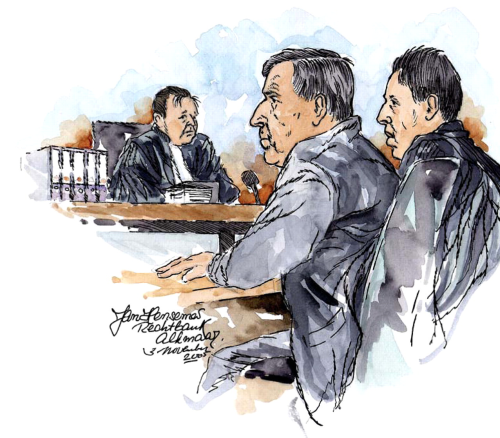
Day in court: A sketch of Henk Slebos (front) during his trial on November 3, 2005.
At the conclusion of his trial, Piffl blurted out that he had begun cooperating with the Bundesnachrichtendienst (BND), Germany's foreign intelligence agency. He helped BND keep track of Pakistan's efforts to supply its nuclear weapons program with imported German materials and equipment.
That was bad timing for Khan. His nuclear network was about to go big time, serving not only Pakistan's established nuclear program but also other centrifuge enrichment efforts getting under way in Libya, Iran, and North Korea. During the second half of the 1990s, the shopping list of goods Khan sought to feed these programs began getting longer and longer. Voracious procurement officials in Islamabad and Rawalpindi left no stone unturned in hunting for centrifuge materials and parts. They took risks. As its appetite grew, the Khan network became increasingly careless.
Despite the revelation that Piffl publicly switched sides in the global effort to stem nuclear proliferation, the Khan network returned to Team Industries in 2000 and again in 2001. Procurement officers working for Khan Research Laboratories (KRL), the organization Khan set up to head Pakistan's uranium enrichment program, posted orders to Karlstraße 26 in Leonberg–which had been the address of Piffl's firm when he was shipping goods to Khan during the 1980s and early 1990s. Now however, BND and ZKA were reading Piffl's mail.
They learned that the logistics for one equipment order in 2001 were to be organized by an intermediary who was identified as a Dutch national named Henk Slebos. German authorities informed their counterparts in the Netherlands of the finding. Both countries were soon to be brought into a closely held international effort led by U.S. and British intelligence to shut down Khan's ever-more globalized procurement empire, as it spread into China, Japan, South Korea, Malaysia, South Africa, Turkey, and the former Soviet Union.
The intercepted order yielded another vital piece of evidence. This time, KRL wasn't trying to buy preforms for centrifuge scoops, but for a certain type of ball bearing. KRL had provided the hardness requirements for a specific chrome steel alloy, and also the diameter–just a hairsbreadth over 4 millimeters. These technical specifications represented an electrifying breakthrough: They matched data for a crucial component in classified Urenco centrifuge design blueprints–the very same blueprints that Dutch intelligence concluded 25 years earlier that Khan misappropriated while working in the Netherlands.
In April 2004, Dutch Customs agents raided Slebos's office in Sint Paneras, a small town near Alkmaar. They confiscated and sifted through reams of files and found enough evidence to permit prosecutors in nearby Haarlem to charge Slebos in May 2004 with having illegally exported an array of dual-use goods to Pakistan–part of a nuclear black market that had been decades in the making.
In 1972, Khan went to work for Fysisch Dynamisch Onderzoek (FDO), a consultant for Ultra-Centrifuge Nederland (UCN), the Dutch partner in the Urenco commercial enrichment program. He returned to Pakistan in late 1975 with a treasure trove; Dutch intelligence concluded that Khan had misappropriated design blueprints from the Urenco program. It was easy pickings. The blueprints for G-2, one of Urenco's centrifuges, had been thumbtacked on to the wall at the shop where Khan worked.
Word about Khan's procurement activities in Europe became public a few years later when, in July 1978, Frank Allaun, a British Labour Party MP, raised a question in the House of Commons about parts being exported by a British firm that would enable Pakistan to acquire nuclear weapons. Shortly thereafter, a German TV report suggested Khan had been involved. The Hague then began intently tracking public reaction.
Dutch diplomatic correspondence and internal files from the ministries of foreign affairs and economics reveal that the Dutch government was anxious to downplay the ramifications of Khan's association with the Urenco program. The suspicion that Khan left Europe with Urenco's know-how to make weapon-grade uranium in Pakistan couldn't have arisen at a more delicate time for The Hague's own nuclear energy plans. In addition to uranium enrichment, Dutch scientists were interested in collaborating with foreign counterparts on breeder reactor development and international projects to develop a commercialized plutonium fuel cycle.
Beginning in 1976, however, U.S. President Jimmy Carter raised objections to ambitious plans for fissile material production in Europe. In response, the International Atomic Energy Agency (IAEA) organized the International Fuel Cycle Evaluation (INFCE), which sought to hammer out an agreement on measures that could allow for the further development of nuclear energy without increasing the risk of nuclear weapons proliferation. Before the review process began, the United States battled with France over its plan to help Pakistan separate plutonium and with Germany over its aim to share uranium enrichment know-how with Brazil. In April 1979, after the U.S. government briefed The Hague about what it had learned about Khan's activities in Pakistan, the Dutch Foreign Ministry warned other agencies that the U.S. information “must be handled with sensitivity … above all it is grist to the mill of all those countries which don't share the basic idea of INFCE.” 2
Some diplomatic cables reported on speculation that the “Khan case,” as official documents started to term it, might bring down the Dutch government. The Dutch Foreign Minister told the Ministry of Economic Affairs in one confidential memo that “also for political reasons … it is of the highest priority [to make known] that from the Netherlands there is not a single contribution to the Pakistani effort.” 3 An interim report on the government's investigation of Khan's activities in May 1979 accordingly underscored that FDO hired Khan under “normal procedures” and that he had been vetted by Dutch security agencies. In the Netherlands, it said, Khan had access only to “non-essential aspects of [Urenco's] centrifuge technology and research.” 4
In 1979 and 1980, the Dutch government prepared two reports on the outcome of its four-year internal investigation of the Khan affair. One report was unclassified and delivered to the Dutch Parliament. 5 It hinted that Pakistan first began enriching uranium on the basis of design information from a Dutch centrifuge called the Commercial Nuclear Obreptitious Rotor (CNOR). Later, Pakistan graduated to a centrifuge based on G-2, a German Urenco model. 6
A second Dutch government report at the end of its investigation was not made public. It contained information from dossiers showing that, contrary to the government's damage control efforts, Dutch intelligence and security agencies suspected Khan of stealing data several months before he left the Netherlands in late 1975. They also document that the harm from Khan's participation in the Urenco centrifuge program was immense. These reports concluded that Khan could have obtained virtually all the design data for both the CNOR and G-2 centrifuges, plus some data for another UCN machine on the drawing board, the 4-M. 7
Shortly after Khan left the Netherlands for Pakistan, investigators found some CNOR blueprints at a company called Van Doorne Transmissie (VDT). Khan interacted with this firm after FDO assigned him the task of solving certain engineering problems together with equipment manufacturers. Intelligence reports reveal that Dutch investigators were certain that Khan personally gave VDT the set of CNOR blueprints, but they could not prove that Khan had stolen them.
What friends are for
Included in the CNOR blueprints found at VDT were four engineering drawings from 1973 for a critical part known as the bottom bearing. Slight variations in the dimensions given in these drawings corroborated the statement of a former Urenco official who told me in 2002 that when Khan went to Pakistan in 1975, the design in that set of CNOR blueprints “wasn't frozen. We knew soon thereafter that if Khan was going to try to build CNOR, he was going to have to do some more work on the machine.”
The CNOR bottom-bearing schematics are a testimony to the skill and ingenuity of Urenco engineers. The diameter of the bearing is precisely given in microns (millionths of a meter), and in some drawings the manufacturing tolerances are given in tenths of microns. The bearing is one of the most critical and difficult-to-produce components of a Urenco gas centrifuge. In simple terms, it is essentially a tiny ball, the size of a small round screwhead, stuck onto a needle, and attached to the end cap at the bottom of the rotor tube. The needle supports the weight of the centrifuge as it rotates at terrific speeds of hundreds of meters per second. The bearing contains a nearly invisible spiral groove, specified to meet the requirements for complex mathematical friction equations, etched into its lower surface. The groove maximizes the efficiency of the bearing as the centrifuge spins on its axis in a small cup of lubricant in which the bearing sits.
Superb engineering was required to develop this technology over a period of several decades. Urenco officials told me that its centrifuges must be so finely balanced that if there are any fingerprints on the rotor tubes, or if the lower bearings are even slightly irregular, they will tilt after they start up, and then crash. The originally estimated lifetime of the early vintage Urenco centrifuges was about 10 years. Most of these centrifuges–which were installed at Urenco's uranium enrichment plants at Gronau in Germany and at Almelo in the Netherlands shortly after Khan obtained the design information–are still spinning on their bottom bearings after a quarter century of virtually uninterrupted operation.
The exact dimensions, manufacturing tolerance data, and associated know-how for these centrifuges are the most highly classified national security-related and strategic industrial secrets in both the Netherlands and Germany. (During the 1990s, when experts who were previously involved in the Urenco program were suspected of having sold the design know-how to Iraq before the first Gulf War, they faced charges of high treason in Germany.) Eventually, this design data would yield clues that would support Dutch authorities' prosecution of Slebos and help shut down one of Khan's most active procurement sources.
When Slebos went on trial in 2004, he was 61 years old and a known commodity in the murky world of Dutch Customs investigations. Like Piffl in Germany, Slebos had known Khan for several decades. Both men were engineers. They became friends in the 1960s while studying metallurgy at the Technical University of Delft. During the 1970s, when Khan was working for FDO in the Netherlands, Slebos worked on a variety of projects, including a stint as an explosives consultant for a firm that also did work for Urenco. Slebos went to Pakistan for the first time in 1976. Thereafter, he began solving logistics and procurement problems for his friend Khan.
After the Dutch government concluded its initial internal investigation of Khan's activities and contacts in 1979, The Hague suspected that Slebos had been involved in exporting maraging steel tubes to Pakistan for the manufacture of centrifuge rotors. But the investigation of Slebos concerning the export of the tubes was dropped for lack of evidence.
However, in 1983 Slebos ran into serious trouble with Dutch export control authorities after he arranged for the re-export of a U.S.-made oscilloscope to Pakistan via Sharja in the United Arab Emirates. Judges sentenced Slebos to a year in prison, but in 1986 an appeals court reduced that penalty to a fine and a six-month suspended sentence because prosecutors failed to prove that the export was destined for Pakistan's nuclear program.
After Slebos's conviction, and throughout the 1990s and beyond, Slebos maintained contact with Khan's organization. His two firms–Slebos Research BV and Bodmerhof BV–exported a large amount of goods to clients in Pakistan. According to Dutch officials, the transactions for which Slebos was formally charged in 2004 represented just a small fraction of Slebos's business with KRL, the Institute of Industrial Automation (IIA), and other related procurement organizations for Khan in Pakistan. One investigator said last year that after customs officials dug out all the freight papers and orders for transactions between Slebos's firms and organizations identified as part of Khan's network since the early 1990s, “It looked as if they were making a shipment to Pakistan on the average of about once a week.”
By the time Slebos faced the 2004 charges on export control violations, information percolating from the ongoing worldwide intelligence investigation of the Khan network suggested that Slebos was also a 15 percent shareholder in a Turkish engineering firm, ETI. Suspects testifying to Malaysian police named this firm as having been involved in setting up, with Khan's partners, a centrifuge parts production shop near Kuala Lumpur to manufacture end caps and other equipment for a uranium centrifuge plant to be erected in Libya. 8
“If you looked at everything on the order books” one Dutch investigator said in 2005, “you would think they were outfitting a hardware store.”
After seizing Slebos's files in 2004, investigators also found that in 1999 he illegally re-exported to Pakistan U.S.-made manometers, which he purchased from a subsidiary of the manufacturer, MKS Instruments, Inc., in Belgium. The equipment is used by Urenco and by the United States Enrichment Corporation (which operates the only uranium enrichment facility in the United States) for monitoring the uranium gas flow and pressure in their enrichment plants. Slebos had been warned in advance not to re-export the equipment without an export permit. 9
In 2001, Dutch export control authorities also warned Slebos not to export a consignment of about 1,000 specialized plastic seals called O-rings that had been ordered by KRL. Before his 2004 trial, prosecutors strongly suspected that an associate of Slebos, Zoran Filipovic, who was also charged in the case, had put the rings into the trunk of his car and off-loaded the cargo in either Budapest or Belgrade, from where it was shipped to Pakistan, Dubai, or elsewhere. 10
Western intelligence officials said that the cumulative trail of evidence showed that KRL and IIA solicited Slebos and Filipovic to obtain a nearly endless assortment of wire, lubricants, valves, oils, industrial fasteners, seals, filters, tools, switches, compressors, torches, and other gear. “If you looked at everything on the order books,” one Dutch investigator said in 2005, “you would think they were outfitting a huge hardware store. We had no idea what most of this stuff was for.”
Dutch investigators were likewise baffled by Slebos's clients' efforts to acquire an array of bearings, which prosecutors included in their charge sheet in Slebos's 2004 arraignment. According to prosecutors, in 2002 Slebos shipped a small number of roller bearings, needle bearings, and ball bearings to IIA, after he ignored warnings not to export the items. Most of these bearings were off-the-shelf items made by well-stocked vendors such as SKF in Sweden. The bearings sought by Slebos, an SKF official said, “have hundreds of possible applications.”
Western officials believe that KRL may have ordered these bearings to disguise orders for truly critical bearing parts–the specifications of which exactly matched the technical data that German investigators had intercepted in the mailbox and fax machine of Piffl's engineering firm. Urenco experts consulted by Dutch authorities had no clue why the bearing hodgepodge was sought by Khan. But they knew immediately that the diameter of one specific chrome steel ball sought by KRL matched the diameter of the CNOR bottom bearing, to the micron, a finding that Dutch officials confirmed.
However, some pieces of the puzzle didn't seem to fit. Why was the Khan network now looking for parts for CNOR? U.S. intelligence had established back in the 1980s that Khan's centrifuge program in Pakistan had abandoned the aluminum CNOR centrifuge in favor of the more powerful G-2 steel machine. More recently, U.S. intelligence analysts determined that Pakistan had gone beyond G-2 and was focusing on still more advanced designs using carbon-fiber rotor tubes, a material that allows the rotors to spin four times faster than CNOR.
One possible explanation for the CNOR procurement was suggested by what U.S. and British intelligence were learning during the 1990s: The Khan network had been put to work for centrifuge enrichment programs in Libya and Iran. U.S. intelligence agents had penetrated Khan's efforts to set up a centrifuge parts factory in Malaysia. And they were confident that the template for this program was CNOR.
U.S. and British agencies briefed Malaysian security officials about this finding in November 2003. A report compiled by the Malaysian government after the briefing said that sample centrifuges flown to Libya from Pakistan in 2001 or 2002 were suspected to be “of the P-l model, i.e., a Dutch-designed model.” 11 Also during 2003, the IAEA likewise learned–though never disclosed in a public document–that the CNOR program provided key engineering parameters for P-1 centrifuges (“P” means “Pakistan”) set up by Iran at an enrichment plant under construction at Natanz. 12
To date, neither Urenco nor the IAEA has seen fit to acknowledge to the outside world that data from the CNOR program and its predecessor SNOR (Scientific Nuclear Obreptitious Rotor) were diverted to the centrifuge programs in Libya and Iran. CNOR is a so-called supercritical centrifuge, with several segments connected by a flexible bellows allowing it to overcome mechanical resonances and therefore spin faster and turn out more enriched uranium than a centrifuge based on a single-rotor tube. Urenco officials claimed to me in 2004 and again in 2005 that the P-1 centrifuge associated with the programs in Pakistan, Libya, and Iran instead resembled G-l, a very early and simple subcriticai German centrifuge with one rotor tube. Likewise, the only reference in official IAEA reports to its governing board about the provenance of the technology in these P-1 programs is a footnote to a document in 2004 that identified P-1 as G-l. A senior IAEA official and Western government experts told me in mid-2005 that the IAEA report was wrong. 13
In July 2001, the German government warned the Netherlands that Khan tapped Slebos to arrange for the procurement of the CNOR bearing preforms. It was too late. Four months earlier, Slebos's firms had shipped 10,000 of the parts, which were eventually obtained from an engineering wholesaler in Alkmaar and sent to ILA in Rawalpindi. Before the cargo was loaded into the hull of a Pakistan Airways international jet bound for Islamabad, Slebos's freight forwarder declared the items to Dutch Customs at Schiphol Airport in Amsterdam as undefined spare parts. Slebos billed ILA for another 10,000 preforms later the same year.
On December 16, 2005, the district court in Alkmaar convicted Slebos for illegal export of dual-use goods on five counts. In addition to the export of O-rings and manometers, the court found that Slebos violated Dutch export control laws in shipping graphite and triethanolamine (a precursor used to produce nitrogen-based chemical weapons) to ILA in Pakistan. Slebos was given a one-year prison sentence, which was reduced to four months, and he and his firms were fined 197,500 euros, about $237,000. 14 He is appealing the conviction. Slebos, however, was not convicted of any criminal offense for his assistance in obtaining the centrifuge bearing parts for IIA.
The Ministry of Economic Affairs is responsible for export controls in the Netherlands. When it was informed during the second half of 2001 of the German intelligence tip that Slebos had been asked by KRL to supply the bearing preforms, it fired off a written warning to Slebos not to export the equipment. It sent the warning on the basis of a so-called “catchall” clause on Dutch law books since 1996. In about 20 cases since then, the clause has been invoked to block shipments of Dutch goods to foreign consignees because authorities suspected that the end user was involved in the arms trade. Unlike other allegations of illegal dual-use exports, the Alkmaar court ruled that it was “not possible to prove” that Slebos received the catchall warning about the bearings before the parts were shipped. “The court acquitted [Slebos] on this point,” it said. 15
Slebos also benefited from another legal loophole. “When Piffl was convicted of exporting scoop preforms to Pakistan in 1998, officials from Germany's federal export office, the Bundesamt für Wirtschaft und Ausfuhrkontrolle (BAFA), said that the equipment qualified as virtually finished centrifuge parts–automatically triggering the requirement of a nuclear export license, which Piffl had not obtained. That was not the case for the bearing preforms that Slebos's firms shipped to IIA in 2001. “To put the scoop preforms in a centrifuge,” a BAFA official explained, “all they needed to do was bend them.” The bearing preforms, he said, “require more processing.” They do not formally qualify as bearings and therefore “don't automatically trigger nuclear export controls if you want to ship them to Pakistan or Iran.”
Processing the bearing performs is, in fact, not trivial. The biggest difficulty lies in using lasers or a photo template to etch the spiral groove into the lower half of the ball and then use electron beam equipment to weld the ball onto the needle, which is then attached to the rotor end cap. Urenco-country diplomats say that problems in these areas may have contributed to the failure of a large number of centrifuges that Iran set up in test cascades in recent years and then had to rebuild as late as mid-2006. “The problem is to impose a 3-D pattern on a curved surface using a negative without having creases,” one European expert says. Pakistan eventually learned how to finish the bottom bearing during the late 1970s and early 1980s. Now it's Iran's turn. “The task requires a certain finesse,” the European expert acknowledges, “but it's not beyond the wit of man.”
Footnotes
1.
Mark Hibbs, “Convicted Centrifuge Preform Exporter Had Kahuta Contacts for 20 Years,” Nuclear Fuel, September 7,1998, p. 14.
2.
Dutch Embassy, “Pakistan-India Nucleair,” note from Dutch Embassy in Islamabad to Ministry of Foreign Affairs, The Hague, April 3,1979.
3.
Foreign Minister Chris van de Klaaw to Ministry of Economic Affairs, internal memorandum, DIO/OV-58603-943GS, April 4,1979.
4.
“Pakistan en het Ultracentrifuge-Procede” (“Pakistan and the Ultracentrifuge Process”), May 10, 1979, Dutch government interagency memorandum, DIO/OV, Vr. 82-79.
5.
Tweede Kamer der Staten-Generaal (Second Chamber of the Estates-General), Meeting 1979-80, 16082, “Onderzoek Zaak-Khan” (“Khan Case Investigation”).
6.
David Albright and Mark Hibbs, “Pakistan's Bomb: Out of the Closet,” Bulletin of the Atomic Scientists, July/August 1992, pp. 38^13.
7.
Mark Hibbs, “Iran, Libya Centrifuge Probes Point to Extensive Know-How Theft,” Nuclear Fuel, January 3,2005, p. 1; Argos, VPRO Radio, January 14,2005.
8.
Jaco Alberts and Karel Knip, “Atoomhandel ging via Turkije” (“Nuclear Deal Went Via Turkey”), NRC Handelsblad, Februrary 27,2004, p. 3; Alberts and Knip, “Henk S., de Nederlandse Handelaar in Gevoelige Apparatuur en Materialen Uit” (“Henk S., the Dutch Trader in Sensitive Equipment and Materials”), NRC Handehblad, May 4,2004, p. 2.
9.
Mark Hibbs, “Pakistan Got U.S.-Ongin UF6-Resistant Gear,” Nuclear Fuel, February 28,2005, p. 1.
10.
Mark Hibbs, “Trial of Khan Suspect Marked by Procedural Errors,” Nuclear Fuel, July 11,2005, p. 13.
11.
“Press Release by Inspector General of Police in Relation to Investigation on the Alleged Production of Components for Libya's Uranium Enrichment Programme,” Polis Diraja Malaysia, February 20,2004.
12.
Hibbs, “Iran, Libya Centrifuge Probes Point to Extensive Know-How Theft.” See IAEA Board of Governors, “Implementation of NPT Safeguards Agreement of the Socialist People's Libyan Arab Jamahiriya,” February 20, 2004, GOV/2 004/12.
13.
Ibid.
14.
Alkmaar District Court, “Celstraf en boete voor Henk S.” (“Jail Sentence and Fine for Henk S.”), December 16,2005.
15.
Ibid.