




Abstract
Spying on the Bomb: American Nuclear Intelligence from Nazi Germany to Iran and North Korea, by Jeffrey T. Richelson. W. W. Norton, 702 pages, 2006, $34.95.
As the professor lectured, one listener in the audience paid particularly close attention. If he heard certain comments on an especially sensitive topic, he intended to draw his hidden handgun and shoot the professor before he left the building. Lectures seldom carry such violent potential, but here, in neutral Switzerland, 1944, was an extraordinary case. The professor was Werner Heisenberg, chief of Nazi Germany's atomic bomb program, and his would-be assassin was Moe Berg, Major League Baseball catcher-turned-agent for the U.S. Office of Strategic Services. Heisenberg gave no indication that Germany was close to completing a bomb, so Berg kept the gun stowed. In addition to highlighting Berg's colorful resumé, this story suggests that, just as the first atomic bombs were primitive by today's standards, so too were the early techniques of nuclear intelligence collection and covert action.
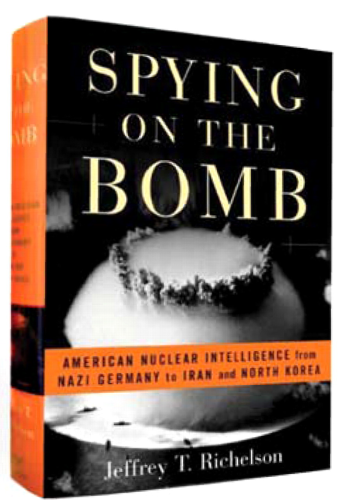
In Spying on the Bomb, Jeffrey T. Richelson, a senior fellow at the National Security Archive and a respected intelligence scholar, focuses on U.S. efforts to learn about every major proliferation case (with the exception of Britain) from World War II through fall 2005–both what each country was actually doing and what the United States thought they were doing.
For all the wondrous sophistication of satellites, air-sampling aircraft, and flash-measuring “bhangmeters,” there remains no substitute for human intelligence.
Richelson tells the story in exhaustive detail. It is difficult to conceive of a more thorough account, or one more prodigiously researched. His sources, reflected in 120 pages of notes, include participant interviews, a breathtaking range of secondary sources, and an impressive amount of declassified documents as well.
Across the many cases examined–from Germany and the Soviet Union, through China and France, on to the trio of the nuclear pariah states of Israel, South Africa, and Taiwan, to India and Pakistan, and finally on to Iraq, Iran, and North Korea–some key themes and patterns emerge. Chief among these is the importance of having a wide range of intelligence sources and methods, both low- and high-tech. One indication that the Soviets had a uranium enrichment plant near Tomsk in the mid-1950s, for example, came from testing the fur hat worn by a German who had returned from working in the area (it bore traces of uranium 235). Time after time, only by piecing together dozens of such evidentiary fragments could analysts render even an educated guess about what the target, often an airtight police state, was up to.
Another motif is that for all the wondrous sophistication of satellites, air-sampling aircraft, and flash-measuring “bhangmeters,” there remains no substitute for human intelligence. This includes not only defectors (who are often unreliable) and the occasional public volunteer, such as Mordechai Vanunu, from whom all the world's spy agencies gained priceless information about Israel's Dimo-na complex by picking up a copy of the London Sunday Times (to whom Vanunu told his story). It also includes highly placed CIA recruits in such countries as France and Taiwan who provided valuable data to their U.S. handlers. The converse is also true: The inability to recruit agents contributed to nuclear intelligence failures in the cases of Israel, South Africa, India, and China.
Richelson also makes the case that one should not underestimate the value of on-site inspections or even routine official visits, no matter how tightly restricted by the host. Over the decades, the CIA has learned a great deal about foreign nuclear programs from the surreptitiously snapped photographs, the details committed to memory, or the careless utterances of hosting scientists that result from these tours with amazing frequency.
Overall, Richelson paints a mixed portrait of successes and failures. Intelligence played vital roles in helping the United States persuade Taiwan to discontinue its nuclear program in the 1980s and South Africa and India to call off planned nuclear tests in 1977 and 1995, respectively. Failures seem to have been more common, but in large part this reflects the enormous difficulty of the task. It is impossible, for example, to “prove a negative”; “no evidence” does not mean “no program.” For all their weaknesses, such as a persistent reluctance to share information with each other, our nuclear intelligence officials come off in this book as hard working, competent, at times even ingenious.
In Iraq, however, the intelligence community failed twice. Before the Persian Gulf War, it grossly underestimated the magnitude of Saddam Hussein's nuclear program, which then was mostly demolished during the war. Then, after 9/11, most of its agencies vastly overstated Saddam's capabilities. As Richelson points out, this has created a long-term credibility problem. “When the United States confronts future challenges,” former CIA analyst Kenneth M. Pollack argues, “the exaggerated estimates of Iraq's WMD will loom like an ugly shadow over the diplomatic discussions.”
It turns out that Saddam, who was in serious breach of international monitoring agreements, probably wanted to reconstitute his WMD program, and indeed might have eventually–but he had not done so. The nuclear age offers several instances of states that have the Bomb but want others to think that they do not; here seems to be a case in which a state did not have the Bomb but acted like it did. The failure to consider this possibility is one additional facet of the larger intelligence breakdown.
Yet this is not merely a story, as Richelson titles his Iraq chapter, of “flawed intelligence.” It is also the story of flawed political leadership, in particular a Bush administration bent on invading Iraq and willing to pressure the intelligence agencies for supporting evidence. In this case, Richelson goes too easy on the White House and leaves the intelligence agencies with more than their fair share of the blame.
In other words, Richelson has produced a magisterial history of the U.S. nuclear intelligence effort, but we must also keep the focus broader–and higher. The intelligence community, whatever its strengths and weaknesses, is only as valuable as the “consumer” allows it to be. If policy makers, for example, are determined to go to war and willing to cherry-pick intelligence toward that end, that is not an “intelligence failure” (at least not that kind). Thus Richelson's final point, that “aggressive and inventive” nuclear intelligence will continue to be critically important to decision makers, is undeniable but narrow. Even more crucial will be political leaders who respect our spies–and us–enough to use the intelligence responsibly.